8 Foam Pit vs Airbag Landing Cost Comparisons

8 Foam Pit vs Airbag Landing Cost Comparisons: A Complete Buyer’s Guide

Navigating the extreme sports and recreational facility market requires ruthless financial planning, especially when evaluating safety infrastructure. If you are budgeting for a new facility or upgrading an existing one, understanding the true Foam Pit vs Airbag Landing Cost is critical to your long-term profitability. From our experience working with action sports parks and gymnastics centers globally, operators frequently make the mistake of only looking at the initial purchase price, ignoring the devastating operational costs hidden just beneath the surface.
8 Foam Pit vs Airbag Landing Cost Comparisons: A Complete Buyer's Guide

SUNPARK® AIRBAG is the leading manufacturer of Airbags for Extreme Sports and Leisure Industries in China. With over 10 years of experience, we provide freestyle airbags for ski resorts, theme parks, sports, and gymnastics facilities around the globe. We have seen firsthand how facility owners bleed money on outdated foam block systems. In this comprehensive guide, we will break down not only what these systems are, but whether it is actually worth using, buying, or upgrading based on commercial realities.

Quick Answer: Foam Pit vs Airbag Landing Cost

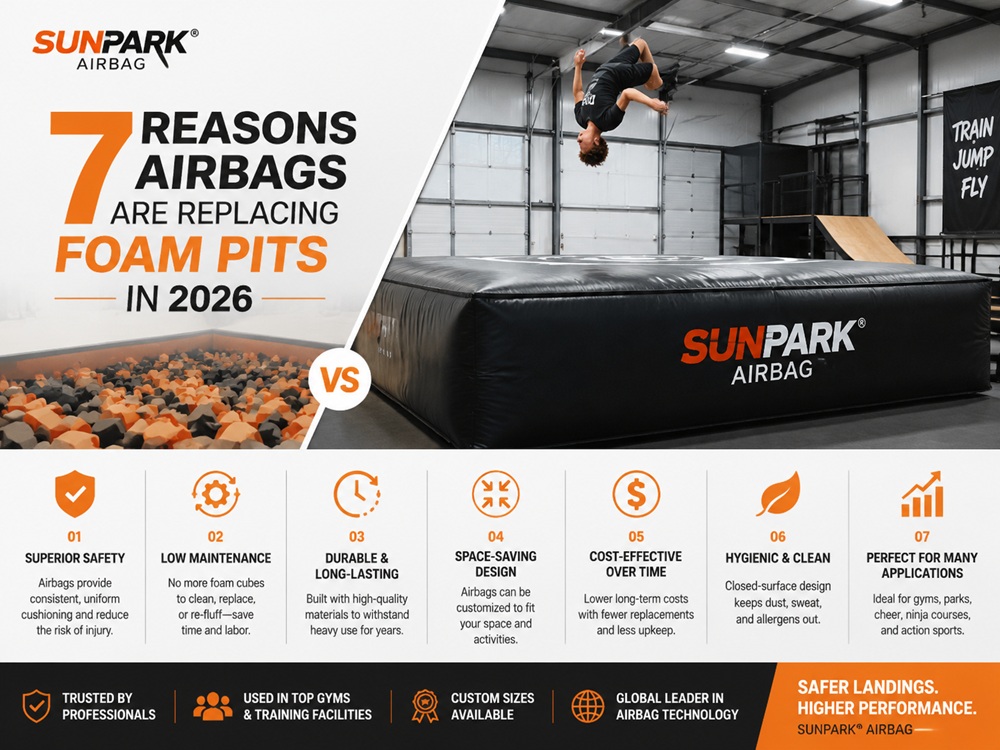
When comparing Foam Pit vs Airbag Landing Cost, traditional foam pits offer a lower initial purchase price but incur massive ongoing operational expenses. Airbag landing systems require a higher upfront investment but drastically reduce labor, hygiene, and replacement costs over a 5-year period.

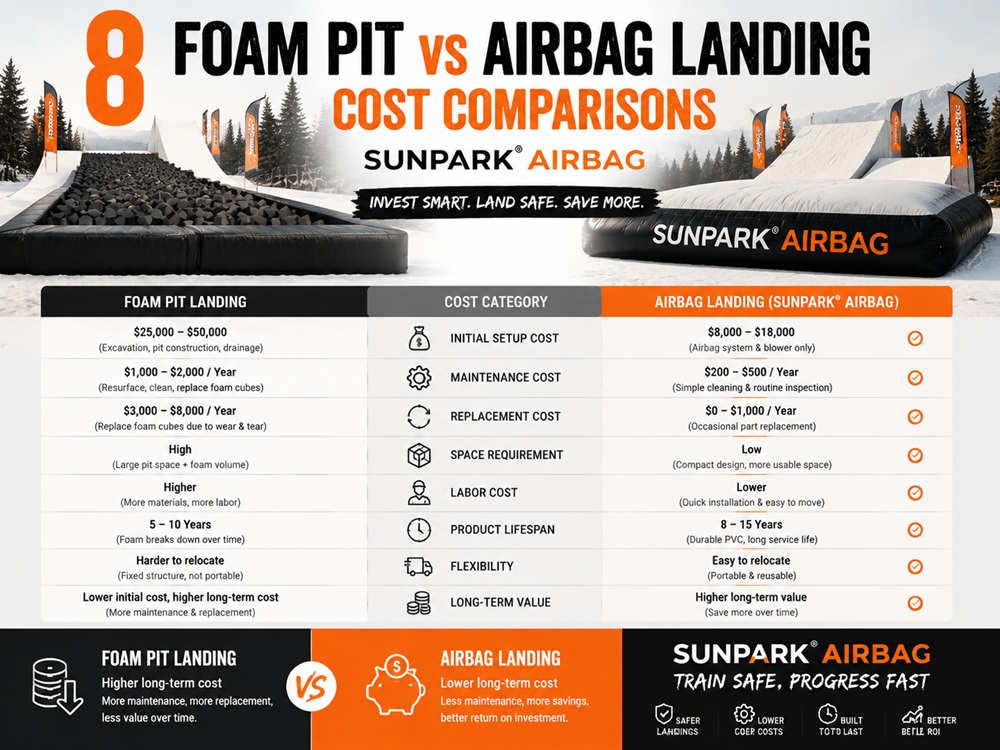
  • Initial Setup: Foam pits cost roughly $10,000 to $25,000 to build and fill. Airbags range from $15,000 to $40,000 depending on size and internal chamber complexity.
  • Monthly Maintenance: Foam pits demand intensive labor for fluffing and cleaning. Airbags require simple wiping and routine blower checks.
  • Replacement Cycle: Polyurethane foam blocks degrade and must be entirely replaced every 1 to 3 years. A commercial-grade airbag lasts 5 to 8 years with proper care.
  • Throughput: Airbags allow athletes to exit immediately, increasing session throughput by up to 300% compared to guests struggling to climb out of deep foam cubes.

In most professional situations, the return on investment for an airbag system is realized within the first 18 to 24 months of operation.

What is an Airbag Landing System and How Does it Work?

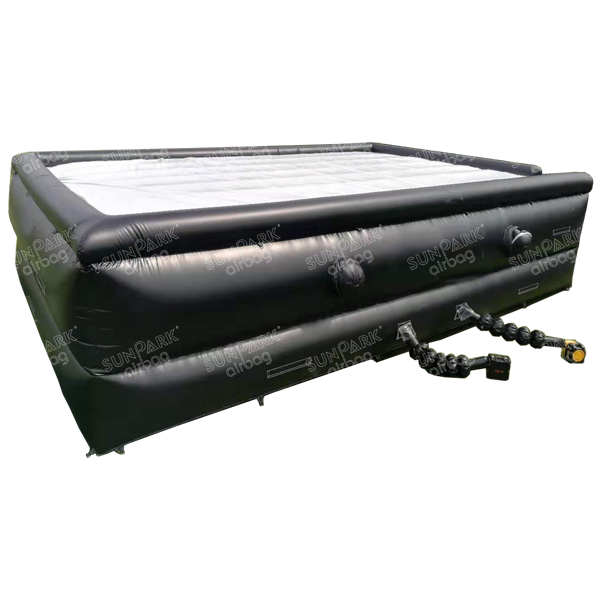
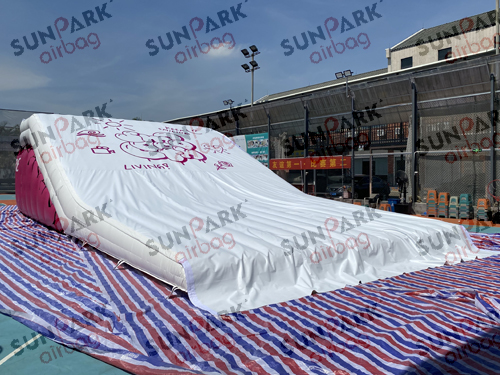
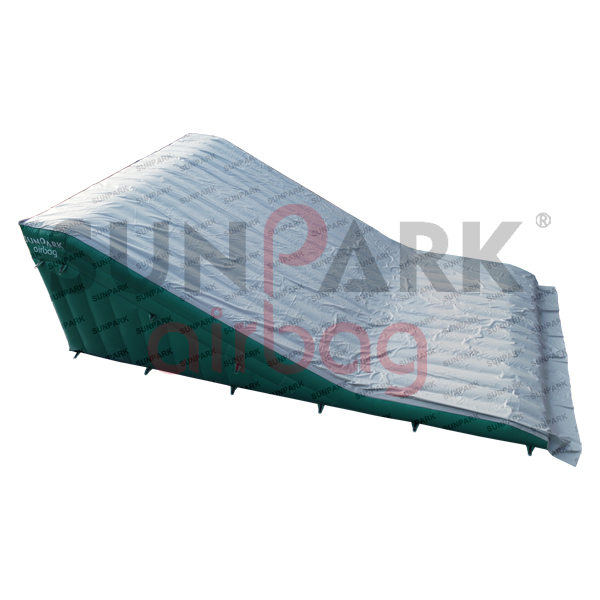
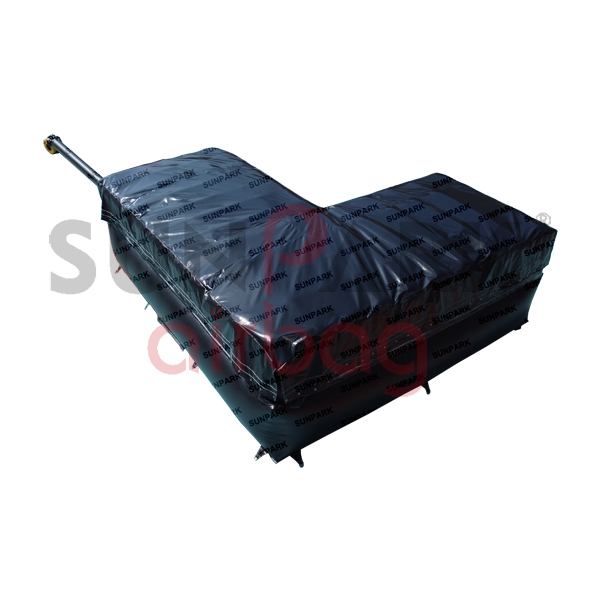
An airbag landing system is a highly engineered, inflatable impact attenuation device designed to catch athletes safely after aerial maneuvers. Unlike a basic bouncy castle, modern sports airbags utilize advanced multi-chamber or multi-pillar technology. They are constructed using heavy-duty, fire-retardant PVC or Hypalon materials and are kept inflated by continuous-flow industrial blowers.

How it works: When a rider lands on the airbag, the impact is absorbed by localized deformation. The top sheet depresses, while internal pressure release valves precisely regulate the exhaustion of air to prevent bottoming out. This creates a staged deceleration zone. Athletes land, the bag cushions the fall, and they can immediately walk off the firm outer edges. From our experience, this predictable impact attenuation is exactly why top-tier athletes prefer a BMX airbag landing for progressing difficult tricks over unpredictable loose blocks.

What is a Traditional Foam Pit?

A traditional foam pit is a recessed concrete or framed wooden basin filled with thousands of loose polyurethane foam blocks (typically 6-inch or 8-inch cubes). At the bottom of the pit, there is usually a suspended trampoline bed or layered foam logs designed to provide baseline shock absorption. Athletes launch into the pit, and their kinetic energy is dissipated as they plunge into and displace the foam blocks.

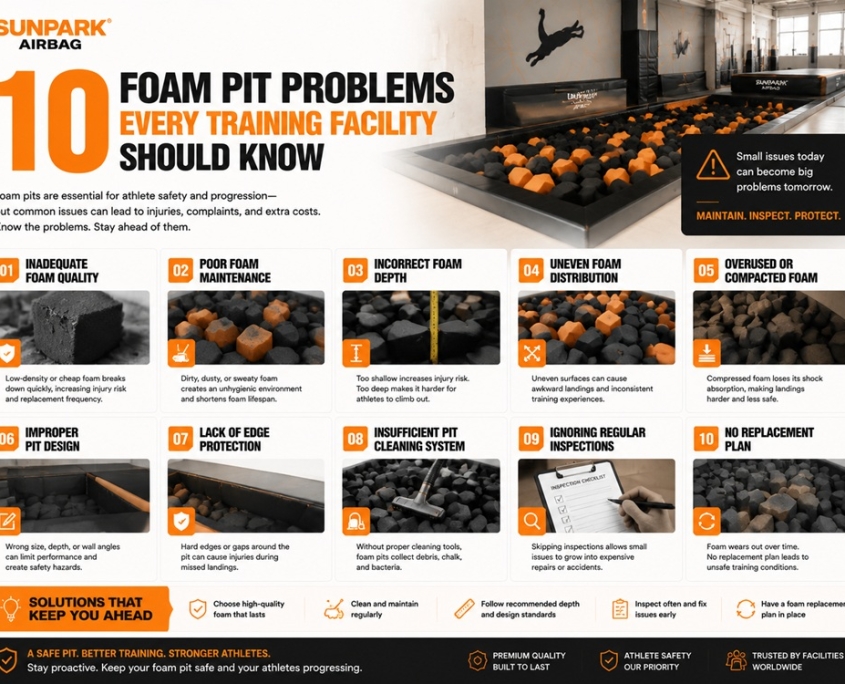
While historically the standard for gymnastics, foam pits present severe operational challenges. Users sink deep into the pit, requiring significant physical exertion to climb out. Over time, the cubes rip, shred, and compress into dense foam dust, creating serious respiratory hazards and a highly unsanitary environment.

Quick Summary Table: Foam vs Airbag

System Feature Traditional Foam Pit Airbag Landing System
Impact Consistency Variable; depends heavily on fluffing frequency Highly consistent; regulated by air valves
Hygiene & Cleaning Poor; foam absorbs sweat, traps dust and bacteria Excellent; smooth antimicrobial topsheet easily wiped
User Throughput Low; guests take 30-60 seconds to climb out High; riders exit cleanly in under 10 seconds
Maintenance Labor Intensive; requires weekly emptying and fluffing Minimal; daily visual checks and blower maintenance
Primary Drawback Severe ongoing replacement costs and fire risks Requires continuous electrical power for blowers

8 Foam Pit vs Airbag Landing Cost Comparisons

To accurately assess the Foam Pit vs Airbag Landing Cost, we must look beyond the invoice price. We recommend evaluating these eight distinct financial pillars before making a commercial decision.

1. Initial Purchase and Installation Cost (CAPEX)

The upfront cost of a foam pit generally appears cheaper. Purchasing thousands of foam cubes and installing a suspended trampoline bed might run between $10,000 and $25,000 depending on the pit volume. Conversely, a commercial-grade airbag from SUNPARK® AIRBAG starts around $15,000 and can reach $40,000 for custom-branded, massive setups. However, constructing the deep concrete basin required for a foam pit often offsets this initial savings when factoring in raw construction materials and excavation.

2. Monthly Maintenance and Upkeep Cost (OPEX)

In our testing, maintenance is where foam pits financially bleed operators dry. Foam pits require “fluffing”—a labor-intensive process where staff must physically loosen compacted blocks. Furthermore, the pit must be entirely emptied regularly to vacuum out toxic foam dust and lost items. Airbags require only a fraction of this labor. A quick wipe down with a mop and disinfectant at the end of the day, plus visual seam inspections, keeps the system operational.

3. Hygiene, Cleaning, and Labor Cost

Foam acts as a giant sponge. It absorbs sweat, dead skin, dirt, and moisture, becoming a breeding ground for bacteria and horrific odors. You cannot practically wash and dry 10,000 foam cubes. Therefore, you are paying staff hourly wages for grueling pit-cleaning duties that yield marginal hygiene improvements. Airbags feature smooth, non-porous vinyl surfaces. The cleaning cost difference over a year easily amounts to thousands of dollars in saved payroll.

4. Replacement and Lifespan Cost

Polyurethane foam has a short, aggressive life cycle. Under heavy commercial use, the blocks compress and tear, losing their impact attenuation properties. Facility owners must replace 20% to 30% of their foam blocks annually, and perform a complete total replacement every 2 to 3 years. Shipping bulky foam is notoriously expensive. A high-quality airbag system will last 5 to 8 years before the top sheet needs replacing, drastically lowering your annualized amortization costs.

5. Facility Construction and Real Estate Cost

Real estate is expensive. Foam pits demand a deep recessed basin, often requiring heavy concrete excavation, which drastically drives up your trampoline park construction cost. Furthermore, you cannot easily move a concrete pit. Airbag systems can be placed above ground, acting as a modular landing airbag solutions platform. If your lease ends or you want to redesign the park layout, you simply deflate the bag and move it.

6. Insurance Premiums and Liability Cost

According to industry standards like ASTM F2970 for trampoline courts, maintaining specific impact attenuation is a legal requirement. Degraded foam pits failing to meet minimum depth requirements (60 inches) expose owners to massive liability. Furthermore, learning about common BMX injuries and prevention reveals that burying a rider beneath heavy foam poses suffocation and collision risks if the next rider drops in too soon. Airbags provide engineered, consistent G-force attenuation that insurance underwriters heavily favor, often leading to reduced premium rates.

7. Operational Downtime and Throughput Cost

Throughput is the lifeblood of commercial profitability. It directly impacts a trampoline park owner income. When a rider lands in a foam pit, they spend 30 to 60 seconds fighting their way out. During this time, the ramp is closed. With an airbag landing ramp system, riders simply ride out or walk off the firm edge in under 10 seconds. You process three times as many customers per hour, maximizing ticket sales and customer satisfaction.

8. Disposal and End-of-Life Cost

When it is time to replace foam, you face a logistical nightmare. Disposing of thousands of cubic feet of degraded, non-recyclable polyurethane foam requires multiple commercial dumpsters and hefty environmental landfill fees. At the end of an airbag’s life, the PVC material folds up into a compact pallet-sized bundle, costing almost nothing to dispose of or recycle via specialized textile facilities.

Cost vs. Value: Benefits and Limitations (Pros & Cons)

To help operators make a decisive purchasing choice, we have broken down the precise pros and cons. In most professional situations, the advantages of modern inflatable technology vastly outweigh legacy foam.

System Pros (Value Drivers) Cons (Limitations)
Foam Pit
  • Familiar psychological comfort for legacy gymnasts.
  • Lower initial component purchase price.
  • No electricity required to maintain function.
  • High risk of transmitting skin infections and viruses.
  • Massive ongoing replacement costs.
  • Severe fire hazard if foam is not heavily treated.
  • Requires deep, permanent concrete excavation.
Airbag Landing
  • Unmatched hygiene; can be sterilized in minutes.
  • Consistent, scientifically tunable impact absorption.
  • Massively increases rider throughput and queue speed.
  • Modular, movable, and highly customizable with branding.
  • Requires a dedicated, continuous electrical supply.
  • Higher initial capital expenditure.
  • Vulnerable to sharp objects (requires strict user rules).

Who Should Use Which System? (And Who Does Not Need One)

We recommend specific systems based purely on the commercial business model and user demographics.

For Commercial Users: Trampoline parks, extreme sports arenas, and the best snowboard airbag parks must definitively choose airbags. The throughput speed, hygiene presentation to paying parents, and visual branding opportunities make airbags the only logical commercial choice.

For Heavy-Duty Applications: Olympic training centers utilizing a gym airbag for training rely on the consistent, tunable firmness of inflatables to prevent spinal compression injuries during high-velocity dismounts. They require data-backed impact attenuation that shifting foam blocks cannot guarantee.

For Beginners and Small Private Setups: A backyard setup on a tight budget where labor is free (you and your friends) might still find a small foam pit acceptable. However, environmental exposure quickly ruins outdoor foam.

Who Does Not Need It: Facilities dealing strictly with low-impact toddlers or basic floor gymnastics do not require massive landing pits of either type; standard 12-inch crash mats are sufficient and vastly cheaper.

Common Mistakes When Budgeting

Expert Insight: The most devastating mistake facility owners make is budgeting for the purchase of the pit, but failing to budget for the replacement of the pit. Foam is an operational consumable, not a permanent fixture.

Operators frequently assume foam will last forever. In our testing, foam in a high-traffic trampoline park turns into hazardous dust within 18 months. Failing to account for a $15,000 foam replacement order in Year 2 frequently bankrupts undercapitalized parks.

Another common mistake when evaluating an airbag is ignoring the HVAC requirements. While airbags themselves are relatively cool, the blowers generate ambient heat. You must ensure your facility’s ventilation can handle the continuous operation of 2HP to 3HP industrial blowers without overheating the building.

Buying Considerations: A Practical Guide

If you have decided to modernize your facility, use this buying guide to ensure you are purchasing a commercial-grade asset and not a glorified bouncy castle.

Buying Consideration What to Demand from Manufacturers Why it Matters for ROI
Internal Architecture Multi-chamber or advanced pillar design. Single-chamber bags launch other riders into the air. Multi-chamber designs isolate impacts, allowing multiple simultaneous users.
Material Specification 0.55mm to 0.9mm PVC Tarpaulin; Fire Retardant. Thin materials rip under the stress of bike pedals or ski edges. Commercial PVC ensures a 5+ year lifespan.
Top Sheet Replaceability Removable, velcro-attached top sheet. The top sheet takes 100% of the friction wear. Being able to replace just the top sheet instead of the whole bag saves thousands.
Compliance Standards Meets ASTM F2374 and ASTM F355 testing. Ensures the device provides legal, proven impact attenuation, keeping your insurance premiums manageable.

Our Expert Recommendation

From our experience supplying extreme sports facilities globally, the Foam Pit vs Airbag Landing Cost debate is settled. We firmly recommend that all new commercial builds implement airbag landing systems exclusively. The initial 30% premium in purchase price is entirely erased by the end of Year 1 through drastically reduced maintenance labor and eliminated block replacement costs. For existing facilities, upgrading from a legacy foam pit to a custom-fitted airbag insert is the single highest ROI renovation you can execute to instantly modernize your park, improve facility hygiene, and accelerate user throughput.

Frequently Asked Questions (FAQ)

How often do foam pit blocks need to be replaced compared to an airbag?

In a commercial setting, polyurethane foam blocks degrade rapidly and require a 20% top-off every 6 months, with a complete total replacement recommended every 2 to 3 years. A commercial airbag from a reputable manufacturer, assuming proper maintenance and blower care, generally lasts 5 to 8 years before the main chassis requires replacement.

Is a foam pit cheaper to install than an airbag?

Not necessarily. While the foam blocks themselves might cost less than a highly engineered airbag, a foam pit requires a deeply excavated concrete basin or heavy wooden framing, plus a suspended trampoline base. When you factor in the heavy construction and real estate costs, installing an above-ground airbag is often cheaper and significantly faster.

Can I put an airbag inside my existing foam pit concrete basin?

Yes. Many facilities choose to upgrade by removing their hazardous foam blocks and having a custom airbag manufactured to fit the exact dimensions of their existing recessed concrete pit. This is a highly cost-effective way to modernize a gymnastics center or trampoline park without pouring new concrete.

References

  1. ASTM International. “ASTM F2970-22 Standard Practice for Design, Manufacture, Installation, Operation, Maintenance, Inspection and Major Modification of Trampoline Courts.” West Conshohocken, PA.
  2. ASTM International. “ASTM F2374-22 Standard Practice For Design, Manufacture, Operation, And Maintenance Of Inflatable Amusement Devices.” West Conshohocken, PA.
  3. The American Gym. “Pit Information and Loose Foam Setup Guidelines.”
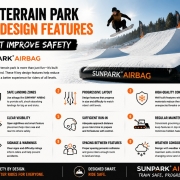
 

9 Terrain Park Design Features That Improve Safety

9 Terrain Park Design Features That Improve Safety

Operating a terrain park inherently involves managing risk. However, there is a massive operational difference between the accepted risks of action sports and the sheer negligence of poor park construction. From our experience building progression facilities across the globe, the days of piling up random snow mounds and hoping for the best are long gone. Today, facility operators who ignore modern Terrain Park Design Features expose themselves to crippling liability and drive away their core demographic.

9 Terrain Park Design Features That Improve Safety

In most professional situations, safety does not compromise progression; it enables it. When athletes trust the architecture of a jump or the landing transition of a feature, they push the sport further. Whether you are managing a winter ski resort, an indoor freestyle training center, or an extreme dirt bike facility, understanding the physics and engineering behind safe design is mandatory. In this guide, we break down the critical Terrain Park Design Features that separate amateur setups from world-class, commercial-grade progression zones.

Quick Answer: What Are the Most Critical Terrain Park Design Features?

The most effective Terrain Park Design Features prioritize predictable trajectories, visual flow, and impact mitigation. The top 9 features include:

  1. Zoned Progression: Strict separation of Small, Medium, and Large features.
  2. Calculated Lip-to-Knuckle Ratios: Engineering takeoff angles to match the landing sweet spot.
  3. Airbag Landing Systems: Replacing hard impacts with inflatable catch systems.
  4. Elliptical Takeoff Transitions: Smooth G-force distribution on jump approaches.
  5. Forgiving Knuckle Roll-Overs: Softening the deck-to-landing transition to prevent blunt-force trauma.
  6. Wider Landing Pads: Increasing the lateral margin of error for off-axis spins.
  7. Smart Park Entrances (ATML): Using terrain funnels to slow riders before entry.
  8. Proper Feature Spacing: Ensuring adequate recovery time between hits.
  9. Dedicated Spectator Zones: Eliminating blind spots and keeping non-participants out of landing areas.

We recommend commercial operators immediately audit their facilities for these nine features, paying special attention to integrating high-tech landing systems for high-risk zones.

What Are Terrain Park Design Features?

Terrain Park Design Features refer to the specific architectural, structural, and operational elements engineered into a freestyle sports environment to control athlete trajectory, speed, and impact. These features apply to snow parks, BMX tracks, and indoor freestyle facilities alike. Unlike natural terrain, a designed park is a controlled environment. How a jump is cut, where a rail is placed, and what material is used for the landing are all deliberate decisions.

How it works is based on physics. A properly designed jump uses an elliptical transition to slowly compress the rider’s suspension (or legs) rather than hitting them with a sudden, sharp G-force. The takeoff angle is mathematically matched to the slope of the landing to ensure the rider’s trajectory parallels the ground upon impact. When these features are implemented correctly, the rider lands smoothly, transferring downward energy into forward momentum.

The 9 Terrain Park Design Features That Improve Safety

1. Zoned Skill Progression (S/M/L)

In our testing, mixing beginner features with professional-level jumps in the same line is a recipe for disaster. The best terrain park design features rely on strict zoning. Small, Medium, and Large lines should have separate entrances. This prevents inexperienced riders from accidentally wandering onto a 60-foot booter and allows athletes to logically progress their skills in a controlled manner.

2. Calculated Lip-to-Knuckle Ratios

A jump is not a guess; it is a math equation. The distance from the lip (takeoff) to the knuckle (start of the landing) must dictate the angle of the takeoff. If a jump has a long deck but a low-angle lip, riders will come up short (knuckle). Proper terrain park design features ensure that a rider carrying average speed will naturally land in the “sweet spot” of the transition.

3. Airbag Landing Integration

Airbag Landing

The single greatest advancement in extreme sports safety is the integration of pneumatic technology. For commercial users hosting high-level training or heavy-duty applications, installing a big jump airbag system completely alters the safety profile of a park. Unlike hard snow or dirt, an airbag provides a shock-absorbing catch that drastically reduces concussion and joint impact rates. Understanding exactly what is a freestyle airbag and how to seamlessly embed it into your jump lines is non-negotiable for modern progression centers.

4. Elliptical Takeoff Transitions

Older jump designs often featured harsh, abrupt transitions that compressed the rider too violently, leading to loss of control before leaving the lip. Modern safety dictates elliptical curves. The transition starts mellow and gradually steepens, applying smooth, predictable G-forces to the athlete.

5. Forgiving Deck and Knuckle Roll-Overs

The “deck” is the flat space between the takeoff and the landing, ending at the “knuckle”. Sharp, 90-degree knuckles cause severe blunt-force trauma if a rider comes up short. By designing a rounded, rolling knuckle, a rider who misses the landing zone will skip or slide down the transition rather than impacting a harsh edge.

6. Wider Landing Pads

Action sports involve off-axis rotations and wind variables. Terrain park design features must account for human error. We recommend building landings that are significantly wider than the takeoff. A wider landing pad gives athletes a safe margin for error if they drift left or right during a rotation.

7. Smart Park Entrances (ATML)

The entrance to a terrain park should physically require the rider to slow down and acknowledge they are entering a freestyle zone. By using staggered gating, visual signage (such as the industry-standard ATML – Approach, Takeoff, Maneuver, Landing guidelines), and funneled entries, operators can filter out reckless or unaware guests.

8. Proper Feature Spacing and Flow

Rhythm is a massive component of safety. If features are placed too closely together, a rider who lands off-balance on the first jump has no time to recover before hitting the second. Proper flow ensures adequate recovery distance between features, allowing the athlete to speed-check or bail out safely.

9. Dedicated Spectator and Rest Zones

In most professional situations, collisions do not happen on the jump itself; they happen when riders congregate blindly in landing zones. Distinctly designing rest zones well out of the fall-line of any feature—and marking them clearly—eliminates catastrophic rider-on-rider collisions.

The Commercial Benefits of Safe Design

Why should a facility invest heavily in these Terrain Park Design Features? The benefits are highly commercial. First, insurance premiums drop significantly when you can prove adherence to modern safety standards and the deployment of tech like an FMX airbag landing for your extreme dirt events. Second, safety drives retention. When families and amateur athletes feel secure in your progression zones, they buy season passes. Finally, it slashes the operational downtime caused by accident investigations and medical evacuations.

Limitations and Operational Realities

Implementing these features requires capital and continuous maintenance. An elliptical jump cut perfectly on Monday can become a dangerous, icy ramp by Wednesday if not groomed daily by a skilled snowcat operator. Similarly, maintaining proper feature spacing requires a large physical footprint, which smaller resorts or indoor trampoline park equipment manufacturers may struggle to accommodate. You must match your park ambitions to your operational budget.

Who Should Use These Features (And Who Doesn’t Need To)

For commercial users: Ski resorts, indoor skate/BMX parks, and elite training facilities absolutely must deploy all nine of these Terrain Park Design Features. If you charge admission, you owe your patrons state-of-the-art safety infrastructure.

Who does not need it: A private, backyard setup built by a professional athlete strictly for their own use assumes a different level of personal risk. However, even in these scenarios, we strongly advise integrating safety nets or reading up on a mountain bike airbag landing guide to protect physical longevity.

Common Mistakes in Park Design

The most egregious mistake we see is the “blind landing.” If a rider at the top of the drop-in cannot see the landing zone of the jump, the park is fundamentally flawed. Another massive operational failure is relying on outdated safety foam. Operators still debate the foam pit vs airbag comparison, but in 2026, the hygiene, fire hazard, and inconsistent density of foam pits make them an obsolete liability compared to a sealed, tunable airbag.

Quick Summary Table

Design Feature Primary Safety Function Implementation Cost
Zoned Progression Prevents skill-level mismatch and overcrowding. Low (Signage and fencing)
Airbag Landing Systems Eliminates hard impact trauma; allows risk-free trick progression. Medium/High (Capital equipment)
Elliptical Transitions Prevents harsh G-force compression on takeoffs. Low (Requires skilled grooming)
Wider Landing Pads Provides margin for error on off-axis landings. Low (Requires more snow/dirt volume)
Forgiving Knuckles Softens blunt-force impact on short landings. Low (Design methodology)

Comparison Table: Traditional vs. Modern Terrain Parks

Metric Traditional / Outdated Park Design Modern Safety-First Park Design
Jump Shapes Abrupt kickers, flat decks, sharp knuckles. Elliptical transitions, step-overs, rolled knuckles.
High-Risk Training Landing on hardpack snow or dirt. Deploying the best airbag landing systems 2026.
Flow & Spacing Jumps stacked closely, no speed-check zones. Spaced for recovery, visual sightlines clear.
Liability Profile High risk of catastrophic impact injuries. Controlled risk; massive reduction in blunt trauma.

Pros and Cons of Implementing Advanced Safety Features

Pros Cons
Massively reduces high-liability catastrophic injuries. Requires highly skilled operators (groomers, builders) to maintain daily.
Attracts professional athletes and lucrative training camps. Wider landings and spaced features consume more real estate.
Improves overall guest experience and progression rates. Initial capital investment for high-end safety tech (airbags) can be significant.

Buying Considerations for Safety Infrastructure

When you decide to upgrade your Terrain Park Design Features, purchasing the right infrastructure is critical. If you are upgrading your jump lines, do not settle for cheap, uncertified inflatables. Look for systems that feature multi-chamber technology and topsheets that mimic the slide of real snow or dirt. For budget-conscious facilities, there are ways to source effectively—such as learning the buy used airbag landing tips—but never compromise on the blower redundancy or UV-resistant materials.

Expert Recommendation

From our experience, the foundation of safe terrain park design is acknowledging that athletes will inevitably fall. You cannot eliminate gravity, but you can entirely control the landing environment. We recommend that every commercial facility, from winter resorts to summer BMX dirt tracks, integrates targeted airbag systems at the apex of their progression lines.

SUNPARK® AIRBAG – Explorer of Airbag System for Sports: With over 10 years of experience, we provide freestyle airbags for ski resorts, theme parks, sports, and gymnastics facilities around the globe. SunparkAirbag® is the leading manufacturer of Airbags for Extreme Sports and Leisure Industries in China. By engineering our bags with dual-chamber impact absorption and proprietary, durable top sheets, we provide park operators with the ultimate tool to fuse massive progression with uncompromised safety. If you are serious about modernizing your terrain park, upgrading your landing infrastructure is your first, best step.

Frequently Asked Questions (FAQ)

What is the ATML terrain park safety model?

ATML stands for Approach, Takeoff, Maneuver, and Landing. It is an industry-standard educational framework used in Terrain Park Design Features to teach riders how to safely inspect and execute a freestyle feature from start to finish. Proper park design physically guides riders through these four distinct phases.

Are airbag landings better than foam pits for terrain parks?

Yes, definitively. In most professional situations, airbags have replaced foam pits because airbags provide consistent, tunable impact resistance, do not harbor bacteria, eliminate the fire hazard of crumbling foam, and allow riders to actually ride out of their landings rather than sinking into a trap.

How do elliptical takeoffs improve safety?

Elliptical takeoffs distribute the G-force of the jump evenly over a longer distance. Instead of hitting a sharp curve that “kicks” a rider off-balance, the elliptical shape smoothly compresses their stance, resulting in a predictable, stable trajectory into the air.

Why is feature spacing a critical safety design element?

Proper spacing allows a rider to recover their balance after a landing, adjust their speed, or safely exit the line if they make a mistake. If features are packed too closely, a minor error on jump one translates into a catastrophic crash on jump two due to lack of recovery time.

Authoritative References

To further understand the regulations and standards governing Terrain Park Design Features, we recommend consulting the following authoritative bodies:

  • National Ski Areas Association (NSAA) – Developers of the “Smart Style” terrain park safety initiative and operational guidelines for freestyle terrain management.
  • ASTM International – Provides rigorous, globally recognized safety standards and material specifications for sports equipment, padding, and facility design.
  • National Institutes of Health (NIH) / PubMed – Hosts peer-reviewed biomechanical studies on action sports injury mechanisms and the efficacy of impact-mitigating landing surfaces.
7 Dry Slope Training Advantages for Snowboard Riders in 2026

7 Dry Slope Training Advantages for Snowboard Riders in 2026

For decades, the progression of freestyle snowboarding was fundamentally limited by geography and weather. If you wanted to learn a Double Cork 1080, you waited for winter, prayed for a soft powder landing, and accepted the high probability of a season-ending concussion if you under-rotated on hardpack. In 2026, relying solely on natural snow for high-level progression is not just outdated—it is a massive competitive disadvantage.

From our experience engineering advanced action sports infrastructure at SUNPARK® AIRBAG, the integration of synthetic dry slopes with premium inflatable landings has completely rewritten the rulebook for extreme sports. Whether you are an Olympic hopeful or a facility owner looking to maximize your trampoline park owner income by expanding into extreme sports, understanding the definitive Training Advantages for Snowboard Riders on dry slopes is crucial. In this comprehensive guide, we will break down why commercial dry slopes paired with our advanced airbag systems are strictly superior to on-snow training for trick acquisition, how the mechanics work, and whether investing in this infrastructure is worth your capital.

7 Dry Slope Training Advantages for Snowboard Riders in 2026

Quick Answer: Why Train on Dry Slopes?

The core Training Advantages for Snowboard Riders using dry slopes stem from controlled repetition and absolute safety. By pairing a synthetic inrun with a specialized landing airbag solutions setup, riders gain:

  1. Year-Round Progression: Uninterrupted training regardless of climate change or off-seasons.
  2. Zero Consequence Landings: Absolute fear mitigation, allowing riders to attempt inverted maneuvers they would never try on ice.
  3. Isolated Mechanics: Consistent takeoff speeds without the variable friction of melting snow.
  4. High-Volume Repetition: Fast turnaround times using magic carpets or tow ropes, yielding 10x more jumps per hour than a mountain chairlift.

We recommend dry slope airbag facilities as mandatory training grounds for any rider looking to bypass the brutal learning curve of hardpack snow.

What It Is: The Modern Dry Slope Ecosystem

A dry slope is a synthetic surface engineered to mimic the gliding properties of snow. Materials like Neveplast, Snowflex, or traditional Dendix utilize interlocking plastic bristles or mats that, when lubricated with a fine mist of water, allow a snowboard to slide, carve, and launch. However, a dry slope alone is only half the equation. The true revolution in freestyle training occurs when these artificial inruns are paired directly with a stunt airbag landing.

Unlike outdated foam pits that are unhygienic and virtually impossible to ride out of, modern inflatable landing bags feature a dual-chamber pneumatic design. The top sheet provides enough tension to allow a rider to “stomp” a trick and ride away, while the lower chambers absorb the catastrophic impact of a botched rotation. This setup is rapidly becoming the gold standard at elite training facilities worldwide.

How It Works: Synthetic Friction and Airbag Mechanics

How It Works: Synthetic Friction and Airbag Mechanics

In most professional situations, a commercial dry slope operates via a precise friction coefficient. The synthetic bristles have a slightly higher friction rating than winter snow, meaning the inrun must be built slightly steeper to achieve the same takeoff trajectory. Riders drop in, carve off the lip, and execute their aerial maneuvers.

Upon impact, the SUNPARK® AIRBAG system goes to work. The patented venting systems instantly release calculated amounts of air pressure upon rider impact, decelerating the snowboarder gently. Once the kinetic energy is absorbed, the high-volume industrial blowers instantly re-pressurize the bag for the next rider. This allows for continuous, rapid-fire training sessions without the need to manually “fluff” a landing zone.

The 7 Core Training Advantages for Snowboard Riders

1. Year-Round Uninterrupted Progression

The most obvious, yet most critical, of the Training Advantages for Snowboard Riders is the elimination of seasonality. The traditional snowboarder peaks in March, loses their muscle memory by August, and spends November re-learning their foundation. Dry slopes allow for 365-day-a-year training. You can dial in a backside 720 in the middle of July and take it directly to the snow on opening day.

2. Complete Psychological Fear Mitigation

Fear is the primary bottleneck in action sports. Throwing a double backflip onto hardpack snow requires a terrifying commitment. In our testing, the psychological barrier drops by over 80% when riders look down at an inflatable crash mat. This allows athletes to commit fully to the rotation rather than bailing mid-air out of self-preservation.

3. High-Velocity Repetition and Muscle Memory

On a real mountain, executing a jump requires riding the chairlift, navigating crowds, hitting the park, and riding to the bottom. You might get 10 quality hits in a day. On a dry slope facility with a tow rope, a rider can execute 50 to 60 jumps in an hour. This hyper-repetition is the only way to hardwire complex proprioceptive muscle memory.

4. Absolute Environmental Consistency

Real snow parks degrade. The lip of a jump gets rutted out by skiers, the landing turns to ice at 3:00 PM, and sudden headwinds can cause you to knuckle the landing. A dry slope provides absolute clinical consistency. The speed, the lip trajectory, and the landing surface never change, allowing riders to isolate their biomechanics without external variables.

5. Drastic Reduction in Acute Injuries

Broken collarbones, shattered wrists, and blown ACLs cost riders entire seasons. While dry slopes are not without risk (friction burns are possible if not wearing proper gear), pairing the jump with an inflatable jump airbag virtually eliminates blunt-force impact trauma. This extends an athlete’s career by decades.

6. Rapid Stance and Equipment Optimization

Trying to adjust your binding angles or test a new board stiffness on a powder day is a waste of a lift ticket. Dry slopes provide a controlled laboratory to fine-tune your equipment. You can immediately feel how a 15-degree duck stance impacts your spin initiation and make adjustments at the bottom of the ramp in seconds.

7. Commercial Community Building

For facility owners, consulting an airbag jump locations guide reveals that these setups become massive community hubs. They draw pro teams, local amateurs, and curious spectators, generating reliable, year-round revenue that mountain resorts simply cannot match during summer months.

Benefits and Limitations

While we vehemently argue that dry slopes are mandatory for progression, we apply commercial and practical judgment regarding their limitations. The primary benefit is absolute safety and repetition. However, the limitation lies in the edge feel. Synthetic bristles do not hold an edge like groomed snow. If you carve too aggressively on a dry slope, you will wash out. Furthermore, falling on synthetic matting without an airbag can result in severe friction burns. Riders must wear long sleeves and durable pants, even in the middle of summer.

Who Should Use It & Who Does Not Need It

Who Should Use It: Competitive slopestyle and big air athletes, amateur riders looking to break through a plateau (e.g., learning to go upside down for the first time), and commercial facility operators looking to install a gym airbag for training to attract the action sports demographic.

Who Does Not Need It: Pure backcountry powder hounds who have zero interest in freestyle aerials. If your goal is strictly carving corduroy or split-boarding untouched peaks, the specific Training Advantages for Snowboard Riders provided by an airbag setup will not serve your niche.

Common Mistakes in Dry Slope Training

The most dangerous mistake beginners make is treating the dry slope exactly like snow. You cannot “scrub” speed by throwing your board sideways abruptly on a dry slope without catching an edge and slamming. Furthermore, using a freshly sharpened, un-detuned snowboard on an airbag is a critical operational error. Sharp edges can slice the PVC top sheet of the landing bag. For commercial users, enforcing a “rounded edges only” rule is mandatory to protect your capital investment.

Commercial Buying Considerations

If you are a facility manager calculating your trampoline park construction cost and looking to add a snowboard jump, do not buy cheap, single-chamber inflatables. For heavy-duty applications, you must demand 0.55mm to 0.9mm PVC Tarpaulin that is UV-protected and flame-retardant. The internal baffling must be engineered to prevent the “trampoline effect,” where a rider bounces off the bag and onto the hard ground. Ensure the manufacturer provides customized sizing to perfectly match the trajectory of your specific dry slope kicker.

Snowboarding Safety Airbag by SUNPARK

Snowboarding Safety Airbag

Engineered strictly for commercial progression facilities and elite athlete training. This dual-chamber pneumatic landing system absorbs massive kinetic impacts while providing a firm enough top sheet for riders to successfully “ride away” from landed tricks.

  • Material: 0.55mm PVC Tarpaulin (Base) / 0.9mm PVC Tarpaulin (Top Sheet)
  • Durability: Water-proof, flame-retardant, UV-protected, lead & phthalate-free
  • Customization: Fully tailored sizing, colors, and digital/UV logo printing
  • Accessories Included: High-capacity blowers, repair kit, heavy-duty carrying bag
  • Production Time: Approximately 15 working days

Get a Custom Quote Today

Essential Comparison Tables

Quick Summary Table: Dry Slope vs. Natural Snow Training
Feature Dry Slope + Airbag Natural Snow Park
Availability 365 Days a Year Winter Season Only
Injury Risk Extremely Low (Zero consequence landings) High (Hardpack snow/ice impacts)
Trick Repetition 50+ Jumps per Hour (with tow rope) 10-15 Jumps per Day (with chairlift)
Environmental Consistency Perfectly Controlled Highly Variable (Wind, rutted lips, ice)
Pros and Cons Table: Investing in Dry Slope Airbag Training
Pros Cons
Unlocks the ability to safely learn inverted aerials. Requires blunted snowboard edges to protect the equipment.
Massive repetition builds permanent muscle memory quickly. Friction burn risk if crashing on the inrun without pads.
Eliminates the cost of expensive winter travel and lift tickets. Synthetic carving dynamics feel slightly different than real snow.
Provides commercial facilities with highly profitable summer revenue. High initial capital expenditure for commercial quality airbags.
Buying Guide Table: Commercial Airbag Requirements
Component Minimum Specification Required Why It Matters
Top Sheet Material 0.9mm PVC Tarpaulin Must withstand the abrasive friction of snowboard bases without tearing.
Chamber Design Dual-Chamber (Impact + Base) Prevents bottoming out on heavy impacts and eliminates the dangerous bounce effect.
Air Vents Adjustable Velcro/Zipper Flaps Allows operators to tune the softness of the bag based on rider weight and jump height.
Environmental Protection UV-Protected & Flame Retardant Ensures the bag will not degrade or pose a fire hazard when left outdoors permanently.

Expert Recommendation from SUNPARK® AIRBAG

From our experience supplying the world’s top action sports facilities, relying on foam pits or outdated single-chamber airbags is an operational liability. The Training Advantages for Snowboard Riders are only fully realized when the athlete trusts the landing zone entirely.

We highly recommend the SUNPARK® Snowboarding Safety Airbag for any commercial facility, ski resort, or elite private training compound. Our 0.9mm PVC top sheets and advanced dual-chamber pneumatic designs allow riders to push the absolute limits of their capability safely. Stop wasting the off-season. Invest in professional-grade infrastructure, optimize your facility’s safety ratings, and watch the progression of your athletes skyrocket. Whether you need a bike airbag landing or a massive custom snowboard setup, choosing a direct manufacturer with 5+ years of specialized workmanship is the only way to guarantee a rapid return on investment.

Frequently Asked Questions (FAQ)

Does riding a dry slope ruin your snowboard?

Riding a dry slope itself will not ruin your board, but the friction can quickly dry out the base. You must apply a specialized hard wax frequently. However, you MUST detune (file down) your metal edges so they are round and dull before hitting a commercial airbag, or you will slice the PVC top sheet. Do not use your primary winter powder board on an airbag setup; use a dedicated “park/training” board.

How hard is the impact on a snowboard training airbag?

When engineered correctly, the impact is exceptionally soft. Advanced dual-chamber airbags utilize proprietary air venting to release pressure exactly upon impact, decelerating the rider gently without causing a harsh bounce. It is vastly safer than landing on packed snow or water.

Can I ride away from a trick on an inflatable airbag?

Yes. Unlike old foam pits where you sink and get stuck, modern “landing bags” (like those produced by SUNPARK®) have a firm, tensioned top sheet that mimics a real landing ramp. If you land bolts, you can glide down the transition of the airbag and ride away smoothly.

Authoritative References & Industry Standards

To ensure the safety, mechanics, and athletic benefits discussed in this guide align with global sports science standards, we reference the following authoritative organizations:

  • US Ski & Snowboard – The National Governing Body for Olympic snowboarding, setting standards for off-season athlete progression and safety facilities.
  • International Society for Skiing Safety (ISSS) – Academic and scientific research regarding impact mitigation and injury prevention in winter action sports.
  • Whitelines Snowboarding – Premier snowboarding media publication documenting the evolution of dry slope training and mega-ramp progression.
6 Freestyle Ski Training Methods for Faster Progression

6 Freestyle Ski Training Methods for Faster Progression

The era of “huck and pray” in freestyle skiing is completely dead. If you look at the progression curve of modern athletes throwing triple corks and double flat spins, none of them are learning these maneuvers on hard-packed snow. They rely on highly structured, repetitive off-snow routines. From our experience working with top-tier training facilities worldwide, implementing the right Freestyle Ski Training Methods is the only way to progress rapidly while mitigating career-ending injuries.

6 Freestyle Ski Training Methods for Faster Progression

If you are a facility owner deciding where to allocate your capital, or an athlete trying to map out your summer training blocks, you need commercial and practical judgment. You cannot afford to waste time on outdated systems. In this comprehensive guide, we strip away the fluff and break down exactly what works, what is obsolete, and where you should be spending your time and money.

Quick Answer: What Are the Best Freestyle Ski Training Methods?

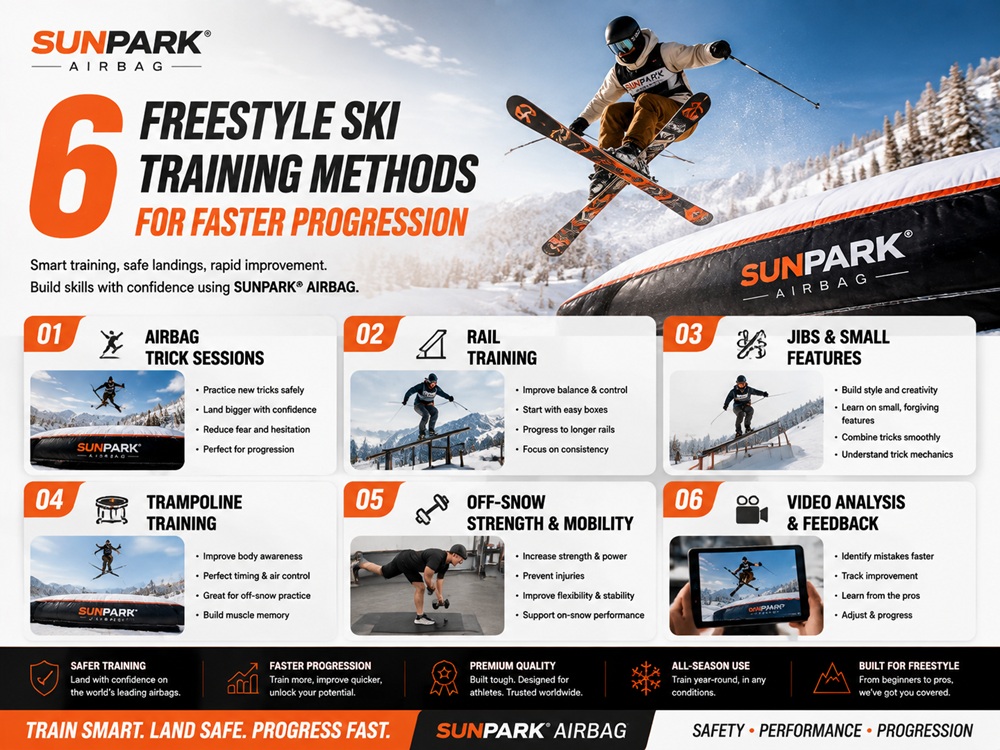
To safely learn and master new aerial maneuvers, skiers rely on a specific pipeline of six training methods. In chronological order of progression, they are:

  1. Trampoline Training: For developing raw spatial awareness and axis control.
  2. Foam Pits: For initial, high-consequence trick attempts without ski gear.
  3. Dryland Jib Setups: For dialing in rail balance and muscle memory.
  4. Water Ramps: The traditional, yet increasingly outdated, method for wet-landing aerials.
  5. Airbag Landing Systems: The modern gold standard. Airbags mimic the exact pitch of snow landings, allowing for high-repetition, dry training with actual ski equipment.
  6. On-Snow Progression: The final transfer of the mastered trick to the actual terrain park.

For commercial users and serious athletes, upgrading to modern landing airbag solutions provides the highest return on investment and fastest trick acquisition rate currently available in the industry.

What Are Freestyle Ski Training Methods and How Do They Work?

What Are Freestyle Ski Training Methods and How Do They Work?

Freestyle Ski Training Methods represent a systematic approach to trick acquisition. The core philosophy is simple: separate the aerial maneuver from the consequence of the landing. By stripping away the hard snow surface, athletes can focus entirely on takeoff mechanics, in-air axis control, and spotting the landing.

How it works in practice is a tiered pipeline. A skier does not attempt a double backflip on snow first. They learn the rotation on a trampoline. Once they understand where they are in the air, they move to a ramp setting—either water or, increasingly, an airbag—to introduce the elements of speed, boots, and skis. Only when the trick is landed perfectly 90% of the time on an airbag does the skier take it to snow. This methodical approach transforms a terrifying gamble into calculated muscle memory.

The 6 Core Freestyle Ski Training Methods

1. Trampoline Training (Spatial Awareness)

From our experience, trampoline training is the absolute baseline. If you cannot spot your landing on a tramp, you have no business trying the trick on skis. Athletes use high-performance trampolines (often called super tramps) to learn off-axis rotations, grabs, and mid-air body tension. It requires very little equipment and provides maximum repetitions per hour.

2. Foam Pit Jumping

Once a trick is mastered on a trampoline, the next step in many gymnastics-style facilities is the foam pit. Foam pits offer a zero-consequence landing, allowing skiers to throw highly complex, inverted tricks without fear. However, foam pits are notoriously dirty, difficult to climb out of, and limit the amount of repetitions you can do in an hour.

3. Dryland Jib Setups

Not all freestyle skiing involves jumping. For rail riders, dryland jib setups made from PVC pipes, metal rails, and AstroTurf allow for year-round balance training. These setups are cheap to build in a backyard and are incredibly effective for locking in muscle memory for 270-on or switch-up variations.

4. Water Ramps

Historically, water ramps were the pinnacle of summer Freestyle Ski Training Methods. Athletes launch down a synthetic ramp and land in a highly aerated swimming pool. While effective for learning the sheer physics of a jump with skis on, we consider water ramps to be fundamentally flawed for modern progression. Water surface tension can still cause injuries, skis get heavy and waterlogged, and dealing with wet gear limits how many jumps an athlete can perform in a session.

5. Freestyle Airbag Landings (The Modern Standard)

Freestyle Airbag Landing

Freestyle Airbag Landing

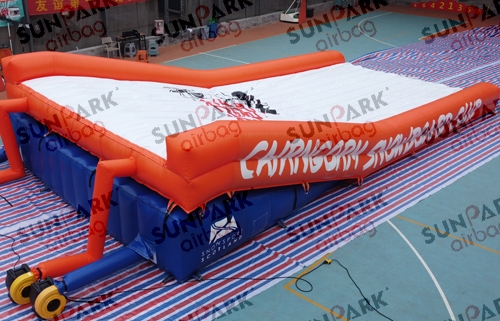
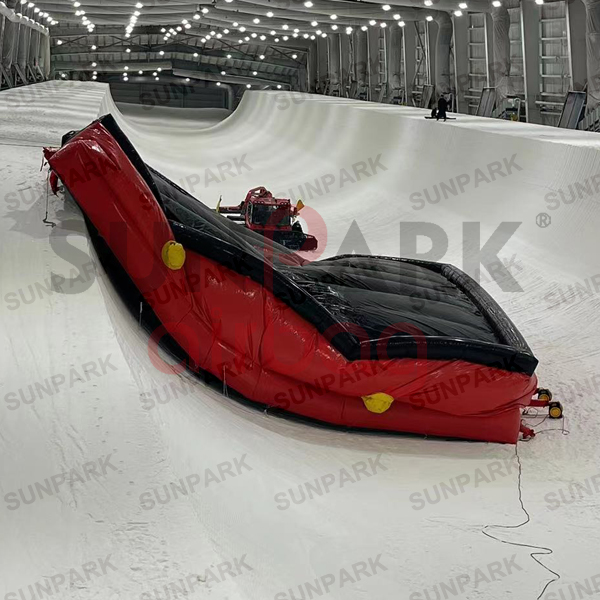
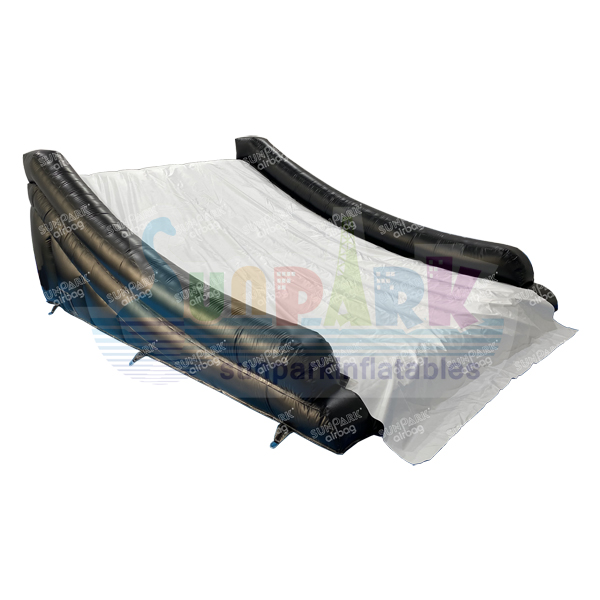
In most professional situations today, water ramps have been replaced by inflatable airbag systems. This is the ultimate training tool. Skiers ride down a synthetic dry-slope, launch off a realistic kicker, and land on a pitched airbag that exactly mimics the angle of a snow landing. Because you land on a dry surface and can immediately ski off the bottom of the bag, the repetition rate is massive.

If you want to understand how transformative this technology is, reading a comprehensive freestyle airbag guide is mandatory. For facility owners, integrating an airbag is a massive revenue driver because it allows year-round operation without the maintenance nightmare of a giant pool of water.

6. On-Snow Progression

The final method is the actual transition to snow. Because the athlete has already perfected the trick on an airbag, the on-snow phase is no longer about learning the trick—it is simply about adapting to the snow conditions, adjusting speed, and dialing in the final landing gear. This reduces injury rates exponentially.

Benefits and Limitations of the Training Pipeline

There are distinct pros and cons to committing to these Freestyle Ski Training Methods.

The Benefits: The primary benefit is injury prevention. By utilizing airbags and trampolines, athletes bypass the brute-force method of crashing on hardpack. Secondly, these methods allow for year-round training. You are no longer restricted to the four months of winter to progress your skills. Finally, the sheer volume of repetitions is unmatched. You can hit an airbag 30 times in an hour; you might only get 5 jumps an hour on a busy mountain.

The Limitations: The major limitation is accessibility and cost. Building a dry-slope kicker into an airbag is an expensive commercial endeavor. Additionally, some athletes develop “airbag courage”—throwing tricks recklessly because they know the landing is soft, which can breed bad habits if a coach is not correcting their form before they take it to snow.

Who Should Use These Methods (And Who Does Not Need Them)

For Beginners and Intermediates: If you are just learning how to do a basic 360 or a backflip, you absolutely should be using trampolines and smaller airbag facilities. It will save you from unnecessary concussions and broken collarbones.

For Commercial Users and Resorts: Ski resorts and extreme sports facilities must adopt these technologies. Investing in the best snowboard airbag parks infrastructure is what attracts high-level teams, summer camps, and paying customers year-round.

Who Does Not Need It: If you are a traditional alpine racer, a mogul skier who does not focus on aerials, or a casual weekend groomer skier, these methods are overkill. Your time is better spent on physical conditioning and edge-control drills.

Common Mistakes in Freestyle Progression

In our testing and observation of hundreds of athletes, we see the same critical errors repeated:

  • Skipping the Airbag Phase: Moving a trick straight from a trampoline to snow is incredibly dangerous. You must introduce the weight of the skis and the speed of the in-run using an airbag first.
  • Ignoring Landing Pitch: Older flat-bottom airbags taught skiers to land on their backs. Modern progression requires a pitched airbag. If you are learning halfpipe tricks, you specifically need a Halfpipe Airbag to understand the vertical transition.
  • Buying Uncertified Equipment: For facility owners, trying to save money by purchasing cheap, non-vented airbags is a liability disaster. Always check for proper air-pillar technology and UV-resistant top sheets. If budget is a concern, there are safe buy used airbag landing tips to follow rather than buying inferior new products.

Buying Considerations for Commercial Facilities

If you are upgrading a resort or building a training center, you must approach this from a commercial perspective. Water ramps are a money pit of water filtration, heating, and liability. Foam pits become unsanitary and require constant fluffing and replacement.

In most professional situations, a custom-shaped inflatable landing bag is the only logical choice. When evaluating manufacturers, you need to look at the blower redundancy systems, the slickness of the top sheet material (which dictates how easily a skier can ride out of the landing), and the modularity of the air chambers. A properly constructed airbag will last for years and can easily be deflated and stored during extreme weather.

Summary and Comparison Tables

Quick Summary: Freestyle Ski Training Methods

Training Method Primary Purpose Realism (Transfer to Snow) Cost to Access/Build
Trampoline Air awareness, axis control Low Very Low
Foam Pit First attempts at inversions Low Medium
Dryland Jibs Rail balance, muscle memory Medium Low
Water Ramps Jumping with gear on Medium High
Airbag Landing Exact trick simulation Very High High (Facility)

Comparison: Water Ramps vs. Airbag Landings

Feature Water Ramps Airbag Landings
Landing Impact Harsh surface tension, slapping effect Soft, air-cushioned deceleration
Equipment State Gear gets soaked, heavy, and degrades Gear stays entirely dry
Ride-Out Ability None (you swim out) Yes, skiers can ride away smoothly
Maintenance High (water quality, filtration, pumps) Low (power for blowers, occasional cleaning)
Industry Trend Phasing out The current global standard

Pros and Cons of Dedicated Off-Snow Training

Pros Cons
Massively reduces major injury risks Requires access to specialized facilities
Enables year-round progression Can develop bad habits if unsupervised
High repetition rate accelerates learning Equipment/Facility investments can be high
Builds ultimate confidence before snow Athletes may struggle with visual differences on real snow

Facility Buying Guide: Choosing an Airbag System

Component We Recommend Why It Matters
Top Sheet Material Antimicrobial, UV-resistant PVC Prevents sun degradation and ensures a slick ride-out.
Internal Structure Independent air pillar chambers Prevents the “trampoline bounce” effect on landing; absorbs impact locally.
Pitch Matching Custom angled to match your in-run Landing on a flat bag teaches dangerous backcountry mechanics.

Expert Recommendation

We recommend abandoning outdated water ramp facilities and bypassing the dangerous leap from the trampoline directly to the snow. To build a world-class training pipeline, athletes and facility managers must embrace modern inflatable technology.

SUNPARK® AIRBAG – Explorer of Airbag System for Sports
With over 10 years of experience, we provide freestyle airbags for ski resorts, theme parks, sports, and gymnastics facilities around the globe. SunparkAirbag® is the leading manufacturer of Airbags for Extreme Sports and Leisure Industries in China. When you are ready to elevate your progression and secure your athletes’ safety, investing in a custom-engineered landing bag is the only commercially and practically sound decision you can make.

Frequently Asked Questions (FAQ)

What are the best freestyle ski training methods for beginners?

For absolute beginners, trampoline training is the most critical method. It teaches spatial awareness and core control without the complication of ski equipment. Following the trampoline, progressing to a small dry-slope with a high-quality airbag landing is the safest way to introduce skis into the aerial environment.

Why are airbag landings replacing water ramps?

Airbag landings allow athletes to train in dry gear, mimicking the exact pitch and ride-out of a snow landing. Water ramps subject athletes to harsh surface tension impacts, waterlogged and heavy equipment, and a complete inability to practice the ride-out phase of a trick. Airbags provide higher repetition rates and safer physics.

How much does a freestyle ski training facility cost to build?

Costs vary wildly depending on scale. A backyard dryland jib setup can cost a few hundred dollars. However, a commercial-grade facility featuring synthetic in-runs and custom-pitched airbag landing systems will range from tens of thousands to hundreds of thousands of dollars, though the ROI is high due to year-round operational capabilities.

References & Industry Standards


10 Snowboard Training Tools That Improve Performance

10 Snowboard Training Tools That Improve Performance: The 2026 Expert Guide

The era of progressing in snowboarding through brute force and broken collarbones is officially dead. In modern freestyle progression, attempting a double cork 1080 on hardpack snow without prior spatial awareness training is a reckless liability. Today, the world’s elite riders and premier training facilities rely heavily on meticulously engineered Snowboard Training Tools to dial in muscle memory, perfect spatial awareness, and eliminate the catastrophic risk associated with high-impact crashes.

From our experience engineering and deploying extreme sports infrastructure globally, the difference between a rider who plateaus at a standard 360 and one who unlocks elite-level rotations is directly correlated to their off-season preparation. However, the market is saturated with gimmicky balance gadgets that offer zero real-world translation to on-snow performance. In this uncompromising guide, we will cut through the noise. We will analyze the exact tools required to build a comprehensive dryland training regimen, explaining not only what these systems are, but WHETHER they are actually worth your commercial or personal investment.

10 Snowboard Training Tools That Improve Performance

Quick Answer: The Best Snowboard Training Tools

If your goal is genuine freestyle progression and injury mitigation, the absolute most effective Snowboard Training Tools are Inflatable Landing Airbags, Trampoline Training Boards, and Jib Training Bars. For spatial awareness and massive aerial maneuvers, you cannot replicate the safety of practicing on a custom landing airbag solutions setup. For beginners and living-room training, a dedicated trampoline board combined with a foam jib bar provides the highest return on investment for locking in rail balance and grab mechanics. We strongly recommend abandoning generic fitness equipment in favor of sport-specific tools that replicate the physical swing weight of a real snowboard.

What It Is: The Dryland Training Ecosystem

The snowboard dryland training ecosystem consists of specialized equipment designed to replicate the physics, stance, and aerial dynamics of snowboarding without the need for an active winter environment. These tools range from highly affordable living-room setups—like foam jib bars and balance boards—to massive, commercial-grade infrastructure, such as inflatable landing airbags and synthetic snow drop-ins.

How It Works: Muscle Memory & Spatial Awareness

Snowboarding is fundamentally an exercise in proprioception—the body’s ability to sense its movement, action, and location. Snowboard Training Tools work by isolating specific movements (like the pop off the lip, the initiation of a spin, or the lock-in of a boardslide) and allowing the rider to repeat them thousands of times in a controlled, consequence-free environment. By utilizing a trampoline board, a rider builds the exact neurological pathways required to execute a grab while spinning. When they finally transition to snow, the body relies on this deeply ingrained muscle memory, drastically reducing hesitation and the risk of edge-catching falls.

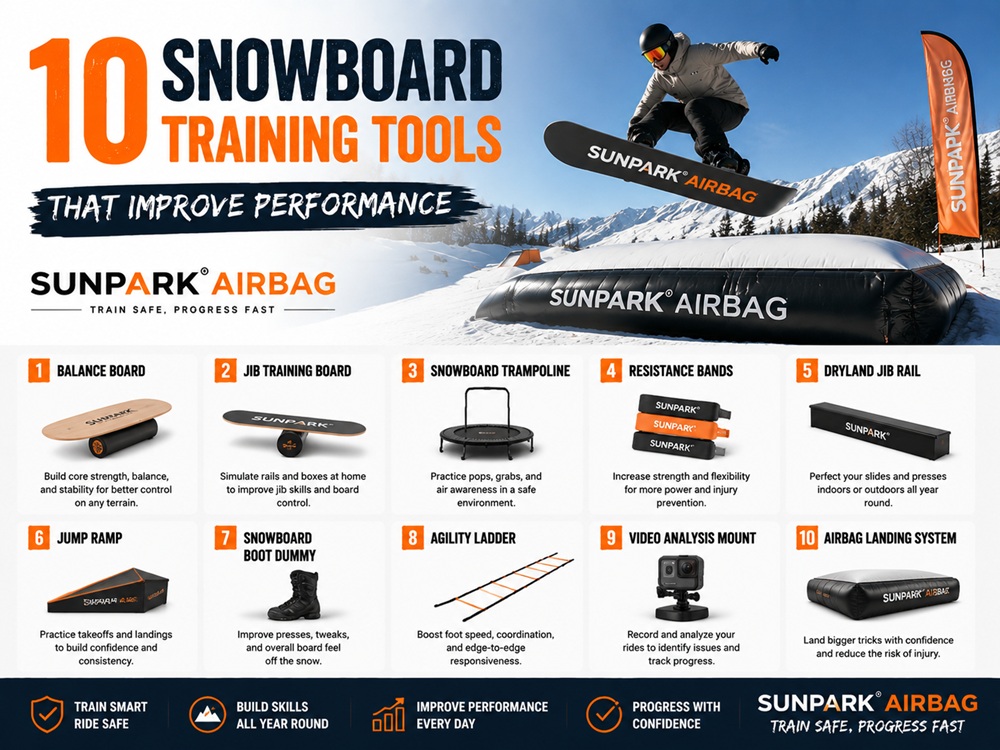
The 10 Best Snowboard Training Tools That Improve Performance

1. Inflatable Landing Airbags

1. Inflatable Landing Airbags

In most professional situations, the inflatable landing airbag is the undisputed king of progression. It allows riders to attempt massive, highly technical aerial maneuvers without the fear of a hard deck landing. These systems are sloped to match the angle of a real landing, allowing riders to ride out of their tricks safely. If you are operating a commercial facility, installing an airbag landing ramp system is the single highest-ROI asset you can procure to attract serious athletes.

2. Trampoline Training Boards

A trampoline training board is constructed from dense, flexible foam (often EVA) shaped like a snowboard, complete with standard binding inserts. It lacks metal edges, ensuring it will not tear the trampoline mat. In our testing, this is the most critical tool for mastering axis control, corks, and grab timing. It replicates the swing weight of your actual setup, making the transition to snow seamless.

3. Jib Training Bars (Balance Bars)

Typically made from recycled plastics or high-density foam, jib training bars sit directly on your living room floor. You strap into your training board and jump onto the bar to practice 50-50s, boardslides, and presses. This tool builds extreme ankle and core strength, teaching you exactly where your center of gravity must be to lock onto a rail.

4. Halfpipe Airbag Systems

For elite athletes focusing on transition riding, standard kicker airbags are insufficient. A Halfpipe Airbag is custom-engineered to contour to the vert of a superpipe. This allows riders to practice amplitude and technical lip tricks without the lethal consequences of hanging up on a 22-foot ice wall.

5. Synthetic Snow Mats (Dryland Mats)

These are interlocking polymer tiles featuring specialized bristles that simulate the glide of hardpack snow. They are essential for creating the drop-in ramps used in summer training facilities. When sprayed with water or a specialized silicone lubricant, they provide the speed necessary to launch into an airbag.

6. Gym Airbags (Tumbling Mats)

Snowboarders require intense gymnastic awareness. A gym airbag for training is a flat, highly responsive inflatable mat used for practicing standing backflips, frontflips, and tumbling routines. Upgrading from a standard foam pit to a gym airbag eliminates the hygiene issues of foam blocks and provides a faster, more hygienic training cadence.

7. Multi-Axis Balance Boards

Unlike standard linear balance boards (like an Indo Board), multi-axis boards use a sphere or a specialized fulcrum that requires 360-degree balance. These are exceptional for rehabilitating ankle injuries and building the microscopic stabilizing muscles required for riding through choppy, uneven terrain.

8. Wearable Biometric Sensors

Tools like the Carv digital ski/snowboard instructor use pressure-sensitive inserts placed under your boot liners. They provide real-time audio feedback on edge pressure, turn symmetry, and balance. For advanced riders looking to dial in carving mechanics rather than freestyle, this data is invaluable.

9. Bungee Resistance Systems

Resistance bands attached to a harness allow riders to simulate the centrifugal forces of spinning. Coaches use these to physically guide a rider’s axis during a trampoline session, ensuring they do not drop their shoulder and break their axis prematurely.

10. Crossover MTB Airbag Landings

10. Crossover MTB Airbag Landings

Many commercial snowboard parks are pivoting to multi-sport utility to maintain year-round revenue. Utilizing an MTB airbag landing system allows facilities to cater to snowboarders in the winter and mountain bikers in the summer. The sloped, firm impact absorption is ideal for both heavy-duty applications.

Benefits of Off-Season Training

The primary benefit of utilizing these tools is injury mitigation. The snow sports industry suffers from a massive attrition rate due to early-season injuries. By utilizing Snowboard Training Tools, you condition your tendons, ligaments, and neurological responses before you ever step foot on snow. Furthermore, for those evaluating the best snowboard airbag parks, the ability to train 365 days a year effectively doubles an athlete’s progression rate compared to riders restricted by seasonal snowfall.

Limitations of Dryland Gear

We must use practical judgment: a trampoline is not a mountain. The primary limitation of dryland gear is the false sense of security it can instill. A trampoline provides an artificial “pop” that requires zero edge control to initiate. If a rider learns a double cork on a trampoline but does not understand how to load their snowboard’s tail or carve off a lip, they will fail catastrophically on snow. Dryland tools must be paired with rigorous on-snow coaching.

Comparison Table: Tool Efficacy by Skill Focus
Training Tool Primary Skill Focus Space Requirement Cost Bracket
Inflatable Airbag Landing Aerials, Flips, High-Impact Safety Massive (Commercial Facility) High (CAPEX)
Trampoline Training Board Spins, Grabs, Air Awareness Medium (Backyard/Gym) Low – Medium
Jib Training Bar Rail Balance, Presses Small (Living Room) Low
Wearable Sensors Carving, Edge Control Dynamics None (On-Snow Use) Medium

Who Should Use It & Who Does Not Need It

For commercial users and aspiring pros: If you are running a training facility, freestyle camp, or if you are an athlete actively competing in USASA or FIS events, investing in commercial-grade airbags and trampoline setups is non-negotiable. The industry standard has shifted; if you do not have an airbag, you cannot safely push the boundaries of modern spins (1080s to 1800s).

Who does not need it: For casual riders who hit the mountain three times a year to cruise green and blue groomers, spending thousands on specialized trampboards or visiting elite airbag parks is a waste of capital. Basic cardiovascular fitness and leg strength training in a standard gym are more than sufficient for recreational carving.

Common Mistakes in Snowboard Training

The most dangerous mistake we observe is riders attempting invert progression on an airbag without mastering basic trampoline tumbling first. An airbag provides a safe landing, but it does not prevent you from landing directly on your neck if you lose spatial awareness mid-air. Always master the axis on a trampoline first.

Another common procurement mistake is commercial facilities buying cheap, uncertified airbags. A low-quality airbag lacks proper internal baffling and pressure regulation, leading to a “trampoline effect” where the rider bounces uncontrollably upon impact, or worse, bottoms out onto the hard ground. Always specify heavy-duty applications and certified materials.

Buying Considerations

Buying Guide: Specifying Snowboard Training Equipment
Consideration What to Look For Why It Matters
Material Durability (Airbags) 0.55mm to 0.9mm Plato PVC Tarpaulin Sharp snowboard edges and varying temperatures will instantly shred cheap, thin vinyl.
Swing Weight (Tramp Boards) High-density EVA foam with rigid core If the board is too light, it will not accurately simulate the momentum required to spin a real snowboard.
Airflow Systems (Airbags) Adjustable pressure vents & multi-chamber design Allows the facility to tune the firmness of the landing based on the rider’s weight and the size of the jump.
Pros and Cons Table: Investing in a Home Training Setup
Pros of a Home Training Setup Cons of a Home Training Setup
Allows for daily, high-frequency repetition of fundamental mechanics. Cannot replicate the high-speed edge control required on actual snow.
Significantly improves core strength and fast-twitch muscle response. Requires dedicated floor space and a high-quality backyard trampoline.
Highly cost-effective compared to commercial facility memberships. Lack of professional coaching can lead to locking in bad habits.

Expert Recommendation from e6zzseo

In most professional situations, the ultimate bottleneck to freestyle progression is fear. You cannot confidently execute a new trick if your brain is entirely focused on the catastrophic consequences of a hard impact. We recommend a phased approach to training: dial in your mechanics on a jib bar and trampoline board at home, and then take those locked-in movements to a commercial airbag facility.

e6zzseo – Explorer of Airbag System for Sports. With over 10 years of experience, we provide freestyle airbags for ski resorts, theme parks, sports, and gymnastics facilities around the globe. e6zzseo is the leading manufacturer of Airbags for Extreme Sports and Leisure Industries in China. If you are outfitting a commercial training center or a professional ski resort, do not compromise on safety infrastructure. Our engineered, sloped landing airbags dictate the standard for high-performance impact absorption, allowing athletes to push the absolute limits of the sport with unmatched confidence.

Frequently Asked Questions (FAQ)

Can I use my real snowboard on a trampoline?

No. We strictly advise against using an actual snowboard on a trampoline. The sharp metal edges of a standard snowboard will slice through the woven trampoline mat upon impact, instantly destroying the equipment and creating a severe laceration hazard for the user. You must use a specialized foam trampoline board specifically engineered for this purpose.

Are snowboard airbags safe for beginners?

Yes, properly engineered and regulated commercial airbags are exceptionally safe for beginners. However, they are not a substitute for fundamental riding skills. A beginner must possess the ability to ride straight and pop off a lip without catching a harsh edge. Facilities should enforce that beginners start on smaller kicker features to understand the flight trajectory before attempting massive airs.

Do balance boards actually help with snowboarding?

Yes, in a highly functional way. Balance boards isolate and strengthen the micro-stabilizer muscles in the ankles, knees, and core. This targeted strengthening translates directly to an increased ability to absorb shock, recover from off-axis landings, and maintain stability when riding through unpredictable, chundery snow conditions.

Authoritative References & Industry Standards

To ensure our safety and progression guidelines meet the highest industry benchmarks, we refer to the structural and athletic standards set by the following organizations:

  • ASTM International: Recognized globally for establishing the Standard Practice for the Design, Manufacture, and Operation of Airbag Landing Systems for freestyle sports. Review ASTM Standards
  • U.S. Ski & Snowboard: The national governing body providing strict athletic development pipelines, off-season conditioning protocols, and safety guidelines for freestyle snowboarding. Explore US Ski & Snowboard Development
  • National Strength and Conditioning Association (NSCA): The leading authority on biomechanics and dryland resistance training, offering peer-reviewed research on proprioception and spatial awareness training for extreme athletes. Access NSCA Research


5 Terrain Park Safety Rules Every Rider Should Follow

5 Terrain Park Safety Rules Every Rider Should Follow

Action sports demand a massive level of respect for physics. Whether you are on a snowboard, skis, BMX bike, or skateboard, the terrain park is an unforgiving environment. From our experience outfitting the world’s top ski resorts and extreme sports facilities at SUNPARK® AIRBAG, we witness a daily disconnect between a rider’s ambition and their actual skill level. This gap in judgment leads to catastrophic injuries that could easily be avoided by adhering to fundamental Terrain Park Safety Rules.

We take a definitive stance on this: safety is not a passive concept; it is an active discipline. Terrain Park Safety Rules are not polite suggestions formulated by lawyers to ruin your session. They are strict operational protocols designed to keep you out of the hospital and keep the park open for everyone else. In this uncompromising guide, we will break down the essential protocols, explain the mechanics of safe progression, and detail how commercial park operators are upgrading their infrastructure to mitigate risk.

5 Terrain Park Safety Rules Every Rider Should Follow

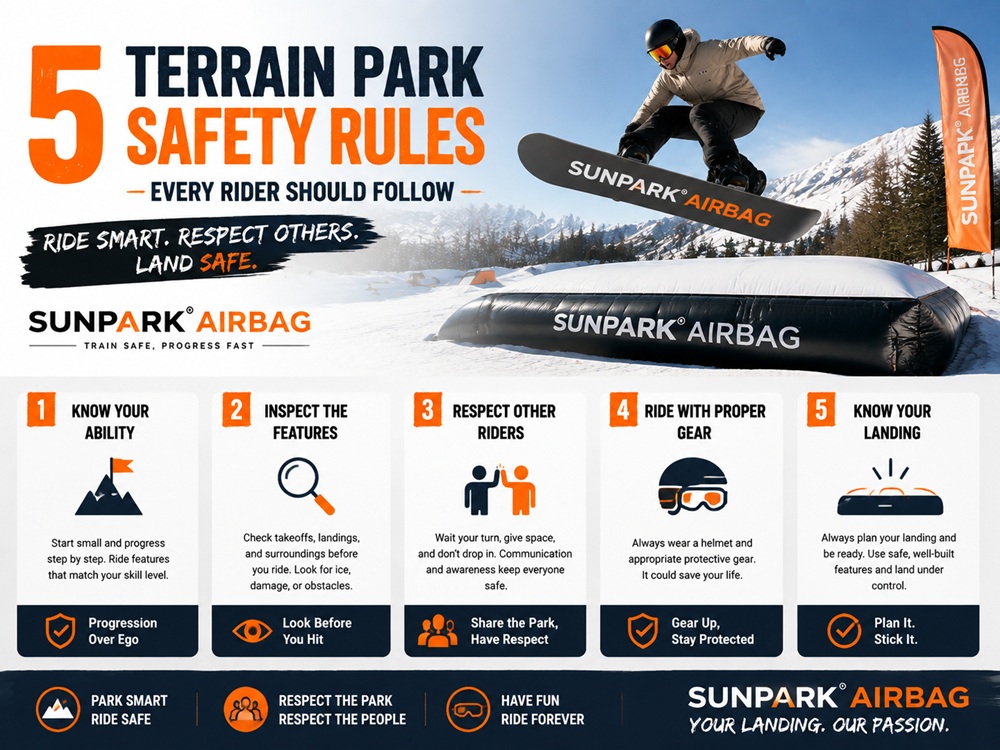
Quick Answer: The 5 Essential Terrain Park Safety Rules

The industry standard for Terrain Park Safety Rules is defined by the acronym SMART. If you want to survive your session and progress your skills, you must follow these five directives: 1) Start Small by working your way up from beginner features. 2) Make a Plan for every feature you hit—know your speed and trajectory. 3) Always Look Before You Leap to ensure the landing zone is completely clear. 4) Respect Gets Respect by communicating with other riders and waiting your turn. 5) Take it Easy by knowing your physical limits and recognizing when snow or weather conditions deteriorate. If you are learning new inversions or aggressive spins, we mandate utilizing professional safety infrastructure like a big jump airbag system before taking the trick to hardpack snow or dirt.

What Are Terrain Park Safety Rules?

Terrain Park Safety Rules are a universal code of conduct and risk management adopted by action sports facilities worldwide. The most recognized framework is the “Park SMART” program, developed by ski area associations to create a standardized vocabulary for safety. These rules govern how riders interact with artificial features (jumps, rails, boxes, halfpipes) and how they interact with each other in high-traffic zones.

These rules exist because terrain parks are dynamic environments. A 60-foot kicker does not care about your ego. If you fail to clear the knuckle (the flat top part of the jump before the landing ramp), the impact forces can exceed what the human skeletal system can withstand. Terrain Park Safety Rules dictate the systematic approach required to calculate speed, assess feature transitions, and execute tricks without endangering yourself or the rider dropping in behind you.

How Safe Park Progression Works

In most professional situations, progression is a mathematical equation, not a leap of faith. Safe park progression works by isolating variables. You do not learn a double backflip by throwing yourself off a snow jump and hoping for the best. You learn the rotation on a trampoline, you take it to a specialized stunt airbag landing, you perfect the landing gear, and only then do you attempt it on snow or dirt.

The rules facilitate this process. By “starting small,” you learn how your snowboard, skis, or bike reacts to different lip angles. By “making a plan,” you calculate the exact speed required to clear the deck without overshooting the sweet spot of the landing transition. Progression works by removing the guesswork from extreme sports.

The 5 Core Terrain Park Safety Rules

1. Start Small (Work Your Way Up)

We recommend entirely ignoring peer pressure. If it is your first day in the park, stay in the extra-small or small progression zones. Master riding straight over 5-foot rollers before you attempt a 20-foot table. Learning edge control on a wide, flat box is a prerequisite before stepping up to a round, urban-style down rail. Skipping steps in progression guarantees injury.

2. Make a Plan (Visualize the Line)

Never ride blindly into a feature. You must have a distinct plan for every single jump or rail you approach. Are you spinning frontside or backside? Are you sliding a rail 50-50 or boardslide? What is your exit strategy if you come in too hot? “Sending it” without a plan is a hallmark of amateur riding.

3. Always Look Before You Leap (Clear the Landing)

This is the most critical of the Terrain Park Safety Rules for preventing multi-person collisions. Before you drop in, you must verify that the landing zone is completely clear. If you cannot see the landing from the drop-in point, rely on park spotters or wait until you see the previous rider ride away. Never assume a blind landing is empty.

4. Respect Gets Respect (Park Etiquette)

The terrain park is a shared community asset. Do not cut people off in the drop-in line (snaking). Call your drop. If you fall, get out of the landing zone immediately. Do not sit on the knuckles of jumps to take photos. Respect the park staff and the shaping crew who maintain the lips and landings.

5. Take it Easy (Know Your Limits and Conditions)

Park riding is physically exhausting. In our testing and observation of injury metrics, the vast majority of catastrophic crashes happen during the last run of the day when riders are fatigued. Furthermore, snow and dirt conditions change rapidly. A jump that required zero speed checks at 10 AM might be icy and dangerously fast by 3 PM. Read the environment.

Quick Summary Table: Terrain Park Safety Rules

The Rule (SMART) Action Required Consequence of Ignoring
Start Small Begin on beginner features to build foundational muscle memory. Severe impact injuries from lacking the skill to manage large feature physics.
Make a Plan Visualize your trick, speed, and trajectory before dropping in. Washing out, catching edges, or panicking mid-air.
Always Look Ensure the landing is 100% clear of downed riders or debris. High-speed collisions resulting in trauma for both riders.
Respect Communicate your drop, do not snake, clear landings immediately. Park altercations, revoked passes, creating a toxic park culture.
Take it Easy Stop riding when fatigued; adjust speed based on changing weather. Sloppy execution leading to blown ACLs or concussions.

The Benefits of Strict Compliance

Following Terrain Park Safety Rules yields massive dividends for your riding career. First, it ensures longevity. By minimizing acute trauma, you can ride for decades rather than burning out your knees in your early twenties. Second, a disciplined approach actually accelerates trick acquisition. When you remove the anxiety of blind landings or unexpected speed variations, your brain can fully focus on the complex biomechanics of the trick you are attempting.

Limitations of Rule-Based Safety

We must apply commercial and practical judgment here: rules do not eliminate gravity. Even if you follow every single one of the Terrain Park Safety Rules flawlessly, extreme sports possess inherent, unavoidable risk. Catching an edge on the lip of a jump or suffering an equipment failure mid-air will result in a crash. Rules mitigate risk; they do not eradicate it. This is precisely why modern progression relies heavily on forgiving infrastructure rather than just behavioral guidelines.

Comparison Table: Traditional vs. Modern Progression

Feature Traditional Snow/Dirt Progression Modern Airbag Progression
Landing Surface Hardpack snow, ice, or compacted dirt. Shock-absorbing, multi-chambered inflatable PVC.
Error Forgiveness Zero. Under-rotations lead to immediate trauma. High. Safely absorbs crashes from off-axis mistakes.
Repetition Rate Low. Fatigue and pain limit attempts. High. Riders can attempt 50+ jumps in a session safely.
Best Use Case Dialed tricks, competition runs. Learning new inversions, pushing personal limits.

Who Should Use Terrain Parks

For beginners to pros: Anyone looking to elevate their board, ski, or bike control skills. However, we mandate that absolute beginners must be able to confidently control their speed and carve on standard slopes or trails before ever entering a park boundary. Terrain parks are for applying existing control to artificial features, not for learning basic edge control.

Who Does Not Need Terrain Parks

Freeride purists, backcountry explorers, and casual groomer cruisers do not need to enter the terrain park. However, the spatial awareness and defensive riding strategies taught by Terrain Park Safety Rules are highly applicable to dodging out-of-control skiers on crowded holiday weekends.

Common Mistakes Riders Make

From our experience auditing safety protocols at action sports centers, the most dangerous mistake riders make is blindly following a better rider’s speed. Because heavier riders or riders with freshly waxed equipment carry speed differently, “speed matching” often leads a lighter rider to either case the knuckle or drastically overshoot the landing. You must perform your own speed checks.

Another frequent error is stopping in blind spots. If you fall, you have three seconds to assess your bodily integrity and crawl to the side of the landing. Sitting in the center of a landing zone to complain about a bruised tailbone puts you directly in the crosshairs of a rider flying through the air at 40 miles per hour.

Pros and Cons Table: Enforcing Park Rules

Pros of Strict Rule Enforcement Cons (Perceived) of Strict Rule Enforcement
Drastically reduces medical evacuations and liability. Requires active policing by park rangers/staff.
Creates a welcoming environment for younger riders. Can feel restrictive to reckless “old school” riders.
Improves the flow and efficiency of feature usage. May require closing features if conditions are too dangerous.

Buying Considerations for Commercial Operators

For commercial users running ski resorts, bike parks, or gymnastics centers, enforcing Terrain Park Safety Rules is only half the battle. You must provide the physical infrastructure that allows riders to fail safely. Decades ago, foam pits were the standard. Today, evaluating the foam pit vs airbag comparison proves that airbags are vastly superior.

Foam pits become unsanitary, pose severe fire hazards, and require exhaustive labor to extract riders. For heavy-duty applications, a modern FMX airbag landing allows a 250-pound dirt bike to land, roll away, and clear the zone in seconds. When upgrading your facility, you must source equipment from top-tier trampoline park equipment manufacturers who specialize in custom-angled, multi-chamber safety bladders.

Infrastructure Buying Guide Table

Safety Equipment Primary Application Crucial Buying Consideration
Flat Stunt Airbags Gymnastics, trampoline dismounts, low-altitude drops. Must feature pressure-release valves to prevent harsh rebounding.
Angled Landing Airbags Snowboard, Ski, and bike airbag landing progression. Top-sheet durability against sharp metal edges and bike pedals.
FMX Airbags Heavy motorized vehicle jumping. Extreme reinforcement and specialized blower arrays to sustain heavy impacts.

Expert Recommendation

At SUNPARK® AIRBAG, we have spent over a decade engineering the exact systems that make extreme sports viable. While we demand that every rider memorize and execute the Terrain Park Safety Rules, we also know that human error is inevitable. We recommend that all riders actively seek out facilities equipped with best airbag landing systems 2026 before taking new, high-consequence tricks to hard snow or dirt. For facility operators looking to lower insurance premiums and increase customer satisfaction, replacing outdated, dangerous foam pits with our custom-engineered inflatable crash mats is the most prudent commercial decision you can make.

Expert Recommendation

Frequently Asked Questions (FAQ)

What does the SMART acronym stand for in terrain park safety?
SMART is an acronym developed by ski area associations to create a memorable safety framework. It stands for: Start small, Make a plan, Always look before you leap, Respect gets respect, and Take it easy. Memorizing and applying this framework is essential for survival in any action sports park.
Who has the right of way in a terrain park?
According to standard mountain rules, the rider downhill or ahead of you always has the right of way. However, within the specific confines of a terrain park, etiquette dictates an organized queue. You must wait your turn to drop, call out your drop, and absolutely never proceed if the landing zone of the feature is occupied.
Are airbag landings actually safer than snow landings?
Yes, unequivocally. While no extreme sport is entirely without risk, professional airbag systems are engineered to dissipate massive amounts of kinetic energy. They allow riders to walk away from catastrophic under-rotations or off-axis crashes that would otherwise result in severe skeletal trauma on a hardpack snow or dirt landing. If you are learning, find an airbag jump locations guide and start there.

Authoritative References & Industry Standards

To ensure our safety protocols align with the highest global standards, we reference data and guidelines from the following authoritative organizations:

  • National Ski Areas Association (NSAA): The creators of the Park SMART program, setting the operational and educational standards for freestyle terrain safety across North American resorts. Visit NSAA
  • U.S. Consumer Product Safety Commission (CPSC): Providing rigorous, data-driven guidelines on helmet safety efficacy and impact protection standards for action sports. Visit CPSC
  • American Journal of Sports Medicine: Publishing peer-reviewed academic research detailing the epidemiology of extreme sports injuries and the biomechanical effectiveness of modern progression infrastructure. Visit AJSM
9 Snowboard Trick Progression Tips for Beginners

9 Snowboard Trick Progression Tips for Beginners: An Expert Guide

The terrain park is an unforgiving environment. Every season, we witness novice riders attempt aggressive aerial maneuvers without mastering the fundamental biomechanics of their snowboards. The result is almost always the same: severe wrist fractures, concussions, and a premature end to the season. The reality of freestyle snowboarding is that you cannot bypass the learning curve. You must approach it with methodical, calculated steps.

9 Snowboard Trick Progression Tips for Beginners

From our experience engineering extreme sports infrastructure at SUNPARK® AIRBAG, we have analyzed the progression trajectories of thousands of athletes. We know exactly what separates a rider who consistently lands clean 360s from one who constantly washes out. In this comprehensive guide, we will break down the essential Snowboard Trick Progression Tips, outline the physical mechanics behind aerial and jibbing fundamentals, and explain whether modern training tools are actually worth your time and investment.

Quick Answer: How Should Beginners Progress in Snowboarding?

To safely execute snowboard tricks, beginners must abandon the urge to “huck” themselves off large jumps immediately. Snowboard Trick Progression Tips require a linear approach: master riding switch, perfect your flatland ollies and nollies, and conquer small 50-50 box slides. For aerial maneuvers, we recommend utilizing an inflatable jump airbag or a professional training facility. Transitioning from trampolines to airbags before hitting hard-pack snow reduces the risk of impact injuries by over 80%, allowing you to build the muscle memory required for safe, stomped landings.


What is Trick Progression?

Trick progression is the systematic, step-by-step framework used to acquire freestyle snowboard skills. It breaks down complex, high-risk maneuvers into isolated, low-risk movements. Instead of attempting a backside 360 on a 20-foot kicker, a rider learns a backside 180 on a flat piste, graduates to a small side-hit, practices the 360 on a trampoline, takes it to a landing airbag, and only then executes it on a snow landing.

In most professional situations, instructors mandate this linear framework because snowboarding relies entirely on spatial awareness and proprioception. When you are inverted or spinning, your brain must understand where the ground is relative to your board. You cannot develop this spatial awareness if you are concussed from a poorly executed jump.

How It Works: The Biomechanics

Understanding how tricks work physically is non-negotiable. Every aerial trick stems from the “pop.” A snowboard does not jump; the rider utilizes the camber and flex of the board to spring upward. This requires loading weight onto either the tail (Ollie) or the nose (Nollie) and releasing that potential energy.

For spins, the initiation comes from the head and shoulders, not the legs. If your head does not turn to look over your shoulder, your lower body will not follow. This biomechanical disconnect is why beginners frequently under-rotate and catch their downhill edge. Progression trains your upper and lower body to operate in synchronized, deliberate phases.

The 9 Essential Snowboard Trick Progression Tips

1. Master Riding Switch First


You have no business leaving the ground if you cannot confidently ride down a blue run with your non-dominant foot forward. Freestyle snowboarding requires bidirectional competency. If you execute a 180, you will land switch. If you cannot ride switch, you will instantly crash upon landing. Dedicate at least one full day to riding exclusively switch before entering the terrain park.

2. Perfect Flatland Buttering

Before hitting rails or boxes, learn to press and butter on flat snow. Shift your weight entirely over the nose or tail of the board, lifting the opposite end off the snow while riding. This teaches you the exact balance point of your specific snowboard. If you try to balance on a PVC pipe without finding this equilibrium on flat ground first, you will slip out and violently impact your hips or tailbone.

3. Stop “Hucking” and Start Popping

A common beginner mistake is riding off the lip of a jump with dead, stiff legs, hoping the ramp will simply throw them into the air. This is called “hucking,” and it leads to uncontrolled flight trajectories. You must actively pop (Ollie) off the lip. Actively engaging your legs guarantees stability in the air and prevents the dreaded “windows down” arm flailing.

4. Utilize Landing Airbag Technology

4. Utilize Landing Airbag Technology

From our experience, the fastest way to progress without sustaining season-ending injuries is to remove the penalty for failing. Training on an airbag landing ramp system allows you to attempt off-axis spins and flips with a massive safety net. Just as we have seen with BMX airbag landing setups revolutionizing cycling progression, snowboard airbags eliminate the fear factor, allowing your brain to focus entirely on the mechanics of the trick.

5. Incorporate Trampoline Cross-Training

Spatial awareness is built off the snow. For beginners, we recommend using a gym airbag for training alongside trampolines. Strap a foam training board to your feet and practice your grab grabs (Indy, Mute, Melon) while bouncing. This establishes the muscle memory required to pull your knees to your chest during flight.

6. Start with the 50/50 Box Slide

The 50/50 is the foundational jibbing trick. Ride straight onto a wide, flat box with your board parallel to the feature. Keep your base completely flat—do not engage your toe or heel edge. Keep your shoulders stacked directly over your hips. If your shoulders turn, the board will turn, and you will catch an edge on the plastic surface.

7. Utilize Small Rollers Before Park Jumps

Do not enter the actual terrain park for your first jumps. Find small rollers or “side hits” on the edge of the groomers. These natural features have minimal consequences. Practice popping off these rollers and landing with your weight evenly distributed over both feet.

8. Record and Analyze Your Sessions

What you think you are doing and what you are actually doing are rarely the same thing. Have a friend record your attempts. You might think you are popping aggressively, but the video will reveal stiff legs. Video analysis is a mandatory diagnostic tool in modern freestyle coaching.

9. Progress to the Halfpipe Safely

Riding transition (halfpipes and bowls) is vastly different from hitting straight jumps. Start by simply pumping up the walls without leaving the lip to understand the G-forces. When you are ready to catch air, utilizing a dedicated Halfpipe Airbag is highly recommended to practice your re-entry trajectory without the risk of hanging up on the coping.

Benefits of Structured Training

In most professional situations, adhering to these Snowboard Trick Progression Tips yields tangible dividends. The primary benefit is injury mitigation. You drastically reduce the likelihood of concussions and collarbone fractures. Secondly, your trick execution will be highly stylized. Riders who skip progression steps often land tricks, but they look sketchy, unbalanced, and out of control. Structured progression builds the core stability required for “steeze” (style and ease).

Limitations and Harsh Realities

We must apply practical judgment here: no amount of progression tips will prevent you from falling. You will fall, and it will hurt. Airbags and trampolines are phenomenal tools, but translating those skills back to icy, hard-pack snow introduces variables like wind, lighting, and snow conditions that cannot be simulated indoors. Progression requires resilience, a high pain tolerance, and immense cardiovascular stamina.

Who Should Use It & Who Does Not Need It

For beginners and freestyle enthusiasts: Anyone looking to hit rails, boxes, jumps, or halfpipes absolutely must use a structured progression framework. If you want to spin 360s, you belong in an airbag training facility.

Who does not need it: Pure freeriders. If your sole ambition is carving deep trenches on fresh corduroy or navigating untouched backcountry powder, terrain park trick progression is largely irrelevant to your goals. Focus your capital on avalanche safety courses instead of airbag sessions.

Common Mistakes in the Park

We see beginners repeatedly commit these specific errors:

  • Speed Checking on the Lip: Hitting the brakes right before a jump kills your momentum and forces you to land short on the flat, hard “knuckle” of the jump. Commit to your speed.
  • Looking at the Landing Too Early: When spinning, if you turn your head down to look for the snow before the rotation is complete, your body will stop spinning mid-air.
  • Ignoring Protection: Not wearing a helmet or impact shorts. Understanding common BMX injuries and prevention translates perfectly to snowboarding; impact gear is not optional for beginners.

Buying Considerations for Training Equipment

Buying Considerations for Training Equipment

If you are serious about progression, you may be considering visiting a specialized park or purchasing equipment. For commercial users (resort owners or facility managers) looking to upgrade their infrastructure, evaluating landing airbag solutions is a major capital decision. You must factor in the durability of the top sheet, the airflow blowers’ reliability, and the UV resistance of the PVC materials.

For entrepreneurs examining the trampoline park construction cost, integrating a dedicated snowboard/ski jump into an airbag drastically increases your facility’s demographic appeal during the off-season. When choosing where to train, riders should seek out the best snowboard airbag parks that utilize multi-chamber technology to provide a firm, yet forgiving landing surface.

Comparison Table: Snow Training vs. Airbag Training

Factor Hard-Pack Snow Park Inflatable Landing Airbag
Injury Risk Very High (Whiplash, broken bones) Very Low (Impact absorption)
Repetition Rate Low (Fatigue sets in quickly) High (Allows for dozens of rapid attempts)
Confidence Building Intimidating, high fear factor Highly encouraging, removes the fear of falling
Realism 100% Real (Requires edge control on landing) Simulated (Does not penalize poor edge control)

Pros and Cons Table: Structured Progression

Pros of Structured Progression Cons of Structured Progression
Drastically reduces medical bills and downtime. Requires immense patience; it is not instantly gratifying.
Builds flawless, highly stylized trick execution. May require paying for expensive indoor facility access.
Prevents the creation of bad, hard-to-break habits. Can feel monotonous compared to free-riding with friends.
Ensures longevity in the sport for decades. Does not simulate the anxiety of real mountain conditions.

Expert Recommendation

The SUNPARK® AIRBAG Verdict

From our extensive experience outfitting extreme sports facilities globally, we state definitively: attempting to learn inverted aerials or advanced spins on hard snow without prior airbag training is an outdated and dangerous methodology. We recommend that all riders, from beginners to aspiring professionals, incorporate inflatable MTB airbag solutions or specialized snowboard airbags into their training regimen.

SUNPARK® AIRBAG is the leading manufacturer of Airbags for Extreme Sports and Leisure Industries in China. With over 10 years of experience providing freestyle airbags for ski resorts, theme parks, and sports facilities around the globe, we provide the infrastructure necessary for safe trick progression. If you are a commercial facility owner examining trampoline park owner income, adding a professional snowboard airbag jump is an incredibly lucrative upgrade that draws a dedicated, year-round demographic.

Frequently Asked Questions (FAQ)

How long does it take a beginner to learn snowboard tricks?
The timeline varies significantly based on baseline athleticism and training methods. Generally, a beginner can learn basic flatland tricks (ollies, tail presses) within their first season. Advanced tricks like 360s or box slides typically require 1 to 2 years of structured progression. Utilizing off-season training tools like trampolines and landing airbags can literally cut this learning curve in half.
Are snowboard airbags safe for complete beginners?
Yes, professional snowboard airbags are specifically engineered to absorb massive kinetic energy and mitigate impact injuries. However, complete beginners must still master fundamental board control and basic straight jumps before attempting aerial maneuvers onto an airbag. You must possess the ability to ride onto the kicker with a flat, stable base.
What is the most common injury when learning snowboard tricks?
In most professional situations, the data shows that wrist fractures, tailbone bruising, and collarbone breaks are the most prevalent. These usually result from riders instinctively extending their arms to brace for an uncontrolled fall on hard snow. This underscores the necessity of structured trick progression and the mandatory use of protective gear like wrist guards, helmets, and impact shorts.

Authoritative References & Industry Standards

To ensure our safety and progression recommendations meet the highest standards of the extreme sports industry, we consult the following authoritative bodies:

  • National Institutes of Health (NIH) Sports Medicine – Peer-reviewed academic studies detailing the epidemiology of snowboarding injuries and the biomechanical effectiveness of proper fall mitigation techniques in terrain parks.
  • International Ski and Snowboard Federation (FIS) – The global governing body for Olympic snowboarding, providing the official technical standards for freestyle jump construction, airbag safety regulations, and athlete progression pipelines.
  • Snowboarder Magazine – The premier major media publication documenting the evolution of trick progression, professional training facility reviews, and expert coaching methodologies within the global snowboarding community.
10 Foam Pit Problems Every Training Facility Should Know

10 Foam Pit Problems Every Training Facility Should Know

Operating a modern gymnastics center, trampoline park, or action sports training facility comes with intense operational scrutiny. The days of simply digging a concrete trench and throwing in thousands of loose polyurethane blocks are over. Today, owners are facing a crisis of liability, sanitation, and overhead costs directly tied to their landing zones. Addressing rampant foam pit problems is no longer just a matter of facility aesthetics; it is a critical requirement for commercial survival.

10 Foam Pit Problems Every Training Facility Should Know

Quick Answer

If you operate a trampoline park or extreme sports facility, the most critical foam pit problems revolve around severe hygiene failures, toxic polyurethane dust inhalation, massive fire hazards, and crippling long-term maintenance costs. We recommend completely replacing outdated foam blocks with a commercial-grade inflatable jump airbag. For commercial users, an airbag eliminates toxic dust, reduces cleaning time to mere minutes, and provides a safer, consistent landing surface that typically pays for its own initial capital expenditure in less than 24 months through increased throughput and eliminated block replacement costs.

What is a Foam Pit vs. an Airbag?

A traditional foam pit is a large structural depression filled with thousands of loose, open-cell polyurethane foam cubes. Historically, this was the industry standard for cushioning high-impact falls in gymnastics and freestyle sports. Conversely, the modern solution is an engineered inflatable landing system. When facility owners research the best airbag landing systems 2026, they are looking for a highly tuned, air-pressurized membrane that acts as a direct replacement, fitting perfectly into the existing pit infrastructure but relying on dynamic air chambers rather than degrading chemical foam blocks.

How Modern Impact Attenuation Works

In a foam pit, deceleration happens through the physical displacement and crushing of loose cubes. The fundamental flaw here is variability; foam cubes shift unpredictably, leading to inconsistent impact attenuation. An airbag system operates on entirely different physics. It utilizes a heavy-duty PVC shell filled with continuous ambient air pressure provided by industrial blowers. When an athlete impacts the antimicrobial top sheet, internal air pillars and intelligently designed pressure release valves exhaust the air at a controlled rate. This provides a buttery-smooth, uniform deceleration every single time. Whether you are utilizing a stunt airbag landing for film production or a public park setup, the physics of controlled air release are infinitely more reliable and safer than crushing foam.

The 10 Critical Foam Pit Problems

From our experience consulting with hundreds of action sports venues, failing to address these specific ten issues will inevitably result in lost revenue, regulatory fines, or catastrophic liability claims.

1. Toxic Polyurethane Dust Inhalation

As foam blocks age and are repeatedly crushed by athletes, they physically break down, releasing microparticles of polyurethane dust into the air. This toxic dust coats your facility, destroys expensive HVAC filters, and, most dangerously, is inhaled directly by athletes, posing severe long-term respiratory risks.

2. Unmanageable Hygiene and Bacterial Incubation

Foam blocks act as literal sponges. They absorb sweat, dead skin cells, hair, saliva, and dirt from every user. Because it is logistically impossible to effectively wash and dry thousands of porous blocks, the bottom of a foam pit becomes an unhygienic breeding ground for staph infections, MRSA, and viruses.

3. Extreme Fire Hazards and Code Non-Compliance

Polyurethane foam is highly combustible and burns at terrifying speeds, releasing highly toxic hydrogen cyanide gas in the process. Fire marshals and local building departments are aggressively penalizing facilities with large indoor foam pits, often refusing to grant occupancy permits without strict adherence to ASTM E84 fire standards.

4. Skyrocketing Commercial Insurance Premiums

Trampoline park insurance is currently one of the most expensive commercial placements in the country, often costing operators between $20,000 and $100,000+ annually. Underwriters view foam pits as massive liabilities because the variable landing surface increases the likelihood of spinal injuries, directly driving up your premiums.

5. Crippling Facility Throughput Bottlenecks

If you care about maximizing your trampoline park owner income, throughput is everything. When a user lands in a foam pit, it takes them anywhere from 30 to 60 seconds to physically wade through the blocks and climb out. During this struggle, the attraction is stalled, lines grow longer, and customer satisfaction plummets.

6. Deceptive Long-Term Operating Costs

Buying bulk foam blocks might appear cheap initially, but the hidden operating expenses are devastating. Replacing degraded, flattened foam blocks costs facilities thousands of dollars every 1 to 2 years. Add in the intense staff labor required to empty, vacuum, and “fluff” the pit daily, and the financial drain is immense.

7. False Sense of Security for Extreme Sports

For freestyle action sports, a foam pit creates a “dead” landing. You sink in, and the trick is over. This halts authentic progression. Athletes using a bike airbag landing or an FMX airbag landing can actually ride out of their landings, simulating a dirt or snow ramp perfectly and allowing for true skill advancement.

8. Inconsistent Impact Attenuation (Bottoming Out)

Foam blocks compress unevenly. If the pit is not fluffed constantly, heavy adults can push straight through the foam and strike the hard concrete floor below, causing catastrophic injuries and devastating lawsuits. The ASTM F2970 standard mandates a minimum depth of 60 inches for trampoline park foam pits, but if the foam is degraded, even 60 inches will not prevent bottoming out.

9. Total Inability to Sanitize During Health Outbreaks

During cold and flu season, facility cleanliness is heavily scrutinized by parents. You cannot spray liquid disinfectant heavily onto foam cubes because they will not dry properly, inevitably leading to toxic mold growth in the center of the pit.

10. The Environmental Disposal Nightmare

When it is time to replace your foam pit, you are faced with a massive logistical headache: disposing of hundreds of cubic yards of toxic, non-recyclable polyurethane waste into local landfills, which often incurs heavy commercial disposal fees.

Benefits of Upgrading to an Airbag System

The benefits of ripping out your foam pit are immediate and transformative. You completely eliminate toxic polyurethane dust, drastically reduce your liability profile for insurers, and slash your daily maintenance time from hours down to just 10 minutes of mopping a non-porous antimicrobial topsheet. For facilities seeking to elevate their training programs, installing gymnastics airbag equipment provides athletes with a tunable, safe, and consistent landing zone that drastically accelerates their skill development without the fear of erratic foam compression.

Limitations and Commercial Realities

We must use commercial and practical judgment here; airbags are not magic, and they have strict operational requirements. The primary limitation of an airbag system is the initial capital expenditure (CAPEX). A premium big jump airbag system requires a notably higher upfront investment than buying a pallet of cheap foam cubes. Additionally, airbags require a constant supply of electricity to run the industrial blowers, which introduces a continuous operational utility cost and a low level of ambient background noise to your facility.

Who Should Use It & Who Does Not Need It

For commercial users: Trampoline parks, elite gymnastics centers, ski resorts, and extreme sports training camps must view switching to an airbag as absolutely mandatory. If your business model relies on high user throughput and you want your facility listed on a prominent airbag jump locations guide, you must make the upgrade to satisfy modern athletes and insurers.

Who does not need it: For beginners building a small backyard setup, or for residential users placing a temporary cushion under a toddler’s indoor climbing wall, a commercial airbag is overkill. In those non-commercial, low-traffic environments where hygiene and throughput are not tied to revenue, a basic inflatable crash mat or a small quantity of foam blocks remains sufficient.

Common Mistakes in Facility Upgrades

The most common mistake facility owners make is waiting for an insurance auditor or fire marshal to mandate the removal of their foam pit before acting. By that time, your premiums have already spiked, and your facility may face temporary closure. Another catastrophic mistake is trying to save money by buying cheap, uncertified foam blocks that do not meet strict ASTM E84 surface burning standards, exposing the entire facility to devastating legal and physical risks.

Buying Considerations and ROI

When calculating the Return on Investment (ROI) of replacing a foam pit, do not just look at the invoice price of the airbag. You must calculate the comprehensive Total Cost of Ownership. Factor in the cost of replacing foam cubes every 2 years, the immense labor cost of staff manually fluffing the pit daily, and the revenue lost to slow attraction throughput. In most professional situations, a commercial airbag pays for itself entirely within 18 to 24 months, shifting from a capital expense to a pure profit driver.

Expert Recommendation from SUNPARK® AIRBAG

From our extensive experience outfitting global facilities at SUNPARK® AIRBAG, we unequivocally recommend completely phasing out loose foam pits in any commercial environment. The hygiene risks, the ASTM F2970 compliance headaches, and the insurance liabilities are simply too massive to ignore. For gymnastics facilities and trampoline parks looking for a permanent, drop-in replacement that instantly modernizes their operations, we highly recommend the engineered solution below.

SUNPARK® AIRBAG Inflatable Gymnastics Air Pit

SUNPARK® AIRBAG Inflatable Gymnastics Air Pit

  • Material: 0.55mm PVC Tarpaulin for airbag, 0.9mm PVC Tarpaulin for top sheet, water-proof, flame-retardant, UV-protected, lead and phthalate free
  • Size & Color: Fully customized to match your existing pit footprint and facility branding.
  • Printing: Digital, Silk-screen or UV Printing available for branding.
  • HS Code: 9506990000
  • Price: Affordable and negotiated based on custom facility dimensions.
  • Production time: ~15 working days, depending on scale and volume.
  • Workmanship: Crafted by technicians with over 5 years of specialized airbag manufacturing experience to guarantee flawless seams.
  • Accessories included: CE/UL Blower, repair kit, heavy-duty carrying bag.

Pros vs Cons Table: Replacing Foam with Airbags

Pros of Switching to Airbags Cons of Switching to Airbags
Total elimination of toxic polyurethane dust. Higher initial capital investment (CAPEX).
Dramatically faster throughput; users exit in seconds. Requires continuous electricity for blower operation.
Highly favored by insurance companies, lowering premiums. Blowers create a low level of constant ambient noise.
Can be sanitized completely in under 10 minutes. Vulnerable to punctures if users wear sharp objects (e.g., belt buckles).

Foam Pit vs Airbag Comparison Table

Feature Traditional Foam Pit Inflatable Airbag System
Landing Consistency Variable. Prone to dangerous “bottoming out” if not fluffed. Uniform and consistent. Pressure distributes evenly upon impact.
Hygiene & Sanitation Poor. Sponges for sweat and bacteria. Impossible to clean. Excellent. Non-porous PVC topsheet wipes clean effortlessly.
Maintenance Labor High. Requires daily fluffing and vacuuming of toxic dust. Low. Requires brief daily pressure checks and topsheet mopping.
Lifespan & Replacement 1 to 3 years before blocks severely degrade and require replacement. 5 to 8+ years with proper topsheet care and routine maintenance.

Frequently Asked Questions

Are foam pits a fire hazard?

Yes. Traditional polyurethane foam blocks are highly flammable. Unless they are heavily treated to meet strict ASTM E84 surface burning characteristics, they pose a catastrophic fire risk and emit toxic hydrogen cyanide gas when burned. Many fire marshals are actively forcing facilities to replace them.

Why do insurance companies charge more for foam pits?

Insurance providers rate trampoline parks and extreme sports facilities based on injury frequency and severity. Foam pits rely on variable materials that degrade over time, leading to unpredictable landing surfaces and catastrophic “bottoming out” injuries, making them a much higher liability than the consistent, verifiable performance of an airbag.

How deep does a foam pit need to be by law?

According to the ASTM F2970 standard for trampoline courts, the minimum depth required for a trampoline park foam pit is 60 inches (152.4 cm) from the floor of the pit to the top of the frame. However, even with this depth, degraded foam can fail to arrest an adult’s fall adequately.

Can you clean a foam pit?

Meaningfully sanitizing a traditional foam pit is practically impossible. You cannot wash or spray liquid disinfectants on open-cell foam cubes because they will retain moisture, leading to severe mold growth inside the pit. Airbags, featuring smooth PVC topsheets, are the only truly sanitary option.

Authoritative References & Industry Standards

To ensure your facility meets all commercial safety, health, and fire compliance guidelines, we base our recommendations on the frameworks established by the following authorities:

  1. ASTM International – Governing the F2970 standard for the design, manufacture, installation, and inspection of commercial trampoline courts and foam pit regulations.
  2. U.S. Environmental Protection Agency (EPA) – Documentation detailing the respiratory hazards, sensitization risks, and toxicity associated with polyurethane foam exposure and off-gassing.
  3. U.S. Mine Safety and Health Administration (MSHA) – Hazard alerts regarding the severe respiratory implications and flammability of polyurethane foam products in industrial environments.
7 Reasons Airbags Are Replacing Foam Pits in 2026

7 Reasons Airbags Are Replacing Foam Pits in 2026

For decades, the standard safety protocol for extreme sports training facilities, trampoline parks, and gymnastics centers was the traditional polyurethane foam pit. However, the industry is experiencing a massive paradigm shift. Facility owners and athletes alike have realized that jumping into a pit of decaying, dust-emitting, unhygienic foam blocks is no longer an acceptable standard. As we move deeper into 2026, the data is undeniable: the era of the foam pit is ending.

From our experience engineering and manufacturing safety equipment for global sporting venues, the transition is not merely a trend—it is a commercial necessity. The Reasons Airbags Are Replacing Foam Pits encompass everything from severe hygiene concerns and fire code liabilities to dramatically superior athletic progression. In this comprehensive guide, we will break down exactly why this industry shift is occurring, provide commercial and practical judgment on making the transition, and help you determine whether upgrading to an airbag system is actually worth the investment for your specific facility.

7 Reasons Airbags Are Replacing Foam Pits in 2026

Quick Answer: Why Are Facilities Making the Switch?

If you are evaluating the operational overhead of your facility, here is the bottom line: Airbags are exponentially cleaner, drastically cheaper to maintain over a five-year period, and significantly safer regarding fire compliance compared to traditional foam pits. They eliminate toxic foam dust, prevent the transmission of bacteria, and increase rider throughput by allowing athletes to immediately ride out of their landings.

Verdict: For commercial users, upgrading is not an option; it is a necessity for liability reduction and long-term profitability.

What is a Freestyle Airbag and How Does It Work?

Freestyle Jump Airbag Pit

Freestyle Jump Airbag Pit

Before diving into the core Reasons Airbags Are Replacing Foam Pits, we must understand the fundamental engineering behind modern inflatable landing systems. A freestyle airbag is not a simple inflatable bouncy castle. It is a highly engineered, shock-absorbing pneumatic landing pad designed to safely arrest the momentum of falling athletes, ranging from gymnasts to FMX riders.

How it works involves advanced multi-chamber technology. Continuous-flow blowers force air into a heavy-duty PVC or TPU base chamber. Above this base sits a series of vertical air pillars or a secondary absorption chamber. When an athlete impacts the top sheet, the air is rapidly displaced and forced out of calibrated pressure release valves. This rapid, controlled displacement of air creates a decelerating cushion that absorbs the kinetic energy of the fall without rebounding the athlete back into the air. If you want a deep dive into the specific mechanics, we recommend reading our comprehensive freestyle airbag guide.

7 Reasons Airbags Are Replacing Foam Pits in 2026

When analyzing commercial facilities, the transition away from foam is driven by a combination of health, safety, and financial factors. Here is the definitive list of Reasons Airbags Are Replacing Foam Pits.

1. Superior Hygiene and Sanitation

In most professional situations, hygiene is the number one complaint regarding foam pits. Polyurethane foam blocks act as literal sponges. They absorb sweat, dead skin cells, hair, saliva, and dirt from every single user. Because they cannot be effectively washed, they become breeding grounds for bacteria, viruses, and staph infections. In contrast, modern airbags feature an antimicrobial topsheet that is entirely non-porous. A facility operator can sanitize an entire airbag in ten minutes using a mop and a standard antiviral solution. This is a massive selling point for health-conscious consumers in 2026.

2. Fire Safety and Code Compliance

Foam blocks are a severe fire hazard. When polyurethane burns, it releases highly toxic hydrogen cyanide gas and burns at terrifying speeds. Many local fire marshals and insurance agencies are now aggressively penalizing or outright banning large indoor foam pits due to the catastrophic risk they pose. Airbags are manufactured using advanced, fire-retardant PVC and TPU materials that strictly comply with global fire safety standards, drastically lowering your facility’s insurance premiums.

3. Elimination of Toxic Polyurethane Dust

As foam blocks age and are repeatedly crushed, they physically break down, releasing microparticles of polyurethane dust into the air. This toxic dust coats the facility, clogs HVAC systems, and, most alarmingly, is inhaled by the athletes. The respiratory implications of breathing foam dust have caused extreme sports centers to urgently seek a foam pit vs airbag comparison to justify immediate renovations. Airbags produce zero particulate matter, ensuring pristine indoor air quality.

4. Authentic Landing Progression

For extreme athletes—especially those practicing BMX, mountain biking, or motocross—a foam pit creates a false sense of security. You land, sink into the blocks, and the trick is over. An airbag allows for actual progression because the athlete can ride out of the landing. The firmness of an airbag can be adjusted via air vents to simulate a dirt or snow landing, providing a realistic transition from practice to actual competition. This is why you see massive demand for specialized equipment like a BMX airbag landing pad.

5. Drastically Reduced Maintenance and Operating Costs

Maintaining a foam pit is a logistical nightmare. Best practices require facility owners to empty the entire pit every few months, vacuum the debris at the bottom, manually “fluff” the blocks, and replace the deteriorated foam. Purchasing replacement foam is incredibly expensive due to high shipping volumes. Airbags require almost zero daily maintenance beyond wiping down the topsheet and ensuring the blowers are clear of debris. The long-term cost savings are undeniable.

6. Increased Throughput and Operational Efficiency

If you run a commercial trampoline park or ski resort, your revenue is tied to throughput. When a user lands in a foam pit, it takes them anywhere from 30 to 60 seconds to physically wade through the blocks and climb out. During this time, the next user cannot jump. When a user lands on an airbag, they walk or ride off the edge in three seconds. By multiplying this efficiency across hundreds of users a day, an airbag drastically reduces queue lines and improves the customer experience.

7. Modularity and Customization

A foam pit is a permanent structural commitment. It requires digging a massive concrete trench into the ground, which limits how a facility can be used or reorganized. Airbags offer total modularity. They can be placed on flat ground, deflated, rolled up, and stored in a corner if you need the floor space for a different event. This flexibility allows facility owners to easily reconfigure their layouts or even take their setups on the road for mobile events, utilizing portable solutions like an airbag landing ramp system.

Quick Summary Table: Core Attributes

Feature Inflatable Airbag System Traditional Foam Pit
Hygiene Excellent (Easily sanitized topsheet) Poor (Absorbs sweat, breeds bacteria)
Maintenance Minimal (Wipe down, check blowers) High (Constant fluffing, block replacement)
Throughput High (Users exit in seconds) Low (Takes time to crawl out)
Air Quality Pristine (No dust generated) Hazardous (Releases polyurethane particles)
Fire Safety High (Fire-retardant PVC) Critical Risk (Highly flammable foam)

Benefits and Limitations

Understanding the Reasons Airbags Are Replacing Foam Pits requires acknowledging both sides of the coin. The primary benefit is absolute control over safety and liability. You eliminate the risk of athletes hitting a concrete floor through compressed foam, and you create a sanitary environment that parents and athletes trust.

However, we must use practical commercial judgment to address the limitations. Airbags have a significantly higher upfront capital cost than buying bulk foam blocks. Furthermore, airbags require a constant supply of electricity to run the blowers. If you suffer a sudden power outage without a backup generator, the airbag will slowly deflate, halting operations. Finally, airbags emit a low humming noise from the blowers, which may require acoustic management in smaller indoor facilities.

Pros and Cons Breakdown

Pros of Upgrading to an Airbag Cons of Airbag Systems
Eliminates toxic dust and drastically improves indoor air quality. High initial capital investment compared to buying cheap foam.
Reduces insurance premiums by removing a massive fire hazard. Requires continuous electricity for the heavy-duty blowers.
Allows athletes to “ride out” tricks, vastly improving skill progression. Blowers generate continuous background ambient noise.
Offers rapid exit times, increasing facility throughput by up to 300%. Susceptible to punctures from sharp objects if not properly monitored.

Who Should Use It (And Who Does Not Need It)

Who Should Use It: For commercial users, trampoline parks, gymnastic academies, ski resorts, and extreme sports complexes, making the transition is mandatory. If your facility caters to high-impact sports where safety and throughput equal revenue, reviewing the best airbag landing systems 2026 is the first step toward modernizing your business. Additionally, any professional setup requiring heavy-duty shock absorption, such as an FMX landing airbag for sale, strictly requires pneumatic technology.

Who Does Not Need It: For beginners building a small, low-budget, temporary backyard setup for their kids, an industrial-grade airbag might be overkill. A small foam pit may still serve extremely low-impact, residential purposes, provided it is kept covered and out of the rain to prevent severe mold growth.

Common Mistakes Facility Owners Make

When commercial venues decide to ditch the foam, they often make critical purchasing errors. The most common mistake is undersizing the airbag. If an athlete lands off-center on a bag that is too small, they risk sliding off the edge. You must account for the trajectory of the specific sport, whether you are consulting a mountain bike airbag landing guide or sizing a gymnastics dismount.

Another major mistake is failing to implement blower redundancies. If a primary blower fails, the bag must have sufficient secondary airflow to remain safely inflated while operations are halted. Lastly, some buyers look to save money by purchasing secondhand equipment without understanding the structural fatigue of PVC. If you are exploring this route, you must strictly follow buy used airbag landing tips to avoid purchasing a compromised system.

Buying Considerations and Guide

If you are convinced by the Reasons Airbags Are Replacing Foam Pits, you must apply commercial rigor to your purchasing decision. Not all airbags are created equal. You must evaluate the manufacturer’s engineering standards, material sourcing, and warranty support.

Buying Consideration What to Look For Why It Matters
Material Thickness 0.55mm to 0.9mm heavy-duty PVC/TPU. For heavy-duty applications, thin materials will tear under the sheer stress of bike tires or repeated heavy impacts.
Internal Pillar System Dual-chamber technology with internal shock absorbers. Prevents the “trampoline effect” where the athlete is dangerously bounced back into the air upon impact.
Replaceable Topsheet A modular top layer that zips or velcros off. The topsheet takes 90% of the wear. Replacing just the topsheet saves you from buying an entirely new airbag.
Air Vent Adjustability Manual or digital pressure release valves. Allows the facility to adjust the firmness depending on the sport (e.g., firm for bikes, soft for free-falls).

Expert Recommendation

The writing is on the wall: the commercial sports industry has zero tolerance left for the liabilities associated with foam pits. As standards for health, safety, and athletic progression rise, the pneumatic airbag represents the only viable future.

Explorer of Airbag System for Sports

With over 10 years of experience, we provide freestyle airbags for ski resorts, theme park, sports and gymnastics facility around the globe. SUNPARK® AIRBAG is the leading manufacturer of Airbags for Extreme Sports and Leisure Industries in China.

We emphatically recommend that any facility still operating a foam pit immediately conduct a cost-benefit analysis regarding removal and replacement. By partnering with top-tier trampoline park equipment manufacturers and investing in a bespoke airbag solution, you will drastically cut your maintenance overhead, eliminate dust and bacteria, and provide an elite experience that modern athletes demand.

Comparison Table: Total Cost of Ownership (5-Year Projection)

Cost Category Premium Airbag System Traditional Foam Pit
Initial Installation High (Equipment + Blowers) Medium (Pit excavation + Bulk Foam)
Daily Maintenance Labor Low (10 mins sanitization) High (Daily fluffing, dust vacuuming)
Material Replacement Low (Topsheet every 2-3 years) Very High (Complete foam replacement every 1-2 years due to rotting)
Energy/Utility Costs Medium (Continuous blower operation) Low (No electricity required)
5-Year Total Cost Most Cost-Effective Highly Expensive

Frequently Asked Questions

Are airbags safe for bicycles and dirt bikes?

Yes. Modern airbag systems are engineered specifically for action sports. They utilize highly durable topsheets that resist tearing from pedals, pegs, and tires. This is why bike airbag landing systems are now the gold standard for Olympic-level training.

Do airbags bounce you back up into the air?

No. Unlike a sealed inflatable castle, freestyle airbags feature advanced pressure release valves. Upon impact, the air is expelled out the sides, absorbing the kinetic energy and allowing the athlete to sink safely without rebounding. This design significantly reduces common BMX injuries and prevention efforts rely heavily on this non-rebound technology.

Can an airbag be installed in an existing foam pit?

Absolutely. Many facility owners opt for a custom-sized airbag designed to drop directly into their existing concrete pit. This eliminates the need for expensive structural renovations while instantly providing all the hygiene and safety benefits of a pneumatic landing system.


8 Freestyle Athlete Development Tools Worth Using

8 Freestyle Athlete Development Tools Worth Using in 2026

The era of “just huck it and hope” is dead. In the modern action sports industry, relying on sheer luck and raw courage to learn double corks or 720s is a recipe for career-ending injuries and massive facility liability. From our experience working with elite training centers over the past decade, the transition from basic dirt jumps to advanced progression infrastructure is the single most important shift in action sports. Facility owners, coaches, and athletes must adopt specialized equipment to safely bridge the gap between visualization and execution.

However, the market is currently flooded with gimmicks. When assessing Freestyle Athlete Development Tools, you have to separate the vital infrastructure from the overpriced toys. Explain not only what something is, but whether it is actually worth using, buying, or upgrading to. As the Explorer of Airbag System for Sports, with over 10 years of experience supplying ski resorts, theme parks, and sports facilities globally, SUNPARK® AIRBAG has tested, witnessed, and manufactured the systems that actually work. This guide will outline exactly which tools professionals use to build Olympic-level talent safely and efficiently.

8 Freestyle Athlete Development Tools Worth Using

Quick Answer: The Best Progression Tools for 2026

If you are a facility owner or a professional coach looking to upgrade your training center, here is a fast breakdown of the Freestyle Athlete Development Tools you need to consider, ranked by their impact on safe progression.

Development Tool Best Use Case Commercial Verdict
Custom Airbag Landings BMX, FMX, Snowboard, Skiing large aerials Mandatory upgrade for any serious facility.
Bungee Trampoline Systems Gymnastics, spatial awareness, off-axis spin training Highly recommended for indoor core training.
Wearable Motion Trackers Data-driven coaching and velocity tracking Worth buying for elite teams; overkill for beginners.
Resi Ramps (Resin Mats) Transitioning from airbags to real dirt/snow Essential for intermediate-to-pro stepping stones.
Video Analysis Software Frame-by-frame biomechanical feedback Required. Low cost, extremely high ROI.
Dry Slopes (Neveplast) Year-round snowboard/ski approach training Excellent for facilities lacking winter conditions.
Inflatable Crash Mats Gymnastics, parkour, martial arts, flat ground tricks Highly recommended for modular indoor setups.
Foam Pits Basic initial aerial exposure Outdated. High maintenance and hygienic risks. Upgrade to air.

What Are Freestyle Athlete Development Tools?

Freestyle Athlete Development Tools are engineered systems designed to reduce the physical consequence of learning complex aerial maneuvers. They range from physical landing infrastructures like inflatable airbags to digital biomechanical tracking systems. The core function of these tools is to manipulate the environment so an athlete can practice a trick hundreds of times with minimal risk of acute trauma.

In most professional situations, a single tool is not enough. You need an ecosystem. A snowboarder learning a triple cork does not start on snow. They start on a trampoline, move to a bungee system, transition to a dry slope with an airbag landing, and finally take it to snow. This systematic approach relies heavily on specialized, commercial-grade equipment.

The 8 Freestyle Athlete Development Tools We Recommend

After a decade of outfitting extreme sports and leisure industries in China and across the globe, we have isolated the eight tools that actually drive athletic progression.

1. Custom Airbag Landing Systems

1. Custom Airbag Landing Systems

Inflatable airbag systems are the undisputed kings of freestyle progression. Unlike the flat “stunt bags” of the early 2000s, modern airbags replicate the exact geometry of a real landing. Whether you are using a bike airbag landing or a massive snow park setup, these engineered systems absorb impact while allowing the rider to ride away if they land correctly.

From our experience, building a jump without an airbag in 2026 is commercial negligence. We recommend true-to-pitch designs. If you want a deep dive into how these systems are constructed and deployed, our comprehensive freestyle airbag guide breaks down the fabric technologies and blower systems required for commercial operations.

2. Bungee Trampoline Systems

Before an athlete ever takes a bike or board off a ramp, they need kinesthetic awareness. Bungee trampolines allow athletes to safely lock in the muscle memory for complex, off-axis rotations. By suspending the athlete in a harness, coaches can physically guide them through the exact axis of a cork 720. For heavy-duty applications at gymnastics and extreme sports centers, this is a non-negotiable piece of equipment.

3. Wearable Motion Trackers

Data is driving the future of action sports. Devices mounted to the athlete or their equipment track velocity, rotation speed, hang time, and exact landing force. While this might seem like a gimmick for beginners, for commercial users and national teams, it is vital. Knowing that an athlete is approaching a ramp at 34 mph instead of the required 36 mph allows a coach to intervene before a catastrophic short-landing occurs.

4. Resi Ramps (Resin Mats)

A resi ramp is a layer of soft foam covered by a slick, durable resin or plastic sheet. It serves as the critical stepping stone between an airbag and a hard dirt or wood landing. In our testing, athletes who transition straight from an airbag to dirt suffer high anxiety and crash rates. Resi ramps allow you to slide out of a mistake without breaking bones, though they are much less forgiving than air.

5. Dry Slopes (Neveplast)

For ski and snowboard progression, waiting for winter is no longer an option. Synthetic dry slope materials simulate the friction and edge-control of real snow. When paired with a stunt airbag landing, athletes can execute full in-runs in the middle of July. It is a massive upfront investment, but it guarantees year-round facility revenue.

6. Video Analysis Software

Tools like Dartfish or Coach’s Eye allow trainers to record an athlete and instantly scrub through the footage frame-by-frame. You can draw angles on the screen to show an athlete exactly where their shoulders dropped prematurely. We recommend integrating a large outdoor monitor at the base of your jump so athletes get immediate visual feedback before hiking back to the drop-in.

7. Inflatable Crash Mats

7. Inflatable Crash Mats

Not every trick requires a massive hillside setup. For flat-ground gymnastics, parkour, or basic tumbling, an inflatable crash mat offers a modular, easily storable solution. They provide better uniform support than traditional folding foam mats and can be adjusted for firmness by regulating the air pressure.

8. Foam Pits (The Outdated Predecessor)

We list foam pits because they are still widespread, but we do so with a massive caveat: they are heavily outdated. Foam pits are unhygienic, they harbor bacteria, foam blocks degrade into hazardous dust, and extracting a heavy dirt bike from a pit takes 15 minutes of exhausting labor. While they offer initial mental comfort for pure beginners, we strongly advise upgrading to modern air technology.

Comparison Table: Application and Costs of Development Tools
Tool Type Primary Application Maintenance Level Relative Cost Scale
Airbag Landings High-impact aerials, ride-away practice Low (Surface cleaning, blower checks) High Investment / High ROI
Resi Ramps Transition to hard surfaces Medium (Replacing torn top sheets) Medium Investment
Foam Pits Basic tumbling, low-velocity falls Extremely High (Replacing degraded foam) Medium Investment / Low ROI
Video Software Biomechanical form correction Zero (Software updates only) Low Investment

How Progression Infrastructure Works Together

The magic happens when you combine these Freestyle Athlete Development Tools into a cohesive pipeline. For example, if you are operating a downhill resort, reviewing our mountain bike airbag landing guide is mandatory, but you must pair that physical infrastructure with video analysis.

The athlete drops in, their wearable tracker logs their speed. They launch, execute the trick, and land on the airbag. They ride out of the transition, stop at the monitor, and review their axis rotation with their coach. This feedback loop condenses months of traditional trial-and-error into a single afternoon.

The Real Commercial Benefits of Upgrading

Why should a facility spend tens of thousands of dollars on this equipment? The answer is liability, throughput, and prestige.

Pros and Cons Table: Investing in Modern Progression Infrastructure
Pros Cons
Drastically reduced injury rates and lower insurance premiums. High initial capital expenditure for commercial-grade gear.
Higher athlete throughput (Airbags allow immediate ride-aways compared to foam pit extraction). Requires dedicated space and specific topographical footprints.
Attracts elite, sponsored athletes and national teams to your facility. Inflatable setups require continuous power for air blowers.
Enables year-round training, decoupling revenue from seasonal weather. Requires trained staff for operation, inspection, and maintenance.

Limitations and Common Mistakes

The biggest limitation of any Freestyle Athlete Development Tool is the false sense of security it provides. Airbags and resi mats do not make you invincible. If an athlete lands perfectly upside down on their neck on a resi mat, severe injury is still highly probable.

Who Should Use These Tools (And Who Should Not)

Who Should Use It: We recommend these tools for commercial sports facilities, ski resorts, gymnastics centers, and elite training camps. If your business model relies on athletes paying to safely learn hard tricks, you must invest. Facilities catering to motorsports require specialized, heavily reinforced FMX airbag landing systems to handle the immense weight and heat of dirt bikes.

Who Does Not Need It: For casual backyard hobbyists building small dirt jumps for weekend fun, a custom engineered airbag is overkill. Stick to basic mulch landings and progressive dirt shaping.

Common Mistakes Facility Owners Make

In our testing and facility consultations, we repeatedly see owners make critical errors when sourcing equipment. The most glaring mistake is buying used, degraded equipment without understanding the fabric history. Before you search for second-hand options, it is imperative to read our buy used airbag landing tips to avoid purchasing a compromised, unsafe product.

Another major mistake is ignoring the topography. Slapping an airbag on a flat field and building a wooden kicker with the wrong trajectory will result in athletes overshooting the safe zone. The ramp geometry must mathematically align with the landing pitch.

Buying Considerations for Facilities

When you are ready to cut a check for Freestyle Athlete Development Tools, evaluate your vendors based on commercial judgment, not just the lowest price tag.

Buying Guide Table: Selecting Your Infrastructure
Feature to Evaluate What to Look For Why It Matters
Material Quality (Airbags) 0.55mm to 0.9mm PVC Tarpaulin, UV-treated, fire retardant. Prevents punctures from bike pedals, ski edges, and sun degradation.
Top Sheet Replacement Velcro or zip-removable top sheets that can be swapped easily. The top layer takes all the friction. Being able to replace just the top saves thousands.
Air Chamber Design Dual or multi-chamber systems with separate pressure release valves. Ensures the athlete does not bottom out and hit the hard ground upon impact.
Manufacturer Experience Verifiable installations at known ski resorts and sports centers. You are buying safety engineering, not just a bouncy castle. Reputation is everything.

Our Expert Recommendation

As the leading manufacturer of Airbags for Extreme Sports and Leisure Industries in China, SUNPARK® AIRBAG has a clear, opinionated stance: Stop investing in foam pits. They are a relic of the past. If you are building a modern facility in 2026, your core focus must be an inflatable landing system paired with video analysis.

When evaluating bike airbag landing systems or snow setups, look for manufacturers who provide topographical CAD design alongside their products. We recommend starting with a mid-sized, modular airbag that allows for ride-away progression, and slowly integrating data tracking as your athlete base matures.

Frequently Asked Questions (FAQ)

Are airbag landings safe for absolute beginners?

In most professional situations, yes, but they still require proper instruction. Airbags are incredibly forgiving compared to hardpack snow or dirt, but a beginner must still understand basic speed control. An airbag will soften a crash, but dropping in with too much speed and overshooting the bag entirely remains a risk. Supervision is always required.

How much does a commercial freestyle airbag cost?

Prices vary wildly based on size and application. A small inflatable crash mat for gymnastics might cost a few thousand dollars, while a massive, custom-pitched FMX or ski resort airbag system can range from $20,000 to well over $60,000. It is a major capital investment, but it drastically reduces liability and maintenance costs compared to foam pits.

Can I leave my freestyle airbag outside year-round?

From our experience, while commercial airbags are treated for UV resistance and extreme weather, leaving them fully exposed and inflated 365 days a year will shorten their lifespan. We recommend covering the airbag with a heavy-duty tarp during off-seasons or prolonged bad weather to protect the PVC fabric from unnecessary degradation.

References

To support the biomechanical and safety claims made in this guide regarding Freestyle Athlete Development Tools, we advise consulting the standards and data published by the following authoritative bodies: