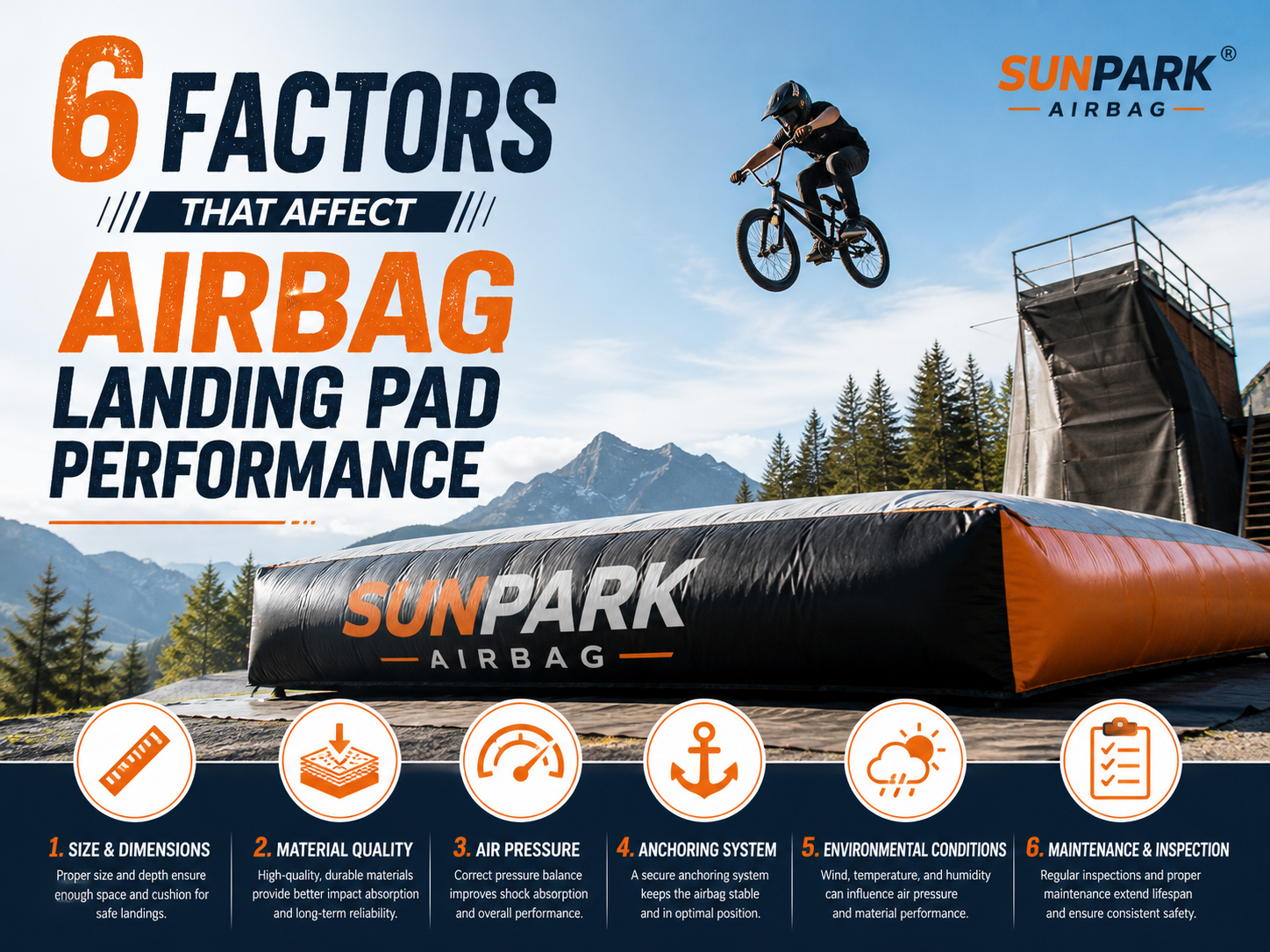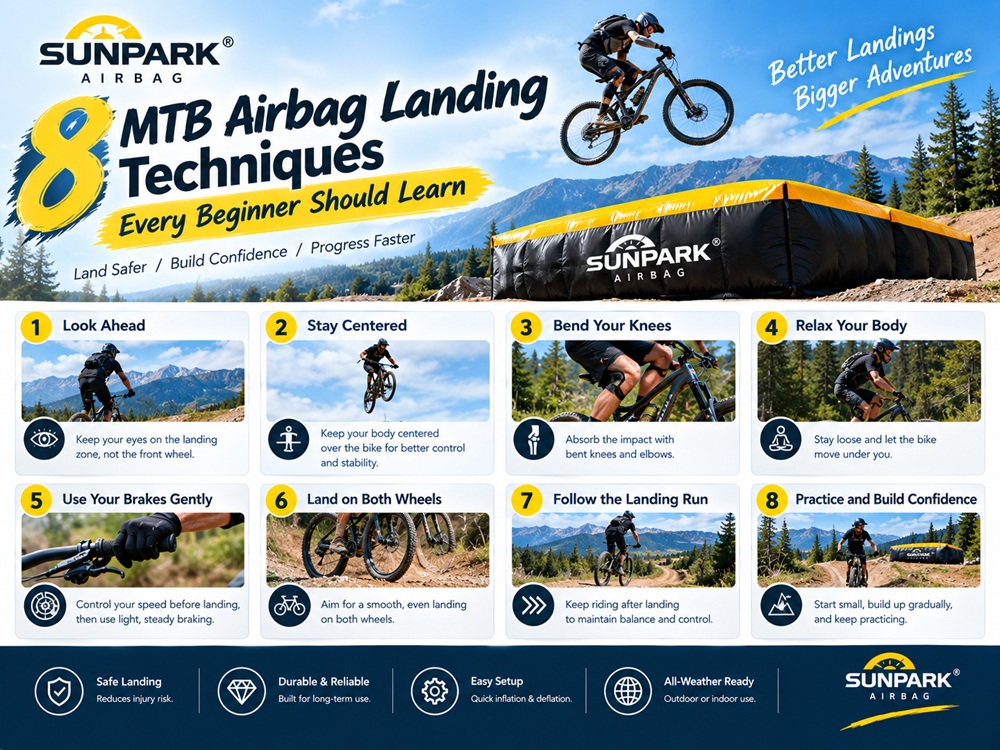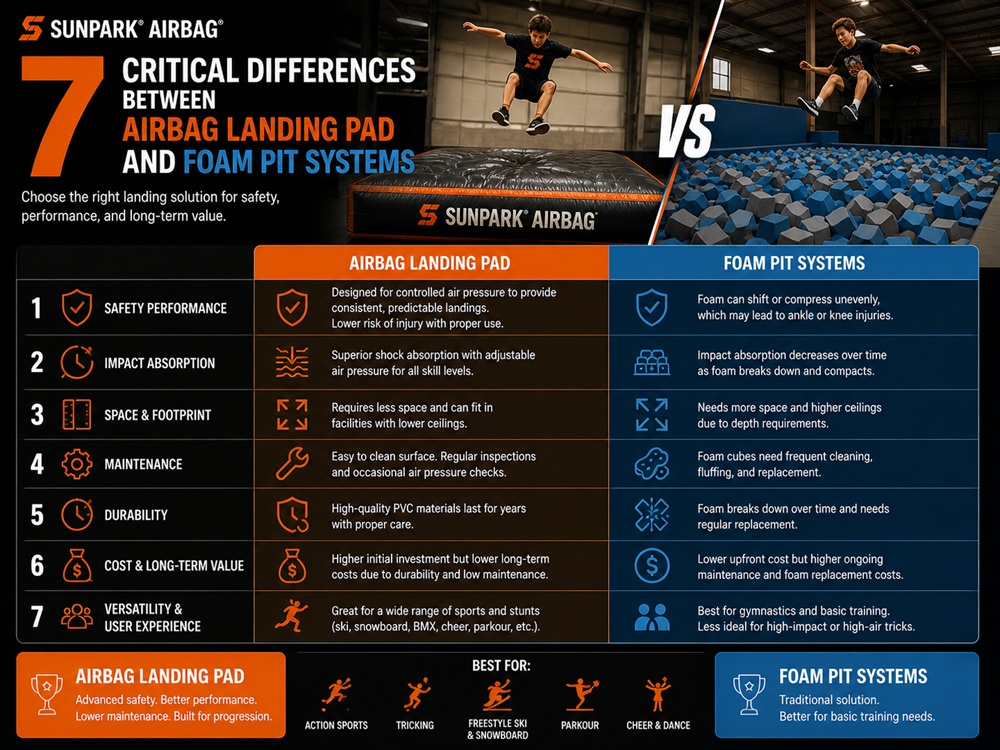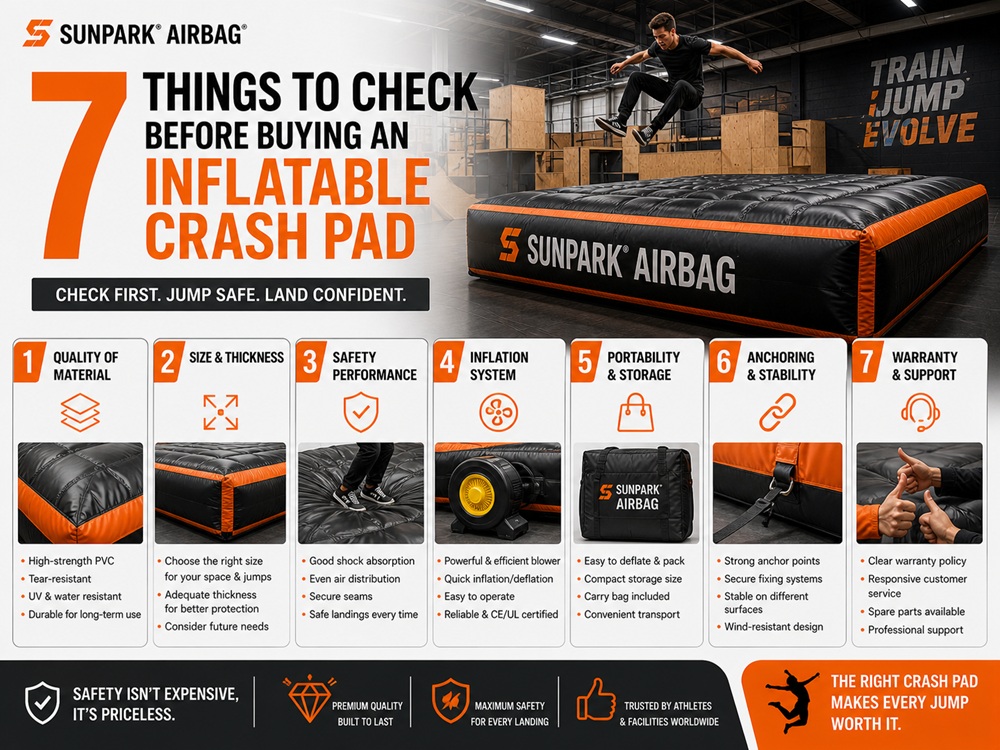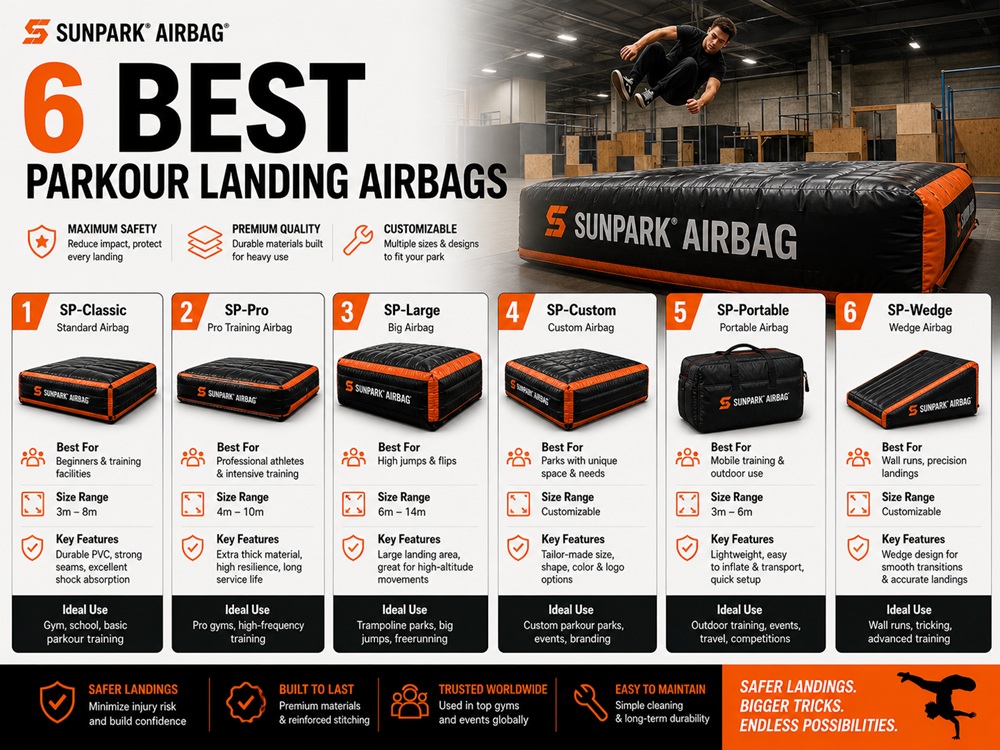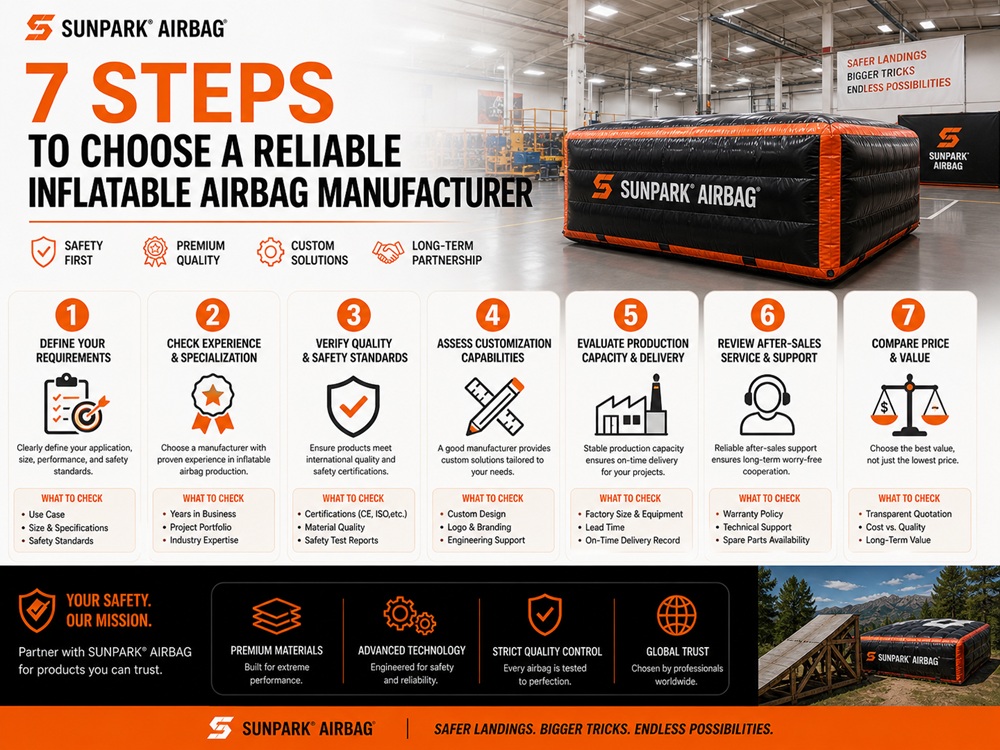
An airbag landing area can give riders a valuable place to practice jumps, test new movements, and build confidence before progressing to harder terrain. But installing an inflatable landing bag does not automatically create a safe training environment. The approach, takeoff speed, landing trajectory, airbag dimensions, anchoring, inflation system, supervision, and operating rules all affect the real risk.
From our experience in the sports airbag industry, the most common planning mistake is focusing on the airbag itself while treating the surrounding area as an afterthought. A well-made landing system can still be used unsafely if riders approach too fast, miss the landing surface, strike an exposed edge, or train when the system is not correctly set up.
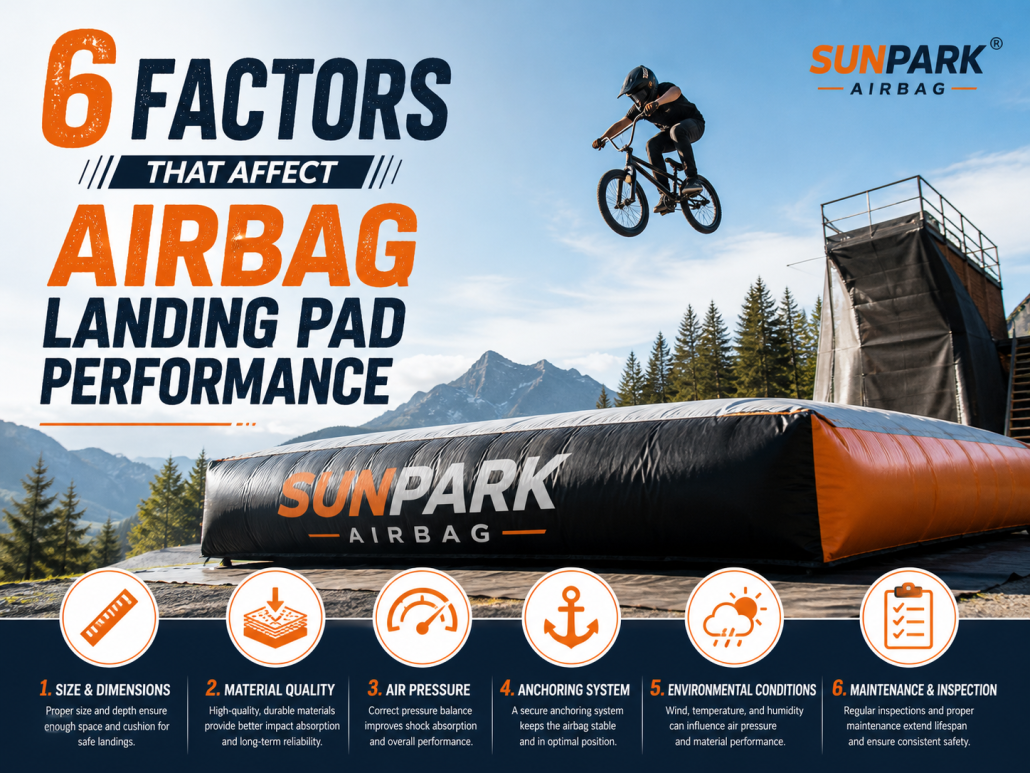
Direct Answer: How Do You Build a Safer Airbag Landing Area?
To build a safer airbag landing area, design the entire landing zone as one controlled system rather than simply placing an inflatable bag at the end of a ramp. Start with the intended sport, rider level, approach speed, jump trajectory, and available site dimensions. Then select a suitable airbag, create a controlled approach corridor, protect the sides and end of the landing zone, prepare a level installation surface, secure and inspect the equipment, and establish operating rules.
The eight priorities are: select the right airbag system, assess the jump trajectory, control the approach, provide adequate landing coverage, prepare the ground, maintain inflation and anchoring, establish inspection procedures, and train riders under qualified supervision.
An airbag can reduce some landing risks, but it cannot eliminate injury. It must never be treated as permission to attempt jumps beyond a rider’s ability or outside the system’s intended design.
This guide is written for bike parks, ski resorts, FMX facilities, trampoline and gymnastics operators, action sports training centers, and organizations planning a new airbag landing installation.
1. What Is an Airbag Landing Area?
An airbag landing area is a purpose-designed inflatable impact-attenuation system used to receive a person after a jump, fall, or controlled stunt. In action sports, these systems are commonly used in bike parks, freestyle skiing and snowboarding facilities, FMX training environments, stunt practice, and selected gymnastics or recreational applications.
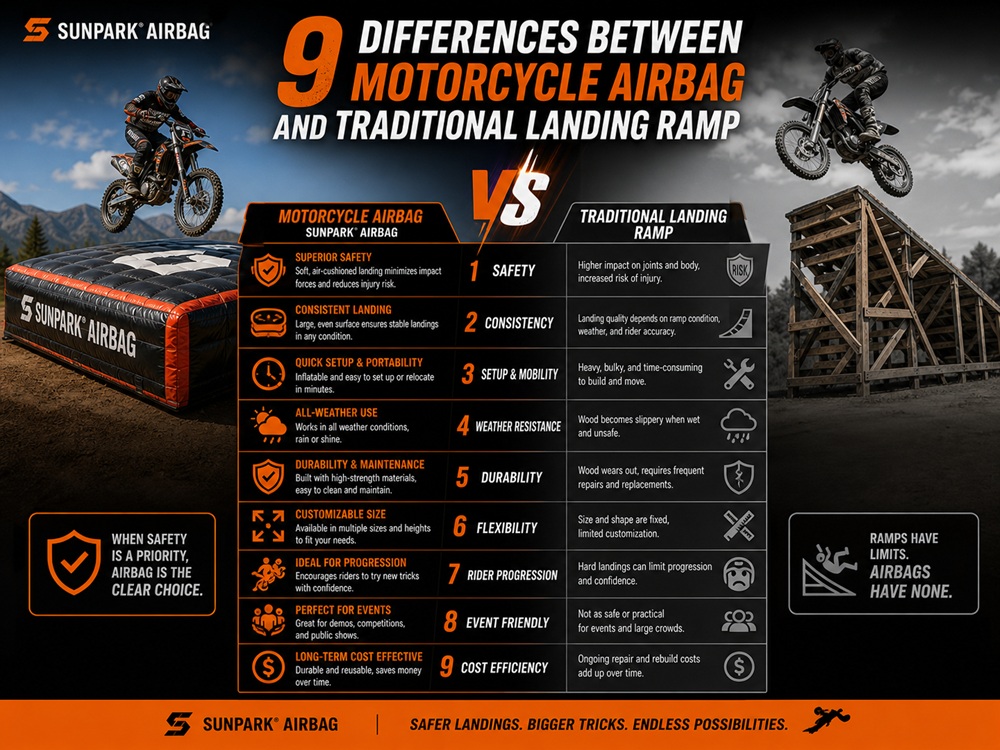
Unlike a conventional landing ramp, an airbag is designed to deform under impact and manage some of the energy transferred from the rider to the landing surface. The actual behavior depends on the airbag’s construction, internal design, inflation conditions, dimensions, rider mass, impact position, and landing velocity.
That distinction is important: not every inflatable product is designed for the same type of impact. A recreational inflatable, a gymnastics landing airbag, a freestyle jump bag, and a stunt landing system should not be treated as interchangeable.
What makes a landing area safer?
A safer landing area combines several elements:
- An airbag designed for the intended sport and impact scenario.
- A suitable approach and takeoff configuration.
- Enough landing coverage for the expected rider trajectory.
- Controlled access and a clear operating zone.
- Correct inflation, anchoring, and surface preparation.
- Routine inspection and maintenance.
- Rider training, supervision, and emergency procedures.
In most professional situations, safety depends on the interaction between these elements. Buying a larger airbag cannot compensate for an uncontrolled approach, and a well-designed ramp cannot compensate for a landing system that is incorrectly installed.
2. 8 Ways to Build a Safer Airbag Landing Area
1. Choose an Airbag Designed for Your Specific Sport
The first decision is not the airbag’s color, price, or advertised size. It is whether the product is designed for the actual activity and impact conditions at your facility.
A bike airbag landing system may need to accommodate a different approach geometry and rider trajectory from an FMX landing airbag. A freestyle ski or snowboard setup has its own considerations, including takeoff speed, flight distance, snow conditions, and the possibility of overshooting the landing zone. Gymnastics airbags are designed around different movement patterns and training objectives.
We recommend defining the application before requesting quotations. Tell manufacturers what sport you operate, the skill levels involved, the type of jump or movement, the expected frequency of use, and whether the system is for individual training or commercial operation.
Compare dedicated bike airbag landing systems and review the relevant mountain bike airbag landing guide before deciding on a configuration.
2. Assess the Jump Trajectory Before Positioning the Airbag
One of the most important parts of landing-area planning is understanding where riders are expected to land. The airbag must be positioned around the actual jump trajectory, not simply where it looks convenient on the site plan.
Approach speed, takeoff angle, ramp shape, rider position, wind, and skill level can all influence flight distance. A small change in takeoff speed may produce a meaningful change in where a rider reaches the landing surface.
A published study examining injuries and landing trajectories on large freestyle airbags identified overshooting as a serious concern. The researchers recommended measures including a controlled approach corridor, side barriers, a steep approach, preference for flat airbags over oval configurations in the studied context, and an elevated end section. These findings underline why airbag placement must be engineered around the jump rather than guessed from appearance.
For a professional installation, have a qualified designer or engineer assess the ramp geometry, likely flight envelope, landing surface, and consequences of undershooting or overshooting. Where possible, use measured operating data and controlled testing rather than relying only on rider estimates.
3. Control the Approach Corridor and Takeoff Speed
A landing airbag cannot compensate for an uncontrolled approach. Riders need a clearly defined route to the takeoff point, with appropriate boundaries that prevent unintended entry, side departures, or conflicting traffic.
For ski and snowboard jump training, approach conditions can change with snow quality, slope preparation, weather, and rider technique. Bike and FMX facilities also need to consider speed consistency, surface condition, ramp geometry, and the possibility of riders entering the jump at different speeds.
Practical measures may include:
- Clearly marking the designated approach route.
- Preventing unauthorized access to the takeoff area.
- Separating riders who are preparing to jump from those landing or exiting.
- Using suitable barriers where a qualified site assessment identifies a need.
- Setting operating rules for rider readiness and permitted progression.
- Stopping operation when approach conditions change beyond the approved limits.
Do not use a generic speed limit copied from another facility. The permitted approach speed must be established for the specific ramp, airbag, rider category, and site layout.
4. Provide Adequate Landing Coverage and Protect the Edges
The landing surface must be appropriate for the expected range of rider trajectories. A bag that is too short, too narrow, or poorly positioned can expose riders to hard ground or surrounding structures if they land outside the intended area.
When planning dimensions, consider more than the ideal landing point. Assess the likely landing distribution, rider variation, jump progression, and the consequences of landing near an edge. The system should be designed with a suitable safety margin determined by qualified technical assessment.
Pay particular attention to:
- The front and rear edges of the landing surface.
- Side exposure and possible off-center landings.
- Transitions between the airbag and surrounding ground.
- Nearby ramps, walls, fences, poles, trees, and equipment.
- The rider’s path after impact and the route for leaving the landing zone.
Never assume that adding loose mats or improvised padding around the airbag automatically creates a safe transition. Any additional protection must be compatible with the system and must not introduce gaps, trip hazards, unstable surfaces, or entrapment points.
5. Prepare a Level, Clear, and Suitable Installation Surface
The ground beneath and around the airbag matters. Stones, sharp objects, exposed roots, metal fittings, debris, and uneven surfaces can damage the product or create hazards if a rider comes off the intended landing area.
Before installation, inspect the site and prepare a suitable foundation according to the manufacturer’s requirements. The surface should be appropriate for the equipment’s load, expected use, drainage conditions, and anchoring method.
For outdoor installations, consider:
- Drainage and the possibility of water collecting around the system.
- Ground stability under the airbag and its anchoring points.
- Wind exposure and the manufacturer’s operating limits.
- Nearby objects that could contact the airbag or a rider.
- Access for maintenance, inflation equipment, and emergency response.
- Protection against abrasion and puncture from the underlying surface.
Do not place an airbag on a surface simply because it is flat enough to look acceptable. Confirm that the surface and installation arrangement are suitable for the specific product.
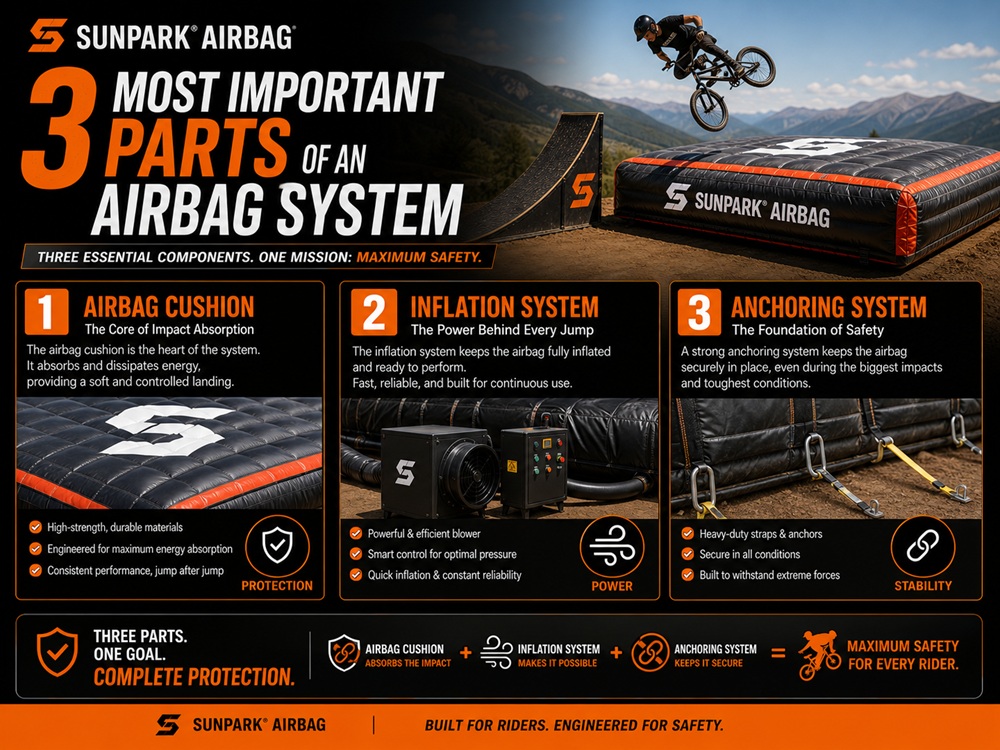
6. Maintain Correct Inflation, Anchoring, and Equipment Configuration
Inflation is a performance-critical part of an airbag landing system. Too little or too much pressure can change the way the product responds to impact. The correct operating condition is determined by the manufacturer for the specific design and application.
Before opening the landing area, verify the equipment is assembled and inflated according to the operating instructions. Check the blower or inflation system, air connections, pressure indicators where provided, seams, valves, and anchoring points.
For systems that rely on continuous air supply, the blower and power arrangement must be appropriate for the product’s requirements. Operators should understand what happens if power is interrupted, an air connection becomes loose, or the system loses pressure during use.
For sealed or specially engineered systems, follow the manufacturer’s specific setup and pressure-check procedure. Do not apply operating assumptions from a different airbag design.
7. Establish Inspection, Maintenance, and Daily Opening Procedures
A professional airbag landing area needs a documented inspection routine. A quick visual check is useful, but it should not replace the manufacturer’s maintenance instructions or a more detailed inspection schedule.
Before each operating session, trained staff should check the airbag’s external condition, seams, connection points, anchoring, inflation equipment, and landing-area surroundings. They should also verify that access controls and rider separation measures are in place.
After heavy use, unusual impacts, a suspected puncture, severe weather, or any equipment fault, carry out the inspection required by the manufacturer before reopening.
Record the following:
- Date, time, and name of the person completing the inspection.
- Visible damage, abrasion, tears, or seam concerns.
- Inflation-system and power-system condition.
- Anchoring and site-surface condition.
- Repairs, replacement parts, and maintenance actions.
- Incidents, unusual landings, and operational stoppages.
- Authorization to return the equipment to service.
For commercial operators, maintenance records are not paperwork for its own sake. They help identify recurring faults, support consistent operating decisions, and make it easier to determine whether a product needs repair or replacement.
8. Train Riders and Staff, and Enforce Clear Operating Rules
The final safety measure is operational discipline. A technically suitable airbag can still be used inappropriately if riders do not understand the facility’s rules or staff cannot stop unsafe activity.
Before a session, riders should receive instructions that match the activity and their skill level. Staff should explain the permitted approach, takeoff conditions, landing-zone boundaries, exit route, and what to do if a rider falls or the system develops a fault.
Facilities should also define:
- Who is permitted to use the airbag and under what conditions.
- Minimum supervision and staff competency requirements.
- How riders are queued and released onto the approach.
- How the landing zone is confirmed clear before another attempt.
- Weather and environmental conditions that require closure.
- Emergency communication and first-response arrangements.
- Who has authority to stop operations.
For beginners, progression should be controlled and based on demonstrated ability. For experienced riders, staff should still enforce the equipment’s operating limits. Experience does not remove the risk of misjudging speed, trajectory, or landing position.
3. Airbag Landing Area Layout: What Should the Site Plan Include?
A landing-area drawing should show the complete operating environment, not only the dimensions of the inflatable product. It should identify how riders enter, approach, take off, land, exit, and return to the start area.
Key layout zones
| Zone | What to plan | Safety objective |
|---|---|---|
| Access and staging area | Controlled entry, rider waiting space, staff access | Prevent unauthorized entry and crowding. |
| Approach corridor | Surface condition, alignment, boundaries, speed management | Reduce unintended deviations and inconsistent approaches. |
| Takeoff structure | Ramp geometry, condition, transitions, approved use | Provide a predictable takeoff configuration. |
| Flight path | Expected trajectory and potential overshoot or undershoot zones | Keep the landing design matched to actual rider movement. |
| Landing airbag | Dimensions, orientation, pressure, anchoring, edge protection | Provide suitable landing coverage for the intended activity. |
| Exit area | Clear route away from the landing surface | Prevent collisions between landing riders and incoming riders. |
| Maintenance and emergency access | Blower access, power isolation, inspection space, response route | Allow staff to manage faults and incidents efficiently. |
Why overshoot and undershoot planning matters
Landing outside the intended airbag surface can expose a rider to the ground or nearby structures. The risk is not limited to an unusually skilled rider attempting an advanced trick. Differences in approach speed, takeoff timing, weather, equipment setup, and rider confidence can all change the landing point.
Research on freestyle jump airbags has specifically examined the risk of riders overshooting the landing surface. It demonstrates why approach control and landing-zone geometry must be considered together. A longer airbag alone is not a substitute for a properly assessed jump configuration.
Before commissioning a facility, have the proposed layout reviewed by people with relevant experience in jump design, structural or mechanical engineering, sports facility safety, and the intended sport. Do not copy another park’s dimensions without confirming that the ramp, rider speeds, site, and airbag design are comparable.
4. Comparing Different Airbag Landing Systems
Choosing an airbag system is a design decision, not simply a product-category decision. The right system depends on the intended activity, landing characteristics, user group, site conditions, and operating model.
| Airbag system | Typical application | Key planning considerations | Best suited for |
|---|---|---|---|
| Bike landing airbag | Mountain biking, BMX, and bike jump training | Approach speed, jump geometry, rider trajectory, edge coverage | Bike parks and dedicated rider training facilities. |
| Freestyle ski and snowboard airbag | Freestyle jump progression and aerial training | Snow conditions, takeoff speed, flight distance, overshoot protection | Ski resorts and specialist freestyle training venues. |
| FMX landing airbag | Freestyle motocross and motorcycle stunt training | Vehicle mass, speed, jump configuration, impact loads, operating controls | Specialist FMX facilities with appropriate technical oversight. |
| Stunt airbag | Controlled stunt and fall training | Fall height, body orientation, landing position, intended stunt type | Professional stunt and performance training environments. |
| Gymnastics airbag | Selected gymnastics and acrobatic training activities | Skill level, landing technique, surface response, coaching supervision | Gymnastics and sports training facilities. |
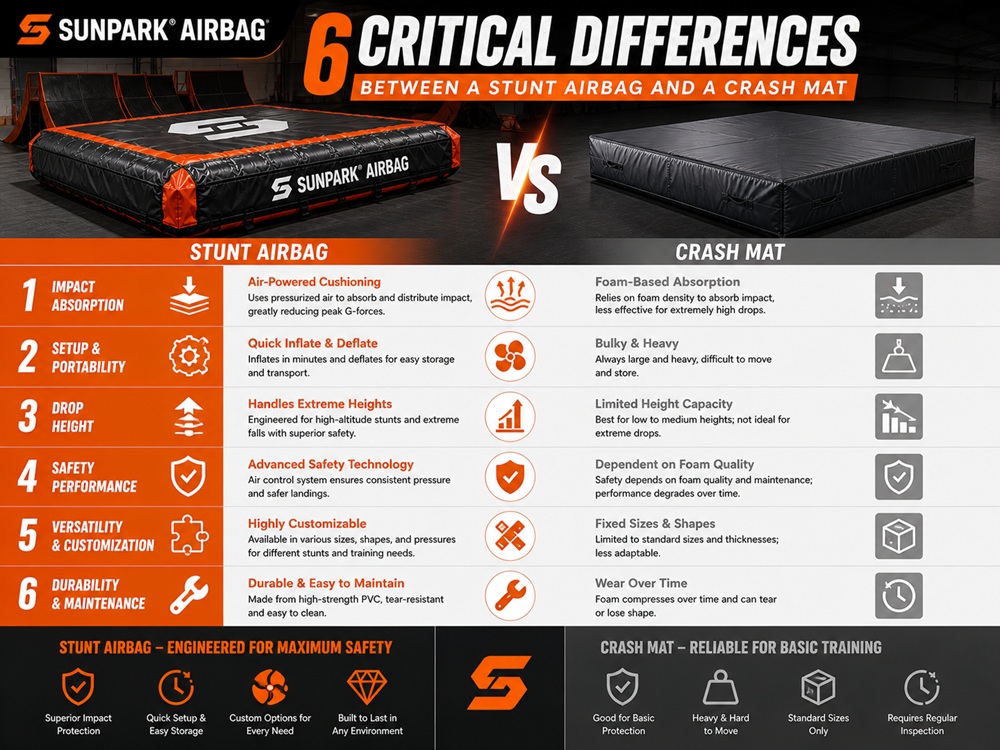
| Inflatable crash mat | Selected controlled impact and training applications | Product-specific impact limits, use instructions, and landing conditions | Facilities whose activities match the product’s intended use. |
For example, a bike park evaluating a bike airbag landing should prioritize jump geometry and rider trajectory. A stunt facility considering a stunt airbag landing system needs to assess the intended fall scenarios and operating controls. A gymnastics facility should evaluate equipment specifically designed for its training movements rather than assuming an action sports landing bag is interchangeable.
Quick summary: What should you prioritize?
| Priority | What to confirm before installation |
|---|---|
| Application | The airbag is designed for the actual sport and impact scenario. |
| Geometry | Approach, takeoff, flight path, and landing coverage have been assessed together. |
| Site | Ground, drainage, access, anchoring, and surrounding hazards are suitable. |
| Operation | Inflation, inspection, supervision, and closure procedures are documented. |
| Supplier | Technical drawings, instructions, support, maintenance guidance, and product limitations are available. |
| Compliance | Applicable local rules and relevant standards have been identified and reviewed. |
Pros and cons of airbag landing systems
| Advantages | Limitations and risks |
|---|---|
| Can provide a dedicated environment for selected jump and stunt training. | Does not eliminate injury risk or make every trick safe. |
| Can support controlled progression before attempting selected skills in more demanding environments. | Incorrect progression can encourage riders to attempt skills beyond their ability. |
| Can be configured for different sports and facility layouts. | One airbag design is not suitable for every sport or impact condition. |
| Inflatable systems can be practical for facilities that need a relocatable or temporary setup, depending on design. | Setup, inflation, anchoring, inspection, and storage require time and trained staff. |
| Can support commercial training and recreational programming. | Ongoing maintenance, supervision, and operational controls add cost. |
| Can create a repeatable training environment when the system and operating conditions are controlled. | Changes in weather, approach speed, pressure, or site conditions can affect performance. |
5. Benefits and Limitations: Is an Airbag Landing Area Worth Building?
For a facility that regularly trains riders in jumps, aerial movements, or controlled stunts, a purpose-designed airbag landing area can be a worthwhile investment. It provides a dedicated training surface and may allow selected skills to be practiced in a more controlled environment than attempting them directly on hard ground.
However, the business case depends on usage frequency, the type of activity, installation requirements, maintenance, staffing, and the value the facility places on structured progression. A system that is poorly matched to the sport or rarely used can become an expensive asset without delivering meaningful operational value.
Where airbag landing systems offer the most value
- Bike parks: A dedicated landing system can support structured jump practice and rider progression.
- Ski resorts: Freestyle training areas can use purpose-designed airbags for selected aerial practice when conditions and operating procedures are suitable.
- FMX training: Specialist facilities may use engineered landing systems as part of controlled stunt development.
- Trampoline and gymnastics facilities: Appropriate inflatable landing equipment can support selected training activities when matched to the skill and facility requirements.
- Theme parks and action sports venues: A suitable system can form part of a supervised attraction or training area.
What an airbag cannot guarantee
An airbag cannot guarantee that a rider will avoid injury. It cannot correct poor technique, eliminate excessive speed, prevent every off-center landing, or compensate for a jump that exceeds the design envelope.
It also cannot replace qualified coaching, appropriate protective equipment, medical response planning, and site-specific safety management. For commercial users, these operational requirements should be included in the project budget from the beginning.
6. Common Mistakes When Building an Airbag Landing Area
Mistake 1: Selecting the airbag before defining the application
Choosing a product based only on dimensions or price often creates a mismatch between the equipment and the activity. Define the sport, rider level, impact scenario, and operating frequency first.
Mistake 2: Ignoring approach speed and flight distance
Overshooting is not simply a rider error. It can be influenced by approach design, takeoff geometry, and operating conditions. Assess the complete trajectory rather than assuming the landing bag will catch every jump.
Mistake 3: Leaving exposed hard surfaces around the airbag
Edges, gaps, nearby structures, and poorly planned transitions can create hazards. Review the full landing and exit area, not only the central inflatable surface.
Mistake 4: Treating inflation as a matter of personal preference
Operators should not change pressure based on whether the surface feels soft or firm. Follow the product-specific operating instructions and use the specified checks.
Mistake 5: Operating without documented inspections
A system that looks inflated may still have damaged seams, loose connections, anchoring issues, or other defects. Establish inspection records and clear stop-use criteria.
Mistake 6: Allowing riders to progress too quickly
An airbag is not a shortcut around skill development. Beginners need coaching and controlled progression. Experienced riders also need to remain within the facility’s approved operating conditions.
Mistake 7: Assuming all inflatable safety standards cover stunt airbags
This is a particularly important procurement mistake. Standards for inflatable amusement devices or trampoline parks may have defined scopes and exclusions. A standard that applies to one category of inflatable equipment does not automatically certify every action sports landing airbag.
For example, ASTM F2374 addresses commercial inflatable amusement devices, but published research discussing large stunt airbags notes that devices relying on sudden air loss to perform their intended impact-attenuation function are excluded from that standard’s scope. Operators should therefore ask the manufacturer and relevant authorities which standards and requirements actually apply to the specific system.
7. Airbag Landing Area Inspection and Maintenance Checklist
Before each session, the operator should complete the checks required by the manufacturer and the facility’s safety plan. The following checklist is a practical starting point, not a substitute for product-specific instructions or a qualified inspection.
| Inspection item | What to check | Action if a problem is found |
|---|---|---|
| Airbag fabric | Visible tears, punctures, abrasion, or unusual wear | Stop use and follow the manufacturer’s repair or inspection process. |
| Seams and connections | Seam separation, damaged connections, loose fittings | Do not operate until assessed and cleared. |
| Inflation system | Blower condition, hoses, valves, electrical supply, pressure indicators where fitted | Stop use if the system cannot maintain its specified operating condition. |
| Anchoring | Anchors, straps, attachment points, and site stability | Secure or repair according to manufacturer instructions before reopening. |
| Landing surface | Debris, water accumulation, uneven ground, exposed objects | Clear or correct the hazard before use. |
| Approach and takeoff | Surface condition, alignment, access control, and visible damage | Restrict access until the issue is resolved. |
| Surrounding area | Barriers, exit routes, obstacles, and unauthorized access | Restore the approved operating layout. |
| Staff and emergency readiness | Supervision, communication, first-response arrangements | Do not open until the required staffing and procedures are in place. |
When should an airbag landing system be taken out of service?
Stop operation if there is suspected structural damage, a pressure or inflation fault, failed anchoring, an unsafe site condition, or uncertainty about whether the product remains within its operating requirements.
Also stop use after severe weather or an unusual impact if the manufacturer requires a further inspection. Do not patch, modify, or return the equipment to service using an improvised repair method.
8. How to Choose an Airbag Manufacturer
For a commercial facility, the supplier’s technical support can be as important as the initial product price. A landing system is a long-term operational asset. The manufacturer should be able to explain what the product is designed to do, how it must be installed, what its limitations are, and how it should be maintained.
Ask for application-specific technical information
Request product drawings, dimensions, material information, inflation requirements, anchoring instructions, installation guidance, operating limits, and maintenance documentation. If the supplier cannot clearly explain the intended use and limitations, do not proceed based on marketing images alone.
Check manufacturing experience and product range
Ask whether the manufacturer has supplied systems for facilities similar to yours. A supplier with experience in bike parks may understand different requirements from one focused on gymnastics or recreational inflatables. Relevant experience should be supported by product documentation and credible project references.
Compare the full cost of ownership
The lowest purchase price is not always the most economical choice. Include installation, shipping, inflation equipment, anchoring, staff training, inspections, maintenance, repairs, storage, and expected replacement costs in your comparison.
| Supplier evaluation factor | Questions to ask | Why it matters |
|---|---|---|
| Application suitability | Is this model designed for our sport and impact scenario? | Prevents buying an unsuitable product. |
| Technical documentation | Can you provide drawings, setup instructions, and operating limits? | Supports correct installation and operation. |
| Materials and construction | What fabrics, seams, connections, and reinforcement methods are used? | Helps assess durability and maintenance needs. |
| Inflation equipment | What blower or pressure system is required? | Ensures the installation can meet the product’s operating requirements. |
| Inspection and repair | What checks and repair procedures are recommended? | Supports long-term serviceability. |
| Customization | Can dimensions and configuration be adapted to the site? | Helps match the system to the facility layout. |
| After-sales support | Are spare parts, technical assistance, and maintenance guidance available? | Reduces avoidable downtime. |
| Compliance information | Which standards or local requirements apply to this exact product? | Avoids unsupported compliance claims. |
When is customization worth the investment?
Customization is worth considering when the facility has unusual dimensions, a specific approach configuration, a defined user group, or operational requirements that a standard product cannot adequately address.
However, customization should not mean changing critical design features without engineering review. Any change to dimensions, internal construction, inflation arrangements, anchoring, or intended use should be evaluated by the manufacturer and relevant technical professionals.
9. SUNPARK AIRBAG: Sports Airbag Systems for Training and Recreation
SUNPARK® AIRBAG develops inflatable airbag systems for sports, freestyle training, leisure, and gymnastics-related applications. With more than 10 years of experience, the company supplies freestyle airbags for ski resorts, theme parks, sports facilities, and gymnastics facilities internationally.
As action sports continue to develop, riders and facility operators need training equipment that supports structured progression while taking the actual risks of each activity seriously. SUNPARK’s product range includes systems for different sports and training environments. The correct model should always be selected according to the intended activity, site layout, and technical requirements.
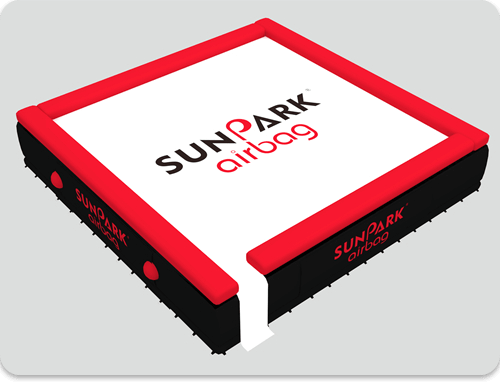
SUNPARK® AIRBAG – Explorer of Airbag Systems for Sports
SUNPARK provides freestyle airbag solutions for ski resorts, theme parks, sports facilities, and gymnastics environments. Its product range supports different training and recreational applications, with system selection based on the intended use.
For facility operators, the key is to match the equipment to the activity and plan installation, inspection, and operating procedures as part of the project.
Which SUNPARK product category should you evaluate?
- Bike airbag landing systems for appropriate bike jump training applications.
- FMX landing airbags for specialist freestyle motocross projects.
- Stunt airbags for controlled stunt and fall-training applications.
- Gymnastics airbag equipment for suitable gymnastics and training environments.
- Inflatable crash mats for applications that match their specified use.
For buyers comparing equipment, SUNPARK recommends starting with the project requirements rather than choosing a product from a photograph. Share the sport, facility type, approximate site dimensions, intended users, and training objectives so the appropriate system can be evaluated.
10. Expert Recommendation: Design the Landing Area Before Ordering the Airbag
Our recommendation is simple: do not begin a professional airbag project by asking only, “How much does the airbag cost?” Begin by defining the operating environment and the risks the system must manage.
For a small training facility
Prioritize a product that matches the activity, a controlled approach, clear supervision, and straightforward maintenance. A compact installation can still require careful trajectory assessment and suitable protection around the landing zone.
For a commercial bike park or ski resort
Plan for repeated use, changing rider abilities, weather exposure, staff procedures, and maintenance downtime. The business case should include installation and ongoing operating costs, not just the purchase price. A more suitable system with clear documentation and dependable support may deliver better long-term value than a cheaper product that is difficult to maintain.
For an FMX or professional stunt facility
Use specialist technical design and risk assessment. The mass, speed, trajectory, and impact characteristics of motorcycles or professional stunt activity require application-specific evaluation. Do not adapt a recreational landing product for a heavy-duty application without explicit manufacturer approval and appropriate engineering review.
For a gymnastics or trampoline facility
Choose equipment designed for the intended training activity and check the standards and regulatory requirements applicable to the facility. A trampoline park, a gymnastics training area, and an action sports jump facility may fall under different technical and operational requirements.
11. Frequently Asked Questions About Building a Safer Airbag Landing Area
1. What is the safest way to build an airbag landing area?
Start by defining the sport, rider level, jump geometry, and expected landing trajectory. Select an airbag designed for that application, prepare a suitable installation surface, control the approach corridor, provide adequate landing coverage, follow inflation and anchoring instructions, and establish inspection and supervision procedures. A qualified technical assessment is important for commercial installations.
2. Does an airbag landing system prevent injuries?
No. An airbag can help manage selected impacts, but it cannot eliminate injury risk. Riders can still overshoot, undershoot, land awkwardly, or exceed the intended operating conditions. Training, supervision, correct equipment selection, and site design remain essential.
3. How large should an airbag landing area be?
There is no universal safe size. Dimensions depend on the sport, jump geometry, approach speed, flight trajectory, rider category, and product design. Have the landing area assessed for the expected range of landings rather than choosing dimensions based only on available space.
4. How do you prevent riders from overshooting an airbag?
Assess approach speed, ramp geometry, takeoff conditions, and expected flight distance. Use a controlled approach corridor and suitable barriers where the site assessment calls for them. Ensure the landing system has appropriate coverage and end protection. Overshoot prevention must be designed into the complete jump and landing configuration.
5. Can one airbag be used for bikes, FMX, and gymnastics?
Do not assume so. These activities involve different equipment, impact conditions, and movement patterns. Use a system specifically designed and approved for the intended application. Ask the manufacturer to confirm suitability in writing.
6. How often should an airbag landing system be inspected?
Follow the manufacturer’s inspection and maintenance schedule. At a minimum, facilities should establish pre-use checks and additional inspections after unusual impacts, suspected damage, severe weather, or equipment faults. Keep records of inspections, repairs, and return-to-service decisions.
7. What happens if an airbag loses pressure during operation?
Stop use and follow the manufacturer’s emergency and shutdown procedure. Keep riders away from the landing area until the system has been assessed and restored to its specified operating condition. Operators should understand the system’s response to blower, power, or air-supply failure before opening the facility.
8. What surface should be placed under an airbag?
The foundation should be suitable for the specific product, site, and anchoring arrangement. It should be stable and free of sharp objects, debris, and hazards that could damage the equipment. Follow the manufacturer’s installation requirements and obtain professional site advice where necessary.
9. Are airbag landing systems covered by ASTM standards?
Some inflatable amusement and recreational equipment falls within defined ASTM standards, but scope and exclusions matter. ASTM F2374 addresses commercial inflatable amusement devices and does not automatically apply to every stunt or action sports impact-attenuation airbag. Confirm the applicable standards for the exact product and jurisdiction with the manufacturer and relevant authorities.
10. What should I ask an airbag manufacturer before buying?
Ask about intended application, product dimensions, materials, construction, inflation requirements, anchoring, installation instructions, operating limits, inspection procedures, repair support, warranty, and applicable compliance documentation. Provide the supplier with your sport, site layout, user group, and expected operating frequency.
11. Is a custom airbag landing system worth the extra cost?
Customization can be worthwhile when a standard product does not match the site’s dimensions, sport, or operating requirements. It should be supported by technical review and manufacturer approval. Avoid modifications to critical design features based only on convenience or price.
12. Can beginners use an airbag landing area?
Beginners may use a suitable system when the facility has an appropriate progression plan, qualified supervision, and clear operating rules. The airbag should not be used as a reason to attempt advanced tricks without the necessary skills. The permitted activities must match the equipment and facility design.
References
- ISO 23659:2022 – Sports and Recreational Facilities: Trampoline Parks – Safety Requirements. This international standard covers design, construction, inspection, maintenance, and operational requirements for trampoline parks and includes landing areas such as airbags and foam pits within its stated scope. Confirm applicability to the specific facility and jurisdiction.
- ASTM F2374-24 – Standard Practice for Design, Manufacture, Operation, and Maintenance of Inflatable Amusement Devices. Defines requirements for specified commercial inflatable amusement devices, including design, installation, operation, maintenance, inspection, and training. Its scope should not be assumed to cover every stunt-style impact airbag.
- Safety Recommendations of Winter Terrain Park Jumps into Airbags. Published research examining jump trajectories and overshoot risks, with recommendations for approach corridors and landing-area design.