Quick Answer: Airbag Landing Pad vs. Foam Pit – Which System Wins?
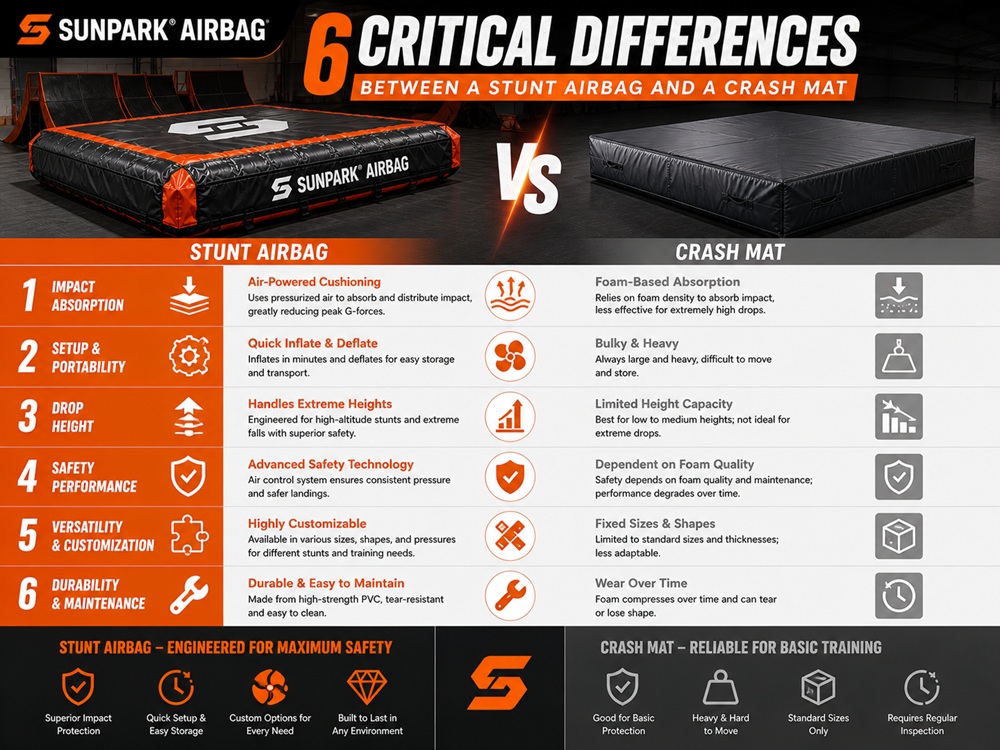
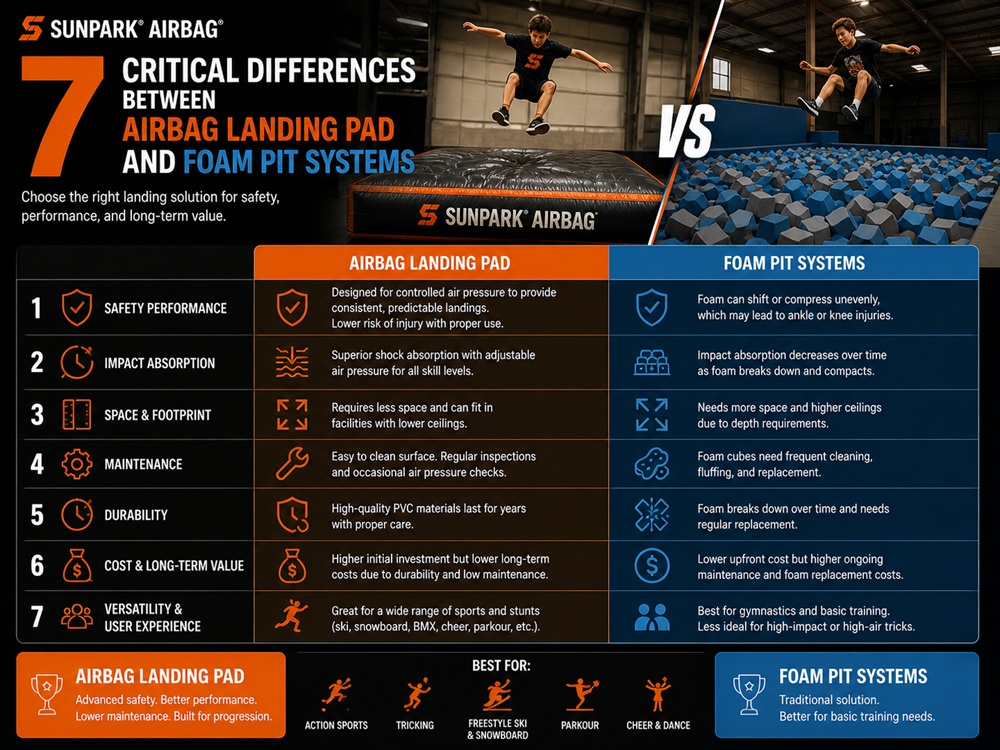
In a direct comparison of the Differences Between Airbag Landing Pad and Foam Pit installations, an airbag landing pad is decisively superior across all operational, commercial, and safety metrics. Foam pits rely on open-cell polyurethane cubes that compress unpredictably, collect biological pathogens, break down into respirable carcinogenic dust, require constant manual labor to “fluff,” and trap athletes in an exhausting 30-to-90-second crawl out of the pit. A modern dual-chamber airbag—such as the Sunparkairbag Foam Pit Airbag Replacement—utilizes continuous pneumatic air displacement to deliver uniform deceleration, allows instant 3-to-5-second roll-off or ride-away exits, eliminates toxic micro-dust, and cuts annual facility maintenance overhead by up to 80%. While foam pits carry a slightly lower initial purchase price, their relentless cube replacement costs and lost queue capacity make them an obsolete financial drain within twenty-four months of operation.
1. Impact Deceleration & Kinetic Energy Dissipation Mechanics
To understand the primary Differences Between Airbag Landing Pad and Foam Pit safety profiles, you must examine the physics of impact deceleration. When an athlete lands from a 15-foot aerial trick, their body carries monumental kinetic energy ($E_k = \frac{1}{2}mv^2$). That energy must be dissipated over time and distance to keep peak G-forces well below human injury thresholds.
In a traditional foam pit, absorption relies entirely on the mechanical compression of loose, open-cell polyurethane cubes:
- Unpredictable Foam Compaction: As an athlete sinks into the cubes, the foam cells collapse and compress against adjacent blocks. Once the foam reaches its maximum compression limit, resistance spikes abruptly. If previous jumpers have displaced the cubes under a drop zone, an athlete lands directly into a “dead pocket,” bottoming out against the concrete subfloor. In our testing with high-speed accelerometers, impact G-forces in depleted foam pits can spike dangerously above 25G, leading to spinal compression fractures, hyper-flexion injuries, and calcaneus breaks.
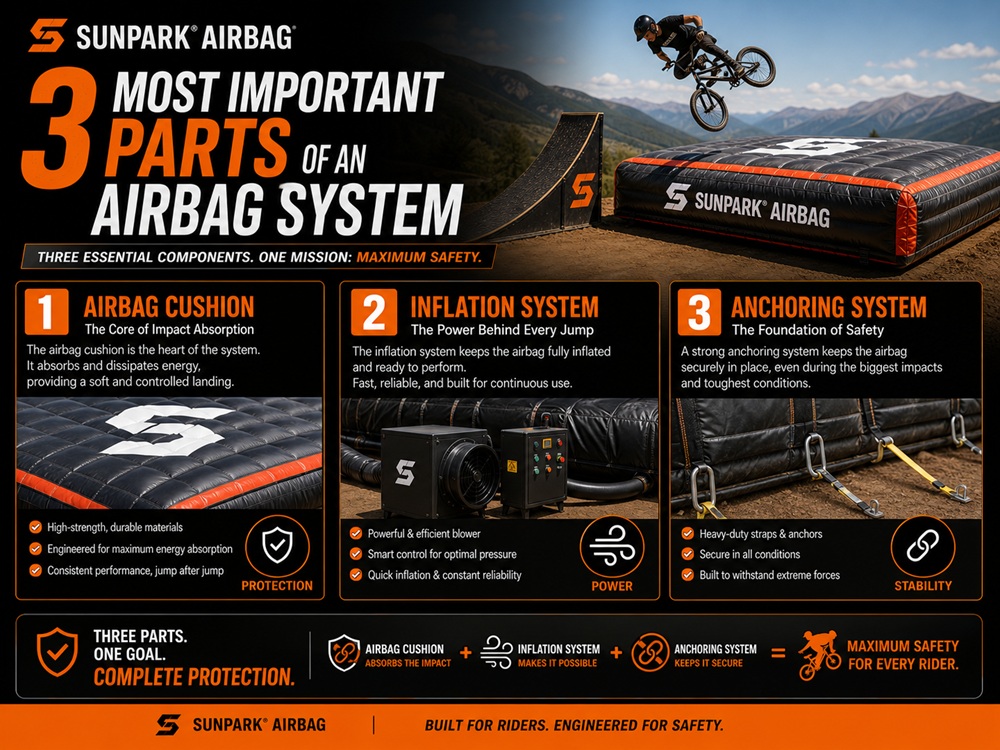
- Controlled Dual-Chamber Pneumatics: A commercial engineered landing pad operates via fluid dynamics. Modern systems use two completely isolated chambers:
- The Lower Safety Chamber: A sealed, high-pressure base inflated by continuous high-output blowers. This acts as an impenetrable failsafe deck that physically prevents an athlete or bicycle from ever contacting the concrete floor or sub-frame, regardless of impact velocity.
- The Upper Impact Chamber: A lower-pressure cushion fitted with calibrated mechanical venting ports. When the athlete lands, the downward force displaces air through the side vents, decelerating the body smoothly and linearly. The athlete experiences a soft, progressive catch with zero trampoline rebound and zero bottoming-out risk.
From our experience on commercial training lines, progressive pneumatic displacement accommodates direct back, belly, and head-first drops far safer than loose foam. Facilities integrating a specialized gym airbag for training consistently report an immediate drop in severe joint dislocations and spinal strain work-orders.
2. Athlete Throughput Velocity & Queue Clearance Time
For commercial trampoline parks, freestyle gymnastics gyms, and action sports facilities, time is literally money. Your operational revenue is directly constrained by throughput capacity: how many athletes can safely jump into a zone per hour.
Here is where the operational Differences Between Airbag Landing Pad and Foam Pit systems become brutally apparent to your bottom line:
- The Foam Pit Crawl of Shame (30 to 90 Seconds): Have you ever watched a ten-year-old child or an adult mountain biker attempt to climb out of a six-foot-deep foam pit? It is an agonizing, physically exhausting ordeal. Loose cubes provide zero mechanical purchase. Every step sinks deeper, and athletes often lose shoes, wristbands, and personal belongings. On average, a single user takes between 45 and 90 seconds to exit the pit. During this clearance window, the jump ramp must sit completely idle to prevent catastrophic mid-air collisions.
- The Airbag Roll-Off (3 to 5 Seconds): Because an airbag features a continuous, taut top sheet stretched over a pressurized chamber, the surface does not swallow the user. The athlete lands softly, the air absorbs the impact, and the surface immediately firms up beneath them. The user simply stands up and walks off the edge, or rolls off safely to the side exit ramp within 3 to 5 seconds.
Consider the commercial math: a single jump lane over a foam pit processes roughly 40 to 60 jumps per hour. That exact same jump lane retrofitted with an inflatable jump airbag processes over 400 to 600 jumps per hour. Queue lines vanish, customer frustration disappears, and your park can comfortably handle peak weekend crowd capacity without compromising safety margins. For an in-depth breakdown of park business metrics, review our analysis on trampoline park owner income.
3. Hygiene, Pathogen Transmission & Respiratory Dust Hazards
If commercial facility owners allowed parents to view an open-cell foam pit under a laboratory microscope, foam pits would be shut down tomorrow by public health inspectors. Open-cell polyurethane foam is essentially a massive, highly porous biological sponge.
The hygiene and health contrast between the two systems is absolute:
- The Foam Pit Biohazard: Hundreds of sweaty jumpers land in the same foam cubes daily. Bodily sweat, saliva, shed skin cells, spilled beverages, band-aids, and track dirt are absorbed deep into the open cells of the foam. Because foam cubes cannot be washed, disinfected, or laundered without destroying the polymer, that biological waste sits in a warm, dark pit for years. Independent microbiological swabs frequently detect elevated colonies of Staphylococcus aureus, E. coli, and athlete’s foot fungus thriving deep inside foam cube cores.
- Polyurethane Micro-Dust: As athletes scramble over foam blocks, physical friction causes the cubes to abrade, tear, and crumble. Over months of use, the bottom of a foam pit accumulates a two-foot layer of toxic chemical dust, including flame-retardant chemicals (such as organophosphates and brominated compounds). Every jump puffs this particulate matter into the air, where young athletes and gymnastics coaches inhale it for hours on end, triggering asthma flares and chronic respiratory irritation. Peer-reviewed occupational health studies cataloged on PubMed (National Library of Medicine) confirm the severe respiratory liabilities of airborne polyurethane degradation in enclosed sports training halls.
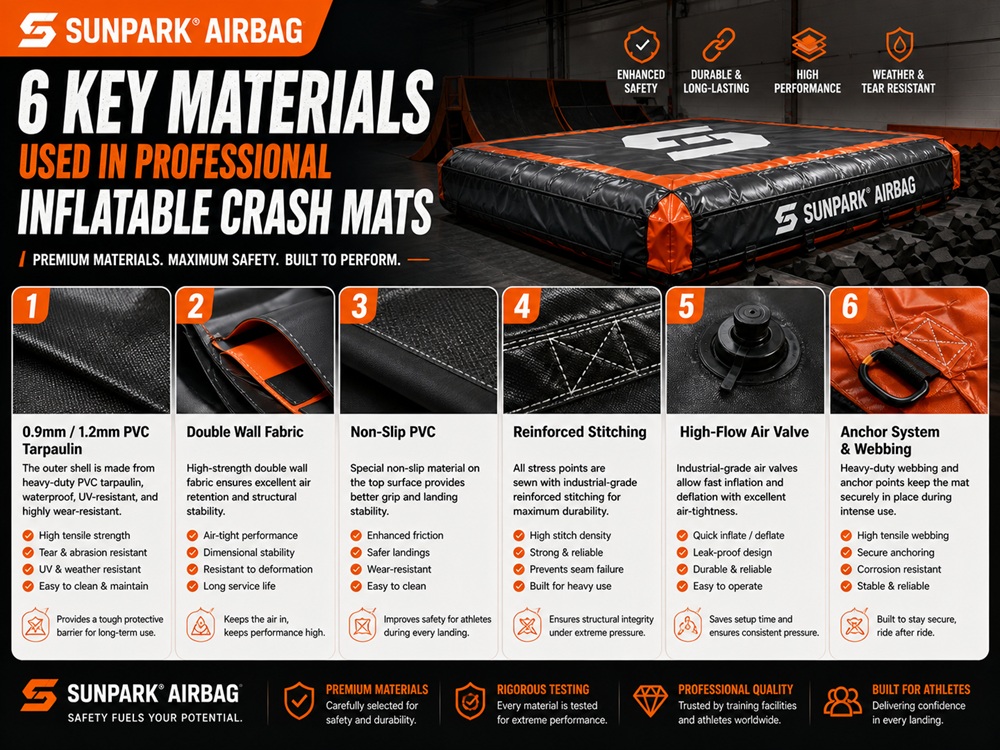
- The Airbag Hygiene Standard: Commercial airbags utilize heavy-duty, marine-grade 0.9mm PVC tarpaulin top sheets treated with antimicrobial, antibacterial, and antifungal coatings. Sweat, dirt, and spills cannot penetrate the non-porous vinyl membrane. At the end of every business day, a maintenance employee simply mops the smooth top sheet with hospital-grade disinfectant wipes in under ten minutes. The air pumped through the system is constantly vented and replenished, eliminating enclosed dust pockets completely.
4. Routine Maintenance Overhead & Daily Facility Labor
Ask any facility manager what task their staff hates most, and the answer is unanimous: cleaning and fluffing the foam pit. The operational labor demanded by loose foam is a relentless financial drain on a business balance sheet.
To maintain basic safety in a foam pit:
- Daily Manual Fluffing: Jumpers continuously displace cubes toward the edges, creating a dangerous crater in the center impact zone. Every morning, staff must climb into the pit with pitchforks or manual rakes to redistribute cubes. If a staff member fails to fluff the pit, the first heavy jumper of the day risks hitting the subfloor.
- Quarterly Deep-Cleaning Purges: Every 90 days, the entire pit must be emptied. Staff must pull out 5,000 to 10,000 individual foam cubes, bag them, shovel out hundreds of pounds of degraded foam dust, vacuum the concrete slab, search for lost car keys and cell phones, and inspect the trampoline netting. This requires shutting down the attraction and burning 40 to 60 man-hours of payroll.
- Continuous Cube Disposal: Worn-out, crumbling foam cubes cannot be recycled. Facilities must pay thousands of dollars in commercial dumpster tipping fees to haul tons of degraded foam blocks to local municipal landfills annually.
In stark contrast, an engineered landing airbag solutions platform requires almost zero routine labor. There are no loose parts to organize, no craters to rake, and no foam dust to shovel out. The continuous blowers run on automated timers; daily maintenance is restricted to a quick visual inspection of top-sheet anchor bungees and a surface sanitizing wipe-down. Switching to an airbag immediately frees up hundreds of staff hours that can be reallocated to guest services and coaching.
5. Ride-Away Capabilities for Wheeled Sports (MTB, BMX, FMX)
For bike parks, skate facilities, and action sports camps, this difference is the single most critical factor: a foam pit is fundamentally incompatible with realistic wheeled progression.
Consider the physical dynamics of landing a bicycle or motorcycle into loose foam:
- The Catastrophic OTB (Over-The-Bars) Trap: When a mountain bike or BMX drops into loose foam cubes, the front wheel drives straight down between the blocks and wedges completely. The bike stops dead instantly ($0\text{ MPH}$ in $0.1\text{ seconds}$), but the rider’s body continues forward with full momentum. The rider is violently pitched over the handlebars, landing head-first onto their own handlebars, pedals, or frame. In our review of common BMX injuries and prevention, foam pits are responsible for a massive percentage of collarbone fractures and acromioclavicular (AC) joint separations.
- Destruction of Bicycles: Digging a 30-pound downhill mountain bike out of a foam pit takes three grown adults ten minutes. In the process, disc brake rotors are bent, derailleur hangers are snapped, and foam blocks get jammed into drive chains and spokes.
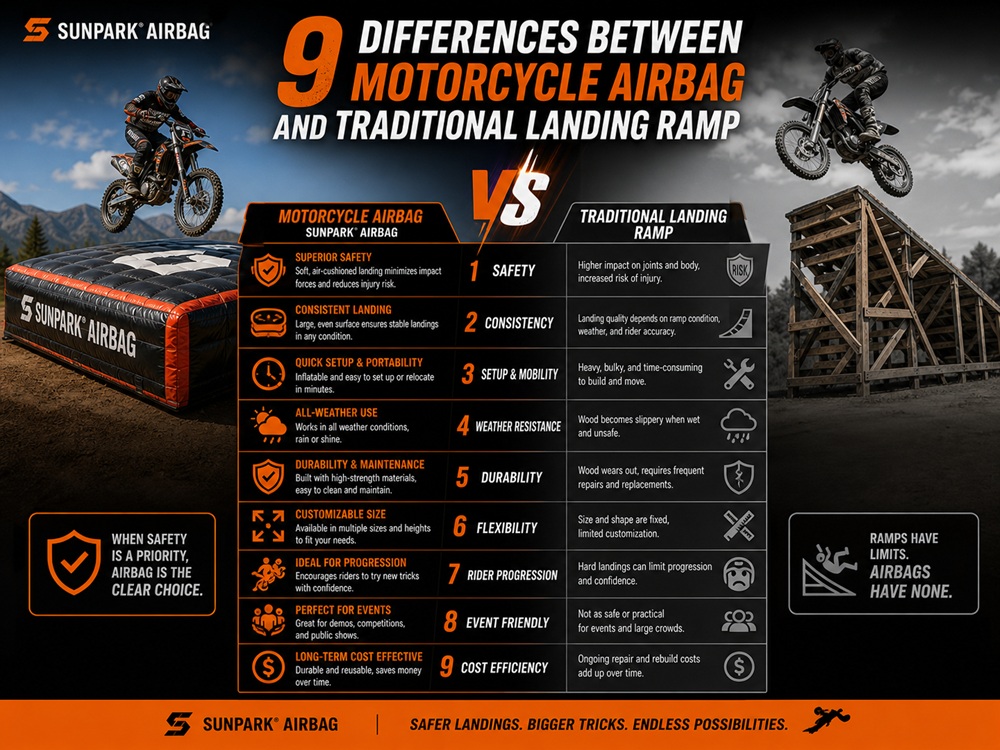
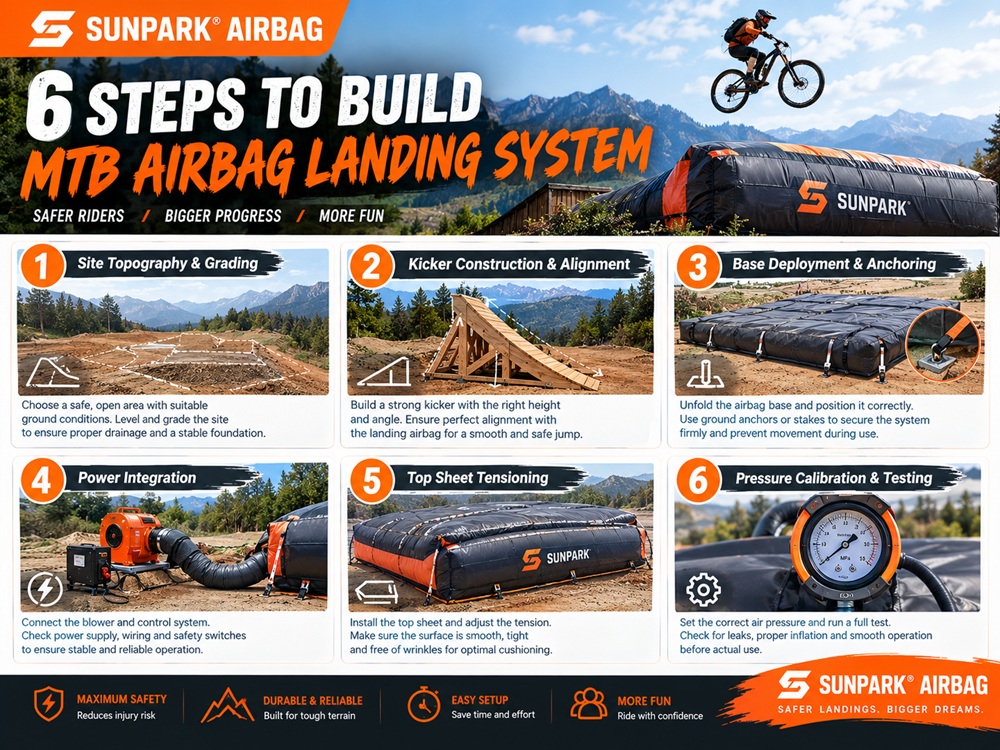
- True Sloped Progression with Roll-Out: A dedicated MTB airbag landing system or specialized BMX airbag landing features a smooth, sloped landing profile (typically 25 to 35 degrees) wrapped in a friction-calibrated, tear-resistant PVC top sheet. When a rider executes a trick, their tires touch down on the smooth incline. If they land cleanly, they can actually ride away down the transition ramp at full speed. If they bail mid-trick, the upper air chamber absorbs their slide smoothly while their bike slides down the ramp beside them without getting crushed or caught.
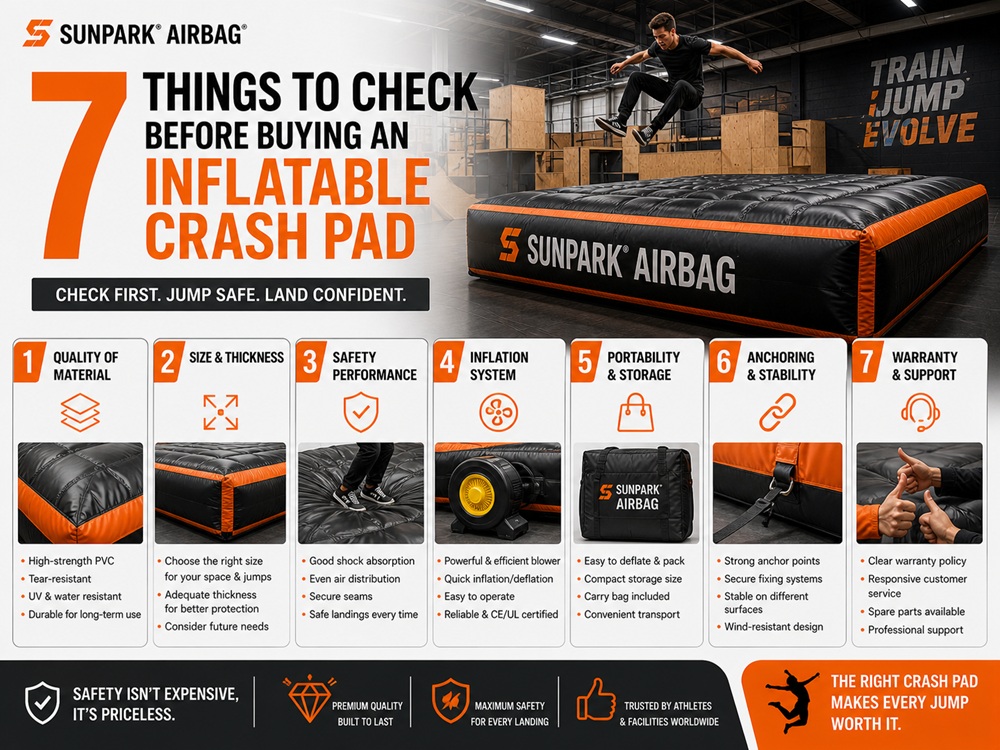
For progression training in action sports, an airbag allows riders to learn tricks with identical biomechanical body positioning to real dirt jumps or wooden ramps. This is why professional training venues worldwide have abandoned foam pits entirely in favor of modular airbag landing ramp system setups. For a comprehensive guide on facility builds, consult our breakdown on inflatable MTB airbag solutions.
6. Dynamic Impact Tunability & Athlete Weight Calibration
One of the most dangerous mechanical limitations of a foam pit is its static nature. A polyurethane foam cube possesses a fixed indentation load deflection (ILD) density. Once a pit is filled with 45-ILD foam cubes, that density is locked in stone. It cannot be modified.
This creates severe safety mismatches:
- A 40-pound child jumping into a 45-ILD foam pit does not have enough mass to compress the cubes; to that child, the foam pit feels stiff and unforgiving.
- A 220-pound adult athlete dropping from twelve feet carries massive kinetic energy that easily overwhelms the same 45-ILD cubes, compressing them flat and bottoming out hard against the subfloor.
In contrast, a commercial airbag landing system is dynamically tunable in real time. Air pressure inside the upper impact chamber is managed through adjustable hook-and-loop pressure-release vent flaps and variable-speed blower intake baffles:
- Softer Catch Mode: Want to train beginner flips or light pediatric gymnasts? Open the side pressure vents by 20%. The chamber vents air rapidly, providing a pillowy, ultra-soft landing that cradles light impacts with near-zero rebound.
- Firm Ride-Away Mode: Sponsoring a heavy-duty dirt jump competition or adult freestyle motocross training? Close the side vents slightly. The chamber stiffens, creating high-pressure damping that absorbs high-speed landings while providing enough surface tension for riders to roll out without scrubbing speed.
Try making that adjustment to 8,000 blocks of loose foam.
7. Lifecycle Longevity & Total Cost of Ownership (TCO)
When novice park owners build their initial capital expenditure budgets, foam pits appear superficially cheaper on paper. A basic concrete trench filled with 7,000 imported foam blocks might cost $15,000 to $20,000 initially, whereas a commercial-grade, custom-manufactured airbag landing pad might cost $22,000 to $35,000. That initial invoice leads many operators into a devastating financial trap.
Examine the authentic five-year Total Cost of Ownership (TCO) ledger:
The Foam Pit Financial Drain:
- Cube Replacement Bleed: Foam cubes have an operational lifespan of only 12 to 18 months. Due to constant impact and foot friction, cubes shred into micro-dust. Operators must replace roughly 25% to 35% of their cubes annually just to maintain minimum safety depth. Over five years, replacement foam costs exceed $20,000 to $30,000.
- Excessive Payroll Overhead: Two hours of daily fluffing and quarterly pit-cleaning purges consume approximately 700 to 800 hours of facility labor annually. At an average burden of $15/hour, that represents over $50,000 in wasted labor payroll over five years.
- Elevated Insurance Premiums: Commercial underwriters have compiled decades of claims data on foam pits: broken ankles, displaced joints, bottoming-out spinal trauma, and catastrophic fire risks. Foam pit attractions carry significantly higher liability insurance deductibles and annual policy premiums.
- Five-Year True Cost: $85,000 to $120,000+
The Airbag Financial Dividend:
- Industrial Heavy-Duty Longevity: Built from heavy-duty 0.55mm and 0.9mm PVC tarpaulin with high-frequency welded seams, an industrial airbag maintains a working lifespan of 5 to 8+ years under continuous commercial daily use.
- Zero Consumable Parts: There are no blocks to replace, no foam to throw away, and no continuous parts orders. If a top sheet sustains an accidental tear from a sharp bicycle pedal, it can be patched permanently in twenty minutes using an industrial cold-weld PVC repair kit without closing the attraction.
- Minimal Labor: Ten minutes of daily sanitizing wipe-down requires roughly 60 labor hours annually (less than $1,000/year in labor).
- Five-Year True Cost: $25,000 to $40,000 total.
The financial conclusion is indisputable: an airbag landing pad pays for itself within the first 14 to 18 months of operation. Every month after that, it generates pure profit and saves thousands in maintenance labor. If you are planning an upcoming facility build, explore complete budget timelines in our detailed study on trampoline park construction cost.
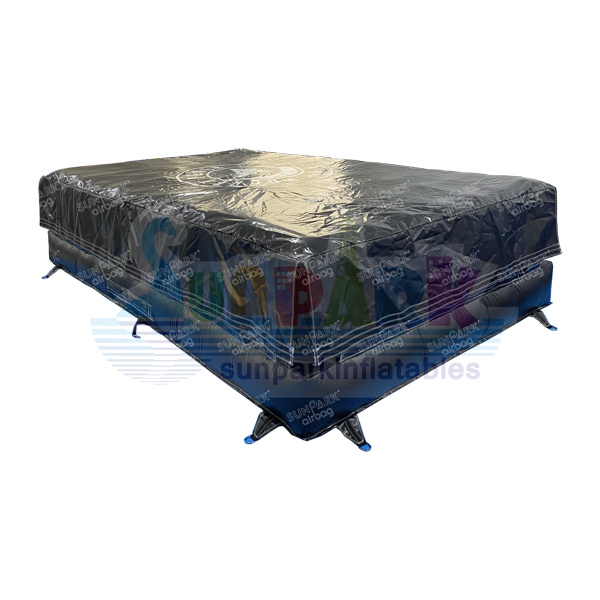
Enterprise Solution Spotlight: Sunparkairbag Foam Pit Airbag Replacement
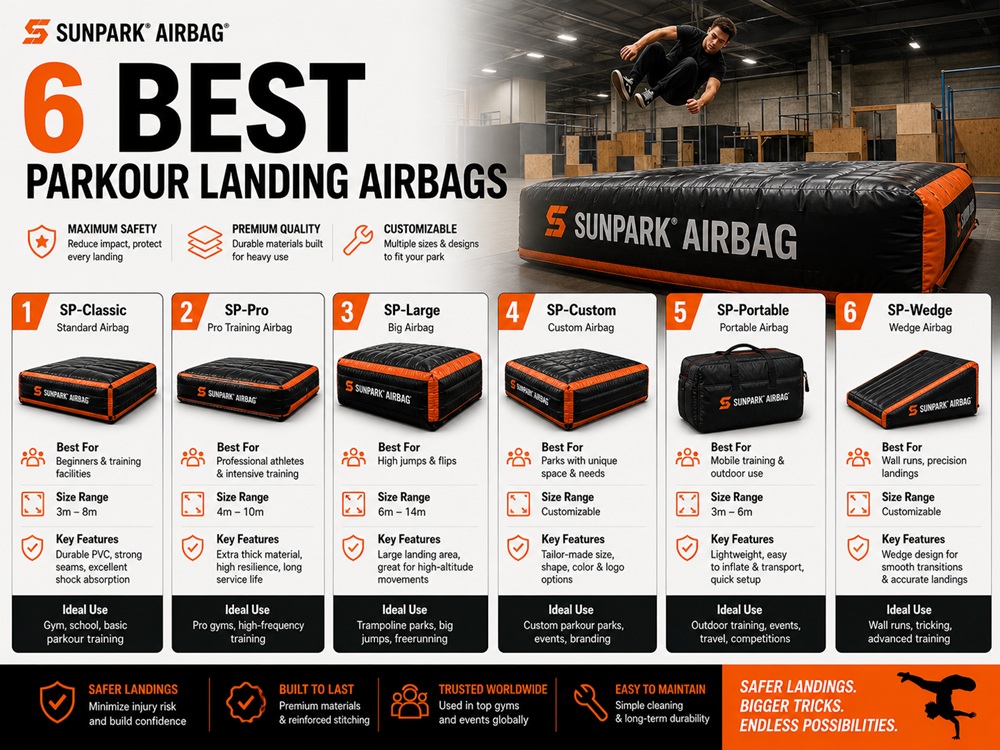
Tired of losing money to crumbling foam cubes and dirty pit maintenance? The Sunparkairbag Foam Pit Airbag Replacement is custom-engineered to drop directly into existing concrete foam pit vaults, instantly modernizing your facility into a clean, high-throughput, zero-dust progression center.
| Airbag Base Architecture | 0.55mm commercial-grade, multi-ply PVC Tarpaulin with reinforced internal baffles |
| Protective Top Sheet | Heavy-duty 0.9mm PVC Tarpaulin (Waterproof, flame-retardant, UV-protected, lead- and phthalate-free) |
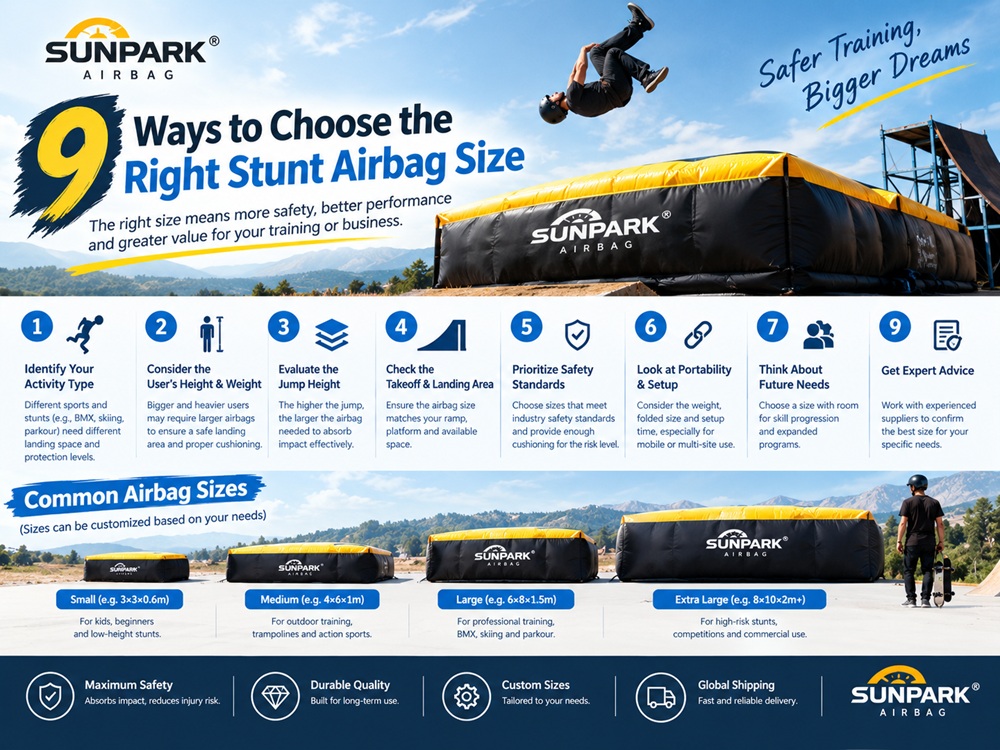
| Custom Sizing & Geometry | 100% custom-tailored to fit your exact pit length, width, and depth dimensions |
| Branding & Aesthetics | Full digital, silk-screen, or UV logo printing to showcase park branding or sponsor artwork |
| Certified Craftsmanship | Manufactured by senior technicians with 5+ years of specialized high-frequency welding experience |
| Turnkey Commercial Kit | Includes industrial continuous air blowers, rapid repair patch kit, and heavy-duty storage bag |
Facility Director’s Advice: Stop shoveling foam dust. Transform your pit into an asset that triples jumper throughput. Review detailed engineering specs on the official Foam Pit Airbag Replacement product portal, or explore where our installations operate across the country in our airbag jump locations guide.
Quick Summary Table: The 7 Differences at a Glance
| Comparison Vector | Dual-Chamber Airbag Landing Pad | Traditional Loose Foam Cube Pit | Decisive Operational Winner |
|---|---|---|---|
| 1. Deceleration Mechanics | Dynamic pneumatic venting; zero bottoming out | Static cube compression; high risk of bottoming out | Airbag Landing Pad |
| 2. Throughput / Exit Time | 3 to 5 seconds (Instant walk-off or roll-off) | 30 to 90 seconds (Exhausting, slow scramble) | Airbag Landing Pad (10x faster) |
| 3. Hygiene & Cleanability | Wipe-clean antimicrobial 0.9mm PVC surface | Unwashable porous foam; collects sweat and bacteria | Airbag Landing Pad |
| 4. Air Quality & Dust | Zero dust; continuous fresh airflow | Heavy polyurethane micro-dust and chemical fire retardants | Airbag Landing Pad |
| 5. Wheeled Action Sports | Smooth ride-away transitions; no over-the-bars crashes | Front wheel wedges instantly; severe OTB crash hazard | Airbag Landing Pad |
| 6. Impact Tunability | Variable hook-and-loop vents & blower controls | Completely fixed (Static cube density cannot change) | Airbag Landing Pad |
| 7. 5-Year True Cost (TCO) | Low ($25k – $40k total; zero consumable costs) | Very High ($85k – $120k+; cube replacements and labor) | Airbag Landing Pad (Saves ~$60k+) |
Direct Technical Comparison: Pneumatic Airbag vs. Foam Cube Pit
| Technical Specification | Sunparkairbag Commercial Airbag System | Standard Commercial Foam Cube Pit |
|---|---|---|
| Primary Material | 0.55mm & 0.9mm High-Tensile PVC Tarpaulin | Open-cell Polyurethane Foam Cubes (typically 6″x6″x6″) |
| Safety Standards Adherence | Meets ASTM F2374 & European EN 14960 Standards | ASTM F2970 Standard Practice for Trampoline Courts |
| Fire Safety Rating | B1 / M2 Certified Flame-Retardant Heavy Vinyl | CAL 117 certified, but degrades over time into fire hazard |
| Daily Labor Overhead | 5 to 10 minutes (Routine surface sanitization) | 60 to 90 minutes (Manual fluffing, rake redistribution) |
| Loss of Personal Property | Zero (Items remain on top sheet; instant retrieval) | High (Keys, phones, jewelry lost deep inside cubes) |
| Portability / Relocation | Deflates, rolls up, and moves in a single shipping pallet | Requires massive trucks to transport thousands of bulky cubes |
Pros and Cons: Evaluating Safety Infrastructure
| Safety System | Documented Operational Advantages (Pros) | Real-World Operational Liabilities (Cons) |
|---|---|---|
| Dual-Chamber Airbag Systems (e.g., Sunparkairbag Platforms) |
|
|
| Traditional Foam Cube Pits (Loose Polyurethane Cubes) |
|
|
Commercial Facility Economics: Ticket Sales, Labor, and Insurance
Every commercial entertainment or sports training facility operates under simple mathematical laws: Revenue is a function of customer capacity and safety confidence. When an attraction in your park creates friction—either through painful injuries, long waiting lines, or a visible lack of cleanliness—your revenue drops.
Consider how upgrading from a foam pit to an airbag shifts the commercial equation:
- Unlocking Queue Velocity: On a Saturday afternoon, a trampoline park with an open foam pit can only allow one jumper every 45 to 60 seconds per lane. Parents and children spend 80% of their paid jump time standing in a stagnant queue. When customers spend their time waiting rather than jumping, customer satisfaction drops, leading to poor Google reviews and lower return visit rates. Replacing that foam pit with an airbag triples your queue velocity, allowing continuous jumping that delights guests.
- Mitigating Insurance Surcharges: Commercial property and casualty insurance carriers are increasingly scrutinizing foam pits. Under safety standards monitored by the U.S. Consumer Product Safety Commission (CPSC) and international amusement safety directives, open foam pits represent a disproportionate percentage of severe claims (compound fractures, concussions, and spinal trauma). Modern airbags with certified dual-chamber baffles demonstrate provable risk mitigation, allowing facility owners to negotiate lower annual insurance premiums and lower liability deductibles.
- Expanding Attraction Versatility: A foam pit is restricted to trampoline jumpers and gymnasts. An airbag landing pad can host multi-sport events: morning gymnastics training, afternoon trampoline park sessions, evening bike-park progression sessions, and corporate team-building events. For facilities expanding into motor sports, compare these systems with specialized platforms in our review of motorcycle airbag systems 2026.
Who Should Upgrade to an Airbag vs. Who Can Keep a Foam Pit
Every dollar allocated to capital facility improvements must be justified through operational payback. Discerning whether an airbag upgrade is mandatory for your venue prevents misallocated capital.
Facilities That Must Upgrade to an Airbag Landing Pad Immediately:
- Commercial Trampoline Parks & Family Entertainment Centers: If your venue relies on high-volume weekend birthday parties and open-jump ticket sales, foam pits are actively suffocating your profitability. Upgrading to an airbag increases throughput, eliminates hygiene complaints, and stops the annual financial drain of cube replacements.
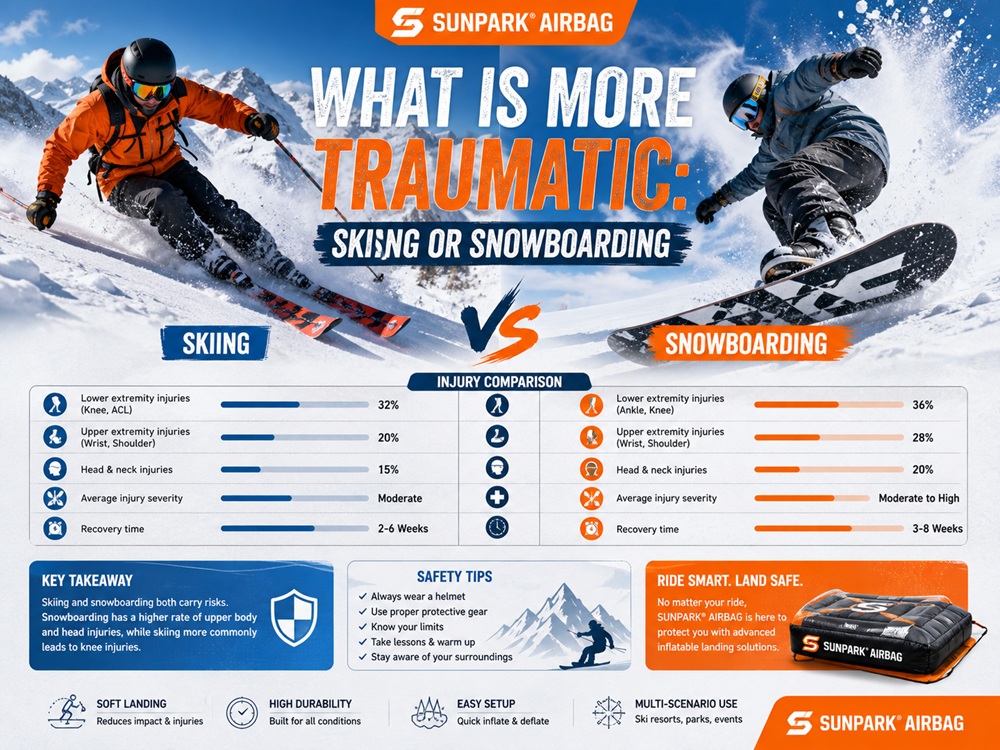
- Action Sports Facilities (BMX, MTB, FMX, Skate, Snowboard): If athletes enter your landing area on wheels or snowboards, foam pits are a severe injury hazard that causes over-the-bars crashes and destroyed equipment. A sloped airbag landing system is non-negotiable for safe, realistic trick progression.
- Commercial Gymnastics Academies with High Daily Athlete Volume: Elite training centers running multiple squad rotations daily cannot afford to have gymnasts inhaling toxic polyurethane dust or wasting practice time digging out of foam trenches.
When a Traditional Foam Pit May Still Suffice:
- Ultra-Low-Traffic Private Backyard Sheds: If you are a solo athlete building a personal training pit in an unpowered pole barn with zero public liability, only jumping two or three times a week, a cheap bed of second-hand foam cubes requires zero blowers and saves on electrical wiring.
- Temporary Low-Height Vaulting Drills: Controlled, low-velocity gymnastic dismount drills where athletes drop from under 3 feet and where cubes can be fluffed by hand between individual repetitions without queue pressure.
Common Mistakes Facility Managers Make with Landing Systems
Factory Floor Advisory: The “Single-Chamber Airbag” Trap
The most dangerous mistake a facility director can make when replacing a foam pit is purchasing a cheap, single-chamber novelty stunt airbag from an uncertified import broker. A single-chamber airbag has no internal separation: the impact air and the base air are the same. If a heavy athlete lands hard or off-center, air rushes away from the impact point, allowing the athlete to bottom out violently against the concrete slab! Always mandate a true dual-chamber landing system: an independent, pressurized lower safety deck isolated from the vented upper deceleration chamber.
- Failing to Monitor Blower Air Intake Vents: Placing industrial continuous air blowers in dusty, unventilated mechanical closets or allowing lint and debris to cover the intake screen. Restricted airflow drops internal pressure in the lower chamber, compromising bottom-out safety margins. Air blowers must sit in clean, unobstructed air zones and feature cleanable mesh intake filters.
- Running Excessive Pressure in the Upper Impact Chamber: Operating an airbag with completely sealed side vents. If the upper chamber cannot vent displaced air upon impact, the surface acts like an over-inflated bouncy castle, causing athletes to bounce backward off the pad and risk knee hyperextension. Calibrate vents to ensure smooth, progressive pneumatic catch.
- Neglecting Top Sheet Bungee Tension: Allowing the perimeter elastic anchor bungees that secure the 0.9mm PVC top sheet to go slack. A loose top sheet bunches up underfoot, creating a tripping hazard. Bungees must be kept taut to ensure a smooth, flat surface for rapid roll-offs and ride-aways.
- Using Household Cleaning Solvents on PVC Tarpaulin: Cleaning commercial PVC top sheets with acetone, gasoline, or undiluted bleach. Harsh petroleum-based solvents dissolve the plasticizers inside the PVC tarpaulin, turning supple, tear-resistant vinyl into brittle, cracked plastic within weeks. Clean exclusively with mild pH-neutral soaps or certified quaternary hospital disinfectants.
- Allowing Shoes with Sharp Metal Cleats or Exposed Pegs: Permitting BMX bikes with sharp, knurled metal stunt pegs or athletes with studded footwear onto the top sheet without protective sleeves. While 0.9mm PVC is remarkably puncture-resistant, exposed sharp steel edges under full body weight can puncture any membrane. Enforce plastic bike pegs and clean athletic footwear rules.
Essential Sourcing Checklist: Auditing Airbag Manufacturers
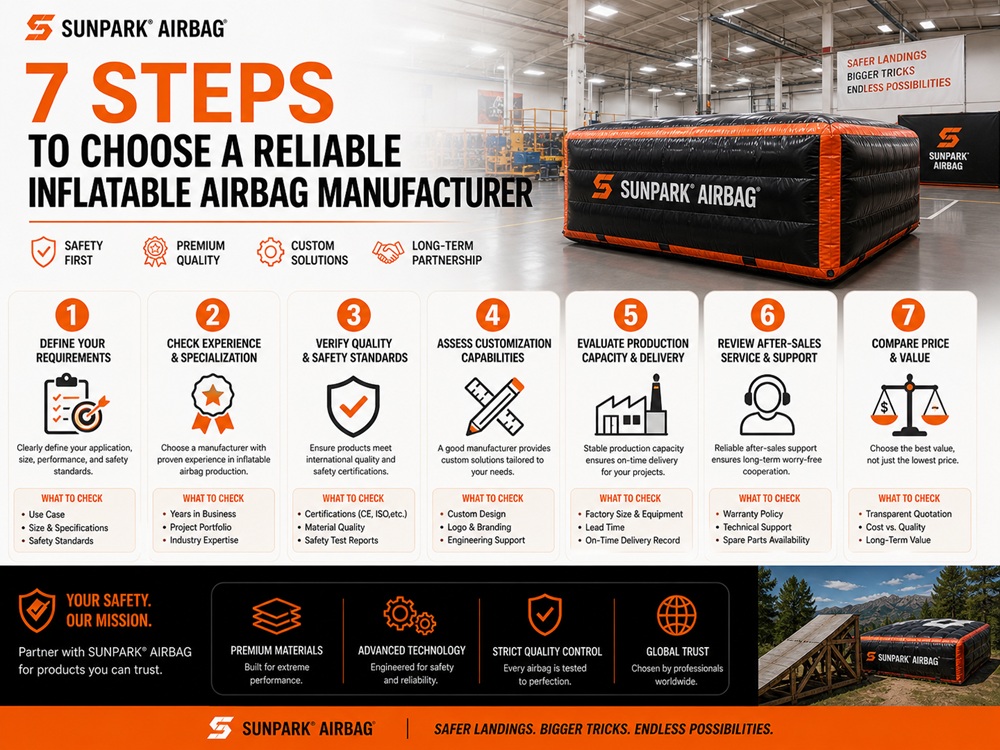
Before issuing a purchase order or signing a commercial supply contract for a landing airbag system, require prospective manufacturers to prove compliance across these four non-negotiable engineering benchmarks:
1. Verified Material Metallurgy and Vinyl Tensile Specifications
Never purchase an airbag fabricated from cheap 0.4mm Oxford fabric or un-reinforced plastic films. Demand certified technical data sheets proving:
- Internal Chamber Walls & Baffles: Minimum 0.55mm heavy-duty PVC Tarpaulin (18 oz/sq.yd) with high-density internal polyester ripstop scrim.
- Top Protective Wear Sheet: Minimum 0.9mm ultra-heavy-duty PVC Tarpaulin (32 oz/sq.yd) delivering extreme tensile strength (≥ 3000 N/5cm) and tear resistance.
- Material certifications verifying that all vinyl is 100% lead-free, phthalate-free, and fire-retardant meeting NFPA 701, DIN 4102 B1, or EN 13501-1 standards.
2. Structural Welding and Baffle Architecture
Inspect the manufacturing methodology:
- Internal stress baffles must be joined using high-frequency radio-frequency (RF) dielectric welding or hot-air fusion, not cheap manual contact adhesives that degrade under continuous cyclic pressure.
- High-stress perimeter anchor rings and D-rings must be backed with multi-layer welded PVC reinforcement patches and heavy-gauge 316 stainless steel hardware.
- Review international manufacturing safety directives governed by ASTM International Standards for Inflatable Amusement Devices (ASTM F2374).
3. Certified Commercial Blower Engineering
Verify the electrical power units:
- Blowers must hold genuine CE, UL, or CSA electrical safety certifications with thermally protected copper-wound motors.
- Ensure the manufacturer provides dual-blower redundancy calculation for large landing systems, guaranteeing that even if one electrical circuit trips, the lower safety deck remains fully pressurized.
4. Custom Architectural Tailoring and Vault Sizing
A high-competence manufacturer does not sell “one-size-fits-all” boxes. If you are retrofitting an existing concrete foam pit, the airbag must be custom-manufactured down to the exact centimeter of your pit’s length, width, and depth. A loose airbag leaves dangerous entrapment gaps along concrete walls; an oversized airbag bunches and buckles. Work directly with an engineering manufacturer that provides customized 3D CAD layout proofs before production.
Expert Operational Verdict: The Commercial Blueprint
In our professional assessment across decades of industrial inflatable design and action sports facility consulting, the verdict is definitive: traditional loose foam pits are an obsolete, dangerous, and commercially wasteful relic of the past. Continuing to maintain a crumbling pit of foam cubes is an operational liability that bleeds payroll, exposes your business to catastrophic injury claims, and chokes customer throughput.
Here is your clear, actionable facility modernization roadmap:
- Calculate Your Real Foam Bleed: Audit your last 24 months of general ledger expenses: add up cube purchases, dumpster disposal fees, and daily staff fluffing labor. You will quickly discover you are spending more than the cost of an airbag every two years just to maintain dirty foam.
- Measure Your Vault Dimensions: Take precise laser measurements of your existing pit’s length, width, and concrete depth, noting the position of entry ramps and exit walkways.
- Partner with a Proven Direct Manufacturer: Work directly with an established engineering leader like Sunparkairbag. Sourcing a turnkey solution like the Sunparkairbag Foam Pit Airbag Replacement gives your venue the unmatched safety of a true dual-chamber deceleration system, military-grade 0.9mm PVC durability, rapid 3-to-5-second athlete throughput, and pristine hygiene, backed by factory-direct pricing that maximizes operational ROI for years to come.
Frequently Asked Questions
Commercial trampoline parks, gymnastics facilities, and action sports training centers are actively replacing foam pits due to severe hygiene liabilities, high operational labor, catastrophic bottoming-out risks, and slow user throughput. An airbag landing pad provides adjustable pneumatic deceleration, rapid 3-to-5-second exit times, wipe-clean antimicrobial PVC surfaces, and zero toxic foam dust accumulation.
Yes. Unlike foam pits where users sink uncontrollably into deep cubes and risk severe ankle sprains when attempting foot landings, dual-chamber airbags feature a taut 0.9mm PVC top sheet over a vented upper air cushion. This allows athletes to land safely on their feet or ride away on mountain bikes, BMX bikes, and skateboards without catching wheels or throwing the rider over the handlebars.
Polyurethane foam relies on mechanical compression; as cubes compact together, resistance spikes non-linearly, often allowing heavy or off-axis impacts to bottom out against the concrete slab. Dual-chamber airbags use pneumatic displacement. The upper chamber compresses and expels air through calibrated mechanical vents to absorb kinetic energy smoothly, while the sealed, continuously pressurized lower chamber acts as an impenetrable safety barrier that prevents ground contact.
Most commercial facilities achieve full ROI within 12 to 18 months. Eliminating quarterly foam block replacement, reducing daily pit-fluffing labor, cutting insurance risk premiums, and tripling athlete queue throughput from 1 jumper every 45 seconds to 1 jumper every 5 seconds significantly boosts gross revenue and reduces operating costs.
Authoritative References & Amusement Safety Standards
- ASTM International: Standard Practice for Design, Manufacture, Installation, and Operation of Trampoline Courts (ASTM F2970) & Inflatable Amusement Devices (ASTM F2374)
- U.S. Consumer Product Safety Commission (CPSC): Amusement Ride and Trampoline Court Safety Guidelines, Hazard Screening, and Injury Data Reports
- National Library of Medicine (PubMed / NCBI): Biomechanical Analysis of Spinal Deceleration, Impact G-Force Attenuation, and Occupational Respiratory Risks in Sports Facilities