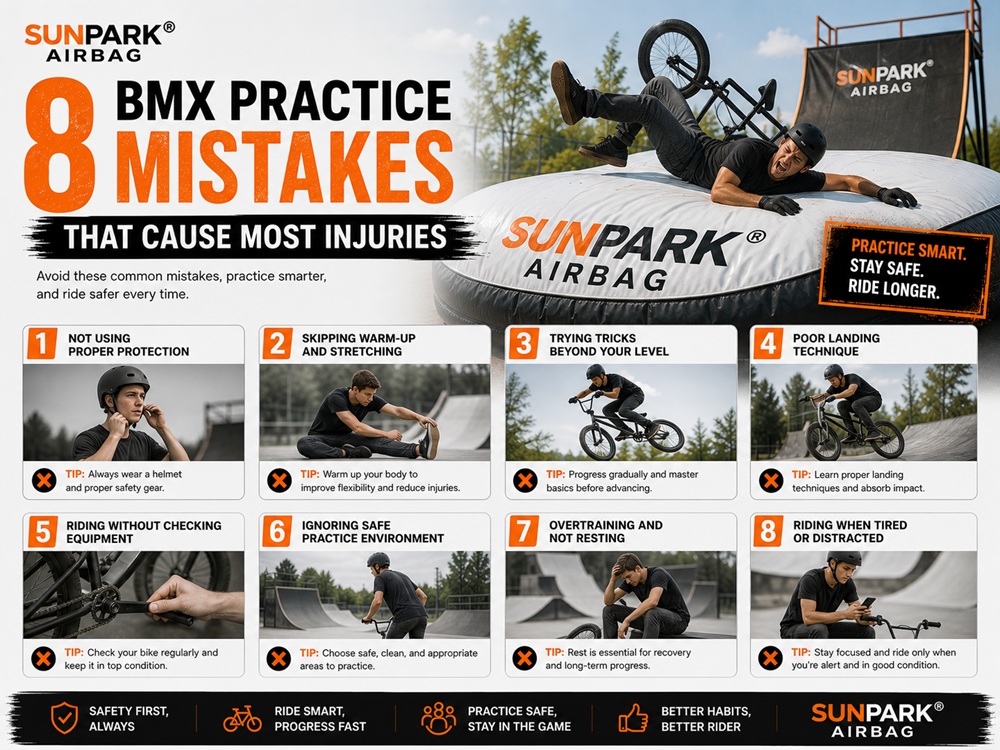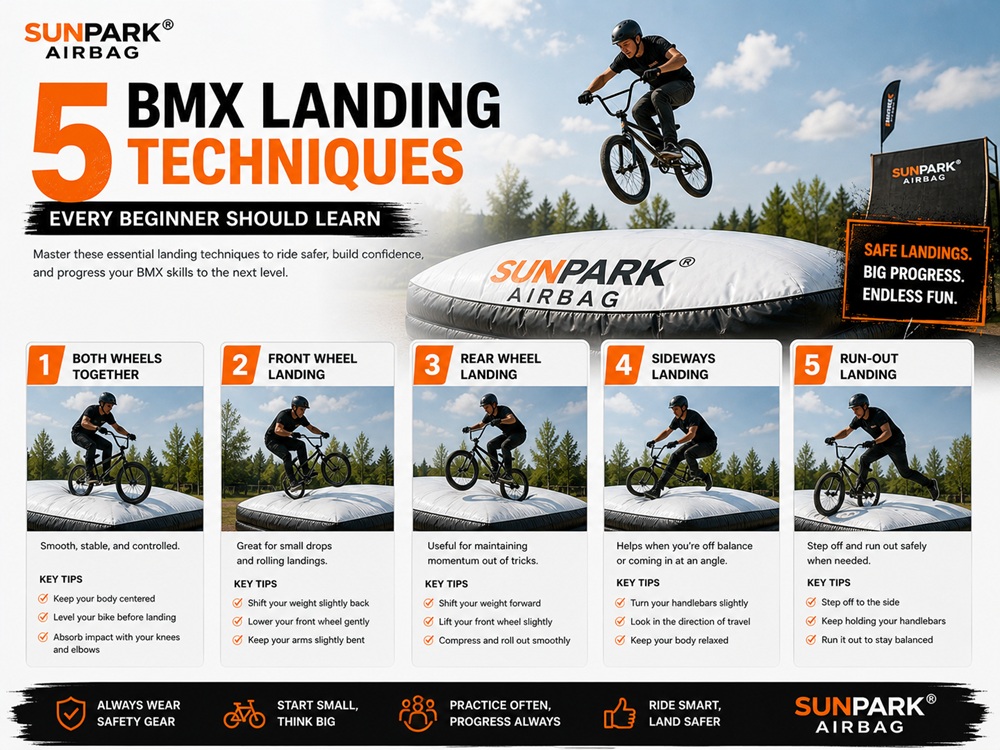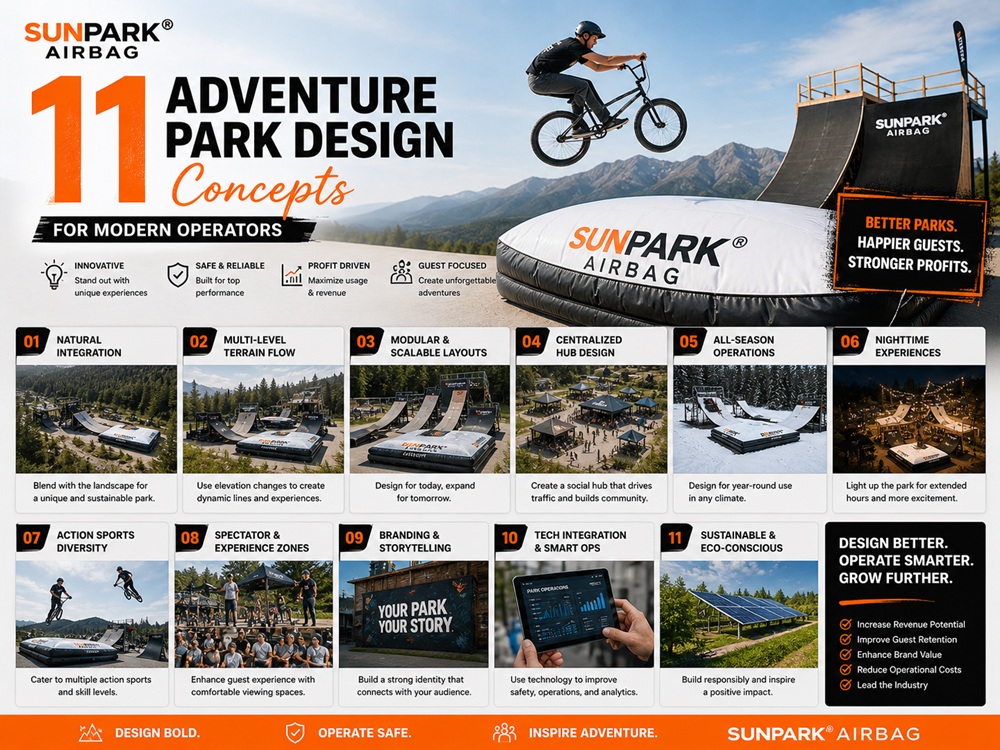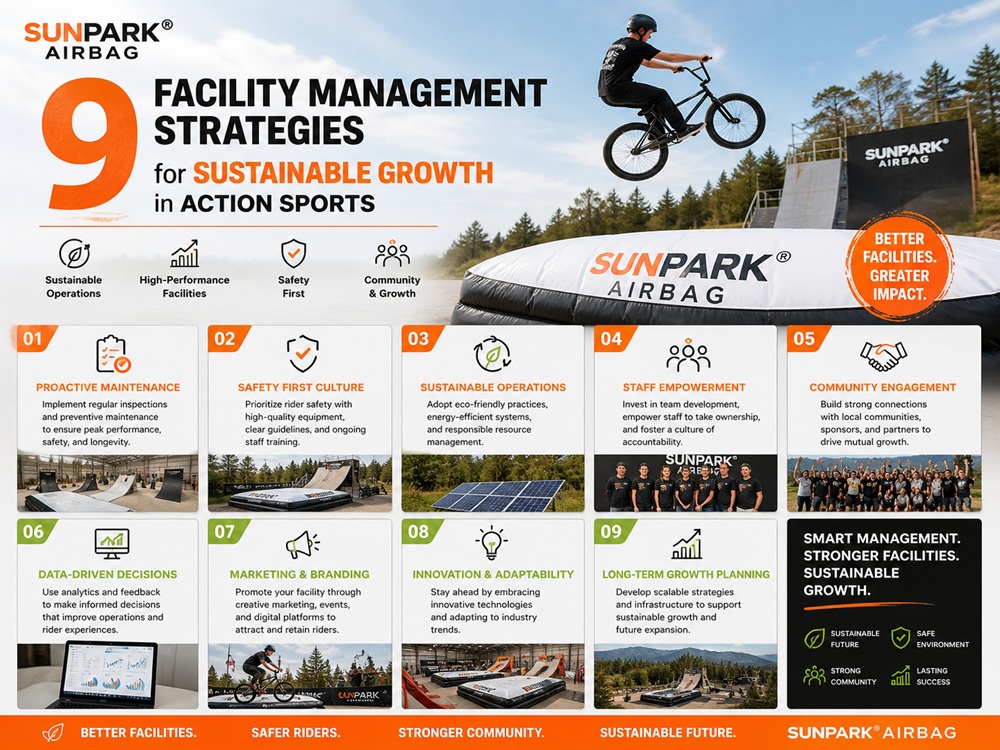
Selecting the proper stunt airbag size requires calculating dynamic trajectory curves, deceleration depths, athlete rebound behavior, and spatial run-out safety margins. An undersized bag means riders risk landing near the perimeter seams or bottoming out through an inadequate air cushion directly into solid ground. Conversely, an oversized setup wastes expensive venue floor space, inflates electrical power demands for continuous air blowers, and complicates daily storage logistics. In our testing across global sports academies, film sets, and bike parks, calculating size based on engineering parameters rather than guesswork separates championship-level progression from severe liability. We examine nine concrete factors that dictate exact stunt airbag dimensions to ensure your setup delivers absolute impact safety.
Quick Answer: How to Choose the Right Stunt Airbag Size
Choosing the correct stunt airbag size requires calculating four non-negotiable physical dimensions based on your sport’s speed and drop height: 1) Deceleration Cushion Depth (requiring a minimum of 25% to 30% of total vertical drop height for freefalls, and 1.5m to 3.5m for high-speed vehicular jumps); 2) Longitudinal Landing Length (matching horizontal launch trajectory plus a 35% safety margin for overshooting or casing); 3) Lateral Safety Width (spanning at least 2.5 to 3 times the track or athlete width, typically 4.5m to 8m, to account for off-axis rotation); 4) Landing Incline Angle (matching the 28-degree to 38-degree vehicle landing transition curve for ride-away landings); and 5) Safety Run-Out Buffers. For film freefalls up to 30 feet, an 8m x 6m x 2.5m flat stunt bag is standard; for freestyle mountain biking, a 10m x 5m x 2m sloped airbag is the proven baseline; and for FMX jumps over 65 feet, platforms must reach at least 15m x 6m x 3.5m. Never base bag size solely on the takeoff ramp width.
The Physics of Airbag Deceleration: Depth, Length, and Drift
To determine the proper stunt airbag size, you must understand the mechanics of kinetic energy absorption. When an athlete impacts an airbag, the goal is controlled mechanical deceleration. According to the work-energy theorem, slowing down a moving body requires absorbing kinetic energy over a defined stopping distance. If an airbag is too shallow (lacking vertical cushion depth), the body exhausts the available air displacement travel before its velocity reaches zero. When that happens, the athlete bottoms out against the ground, transferring destructive G-forces into the musculoskeletal frame.
The required cushion depth is governed by impact velocity. In vertical high falls, velocity increases with the square root of drop height ($v = \sqrt{2gh}$). For a 40-foot drop, the performer strikes the bag at approximately 35 miles per hour (51 feet per second). Safely absorbing that force while keeping deceleration within human tolerance (typically under 15 to 20 Gs) requires at least 2.5 to 3.0 meters of active air displacement. The upper chamber must vent air through calibrated side release valves, allowing the top sheet to catch the performer while the separate lower safety chamber remains pressurized to eliminate ground contact.
In our testing across action sports installations, horizontal speed complicates sizing calculations. A BMX or dirt bike rider does not drop straight down; they carry forward momentum along a parabolic trajectory. If a rider misjudges take-off speed by two miles per hour, their landing spot shifts forward by five to ten feet. If the airbag length matches only the nominal landing target, any minor overshot sends the rider over the front edge of the bag. Sizing must accommodate this variable landing scatter.
Quick Summary: Sizing Benchmarks Across Extreme Sports Disciplines
The table below provides a quick reference to recommended dimensions, thickness profiles, and blower configurations across the most common stunt and action sports applications:
| Application / Sport Discipline | Typical Jump Gap / Drop Height | Recommended Airbag Dimensions (L × W × H) | Airbag Profile Type | Blower Configuration Required |
|---|---|---|---|---|
| Film & Stunt High Falls | 20 to 50 ft Vertical Drop | 8.0m × 6.0m × 2.5m (26 × 20 × 8.2 ft) | Dual-Chamber Flat Stunt | 2 × 1.5 HP Continuous Blowers |
| Extreme High Falls (World Record) | 50 to 100+ ft Vertical Drop | 15.0m × 10.0m × 4.0m (50 × 33 × 13 ft) | Deep Multi-Pillar Flat Stunt | 4 × 2.0 HP Commercial Blowers |
| BMX / Skate Progression | 10 to 25 ft Gap / 6 ft Kickers | 8.0m × 4.5m × 1.8m (26 × 15 × 6 ft) | Sloped Landing Transition | 1 × 1.5 HP Commercial Blower |
| Mountain Bike (MTB) Dirt Jumps | 20 to 45 ft Gap / 8 ft Kickers | 10.0m × 5.0m × 2.2m (33 × 16.5 × 7.2 ft) | Integrated Incline Transition | 2 × 1.5 HP Commercial Blowers |
| Freestyle Motocross (FMX) | 60 to 85 ft Gap / 10 ft Ramps | 15.0m × 6.0m × 3.5m (50 × 20 × 11.5 ft) | Heavy Sloped Landing Airbag | 3 × 2.0 HP High-Static Blowers |
| Snowboard / Ski Big Air | 30 to 70 ft Gap / Snow Inruns | 18.0m × 7.5m × 3.0m (60 × 25 × 10 ft) | Curved Snow Hill Incline | 2 to 3 × 2.0 HP Winter-Spec Blowers |
| Gymnastics / Trampoline Parks | Podium Dives / Trampoline Launch | 6.0m × 4.0m × 1.5m (20 × 13 × 5 ft) | Pit-Recessed Flat Airbag | 1 × 1.5 HP Low-Noise Blower |
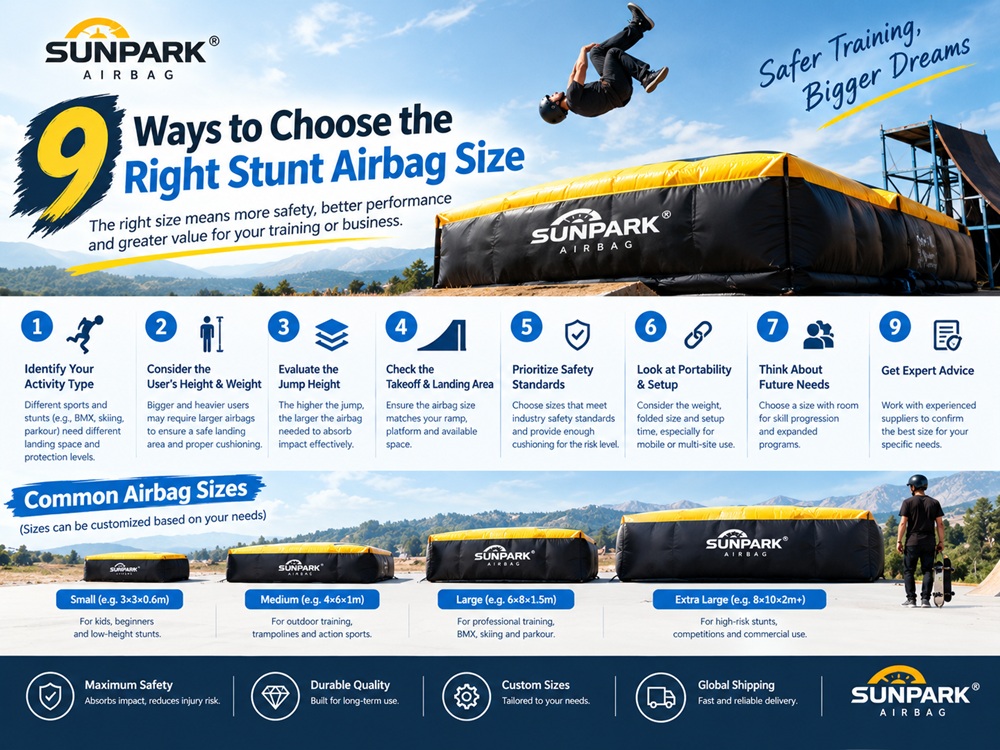
9 Ways to Choose the Right Stunt Airbag Size
1. Calculate the Deceleration Depth by Maximum Vertical Velocity
The single most critical dimension of any stunt airbag is its vertical thickness. Many amateur operators focus on width and length while purchasing a shallow 1.2-meter mat to save money. For flat stunt falls, the depth must scale directly with maximum drop height. A basic engineering rule of thumb dictates that the airbag thickness must equal at least 20% to 30% of the total freefall height.
If you perform twenty-foot falls, a 1.8-meter (6-foot) thick bag provides sufficient deceleration distance. If you jump from forty feet, you must specify a minimum thickness of 2.5 to 3.0 meters. The upper air chamber requires this physical distance to bleed air through relief vents, slowing the falling body gradually without bottoming out against the high-pressure safety floor. Review dedicated drop setups in our stunt airbag landing solutions.
2. Size Length to Match Parabolic Speed Dispersion (The 35% Rule)
For vehicular sports like BMX, MTB, and FMX, athletes do not land vertically; they enter the landing zone with substantial forward speed. Human error and varying weather conditions mean riders rarely hit the exact center of a landing zone every run. Tailwind gusts, tire pressure variations, and minor differences in take-off speed alter the distance a rider travels.
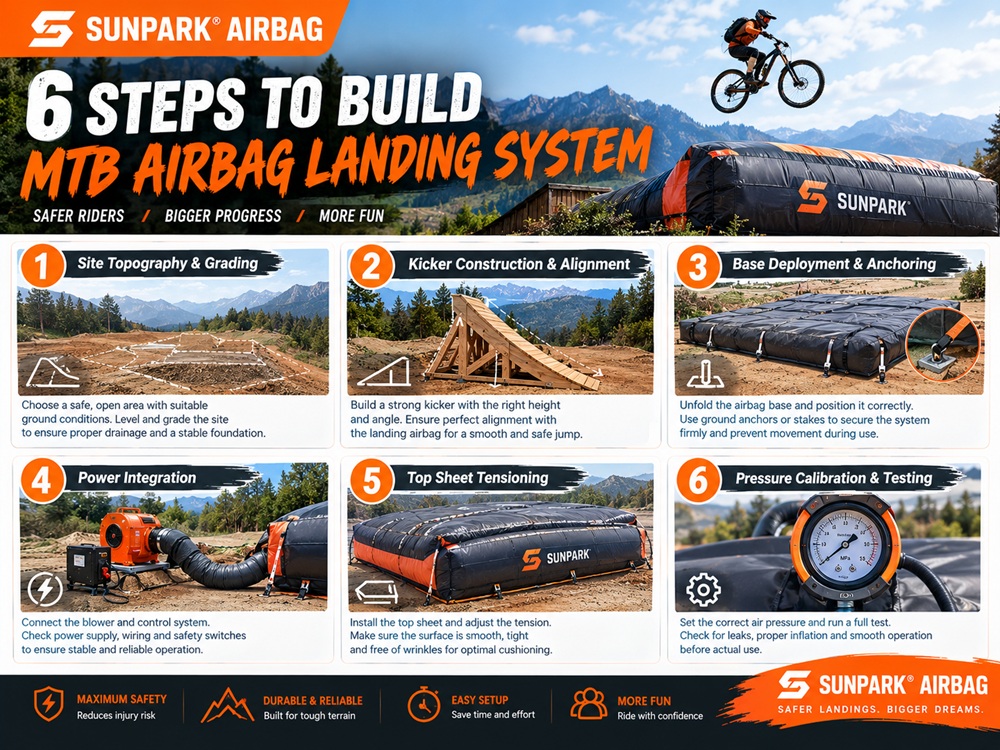
From our experience on progression courses, the landing airbag’s sloped surface length must equal your target flight trajectory plus a minimum 35% safety margin. If your ramp-to-landing gap is designed for 30 feet, the landing zone must measure at least 40 to 45 feet in length. This provides sufficient room for short casings while ensuring overshot jumps still land on the supportive air cushion. For wheeled launch setups, check our purpose-built bike airbag landing platforms.
3. Allow for Lateral Drift and Off-Axis Aerial Rotation
When athletes learn complex tricks—such as 720-degree spins, tailwhips, or off-axis corks—rotational momentum can cause unexpected lateral drift. If a rider separates from their bike mid-air or under-rotates, they often land several feet to the left or right of their launch line.
An airbag’s width must never equal just the width of the kicker ramp. A standard mountain bike ramp may be five feet wide, but the landing airbag must measure at least 15 to 16.5 feet (4.5 to 5.0 meters) wide. For high-speed freestyle motocross where a drifting 250-pound motorcycle separates from the rider, minimum lateral width expands to 20 feet (6.0 meters). This ensures the rider and machine land safely on the vinyl surface rather than missing the mat entirely.
4. Match the Landing Incline Angle to the Kinetic Trajectory
In action sports, athletes prefer landing on sloped airbags rather than flat pads so they can ride away from successful tricks. The slope angle must match the downward parabolic arc of the jump.
If the landing slope is too steep, the rider slides down too quickly; if it is too flat, landing on the transition creates heavy vertical impact compression. Standard sloped airbags are engineered with transition angles between 28 degrees and 35 degrees. For high-speed FMX and big-air snow jumps, that incline angle steepens to 36 to 38 degrees, converting downward kinetic energy into forward roll-away momentum. Examine large transition engineering in our overview of big jump airbag system builds and review top platforms in the best airbag landing systems 2026.
5. Account for Vehicle Mass in Heavy-Impact Dimensions
A 150-pound gymnast landing in a training pit displaces a modest volume of air. A 230-pound freestyle motocross bike paired with a 180-pound rider landing at 40 miles per hour exerts massive kinetic force. Heavy vehicular impacts compress air chambers at violent speeds.
Sizing an airbag for motorbikes requires substantial air volume within the internal pillars to prevent rapid pressure spikes from popping internal baffles. That is why FMX airbags require minimum lengths of 15 meters and heights of 3.5 meters: the sheer volume of internal air provides a cushion that smaller, lighter bags cannot replicate. Review high-payload builds in our FMX airbag landing and dirt bike airbag landing divisions.
6. Size for Ride-Away Run-Out Space and Roll-Out Buffers
A common mistake when laying out an indoor action park is forgetting what happens after the rider touches down. When a mountain biker lands cleanly on a 30-degree sloped airbag, they exit the transition at 15 to 25 miles per hour. If the airbag ends three feet from a concrete facility wall, the rider has no room to slow down safely.
Your layout must account for the airbag’s overall length plus a run-out buffer of at least 20 to 30 feet of flat, unobstructed surface. If your building length is restricted, choose an airbag with an integrated flat run-out deceleration apron rather than a steep cut-off ramp.
7. Align Bag Dimensions with Indoor Ceiling and Rigging Heights
When installing a stunt airbag indoors, vertical ceiling height dictates your sizing limits. An airbag with a 2.5-meter (8.2-foot) cushion depth installed under a 16-foot ceiling leaves less than eight feet of clearance above the pad. An athlete jumping from a high podium could strike the ceiling, roof trusses, or lighting fixtures.
For indoor trampoline parks and gymnastics academies, flush in-ground pits provide the ideal solution. Sizing the airbag to match the pit cavity allows the top sheet to sit flush with the surrounding floor, preserving total ceiling height for aerial maneuvers. Compare these configurations in our foam pit vs airbag comparison and explore gymnastics equipment in our gymnastics airbag equipment catalog.
8. Dimension for Dual-Chamber Pressure Independence
A true stunt airbag relies on two distinct functional chambers: an upper deceleration chamber and a lower safety chamber. When an athlete hits the top sheet, internal air vents allow the upper chamber to compress. However, the lower chamber remains firm under continuous positive pressure, preventing the jumper from touching the ground.
When calculating required bag height, keep in mind that the upper chamber accounts for roughly 60% of total thickness, with the lower safety chamber providing the remaining 40%. A 2.0-meter tall bag gives you approximately 1.2 meters of soft top compression and 0.8 meters of firm bottom cushion. Skimping on total height reduces this critical safety buffer.
9. Factor in Blower Redundancy and Power Capacity
The larger the stunt airbag size, the greater the volume of air required to maintain operating pressure. A compact 6m x 4m gym mat operates reliably on a single 1.5-horsepower commercial blower. A large 15m x 6m x 3.5m FMX sloped landing requires two or three 2.0-horsepower continuous blowers running simultaneously to maintain chamber pressure.
Ensure your facility’s electrical distribution panel can supply sufficient amperage on dedicated circuits without tripping breakers during operations. For outdoor events, large bags demand commercial mobile generators to keep blowers running continuously without voltage drops.
Platform Comparison Matrix: Flat Stunt Airbags vs. Sloped Landing Airbags
To help you choose the right geometry for your application, compare performance characteristics between flat stunt pads and sloped landing platforms:
| Engineering Parameter | Flat Stunt Airbags (High Falls) | Sloped Landing Airbags (Wheeled Sports) | Flush-Recessed Foam Pit Airbags |
|---|---|---|---|
| Primary Motion Vector | Pure vertical descent ($90^\circ$ drop) | Forward horizontal + vertical parabola | Rotational aerial drop into pit cavity |
| Standard Cushion Depth | Deep (2.0m to 3.5m+ thickness) | Moderate (1.5m to 2.5m over slope) | Low to Moderate (1.2m to 1.5m depth) |
| Ride-Away Capability | Zero (Athlete catches and stops) | Full ride-away (28° to 35° exit slope) | Zero (Athlete climbs out of pit) |
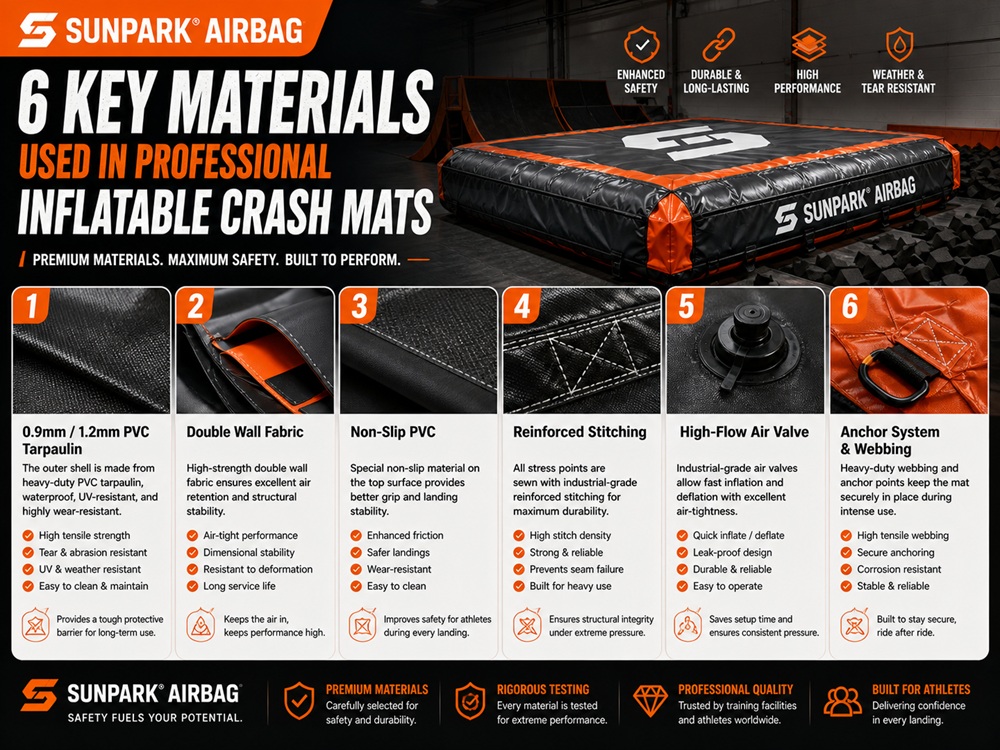
| Topsheet Material Spec | 0.55mm soft-touch PVC or ripstop | 0.9mm heavy-duty anti-rip PVC | 0.55mm flame-retardant vinyl |
| Footprint Demands | Compact square or rectangular | Very long (Requires run-in and run-out) | Exact pit dimensions required |
Pros and Cons of Sizing Up vs. Compact Portability
Weigh the performance advantages and logistical trade-offs of sizing up your airbag setup:
| Configuration Choice | Safety & Operational Advantages (Pros) | Logistical Demands & Constraints (Cons) |
|---|---|---|
| Oversized Sizing Profile (Adding 20%–35% safety margins) |
|
|
| Compact Sizing Profile (Strictly matching takeoff width) |
|
|
Who Needs Full-Scale Airbags vs. Who Can Use Compact Foam Systems
In our experience evaluating commercial facilities, equipment sizing must align with athlete skill levels and insurance liability standards.
Who Needs a Full-Scale Professional Stunt Airbag:
- Commercial Action Sports and Bike Parks: Venues hosting public riders on dirt jump lines need large, forgiving landing zones (10m x 5m minimum) to accommodate varying skill levels and minimize accident liabilities.
- Professional Film and Stunt Teams: Stunt coordinators rigging high falls from buildings, cranes, or scissor lifts require deep dual-chamber flat bags (2.5m+ depth) to absorb vertical drops safely.
- Commercial Trampoline Parks and Family Fun Centers: Facilities replacing dirty, fire-prone foam pits with modern airbags. Review equipment costs in our guide to trampoline park equipment manufacturers.
Who Can Use Compact or Traditional Foam Systems:
- Low-Elevation Bouldering and Vaulting Studios: Gyms with drop heights under six feet operate safely using dense, multi-density folding inflatable crash mat pads or standard bonded foam flooring.
- Low-Speed Backyard Pump Tracks: Casual riders practicing balance on flat ground do not generate the speed or height that warrants a commercial landing bag.
Featured Commercial Equipment: Sunparkairbag Extreme Systems
With over 10 years of experience, we provide freestyle airbags for ski resorts, theme parks, sports facilities, and gymnastics centers around the globe. SunparkAirbag is the leading manufacturer of Airbags for Extreme Sports and Leisure Industries in China.
As extreme sports have developed, more snowboarders and serious athletes seek safer training possibilities to progress without injury risks. We create products for World Champion snowboarders, professional riders, and trampoline parks worldwide, backed by rigorous development and continuous testing.
View complete system specifications on the official Explorer of Airbag System for Sports portal.
Costly Mistakes Riggers Make When Sizing Stunt Airbags
In our field audits of action sports facilities, accidents almost always trace back to four common sizing errors:
- Sizing Bag Width Exactly to Kicker Ramp Width: A jump ramp that is four feet wide launches an athlete who may drift six feet off-line mid-air. Specifying a six-foot wide airbag leaves zero margin for error. The landing bag must always measure at least 2.5 to 3 times the width of the launch kicker.
- Ignoring Ambient Temperature Effects on Internal Pressure: In hot summer conditions, air inside an airbag expands, firming up the cushion; in sub-zero winter setups, air density drops, softening the bag. If an airbag is sized too small in volume, these temperature swings can cause severe bottoming-out on cold mornings. Choose a bag with ample internal volume to absorb temperature variations safely.
- Failing to Account for Wind Drift on High Falls: A stunt performer jumping from fifty feet into an outdoor bag will drift laterally under even modest 10-knot crosswinds. If the target bag measures only 5m x 5m, wind drift can push the performer toward the perimeter seams. High-fall bags must provide a broad landing target (8m x 6m minimum).
- Confusing Overall Length with Usable Landing Length: The overall length of a sloped airbag includes the anchor flaps, the bottom run-out apron, and the rear vertical wall. The true usable landing slope is typically 15% to 20% shorter than the bag’s total physical footprint. Verify the usable landing length on engineering drawings before ordering.
Commercial Sourcing and Facility Procurement Considerations
Before issuing a deposit or approving CAD production drawings for a stunt airbag, verify these four manufacturing standards:
- Topsheet Fabric Thickness and Tensile Rating: Demand heavy-duty 0.9mm (1000D x 1000D, 30oz/yd²) knife-coated PVC for the replaceable top wear sheet. Standard 0.55mm vinyl is suitable for the lower chambers, but will wear quickly if used on the high-friction top sheet.
- ASTM and EN Safety Compliance: Confirm that the manufacturer complies with international inflatable safety standards, including ASTM F2374 and EN 14960. Commercial facility insurers require proof of verified material tensile strengths and certified flame-retardant ratings.
- Anchoring Point Engineering: A large airbag presents substantial surface area to crosswinds. Ensure the base perimeter features heavy multi-ply nylon webbing and forged 316 stainless steel D-rings rated to 2,500+ kg, allowing safe anchoring to ground stakes or ballast weights.
- Dual-Chamber Pressure Gauge Monitoring: Insist on integrated pressure monitoring ports on both the upper and lower chambers to allow operators to verify proper operating pressure before sessions begin.
Expert Recommendation and Dimensioning Verdict
In most professional situations, we recommend avoiding the temptation to downsize an airbag to save a few dollars or fit a tight space. An undersized stunt airbag is an accident waiting to happen, while a properly sized system builds athlete confidence and protects your facility from liability.
If you run a freestyle bike park or progression center, standardize on a 10m x 5m x 2.2m sloped landing airbag with a 30-degree transition angle. If your operation involves high falls for film stunts, invest in an 8m x 6m x 2.5m dual-chamber flat bag with independent pressure relief venting. Sourcing directly from an established manufacturer like Sunparkairbag ensures you receive heavy-duty 0.9mm topsheets, certified dual-chamber safety engineering, and custom CAD sizing tailored to your facility’s exact launch gaps, keeping athletes progressing safely season after season.
Frequently Asked Questions (FAQ)
How do I calculate the right stunt airbag size for high falls?
Calculate required airbag depth by allocating at least 20% to 30% of total vertical drop height as active deceleration space (e.g., a 30-foot fall requires at least 2.0 to 2.5 meters of cushion depth). The surface dimensions should measure at least 8 meters long by 6 meters wide to account for wind drift and body separation during freefall.
What is the difference between a flat stunt airbag and a sloped landing airbag?
A flat stunt airbag is designed to absorb purely vertical impacts, catching falling stunt performers and bringing their downward momentum to a complete stop. A sloped landing airbag features a 28-to-35-degree angled transition designed for wheeled sports (BMX, MTB, FMX, snowboards), matching the vehicle’s flight arc so the rider can ride away from the jump.
Can an airbag be too small for mountain bike jumps?
Yes. An undersized airbag leaves no margin for error if a rider misjudges take-off speed or drifts off-center mid-air. An undersized landing mat can result in riders overshooting the bag onto hard ground, casing the back edge, or landing off the sides during rotational tricks.
How many air blowers are needed to power a large stunt airbag?
Small gym mats typically run on a single 1.5 HP commercial blower. Large action sports airbags (10m to 15m in length) require two to three 1.5 HP or 2.0 HP commercial blowers running simultaneously to maintain positive chamber pressure in the lower safety compartment and feed the adjustable upper landing deck.
Why do professional stunt airbags use dual-chamber construction?
Dual-chamber construction prevents athletes from bottoming out against the ground. The upper chamber features adjustable vents that bleed air to softly cushion the initial impact, while the independent lower chamber maintains high continuous pressure, providing a firm safety floor that keeps the body elevated off the ground.
Authoritative References
- ASTM International: Standard Practice for Design, Manufacture, Operation, and Maintenance of Inflatable Amusement Devices (ASTM F2374)
- International Organization for Standardization: ISO 13934-1 Tensile Properties and Tear Resistance of Coated Structural Fabrics
- SAG-AFTRA Safety Bulletins: Industry Safety Guidelines for High Fall Stunt Equipment and Impact Attenuation