A stunt airbag is not just a soft landing for extreme sports. Used correctly, it gives athletes a practical environment to rehearse movement patterns, test progressions and build confidence before attempting selected skills on harder or less forgiving landing surfaces. The biggest gains come when the airbag matches the sport, the skill and the athlete’s stage of development.
Who Can Benefit From Stunt Airbag Training?
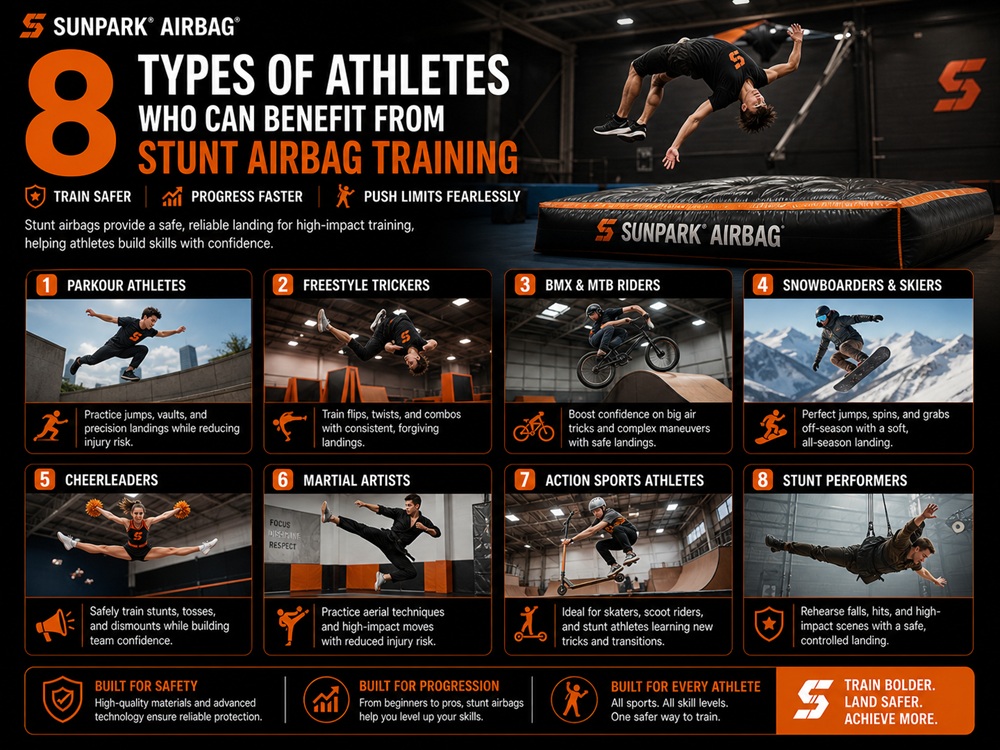
Eight athlete groups can benefit particularly well from stunt airbag training: BMX riders, skateboarders, motocross riders, freestyle skiers and snowboarders, gymnasts, trampoline athletes, parkour practitioners, and stunt performers or action-sports training teams. These athletes often need to rehearse jumps, rotations, aerial body positions or controlled dismounts where the consequences of a poor landing can be significant.
Our recommendation is to choose an airbag based on the intended skill and landing trajectory—not simply its size or price. A BMX landing system, for example, needs a different approach to approach speed and transition geometry than an airbag used for gymnastics drills. An airbag can reduce some landing impact under suitable conditions, but it cannot eliminate injury risk or replace qualified coaching, progressive training and equipment inspection.
Quick Answer
Best candidates: Athletes learning or refining aerial skills, practicing repeatable jump progressions, or testing selected movements before progressing to a more demanding landing surface.
| Athlete type | Most useful training application | What to prioritize |
|---|---|---|
| BMX riders | Jump trajectory, rotation and landing practice | Approach geometry and landing-zone design |
| Skateboarders | Selected aerial tricks and controlled dismounts | Ramp compatibility and a clear landing area |
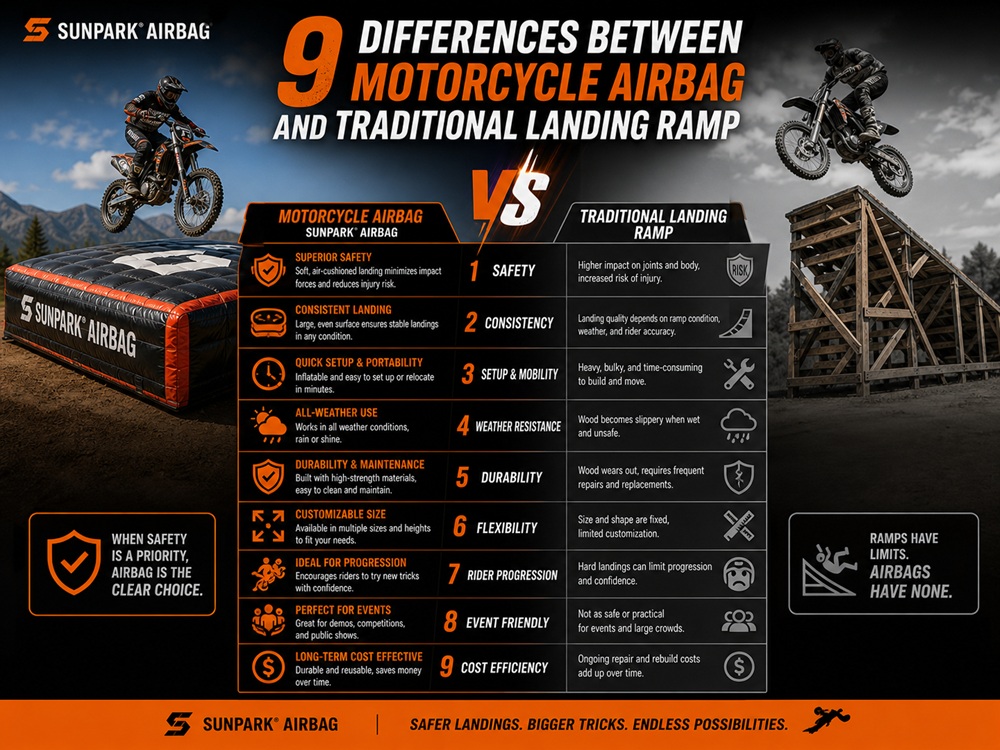
| Motocross riders | Supervised aerial-movement progressions | Purpose-designed system and professional oversight |
| Skiers and snowboarders | Freestyle rotations and aerial technique drills | Sport-specific setup and trained coaching |
| Gymnasts | Selected tumbling and aerial progressions | Correct pressure, level surface and skill supervision |
| Trampoline athletes | Controlled aerial drills and movement analysis | Appropriate landing configuration |
| Parkour practitioners | Jumping, rotation and landing-position practice | Landing accuracy and staged progressions |
| Stunt performers | Rehearsed falls and repeatable performance sequences | Rigging, positioning and specialist supervision |
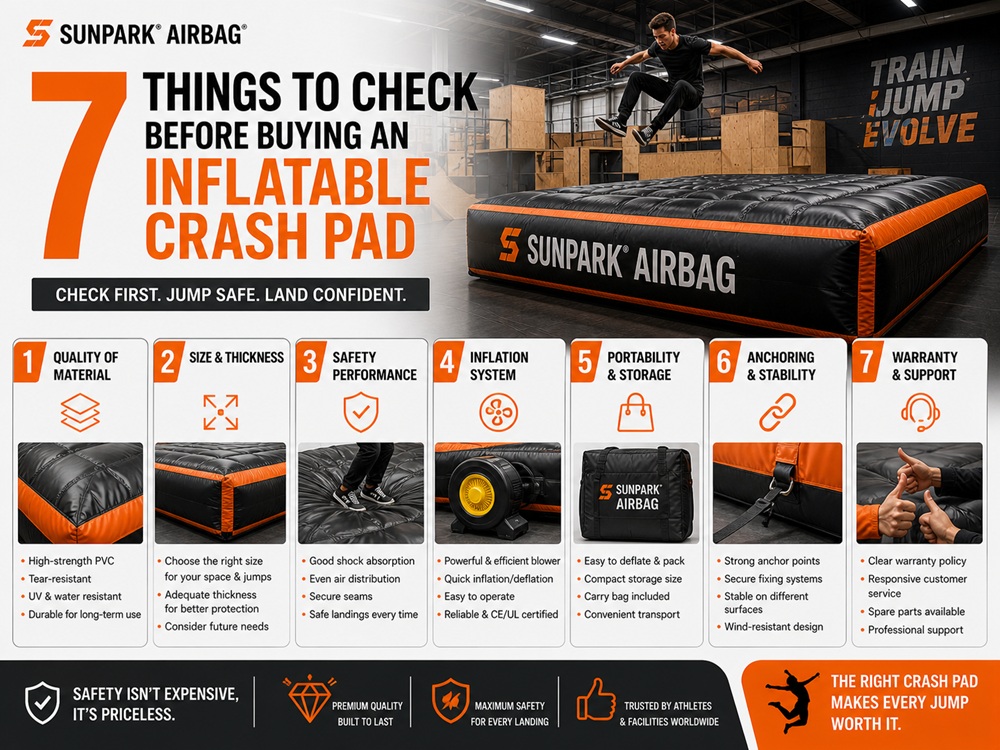
Buying advice: For a club or training facility, prioritize the intended use, dimensions, air management, material specification, blower reliability, inspection process and supplier support. The lowest initial quote is not necessarily the best long-term value.
1. What Is a Stunt Airbag?
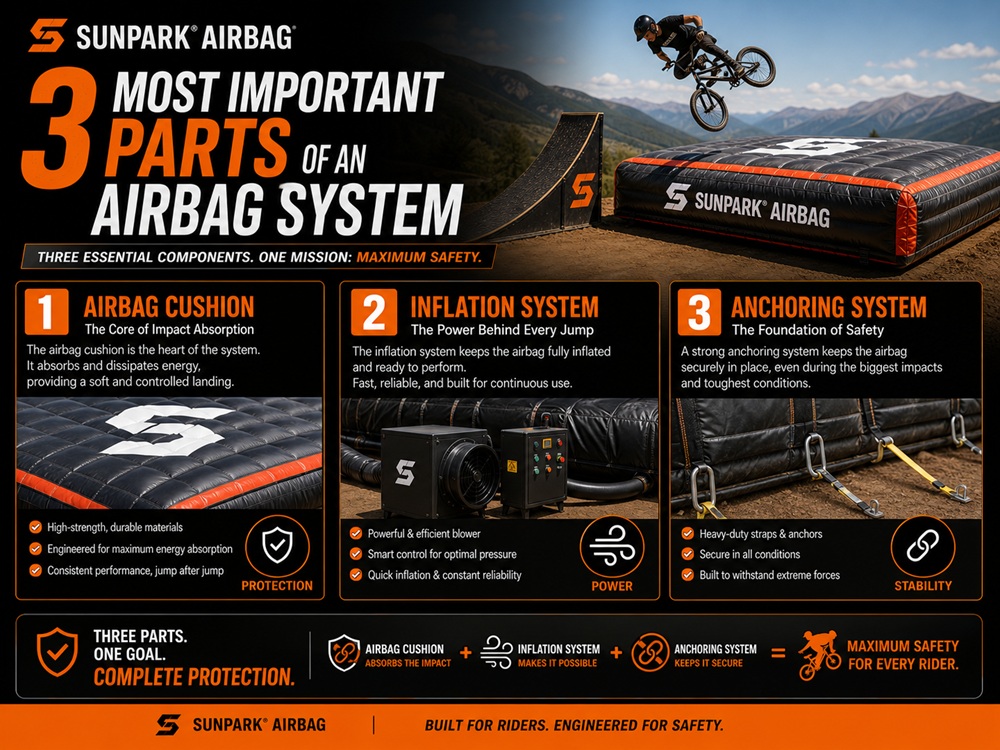
A stunt airbag is an inflatable landing surface designed for selected jump, aerial-skill and stunt-training applications. Its internal air volume and surface construction help manage landing forces, while its size and shape provide a designated landing zone. Depending on the system, the equipment may be used for action sports, organized training, recreational jump facilities or supervised performance rehearsals.
Airbags are not all interchangeable. A large, flat landing bag may suit certain aerial drills, while a purpose-designed landing ramp system may be more appropriate for a bike or board approaching at speed. A gymnasium may need a configuration designed around controlled tumbling progressions rather than a large outdoor jump.
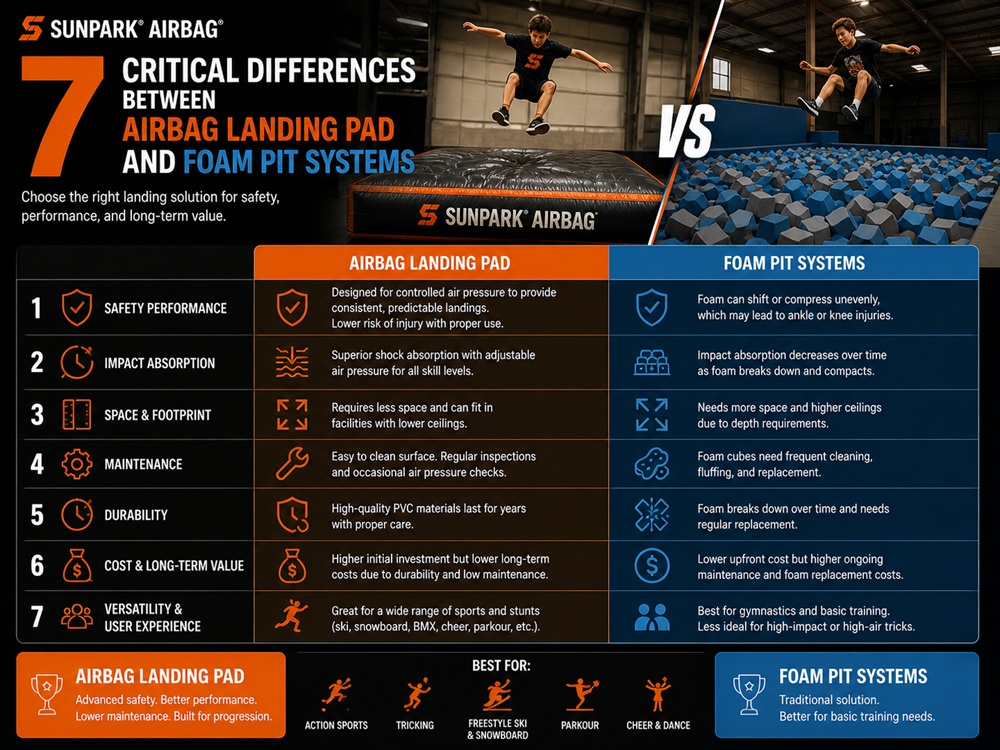
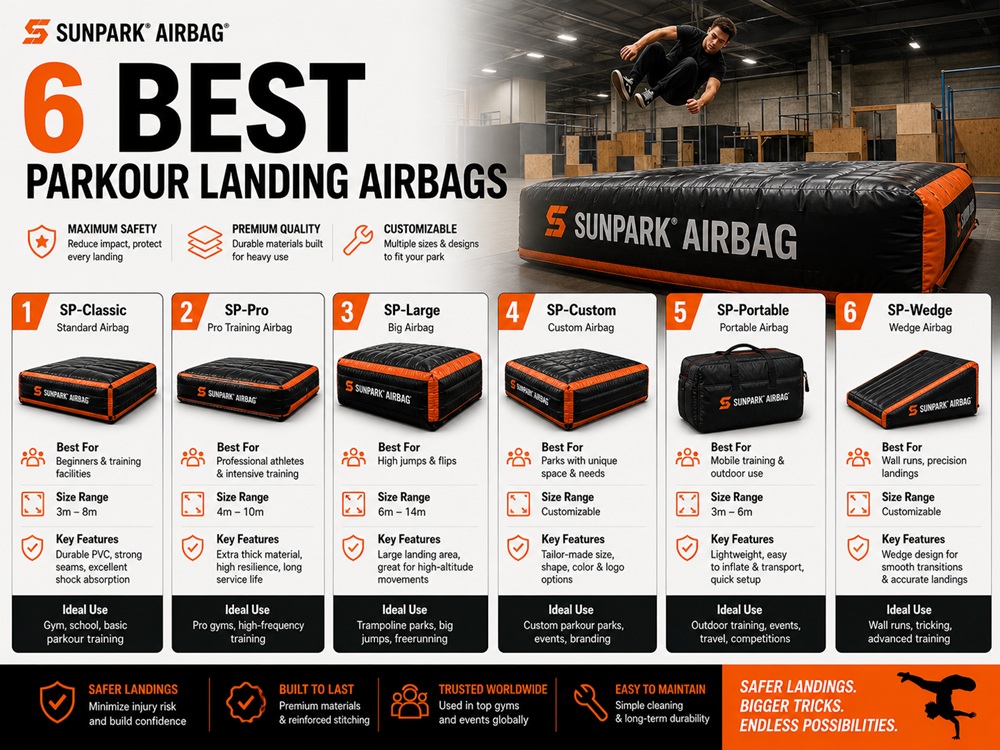
For facilities evaluating equipment, start with the intended skill, expected approach speed, landing orientation, user group and available setup area. SUNPARK offers different categories of stunt airbag landing equipment, along with sport-specific options such as a airbag landing ramp system. The right configuration depends on the actual training plan.
2. How Stunt Airbag Training Works
Effective airbag training follows a progression. The athlete first learns or rehearses the relevant movement at a suitable difficulty level, receives coaching feedback, and repeats the drill under consistent conditions. Only when the coach considers the skill sufficiently controlled should the athlete move toward more demanding variations or different landing surfaces.
Step 1: Define the skill and landing requirements
Identify the movement being trained, the expected landing position, the athlete’s experience and the consequences of an off-center landing. A flat landing bag is not automatically suitable for every jump, rotation or vehicle-based sport. High-speed applications require specialist assessment of the entire takeoff-to-landing system.
Step 2: Match the airbag to the athlete
Check the usable landing area, depth, surface behavior, anchoring, air supply and manufacturer’s operating instructions. For organized facilities, establish clear access rules and keep spectators, loose equipment and other athletes outside the landing zone.
Step 3: Train in controlled progressions
Start with familiar, lower-complexity movements. Coaches should evaluate consistency, body position and landing control instead of treating a soft surface as permission to attempt a skill beyond the athlete’s current ability. Fatigue, poor timing and overconfidence can still create dangerous situations.
Step 4: Inspect and review
Check the equipment before use and after any unusual landing, abrasion or impact. Follow the supplier’s guidance for inflation, pressure or firmness, anchoring, cleaning, repairs and storage. Record recurring issues in a facility maintenance log and remove damaged equipment from service until it has been assessed.
3. 8 Athletes Who Can Benefit From Stunt Airbag Training
1. BMX Riders
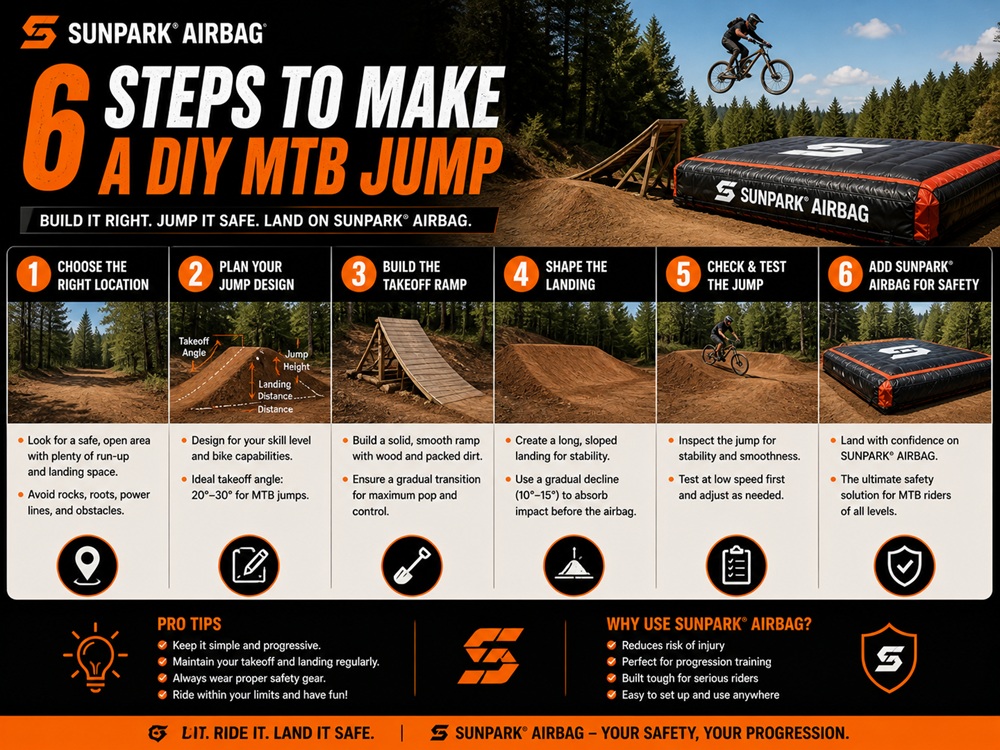
BMX riders often need to manage takeoff timing, bike control, rotation and landing alignment. For suitable drills, an airbag landing zone can provide a repeatable target for practicing selected aerial movements without immediately moving to a hard-packed landing. Coaches can review whether the rider consistently reaches the intended zone and maintains control through the landing sequence.
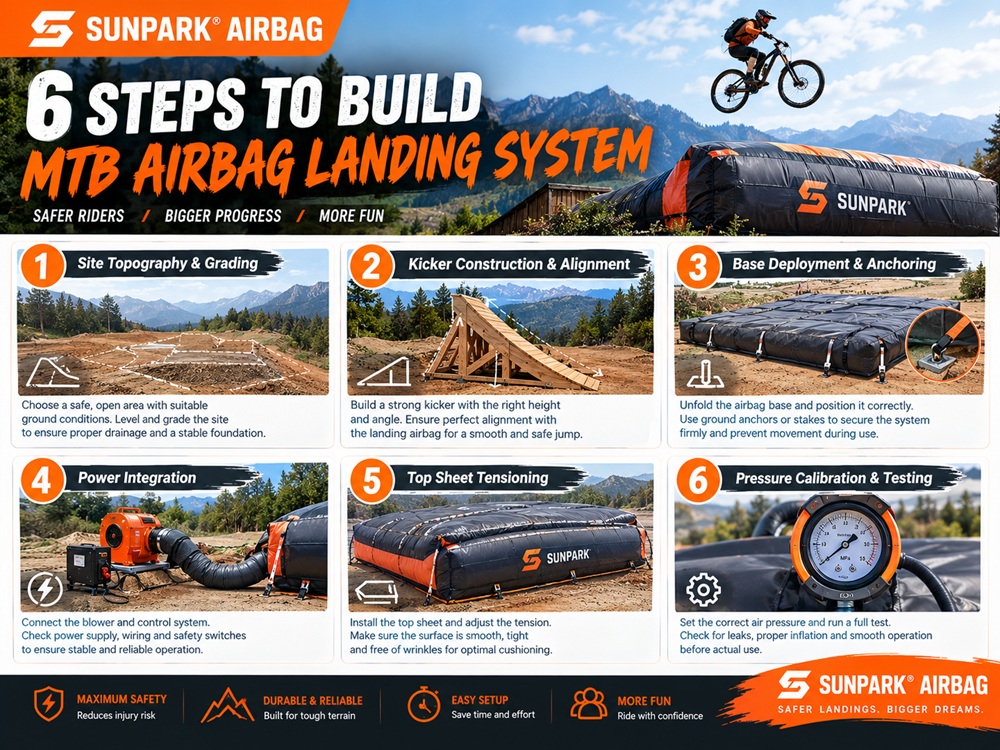
For BMX clubs and action-sports facilities, choose the landing system around the ramp geometry and rider approach—not simply the rider’s preferred trick. A dedicated bike airbag landing or BMX airbag landing system may be a better fit than a general-purpose bag. Review common BMX injuries and prevention strategies as part of a broader risk-management plan.
Our advice: Prioritize a stable setup, a clearly defined landing zone and coaching oversight. An airbag is a training tool, not a substitute for correct ramp design or rider judgment.
2. Skateboarders
Skateboarders may use suitable airbag setups to rehearse selected aerial tricks, body positioning and controlled dismounts. The main benefit is the opportunity to repeat a movement while focusing on timing and technique. This can be useful when an athlete is working on a progression that is not yet consistent on a conventional landing.
Not every skateboard trick belongs on an airbag. The board may move independently from the rider, and the interaction between wheels, deck and landing surface can differ from a skatepark floor. Facility operators should confirm that the configuration is suitable for the exact drill and that the athlete can enter and exit the landing zone safely.
Best for: supervised skill development where the coach can define the approach, landing target and acceptable progression. It is less useful when the training objective depends on the precise wheel-to-concrete response of a finished skatepark landing.
3. Motocross Riders
Motocross aerial training introduces additional variables: motorcycle mass, speed, takeoff shape, rider posture, vehicle trajectory and landing dynamics. A stunt airbag should only be used for motorcycle-based training when the complete setup is specifically designed and professionally assessed for that purpose. A general inflatable landing bag should never be assumed suitable for a motorcycle simply because it looks large enough.
For commercial training facilities, the decision should involve experienced coaches, system designers and the equipment supplier. Access control, approach consistency, emergency procedures and maintenance are as important as the airbag fabric itself. If the proposed application involves a motorcycle, obtain written confirmation of intended use and operating limits before purchase.
Our recommendation: Treat motocross airbag training as a specialist installation, not a do-it-yourself adaptation.
4. Freestyle Skiers and Snowboarders
Freestyle skiers and snowboarders develop aerial awareness, rotation control and landing technique through progressive practice. A suitable airbag facility can support selected dryland or aerial drills when the equipment, takeoff structure and coaching plan are designed for the sport.
The main purchasing question is whether the setup reproduces the training objective closely enough to be useful. An airbag can provide a forgiving landing target, but it does not reproduce every condition of snow, slope angle, speed or edge control. Athletes still need sport-specific coaching and an appropriate transition to the intended surface.
Best for: supervised aerial-skill progressions where coaches can separate the technique being rehearsed from the conditions that must be learned on snow.
5. Gymnasts
Gymnasts may benefit from selected airbag drills when learning spatial awareness, practicing controlled aerial movements or working through an appropriate progression. The goal is not to replace the gym’s normal equipment. It is to provide a suitable training option for specific skills under qualified supervision.
For gymnastics programs, surface response and stability matter. The airbag must be appropriate for the skill and used according to the manufacturer’s guidance. Coaches should decide when an athlete is ready to progress to a standard landing mat or other apparatus, rather than relying on the softness of the airbag as the only measure of readiness.
Facilities should compare general stunt airbags with dedicated gymnastics airbag equipment and other training surfaces. For some controlled drills, an inflatable crash mat may be the more appropriate product category, depending on the intended movement and manufacturer instructions.
6. Trampoline Athletes
Trampoline athletes rely on body awareness, consistent takeoff mechanics and controlled landings. An appropriately configured airbag can support selected supplementary aerial drills, particularly where a coach wants to observe a movement repeatedly in a defined landing area.
However, trampoline training has its own equipment and supervision requirements. An airbag should not be treated as a universal replacement for a trampoline safety bed, standard landing mats or a dedicated trampoline training system. Check whether the intended drill is supported by the equipment manufacturer and the facility’s governing safety procedures.
For commercial operators, a clear distinction between recreational use and coached training is essential. A public-access attraction needs user instructions, supervision, maintenance routines and capacity rules that match the facility’s actual risk profile.
7. Parkour Practitioners
Parkour practitioners practice jumps, vaults, rotations, precision landings and transitions between obstacles. A stunt airbag can be useful for selected aerial movements or progressions in which a coach wants the athlete to rehearse a controlled landing before moving to a more demanding setup.
The limitation is specificity. Parkour often depends on accurate foot placement, surface friction, balance and the ability to continue moving after contact. An airbag does not reproduce a narrow wall, rail, concrete edge or uneven urban surface. Athletes should use it to develop appropriate movement skills, not to assume that a successful landing on an inflatable surface guarantees readiness for a hard obstacle.
Practical recommendation: Use the airbag for clearly defined progressions, then develop precision and surface-specific skills in appropriate environments under competent supervision.
8. Stunt Performers and Action-Sports Training Teams
Professional stunt performers may need to repeat falls, jump sequences or choreographed aerial movements for rehearsal and production preparation. A purpose-selected airbag can help a team rehearse a defined landing sequence while managing some of the impact exposure associated with repeated takes.
Professional use requires planning beyond the product itself. The stunt coordinator or qualified supervisor should assess the fall height, trajectory, landing orientation, clothing and props, surrounding structures, access routes and emergency response. A landing bag must be appropriate for the planned stunt and installed according to the supplier’s requirements.
For commercial users, repeatability and downtime matter. Documented inspections, staff training, repair support and clear operating limits can be more valuable over time than a small reduction in the initial purchase price.
4. Benefits and Limitations of Stunt Airbag Training
Benefits that matter in practice
- More opportunities for controlled repetition: Coaches can arrange suitable drills around a defined landing zone and review repeated attempts.
- Support for skill progression: For selected movements, an airbag may provide an intermediate step between basic drills and a more demanding landing surface.
- Useful visual feedback: Instructors can observe body position, approach consistency and landing accuracy when the training environment is well organized.
- Flexible training applications: Depending on the design, airbags can support action-sports facilities, clubs, performance teams and selected gym training environments.
- Potential operational value: Facilities that schedule regular training may benefit from a reusable system when it is properly maintained and matched to their programming.
Limitations buyers should not overlook
- No guarantee against injury: An airbag can still produce harmful landings, particularly when the skill, landing trajectory or setup is inappropriate.
- Limited surface realism: An inflatable surface does not behave exactly like concrete, packed dirt, snow, a trampoline bed or a standard gymnastics mat.
- Space and setup requirements: The usable landing area, approach zone, anchoring and blower arrangement may require more room than buyers initially expect.
- Maintenance and operating costs: Blowers, electricity, cleaning, inspections, repairs, storage and staff time all contribute to the total cost of ownership.
- Sport-specific design requirements: A general-purpose airbag may be unsuitable for high-speed or vehicle-based applications.
From our experience with equipment selection, the biggest mistake is judging a landing system by how soft it feels when pressed by hand. What matters is whether the complete system is designed for the intended movement and whether it can be operated and maintained within documented limits.
5. Comparison Table: Choosing the Right Airbag
Different training environments need different equipment. Use this table as a starting point for supplier discussions, not as a substitute for a technical assessment of the proposed application.
| Equipment type | Typical use | Primary selection concern | Buyer priority |
|---|---|---|---|
| General stunt airbag | Selected aerial skills and stunt landing practice | Dimensions, landing behavior and intended use | Match the bag to the skill and environment |
| Bike or BMX landing airbag | Bike-based jump training in a purpose-designed setup | Approach speed, transition and landing geometry | Confirm compatibility with the complete ramp system |
| Gymnastics airbag | Selected gymnastics and tumbling progressions | Surface response and skill-specific suitability | Get coach and supplier approval for each intended drill |
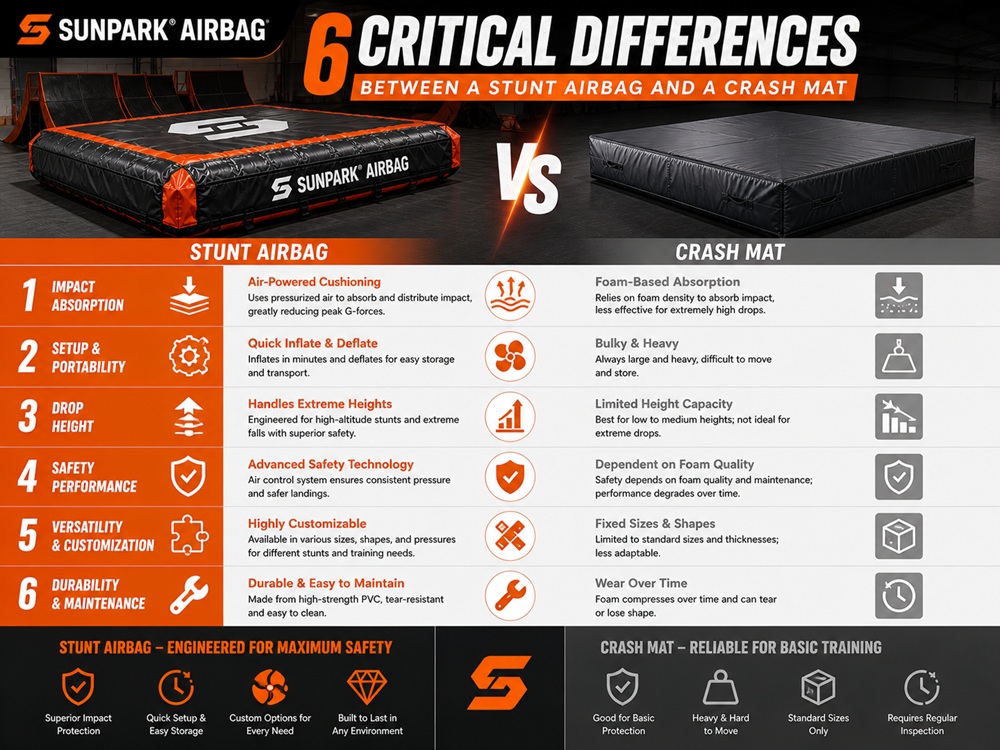
| Inflatable crash mat | Selected controlled falls and training applications | Thickness, construction and impact-use limits | Choose for the actual fall and landing scenario |
| Big jump airbag system | Purpose-designed jump installations | Overall layout, capacity, approach and exit areas | Assess the whole installation, not just the landing bag |
Explore SUNPARK’s gym airbag for training, big jump airbag system and other purpose-specific products when comparing configurations. The correct option is the one that satisfies the training requirements and can be operated safely and consistently—not necessarily the one with the largest dimensions.
6. Pros and Cons of Stunt Airbag Training
| Pros | Cons |
|---|---|
| Can support repeated practice of selected aerial skills | Does not eliminate injury risk |
| Offers a defined landing zone for supervised drills | May not reproduce the feel of the final landing surface |
| Can be useful across several athlete groups when correctly specified | Different sports may require different system designs |
| May support structured training programs and facility scheduling | Requires setup space, power, inspections and maintenance |
| Custom dimensions and printing may be available from some manufacturers | Customization can affect price, lead time and replacement-part planning |
| Reusable equipment may provide value for facilities with frequent sessions | Purchase price alone does not reflect lifetime operating cost |
The commercial case is strongest when the airbag will be used regularly, serves a clearly defined training purpose and fits the facility’s supervision and maintenance capabilities. For an individual who only practices occasionally, supervised access to a suitable facility may be more economical than owning and storing a large system.
7. Who Should Use It—and Who May Not Need It?
Who should consider stunt airbag training?
- Athletes working through coach-approved aerial skill progressions.
- Sports clubs that can schedule regular sessions and maintain the equipment.
- Training centers that need a repeatable landing area for selected drills.
- Stunt teams rehearsing a defined sequence under professional supervision.
- Commercial facilities able to implement inspection, access-control and emergency procedures.
Who may not need to buy one?
- Beginners who have not yet learned the foundational movement or safe landing mechanics.
- Casual users who would rarely use the equipment and have access to a suitable supervised facility.
- Facilities without enough room for the landing area, approach, anchoring and safe access routes.
- Buyers who cannot provide suitable supervision or follow the manufacturer’s maintenance instructions.
- Anyone planning to adapt a general-purpose airbag for a high-speed vehicle or stunt without explicit technical approval.
For beginners, coaching and fundamental movement skills should come first. For experienced athletes, the value of an airbag depends on whether it addresses a specific training limitation. For commercial users, the purchase should be justified by session demand, usable operating hours, staffing and total ownership cost.
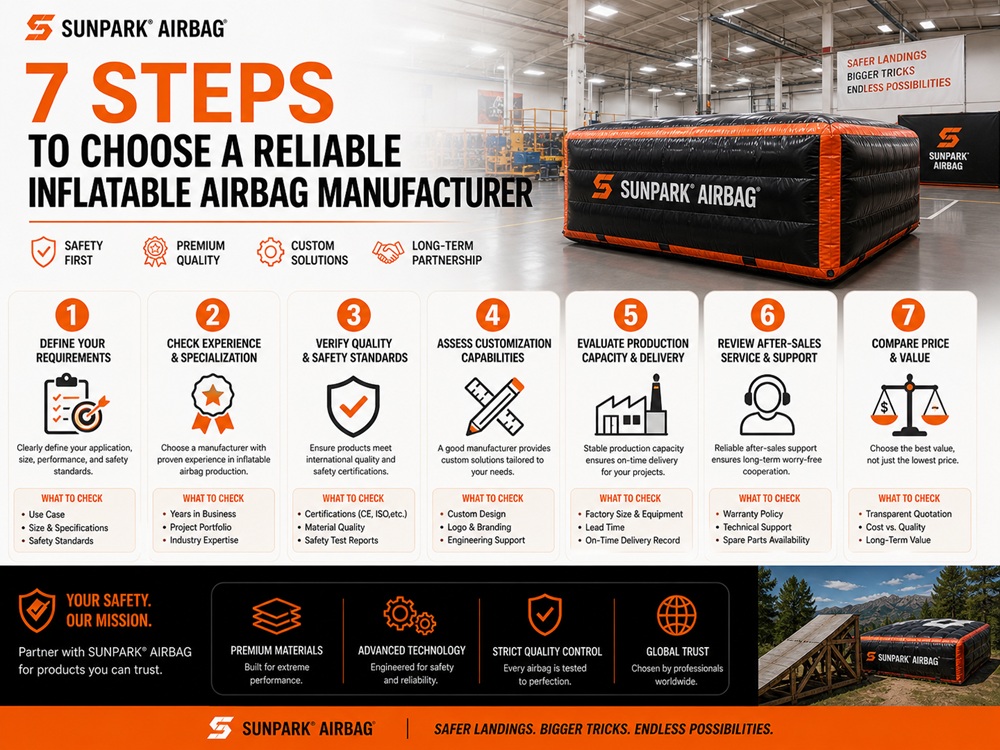
8. Buying Considerations for Clubs and Facilities
1. Start with the intended application
Write down the sport, skill, expected approach, landing orientation, athlete range and operating environment. Ask the manufacturer to confirm that the product is designed for the intended use. If the application involves bikes, motorcycles or other vehicles, require a specialist assessment of the complete system.
2. Confirm dimensions and usable landing area
Nominal dimensions do not tell the entire story. Consider the approach, takeoff structure, landing zone, side clearance, anchoring, entry and exit paths, and spectator separation. Measure the actual installation area before ordering a custom product.
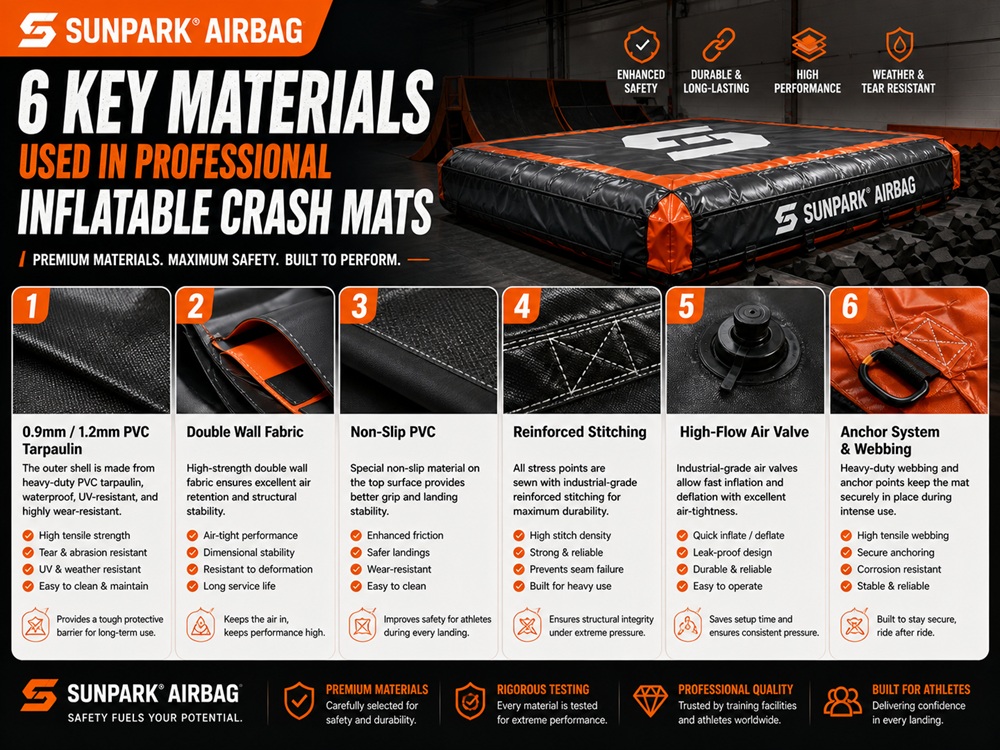
3. Review material and construction specifications
Ask for written information about the fabric, seams, reinforcement, surface material, UV resistance, water resistance and any relevant flame-retardancy claims. Confirm what each specification applies to and request supporting documentation where necessary. A material description alone does not establish that the complete product complies with every applicable safety requirement.
4. Evaluate the blower and air-management setup
Ask how the system is inflated, what power supply it needs, how firmness is managed, and what operating limits apply. Confirm whether continuous airflow is required and what procedures should be followed if a blower stops or power is interrupted. Follow the exact operating instructions for the model being purchased.
5. Compare total cost, not just the quotation
Purchase price is only one part of the budget. Include shipping, installation, electrical supply, staff training, maintenance, repair materials, storage, downtime and replacement components. For commercial facilities, calculate expected use over the equipment’s service life and compare the cost with the alternative of renting time at a suitable training venue.
6. Check lead time, warranty and after-sales support
Ask for a written production schedule, shipping estimate, warranty terms, spare-part availability and repair process. Clarify whether the quoted lead time refers to manufacturing only or includes shipping and installation. For a seasonal or scheduled facility launch, a clear delivery plan can be more valuable than a modest price discount.
7. Plan inspection and retirement
Establish who checks the equipment, what defects require it to be taken out of service, how repairs are documented and how the system is cleaned and stored. Use the manufacturer’s instructions rather than an assumed universal lifespan. SUNPARK’s airbag lifespan and safety guide can be a useful starting point for maintenance discussions, but the condition of the specific product and its inspection history must guide any decision to continue using it.
9. Common Training and Purchasing Mistakes
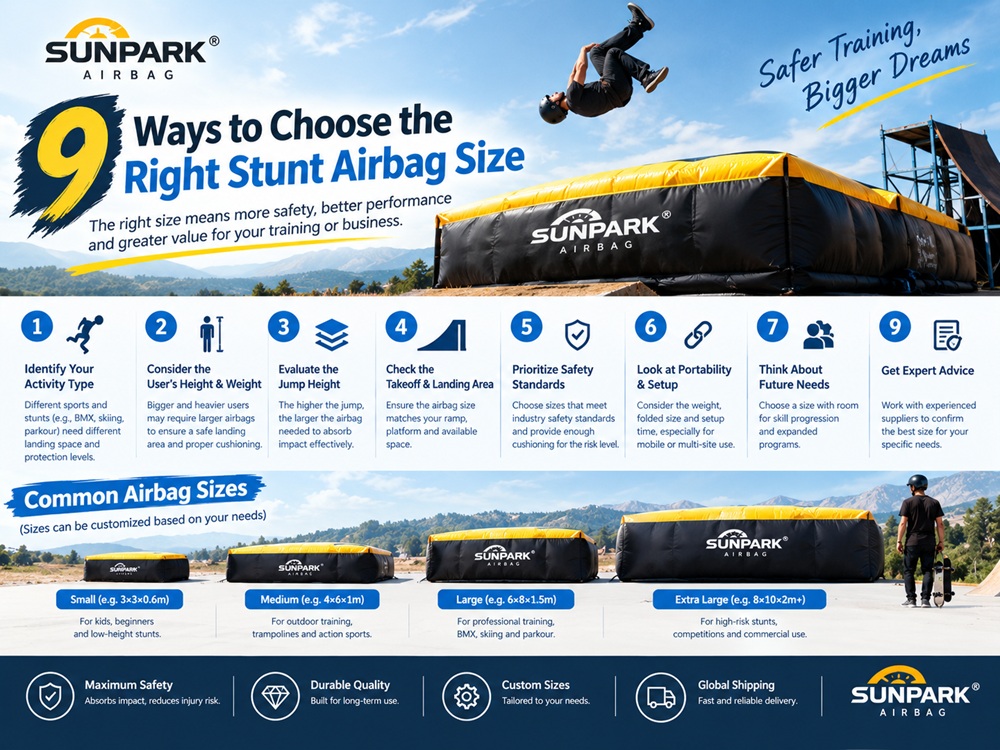
Choosing the biggest airbag instead of the right airbag
A larger landing area may sound more forgiving, but dimensions alone do not establish suitability. Landing behavior, geometry, inflation requirements and intended use must all match the training plan. Ask the supplier to explain why its design fits the actual skill.
Assuming a soft landing makes an advanced skill safe
Athletes can still land awkwardly, rotate unexpectedly or move outside the intended landing zone. Progression, coaching and clear operating rules remain essential. Never use an airbag as justification for attempting a skill beyond the athlete’s preparation.
Using one product for every sport
Gymnastics, BMX, parkour and vehicle-based stunts impose different demands. A product that is suitable for one controlled drill may be inappropriate for another. Confirm the use case in writing, particularly when speed, vehicle mass or specialized ramp geometry is involved.
Ignoring maintenance and operating costs
Fabric, seams, blowers, anchors and electrical components need routine attention. Build the inspection and maintenance process into the operating budget before opening the facility. Keep repair supplies and supplier contact details accessible, and remove equipment from use whenever its condition raises a safety concern.
Buying without a clear training plan
Before placing an order, identify who will use the airbag, how frequently it will be used, which skills it will support and who will supervise each session. If these questions cannot be answered, renting supervised access or refining the program first may be the better decision.
10. A Stunt Airbag Option From SUNPARK
For clubs, training facilities and event operators evaluating a general stunt airbag, SUNPARK offers a customizable model with multiple size options and accessories. It may be worth considering when the planned application matches the manufacturer’s approved use and the buyer needs a tailored size, color or printed design.
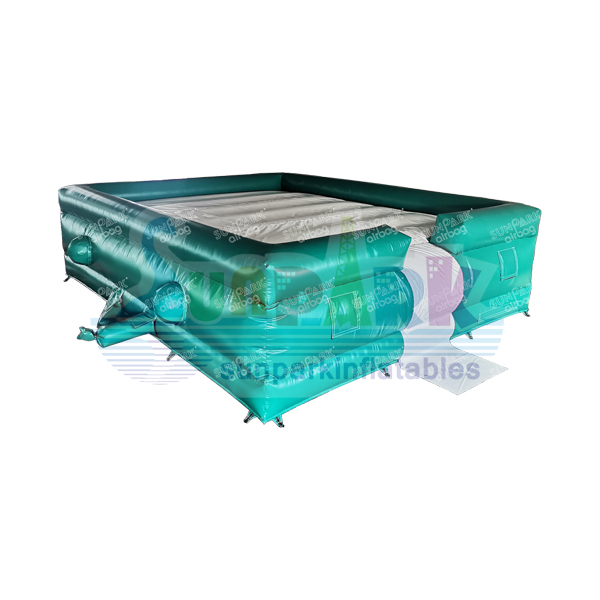
SUNPARK Stunt Airbag
Price: Affordable and negotiable; request a quotation for the intended size and configuration.
- Listed material: 0.55 mm PVC tarpaulin for the airbag and 0.9 mm PVC tarpaulin for the top sheet.
- Material features stated by the supplier: Waterproof, flame-retardant, UV-protected, lead-free and phthalate-free.
- Listed size: 7 × 6 × 2 m.
- Other size options: Regular options include 10 × 10 × 3 m and 15 × 15 × 3 m, with customization available.
- Customization: Color options and digital, silk-screen or UV printing.
- Accessories: Blower, repair kit and heavy-duty carrying bag.
- Packaging: Airbags packed in heavy-duty carrying bags; blowers packed in strong boxes.
- Indicative production time: Around 15 working days, depending on order size and quantity. Confirm the current schedule before ordering.
- HS code listed by supplier: 9506990000. Confirm classification with your customs broker for the destination country and product configuration.
Supplier specifications should be verified in the final quotation, drawings and product documentation. Ask for the operating instructions, warranty terms, applicable test reports and written confirmation of the intended application before committing to purchase.
When requesting a quotation, provide the intended sport, skill, target dimensions, indoor or outdoor environment, expected usage frequency, preferred color, printing requirements and delivery destination. This helps the supplier assess the configuration instead of pricing a product that may not suit your actual needs.
11. Expert Recommendation: When Is Stunt Airbag Training Worth It?
We recommend stunt airbag training when it solves a specific training problem: an athlete needs controlled repetitions, a coach needs a defined landing zone, or a facility needs equipment for a planned and supervised progression. It is most valuable when the system is used consistently and its design matches the sport.
For an individual athlete, start by finding a reputable facility that already has appropriate equipment and qualified coaching. That is usually the sensible route before investing in a large inflatable system. For a club, assess the expected number of sessions, available space, supervision requirements and maintenance budget. For commercial operators, evaluate the full installation and operational process—not just the bag.
Before buying, compare the intended use, construction, dimensions, blower requirements, customization, warranty, service support and total cost of ownership. Ask for written confirmation that the proposed system is appropriate for the planned training application. If a supplier cannot explain the intended use and operating limitations clearly, do not treat a low price as a reason to proceed.
Our final position: A stunt airbag is a useful training investment when it supports a defined, coach-led progression and is selected for the exact application. It is not a shortcut to advanced skills and should never be treated as a guarantee against injury. Match the system to the athlete, verify the specifications and build inspection and supervision into the plan from day one.
12. Frequently Asked Questions
1. What athletes benefit most from stunt airbag training?
BMX riders, skateboarders, motocross riders, freestyle skiers and snowboarders, gymnasts, trampoline athletes, parkour practitioners and stunt performers may benefit from suitable airbag training. The value depends on the skill, equipment design, athlete experience and quality of supervision.
2. Does a stunt airbag prevent injuries?
No. A suitable airbag may help manage some landing impacts in its intended application, but it cannot eliminate injury risk. Poor technique, inappropriate equipment, high-speed approaches, awkward landings and inadequate supervision can still cause serious injury.
3. Can beginners train on a stunt airbag?
Beginners may use an airbag for appropriate basic drills under qualified supervision, but they should first learn foundational movement and landing skills. A forgiving landing surface does not make an advanced trick suitable for an unprepared athlete.
4. Can one stunt airbag be used for multiple sports?
Some systems can support more than one suitable training application, but this must be confirmed by the manufacturer. A general-purpose airbag should not be assumed suitable for high-speed bike or motorcycle use, gymnastics, or every type of aerial landing.
5. What size stunt airbag should I buy?
Choose dimensions based on the intended skill, landing trajectory, approach speed, user group, surrounding clearance and manufacturer’s design requirements. Measure the full installation area and seek a technical recommendation before ordering a custom product.
6. What should a training facility check before purchasing?
Confirm intended use, dimensions, material and seam specifications, blower requirements, anchoring, operating instructions, warranty, repair support, delivery time and maintenance requirements. Ask for relevant documentation and written confirmation of the proposed application.
7. How long does a stunt airbag last?
Service life varies with materials, design, usage frequency, exposure, storage, maintenance and repair history. Follow the manufacturer’s inspection and retirement guidance. Do not rely on age alone or assume an airbag remains safe simply because it still inflates.
8. Is a stunt airbag worth the investment for a commercial facility?
It can be worthwhile when the facility has consistent demand, suitable space, trained staff and a clear maintenance process. Compare the purchase and operating costs with expected usage and alternatives such as renting time at an established training venue. The correct financial decision depends on actual utilization, not just the initial quotation.
13. References
The following authoritative resources provide broader context for sports safety, facility risk management and injury prevention. They do not certify any specific stunt airbag product; buyers should also review the selected manufacturer’s documentation and the requirements applicable to their facility.
- U.S. Consumer Product Safety Commission — Sports, Fitness and Recreation Safety. General consumer safety resources relevant to recreational equipment and injury prevention.
- National Athletic Trainers’ Association. Professional resources on athletic health, training practices and injury prevention.
- U.S. Centers for Disease Control and Prevention — HEADS UP. Concussion recognition and response resources relevant to sports settings and head-impact awareness.