Quick Answer: What to Check Before Buying an Inflatable Crash Pad
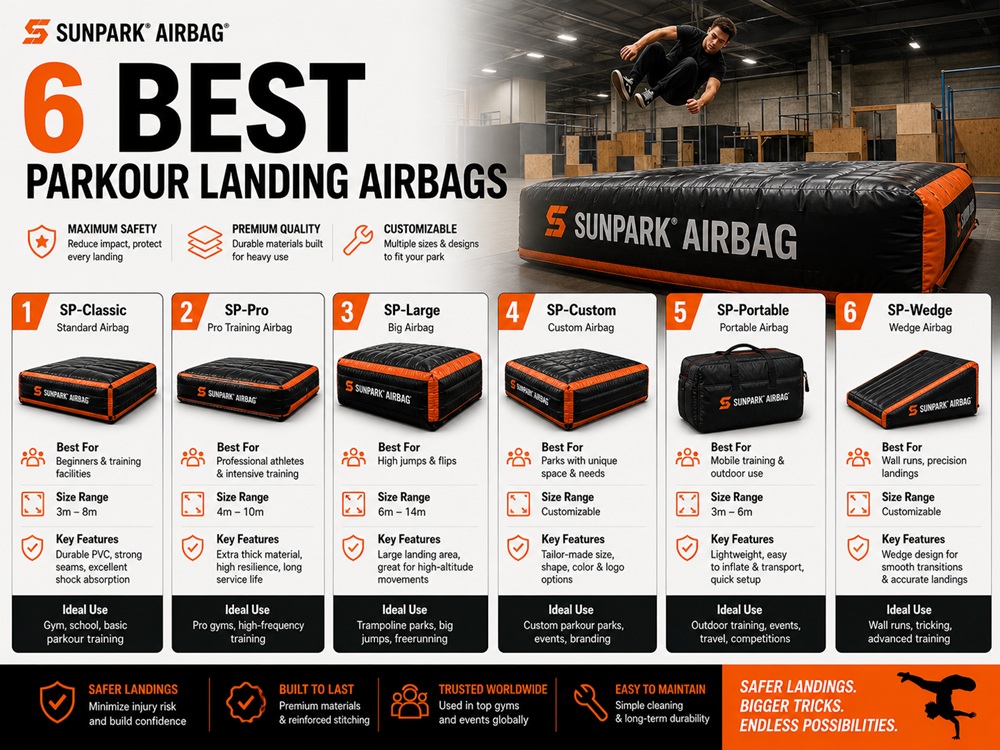
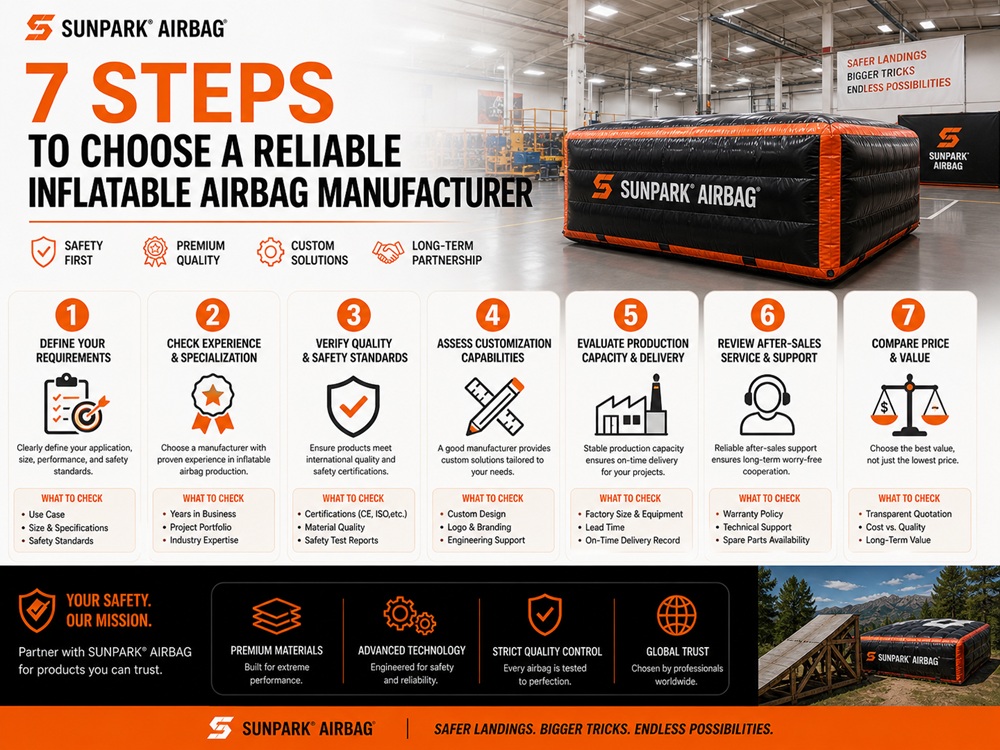
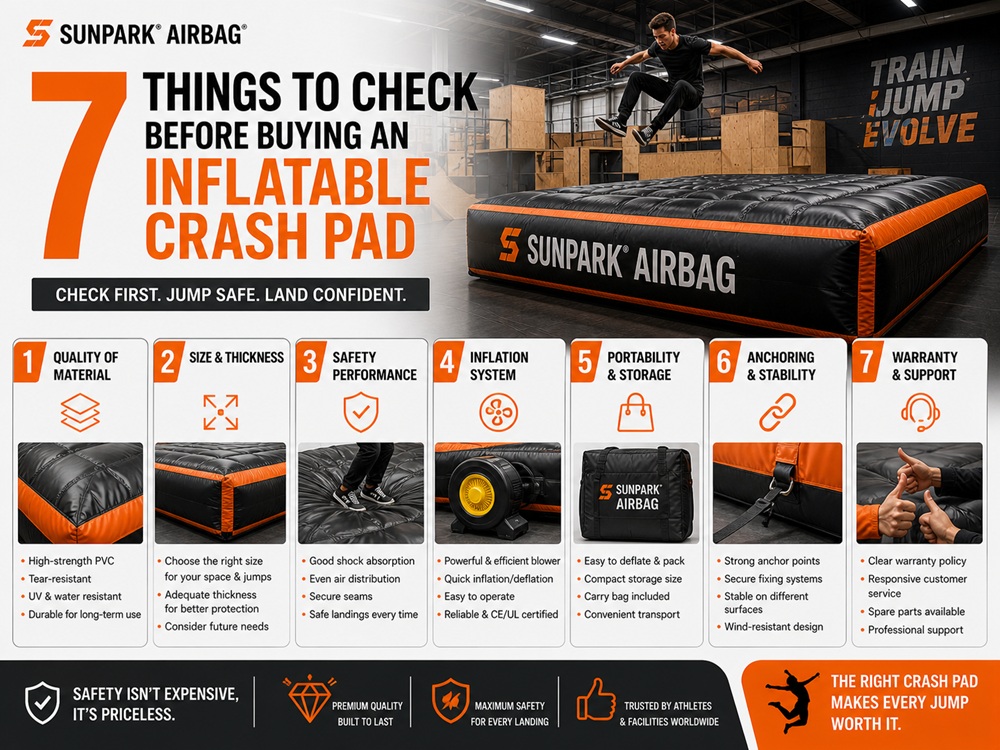
Before buying an inflatable crash pad, commercial buyers must bypass superficial promotional claims and audit seven non-negotiable physical and structural engineering benchmarks: (1) Dual-Chamber Safety Architecture (an upper soft-landing absorption layer paired with an isolated, independently pressurized lower safety reservoir to eliminate bottoming-out); (2) Commercial Material Caliber (a minimum of 0.55mm / 18oz commercial-grade PVC tarpaulin for internal baffles, paired with an ultra-durable 0.9mm / 32oz replaceable top wear sheet); (3) Calibrated Air-Relief Venting and Continuous-Blower CFM (adjustable pressure relief valves that dynamically exhaust air on impact without launching the athlete upward on a rebound wave); (4) Fall-Height Deceleration Depth Ratios (matching cushion thickness to kinetic fall velocity, from 0.5m for low gymnastics up to 3.5m+ for extreme jump towers); (5) Friction-Free Replaceable Top Sheet Design (heavy-duty hook-and-loop anchoring that prevents friction burns and allows cheap sheet replacement without discarding the main airbag core); (6) Certified Fire-Retardant and Toxicological Compliance (verified adherence to ASTM F2970, EN 14960, and NFPA 701 fire safety standards); and (7) Manufacturer Experience and Turnkey Accessories (sourcing from established factories with at least 5+ years of verified workmanship, certified blowers, and comprehensive repair bundles). Sourcing an engineered landing platform like the Sunparkairbag Airbag Crash Mat guarantees proven multi-year impact resilience.
What It Is: The Aerodynamic Deceleration Mechanics of an Inflatable Crash Pad
To evaluate what you need before buying an inflatable crash pad, you must understand the physical mechanics of aerodynamic deceleration. When an athlete jumps from a platform, a trampoline, or a bike ramp, their body accumulates kinetic energy proportional to their mass and the square of their falling velocity ($E_k = \frac{1}{2}mv^2$). To bring that athlete to a dead stop without breaking bones, tearing ligaments, or injuring the cervical spine, that kinetic energy must be dissipated over a controlled distance and time ($W = F \times d$).
Traditional open-cell polyurethane foam cubes absorb impact purely through mechanical cell compression. As the foam compresses, its internal resistance increases exponentially; if an athlete drops from a high jump tower, the foam cubes compress completely, causing an abrupt physical deceleration spike at the bottom. Furthermore, traditional pits are notorious hygiene disasters: they trap sweat, dead skin cells, hair, and dust mites, and their open-cell matrix breaks down into breathable chemical dust.
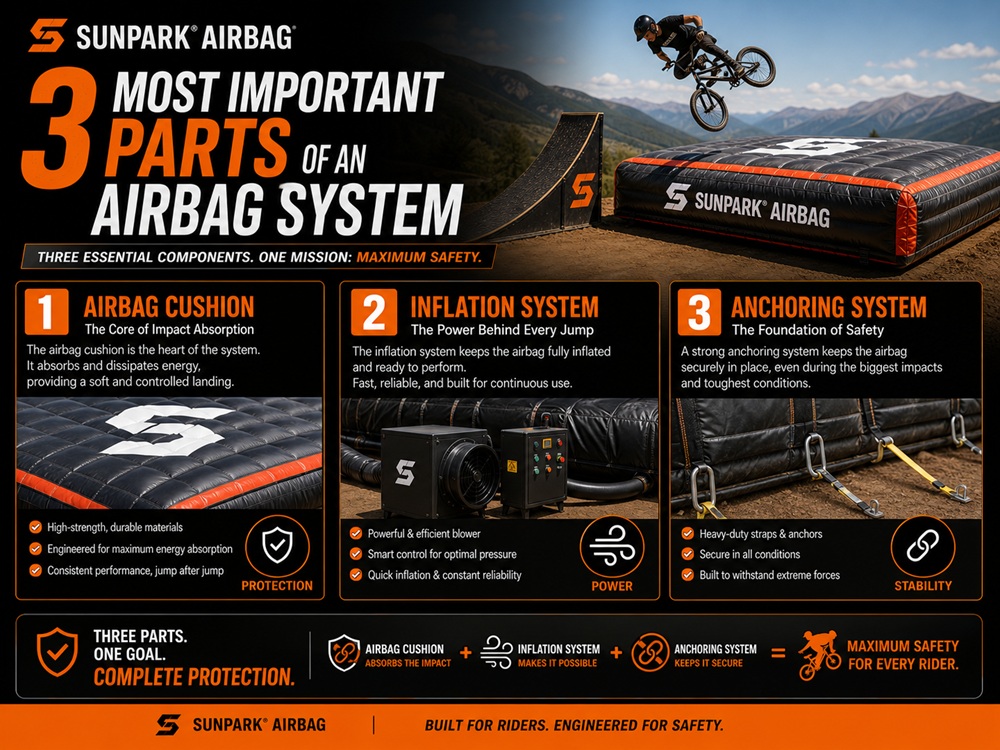
A professional inflatable crash pad operates on the principle of controlled aerodynamic displacement. When an athlete strikes the top surface of the cushion:
- The top sheet depresses, compressing the air volume inside the upper chamber.
- Specially calibrated pressure-relief exhaust vents open, discharging a calculated volume of air to absorb the downward momentum smoothly and evenly.
- Rather than rebounding like a rubber trampoline or hitting a hard bottom limit, the athlete experiences a progressive, constant-force deceleration curve.
- An electric blower continuously pumps fresh air into the sealed internal core, re-inflating the upper chamber within seconds so the next athlete can jump safely.
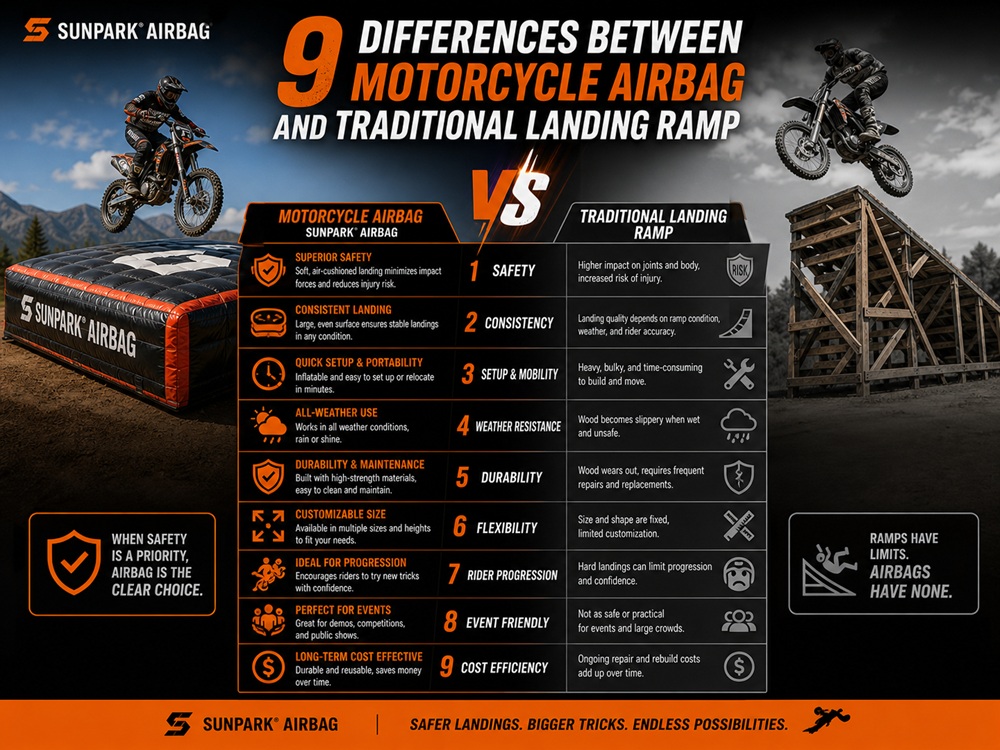
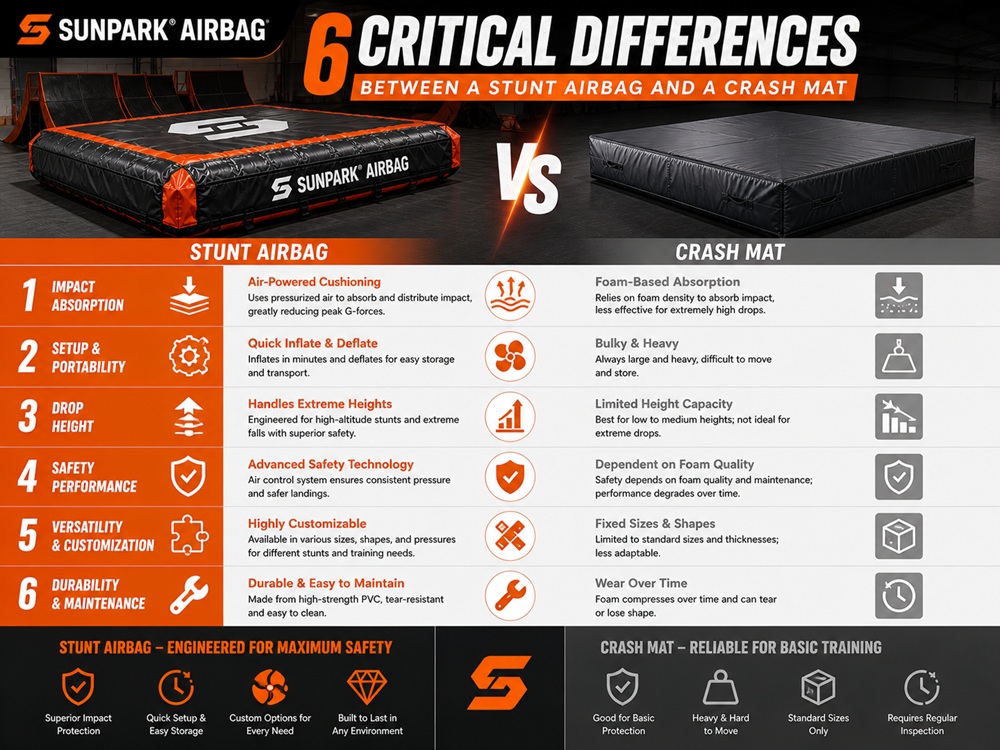
In most professional situations, replacing legacy foam cubes with an engineered gym airbag for training cuts facility operating costs dramatically, improves air quality, and accelerates athlete progression. If you are comparing facility renovation options, review our deep dive into the foam pit vs airbag comparison before spending capital on new foam blocks.
Quick Summary Table: The 7 Pre-Purchase Inspection Checkpoints
| Inspection Factor | Engineering Metric | Commercial Target Benchmark | Critical Failure Prevented | Operational Bottom Line |
|---|---|---|---|---|
| 1. Internal Chamber System | Baffle architecture | True dual-chamber design (Top soft, bottom firm) | Bottoming-out against concrete subfloor | Zero spinal compression injuries |
| 2. PVC Tarpaulin Caliber | Material weight & thickness | 0.55mm base/baffles + 0.9mm top wear sheet | Punctures, tears, and catastrophic seam blowout | Delivers 5 to 8+ years of continuous service |
| 3. Airflow Venting & Blower | Exhaust CFM & blower power | Adjustable hook-and-loop vents + commercial blower | Violent trampoline rebound launching jumper | Smooth, progressive deceleration profile |
| 4. Depth-to-Fall Ratio | Cushion thickness (meters) | Calculated 1:3 or 1:4 fall-height-to-depth ratio | Insufficient deceleration distance on heavy drops | Protects multi-story and high-velocity stunts |
| 5. Top Sheet Replaceability | Attachment & friction index | Industrial hook-and-loop + low-friction PVC finish | Friction burns; discarding entire bag when worn | Cheap sheet swapping extends core lifespan |
| 6. Safety Certifications | Standards compliance | ASTM F2970, EN 14960, NFPA 701 (Fire retardant) | Insurance policy cancellations and fire marshal shutdowns | Guarantees legal commercial operation |
| 7. Factory Workmanship | Welding & reinforcement | Hot-air welding, reinforced stress points, 5+ yr exp | Premature seam delamination and constant leaks | Maximizes daily facility uptime and revenue |
The 7 Things to Check Before Buying an Inflatable Crash Pad
1. Dual-Chamber vs. Single-Chamber Internal Baffle Engineering
The single most dangerous mistake when buying an inflatable crash pad is settling for a cheap, single-chamber design. In a single-chamber bag, the entire inflatable is one giant hollow pocket of air. When an athlete lands, air simply rushes away from the point of impact toward the edges of the bag. If the athlete drops from a high platform or lands off-balance, the localized impact pushes through the air pocket and slams directly into the concrete floor beneath—a catastrophic failure known as bottoming out.
In contrast, professional facilities demand a dual-chamber internal baffle architecture:
- The Upper Absorption Chamber: Features flexible internal vertical baffle walls and adjustable exhaust vents. When the jumper lands, this top section compresses progressively, exhausting air to cushion the initial impact smoothly without jarring joints.
- The Lower Safety Reservoir: A completely separate, sealed lower air foundation running on independent higher pressure. Even if an athlete takes a high-velocity landing that completely compresses the upper chamber, the lower safety chamber never bottoms out. It acts as an immovable pneumatic floor, absorbing the final residual kinetic energy safely above the subfloor.
From our experience on commercial drop towers, dual-chamber safety engineering is non-negotiable for any fall height exceeding 1.5 meters. Whether deploying a stunt airbag landing or a dedicated gymnastics airbag equipment installation, dual-chamber architecture is the baseline of commercial safety.
2. Material Caliber: 0.55mm Core vs. 0.9mm Heavy-Duty Wear Layers
In the inflatable manufacturing sector, cutting material costs is easy: dishonest vendors use lightweight 420D Oxford nylon or cheap 0.4mm laminated plastic film that looks fine in catalog photos but shreds under commercial athletic use. Real commercial durability requires industrial-grade, high-tensile polyvinyl chloride (PVC) tarpaulin reinforced with an internal high-density polyester scrim.
When reviewing manufacturer specifications, enforce the 0.55mm / 0.9mm Standard:
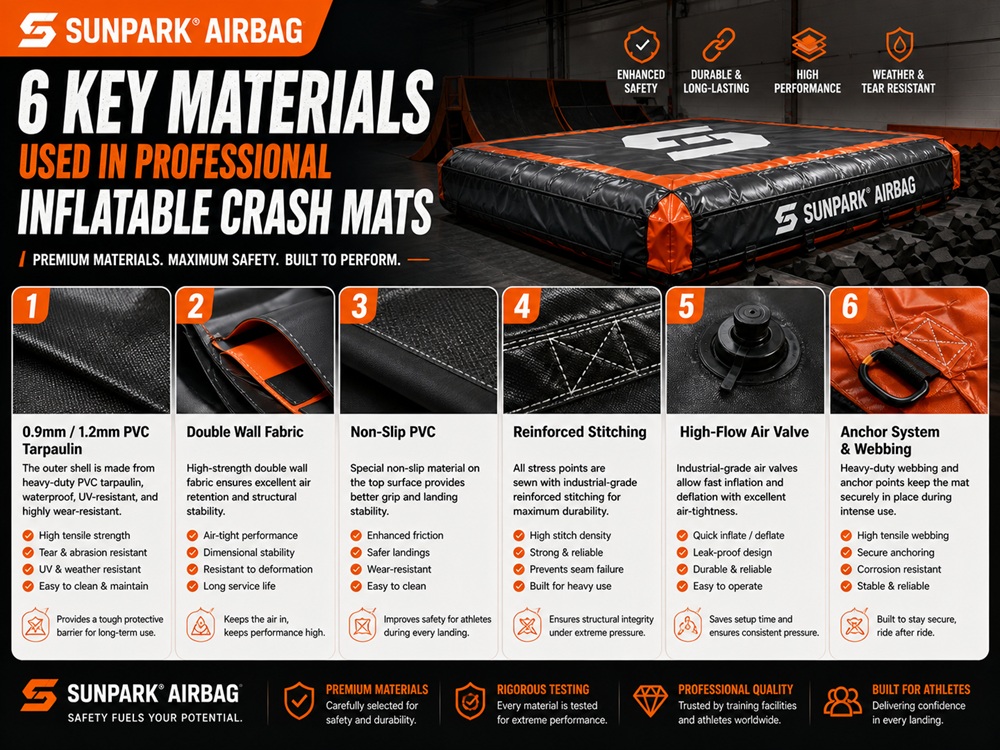
- 0.55mm (18oz / 650g/m²) PVC Tarpaulin: The gold standard for the internal structural baffles, side perimeter walls, and ground sheet. It provides exceptional tensile break strength (≥ 2500 N/5cm) and puncture resistance while remaining light enough to allow clean baffle movement.
- 0.9mm (32oz / 1000g/m²) Heavy-Duty PVC Tarpaulin: Mandatory for the top landing sheet. The top surface absorbs thousands of shoe impacts, skateboard wheels, bike pedals, and landing friction every week. A 0.9mm wear sheet resists punctures from dropped keys or buckles, withstands intense surface abrasion, and repels water and sweat effortlessly.
Ensure the material is certified lead-free, phthalate-free, and UV-stabilized so the plasticizer does not crack under indoor lighting or outdoor sunlight. For high-impact extreme sports applications, explore our specialized bike airbag landing and dirt bike airbag landing systems.
3. Airflow Relief Valves, Blower CFM & Pressure Tuning
An inflatable crash pad is not a static balloon; it is a dynamic air-flow system. If an inflatable bag is sealed completely airtight with nowhere for air to exhaust during a jump, it behaves like an over-inflated rubber ball: the athlete lands, and the trapped air pressure launches them violently back into the air or rolls them off the side onto the concrete floor.
Audit the pneumatic management system:
- Adjustable Hook-and-Loop Relief Vents: The side perimeter of the upper chamber must feature adjustable air vents sealed with heavy-duty commercial hook-and-loop flaps. This allows facility operators to fine-tune the firmness of the landing. For a 40 kg child in a gymnastics class, open the vents slightly wider for a feather-soft catch; for an 85 kg adult practicing parkour or tricking, close the vents down to increase pneumatic backpressure.
- Blower Cubic Feet per Minute (CFM) & Static Pressure: The system must be paired with an industrial-grade centrifugal blower that matches the bag’s internal cubic volume. The blower must provide enough continuous static pressure to maintain full shape during standby, yet allow smooth air exhaust during impact and complete re-inflation within 3 to 5 seconds after the athlete steps off.
4. Deceleration Depth vs. Critical Fall Height Metrics
One of the most dangerous commercial procurement errors is purchasing an undersized, shallow crash pad to save money or fit a tight ceiling space. In physical dynamics, you cannot compress deceleration distance past the laws of gravity. If you drop a jumper from a 4-meter platform onto a 0.5-meter deep pad, the deceleration force will exceed 10 Gs, causing severe spinal compression and whiplash.
Use these field-tested depth-to-height ratios when buying an inflatable crash pad:
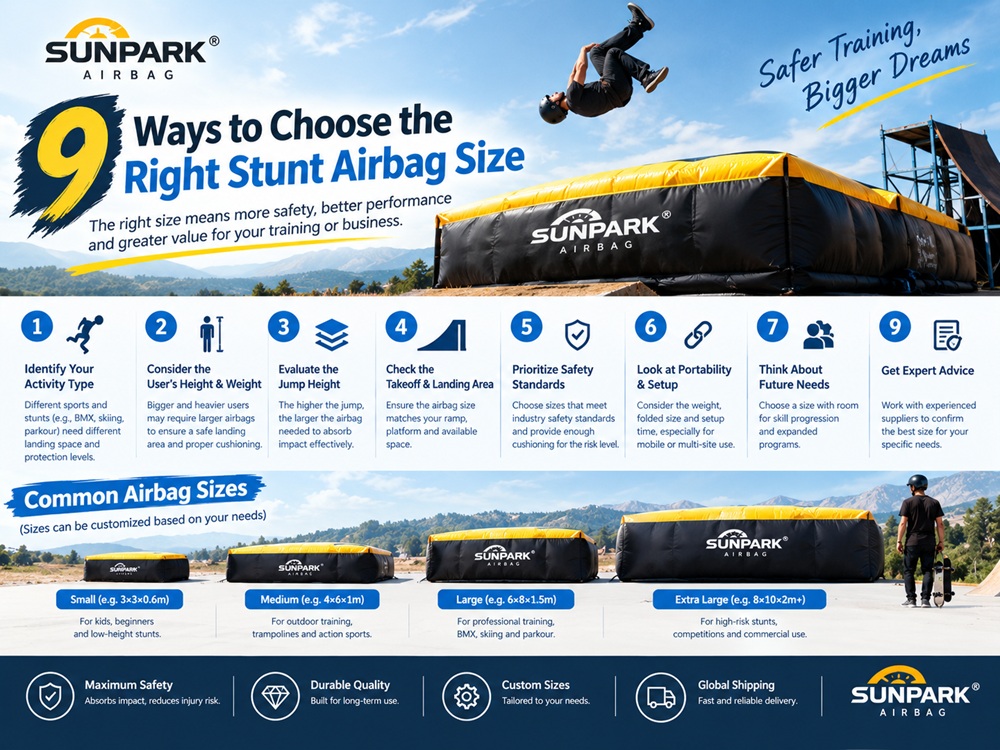
- Low Gymnastics, Tumbling & Bouldering (Falls up to 1.8m): Pad depth of 0.5 to 0.8 meters (20 to 32 inches). Provides progressive cushioning for dismounts and low vaulting.
- Trampoline Discharges, Parkour & Freestyle Tricking (Falls of 2.0 to 4.5m): Pad depth of 1.2 to 1.5 meters (4 to 5 feet). The universal standard for commercial trampoline parks and extreme action facilities.
- Extreme High Jump Towers, Stunts & FMX (Falls of 5.0 to 10.0+ meters): Pad depth of 2.0 to 3.5 meters (6.5 to 11.5 feet). Mandatory for large-scale drop towers and big-air bike gaps. Review heavy-duty platforms across our big jump airbag system catalog.
5. Removable Top Sheet Friction Index and Maintenance Modularity
The top landing surface of an inflatable crash pad takes 95% of all operational abuse. If an athlete lands on a high-friction, sticky vinyl surface while wearing shorts or with exposed elbows, the mechanical shearing force causes painful friction burns (similar to turf burn). Furthermore, if the top sheet is permanently stitched directly to the core airbag baffles, a single tear from an errant tool or shoe buckle ruins the entire multi-thousand-dollar crash pad.
Demand an independent, detachable top wear sheet:
- The top sheet must feature a specialized satin-finish or micro-textured PVC coating that allows skin and clothing to slide smoothly without sticking.
- It should attach around the entire upper perimeter using a continuous, heavy-duty 4-inch to 6-inch industrial hook-and-loop fastening system reinforced with stainless steel D-rings.
- If the top sheet eventually wears out after three years of heavy commercial traffic, you simply unpeel the hook-and-loop border and zip on a brand-new top sheet for a few hundred dollars, instantly restoring the landing surface to factory-new condition without replacing the main internal airbag core.
6. Fire Retardancy, Non-Toxicity, and ASTM/EN Safety Certifications
Operating a commercial athletic facility requires strict adherence to municipal fire codes, commercial liability insurance standards, and regional safety inspectors. If a local fire marshal inspects your gym and finds an uncertified inflatable cushion fabricated from flammable plastic film, your facility will be shut down immediately.
Before issuing payment, mandate certified laboratory test reports verifying compliance with:
- ASTM International: ASTM F2970 Standard Practice for Design, Manufacture, Installation, and Operation of Trampoline Courts (which governs airbag landing pit integration).
- European Standard EN 14960: Inflatable Play Equipment – Safety Requirements and Test Methods.
- National Fire Protection Association: NFPA 701 Standard Methods of Fire Tests for Flame Propagation of Textiles and Films.
Confirm that all PVC materials are certified lead-free, cadmium-free, and phthalate-free, guaranteeing that athletes rolling on the surface are never exposed to toxic plasticizer off-gassing. For venue construction planning, evaluate regulatory requirements in our breakdown of trampoline park construction cost benchmarks.
7. Production Workmanship, Baffle Welding, and Turnkey Accessories
The final thing to check is the factory’s structural manufacturing technique. Traditional party inflatables are simply sewn together using basic needle threads, leaving thousands of puncture holes that leak air rapidly and tear under heavy shock loads. Commercial-grade crash pads demand a combination of high-frequency hot-air thermal welding and reinforced double-to-quadruple needle stitching using bonded nylon continuous-filament thread.
Examine the manufacturer’s operational pedigree:
- Do the factory assembly workers have at least five years of specialized experience in structural airbag fabrication?
- Are all internal baffle anchor joints reinforced with double-layer PVC load-distribution patches to prevent tear-out under dynamic pressure spikes?
- Does the unit ship as a complete turnkey package including certified commercial blowers, heavy-duty Oxford transport bags, anchor straps, and a comprehensive PVC heat-weld repair patch kit?
Explore vetted manufacturer rankings in our review of trampoline park equipment manufacturers.
Featured Commercial Solution: Sunparkairbag Airbag Crash Mat
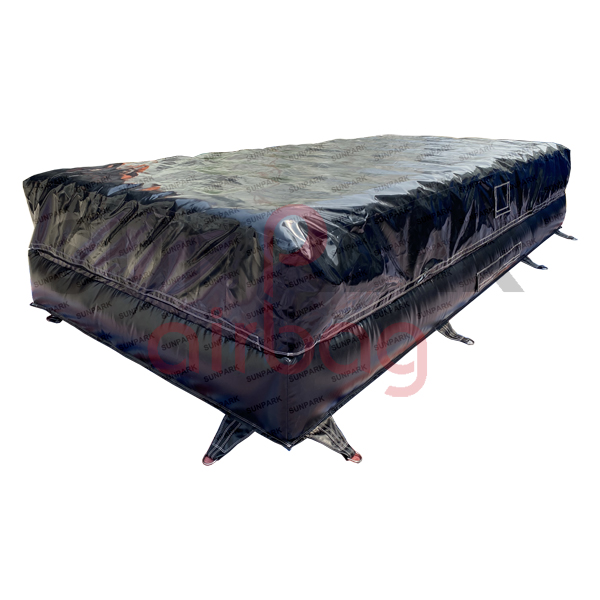
Engineered to eliminate bottoming-out hazards while delivering a clean, low-maintenance landing zone for gymnastics gyms, action sports centers, and trampoline arenas, the Sunparkairbag Airbag Crash Mat represents the peak of commercial inflatable safety engineering.
| Base & Baffle Construction | 0.55mm heavy-duty commercial PVC Tarpaulin with reinforced internal load baffles |
| Top Wear Sheet | 0.9mm ultra-durable, flame-retardant, UV-protected, lead- and phthalate-free PVC Tarpaulin |
| Safety Certification Standards | Water-proof, flame-retardant (NFPA 701 compliant), non-toxic, and ASTM F2970 aligned |
| Custom Sizing & Branding | Fully customizable dimensions, perimeter colors, and high-resolution digital/UV logo printing |
| Manufacturing Provenance | Hand-assembled by master technicians with 5+ years of specialized structural airbag experience |
| Turnkey Commercial Package | Includes certified commercial air blower, heavy-duty carrying bag, and complete repair kit |
Industry Procurement Advice: Stop wasting thousands of dollars on decomposing foam cubes. Inspect full product specifications on the official inflatable crash mat product page, or explore high-velocity jump systems across our inflatable jump airbag line.
Direct Technical Comparison: Dual-Chamber Airbag vs. Foam Pit vs. Stunt Mat
| Performance Feature | Dual-Chamber Inflatable Airbag (Sunparkairbag) | Traditional Open-Cell Foam Pit | High-Density Bonded Stunt Foam Mat |
|---|---|---|---|
| Deceleration Profile | Dynamic pneumatic displacement; smooth, constant deceleration | Mechanical foam compression; exponential resistance spike | Rapid, firm deceleration; high peak impact force |
| Bottoming-Out Hazard | Zero (Isolated lower safety reservoir blocks floor contact) | High (Blocks shift aside; jumpers hit concrete floor) | Moderate to High (Not designed for multi-meter drops) |
| Hygiene & Cleanliness | Exceptional: Non-porous PVC wiped down in 5 minutes | Abysmal: Traps sweat, body oil, dust mites, and bacteria | Moderate: Vinyl cover is wipeable, but seams leak over time |
| Fire Safety Hazard | Certified flame-retardant (Self-extinguishing PVC) | Severe fire hazard (Polyurethane foam burns rapidly with toxic smoke) | Moderate (Requires treated vinyl covers) |
| Ongoing Maintenance Labor | Near zero: Turn on blower in the morning, turn off at night | Backbreaking: Daily manual fluffing, vacuuming, cube extraction | Minimal daily labor; periodic visual inspection |
| Athlete Reset / Exit Speed | Instant: Athlete stands up and walks off firm top sheet (3s) | Slow: Athlete struggles to crawl out of deep foam cubes (30s) | Instant: Firm surface allows immediate exit |
| 5-Year Total Cost of Ownership | Low (Single purchase; cheap top sheet replacement) | Extremely High (Continuous cube replenishment every 2 years) | Moderate (Requires foam core replacement as foam fatigues) |
Pros and Cons: Inflatable Airbags vs. Traditional Foam Pits
| Cushioning Technology | Documented Operational Strengths (Pros) | Real-World Operational Liabilities (Cons) |
|---|---|---|
| Commercial Inflatable Airbags (e.g., Sunparkairbag Systems) |
|
|
| Traditional Open-Cell Foam Pits (Loose Polyurethane Cubes) |
|
|
Commercial Economics: Cost-Benefit Analysis and Maintenance ROI
When commercial leisure operators evaluate buying an inflatable crash pad, the initial capital expenditure often appears higher than simply ordering bulk foam cubes from a local upholstery supplier. In real-world commercial operations, that calculation is an illusion. When you evaluate the total cost of ownership (TCO) across a 36-month timeline, an inflatable airbag is drastically more profitable.
Look at the authentic commercial balance sheet:
- The Foam Pit Money Pit: A standard 6 × 8 meter foam pit requires roughly 4,000 to 5,000 open-cell foam blocks. Within 18 to 24 months of heavy public jumping, those cubes compress, shred, and lose their density. Purchasing replacement flame-retardant foam blocks costs between $6,000 and $12,000 every two years. Add in the weekly labor cost—paying two employees four hours every week to empty the pit, vacuum the concrete floor beneath, sanitize the space, and fluff the cubes ($3,000 to $5,000 annually)—and a traditional foam pit burns tens of thousands of dollars in maintenance overhead.
- The Inflatable Airbag Payoff: An engineered dual-chamber inflatable airbag requires zero block replacement. Daily maintenance consists of spraying a disinfectant solution and wiping the 0.9mm PVC top sheet in five minutes. More importantly, it dramatically increases facility revenue. In a busy trampoline park, an athlete takes 30 to 45 seconds to claw their way out of a deep foam cube pit, restricting throughput to roughly 60 jumps per hour per lane. On an inflatable airbag, the jumper lands softly, immediately stands up on the taut top surface, and walks off in under 5 seconds. This expands throughput to over 400 jumps per hour per lane, eliminating waiting lines and boosting park capacity during peak weekend revenue windows.
Learn more about commercial operational margins in our industry analysis of trampoline park owner income.
Who Needs an Inflatable Crash Pad vs. Who Can Use Traditional Mats
Every dollar allocated to facility safety must align with your athletes’ velocity, fall heights, and throughput demands. Inflatable crash pads are a transformative safety asset for specific applications, but unnecessary for others.
Facilities That Must Invest in an Inflatable Crash Pad:
- Commercial Trampoline Parks & Leisure Centers: High-traffic commercial venues where hundreds of children and adults jump into landing pits daily. The hygiene benefits, rapid exit speed, and elimination of bottoming-out liability make airbags mandatory.
- Gymnastics & Cheerleading Academies: Coaches training competitive athletes on high-velocity vaulting dismounts, uneven bar releases, and tumbling passes require a consistent, predictable catch that protects ankles and wrists while allowing athletes to land on their feet without sinking awkwardly.
- Action Sports Facilities (BMX, FMB, Skate, Snowboard): Training centers where athletes launch bicycles, rollerblades, or training boards into the air. A bike pedal or axle peg will instantly slice through traditional foam mats; an airbag equipped with a heavy-duty 0.9mm replaceable top sheet absorbs bike impacts effortlessly. Review facility options in our airbag jump locations guide.
When Basic Bonded Foam Mats Are Sufficient:
- Low-Level Martial Arts & Judo Dojos: Traditional dojos practicing ground sweeps, hip throws, and takedowns from standing height (under 1.5 meters) perform best on traditional dense tatami mats or bonded EVA puzzle mats that provide firm footing for balance.
- Home Garage Bouldering Walls: If you operate a compact 8-foot home climbing wall where drops never exceed two meters and jumping traffic is limited to one person, an inflatable airbag is over-engineered. A standard tripartite folding bouldering crash mat is far more practical and portable.
Costly Mistakes Buyers Make When Purchasing an Airbag Landing
Factory Floor Advisory: The “Unreinforced Internal Baffle” Disaster
The most common manufacturing defect found in cheap imported crash pads is using thin, single-stitched vinyl for the internal vertical baffles. When a heavy jumper lands, the internal air pressure spikes violently. If the internal baffles lack reinforced PVC stress patches at their anchor seams, the baffles tear away from the outer floor. Once two or three baffles fail internally, the airbag balloons out like a giant sausage, destroying the flat landing surface and rendering the entire crash pad completely unusable. Always demand proof of double-layer reinforced baffle welding from your manufacturer before approving production.
- Buying an Inflatable Built from Lightweight Oxford Fabric: Sourcing an airbag fabricated from woven polyester Oxford cloth instead of true PVC tarpaulin to save 25% on shipping weight. Oxford cloth is porous, stains easily, absorbs sweat and bacteria, and wears out rapidly under commercial foot traffic. Commercial crash pads must be built from heavy-gauge, non-porous PVC tarpaulin.
- Failing to Verify Continuous Power Reliability: Installing an inflatable crash pad in a facility with unstable electrical circuits. If an unmonitored circuit breaker trips and cuts power to the blower while athletes are actively jumping, the bag will slowly deflate. Modern installations must pair continuous blowers with an audible low-pressure alarm or automatic backup blower switch to ensure constant operational pressure.
- Ignoring Ceiling Height and Jump Platform Clearances: Ordering a 1.5-meter deep crash pad for a room with an 8-foot (2.4-meter) ceiling. If the pad is 1.5 meters tall, the athlete lands with their head only inches away from ceiling joists and lighting fixtures. Always calculate total clearance: Subfloor to Ceiling = Pad Depth + Athlete Height (2m) + Safety Clearance (1.5m minimum).
- Selecting Dark Top Sheet Colors for Outdoor Installations: Sourcing black or deep navy PVC top sheets for an outdoor bike park or mobile stunt show. Under direct summer sunlight, dark PVC absorbs radiant heat rapidly, pushing surface temperatures past 60°C (140°F) and creating severe contact burn hazards for bare skin. Outdoor airbags should always feature light gray, white, or beige top sheets.
Essential Sourcing Checklist: Auditing an Inflatable Airbag Manufacturer
Before issuing a commercial purchase order or transferring funds for buying an inflatable crash pad, require prospective manufacturers to prove compliance across these four non-negotiable craftsmanship standards:
1. Verified Raw Material Certifications & Chemical Compliance
Demand certified, third-party laboratory datasheets verifying that all PVC tarpaulin materials comply with:
- Flame propagation resistance meeting NFPA 701 Test Method 2 or European EN 13501-1 Class B-s1,d0 standards.
- Heavy metal and chemical safety verified lead-free and phthalate-free under U.S. Consumer Product Safety Commission (CPSC) Children’s Product Safety Directives.
- Hydrostatic tear strength (≥ 300 N) and tensile break resistance (≥ 2500 N/5cm) certified to ISO 13934-1 testing standards.
2. Structural Seam Fabrication Technology
Audit the factory’s production machinery. Settle for nothing less than:
- High-frequency hot-air computerized thermal welding machines that molecularly fuse PVC layers together with seamless airtight bonds.
- All structural perimeter seams reinforced with heavy-gauge, multi-strand rot-proof bonded nylon thread (minimum 4 to 5 stitches per inch).
- Stress-relief corner gussets and heavy-duty 304 stainless steel anchoring D-rings pull-tested to withstand at least 500 kg of lateral tension.
3. Air Blower Certification and Electrical Safety
A high-performance airbag is useless without a reliable air source. Verify that all supplied blowers carry official safety marks:
- UL / CUL certification for North American power grids (110V–120V / 60Hz) or CE / GS certification for European grids (220V–240V / 50Hz).
- Thermally protected electric motors with copper windings and IP54 or IP65 water-resistant casing to prevent short circuits during humid indoor or outdoor operation.
4. Customization, Sizing Flexibility, and Factory Direct Pricing
Every gym and trampoline park has unique pit dimensions, column obstructions, and branding requirements. Avoid rigid catalog distributors who resell pre-made stock sizes. Partner directly with a verified manufacturer like Sunparkairbag that provides full custom 3D CAD modeling, individual color selection matching your corporate identity, high-resolution digital logo printing, and flexible production turnarounds in 15 working days. Review our latest technical evaluations across the best airbag landing systems 2026.
Expert Engineering Verdict: The Definitive Procurement Roadmap
In our professional assessment across thousands of commercial installations, the conclusion is absolute: buying an inflatable crash pad is the single highest-return safety investment an athletic facility or action park can make. Clinging to traditional foam pits drains operational revenue, creates toxic air quality, and exposes your business to catastrophic bottoming-out injury liabilities.
Here is your definitive, field-tested procurement roadmap:
- Never Compromise on Dual-Chamber Safety: Settle for nothing less than an isolated, dual-chamber internal baffle system. The upper chamber must absorb kinetic impact progressively, while the independently pressurized lower chamber guarantees athletes never bottom out against the concrete floor.
- Mandate the 0.55mm/0.9mm Material Benchmark: Insist on 0.55mm commercial PVC tarpaulin for the internal core and an ultra-durable 0.9mm PVC wear sheet for the landing face. Ensure the top sheet is detachable via industrial hook-and-loop so you can refresh the wear layer for pennies on the dollar after years of play.
- Verify Air Venting and Deceleration Depth: Match your cushion thickness to your fall heights (minimum 1.2m to 1.5m for standard trampoline and freestyle jumps), and ensure the side walls feature adjustable hook-and-loop relief vents to prevent dangerous rebound launching.
- Partner Directly with a Proven Manufacturer: Bypass domestic promotional middlemen and partner with an established, asset-backed manufacturing leader like Sunparkairbag. Sourcing an engineered landing platform like the Sunparkairbag Airbag Crash Mat gives your facility certified flame-retardant materials, master-welded seams, complete turnkey blower packages, and dedicated engineering support, allowing your business to maximize jump capacity, eliminate maintenance headaches, and deliver world-class athletic safety for years to come.
Frequently Asked Questions
The single most critical feature when buying an inflatable crash pad is a dual-chamber internal baffle architecture. A dual-chamber system separates the upper impact absorption layer from a permanently pressurized lower safety base. This guarantees that even if an athlete lands with extreme localized force, the upper chamber vents air progressively while the bottom chamber prevents them from bottoming out against the concrete floor.
Inflatable crash pads eliminate the severe health, fire, and maintenance liabilities of traditional foam pits. Foam cubes break down into toxic, breathable polyurethane dust, harbor bacteria, present extreme fire hazards, and require backbreaking manual fluffing and costly block replacement every two years. Inflatable airbags offer hygienic, flame-retardant wipe-clean surfaces, uniform deceleration, and multi-year operational lifespans with near-zero daily labor.
For commercial facilities, trampoline parks, and gymnastics centers, demand a minimum of 0.55mm (18oz) heavy-duty commercial PVC tarpaulin for the internal baffles and structural base, paired with a heavy-duty 0.9mm (32oz) tear-resistant PVC tarpaulin for the top landing sheet. Lighter materials like Oxford nylon or 0.4mm vinyl fail rapidly under repetitive commercial impacts.
The depth of an inflatable crash pad directly dictates the available deceleration distance. For low-impact gymnastics and bouldering (falls under 2 meters), a 0.5 to 0.8-meter pad depth is sufficient. For standard trampoline jumps, parkour, and freestyle tricks (falls of 2 to 4 meters), a 1.2 to 1.5-meter depth is mandatory. For high-velocity stunts, BMX, and extreme drop towers (falls of 5 to 10+ meters), a 2.0 to 3.5-meter deep multi-chamber bag is required to safely dissipate kinetic energy.
Authoritative References & Athletic Safety Standards
- ASTM International: ASTM F2970 Standard Practice for Design, Manufacture, Installation, and Operation of Trampoline Courts
- European Committee for Standardization (CEN): EN 14960-1 Inflatable Play Equipment – Safety Requirements and Test Methods
- U.S. Consumer Product Safety Commission (CPSC): Amusement Ride and Inflatable Device Safety Guidelines