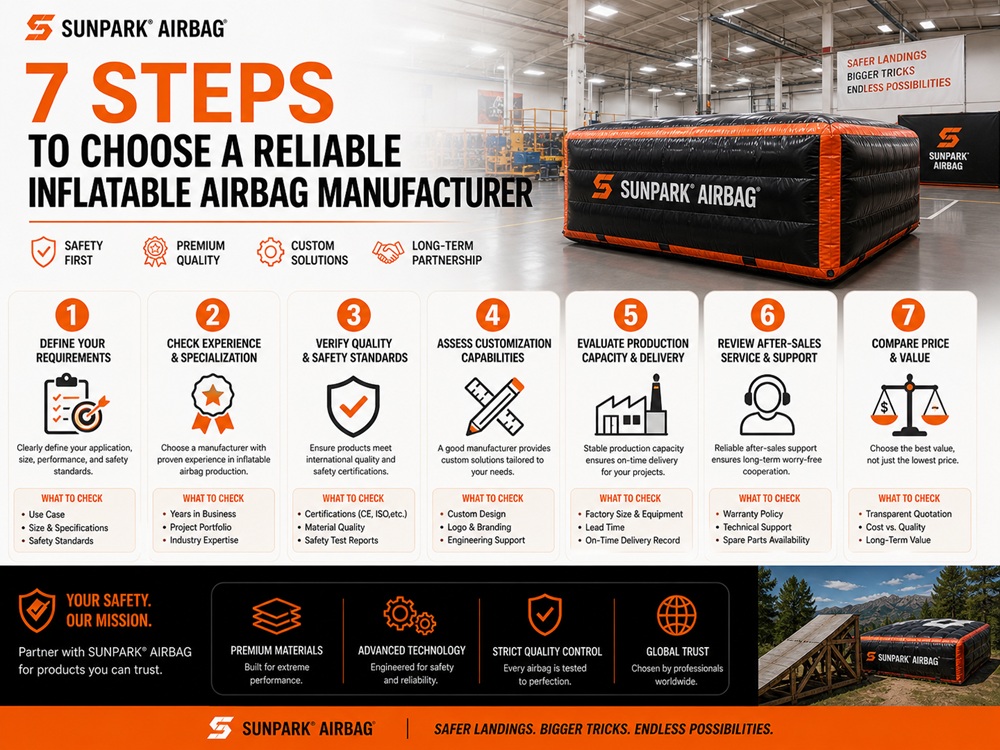
Quick Answer: How to Choose a Reliable Inflatable Airbag Manufacturer
To successfully vet and choose a Reliable Inflatable Airbag Manufacturer, commercial operators must execute seven rigorous verification steps: (1) Verify Direct Asset Ownership by auditing the physical factory floor, automated cutting tables, and welding machinery to filter out trading brokers; (2) Mandate Certified Heavy-Duty Materials, specifically 0.55mm (18 oz) base PVC tarpaulin paired with an indestructible 0.9mm (32 oz) anti-friction top wear sheet; (3) Inspect Dual-Chamber and Baffle Engineering to guarantee progressive kinetic energy absorption without bottoming out; (4) Demand International Safety and Fire Certifications, including compliance with ASTM F2374, EN 14960, and NFPA 701; (5) Audit Seam Integrity and Reinforcement, verifying multi-needle quadruple stitching and high-frequency welded anchor D-rings; (6) Evaluate 3D CAD Trajectory Customization to ensure the airbag geometry matches your exact launch kicker speed and landing slope; and (7) Confirm Turnkey Commercial Support, including industrial blower provision, comprehensive field repair kits, and structured warranty enforcement. Partnering with a vertically integrated specialist like Sunparkairbag guarantees that your landing installation meets commercial engineering standards from day one.
What It Is: The Critical Physics of Inflatable Landing Deceleration
To evaluate a Reliable Inflatable Airbag Manufacturer with practical competence, one must first understand what occurs mechanically when an athlete impacts a landing surface. In standard foam pits, deceleration is achieved through passive displacement of polyurethane foam cubes. While effective for initial training, foam pits carry severe operational liabilities: they collect sweat, dust, and bodily fluids, deteriorate into micro-particulate dust that damages athlete lungs, present extreme fire hazards, and require winches or cranes to extract heavy machines like mountain bikes or dirt bikes.
A modern commercial landing airbag is an active pneumatic decelerator operating under controlled fluid dynamic displacement. When an athlete lands, kinetic energy ($E_k = \frac{1}{2}mv^2$) must be absorbed across a calculated displacement depth. If the displacement is too shallow, the athlete experiences high deceleration rates ($a = \frac{\Delta v}{\Delta t}$) exceeding 40G, resulting in concussions, broken clavicles, and joint damage. If the displacement is uncalibrated, the air compresses elastically like a trampoline, storing potential energy and catapulting the athlete back into the air.
A professional manufacturer designs systems with two distinct pneumatic zones:
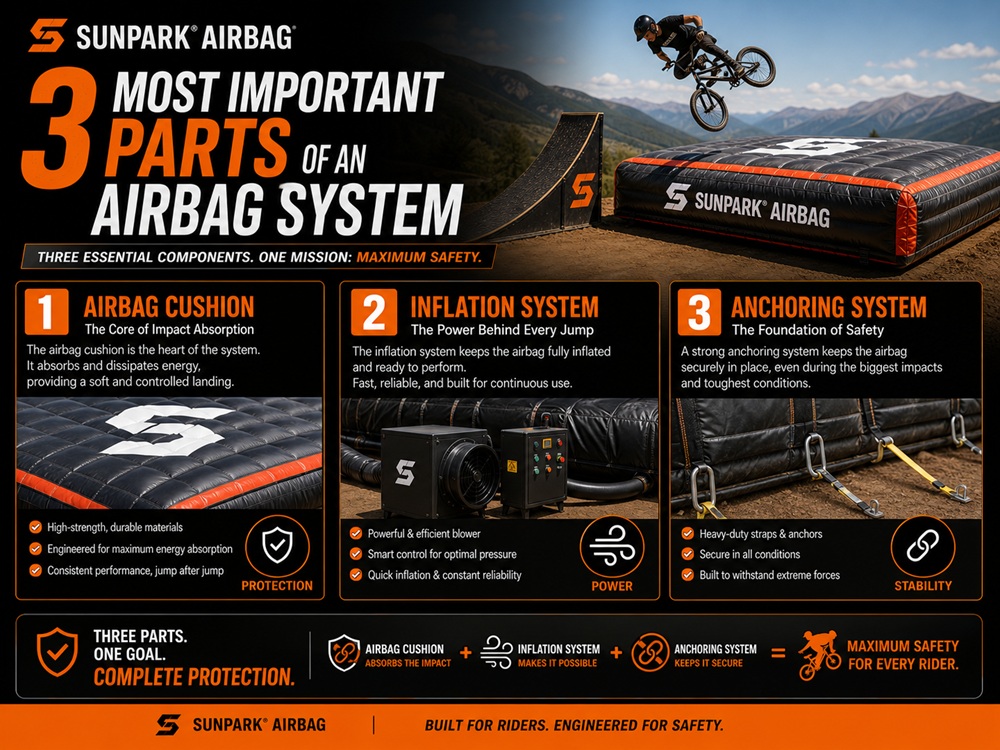
- The Lower Safety Chamber: A high-pressure foundation built with internal vertical baffle columns that contain thousands of cubic feet of air. This chamber acts as an unyielding fail-safe buffer, preventing the athlete or heavy motorized vehicle from ever bottoming out onto the hard concrete or earth below.
- The Upper Absorption Layer: A calibrated, softer chamber featuring adjustable perimeter air-exhaust vents. When an impact occurs, air is forced through these perimeter relief ports, converting kinetic impact energy into controlled exhaust flow. This extends deceleration time ($\Delta t$) by orders of magnitude and reduces peak G-forces beneath 10G.
- The Tensioned Top Sheet: A heavy-duty, smooth 0.9mm PVC tarpaulin sheet floats across the top of these chambers. On clean wheeled landings, the top sheet remains taut, allowing the athlete to roll down the transition and exit cleanly. On crashes, the sheet deflects into the pneumatic chambers, cradling the fall safely.
From our experience on test tracks, building an airbag that reliably balances ride-away firmness with crash absorption requires deep mathematical modeling. Sourcing from a generic vendor who does not understand aerodynamic flow rates and internal baffle tensioning puts your entire operation at severe legal and physical risk.
Quick Summary Table: The 7 Steps to Choose a Manufacturer
| Verification Step | Primary Technical Metric | Audit Methodology | Critical Failure Prevented | Industry Standard Baseline |
|---|---|---|---|---|
| 1. Asset Ownership Audit | Direct factory ownership vs. middleman agency | Live video audit, business license, machinery plant check | 30% broker markups, communication bottlenecks, lack of QA | ISO 9001:2015 certified production plant |
| 2. Raw Material Validation | PVC Tarpaulin caliber (0.55mm base / 0.9mm top sheet) | Micrometer gauge measurement, tensile lab test sheets | Tear propagation, punctures from pedals and exhaust headers | Lead-free, phthalate-free, UV-stabilized PVC |
| 3. Internal Chamber Architecture | Multi-chamber baffling vs. single open cavity | Internal structural CAD review, cross-section schematics | Catastrophic bottoming-out, violent kinetic rebound | Dual-chamber progressive pneumatic displacement |
| 4. Safety & Fire Certification | Documented international compliance certificates | Third-party laboratory test verification (TUV, SGS, Intertek) | Municipal permit rejections, commercial insurance denial | ASTM F2374, EN 14960, NFPA 701 flammability |
| 5. Seam & Hardware Workmanship | Multi-needle quadruple stitching & thermal RF welding | Physical inspection of seam overlap, stitch count, D-rings | Seam bursting under multi-rider impacts, anchor failure | 9-ply nylon bonded thread, reinforced anchor plates |
| 6. 3D Trajectory Customization | Geometric slope matching (32° to 38°) and runout lengths | Review of flight trajectory CAD models and kicker profiles | Knuckle casing injuries, overshoot landing flat on hard deck | Tailored CAD modeling matching jump gap velocity |
| 7. Turnkey Support & Warranty | Commercial blowers, heavy repair kits, written warranty | Audit of after-sales policy, spare parts availability | Downtime from missing patches, unpowered blower failures | Minimum 1-to-2-year structural warranty on seams/valves |
The 7 Proven Steps to Evaluate an Inflatable Airbag Manufacturer
Step 1: Audit Direct Asset Ownership and Factory Footprint vs. Trading Brokers
The global inflatable market is saturated with digital storefronts, trading intermediaries, and sourcing brokers who do not own a single square foot of manufacturing floor space. These middlemen take your technical requirements, add a 30% to 50% commission markup, and subcontract production to the lowest-bidding regional workshop. When production defects occur, seams burst, or delivery deadlines are missed, brokers have zero technical control over the assembly floor and will deflect blame to the subcontractor.
In most professional situations, we recommend executing a comprehensive direct asset audit before wiring any capital deposit:
- Demand a Live Video Factory Walkthrough: Require the sales team to walk their production floor via live video. Verify that you can see computerized CNC fabric cutting beds, high-frequency radio-frequency (RF) thermal welding stations, heavy-duty industrial sewing lines, and large-scale test inflation staging bays where finished airbags are inflated and pressure-tested for 24 hours.
- Inspect Business Licenses and Export Registrations: Check corporate business licenses to confirm the company is registered as a manufacturer rather than a wholesale trading firm. Review international shipping records and verify standard customs classifications (such as HS Code: 9506990000 for commercial sporting equipment).
Working directly with an asset-backed manufacturer ensures direct communication with the engineering team, shorter production lead times (typically 12 working days for custom units), and direct accountability for structural quality.
Step 2: Verify Heavy-Duty Tarpaulin Material Grade and Dual-Layer Thickness
Never purchase an action sports landing airbag based on vague catalog descriptions like “heavy-duty vinyl.” In commercial freestyle sports, material specification must be precise. Substandard manufacturers cut costs by utilizing cheap 0.4mm or 0.45mm commercial bounce house vinyl that lacks the tensile tear strength to survive aggressive impacts.
A true, Reliable Inflatable Airbag Manufacturer utilizes specialized, multi-layer polymer composites:
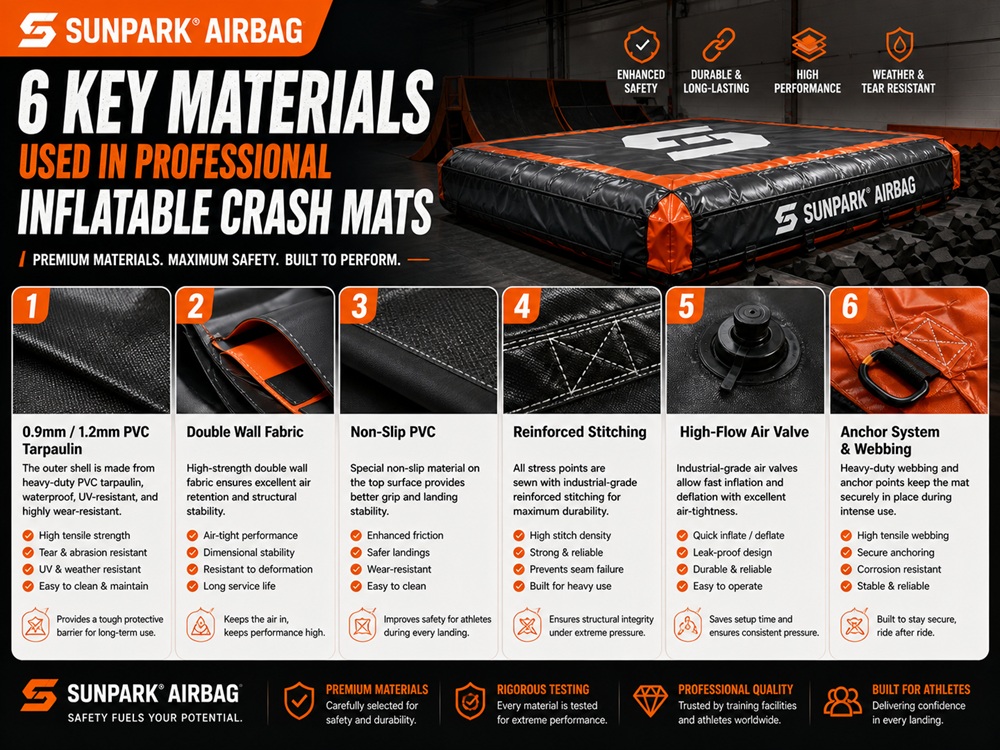
- Internal Structure & Airbag Base (Minimum 0.55mm / 18 oz PVC Tarpaulin): The internal baffles, bottom floor, and sidewalls must be fabricated from at least 0.55mm high-density, high-tensile PVC tarpaulin. This material incorporates a dense internal woven polyester scrim (typically 1000D×1000D) laminated between double-sided PVC coatings, providing tensile strengths exceeding 2,500 N/5cm to withstand continuous internal air pressure.
- Top Impact Wear Sheet (Minimum 0.9mm / 32 oz PVC Tarpaulin): The replaceable top cover takes direct abuse from rubber tires, sharp shoe pedals, metal footpegs, and spinning motocross knobbies. Settle for nothing less than 0.9mm heavy-duty, UV-treated, and flame-retardant PVC tarpaulin. In our testing, 0.9mm material resists gouging, withstands hot exhaust pipe contact, and features specialized surface slickness that allows athletes to slide out of crashes safely.
- Chemical Safety Testing: Ensure the PVC formulation is certified 100% lead-free, cadmium-free, and phthalate-free, preventing toxic exposure to athletes and staff during hot summer operations.
Learn more about specialized vehicle landing requirements across our dedicated motorcycle airbag systems 2026 review.
Step 3: Inspect Multi-Chamber Internal Baffle Engineering and Pressure Relief
The single biggest dividing line between a cheap gimmick and an elite training tool is internal pneumatic architecture. Low-cost manufacturers often build massive, single-cavity open bags. When an athlete hits the center of a single-cavity bag, the air has nowhere to go; it compresses rapidly, pushing air into the corners, causing the center to bottom out onto the ground while launching the corners violently upward.
Demanding suppliers construct dual-chamber, progressive decelerators:
- Lower Fail-Safe Chamber: Operating at higher static pressure, the lower chamber features internal vertical baffle walls that distribute structural tension evenly. It never exhausts fully, guaranteeing a rigid cushion that stops heavy impact penetration.
- Upper Dynamic Deceleration Chamber: Calibrated at lower static pressure, the upper chamber features adjustable exhaust relief zippers and calibrated perimeter ports. When the rider lands, air vents smoothly, decelerating the body over 18 to 24 inches of controlled displacement.
- Zero-Rebound Tuning: The manufacturer must configure exhaust dampers so the bag absorbs energy rather than acting like a spring. This controlled deceleration is what allows athletes to train high-risk aerial maneuvers repeatedly without chronic fatigue or impact injury.
Explore comprehensive multi-discipline platforms across our complete landing airbag solutions catalog.
Step 4: Demand International Safety Certifications and Regulatory Compliance
If you operate a commercial bike park, action sports camp, or trampoline center, your municipal permitting and commercial liability insurance policies depend on documented engineering compliance. If an accident occurs and your equipment lacks certified engineering testing, insurance underwriters can deny coverage, exposing your business to devastating financial liability.
Require your prospective manufacturer to provide authenticated third-party test reports from recognized testing agencies (such as TUV, SGS, or Intertek) proving compliance with:
- ASTM International: ASTM F2374 Standard Practice for Design, Manufacture, Operation, and Maintenance of Inflatable Amusement Devices governing structural anchoring, tensile strength, and impact deceleration.
- European Standard EN 14960: Safety Requirements and Test Methods for Inflatable Equipment, enforcing strict dimensional stability and air retention protocols.
- National Fire Protection Association (NFPA 701): Standard Methods of Fire Tests for Flame Propagation of Textiles and Films, ensuring the heavy PVC tarpaulin will not propagate fire if exposed to pyrotechnics, hot engines, or electrical faults.
Step 5: Audit Seam Workmanship, Quadruple Stitching, and Welded Anchorage
An inflatable landing airbag is subjected to violent, pulsating shear stresses every time an athlete lands. The seams are the primary structural failure point on poorly constructed bags. Low-cost suppliers use standard 2-thread or 3-thread overlock stitching with low-grade domestic cotton-polyester threads that rot quickly when exposed to rain, mud, and outdoor humidity.
Examine the manufacturer’s stitching and anchoring standards:
- Multi-Needle Quadruple Stitching: High-stress seam intersections—particularly where internal baffles join the outer shell—must feature quadruple stitching using heavy-duty, rot-proof 9-ply bonded nylon or high-tensile Kevlar thread. Stitch length must be tightly calibrated: too loose, and air leaks excessively; too tight, and the needles perforate the PVC like a postage stamp, creating easy tear lines.
- Reinforced High-Frequency Thermal Welds: For sealed airtight components, seams should be bonded using automated high-frequency radio-frequency (RF) thermal welding that fuses the PVC molecules at a chemical level, creating a molecular bond stronger than the parent fabric itself.
- Engineered Tie-Down D-Rings: An airbag landing weighing several hundred pounds will shift under high-velocity landings if not anchored securely. Look for heavy-duty, non-rusting 316 stainless steel D-rings set into heavy multi-layer PVC reinforcement patches (sandwich-stitched and welded) rated to withstand thousands of pounds of lateral shear load.
Review specialized heavy-load construction techniques across our BMX airbag landing and airbag landing ramp system lines.
Step 6: Assess Turnkey Customization, 3D CAD Trajectory Modeling, and Scale Matching
An airbag landing cannot be selected from a static catalog of generic rectangular mattresses. An elite training setup requires seamless geometric integration between the takeoff kicker ramp, the gap distance, the flight trajectory arc, and the landing transition slope. If the landing slope is too steep, riders compress excessively; if it is too flat, landing energy transmits directly into the rider’s wrists and ankles.
A true, Reliable Inflatable Airbag Manufacturer maintains an in-house engineering and CAD design department. They will ask for your takeoff ramp specifications—including ramp height, radius curve, lip angle, and planned flight speed—and generate custom 3D parametric models. Whether configuring an integrated MTB airbag landing system, a massive winter sports Halfpipe Airbag, or a versatile inflatable jump airbag, the manufacturer must customize slope angles (typically 32 to 38 degrees), deck heights, and safety aprons to match your exact athletic discipline. Discover how premier venues configure custom transitions in our global airbag jump locations guide.
Step 7: Verify Warranty Enforcement, Rapid Repair Kit Provision, and Spare Parts Support
The final step in selecting a Reliable Inflatable Airbag Manufacturer is evaluating post-delivery operational continuity. Even the finest 0.9mm PVC top sheet will eventually encounter a sharp, broken metal footpeg or a jagged rock on an uncleaned launchpad. When downtime strikes, your venue needs immediate field-repair capability.
Audit the manufacturer’s after-sales support package:
- Comprehensive Commercial Accessories: Ensure the factory supplies high-output, certified centrifugal blowers (matched to your local grid voltage: 110V/60Hz or 220V/50Hz) housed in durable impact boxes, paired with heavy-duty vinyl transport storage bags.
- Professional Industrial Repair Kits: The manufacturer must include matching PVC patches (both 0.55mm base and 0.9mm top sheet), specialized high-strength vinyl contact adhesives, thread spools, spare air-exhaust zipper pulls, and valve replacements.
- Enforceable Commercial Warranty: Demand an explicit, written manufacturer’s warranty—typically 1 to 2 years—covering seam integrity, internal baffle stitching, and material delamination. A supplier that refuses to put their warranty terms in writing should be eliminated from your procurement shortlist immediately. For long-term durability insights, consult our guide on airbag lifespan and safety guide.
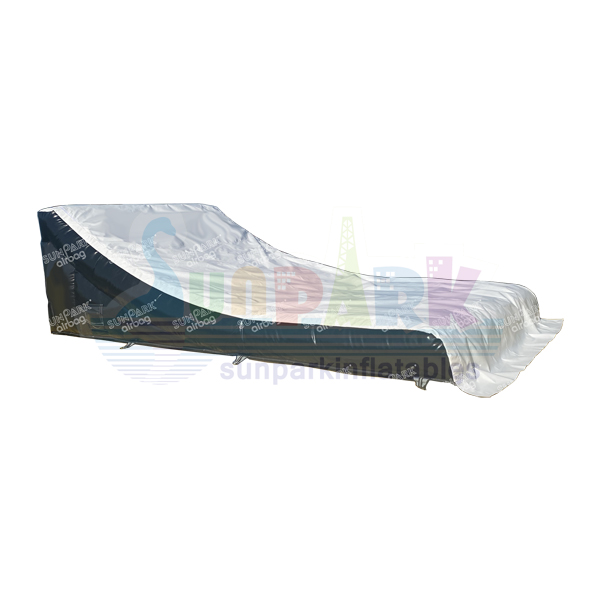
Manufacturer Spotlight: Sunparkairbag Commercial Inflatable Airbag Landing
Demonstrating full vertical manufacturing execution, Sunparkairbag engineers industrial-grade action sports landing systems built to withstand the rigorous demands of professional mountain biking, freestyle motocross, BMX, and multi-sport progression centers.
| Airbag Base & Baffles | 0.55mm heavy-duty PVC Tarpaulin (Waterproof, flame-retardant, UV-protected, lead & phthalate-free) |
| Top Impact Wear Sheet | 0.9mm ultra-dense, puncture-resistant PVC Tarpaulin with slick anti-friction coating |
| Standard & Custom Sizing | Standard footprint: 6.5 × 3.5 × 2.0 meters, or 100% custom-tailored to facility CAD drawings |
| Color & Branding Customization | Full color palette selection with high-resolution digital, silk-screen, or UV printing capabilities |
| Factory Production Workmanship | Fabricated by master technicians with 5+ years specialized commercial inflatable experience |
| Turnaround & Logistics | Fast 12-working-day production timeline; HS Code: 9506990000; packed in heavy-duty vinyl bags with blowers in strong boxes |
| Included Accessories | Commercial continuous blowers, comprehensive industrial field repair kit, and heavy-duty transport bags |
Sourcing Advice: Eliminate middleman broker markups and secure factory-direct pricing. Explore full engineering specifications directly on the official Inflatable Airbag Landing portal, discover portable alternatives in our review of inflatable MTB airbag solutions, or evaluate budget parameters across our cheap MTB airbag options 2026 breakdown.
Direct Technical Comparison: Direct Manufacturers vs. Trading Companies vs. Low-Cost Copycats
| Evaluation Parameter | Verified Direct Manufacturer (e.g., Sunparkairbag) | Online Trading Broker / Intermediary | Low-Cost Copycat Workshop |
|---|---|---|---|
| Direct Asset Ownership | 100% Direct factory ownership; physical machinery audit verified | Zero; operates from commercial office suites; outsources production | Small regional sweatshop; lacks precision cutting and testing gear |
| Material Formulation | Certified 0.55mm base + 0.9mm top sheet PVC tarpaulin | Varies; often quotes 0.55mm but delivers cheaper 0.4mm | Sub-0.45mm low-grade toy vinyl; high chemical odor |
| Internal Pneumatics | Dual-chamber progressive baffling with calibrated relief ports | Standard stock design; lacks fluid dynamic tuning | Single-cavity open bag; extreme bottoming-out risk |
| Compliance Documentation | Full ASTM F2374, EN 14960, and NFPA 701 lab test reports | Photocopied, expired, or forged compliance certificates | Zero safety or flammability compliance documentation |
| Seam Workmanship | Multi-needle quadruple stitching + RF thermal molecular welds | Basic double stitching; inconsistent quality across sub-tier batches | Single-line manual stitching; rapid thread unraveling |
| Commercial Pricing | Factory-direct wholesale pricing (Maximum ROI) | 30% to 50% commission markup added | Unrealistically cheap upfront; massive long-term liability |
| After-Sales Support | Dedicated technical engineers, rapid spares, clear warranty | Slow response; deflects responsibility to subcontractors | Disappears immediately after initial payment clearance |
Pros and Cons Table: Contracting an Enterprise Airbag Manufacturer
| Procurement Vector | Commercial & Operational Strengths (Pros) | Operational Realities & Requirements (Cons) |
|---|---|---|
| Direct Manufacturer Sourcing (e.g., Sunparkairbag Partnership) |
|
|
| Sourcing from Low-Cost Brokers (Unvetted Online Marketplace Blanks) |
|
|
Operational Realities: Safety Benefits vs. Facility Management Requirements
Before issuing a commercial purchase order, every park director and event promoter must balance the immense protective value of an inflatable airbag against the operational requirements of managing pneumatic installations.
The Real Commercial and Safety Benefits:
- Accelerating Athlete Progression Safely: In our testing across training facilities, athletes attempt complex aerial tricks three to five times more frequently on an airbag landing than on dirt or timber. Eliminating the fear of catastrophic bone fractures allows athletes to commit fully, turning a seasonal progression curve into a matter of weeks. Review injury mitigation data in our breakdown of common BMX injuries and prevention.
- Flawless Hygiene and Sanitation: Unlike traditional foam pits that absorb sweat, shed toxic micro-dust, and harbor bacteria, an inflatable airbag features smooth, non-porous PVC tarpaulin that can be fully disinfected, washed down, and dried in minutes. Learn how modern fitness centers deploy hygienic systems in our gym airbag for training guide.
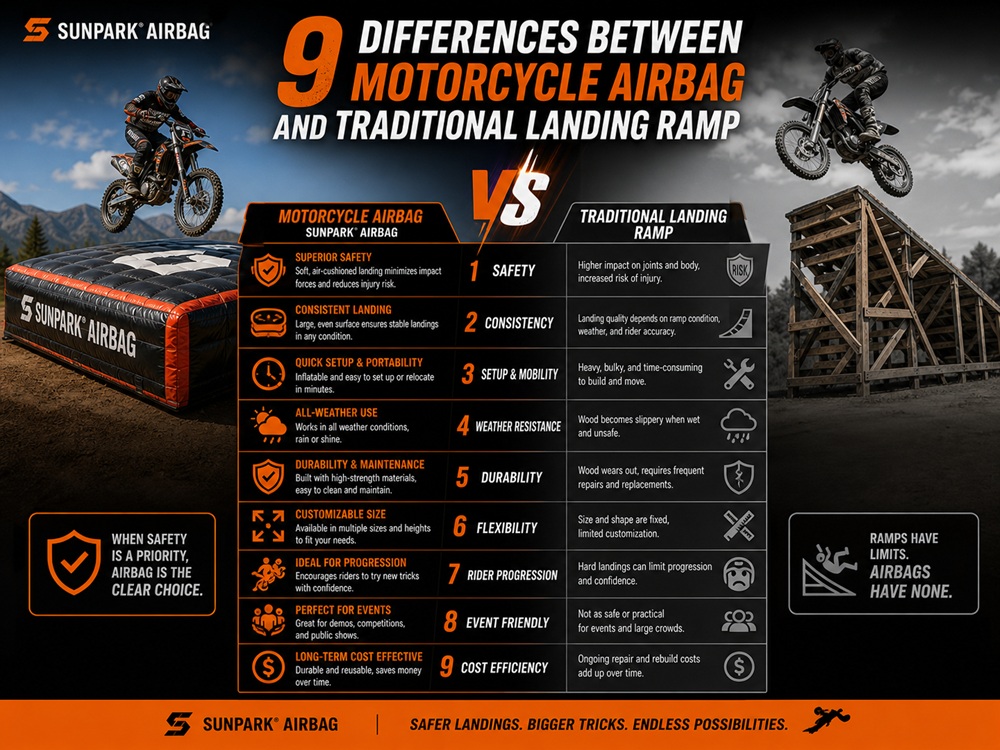
- Mobility and Venue Versatility: A 50-foot landing setup that weighs tons when built in dirt or steel can be deflated, rolled up, and transported in a standard utility trailer. This mobility enables temporary stadium competitions, pop-up city tours, and winter-to-summer seasonal conversions at ski resorts, as highlighted in our review of the best snowboard airbag parks.
The Inherent Operational Constraints:
- Continuous Electrical Power Requirements: An open-flow inflatable landing airbag is not a sealed raft; it relies on continuous positive pressure supplied by commercial electric centrifugal blowers (typically 1.5kW to 2.2kW per unit). Operating an outdoor setup requires dedicated, reliable electrical grid connections or commercial portable generators.
- High-Wind Operating Ceilings: Because of their immense surface area, large inflatable landing ramps act like giant sails in severe weather. Safe operation mandates strict wind monitoring: operations must cease, and the bag must be deflated, when sustained wind speeds exceed 25 to 30 miles per hour.
Who Needs a Commercial-Grade Airbag vs. Who Can Use Basic Mats
Every commercial capital expenditure must align with your venue’s risk profile and customer throughput. Sourcing from a Reliable Inflatable Airbag Manufacturer is mandatory for high-velocity sports, while simpler equipment suffices for basic gym gymnastics.
Operations That Must Partner with a Reliable Inflatable Airbag Manufacturer:
- Commercial Bike Parks & Freestyle Motocross Compounds: When riders land 250-pound dirt bikes or downhill mountain bikes from 20-foot vertical drops, cheap consumer vinyl will fail immediately. Only heavy-duty 0.55mm/0.9mm dual-chamber landing airbags can survive the mechanical friction and structural impact energy.
- Commercial Trampoline Parks & Action Sports Complexes: Indoor multi-sport parks processing hundreds of paying visitors daily must eliminate liability risks. Replacing dirty foam pits with certified, fire-retardant airbags drives bookings, simplifies maintenance, and protects institutional profitability. Explore project modeling in our guides on trampoline park construction cost and trampoline park owner income.
- Professional Stunt Production & Touring Shows: Traveling stunt teams jumping snowmobiles, quads, or executing high-fall jumps require certified, mobile impact equipment that inflates in 15 minutes and carries verifiable engineering documentation for local fire and safety inspectors.
Operations That Can Rely on Basic Foam Mats:
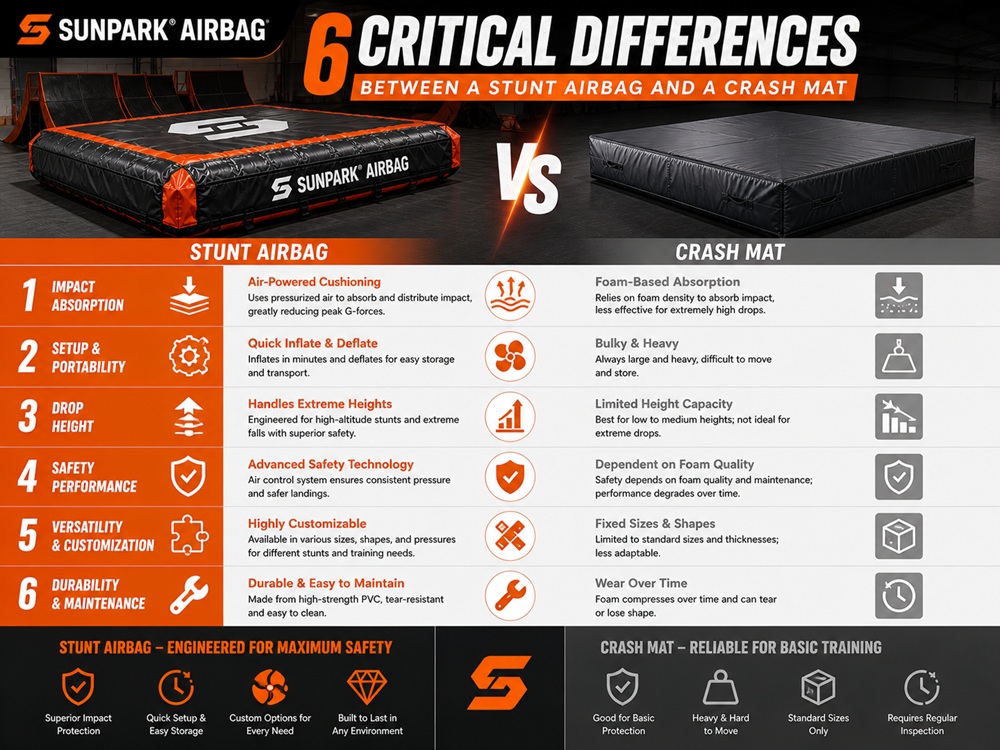
- Low-Altitude Youth Gymnastics Studios: If your activity consists of young children practicing forward rolls and floor beam balances from heights under three feet, standard polyurethane carpet-bonded foam mats provide adequate protection without the need for powered blowers.
- Casual Flat-Ground Parkour Stations: Low-velocity horizontal vaults and ground-level tricking do not generate the vertical kinetic energy that warrants commercial pneumatic deceleration systems.
Costly Sourcing Mistakes Facility Managers Make
Factory Floor Advisory: The “Bounce House Vinyl” Trap
The most financially ruinous error a facility manager can make is purchasing an action sports landing airbag from a residential bounce house workshop. Bounce house suppliers use cheap 0.4mm single-layer vinyl, weak sewing thread, and open-cavity designs intended for 40-pound toddlers. Subjecting this equipment to a 180-pound cyclist landing at 30 miles per hour causes instantaneous seam bursting, air chamber collapse, and severe athlete impact trauma.
- Failing to Verify Top Sheet Replaceability: Even the highest-grade 0.9mm PVC top sheet is a sacrificial wear item that will eventually abrade from years of metal pedal strikes. Cheap manufacturers stitch the top sheet directly into the main airbag body. When the top sheet wears out, the entire airbag must be thrown away. A reliable manufacturer attaches the top wear sheet using heavy-duty, industrial marine-grade Velcro and perimeter ratchet tensioners, allowing you to swap out the top sheet in 30 minutes for a fraction of the cost of a new bag.
- Neglecting Ambient Blower Noise Considerations: Running open, unshielded commercial blowers inside an indoor trampoline park or gym creates an unbearable 95-decibel acoustic whine. Always ensure your manufacturer provides high-efficiency blowers equipped with sound-dampening muffler boxes or duct extensions that allow blowers to be isolated in external utility rooms.
- Accepting Uncalibrated Exhaust Pressure Relief Zippers: Cheaper suppliers use standard plastic luggage zippers on perimeter air vents. Under high-pressure impacts, plastic teeth strip and burst open, dumping all internal air instantly. Demand heavy-duty, marine-grade metal tooth or molded Delrin release zippers reinforced with multi-layer velcro flaps.
- Overlooking Proper Ballast Anchor Point Engineering: An outdoor landing airbag can weigh over 800 pounds, but when inflated, it acts as a massive aerodynamic wing. Tying off the airbag to flimsy tent stakes will lead to catastrophic blowaways in sudden thunderstorms. Ensure the manufacturer integrates structural 316 stainless steel D-rings backed by 4-layer PVC load-spreader plates rated for heavy ground screw anchors or concrete ballast weights.
Essential Sourcing Checklist: Auditing Machinery, Warranties, and Logistics
Before wiring a production deposit or signing an equipment contract with an inflatable manufacturer, audit prospective vendors against these four non-negotiable operational benchmarks:
1. Verified Production Equipment Assets
Inquire about the factory’s tooling. Does the facility utilize automated CNC laser or oscillating-knife cutting tables to guarantee sub-millimeter precision on internal baffle patterns, or are workers hand-cutting curved PVC panels with utility knives? Automated cutting ensures identical panel tension across the entire bag, eliminating crooked seams and localized pressure hot-spots.
2. Certified PVC Polymer Formulation Data
Demand documented material specification sheets confirming:
- Base fabric density: minimum 1000D × 1000D high-tenacity polyester scrim.
- Total thickness: minimum 0.55mm (internal/base) and 0.9mm (top wear cover).
- Certified anti-fungal, anti-mildew, and UV degradation inhibitors tested for outdoor longevity.
- Fire retardancy certification compliant with NFPA 701 or European EN 13501-1.
3. Real-World Factory Pressure-Testing Protocols
Require your manufacturer to provide video proof of a continuous 24-hour pressure test of your exact completed unit prior to crating and export shipping. The factory must inflate the bag, inspect all baffle lines for symmetry, test internal pressure retention, verify exhaust valve venting, and verify that all custom digital branding is flawless.
4. Total Landed Logistics and Packaging Engineering
Commercial airbags are heavy, dense shipments. Ensure the manufacturer packs the airbag inside heavy-duty 0.9mm PVC vinyl transportation duffel bags reinforced with lifting handles, while packaging sensitive centrifugal blowers inside double-wall reinforced wooden crates to prevent motor damage during international ocean and air freight.
Expert Action Sports Practitioner’s Final Procurement Verdict
In our professional assessment across decades of action sports infrastructure design and manufacturing operations, choosing an inflatable airbag supplier is a life-safety decision that directly dictates your business longevity. Attempting to save 15% on your capital expenditure by purchasing uncertified, thin-vinyl copycat products from unvetted online brokers is commercial negligence that guarantees premature failure and severe liability exposure.
Here is your clear, actionable procurement roadmap:
- Bypass Middlemen and Contract Direct: Partner exclusively with an asset-backed, verified Reliable Inflatable Airbag Manufacturer that owns its cutting tables, welding lines, and testing facilities.
- Lock Down Heavy-Duty Dual-Layer Specifications: Mandate 0.55mm high-tensile PVC tarpaulin for internal structures and the base, paired with a replaceable, tensioned 0.9mm top wear sheet with anti-friction treatment.
- Insist on Dual-Chamber Progressive Deceleration: Reject dangerous single-cavity bounce bags. Ensure your system features an isolated lower safety cushion and an upper dynamic chamber with calibrated pressure exhaust ports.
- Demand Comprehensive Safety Compliance: Secure verified ASTM F2374 and EN 14960 laboratory test certificates, an explicit multi-year warranty, commercial centrifugal blowers, and an industrial field repair kit before authorizing shipment.
By partnering with an established, vertically integrated manufacturing leader like Sunparkairbag, you eliminate middleman markups, secure precision 3D CAD trajectory modeling, and invest in an engineered, commercial-grade landing installation that keeps your athletes safe, your progression soaring, and your commercial facility thriving for years to come.
Frequently Asked Questions
A genuine manufacturer can provide live video audits of the production floor, showcasing high-frequency thermal welding beds, automated digital cutting tables, and heavy-duty multi-needle sewing stations. They readily share technical CAD drawings, provide factory test inflation videos of your exact unit, and do not mark up custom dimensions or OEM logo requests like commercial broker agencies do.
For commercial mountain biking, motocross, and trampoline facilities, the internal structure and bottom base must use a minimum of 0.55mm (18 oz) high-tensile PVC tarpaulin. The top impact sheet requires 0.9mm (32 oz) heavy-duty, UV-treated, and flame-retardant PVC tarpaulin with an anti-friction coating to withstand repetitive tire friction, boot abrasion, and continuous outdoor weathering.
Single-cavity bounce bags suffer from uncontrolled air displacement, causing severe bottoming-out on center impacts or violent rebound that can launch a rider off the landing surface. Multi-chamber landing airbags feature isolated dual-pressure zones: a progressive lower safety chamber that absorbs catastrophic G-forces and an upper chamber with calibrated perimeter relief valves that cradles the impact while preventing rebound.
A compliant manufacturer must build equipment according to ASTM F2374 standards for inflatable impact devices and European standard EN 14960. Furthermore, materials must meet NFPA 701 or EN 13501-1 flame-retardancy standards and pass certified non-toxic tests ensuring lead-free and phthalate-free PVC formulations.
Authoritative Standards & Industry References
- ASTM International: Standard Practice for Design, Manufacture, Operation, and Maintenance of Inflatable Amusement Devices (ASTM F2374)
- European Committee for Standardization: EN 14960 Inflatable Play Equipment Safety Requirements and Test Methods
- National Fire Protection Association (NFPA): Standard Methods of Fire Tests for Flame Propagation of Textiles and Films (NFPA 701)