A stunt airbag is not simply a large inflatable cushion. It is a purpose-designed landing system that must manage impact, control air movement, maintain a predictable landing surface, and suit the tricks and drop conditions expected at the facility. Choosing one by size or price alone is a costly mistake. The wrong landing geometry, unsuitable venting, weak anchoring, or inadequate blower arrangement can make an otherwise impressive-looking airbag unsuitable for its intended use.
For ski resorts, bike parks, FMX training facilities, trampoline parks, and action-sports venues, the right purchasing decision starts with the athlete, the jump, and the operating environment. The following ten stunt airbag features are the ones we recommend comparing before requesting a quotation or approving a custom design.
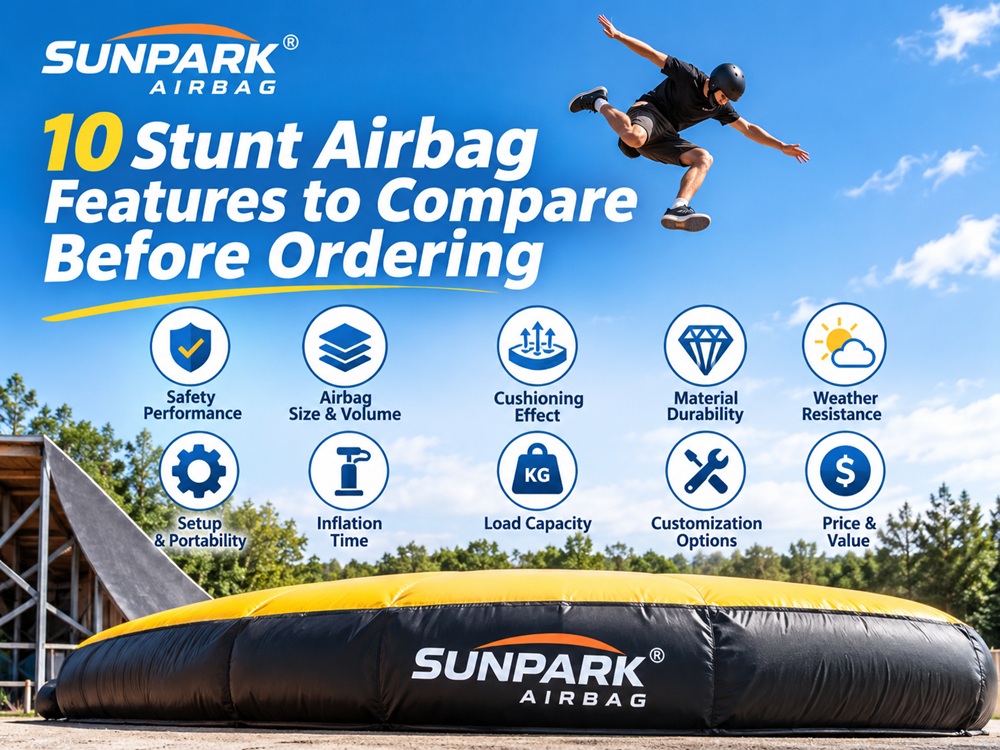
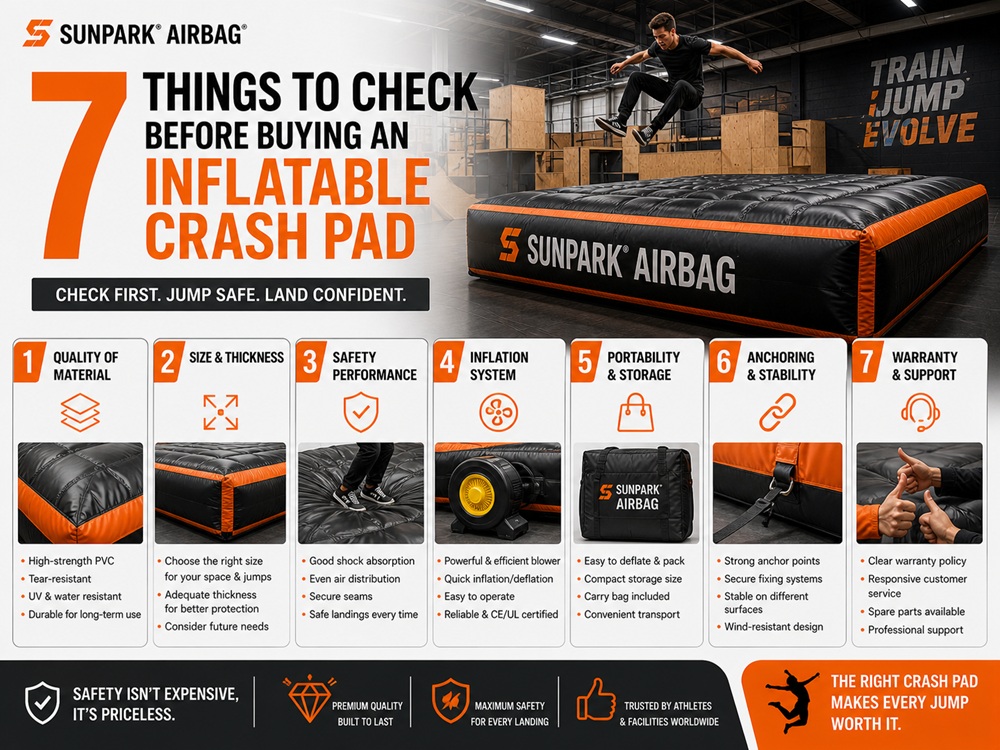
| Quick Summary Table: Feature | What to compare | Why it matters | What to request from the supplier |
|---|---|---|---|
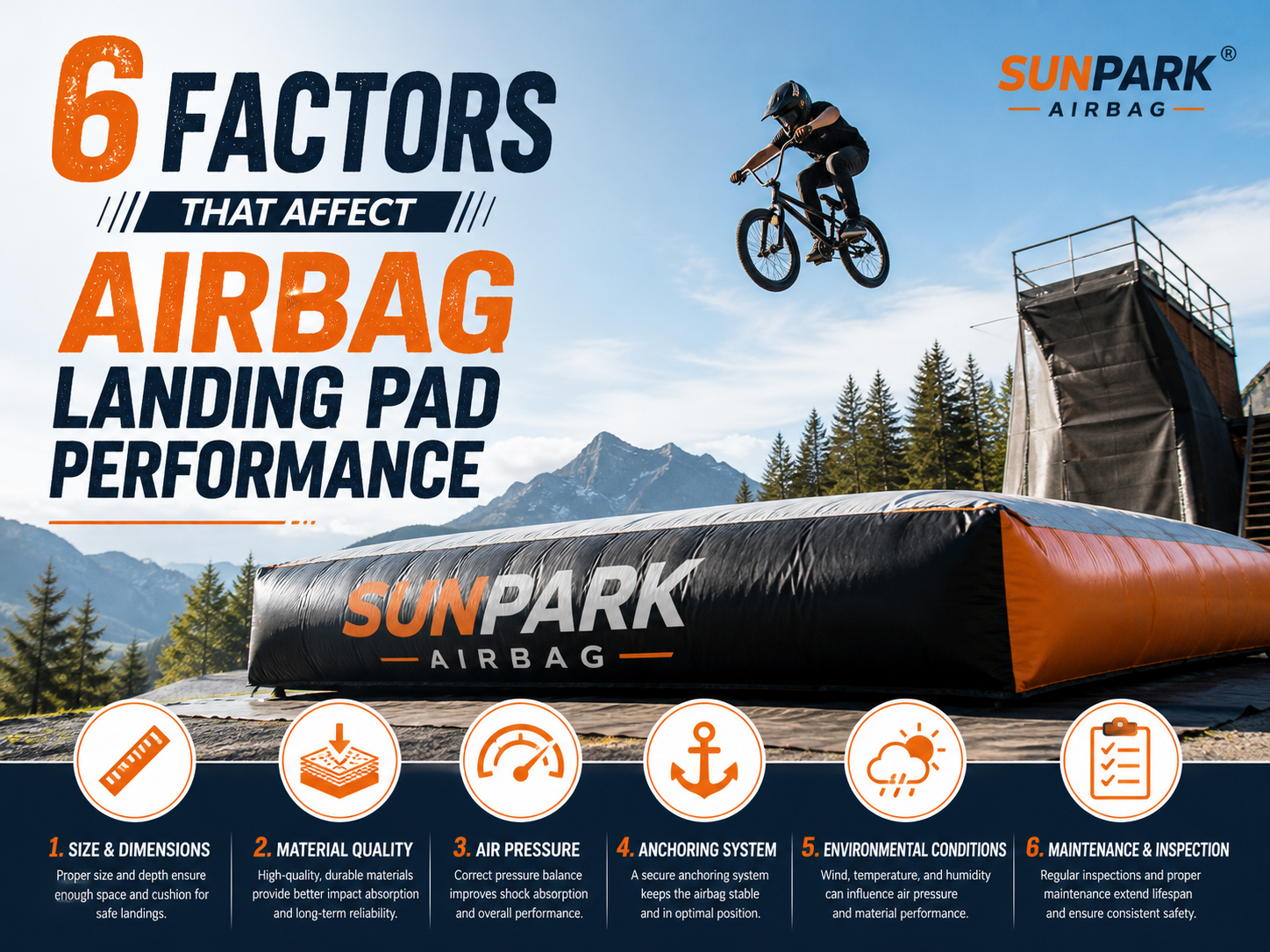
| 1. Landing dimensions and geometry | Length, width, depth, slope, transition and landing profile | Must match the approach, trajectory and expected landing area | Dimensioned layout and application-specific design review |
| 2. Impact-management design | Internal chambers, air displacement, landing response | Influences how the system responds to impact | Design explanation and relevant test information |
| 3. Air pressure and venting | Pressure range, vent locations, airflow behaviour | Affects landing response and operating consistency | Operating parameters and setup instructions |
| 4. Fabric and reinforcement | Material specification, coating, abrasion and tear resistance | Determines durability under repeated use | Fabric data and construction specification |
| 5. Seams and construction | Welding or sewing methods, reinforcement, stress points | Weak joints can cause leakage or premature failure | Construction details and quality-control records |
| 6. Anchoring and stability | Anchor points, tie-downs, ground interface | Helps prevent unwanted movement during use | Site-specific anchoring plan |
| 7. Blower and air supply | Capacity, electrical requirements, backup arrangements | Supports the intended operating configuration | Blower specifications and operating instructions |
| 8. Access and maintenance | Inspection access, repairability, cleaning and storage | Reduces downtime and supports routine checks | Maintenance manual and repair procedure |
| 9. Weather and site suitability | Wind, rain, temperature, UV and surface conditions | Outdoor conditions can affect operation and service life | Environmental limits and site preparation requirements |
| 10. Manufacturer support | Customization, testing, warranty, spare parts and training | Determines long-term serviceability and operating confidence | Written scope, warranty terms and after-sales plan |
What Is a Stunt Airbag?
A stunt airbag is an inflatable landing system designed for specific action-sports training, progression, or controlled stunt applications. Depending on its design, it can provide a landing surface for activities such as freestyle skiing, snowboarding, BMX, mountain biking, FMX, and gymnastics-related training.
Unlike a basic inflatable mattress, a purpose-designed stunt airbag uses a combination of landing geometry, internal structure, air management, fabric construction, and ground anchoring. These elements must be considered together. The objective is to provide a landing environment that behaves predictably within a defined operating envelope—not to promise a risk-free landing.
Different sports create different landing demands. A snowboard jump, a mountain-bike jump, and a motorcycle stunt setup do not have identical approach speeds, equipment weights, landing trajectories, or site requirements. A single generic airbag specification should not be assumed suitable for all three.
For facilities comparing options, start with the intended application and then review a purpose-built stunt airbag landing system. The supplier should explain how its design relates to your actual jump configuration rather than simply offering a standard size.
10 Stunt Airbag Features to Compare Before Ordering
FEATURE 01
Landing-Zone Dimensions and Geometry
Size is the first visible specification, but the useful question is whether the landing zone matches the athlete’s expected trajectory and the available site. Compare usable landing length and width, overall depth, transition shape, side geometry, and the relationship between the takeoff and landing zones.
A landing area that looks large in a product photograph may be unsuitable once the actual approach angle, jump distance, and athlete movement are considered. Equally, simply ordering the largest available model may create unnecessary transport, installation, anchoring, and operating costs.
What to check before ordering
- Sport and discipline, including the specific tricks or training activities planned.
- Takeoff height, gap, approach speed, and expected landing trajectory.
- Usable landing area rather than only the airbag’s external dimensions.
- Site footprint, access routes, and clearance around the equipment.
- Whether the landing profile is compatible with the facility’s existing ramp or jump.
Our recommendation: Provide the manufacturer with drawings, site photographs, and jump measurements. Ask for a dimensioned layout before approving production. Do not select a model based on a headline width or length alone.
FEATURE 02
Impact-Management Design
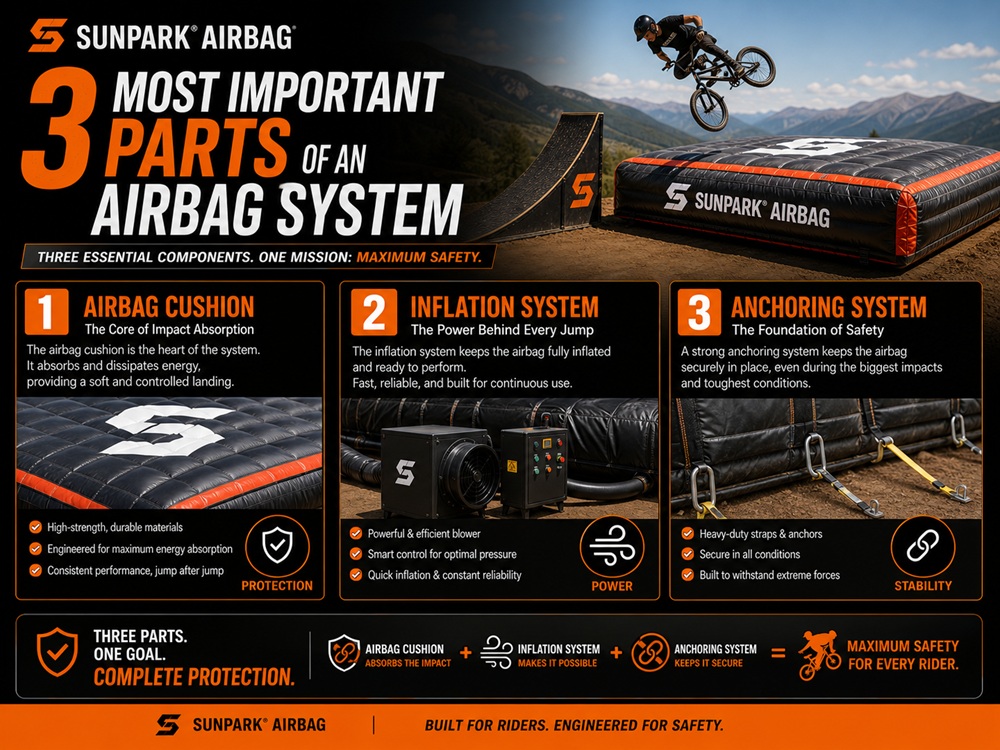
The impact-management design is central to a stunt airbag’s function. It determines how the landing structure responds when an athlete contacts the surface and how air moves through the system during that event.
Some systems use internal chambers, controlled openings, layered structures, or other design arrangements to influence the landing response. These configurations are not interchangeable. Their suitability depends on the sport, the intended landing conditions, and the manufacturer’s engineering approach.
Ask the supplier to explain the internal construction and the design assumptions used for your application. If the manufacturer provides test data, clarify what was tested, how the test was conducted, which configuration was used, and whether the results apply to your proposed installation.
Important: Do not treat a generic statement such as “soft landing” or “shock absorption” as proof of performance. A stunt airbag is not a guarantee against injury. Its use must be supported by appropriate site assessment, operating rules, qualified supervision, and a defined progression plan.
FEATURE 03
Air Pressure and Venting Configuration
Air management is one of the most important differences between a stunt landing airbag and an ordinary inflatable platform. Pressure, airflow paths, vent configuration, and internal volume all influence how the system behaves during operation.
Some designs depend on continuous blower operation, while others use different air-retention or controlled-air-displacement arrangements. The correct setup must come from the product’s engineering and operating instructions. It should never be improvised by changing vents, blocking openings, or adjusting pressure without manufacturer approval.
Questions to ask
- What is the specified operating configuration?
- Which components control air intake and exhaust?
- What checks are required before opening the system?
- How should operators respond to pressure or airflow changes?
- Are there different approved configurations for different applications?
Our recommendation: Request clear setup instructions and operating limits. A supplier should be able to explain how its air-management design works without relying on vague claims about softness.
FEATURE 04
Fabric Strength and Surface Material
The fabric is exposed to repeated contact, abrasion, environmental conditions, handling, and transport. Material selection therefore affects service life, repair requirements, and the practical cost of ownership.
Compare the fabric type, base material, coating, thickness, tensile properties, tear resistance, abrasion performance, UV suitability, and compatibility with the intended operating environment. Ask whether the specification applies to the complete airbag or only to a sample of the base fabric.
For outdoor facilities, exposure to sunlight, moisture, temperature variation, dirt, and repeated folding can influence material ageing. A fabric that performs well in an indoor gymnastics facility may not be the best choice for a permanently installed outdoor bike park.
Our recommendation: Request the fabric specification and ask the supplier how it selects materials for your operating conditions. Avoid comparing products by fabric thickness alone; thickness does not independently establish overall durability or landing performance.
FEATURE 05
Seam Construction and Reinforcement
Seams and reinforced connection points deserve as much attention as the main fabric. Stress is not distributed evenly across an inflatable structure. Corners, handles, anchor points, access openings, and transitions may experience concentrated loads during handling and use.
Ask whether the construction uses high-frequency welding, heat welding, sewing, or a combination of methods. The appropriate technique depends on the fabric and product design. What matters is that the manufacturer has a repeatable process and inspects critical joints.
Check these details
- Seam layout and reinforcement around high-stress areas.
- Construction around anchor points and lifting or handling features.
- Quality-control procedures for welded or sewn joints.
- Repair access and availability of compatible repair materials.
- Inspection procedures for leakage, separation, and visible damage.
Commercial consideration: A slightly lower purchase price is rarely attractive if the product requires frequent seam repairs or long periods out of service. Ask for the manufacturer’s repair process and warranty exclusions before placing the order.
FEATURE 06
Anchoring and Ground Stability
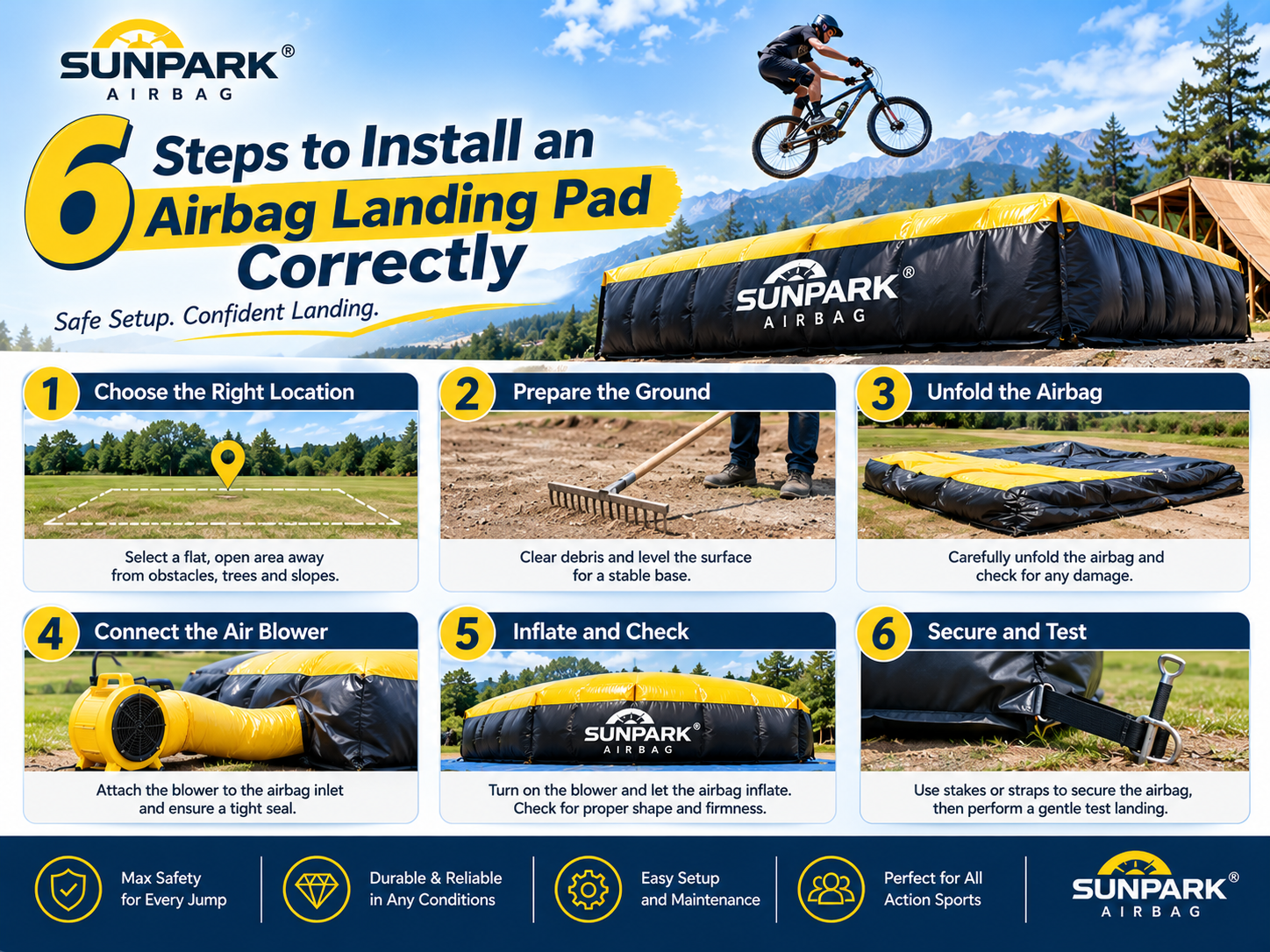
A stunt airbag must be installed in a suitable location and secured according to its design. The anchoring system, ground conditions, slope, drainage, surrounding obstacles, and wind exposure all affect installation planning.
Compare the number and location of anchor points, the type of attachment hardware, the recommended tie-down arrangement, and the installation surface. Do not assume that the same anchoring method will work on grass, concrete, snow, or a temporary event platform.
Outdoor facilities should also establish procedures for changing weather conditions. Wind can create serious handling and stability issues for large inflatable structures, especially during setup, deflation, and storage.
Our recommendation: Require a site-specific anchoring and installation plan. If the facility is temporary or frequently relocated, make sure the equipment and anchoring approach are designed for that operating model.
FEATURE 07
Blower Capacity, Air Supply, and Backup Arrangements
Blowers and air-supply components must match the manufacturer’s design. Compare the specified blower capacity, electrical requirements, connection arrangements, operating noise, protection requirements, and maintenance needs.
For a facility operating long sessions or commercial hours, reliability and serviceability matter. Ask whether spare blowers or critical replacement components are available, how operators identify abnormal operation, and what the approved response is if the air supply is interrupted.
Do not assume that installing a more powerful blower improves landing performance. The system should operate within the manufacturer’s specified configuration. Unapproved changes can alter the intended behaviour and may create new risks.
What to request: A complete equipment list, electrical specification, operating instructions, troubleshooting guide, and recommended spare-parts list.
FEATURE 08
Access, Inspection, Cleaning, and Repairability
A stunt airbag is a working asset, not a disposable event prop. Its long-term value depends partly on how easily the facility can inspect, clean, maintain, and repair it.
Look for practical access to relevant compartments and connection points, clear inspection instructions, suitable repair materials, and a documented procedure for dealing with damage. The supplier should explain how to identify abrasion, punctures, seam separation, fabric deterioration, and other conditions that require the product to be taken out of service.
Cleaning also matters. Dirt, moisture, oils, and debris can affect surface condition and make damage harder to identify. The cleaning method should be compatible with the fabric and coating. Avoid solvents or aggressive chemicals unless the manufacturer specifically approves them.
Our recommendation: Compare maintenance requirements before comparing warranty periods. A repairable design with accessible support can be more valuable over several seasons than a cheaper product with limited service options.
FEATURE 09
Weather Resistance and Site Suitability
The operating environment should influence the specification from the beginning. A stunt airbag used at an indoor trampoline or gymnastics facility faces different conditions from one installed at a ski resort, bike park, or outdoor event venue.
For outdoor use, discuss UV exposure, rain, drainage, temperature range, snow, wind, ground contact, and storage. For indoor use, consider available floor space, ceiling height, access for installation, ventilation, and electrical supply.
Weather resistance should be described in terms of actual material and operating limits. A general statement that a product is “weatherproof” is not enough to establish suitability for permanent outdoor use.
Our recommendation: Tell the manufacturer where the airbag will be installed, how often it will be moved, and the seasonal conditions it will face. Ask for written environmental limitations and storage guidance.
FEATURE 10
Manufacturer Experience, Customization, and After-Sales Support
The final feature is not part of the inflatable structure, but it can determine whether the purchase works commercially. A manufacturer should understand the intended sport, the facility’s operating model, and the practical requirements of installation and maintenance.
Compare the supplier’s experience with similar applications, customization capability, technical communication, production quality controls, lead time, spare-parts availability, warranty terms, and support after delivery.
SUNPARK® AIRBAG has more than 10 years of experience providing freestyle airbag solutions for ski resorts, theme parks, sports facilities, and gymnastics facilities internationally. Its work includes products developed for professional riders, world champion snowboarders, and trampoline parks. This background is relevant when discussing application-specific requirements, but buyers should still review the proposed design, documentation, and references for their own project.
Explore the wider SUNPARK® AIRBAG product range to compare different landing and training applications.
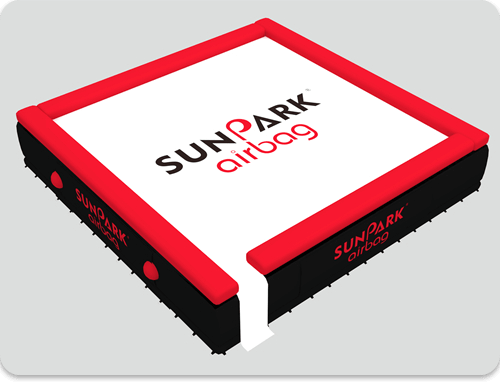
Our recommendation: Choose a supplier that can discuss the complete system—not just fabric and dimensions. Ask who provides design support, what information is needed from your site, how the equipment is inspected before shipment, and what support is available after installation.
How a Stunt Airbag Works
A stunt airbag is designed to manage an athlete’s landing through its structure and air-management system. When the athlete contacts the landing surface, the inflatable construction responds to the applied load. Depending on the design, air may move between internal sections or exit through designated openings, while the structure changes shape under impact.
The actual response depends on the complete system: internal layout, material properties, air pressure, venting, landing geometry, and the conditions for which the airbag was designed. That is why a product intended for one sport or jump configuration should not automatically be used for another.
It is also important to distinguish a stunt airbag from a constant-air inflatable platform. Some inflatables are designed to remain firm through continuous air supply. Stunt landing systems may use different impact-management principles. The supplier must explain the operating method for the exact model being purchased.
Stunt Airbag vs. Other Landing and Training Systems
Not every facility needs the same landing equipment. The right choice depends on the sport, the skill being practiced, available space, budget, and intended operating frequency.
| System | Typical use | Main purchasing consideration | When to consider it |
|---|---|---|---|
| Stunt airbag | Action-sports jump and trick progression | Landing geometry, air management, site-specific design | When the facility needs a dedicated landing system for a defined jump setup |
| Inflatable crash mat | General impact-management and training applications | Intended activity, dimensions, construction and operating method | When the training task is suited to a mat-style inflatable rather than a jump landing system |
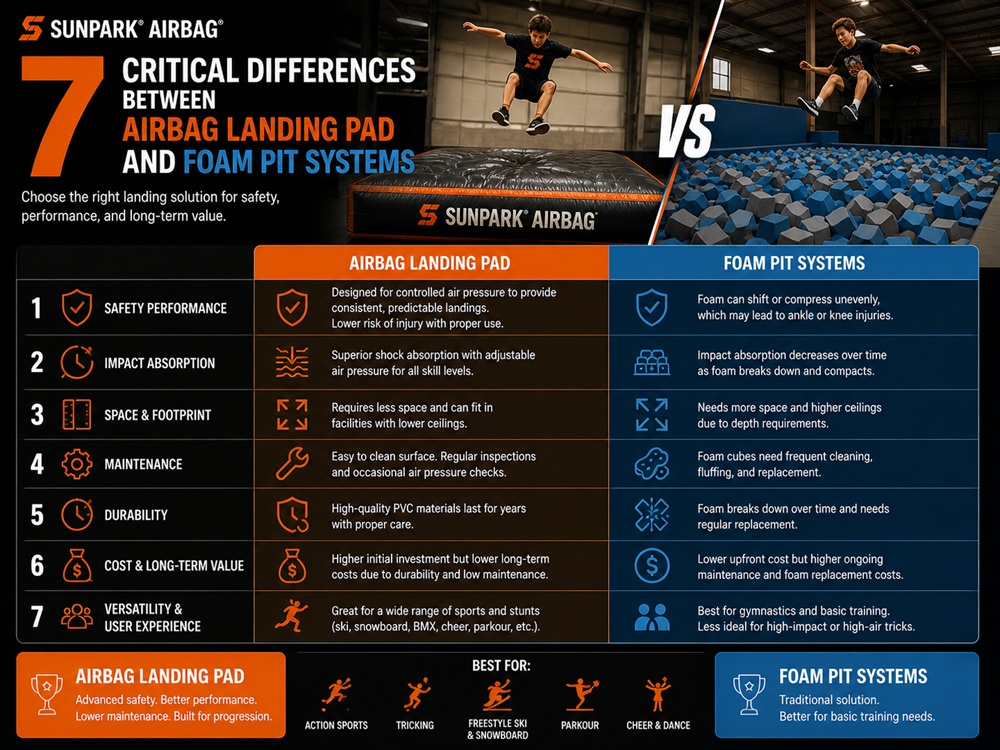
| Foam pit | Gymnastics, freestyle and selected indoor training | Pit depth, foam condition, hygiene, maintenance and space | When the facility can support the space and ongoing foam management |
| Traditional landing mat | Gymnastics and controlled low-height training | Material, thickness, firmness and intended use | For activities designed around mat-based landings |
| Sport-specific airbag | Bike, snowboard, halfpipe or gymnastics training | Compatibility with the sport’s approach and landing conditions | When the facility needs a design tailored to a specific discipline |
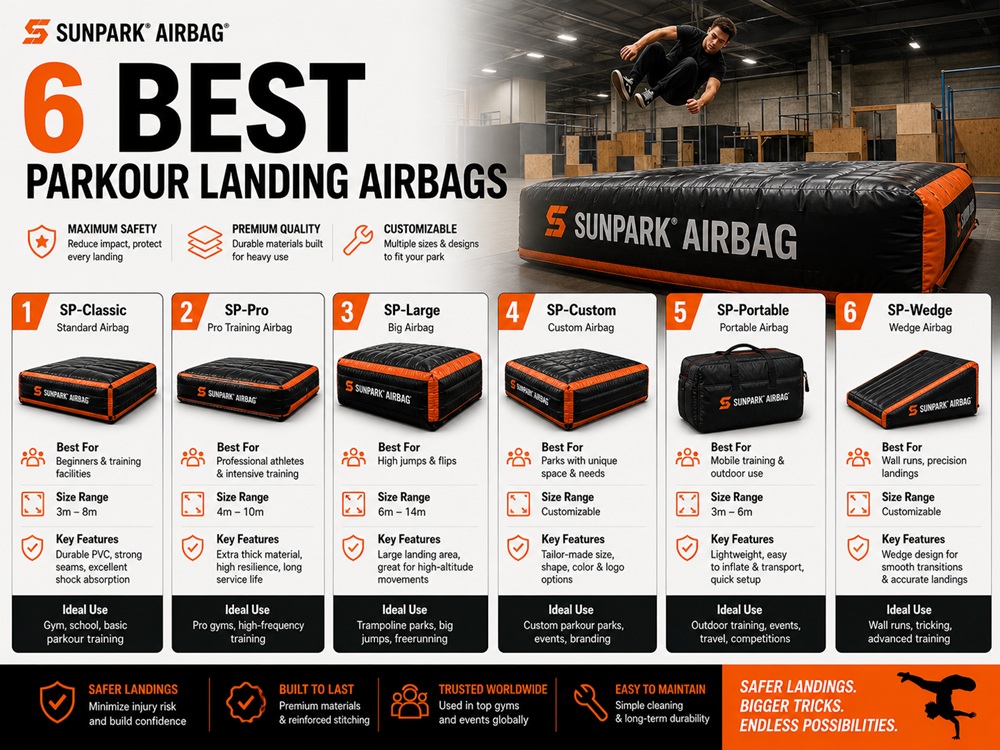
For example, a bike park may need a dedicated MTB airbag landing system rather than a general-purpose inflatable. A facility focused on gymnastics may find gymnastics airbag equipment more relevant. The product should follow the activity, not the other way around.
Pros and Cons of Buying a Stunt Airbag
| Pros | Cons and trade-offs |
|---|---|
| Can provide a dedicated landing environment for structured action-sports training and progression. | Does not eliminate injury risk or replace coaching, skill progression, and site safety procedures. |
| Can support repeated practice without constructing a permanent foam pit. | Still requires suitable installation space, setup, inspection, and maintenance. |
| Can be customized for particular sports and facility layouts. | Custom designs may increase engineering time, development cost, and lead time. |
| Can be deflated and stored or relocated when designed for that purpose. | Transport, handling, drying, and storage require planning and staff time. |
| Can support commercial training, events, and controlled progression programs. | Blower, power, anchoring, and operating requirements add to the total cost. |
| Offers a visible and attractive training feature for sports venues. | Appearance and size alone do not establish performance or suitability. |
Benefits and Limitations of Stunt Airbag Features
Key Benefits
- Application-specific design: A purpose-built system can be configured around the sport, jump layout, and available installation area.
- Training progression: Facilities can incorporate an airbag into structured skill development under appropriate supervision.
- Flexible installation: Some models can be deflated and relocated, depending on their design and size.
- Commercial attraction: A dedicated airbag feature can support training sessions, events, and visitor engagement.
- Custom branding and dimensions: Manufacturers may offer project-specific layouts, colours, and other options.
Important Limitations
- No risk-free landing: An airbag cannot guarantee that an athlete will avoid injury.
- Application limits: A system designed for one sport or jump profile may not suit another.
- Operating costs: Power, labour, inspection, repairs, transport, and storage should be included in the budget.
- Weather constraints: Outdoor use depends on site conditions and the manufacturer’s operating limits.
- Maintenance requirements: Fabric, seams, air systems, anchors, and accessories require routine inspection.
- Space requirements: The full installation footprint may be substantially larger than the airbag’s visible landing surface.
Who Should Use a Stunt Airbag?
Ski Resorts and Snowboard Training Facilities
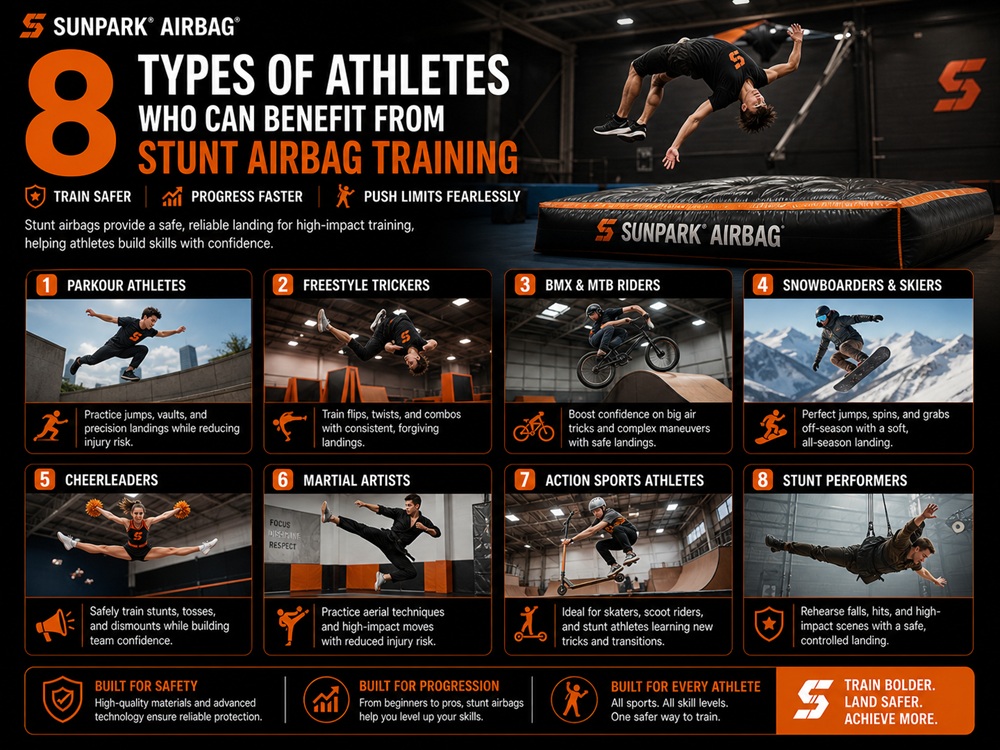
Ski resorts and snowboard facilities may use airbags to support controlled freestyle training and progression. The design should reflect the jump geometry, approach conditions, athlete level, seasonal environment, and available site space. A purpose-designed big jump airbag system may be relevant when the project involves a larger jump configuration, subject to a proper design review.
Facilities comparing destinations and training concepts can also review snowboard airbag parks for examples of how airbag features are incorporated into action-sports environments.
Mountain Bike and BMX Parks
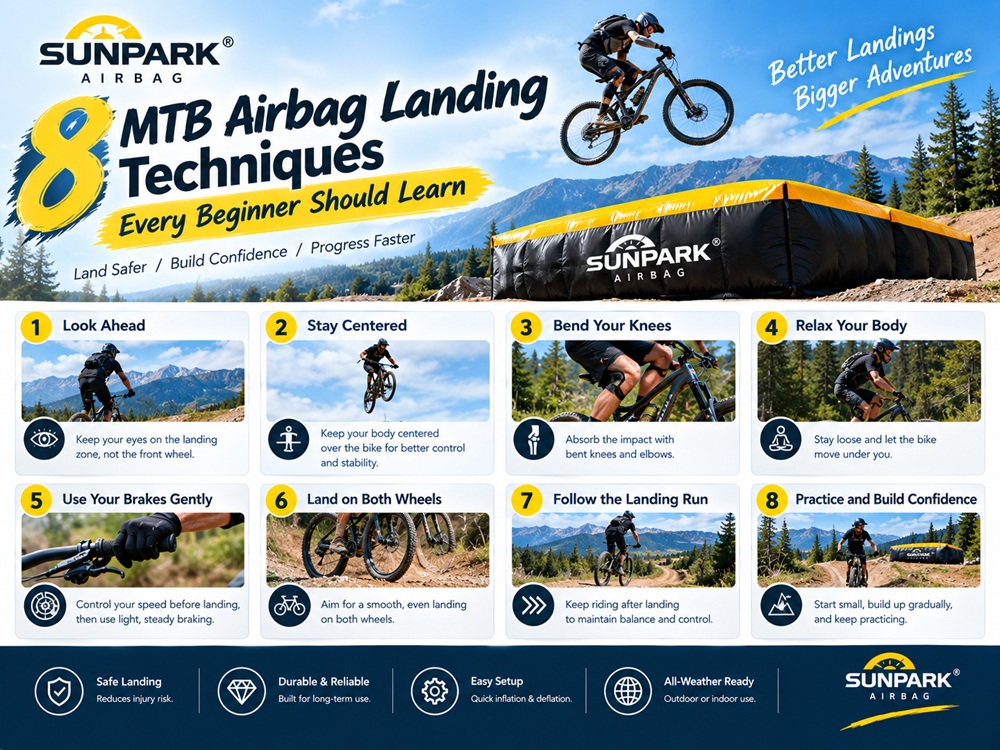
Bike parks need to consider bicycle trajectory, approach speed, jump shape, rider clearance, and the landing surface. A dedicated bike airbag landing system or MTB-specific design may be more suitable than adapting an unrelated product.
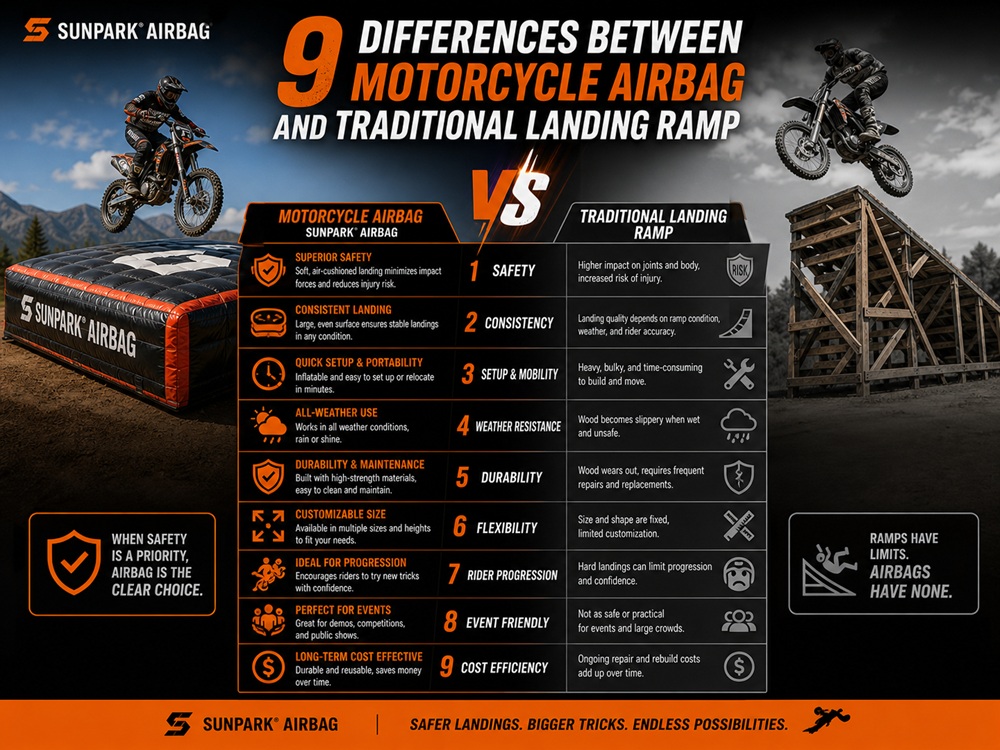
FMX and Motorcycle Training Venues
FMX applications involve different equipment mass, speed, and landing conditions from bicycle or snowboard use. Do not assume that a bike airbag can be used for motorcycle stunts simply because both involve ramps. The supplier should assess the exact application and provide a design specifically intended for it. Facilities exploring this category can review the FMX landing airbag options.
Gymnastics and Trampoline Facilities
Indoor facilities may use inflatable landing equipment as part of a wider training setup. However, the correct equipment depends on the movement being practiced, the athlete’s level, and the facility’s coaching and supervision procedures. Compare a stunt landing system with purpose-designed inflatable crash mats before deciding.
Who Does Not Need a Stunt Airbag?
A stunt airbag may be unnecessary for a small facility that only needs conventional gymnastics mats, low-height training surfaces, or basic recreational inflatables. It may also be unsuitable where the site cannot provide the required footprint, anchoring, electrical supply, trained operators, or maintenance resources.
For beginners, the priority should be coaching, basic skill development, and an appropriate training environment. An airbag is not a shortcut to advanced tricks. For commercial operators, the investment makes sense only when the facility has a defined use case, sufficient demand, and the staff and procedures to operate the system responsibly.
Common Mistakes When Ordering a Stunt Airbag
1. Choosing by Size Alone
A large landing surface does not automatically make a system suitable. Geometry, internal construction, and the intended jump must be considered together. Provide site drawings and ask for a proposed layout.
2. Treating Every Airbag as the Same Product
Stunt airbags, bike landing systems, gymnastics airbags, crash mats, and constant-air inflatables have different purposes. Confirm the intended use of the exact model instead of relying on a broad product category.
3. Ignoring Airflow and Operating Instructions
Venting and blower arrangements are part of the engineered system. Never block openings, change blower specifications, or modify operating pressure without written manufacturer approval.
4. Overlooking Anchoring and Site Conditions
Installation must account for ground type, wind exposure, drainage, access, and surrounding obstacles. Ask for an installation plan before the product arrives.
5. Comparing Fabric Thickness Instead of Full Construction
Fabric thickness is only one specification. Coating, base material, seams, reinforcement, stress distribution, and repairability all matter.
6. Assuming a Warranty Replaces Maintenance
A warranty does not remove the need for daily checks, scheduled inspections, correct storage, and prompt repair. Understand the maintenance obligations and warranty exclusions before purchase.
7. Failing to Define the User Group
Age, body size, skill level, equipment, and intended activity influence the suitability of the system. The manufacturer needs this information to assess the application.
8. Treating an Airbag as a Guarantee Against Injury
No landing system can eliminate risk. Facilities need documented operating procedures, trained supervision, controlled progression, and clear rules for stopping use when conditions are unsuitable.
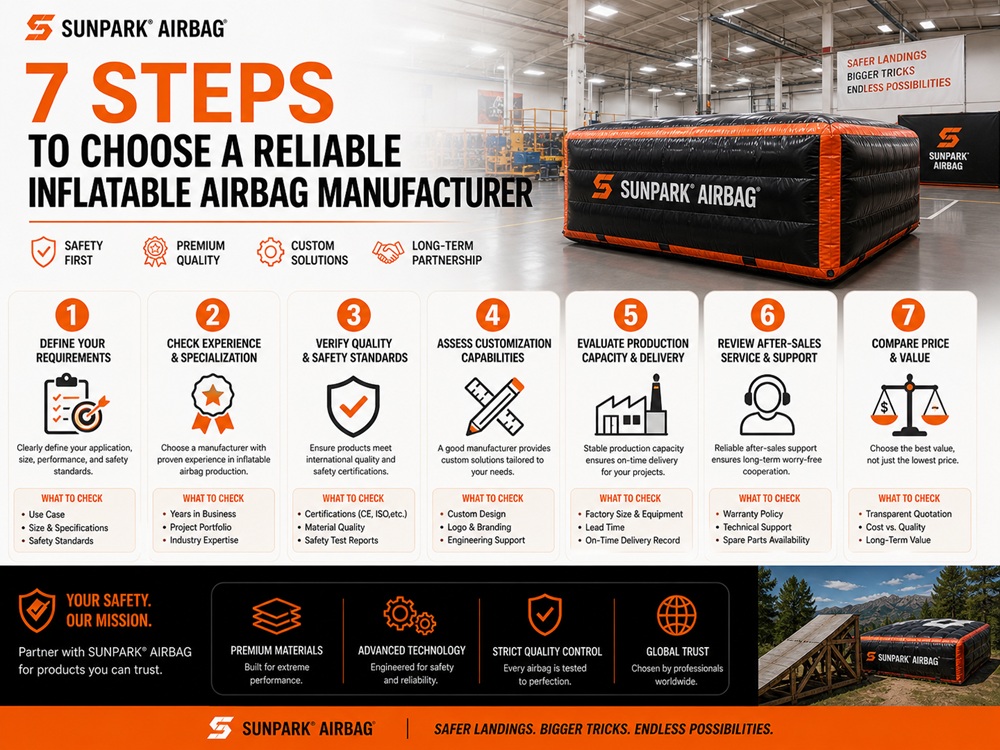
How to Choose a Stunt Airbag Manufacturer
For a commercial facility, the manufacturer should be able to translate your sport and site requirements into a documented equipment proposal. The supplier’s job is not simply to quote a standard model. It is to establish whether the proposed configuration is appropriate for the intended application and explain its limitations.
1. Prepare a Complete Project Brief
Include the sport, intended tricks or training activities, athlete group, jump dimensions, approach and landing geometry, indoor or outdoor location, available footprint, expected operating hours, and seasonal conditions. Photos, drawings, and site measurements make the discussion more productive.
2. Ask for a Technical Proposal
Request dimensions, internal layout information, material specifications, seam and reinforcement details, blower requirements, anchoring arrangements, operating instructions, and maintenance requirements. Ask the supplier to identify which details are standard and which are customized for your project.
3. Request Relevant Test Information
Ask what performance tests or quality checks are conducted and what the results actually demonstrate. Request the test method, sample configuration, conditions, and acceptance criteria. Avoid accepting a certificate or test report without confirming that it applies to the product and application being quoted.
One important standards distinction: ASTM F2374 covers many commercial inflatable amusement devices, but its scope specifically excludes professional exhibition or stunt devices and certain stunt-bag-style impact attenuation devices. Therefore, a supplier should not claim that ASTM F2374 automatically certifies a stunt airbag. Ask which requirements and independent assessments are relevant to your exact installation and jurisdiction.
4. Compare OEM Customization and Standard Models
A standard model may be more economical and faster to deliver when its dimensions and operating design already fit your application. A custom system may be justified when the site has unusual dimensions, the sport requires a specialized landing profile, or the facility needs integration with an existing ramp.
Compare the additional engineering cost and lead time against the operational value of customization. Do not pay for custom features that do not solve a defined problem.
5. Evaluate Total Cost of Ownership
The purchase price is only the starting point. Include shipping, installation, blower and electrical requirements, staff training, inspection, repairs, storage, seasonal handling, spare parts, and downtime. For a venue operating daily, serviceability and repair turnaround can have a meaningful effect on profitability.
6. Confirm Warranty and After-Sales Support
Clarify warranty duration, covered components, exclusions, damage assessment, repair responsibility, and availability of replacement parts. Ask who will support installation and how technical questions are handled after delivery.
7. Check Manufacturer Experience in Your Sport
Experience with a different type of inflatable is not necessarily proof of experience with your intended landing application. Ask for relevant project examples and discuss how the supplier handles design review, production inspection, delivery, setup, and operator guidance.
SUNPARK® AIRBAG develops freestyle airbag solutions for ski resorts, theme parks, sports facilities, and gymnastics venues. Its product range includes halfpipe airbags and other sport-specific landing products. When comparing suppliers, use these product categories as a starting point for a technical discussion—not as a substitute for reviewing the requirements of your own site.
Expert Recommendation: What Should You Prioritize Before Ordering?
Our recommendation is to rank the ten features by operational importance rather than treating every specification as equally important. For most buyers, the first five decisions should be application fit, landing geometry, impact-management design, air-management configuration, and site anchoring. These determine whether the proposed system is appropriate for the intended use and installation.
Recommended Priorities by Facility Type
| Facility type | Prioritize first | Do not overlook |
|---|---|---|
| Ski resort or snowboard park | Jump geometry, landing profile, weather suitability | Seasonal setup, storage, wind and snow conditions |
| MTB or BMX park | Bike-specific trajectory, landing width, anchoring | Surface wear, outdoor exposure, access for maintenance |
| FMX training venue | Application-specific engineering and operating limits | Equipment mass, jump configuration, specialist supervision |
| Gymnastics or trampoline facility | Training task, user group, indoor footprint | Cleaning, inspection, staff training and storage |
| Theme park or commercial attraction | Operating model, throughput, maintenance support | Daily inspection, operator procedures, downtime planning |
When Is a Custom Stunt Airbag Worth the Investment?
A custom design is worth considering when a standard product cannot match the site’s geometry, sport-specific requirements, or operating conditions. It may also be justified when the facility expects frequent use and needs a configuration that integrates with an existing ramp or training program.
It is less compelling when the facility has not yet defined its activity, lacks site measurements, or is still testing whether there is enough demand for the feature. In those situations, resolve the operational plan first. Buying a large custom airbag before the use case is clear can lock the facility into unnecessary cost and installation complexity.
Final Pre-Order Checklist
- We have defined the sport, skill level, and intended training activities.
- We have supplied accurate site measurements and jump geometry.
- We have reviewed the landing-zone dimensions and proposed layout.
- We understand the air-management and blower configuration.
- We have received material and construction specifications.
- We have a site-specific anchoring and installation plan.
- We understand operating limits and environmental restrictions.
- We have a written inspection, maintenance, and repair plan.
- We have reviewed relevant test information and its limitations.
- We have confirmed warranty, spare parts, and after-sales support.
A stunt airbag should be purchased as part of a complete training and operating system. The best supplier is the one that can explain why its design fits your application, provide the technical information to support that proposal, and help you maintain the equipment over its service life.
Frequently Asked Questions About Stunt Airbag Features
1. What are the most important stunt airbag features?
The most important features are landing-zone geometry, impact-management design, air pressure and venting configuration, fabric strength, seam construction, anchoring, blower capacity, maintenance access, weather suitability, and manufacturer support. Their relative importance depends on the sport and installation.
2. How do I choose the right stunt airbag size?
Start with the sport, jump dimensions, approach speed, expected landing trajectory, athlete group, and available site footprint. Ask the manufacturer to review a site drawing and provide a dimensioned proposal. Do not select a size based only on the product’s overall width or length.
3. Are all stunt airbags suitable for MTB, FMX, and snowboarding?
No. These sports have different equipment, approach conditions, jump geometry, and landing requirements. A system designed for one application should not be assumed suitable for another. Request a sport-specific design review.
4. What fabric should a stunt airbag use?
The appropriate fabric depends on the construction, operating environment, and expected wear. Compare the base material, coating, tensile and tear properties, abrasion resistance, UV suitability, seams, and reinforcement. Fabric thickness alone is not enough to judge durability.
5. Does a stunt airbag need a blower?
That depends on the design. Some inflatable systems require continuous air supply, while others use different air-retention or controlled-airflow arrangements. Follow the manufacturer’s specification for the exact model and do not substitute or modify blower equipment without approval.
6. Can a stunt airbag be used outdoors?
Some models are designed for outdoor use, but suitability depends on fabric, weather limits, anchoring, drainage, ground conditions, and operating procedures. Ask the manufacturer for written environmental limits and installation guidance.
7. How often should a stunt airbag be inspected?
Inspection frequency should follow the manufacturer’s instructions and the facility’s risk-management procedures. Operators should complete required pre-use checks and scheduled inspections, documenting damage, repairs, and any conditions that require the equipment to be taken out of service.
8. Is a stunt airbag safer than a foam pit?
Neither option is automatically safer in every situation. They have different construction, maintenance, space, and operating requirements. The right choice depends on the activity, facility layout, user group, supervision, and documented suitability of the equipment.
9. What should I ask a stunt airbag manufacturer before ordering?
Ask about application suitability, landing dimensions, internal design, air management, fabric and seams, anchoring, blower requirements, test information, environmental limits, inspection, maintenance, warranty, and spare parts. Provide accurate site and jump information so the supplier can assess the actual project.
10. Does a stunt airbag eliminate the risk of injury?
No. A stunt airbag does not eliminate injury risk. It should be used only within its intended operating conditions, with appropriate site assessment, trained supervision, athlete progression, inspection, and clear operating procedures.
References
- ASTM International – ASTM F2374: Standard Practice for Design, Manufacture, Operation, and Maintenance of Inflatable Amusement Devices. Useful for understanding the scope of commercial inflatable amusement-device requirements. Note that stunt and certain impact-attenuation devices are specifically excluded from its scope; buyers should not treat it as a blanket certification for stunt airbags.
- Impact Forces and Injury Potential from Landing on Large Inflatable Airbags. Research discussing impact forces and injury considerations associated with large inflatable landing airbags.
- U.S. Consumer Product Safety Commission – Inflatable Amusement Devices Staff Report. Background on inflatable-device hazards and safety considerations. Its scope should be distinguished from sport-specific stunt airbag engineering.