The Ultimate Guide to Ski Airbag Jump Cost in 2026

The Ultimate Guide to Ski Airbag Jump Cost in 2026

As extreme sports have developed at a staggering pace, the demand for elite, risk-mitigating training infrastructure has skyrocketed. More and more snowboarders, freestyle skiers, and serious sports enthusiasts are looking for safer training possibilities to progress without risks of getting injured. The days of testing a triple cork on a hard-packed snow landing are behind us. Today, progression requires advanced pneumatic technology. However, facility operators, resort managers, and private athletes constantly ask us one primary question: what is the true Ski airbag jump cost in 2026?

The Ultimate Guide to Ski Airbag Jump Cost in 2026

Authored by SunparkAirbag® - The leading manufacturer of Airbags for Extreme Sports and Leisure Industries in China. We create products for World Champion Snowboarders, famous riders, and trampoline parks worldwide. Quality is our highest priority, ensuring every jumper’s safety.

From our experience at SunparkAirbag®, understanding the Ski airbag jump cost requires looking far beyond the initial purchase price. It involves analyzing material longevity, safety certifications, operational overhead, and the incredible return on investment (ROI) these systems generate. We are deeply committed to the development and improving of our own products, ensuring that when you invest in a landing system, you are receiving the pinnacle of extreme sports engineering. In this comprehensive guide, we will break down every financial and technical aspect of the Ski airbag jump cost for 2026.

Core Factors Influencing the Ski Airbag Jump Cost

We recommend approaching the Ski airbag jump cost as a holistic capital expenditure. The price of a professional-grade airbag is dictated by its dimensions, the complexity of its internal chamber architecture, and its intended application. A compact training bag for a local gymnastics center will carry a vastly different price tag than a colossal, custom-branded landing pad engineered for a World Cup big air event.

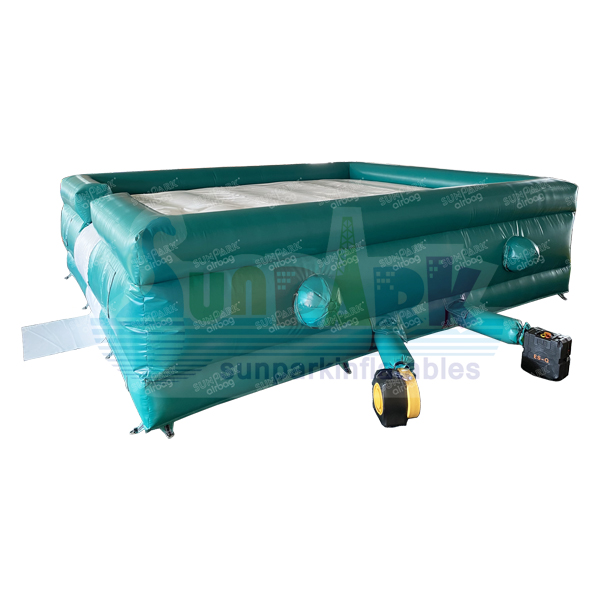
Firstly, the volume of the airbag directly correlates to the volume of raw materials required. A standard big jump airbag system designed for a commercial ski resort often spans over 15 to 20 meters in width and up to 50 meters in length to safely accommodate the trajectory of elite athletes. The Ski airbag jump cost for a system of this magnitude encompasses specialized internal pillars and dual-chamber technology. The lower chamber remains firm to prevent bottoming out, while the upper chamber is soft and ventilated to absorb the kinetic energy of the skier.

Secondly, customized top sheets influence the final Ski airbag jump cost. Many resorts offset their initial investment by selling advertising space on the airbag’s surface. High-resolution, UV-resistant digital printing adds to the upfront manufacturing cost but transforms the airbag into a highly lucrative billboard.

Summary Table: Estimated Ski Airbag Jump Cost Breakdown

To provide a clear financial perspective for 2026, we have compiled a summary table detailing the average Ski airbag jump cost across different facility requirements. Please note that these are industry estimates; actual pricing depends on specific customization and shipping logistics.

Airbag Category / ApplicationAverage Dimensions (W x L x H)Estimated Ski Airbag Jump Cost (USD)Ideal Target User
Entry-Level / Backyard Training6m x 9m x 1.5m$4,500 – $8,000Private athletes, small clubs
Mid-Size Resort / Progression Park10m x 15m x 2m$12,000 – $25,000Regional ski resorts, training camps
Professional Big Air / Olympic Training15m x 30m+ x 3m+$30,000 – $65,000+World Champion Snowboarders, major resorts
Multipurpose Indoor Action SportsCustom contours$15,000 – $40,000Trampoline parks, indoor dry slopes

Material Quality: The Plato Brand Difference

When analyzing the Ski airbag jump cost, one must heavily scrutinize the raw materials. From our experience, utilizing inferior PVC leads to rapid degradation, seam blowouts, and ultimately, catastrophic safety failures. At SunparkAirbag®, our products are built with the best materials outside and inside, utilizing the industry-leading Plato Brand PVC. This eco-friendly, highly durable material is specifically engineered to withstand extreme temperature fluctuations, from the freezing alpine environments of winter resorts to the blistering UV exposure of summer dry-slope training.

The topsheet material is incredibly vital. It must be slick enough to allow a skier to “ride out” their landing, yet tough enough to resist the slicing action of sharp ski edges and snowboard bindings. Investing in a premium topsheet slightly elevates the initial Ski airbag jump cost, but it drastically reduces the frequency of replacements, resulting in long-term financial savings.

Certification and Safety Standards

Quality is our highest priority, ensuring every jumper’s safety. A significant portion of the Ski airbag jump cost is dedicated to rigorous testing and compliance with international safety standards. SunparkAirbag® is trusted and recognized by World Champions, Famous Riders, and top-tier Ski Resorts because our products are internationally certificated by CE EN14960, which meets the strictest European Standards for inflatable play and sporting equipment.

We recommend that facility operators never compromise on certification to lower their Ski airbag jump cost. Non-certified airbags expose your business to immense legal liability and void insurance policies. The engineering required to achieve CE EN14960 compliance involves precision airflow dynamics, highly reinforced stitching, and fail-safe pressure release valves—all of which are standard in our best airbag landing systems 2026.

Hidden Operational and Maintenance Expenses

The true Ski airbag jump cost extends beyond the manufacturer’s invoice. From our experience, clients must budget for operational infrastructure. Large airbags require constant, regulated airflow. This necessitates industrial-grade, continuous-flow blowers. The electricity required to run multiple 1500W to 2000W blowers for 8 to 10 hours a day should be factored into your operational Ski airbag jump cost.

Furthermore, winter environments require regular snow clearing. Leaving heavy, wet snow on an deflated airbag can damage the internal baffles. Proper storage during the off-season, including heavy-duty tarps and rodent-proof warehousing, is also a necessary expense. However, routine maintenance on a high-quality SunparkAirbag® is minimal, usually limited to patching minor surface scuffs and ensuring the blowers are free of debris.

Foam Pits vs. Airbags: A Financial Perspective

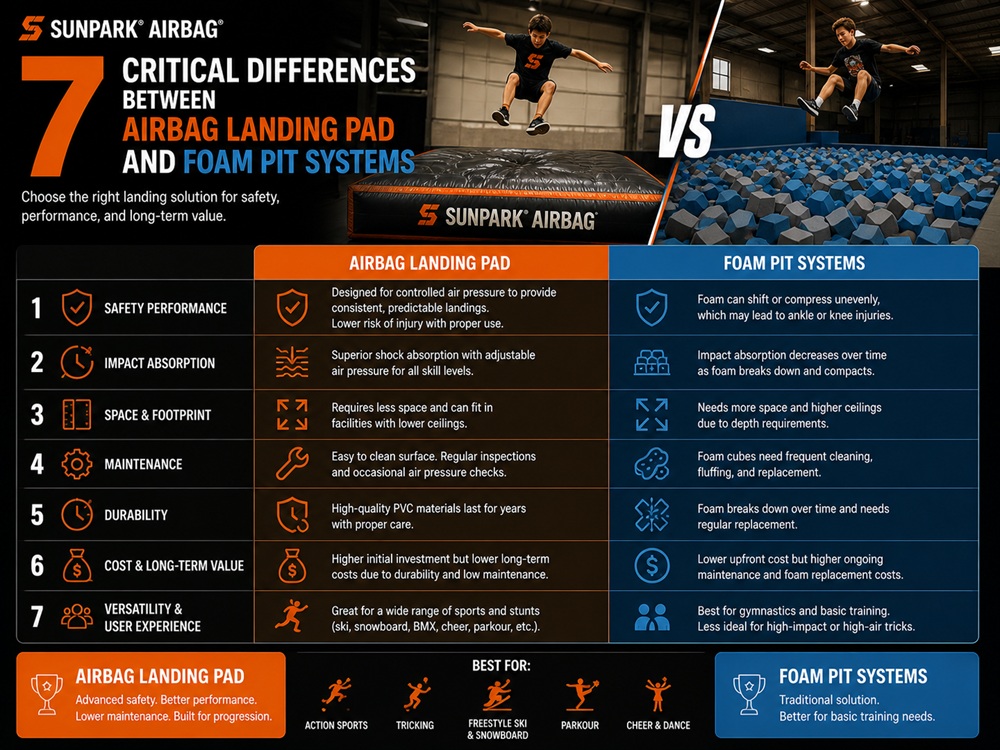
Historically, training facilities utilized massive pits filled with polyurethane foam blocks. When comparing the Ski airbag jump cost to the construction and maintenance of a foam pit, the airbag wins on almost every financial metric. We detail this extensively in our foam pit vs airbag comparison.

Foam pits require a massive concrete or wooden structure to contain the blocks. The blocks themselves degrade rapidly, turning into toxic dust that poses respiratory hazards to athletes and requires expensive, constant replenishment. Furthermore, athletes cannot “ride away” from a foam pit landing; they sink, wasting valuable training time crawling out. An airbag offers rapid turnaround times, zero toxic dust, and a much lower total cost of ownership over a 5-to-10-year lifespan.

Versatility and Multi-Sport ROI

One of the most effective ways to justify the Ski airbag jump cost is by utilizing the system across multiple disciplines. SunparkAirbag® systems are not limited exclusively to winter sports. During the summer months, ski resorts can easily transition their airbags to serve mountain biking communities. By adjusting the pressure valves, the same bag can be used as a bike airbag landing or a dirt bike airbag landing.

For indoor facilities, integrating an airbag opens up revenue streams across various demographics. As one of the top trampoline park equipment manufacturers, we see facilities using the same foundational technology for gymnastics airbag equipment, stunt airbag landing setups, and even inflatable crash mats for parkour. For extreme motorized sports, our heavy-duty FMX airbag landing systems prove that the technology can handle the immense weight and impact of motorcycles, ensuring your investment pays dividends across every season and sport.

Frequently Asked Questions (FAQs)

Why does the Ski airbag jump cost vary so much between manufacturers?

From our experience, extreme price variations usually stem from the quality of the PVC, the internal baffle engineering, and safety certifications. SunparkAirbag® uses premium, eco-friendly Plato Brand materials and holds CE EN14960 certification. Cheaper alternatives often use brittle plastics, single-stitch seams, and lack the dual-chamber safety mechanisms, resulting in a product that is both dangerous and short-lived.

How long does a commercial ski airbag last?

With proper maintenance, regular cleaning, and appropriate off-season storage, a high-quality SunparkAirbag® will easily last 5 to 8 years under heavy commercial use. The topsheet, which takes the brunt of the ski edge friction, is designed to be replaceable, further extending the overall lifespan of the main inflatable structure.

Is the blower equipment included in the initial Ski airbag jump cost?

Yes, we recommend and typically include the necessary industrial blowers in our comprehensive quotes. The number and power of the blowers required depend entirely on the total cubic volume of the airbag. We ensure that the blowers provided are CE/UL certified and matched perfectly to your system’s pressure requirements.

Can I customize the airbag with my resort’s logos?

Absolutely. Custom branding is highly encouraged. We offer high-definition digital printing on the sides and topsheets of the airbag. While this slightly increases the initial Ski airbag jump cost, it provides incredible marketing value for your resort or sponsors during high-profile events and social media coverage.

Industry References

To ensure our clients have the most authoritative data regarding action sports safety and engineering standards, we refer to the following institutions:

Are Airbags Safe for Snowboarders

Are Airbags Safe for Snowboarders?

As extreme sports have developed at an unprecedented pace over the last decade, more and more snowboarders and serious sports enthusiasts are looking for safer training possibilities to progress without the high risks of getting injured. When evaluating modern freestyle training facilities, one of the most frequently asked questions we receive from athletes, coaches, and resort managers is: are airbags safe for snowboarders? The short answer is yes, but understanding the engineering, materials, and physics behind these massive inflatable structures is critical to fully appreciating their safety profile.

Are Airbags Safe for Snowboarders

With over 10 years of experience, we provide freestyle airbags for ski resorts, theme parks, sports, and gymnastics facilities around the globe. SunparkAirbag® is the leading manufacturer of Airbags for Extreme Sports and Leisure Industries in China. We create products for World Champion Snowboarders, famous riders, and trampoline parks worldwide. We are deeply committed to the development and improving of our own products.

From our experience engineering advanced pneumatic landing systems, the transition from hard snow landings and outdated foam pits to sophisticated airbag technology has revolutionized the progression of snowboard tricks. In this comprehensive industry guide, we will analyze exactly why airbags safe for snowboarders are considered the gold standard in action sports training, detailing the structural mechanics, pressure displacement systems, and facility implementation best practices.

The Evolution of Freestyle Training

Historically, learning a new rotation or inverted aerial maneuver on a snowboard meant committing to a hard-packed snow landing. The physical toll on an athlete’s knees, spine, and ankles was immense. The industry temporarily shifted toward foam pits, but these posed their own hazards: they harbor bacteria, degrade quickly under UV light, and pose a severe fire risk. More importantly, foam pits do not allow a rider to ride away from a trick; they simply swallow the athlete, making it difficult to simulate real-mountain physics.

When asking are airbags safe for snowboarders, we must look at the modern contoured landing bag. Unlike early flat stunt bags that acted like giant inflatable mattresses, today’s advanced landing airbag solutions are built on an inclined pitch. This mimics the exact angle of a snow landing. Riders can land on their edges, absorb the impact safely if they crash, or literally ride out of the trick down the inflatable transition. This technological leap is precisely why the best snowboard airbag parks have become mandatory training grounds for Olympic-level athletes.

The Evolution of Freestyle Training

Summary Table: Airbags vs. Traditional Landings

Feature / MetricSUNPARK® Snowboard AirbagHard Packed SnowTraditional Foam Pit
Impact AbsorptionExcellent (Adjustable pneumatic displacement)Poor (High risk of acute trauma)Good (But abrupt deceleration)
Ride-Out CapabilityYes (Pitched landing designs)YesNo (Rider gets stuck)
Hygiene & MaintenanceHigh (Easy to clean PVC topsheet)High (Natural melting/grooming)Low (Collects dust, sweat, and debris)
Progression SafetyExtremely High (Forgiving on under-rotations)Low (Unforgiving on edge catches)Moderate (Risk of twisting limbs upon entry)
VersatilityHigh (Can be used year-round)Low (Weather dependent)Moderate (Usually indoors only)

The Science of Safety: How Our Airbags Work

To definitively state that airbags safe for snowboarders are a reality, we must examine the physics of impact deceleration. When a snowboarder weighing 180 pounds drops from a 20-foot kicker, the kinetic energy upon landing is substantial. If the landing surface does not displace this energy over time, the energy is transferred directly into the rider’s joints and skeletal system.

Dual-Chamber Technology

From our experience in manufacturing high-end systems, single-chamber bags are insufficient for extreme sports. SUNPARK® utilizes a dual-chamber system. The bottom chamber is kept firm, providing a solid foundation that prevents the rider from ever bottoming out and hitting the ground. The top chamber is softer and highly shock-absorbing. When a snowboarder lands, the top chamber compresses, cradling the board and body, while the bottom chamber maintains the structural integrity of the landing slope. This is the same principle we apply when engineering our MTB airbag landing system and our highly sought-after inflatable MTB airbag solutions.

Advanced Pressure Release Valves

Are airbags safe for snowboarders if they are over-inflated? No, which is why we engineer sophisticated pressure release systems. When an impact occurs, internal air must escape rapidly to soften the blow. Our airbags feature adjustable air vents that allow facility operators to tune the softness of the bag based on the weight of the riders and the height of the jump. If World Champion snowboarders are hitting a massive 70-foot jump, the vents are calibrated differently than if children are using an inflatable jump airbag for the first time.

Commercial-Grade Materials and Construction

The safety of a product is only as good as the materials used to construct it. A major factor that makes airbags safe for snowboarders is the use of heavy-duty, commercial-grade PVC tarpaulin. Snowboard edges are sharp, and riders wear hard boots and bindings. We utilize a specialized, friction-resistant topsheet that allows the snowboard to glide across the surface without catching or slicing the material.

Furthermore, we implement quadruple stitching at all high-stress seams. This ensures that even under the immense pressure of repeated daily impacts at high-volume resorts, the structural integrity of the airbag remains uncompromised. This dedication to material science extends across our entire product line, from action sports systems to our specialized gym airbag for training.

Addressing the Core Question: Are Airbags Safe for Snowboarders of All Levels?

We routinely hear the question: are airbags safe for snowboarders who are just beginners, or are they only for professionals? We recommend airbag training for riders of all skill levels, but the benefits differ based on experience.

For professionals, airbags are a tool for pushing the boundaries of the sport. Triples and quad corks are essentially impossible to learn on snow without facing catastrophic injury risks. For these athletes, airbags provide a vital safety net that allows them to build muscle memory safely.

For beginners and intermediates, airbags safe for snowboarders offer the psychological freedom to overcome fear. Learning a basic 360 or backflip is mentally daunting. The forgiving nature of the SUNPARK® airbag eliminates the fear of catching an edge on a hard landing, allowing the rider to focus entirely on their aerial mechanics. We do, however, strongly recommend that beginners receive proper coaching on how to approach the kicker and how to orient their bodies for a safe landing, even on an airbag.

Facility Management and Progression Synergy

The integration of airbag technology is transforming business models for sports facilities. From our consultations regarding trampoline park construction cost to projecting trampoline park owner income, adding a snowboard or ski jump airbag significantly increases foot traffic and revenue. It attracts a highly dedicated demographic of action sports enthusiasts who will purchase recurring memberships to train safely year-round.

For riders looking to find these cutting-edge facilities, we have compiled an airbag jump locations guide to help you locate the nearest SUNPARK® equipped venue.

Interestingly, the cross-training benefits of airbags have permeated other high-speed sports. The technology we developed to keep snowboarders safe has directly influenced the safety protocols in motorsports, which you can read about in our analysis of motorcycle airbag systems 2026.

Our Expert Recommendations for Riders

While we confidently state that airbags safe for snowboarders are a factual reality, the equipment must be used responsibly. From our experience as industry leaders, we recommend the following guidelines for athletes:

  • Inspect Your Equipment: Ensure your snowboard edges do not have jagged burrs that could damage the topsheet. Even the strongest materials have limits.
  • Clear the Landing: Never drop into a jump until the rider before you has completely cleared the airbag and exited the landing zone.
  • Start Small: Do not attempt a double backflip on your first try just because the landing is soft. Use the airbag to incrementally build your skills from basic straight airs to complex rotations.
  • Wear a Helmet: An airbag protects your body from impact with the ground, but it does not prevent you from accidentally hitting your head with your own knee or board upon compression. Helmets are always mandatory.

Frequently Asked Questions (FAQs)

Are airbags safe for snowboarders if they land directly on their head or neck?

While airbags drastically reduce the impact forces compared to snow or dirt, landing directly on your head or neck is inherently dangerous in any sport. Our dual-chamber airbags are designed to absorb maximum impact, but proper aerial awareness and attempting tricks within your skill level remains critical. The airbag minimizes risk, but it does not grant invincibility.

Can snowboard edges pop or puncture the airbag?

Standard flat airbags can be damaged by sharp edges. However, SUNPARK® utilizes a highly durable, specialized topsheet designed specifically to withstand the friction and sharp edges of snowboards and skis. Routine maintenance and avoiding heavily detuned or jagged edges ensures the longevity of the equipment.

Do I need a special snowboard to use an airbag?

No, you can use your regular setup. However, some training facilities provide specialized “training boards” that have no metal edges or use roller-wheels for dry-slope run-ins. If you are riding on a snow run-in into an airbag, your standard snowboard is perfectly fine.

How does weather affect outdoor snowboard airbags?

SUNPARK® airbags are constructed with UV-resistant and weather-proof commercial PVC. They can withstand freezing mountain temperatures and heavy snowfall. Facility operators must simply clear snow off the topsheet to maintain the proper gliding surface for ride-out landings.

References


5 Best Airbag Landing for Jumps in 2026

5 Best Airbag Landing for Jumps in 2026: An Expert Guide

Extreme sports, stunt training, and high-altitude freefalls require equipment where compromise is entirely unacceptable. As athletes push the boundaries of physics on bikes, skis, and freefall platforms, the necessity for flawless impact absorption has never been greater. At SunparkAirbag, we have dedicated our engineering capabilities to developing impact mitigation systems that provide confidence, durability, and absolute safety. From our experience, we know that selecting the Best airbag landing for jumps is a critical decision that influences not only the progression of an athlete’s skills but also their long-term health and career.

5 Best Airbag Landing for Jumps in 2026

We recommend that facility operators, event organizers, and professional athletes look beyond generic inflatables and focus on commercial-grade, meticulously engineered landing systems. Whether you are constructing a freestyle BMX training facility or a towering freefall attraction, the Best airbag landing for jumps must feature precision air-venting, ultra-durable top sheets, and compliance with rigorous international safety standards. In this authoritative guide, we detail the top five solutions available in 2026, offering transparency on materials, dimensions, and operational best practices.

Summary Table of the Best Airbag Landing for Jumps

To assist in your procurement process, we have summarized the core specifications of the Best airbag landing for jumps currently leading the industry.

Product ModelPrimary ApplicationMax Safe Jump HeightMaterial SpecificationsKey Feature
Bike Jump AirbagMTB, FMX, SkateboardingCustomizable to ramp height0.55mm PVC Base, 0.9mm PVC Top SheetUV-protected, lead & phthalate-free
Tower Jump PillowFreefall, Stunt TrainingUp to 10 meters (5 stories)Commercial-grade PVC Tarpaulin10m x 10m surface, 3m thickness
Giant Airbag JumpExtreme Stunts, Amusement ParksUp to 12 metersCommercial-grade PVC TarpaulinBuilt-in precise pressure air vents
BMX Airbag LandingBMX Freestyle TrainingTailored to standard BMX ramps0.55mm PVC Base, 0.9mm PVC Top SheetSloped design for ride-out capability
Landing Ramp SystemAll-in-one Facility IntegrationVariable based on ramp angleHeavy-duty PVC TarpaulinIntegrated ramp and impact zone

1. Bike Jump Airbag: The Standard for Two-Wheeled Progression

1. Bike Jump Airbag: The Standard for Two-Wheeled Progression

When engineering the Best airbag landing for jumps specific to mountain bikes (MTB) and freestyle motocross (FMX), material resilience is the defining factor. Our Bike Jump Airbag is constructed using a 0.55mm PVC Tarpaulin for the main airbag chamber and a much thicker 0.9mm PVC Tarpaulin for the top sheet. From our experience, the top sheet takes the brunt of the rotational friction from tires and pedals; therefore, employing a 0.9mm thickness ensures the bag resists tearing and puncturing under intense daily use.

We recommend this model for training camps because it is water-proof, flame-retardant, UV-protected, and strictly lead and phthalate-free. For facility owners looking to maintain brand visibility, the size and color are completely customizable based on our color sheet, with options for Digital, Silk-screen, or UV Printing. Operating under HS Code 9506990000, this setup is globally recognized for sports equipment import. With a production time of approximately 15 working days, our team—backed by over 5 years of experience in airbag manufacturing—guarantees exceptional workmanship. The package includes blowers packed in strong boxes, a repair kit, and a heavy-duty carrying bag for the airbag itself.

2. Tower Jump Pillow: Safe Landings from Five Stories

2. Tower Jump Pillow: Safe Landings from Five Stories

Thrill-seekers and stunt professionals require specialized impact zones when engaging in vertical drops without harnesses. The Tower Jump Pillow by SunparkAirbag is the premier solution and easily qualifies as the Best airbag landing for jumps in vertical freefall scenarios. Designed explicitly for participants leaping from platforms up to five stories high (10 meters), this massive system ensures a secure landing every single time.

The engineering behind the Jumping Tower Airbag focuses heavily on volume and air displacement. Featuring a massive 3-meter-high Freefall Bag structure, the internal baffling absorbs kinetic energy smoothly, preventing the “trampoline effect” that causes dangerous rebounds. The expansive 10m x 10m surface area provides an enormous target, accommodating jumpers of all skill levels. If your facility is upgrading its stunt platforms, this pillow is an uncompromising investment in user safety.

3. Giant Airbag Jump: Extreme High-Altitude Shock Absorption

3. Giant Airbag Jump: Extreme High-Altitude Shock Absorption

Pushing the limits even further, the Giant Airbag Jump caters to extreme sports professionals executing maneuvers from extreme heights. Rated for safe and secure landings from heights up to 12 meters off the ground, this Tower Jump Airbag utilizes advanced fluid dynamics within its chambers. Measuring 10m x 10m with a 3-meter thickness, it offers the ultimate safety net.

What makes this specific model the Best airbag landing for jumps at this extreme altitude is the integration of built-in air vents. We recommend facility operators closely monitor the internal pressure based on the jumper’s weight and the specific altitude of the jump. These precise pressure adjustments allow the airbag to offer a customized deceleration curve, making it ideal for flips, multi-rotational stunts, and prolonged freefalls. The durable, commercial-grade materials ensure that the structural integrity of the vents and seams remains intact even under maximum compression forces.

4. BMX Training Landing: Mitigating Hard Impacts

BMX riders experience unique trajectory curves, often coming down hard on the rear wheel or casing a landing during backflip and tailwhip progression. Finding the Best airbag landing for jumps in the BMX sector means looking for a setup that allows for a smooth “ride-out” if the trick is landed, but offers a plush collapse if the rider bails. Our BMX airbag landing is tailored to mimic the exact angle of dirt or wooden transitions.

By transitioning to a professional airbag system, skateparks can drastically reduce liability. We have documented the biomechanics of falls in our guide on the common BMX injuries and prevention, noting that a properly vented airbag mitigates clavicle and wrist fractures almost entirely during the learning phase of new tricks.

5. Complete Airbag Landing Ramp System

For those looking for an all-encompassing setup, the Best airbag landing for jumps is often an integrated system. Our airbag landing ramp system combines the takeoff trajectory seamlessly with the inflatable impact zone. This is particularly popular for touring stunt shows and temporary event setups, as it removes the guesswork from calculating the gap between a rigid wooden kicker and the inflatable landing.

For independent riders or smaller clubs managing a tighter budget, securing high-quality safety gear is still possible. We advise reviewing our breakdown of cheap MTB airbag options 2026 to find scaled-down versions of our premium models that do not sacrifice the 0.9mm top sheet durability.

Expert Buying Guide: What to Look For

When sourcing the Best airbag landing for jumps, procurement teams must evaluate several critical manufacturing specifications. From our experience, prioritizing price over material grade leads to catastrophic equipment failure.

  • Material Thickness: The industry standard for the impact zone (top sheet) must be 0.9mm PVC Tarpaulin. Anything less will degrade rapidly under the friction of bicycle tires or ski edges. The base and side walls can utilize 0.55mm PVC to save weight without compromising structural integrity.
  • Air Venting Mechanics: Impact absorption relies on controlled air release. The Best airbag landing for jumps will feature adjustable vents that allow operators to tune the firmness of the bag. A bag that is too firm will cause injuries; a bag that is too soft will cause the athlete to “bottom out” against the hard ground.
  • Manufacturing Techniques: Look for high-frequency heat welding on critical seams rather than traditional stitching. Welded seams ensure absolute air retention and superior water resistance, which is vital for outdoor setups.
  • Longevity and Maintenance: An investment of this size should yield years of service. Understanding UV degradation and proper storage is essential. We strongly recommend reading our airbag lifespan and safety guide to implement proper maintenance protocols that extend the life of your equipment.

Frequently Asked Questions

What is the production time for a custom airbag?
At SunparkAirbag, our standard production time is approximately 15 working days. However, this depends on the physical size of the stunt airbag, the complexity of the custom printing, and the volume of the order.
Can I jump into a bike airbag without a bike?
While a Bike Jump Airbag offers excellent shock absorption, we recommend using dedicated freefall bags like our Tower Jump Pillow for body-only freefalls. Freefall pillows are engineered with thicker chambers (up to 3 meters) and specific internal baffling to catch a human body safely from extreme heights.
What accessories are included with a commercial airbag purchase?
To ensure operational readiness, the Best airbag landing for jumps should come as a complete kit. Our packages include the necessary high-output blowers (packed in strong protective boxes), a comprehensive repair kit for minor punctures, and a heavy-duty carrying bag for transporting the deflated airbag.
Are these airbags safe to leave outdoors permanently?
Our materials are UV-protected, water-proof, and flame-retardant. However, continuous exposure to harsh elements will eventually weather any PVC material. We recommend covering the airbag with a protective tarp when not in use for extended periods and storing it indoors during extreme winter conditions.

References

To ensure our clients have access to the highest standards of safety and material specifications, we align our manufacturing protocols with guidelines published by authoritative organizations:

Are Ski Airbags Worth It

Are Ski Airbags Worth It? An Expert Analysis for Athletes and Resorts

The progression of winter action sports over the last decade has been nothing short of astronomical. Tricks that were once deemed physically impossible are now standard features in professional slopestyle and big air competitions. This rapid evolution begs a critical question regarding the infrastructure supporting these athletes: Are ski airbags worth it? When evaluating the costs associated with facility upgrades, medical bills, and athlete downtime, understanding the technical and financial return on investment of pneumatic landing systems is paramount.
Are Ski Airbags Worth It
Authored by SUNPARK® AIRBAG. With over 10 years of experience, we provide freestyle airbags for ski resorts, theme parks, sports, and gymnastics facilities around the globe. SunparkAirbag® is the leading manufacturer of Airbags for Extreme Sports and Leisure Industries in China. As extreme sports have developed, more and more snowboarders and serious sports enthusiasts are looking for safer training possibilities to progress without the risks of getting injured. We create the products for World Champion Snowboarders, famous riders, and trampoline parks worldwide. We are deeply committed to the development and improvement of our own products.

Historically, the learning curve for freestyle skiing and snowboarding was fraught with high-impact injuries. Athletes relied on powder days or rudimentary foam pits to practice new rotations and inverts. However, foam pits are notorious for harboring bacteria, lacking genuine ride-away realism, and posing fire hazards. The transition to highly engineered, continuous-flow landing airbags has revolutionized the industry. From our experience partnering with Olympic training facilities globally, we observe that the implementation of precision-engineered airbags drastically alters both athlete progression rates and commercial resort profitability.

In this authoritative engineering and operational guide, we will dissect the mechanical advantages of modern landing pads, evaluate the psychological benefits for extreme sports enthusiasts, and definitively answer the question: Are ski airbags worth it? We recommend that facility managers, professional coaches, and serious athletes review the underlying physics and commercial data presented below to make an informed decision regarding their training infrastructure.

1. The Evolution of Freestyle Snow Training

To fully grasp whether Are ski airbags worth it, one must look at the historical context of freestyle training. In the early 2000s, terrain parks were built solely from packed snow. If an athlete over-rotated a double cork, the consequence was a direct impact on an unforgiving, icy knuckle. The subsequent introduction of foam pits provided a softer landing but failed to simulate the actual mechanics of riding away from a trick.

Modern ski airbags solve this critical deficit. Advanced systems utilize a dual-chamber or multi-pillar continuous airflow design that absorbs kinetic energy while maintaining a firm enough top sheet to allow athletes to land on their edges and ride away. This seamless transition from training environment to competition environment is exactly why World Champion Snowboarders exclusively utilize airbag systems during their off-season preparation.

2. Injury Prevention vs. Medical Costs: Are Ski Airbags Worth It?

The most direct way to answer Are ski airbags worth it is to evaluate the cost of physical trauma. Knee ligament tears (ACL/MCL), clavicle fractures, and concussions are statistically prevalent in freestyle winter sports. The surgical intervention, physical therapy, and lost competitive seasons associated with a single severe injury can cost an athlete or their sponsor tens of thousands of dollars.

From our experience engineering these safety devices, a high-quality landing airbag absorbs up to 90% of the impact force compared to a hard snow landing. By dissipating the deceleration forces across thousands of internal air pillars, the joints and spine of the athlete are protected. When athletes and parents ask us Are ski airbags worth it, we point to the massive reduction in catastrophic injuries at facilities utilizing our products. The financial investment in an airbag is immediately justified the moment it prevents a single surgical injury.

3. Accelerating Skill Progression Through Psychological Safety

Progression in extreme sports is as much a psychological battle as it is a physical one. The fear of injury is the primary limiting factor preventing an athlete from attempting a new axis of rotation. Are ski airbags worth it for skill acquisition? Absolutely. The presence of a forgiving landing zone removes the mental block associated with falling.

We recommend that coaches integrate airbag sessions before moving athletes to snow. The repetition allowed by an airbag—where an athlete can hike back up and attempt a trick 50 times in an afternoon without suffering physical fatigue from hard crashes—accelerates muscle memory development exponentially. Athletes who utilize airbags learn spatial awareness and aerial spotting much faster, translating to safer, more confident executions when they transition to the actual mountain.

4. The Engineering Mechanics of a Professional Landing Airbag

Not all inflatable structures are created equal. The technology that dictates whether Are ski airbags worth it lies in the internal architecture and material science of the product. At SUNPARK® AIRBAG, we utilize heavy-duty, UV-resistant, and flame-retardant Plato PVC tarpaulin to withstand the harsh edges of skis and snowboards.

The core mechanism is the continuous airflow system. High-capacity blowers maintain optimal pressure in the base chamber to prevent bottoming out, while the upper impact chambers feature adjustable pressure release valves. When a rider lands, the top layer rapidly exhausts air to cradle the impact, then instantly reinflates for the next jumper. Furthermore, our specialized top sheets mimic the friction coefficient of snow, allowing for a realistic ride-out. This complex engineering is what separates a professional training tool from a standard inflatable, justifying the investment.

5. Commercial ROI for Ski Resorts and Training Facilities

For operations directors and resort managers, the question Are ski airbags worth it must be answered via profitability metrics. Installing a year-round or seasonal airbag setup transforms a standard ski hill into a premier destination for elite athletes and aspiring amateurs.

We recommend resorts charge a premium access fee or integrate airbag access into specialized freestyle camps. The visual spectacle of athletes launching into a massive branded airbag also serves as a potent marketing tool, generating organic social media traction. Additionally, summer training facilities can operate our airbags on dry slopes using synthetic snow surfaces, generating revenue during the traditional off-season. From a liability standpoint, providing a designated, engineered safe zone reduces the frequency of emergency medical evacuations on the mountain.

6. Exploring Dedicated Solutions for Extreme Sports

As the leading manufacturer in China, we tailor our pneumatic systems to the specific trajectories and velocities of different extreme sports. Determining if Are ski airbags worth it depends highly on selecting the correct model for your operational needs.

  • For Professional Ski and Snowboard Facilities: Our Snowboarding Airbag Training systems are engineered with a sloped profile to perfectly match the landing angle of competition kickers, ensuring a realistic transition to snow.
  • For Big Air Competitions and Events: The Airbag Snowboard Jump setup is designed for maximum amplitude, featuring ultra-thick base chambers capable of safely absorbing falls from massive heights.
  • For Summer Camps and Skateparks: Our Skateboard Airbag utilizes an abrasion-resistant top sheet capable of withstanding the harsh impacts of grip tape, trucks, and wheels, providing cross-training opportunities.
  • For General Winter Resort Operations: The versatile Airbag for Snow Sport is perfect for public access, allowing resort guests to safely attempt their first jumps under controlled conditions, greatly enhancing the guest experience.

7. Summary Table: Analyzing the ROI of Ski Airbags

To quickly summarize the value proposition and address why Are ski airbags worth it, we have compiled the following matrix outlining the benefits across different user groups.

StakeholderPrimary BenefitSecondary BenefitOverall Verdict: Are ski airbags worth it?
Professional AthletesSafe acquisition of complex, multi-axis tricks.Extension of career longevity due to reduced joint trauma.Yes. Essential for modern competitive progression.
Amateur EnthusiastsOvercoming psychological fear of falling.High repetition of practice without severe fatigue.Yes. Drastically shortens the learning curve.
Ski ResortsCreation of a highly marketable, premium attraction.Reduction in terrain park severe injury liability.Yes. Strong ROI through ticketing and freestyle camps.
Summer Training FacilitiesYear-round revenue generation on dry slopes.Attracting international teams for off-season training.Yes. Maximizes facility utilization year-round.

8. Frequently Asked Questions (FAQs)

Exactly why Are ski airbags worth it compared to traditional foam pits?

From our experience, foam pits are highly unsanitary, expensive to clean, and present significant fire hazards. More importantly, you cannot “ride away” from a foam pit landing; you sink and must be pulled out. A modern ski airbag features a sloped, tensioned top sheet that allows the athlete to land on their edges and ride out the momentum, which is vital for building true muscle memory for snow landings.

Are ski airbags worth it for beginner snowboarders?

Yes. While massive big-air setups are designed for professionals, smaller airbag configurations are incredibly valuable for beginners learning basic straight airs, 180s, and 360s. The forgiving surface prevents the harsh concussions and wrist fractures common among novice riders, keeping them engaged and enthusiastic about the sport rather than quitting after a bad fall.

How durable are the top sheets against ski edges?

At SUNPARK® AIRBAG, we utilize advanced Plato PVC materials specifically engineered to resist the slicing action of sharpened metal ski and snowboard edges. While intentional vandalism can damage any material, under normal training conditions, our top sheets are highly durable and easily replaceable, ensuring your investment remains operational for years.

9. Industry and Academic References

To further support our technical analysis on injury prevention and biomechanics in extreme sports, we recommend consulting the following authoritative sources:


6 Core Components of an Airbag System for Extreme Sports

6 Core Components of an Airbag System for Extreme Sports

Authored by SUNPARK® AIRBAG – The leading manufacturer of Airbags for Extreme Sports and Leisure Industries in China. With over 10 years of experience, we provide freestyle airbags for ski resorts, theme parks, sports, and gymnastics facilities around the globe.

When the phrase components of an airbag system is mentioned, the general public immediately visualizes the automotive industry—sensors, chemical inflators, and woven nylon cushions deploying in fractions of a second. However, in the realm of extreme sports, snowboarding, freestyle skiing, and gymnastics, the components of an airbag system refer to a highly engineered, continuous-flow pneumatic structure designed to safely absorb the kinetic energy of human free-fall and aerial maneuvers.

6 Core Components of an Airbag System for Extreme Sports

As extreme sports have developed, more and more snowboarders, BMX riders, and serious sports enthusiasts are looking for safer training possibilities to progress without the risks of getting injured. We create the products for World Champion Snowboarders, famous riders, and trampoline parks worldwide. We are deeply committed to the development and improving of our own products. From our experience designing world-class landing zones, understanding the specific components of an airbag system is critical for facility managers, event organizers, and athletes to ensure maximum safety, performance, and equipment longevity.

In this comprehensive technical guide, we will dissect the architecture of freestyle airbags, examining how specialized materials, air displacement mechanics, and structural design converge to create the ultimate safety equipment for extreme athletes.

1. The Mechanics of Continuous-Flow Airbags

Unlike automotive impact cushions which rely on sealed chemical deployment, a freestyle sports airbag is a continuous-flow system. This means that the components of an airbag system in this context are constantly working to maintain optimal internal pressure while simultaneously allowing specific amounts of air to escape upon impact. This controlled displacement of air is what provides a soft, decelerating landing rather than a hard bounce.

When a snowboarder or gymnast lands on the structure, the kinetic energy compresses the upper chambers. The air within these chambers is forced downward and outward through designated release valves and breathable fabrics. If the components of an airbag system were completely sealed, the athlete would bounce dangerously back into the air. Therefore, the precise calibration of air intake versus air exhaust is the foundational engineering principle behind every SUNPARK® installation.

2. Detailed Breakdown: Core Components of an Airbag System

To achieve a seamless, safe landing, several critical layers and mechanical parts must work in perfect unison. Here is a detailed analysis of the primary components of an airbag system utilized in professional extreme sports.

The Top Sheet (Impact Surface)

The top sheet is the immediate point of contact between the athlete and the airbag. We recommend that this layer be constructed from advanced, friction-resistant PVC or specialized canvas that prevents friction burns while remaining highly durable against sharp edges, such as snowboard bindings or BMX pedals. In the SUNPARK® architecture, this top sheet is often easily removable and replaceable, extending the overall lifespan of the system.

The Internal Impact Pillars (Baffles)

Beneath the top sheet lies the most crucial architectural element among the components of an airbag system: the internal pillars. Instead of a single massive cavity of air, premium airbags utilize a multi-chamber or pillar design. These vertical tubes of air absorb the impact locally. When an athlete lands, only the pillars directly beneath them compress, allowing for multiple athletes to land on the same airbag simultaneously without catapulting each other. These baffles also dictate the shape and contour of the landing zone, which is critical for angled ski landings.

The Base Chamber

The base chamber acts as the foundation. While the upper pillars compress to absorb the fall, the base chamber remains fully inflated to ensure the athlete never bottoms out and hits the hard ground. The separation between the impact layer and the base layer is a non-negotiable safety standard within the components of an airbag system for extreme heights.

Air Blowers and Intake Tubes

Constant air pressure is maintained by industrial-grade electrical air blowers. These blowers are connected to the main body via heavy-duty intake tubes. From our experience, redundancy is vital; large commercial setups utilize multiple blowers. If one experiences a power fluctuation, the secondary blowers maintain sufficient pressure to safely absorb any athletes already in mid-air.

Pressure Release Valves and Vents

To prevent the airbag from bursting and to control the softness of the landing, adjustable pressure release vents are strategically placed along the sides of the base and upper chambers. Operators can open or close these vents to tune the firmness of the landing based on the weight of the athletes and the height of the jumps.

3. Applying the Components to Specific Extreme Sports

3. Applying the Components to Specific Extreme Sports

The exact configuration of the components of an airbag system varies depending on the intended sport. At SUNPARK®, we tailor the engineering to the specific trajectory and impact force of the activity.

Snowboarding and Freeskiing

For winter sports, riders require a landing surface that mimics the downhill slope of a mountain to ride away smoothly. Our Airbag Landing and Inflatable Landing systems are engineered with angled baffles. The components of an airbag system here include a specialized snow-retention top sheet that allows resorts to pack a thin layer of snow directly onto the airbag, providing a realistic feel while maintaining absolute safety.

Gymnastics and Trampoline Parks

Indoor facilities require smaller footprints but massive impact absorption for vertical drops. The Foam Pit Jump Airbag is designed to replace unhygienic traditional foam pits. The components of an airbag system in this setup prioritize ultra-soft top sheets and rapid air displacement, allowing gymnasts to sink safely into the bag from high vaults or trampolines.

BMX, FMX, and Stunt Shows

Extreme vehicular sports and professional stunt work generate immense kinetic energy. The Stunt Airbag and Free Fall Airbag feature reinforced base layers and heavier gauge PVC. When configuring the components of an airbag system for a free fall from 50 feet, we utilize a dual-chamber system where the bottom chamber is strictly pressurized to prevent ground contact, while the top layer is highly ventilated to catch the falling mass like a catcher’s mitt.

Tailored Facility Integration

Because no two extreme sports facilities are identical, a one-size-fits-all approach is insufficient. Through our Custom Airbag service, we modify the components of an airbag system—altering dimensions, adding custom branding to the top sheet, and adjusting blower capacities—to perfectly integrate into any existing indoor or outdoor infrastructure.

4. Material Science and Manufacturing Excellence

The physical materials that make up the components of an airbag system must withstand severe environmental stressors, including intense UV radiation, freezing temperatures, and constant mechanical flexion. We utilize Plato PVC tarpaulin, ranging from 0.55mm to 0.9mm in thickness. This material is inherently fire-retardant, waterproof, and treated for UV resistance.

Furthermore, the manufacturing techniques used to assemble these components are paramount. We rely on advanced high-frequency welding and double-to-quadruple stitching in high-stress areas. From our experience, an airbag is only as strong as its weakest seam. By utilizing reinforced webbing at all anchor points and blower connections, we ensure that the components of an airbag system maintain their structural integrity even under continuous commercial use.

5. Maintenance Protocols for Airbag Systems

To maximize the lifespan of your investment, proper maintenance of the components of an airbag system is required. We recommend the following protocols for facility operators:

  • Daily Inspections: Check all blower connections and ensure the intake tubes are free of debris. Verify that the pressure release vents are set to the correct aperture for the day’s specific training activities.
  • Top Sheet Care: The top sheet takes the brunt of the wear. Clean it regularly with mild soap and water. Inspect for small punctures caused by sharp sports equipment and utilize provided patch kits immediately to prevent tear propagation.
  • Moisture Management: For outdoor setups, ensure the internal chambers are dried thoroughly before deflation and storage to prevent mold and mildew degradation of the PVC coatings.
  • Anchoring Checks: Wind is a significant factor for outdoor installations. Regularly inspect the D-rings, tie-down straps, and ground stakes to ensure the airbag remains firmly secured.

6. Summary Table: Components of an Airbag System

The following table provides a quick reference guide to the fundamental components of an airbag system used in extreme sports and their primary functions.

ComponentPrimary FunctionMaterial / Engineering Focus
Top SheetImmediate impact surface; protects internal chambers.Friction-resistant, replaceable PVC or specialized canvas.
Internal Pillars/BafflesLocalizes impact absorption; dictates surface shape.Flexible vertical air chambers, highly durable stitching.
Base ChamberPrevents bottoming out; maintains overall structure.High-pressure containment, heavy-gauge reinforced PVC.
Air BlowersProvides continuous airflow to maintain inflation.Industrial electrical motors, weather-resistant housing.
Release VentsRegulates internal pressure and landing softness.Adjustable Velcro or zippered apertures.
Anchor PointsSecures the airbag to the ground or facility floor.Heavy-duty steel D-rings and reinforced webbing.

7. Frequently Asked Questions (FAQs)

How do the components of an airbag system differ for bikes vs. snowboards?
While the core mechanics are the same, airbags for BMX and mountain bikes require highly puncture-resistant top sheets to withstand pedals and exposed metal. Snowboard airbags focus more on mimicking the exact angle of a snow landing and utilize top sheets designed to grip a thin layer of snow.
What happens if a blower fails while someone is jumping?
Safety is our absolute priority. The components of an airbag system are designed with redundancy. Large airbags utilize multiple blowers. Additionally, the internal check valves prevent the air from escaping instantly, meaning the airbag will deflate slowly enough to safely catch an athlete who is already in the air during a sudden power outage.
Can the components of an airbag system be left outside all year?
Yes, our systems are built with heavy-duty, UV-resistant, and cold-crack-resistant materials. However, from our experience, we recommend covering the airbag when not in use for extended periods and ensuring it is clear of heavy snow accumulation to prolong the lifespan of the top sheet and internal baffles.

8. Industry References

For further reading on the safety standards, materials science, and engineering protocols relevant to the components of an airbag system and inflatable amusement devices, we recommend consulting the following authoritative sources:

Are Airbag Jumps Safe

Are Airbag Jumps Safe? An Expert Analysis of Extreme Sports Landing Systems

By SUNPARK® AIRBAG | The Leading Manufacturer of Airbags for Extreme Sports and Leisure Industries in China

As extreme sports and high-performance gymnastics continue to push the boundaries of human athletic potential, the question of risk mitigation becomes paramount. Facility owners, professional athletes, and parents of aspiring gymnasts frequently ask: are airbag jumps safe? From our experience at SUNPARK® AIRBAG, the answer is a definitive yes, provided the equipment is engineered with precision, utilized correctly, and manufactured to the highest industry standards.

Are Airbag Jumps Safe

With over 10 years of experience, we provide freestyle airbags for ski resorts, theme parks, sports, and gymnastics facilities around the globe. As extreme sports have developed, more and more snowboarders and serious sports enthusiasts are looking for safer training possibilities to progress without the risks of getting injured. We create products for World Champion Snowboarders, famous riders, and trampoline parks worldwide. We are deeply committed to the development and improvement of our own products. In this comprehensive guide, we will explore the science of pneumatic impact absorption, compare modern systems to legacy training methods, and definitively answer the question: are airbag jumps safe?

1. The Science of Pneumatic Impact Absorption

To fundamentally understand the mechanics and answer the query, are airbag jumps safe, one must look at the physics of kinetic energy dispersion. When an athlete performs an aerial maneuver and lands, their body carries significant kinetic energy. A hard surface forces the joints, ligaments, and bones to absorb this shock, which frequently leads to acute or chronic injuries.

In contrast, a meticulously engineered pneumatic system operates on the principle of controlled air displacement. When an athlete impacts an inflatable landing zone, the system does not act as a rigid trampoline that violently rebounds the energy. Instead, internal pillars and adjustable air release valves allow the air to escape at a calibrated rate. This controlled deflation decelerates the athlete gradually, spreading the impact force over a larger surface area of the body and a longer duration of time. From our experience, this specific deceleration profile is exactly why athletes consistently find that are airbag jumps safe for repetitive training.

2. The Evolution of Training: Foam Pits vs. Airbags

For decades, loose polyurethane foam blocks were the industry standard for gymnastics and extreme sports training facilities. However, as sports science has advanced, the flaws of these legacy systems have become glaringly apparent. Facility managers transitioning their setups routinely ask us, are airbag jumps safe compared to foam pits? We recommend pneumatic systems over foam for several critical reasons.

First, foam blocks degrade over time. As they break down, they create a phenomenon known as “bottoming out,” where an athlete sinks through the foam and strikes the hard floor beneath. Furthermore, foam pits are notoriously unhygienic. They trap sweat, dust, skin cells, and bacteria, acting as breeding grounds for staph infections and respiratory irritants. They also present a severe fire hazard.

To combat these dangers, we developed the Gymnastics Foam Pit Airbag and the Foam Pit Inflatable Airbag. These products fit perfectly into existing pit structures but replace the loose foam with a dual-chamber pneumatic system. The top sheet can be sanitized in minutes with a simple antibacterial wipe down, completely eliminating the respiratory and hygienic risks associated with decaying foam. Furthermore, the firmness of our airbags can be adjusted, eliminating the risk of bottoming out entirely.

3. Engineering Excellence: What Makes Our Systems Secure

When consumers ask are airbag jumps safe, the answer heavily depends on the manufacturing quality of the equipment. Not all inflatables are created equal. At SUNPARK® AIRBAG, we utilize heavy-duty, fire-retardant, and UV-resistant Plato PVC tarpaulin. This material is specifically chosen for its high tensile strength and resistance to punctures.

Furthermore, we employ advanced hot-air welding and double-to-quadruple stitching on all stress points. A critical safety feature of our designs is the multi-chamber architecture. The lower chamber remains constantly inflated to provide a failsafe base layer, while the upper chamber is designed to compress and absorb the impact. This ensures that even in the event of a power failure to the blowers, the athlete will still have a pressurized cushion to land on safely.

4. Specialized Product Applications for Maximum Safety

The versatility of pneumatic technology allows us to cater to various athletic disciplines. By tailoring the design to the specific sport, we ensure that are airbag jumps safe is a statement of fact for every user.

Gymnastics and Trampoline Parks

In trampoline parks, the risk of erratic bouncing requires specialized solutions. We recommend the Airbag Trampoline for these environments. It integrates seamlessly with high-performance trampolines, providing a safe run-out zone that stops the athlete’s momentum smoothly, preventing uncontrolled rebounds. For tumbling tracks and vaulting, our Inflatable Gymnastics Mat offers a highly responsive yet forgiving surface that reduces repetitive stress injuries on gymnasts’ ankles and wrists.

Freestyle Skiing, Snowboarding, and BMX

For serious sports enthusiasts attempting double or triple corks, the margin for error is zero. The Gym Air Bag and our large-scale freestyle airbags provide a massive, customized landing zone. The top sheets are designed to be smooth enough to allow athletes to ride away from their landings if they land on their feet, yet forgiving enough to catch them safely if they fall.

Stunt Training and Bouldering

For stunt professionals and indoor climbers, we offer the Inflatable Crash Mat and Inflatable Crash Pad. These are highly portable, rapidly deployable solutions that provide superior impact protection compared to traditional bouldering foam pads, which can separate and leave dangerous gaps.

5. Facility Guidelines: Ensuring Airbag Jumps Are Safe

5. Facility Guidelines: Ensuring Airbag Jumps Are Safe

While the equipment itself is engineered for maximum protection, human factors play a crucial role in safety. To confidently assert that are airbag jumps safe within your facility, we recommend adhering to the following strict operational protocols:

  1. Daily Pressure Calibration: The firmness of the airbag must be checked daily. Variables such as temperature and altitude affect air density. Ensure the blower settings and air release valves are optimized for the weight class of the athletes using the equipment that day.
  2. Supervised Progression: Athletes should never attempt new, highly complex maneuvers without mastering the foundational skills first. The airbag is a tool for safe progression, not a substitute for proper technique.
  3. Routine Maintenance Inspections: Inspect the top sheet for wear and tear, verify that all seams are intact, and ensure the blowers are free of dust and debris.
  4. Clear Landing Zones: Implement a strict “one at a time” rule. The previous athlete must completely exit the Foam Pit Inflatable Airbag or landing zone before the next athlete begins their approach.

6. Summary Table: Airbag Safety Matrix

Feature / MetricSUNPARK® AIRBAG SystemsTraditional Foam Pits
Impact AbsorptionControlled pneumatic decelerationVariable; prone to bottoming out
HygieneNon-porous PVC; easily sanitizedPorous; harbors bacteria, dust, and sweat
Maintenance CostLow (Occasional top sheet replacement)High (Frequent block replacement required)
AdjustabilityFully adjustable firmness via air ventsStatic; cannot be adjusted for user weight
Product ExampleGymnastics Foam Pit Airbag, Inflatable Crash PadStandard Polyurethane Blocks

7. Frequently Asked Questions (FAQs)

Are airbag jumps safe for young children and beginners?

Yes, absolutely. Because the air pressure can be calibrated, facility operators can adjust the Gym Air Bag to be softer and more forgiving for lighter, younger users. From our experience, introducing beginners to aerial awareness over an airbag significantly reduces fear and accelerates the learning curve safely.

How do you clean and maintain an Inflatable Gymnastics Mat or Airbag?

Maintenance is incredibly straightforward. We recommend using a mild, non-abrasive antibacterial soap and water solution to wipe down the PVC top sheet. Unlike foam pits that require total excavation to clean, a SUNPARK® AIRBAG can be sanitized in place in a matter of minutes.

What happens if the power to the blower fails during a jump?

Our professional-grade airbags are designed with safety redundancies. They feature a sealed base chamber that remains inflated even if power is lost to the primary continuous-flow blowers. This ensures that if an athlete is mid-air during a power outage, they will still land on a pressurized, safe surface.

8. Industry References

To further understand the biomechanics of sports injuries and the efficacy of pneumatic landing systems, we encourage facility owners to consult authoritative sports medicine research:


The 6 Best Bike Jump Airbag Solutions for Extreme Sports in 2026

The 6 Best Bike Jump Airbag Solutions for Extreme Sports in 2026

As we advance into 2026, the landscape of extreme sports has evolved dramatically. Riders in BMX, mountain biking (MTB), and freestyle motocross (FMX) are pushing the boundaries of physics, attempting double and triple rotations that were considered impossible a decade ago. To achieve these feats safely, athletes require specialized training infrastructure. From our experience at SunparkAirbag, integrating the Best bike jump airbag into a training facility or backyard setup is the single most effective way to accelerate progression while mitigating catastrophic injury.

Authored by SunparkAirbag — The industry-leading manufacturer of high-performance inflatable landing systems. We specialize in designing the Best bike jump airbag solutions for BMX, MTB, dirt bikes, and extreme sports. With premium materials and decades of collective engineering experience, our airbags provide a safe and secure way to land jumps, flips, and tricks, radically reducing the risk of injury while enhancing training progression worldwide.

The 6 Best Bike Jump Airbag Solutions for Extreme Sports in 2026

1. Progression and Safety: The Need for the Best Bike Jump Airbag


Finding the Best bike jump airbag is no longer just about buying a large inflatable cushion; it is about investing in highly engineered impact absorption technology. A modern landing system must mimic the geometry of a dirt landing while providing a forgiving surface that dissipates kinetic energy upon impact. In this comprehensive industry guide, we will analyze the top solutions on the market, detailing why specific materials, chamber designs, and custom geometries are critical for rider safety and equipment longevity.

2. Engineering Criteria: What Makes the Best Bike Jump Airbag?

Not all inflatable landings are created equal. When evaluating the Best bike jump airbag for your facility or personal use, you must look beyond the surface. We recommend analyzing the internal architecture and material specifications. A substandard airbag can cause riders to bounce uncontrollably or bottom out, leading to severe injuries.

From our extensive R&D at SunparkAirbag, we have identified several non-negotiable features that define the Best bike jump airbag. First is the inclusion of a dual-chamber impact absorption system. This consists of a softer upper Catching Zone designed to absorb the immediate shock of the rider and bike, supported by a firmer lower Safety Zone that prevents bottoming out against the ground. Second, the Best bike jump airbag must feature a removable and replaceable top sheet and exit sheet. Constant tire friction will wear down the surface, and replacing a top sheet is vastly more economical than replacing an entire airbag.

3. The 6 Best Bike Jump Airbag Models for 2026

Based on rigorous field testing, rider feedback, and manufacturing innovations, we have curated a list of the premier inflatable landing systems available today. These models represent the pinnacle of extreme sports training infrastructure.

3.1 SunparkAirbag BMX Airbag Lander

BMX Airbag Lander

Taking the top spot as the absolute Best bike jump airbag for precision riding is our flagship SunparkAirbag BMX Airbag Lander. We engineered this unit specifically for the steep, technical trajectories characteristic of BMX and slopestyle MTB. The core of this system is our proprietary 2 chambers impact absorption system, featuring a dedicated Catching Zone and an underlying Safety Zone. This ensures that whether a rider lands cleanly on their wheels or crashes heavily, the impact is smoothly dissipated.

Furthermore, this model features a robust safety perimeter for secure landings and an advanced anchoring system for secure fixation, ensuring the airbag does not shift during high-frequency use. We utilize 0.55mm PVC Tarpaulin for the main airbag structure and a rugged 0.9mm PVC Tarpaulin for the top sheet. It is fully customizable in size and color, making it the premier choice for professional training compounds.

3.2 SunparkAirbag Bike Airbag Jump Landing

3.2 SunparkAirbag Bike Airbag Jump Landing

For versatile applications across multiple disciplines, the SunparkAirbag Bike Airbag Jump Landing is undeniably one of the Best bike jump airbag solutions on the global market. Designed to accommodate everything from dirt bikes to downhill MTBs, this durable design is built for heavy impact and long-term use. We recommend this model specifically for bike parks, dirt tracks, and freestyle shows where varying speeds and vehicle weights are present.

We provide full logo branding with digital, silk-screen, or UV printing, allowing event organizers to showcase sponsors prominently. Like our BMX specific model, it features strong reinforcements made where it matters most, particularly along the seams and transition edges. With a 2-Year warranty, it offers unparalleled peace of mind for facility operators investing in the Best bike jump airbag technology.

3.3 The Freestyle Mega-Ramp Edition Airbag

When dealing with gaps exceeding 50 feet, the standard dimensions of an airbag must be drastically scaled up. The Mega-Ramp Edition represents the Best bike jump airbag for stadium-scale freestyle events. These massive installations require specialized internal baffling to maintain their shape under the immense aerodynamic pressure of a soaring dirt bike. We recommend this tier of airbag strictly for professional event coordinators, as the logistics of inflation and anchoring require dedicated heavy-duty blowers and engineered tie-down points.

3.4 Compact Backyard MTB Training Airbag

Not every rider has access to a commercial bike park. The Compact Backyard MTB model is designed to be the Best bike jump airbag for private, residential training. Its smaller footprint allows it to be paired with wooden kicker ramps in standard suburban yards. Despite its smaller size, it retains the critical water-proof, flame-retardant, and UV-protected properties of professional models. At SunparkAirbag, our production time for these custom, smaller units is generally 15 working days or so, making it highly accessible for dedicated amateurs.

3.5 High-Impact Dirt Bike Airbag Lander

A 250cc dirt bike weighs significantly more than a carbon fiber mountain bike. Therefore, the Best bike jump airbag for FMX requires entirely different pressure thresholds. The High-Impact Dirt Bike model utilizes an ultra-dense lower safety chamber and relies heavily on the 0.9mm PVC top sheet to resist the tearing force of knobby, motorized tires. From our experience, utilizing an airbag not specifically rated for motorized vehicles will result in rapid top sheet failure.

3.6 Indoor Skatepark Flat-Top Airbag

Indoor action sports centers require landings that fit flush against wooden deck structures. The Flat-Top Skatepark model is the Best bike jump airbag for indoor integration. Unlike the pitched landing airbags designed to mimic dirt transitions, this flat-top design acts as a massive rescue pit. It is completely lead and phthalate-free, ensuring it meets strict indoor air quality and safety standards for municipal recreation centers.

4. Material Science and Workmanship in Airbag Manufacturing

To truly understand why a specific model is the Best bike jump airbag, one must examine the raw materials. At SunparkAirbag, we strictly utilize commercial-grade, lead and phthalate-free PVC tarpaulin. The main body of our airbags is constructed from 0.55mm PVC, while the high-friction top sheets utilize 0.9mm PVC. This material is rigorously tested to be water-proof, flame-retardant, and UV-protected, preventing environmental degradation when left outside at a dirt track.

Equally important is the human element. Our manufacturing facility employs workers who have 5+ years of experience in airbag manufacturing to guarantee that everything is made well. Precision heat-welding and double-stitched reinforcements are applied to every high-stress seam. When you order the Best bike jump airbag from us (Customs HS Code: 9506990000), it arrives as a complete, turnkey package. All airbags are packed with heavy-duty carrying bags, and the required blowers are packed in strong boxes, alongside a comprehensive repair kit.

5. Summary Table: 2026 Airbag Benchmarks

To assist facility managers and riders in selecting the Best bike jump airbag for their specific requirements, we have compiled the essential specifications of our top-tier inflatable landings into the table below.

Airbag ModelPrimary DisciplineImpact SystemTop Sheet MaterialRecommended Use
SunparkAirbag BMX LanderBMX / Slopestyle MTB2 Chambers (Catching & Safety)0.9mm PVC TarpaulinPro Training Compounds, Academies
SunparkAirbag Bike Jump LandingDirt Bike / Downhill MTBHeavy-Duty Baffled System0.9mm PVC TarpaulinBike Parks, Freestyle Shows
Freestyle Mega-Ramp EditionFMX / Big AirHigh-Volume Triple Chamber1.2mm Reinforced PVCStadium Events, X-Games Style Venues
Compact Backyard MTBAmateur MTB / BMXStandard Dual Chamber0.9mm PVC TarpaulinResidential Backyards, Small Crews
High-Impact Dirt BikeFreestyle MotocrossUltra-Dense Base Chamber0.9mm PVC + Tear Resistant MeshProfessional FMX Training
Indoor Flat-TopSkate / Scooter / BMXLow-Pressure Resi-Pit0.55mm PVC TarpaulinIndoor Skateparks, Gymnastics Centers

6. Frequently Asked Questions (FAQs)

What is the production time for the Best bike jump airbag?
At SunparkAirbag, our standard production time is 15 working days or so; this depends on how big the stunt airbag is, the complexity of the custom printing, and how many units you order. We strive to deliver promptly without ever compromising our strict quality control standards.
Can the top sheet of the airbag be replaced?
Absolutely. We highly recommend purchasing an airbag with a removable & replaceable top sheet and exit sheet. Over time, tire treads and pedals will wear the surface down. Replacing just the top sheet is highly cost-effective and extends the life of your Best bike jump airbag indefinitely.
What accessories are included when purchasing an airbag?
We ensure you have everything needed to start training immediately. All our models come complete with the necessary blower, a professional repair kit, and a heavy-duty carrying bag for easy transport and off-season storage.
Are these airbags safe to leave outside?
Yes, our Best bike jump airbag models are manufactured using premium water-proof and UV-protected PVC tarpaulin. While long-term extreme weather exposure should be avoided to maximize longevity, they are fully capable of withstanding rain and intense sun during the outdoor riding season.
How does the 2-chamber impact absorption system work?
The upper Catching Zone runs at a lower air pressure to absorb the initial impact, acting like a soft cushion. The underlying Safety Zone operates at a higher pressure, providing structural rigidity and ensuring the rider never impacts the hard ground below. This dual setup is the hallmark of the Best bike jump airbag design.

7. Industry References

Are 20/25 Year Old Airbags Safe

Are 20/25 Year Old Airbags Safe? The Ultimate Guide to Impact Safety Lifespans

Impact safety technology surrounds us, from the steering wheel of our daily commuter vehicles to the massive inflatable structures utilized in world-class extreme sports training facilities. A question we frequently encounter from safety-conscious consumers and automotive enthusiasts alike is: are 25 year old airbags safe? The short answer is complex. Automotive safety restraints were originally engineered with a finite lifespan in mind, relying on highly sensitive chemical propellants to execute a single, life-saving deployment in milliseconds.

Are 20/25 Year Old Airbags Safe

At SUNPARK®, we operate at the bleeding edge of impact absorption. With over 10 years of experience, we provide freestyle airbags for ski resorts, theme parks, sports, and gymnastics facilities around the globe. As the leading manufacturer of Airbags for Extreme Sports and Leisure Industries in China, our engineering teams possess a deep, structural understanding of how inflatable safety mechanisms degrade, perform, and evolve over time. While automotive airbags are single-use pyrotechnic devices, our extreme sports airbags are continuous-flow structures designed to withstand thousands of daily impacts. However, the fundamental principles of material degradation, seal integrity, and pressure management remain intricately linked.

In this comprehensive guide, we will dissect the chemical and mechanical reality of automotive airbag aging, definitively answer whether 25 year old airbags safe to rely on, and explore how modern impact safety has evolved into the highly durable, reusable extreme sports applications manufactured by SUNPARK® today.

Summary Table: Comparing Airbag Lifespans and Technologies

To understand the nuances of impact safety, it is essential to distinguish between automotive applications and continuous-use sports applications. We have compiled this summary table to clarify the lifespans, mechanisms, and safety profiles of both technologies.

SpecificationAutomotive Airbags (e.g., 1990s-2000s)SUNPARK® Extreme Sports Airbags
Deployment MechanismChemical propellant (Sodium Azide/Ammonium Nitrate) triggering a pyrotechnic explosion.Continuous air flow via external industrial blowers maintaining specific internal pressure.
Intended UsageSingle-use, emergency deployment only.Multi-use, designed for thousands of impacts per day.
Lifespan ExpectancyOriginally 10-15 years. Are 25 year old airbags safe? Highly questionable due to chemical degradation.Years of heavy commercial use, with replaceable top sheets extending longevity indefinitely.
Primary Degradation FactorMoisture intrusion breaking down chemical propellants over thermal cycling.UV exposure and mechanical friction on the outer PVC/TPU layers.
Safety Check MethodSRS diagnostic computer scanning; physical inspection requires destructive dismantling.Visual inspection of seams, pressure testing, and regular cleaning of the landing surface.

The Science of Automotive Airbag Degradation

When assessing whether 25 year old airbags safe, we must look at the technology utilized in the late 1990s and early 2000s. Automotive airbags are not simply balloons filled with compressed air; they are sophisticated solid-propellant generators. In older vehicles, the primary chemical used to generate the necessary nitrogen gas was sodium azide (NaN3). When the vehicle’s crash sensors detect a severe impact, an electrical charge is sent to an igniter (squib), which initiates a rapid chemical reaction.

From our experience studying pneumatic and chemical inflation dynamics, we know that no automotive seal is perfectly hermetic over a quarter of a century. Over 25 years, a vehicle undergoes extreme thermal cycling—baking in summer heat and freezing in winter cold. This continuous expansion and contraction gradually compromise the rubber and silicone seals protecting the inflator casing.

Are 25 Year Old Airbags Safe to Rely On?

Are 25 year old airbags safe? We recommend approaching any 25-year-old pyrotechnic safety device with profound skepticism. While many original equipment manufacturers (OEMs) removed the explicit 10-to-15-year replacement intervals from their owner’s manuals in the late 1990s—shifting instead to a “lifetime of the vehicle” claim—the definition of a vehicle’s “lifetime” rarely extended to 25 years in the eyes of an engineer.

From our experience: Moisture is the absolute enemy of chemical propellants. When ambient humidity breaches the degraded seals of a 25-year-old inflator, the propellant tablets can break down, crumble, or alter their burn rate. This can lead to two catastrophic failures: the airbag deploying far too slowly to protect the occupant, or the propellant detonating with too much explosive force, rupturing the metal housing.

Moisture, Heat, and the Takata Recall Context

The conversation regarding whether 25 year old airbags safe cannot be separated from the historic Takata airbag recall. While Takata primarily utilized ammonium nitrate (a highly volatile chemical sensitive to moisture and heat) rather than the older sodium azide, the fundamental lesson remains the same: time, humidity, and heat degrade airbag inflators. If you are driving a vehicle manufactured in the late 1990s or early 2000s, it is imperative that you run your Vehicle Identification Number (VIN) through a national recall database. Even if your specific vehicle was not part of the recall, relying on 25-year-old electronics, degraded wiring harnesses, and aging chemical propellants is a significant risk.

From Automotive to Extreme Sports: The Evolution of Airbag Safety

While the automotive industry grapples with the degradation of single-use chemical inflators, the extreme sports industry has taken the concept of the “airbag” and revolutionized it into a sustainable, multi-use safety platform. As extreme sports developed, more and more snowboarders and serious sports enthusiasts began looking for safer training possibilities to progress without the risks of getting injured. This demand necessitated a shift from chemical deployment to continuous pneumatic support.

At SUNPARK®, we recognized that a true safety training tool could not be a single-use item. We create products for World Champion Snowboarders, famous riders, and trampoline parks worldwide. Our engineering focus shifted toward heavy-duty, multi-chambered structural designs using advanced PVC and TPU materials. Unlike a 25-year-old car airbag that sits dormant, our extreme sports airbags actively breathe. They utilize high-volume industrial blowers to maintain a precise internal pressure, instantly expelling air through calibrated release valves upon impact to absorb the kinetic energy of a falling athlete, and reinflating within seconds.

How SUNPARK® Engineered the Future of Repeated Impact Safety

We are deeply committed to the development and improving of our own products. By understanding the limitations of older impact technologies, we have engineered a diverse lineup of specialized landing systems designed to provide decades of safe, reliable use for commercial facilities.

How SUNPARK® Engineered the Future of Repeated Impact Safety

Airbag Landing and Inflatable Landing Systems

For ski resorts, BMX dirt jumps, and freestyle motocross (FMX), our Airbag Landing and Inflatable Landing systems represent the pinnacle of outdoor impact absorption. These giant structures are built with multi-tiered internal chambers. The top layer acts as a soft, yielding surface, while the bottom base layer maintains rigid pressure to prevent the athlete from ever contacting the hard ground. Unlike the questionable status of whether 25 year old airbags safe, our landing systems feature replaceable top sheets. When the surface wears down from snowboard edges or bike tires, the facility simply zips on a new top sheet, restoring the airbag to factory safety standards.

Foam Pit Jump Airbag and Free Fall Airbag

Traditional foam pits in gymnastics and trampoline parks are notoriously unhygienic and break down into toxic dust over time. We recommend replacing outdated foam pits with our Foam Pit Jump Airbag. This system utilizes vertical, interconnected air pillars that provide a uniform, soft catch that is incredibly easy to clean and sanitize. Similarly, for amusement parks offering high-altitude drops, our Free Fall Airbag is engineered with specialized rapid-deflation valves to safely decelerate a human body falling from extreme heights, providing a predictable and safe landing every single time.

Stunt Airbag and Custom Airbag Solutions

Hollywood stunt professionals require absolute certainty when performing high-wire falls. A Stunt Airbag from SUNPARK® is meticulously tested for impact distribution. Furthermore, because no two sports facilities are identical, we offer comprehensive Custom Airbag design services. Whether you need a specific pitch angle for a snowboard landing or specific dimensions to fit an indoor skatepark, we tailor the aerodynamics and pressure zones to your exact requirements.

Maintaining Safety Equipment for Maximum Longevity

If you are wondering are 25 year old airbags safe in a vehicle, the only way to know is through a professional diagnostic check of the Supplemental Restraint System (SRS). If the SRS light on your dashboard is illuminated, the system is compromised and will likely not deploy. We recommend that any vehicle over 20 years old have its airbag modules and clock springs inspected by a certified technician.

Conversely, maintaining a SUNPARK® extreme sports airbag is highly transparent. Because the system is continuously active, operators can easily monitor internal pressure via digital manometers. Routine maintenance involves visually inspecting the high-frequency welded seams, ensuring the blower intakes are clear of debris, and cleaning the PVC top sheet with non-abrasive UV-protectant cleaners. By following our strict maintenance protocols, sports facilities ensure that their athletes are protected by equipment operating at 100% efficiency, day in and day out.

Frequently Asked Questions (FAQs)

Are 25 year old airbags safe to use in a classic car?

From an engineering standpoint, relying on a 25-year-old chemical propellant is highly risky. Moisture intrusion over a quarter of a century can cause the sodium azide or ammonium nitrate to degrade, leading to slow deployment or catastrophic, explosive ruptures. We strongly advise having the system inspected by an automotive safety specialist.

Do automotive airbags expire?

While modern manufacturers state that airbags are designed for the “lifetime of the vehicle,” the practical lifespan of the chemical seals is generally considered to be 10 to 15 years. Older manuals explicitly mandated replacement at the 10-year mark to guarantee deployment safety.

How does a SUNPARK® Foam Pit Jump Airbag differ from a car airbag?

A car airbag is a single-use, sealed system inflated by a chemical explosion in milliseconds. A SUNPARK® Foam Pit Jump Airbag is a multi-use, highly durable PVC/TPU structure that is constantly inflated by industrial air blowers. It features specific pressure release valves to absorb human impacts safely and repeatedly, serving as a hygienic replacement for traditional foam blocks.

Can SUNPARK® manufacture a Custom Airbag for a specific extreme sports setup?

Yes. With over 10 years of experience as the leading manufacturer of Airbags for Extreme Sports and Leisure Industries in China, we specialize in Custom Airbag solutions. We can design the exact dimensions, angles, and pressure zones required for your specific ski resort, trampoline park, or stunt facility.

Industry References and Safety Standards

To ensure our clients have access to the most accurate and authoritative information regarding impact safety, material degradation, and extreme sports safety guidelines, we recommend consulting the following regulatory and academic resources:

How much does an air bag system cost 2026

How Much Does an Air Bag System Cost in 2026?

As extreme sports have developed globally over the last decade, the infrastructure supporting these high-adrenaline activities has undergone a massive technological revolution. More and more snowboarders, freestyle BMX riders, and serious sports enthusiasts are looking for safer training possibilities to progress without risks of getting injured. At SUNPARK® AIRBAG, we have been at the forefront of this evolution. With over 10 years of experience, we provide freestyle airbags for ski resorts, theme park installations, and sports and gymnastics facility setups around the globe. As the leading manufacturer of Airbags for Extreme Sports and Leisure Industries in China, we are frequently asked by facility directors and resort managers: exactly how much does an air bag system cost in 2026?

How much does an air bag system cost 2026

Calculating the true air bag system cost involves much more than simply looking at a price tag. It requires a deep understanding of manufacturing materials, air pillar technology, commercial safety compliance, and long-term return on investment (ROI). We create products trusted by World Champion Snowboarders, famous riders, and premium trampoline parks worldwide. Because we are deeply committed to the development and improving of our own products, we have compiled this authoritative guide to help you navigate the air bag system cost for your specific commercial application.

Summary Table: Estimated Air Bag System Cost in 2026

To provide immediate clarity, we have prepared a baseline summary table. Please note that the air bag system cost varies significantly based on dimensions, required blower units, and custom branding requirements. The figures below represent standard commercial-grade baseline estimates in the 2026 global market.

Air Bag TypeTypical ApplicationAverage DimensionsEstimated Air Bag System Cost (USD)
Foam Pit Jump AirbagTrampoline Parks, Gymnastics6m x 6m x 1.5m$3,500 – $7,000
Airbag Landing / Inflatable LandingSki Resorts, BMX Dirt Jumps15m x 11m x 2.5m$12,000 – $25,000
Stunt AirbagFilm Production, Parkour10m x 8m x 2m$8,000 – $18,000
Free Fall AirbagTheme Parks, High Jump Towers10m x 10m x 3m$10,000 – $22,000
Custom AirbagUnique Facility LayoutsVariableQuoted per project

Primary Factors Influencing Air Bag System Cost

From our experience at SUNPARK® AIRBAG, we know that clients often wonder why there is such a wide variance in the air bag system cost across different manufacturers. The reality is that commercial extreme sports equipment must endure relentless impact, intense UV exposure, and constant abrasion. We recommend that buyers evaluate the following factors that directly dictate the overall air bag system cost.

Material Sourcing and Thickness

The foundation of a durable airbag is its raw material. In 2026, the industry standard for premium products is 0.55mm to 0.9mm Plato PVC tarpaulin. This material is fire-retardant, UV-resistant, and treated for anti-fungal properties. Cheaper alternatives use thinner vinyl that quickly degrades, leading to catastrophic blowouts. Investing in high-grade PVC naturally increases the initial air bag system cost, but it triples the lifespan of the unit.

Internal Air Pillar Technology

Modern airbags do not function like simple bouncy castles. They utilize complex internal air pillar systems (often referred to as a multi-chamber or advanced venting system). These internal chambers absorb and dissipate kinetic energy safely, preventing the “slingshot” effect. The engineering complexity of these internal baffles significantly impacts the air bag system cost.

Top Sheet Replacement Capability

The top sheet of an airbag takes the most abuse from snowboards, bikes, and shoes. We engineer our products with removable, replaceable top sheets. While this modular design adds slightly to the upfront air bag system cost, it drastically lowers long-term maintenance expenses since you only replace the top layer rather than the entire bag.

Detailed Product Breakdown and Cost Analysis

Let us explore the specific categories of extreme sports infrastructure to better understand how the air bag system cost is calculated for different facilities.

Airbag Landing and Inflatable Landing Systems

Airbag Landing and Inflatable Landing Systems

For ski resorts and professional BMX training facilities, the Airbag Landing and Inflatable Landing systems have completely replaced traditional mulch or snow landings. These setups mimic the exact contour of a real landing ramp but offer a forgiving surface for riders attempting complex aerial maneuvers. Because these systems are massive—often exceeding 15 meters in length—and require dual-chamber independent blower systems to maintain correct bottom-chamber rigidity and top-chamber softness, the air bag system cost here represents a significant capital investment. You can expect the air bag system cost for a full-scale resort setup to range from $12,000 to over $25,000, depending on the slope gradient and custom branding overlays.

Foam Pit Jump Airbag Replacements

Inflatable Gymnastics Mat

Trampoline parks and gymnastics centers are rapidly abandoning traditional foam cubes in favor of the Foam Pit Jump Airbag. From our experience, foam cubes pose severe hygiene risks, degrade into toxic dust, and present a massive fire hazard. A Foam Pit Jump Airbag eliminates these issues entirely. Furthermore, the air bag system cost for a foam pit replacement is surprisingly affordable. For a standard gymnastics dismount pit, the air bag system cost typically falls between $3,500 and $7,000. When facility owners factor in the cost of replacing 10,000 foam cubes every two years, the ROI on an airbag becomes undeniable.

Stunt Airbag and Free Fall Airbag Solutions

Theme parks and film production sets demand specialized impact attenuation. A Stunt Airbag or a Free Fall Airbag is engineered to absorb direct vertical drops from significant heights. These bags utilize towering internal pillars that slowly release air upon impact through calibrated pressure valves. Because a Free Fall Airbag must guarantee absolute safety for untrained theme park guests jumping from platforms, the testing and engineering tolerances are incredibly strict. The air bag system cost for these high-velocity impact bags generally ranges from $10,000 to $22,000, heavily dependent on the maximum certified jump height.

Custom Airbag Engineering

No two sports facilities are identical. Many of our clients require a Custom Airbag tailored to fit around existing structural columns, specific ramp angles, or unique indoor dimensions. When assessing the air bag system cost for a Custom Airbag, our engineering team utilizes advanced 3D CAD modeling to simulate airflow and impact distribution. We recommend reaching out directly to our consultation team, as the air bag system cost for custom geometry is calculated based on the precise square meterage of material and specific blower requirements.

Understanding Operational Air Bag System Cost

When budgeting for your facility, the invoice from SUNPARK® AIRBAG is only the beginning. You must also calculate the ongoing operational air bag system cost. The primary operational expense is electricity. Commercial airbags require constant airflow from industrial blowers (typically 1500W to 2000W units). We recommend calculating your local kilowatt-hour (kWh) rates multiplied by your daily operational hours to understand this monthly overhead.

Secondary operational air bag system costs include routine maintenance. The PVC material must be cleaned with non-abrasive, vinyl-safe detergents to prevent material fatigue. Additionally, as mentioned earlier, budgeting for a new top sheet every 2 to 3 years ensures your airbag always looks pristine and performs safely.

Why the Initial Air Bag System Cost Yields High ROI

We frequently speak with investors who experience sticker shock regarding the initial air bag system cost. However, from our experience supplying global theme parks, the integration of a SUNPARK® AIRBAG dramatically transforms a facility’s profitability.

First, an Airbag Landing allows athletes to practice longer without fatigue or injury, increasing pass sales and customer retention. Second, a Foam Pit Jump Airbag drastically increases the throughput of a trampoline park; athletes can exit an airbag in three seconds, whereas climbing out of a foam pit takes up to thirty seconds. Finally, insurance premiums. Commercial liability insurers strongly favor the predictable, hygienic, and fire-retardant nature of inflatable systems over outdated safety infrastructure. The reduction in insurance premiums alone often offsets the entire air bag system cost within the first two years of operation.

Frequently Asked Questions (FAQs)

Does the air bag system cost include the required blowers?

Yes, when you receive a quote from SUNPARK® AIRBAG, the total air bag system cost typically includes the appropriate CE/UL certified electric blowers required to operate the specific volume of your airbag.

How long does a commercial airbag last?

With proper maintenance and indoor use, a premium Foam Pit Jump Airbag can last 5 to 8 years. For outdoor setups like an Airbag Landing at a ski resort, the lifespan is generally 3 to 5 years before the top sheet requires replacement due to UV and mechanical wear.

Can you print our resort or park logo on the airbag?

Absolutely. We specialize in Custom Airbag solutions, including full-color digital printing on the top sheets and side skirts. This branding service is highly affordable and adds minimal expense to the overall air bag system cost.

Are these systems safe for amateur users?

Yes. Our products, including the Free Fall Airbag, are engineered with advanced pressure release valves that provide a soft, safe landing for both World Champion Snowboarders and weekend enthusiasts. However, proper staff supervision and safety protocols are always required.

Industry References

To ensure our clients understand the strict safety and manufacturing standards governing the extreme sports industry, we align our engineering practices with global safety protocols. We encourage facility owners to review relevant safety standards when evaluating their operational infrastructure:

7 Best Commercial Airbag Landing Setups for Extreme Sports in 2026

7 Best Commercial Airbag Landing Setups for Extreme Sports in 2026

Authored by SUNPARK® AIRBAG. With over 10 years of experience, we provide freestyle airbags for ski resorts, theme parks, and sports and gymnastics facilities around the globe. SunparkAirbag® is the leading manufacturer of Airbags for Extreme Sports and Leisure Industries in China. As extreme sports have developed, more snowboarders and serious sports enthusiasts are looking for safer training possibilities to progress without the risks of getting injured. We create products for World Champion Snowboarders, famous riders, and trampoline parks worldwide. We are deeply committed to the development and improvement of our own products.

The landscape of extreme sports infrastructure has undergone a massive transformation as we move through 2026. The days of relying on unsanitary, high-maintenance foam pits or dangerous bark mulch landings are entirely behind us. Today, progression in freestyle disciplines requires precision-engineered pneumatic safety systems. Whether you operate a high-altitude winter resort or a massive indoor trampoline park, securing the Best commercial airbag landing is the most critical operational decision you will make. It directly impacts athlete safety, facility liability, and overall throughput efficiency.

7 Best Commercial Airbag Landing Setups for Extreme Sports in 2026

From our experience working with elite athletes and facility managers worldwide, we know that not all inflatable systems are created equal. The Best commercial airbag landing must offer a sophisticated dual-chamber pressure system, exceptional material durability to withstand sharp edges and heavy mechanical loads, and specialized top sheets tailored to the specific sport. In this authoritative engineering guide, we will dissect the physics of impact absorption, evaluate the specific needs of various freestyle disciplines, and present the 7 Best commercial airbag landing configurations available on the market today to help your facility elevate its training capabilities.

1. Engineering Standards for the Best Commercial Airbag Landing

When procurement officers and resort managers ask us how to identify the Best commercial airbag landing, we direct them to the internal architecture of the unit. A professional-grade system is not a simple balloon; it is a highly calibrated energy dissipation matrix. The foundation of the Best commercial airbag landing is the dual-chamber system. The lower chamber is kept firm to ensure the athlete never bottoms out and strikes the ground, while the upper chamber utilizes proprietary air pillars and exhaust vents to provide a soft, decelerating catch.

Furthermore, material science is non-negotiable. We recommend utilizing exclusively 0.55mm to 0.9mm Plato PVC tarpaulin. This industrial-grade textile is treated to be highly UV resistant, flame retardant, and crucially for winter sports, cold-crack resistant down to extreme sub-zero temperatures. To maintain optimal pressure, the Best commercial airbag landing systems integrate smart variable-frequency blowers that adjust airflow based on barometric pressure and athlete weight, ensuring a consistent landing profile regardless of environmental fluctuations.

2. The 7 Best Commercial Airbag Landing Setups in 2026

Based on rigorous biomechanical testing and decades of deployment in elite global facilities, we have categorized the top systems tailored to specific athletic disciplines. These represent the absolute Best commercial airbag landing solutions for modern infrastructure.

1. Professional Snowboard Airbag Training Systems

1. Professional Snowboard Airbag Training Systems

Snowboarding involves sharp edges and high-velocity lateral impacts. A dedicated Snowboard airbag training setup is explicitly designed with a highly durable, replaceable top sheet that mimics the friction coefficient of real snow. From our experience, the Best commercial airbag landing for snowboards must feature a sloped true-to-transition geometry, allowing riders to ride out their landings rather than simply falling flat. This drastically reduces spinal compression and allows World Champion Snowboarders to practice quadruple corks with absolute confidence.

2. Heavy-Duty FMX Airbag Landing Training Ramps

2. Heavy-Duty FMX Airbag Landing Training Ramps

Freestyle Motocross (FMX) introduces massive mechanical weight into the equation. A 250cc dirt bike landing from 40 feet in the air requires the absolute pinnacle of impact absorption. An FMX airbag landing training system utilizes reinforced internal baffling and a significantly higher baseline pressure in the bottom chamber. The Best commercial airbag landing for motorized sports also incorporates a highly abrasive-resistant top cover to withstand the sheer force of spinning rubber tires and hot exhaust components.

3. Advanced BMX Airbag Landing Training Platforms

BMX riders require steep, aggressive landing transitions. The BMX airbag landing training setup is characterized by its steep pitch and firm top layer, which allows riders to roll away smoothly without their tires sinking deeply into the bag. We recommend these systems for extreme sports parks looking to host professional freestyle competitions. The Best commercial airbag landing for BMX integrates seamless attachment points to wooden or scaffolding take-off ramps to prevent dangerous gaps.

4. High-Impact MTB Airbag Training Cushions

Mountain biking (MTB) freeride courses demand massive, wide landing zones to accommodate unpredictable wind conditions and off-axis trajectories. The MTB airbag training system provides an expansive surface area. The Best commercial airbag landing for MTB trails is typically a “NextStep” or ride-out design, featuring a specialized slick top sheet that allows the large, knobby mountain bike tires to decelerate safely without gripping and throwing the rider over the handlebars.

5. Elite Ski Airbag Training Slopes

Skiers, much like snowboarders, carry sharp metal edges that can shred inferior inflatables. A professional Ski airbag training platform utilizes a multi-layer protective top sheet. Because skiers often land switch (backward) or slightly off-balance during complex aerial maneuvers, the Best commercial airbag landing for skiing features an ultra-responsive top chamber that instantly conforms to the skier’s body, preventing joint torsion and knee injuries that are common in firm snow landings.

6. Multi-Discipline Mega Park Airbags

For theme parks and massive action sports complexes, versatility maximizes return on investment. The Mega Park Airbag is a colossal, flat-top or gently sloped system designed to accommodate skateboards, rollerblades, scooters, and parkour athletes simultaneously. We recommend this as the Best commercial airbag landing for facilities that host diverse daily sessions. It utilizes modular top sheets that can be easily sanitized and swapped depending on the event being hosted.

7. Commercial Gymnastics and Trampoline Park Airbags

Indoor sports facilities have entirely different operational requirements. They do not face extreme weather, but they process thousands of jumps per hour. The Best commercial airbag landing for a gymnastics or trampoline park is a flat-top, zero-bounce airbag. These are specifically engineered to sit flush within existing concrete or wooden pits. They offer rapid deflation and inflation cycles upon impact, allowing athletes to exit the landing zone in seconds, thereby drastically increasing the operational throughput of the facility.

3. The Obsolescence of Foam Pits in Modern Facilities

Historically, sports and gymnastics facilities relied on polyurethane foam cubes to arrest athletic falls. In 2026, this methodology is widely considered obsolete and a significant liability. From our experience auditing facility safety, foam pits degenerate rapidly, creating toxic dust that presents severe respiratory hazards to athletes. Furthermore, foam acts as a sponge for sweat, bacteria, and pathogens, creating an unsanitary environment that is virtually impossible to clean.

Transitioning to the Best commercial airbag landing entirely eliminates these issues. Our advanced Plato PVC materials are naturally antimicrobial and can be fully sanitized with standard commercial disinfectants in minutes. Additionally, the time required to extract oneself from a foam pit causes severe bottlenecks during training sessions. An airbag allows the athlete to stand up and walk off immediately. While the initial capital expenditure for the Best commercial airbag landing is higher than purchasing foam blocks, the total cost of ownership is drastically lower due to the elimination of foam replacement costs and reduced cleaning labor.

4. Summary Table: Best Commercial Airbag Landing Matrix

To assist facility directors in their procurement planning, we have compiled a summary of the Best commercial airbag landing configurations and their ideal operational environments.

Airbag CategoryIdeal Facility / EnvironmentKey Engineering FeaturesPrimary Athletic Disciplines
Ride-Out Sloped AirbagSki Resorts, Outdoor Mega RampsTrue-to-transition geometry, high cold-crack resistance.Snowboard, Ski, Mega BMX
Flat-Top Drop-In AirbagTrampoline Parks, Gymnastics CentersZero-bounce pillars, high-throughput rapid exit design.Gymnastics, Trampoline, Parkour
Heavy-Duty Reinforced AirbagMotorcross Parks, Dirt TrailsHigh baseline pressure, abrasive-resistant top cover.FMX, Heavy MTB
Multi-Discipline Flat AirbagAction Sports Theme ParksModular top sheets, massive surface area catch zone.Skateboard, Scooter, BMX

5. Frequently Asked Questions (FAQs)

What makes the Best commercial airbag landing durable enough for sharp snowboards and skis?

At SUNPARK®, we engineer our winter sports airbags with a proprietary, multi-layered protective top sheet. This sacrificial layer takes the abrasion from sharp edges and can be easily replaced without compromising the hermetic integrity of the main air chambers underneath. This is what defines the Best commercial airbag landing for winter resorts.

How does a commercial airbag handle extreme winter temperatures?

Standard PVC becomes brittle and shatters in freezing conditions. We utilize highly specialized, cold-crack resistant Plato PVC and TPU blends that maintain their elasticity and impact-absorbing properties even in extreme alpine environments, ensuring the Best commercial airbag landing performs flawlessly in the dead of winter.

Are commercial airbags difficult to maintain compared to foam pits?

From our experience, they are significantly easier. The Best commercial airbag landing requires only routine visual inspections of the seams and daily wiping of the top sheet with a mild sanitizing solution. There is no toxic foam dust to vacuum and no hazardous physical extraction required to retrieve lost items from the bottom of a pit.

Can SUNPARK® customize the dimensions of an airbag for my specific facility?

Absolutely. We provide complete individual development cooperation. Whether you need a massive FMX landing ramp or a custom-fitted airbag to drop into an existing, irregular concrete pit at a gymnastics facility, we engineer the Best commercial airbag landing to your exact spatial and aerodynamic requirements.

6. Industry Safety References

To further understand the regulatory standards surrounding extreme sports safety infrastructure and materials science, we recommend consulting the following authoritative bodies: