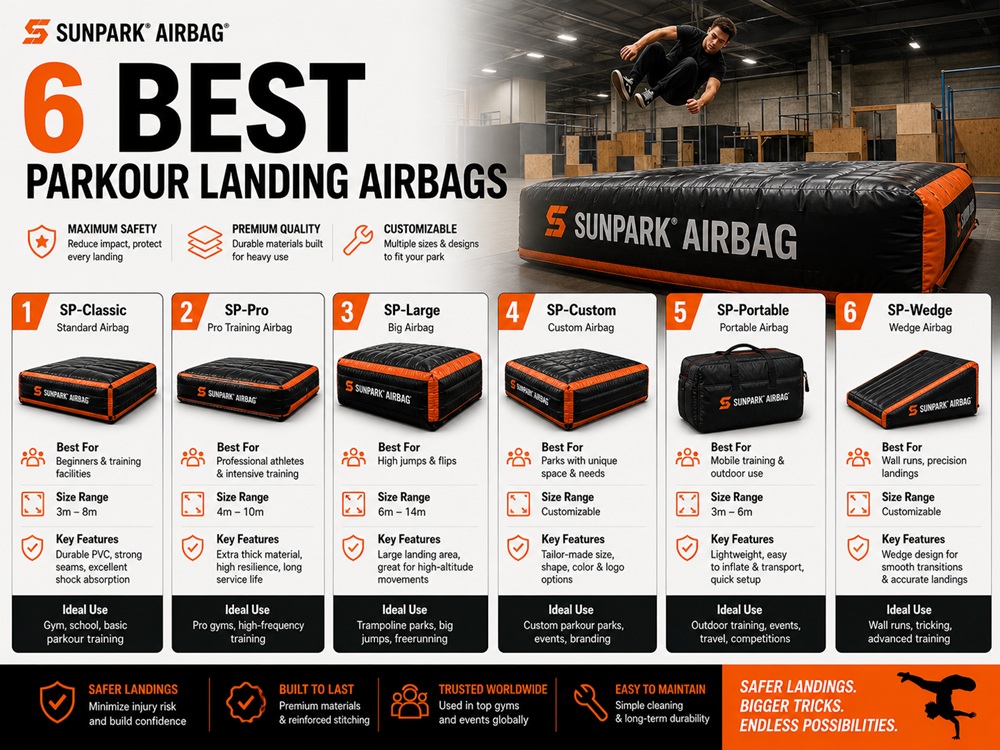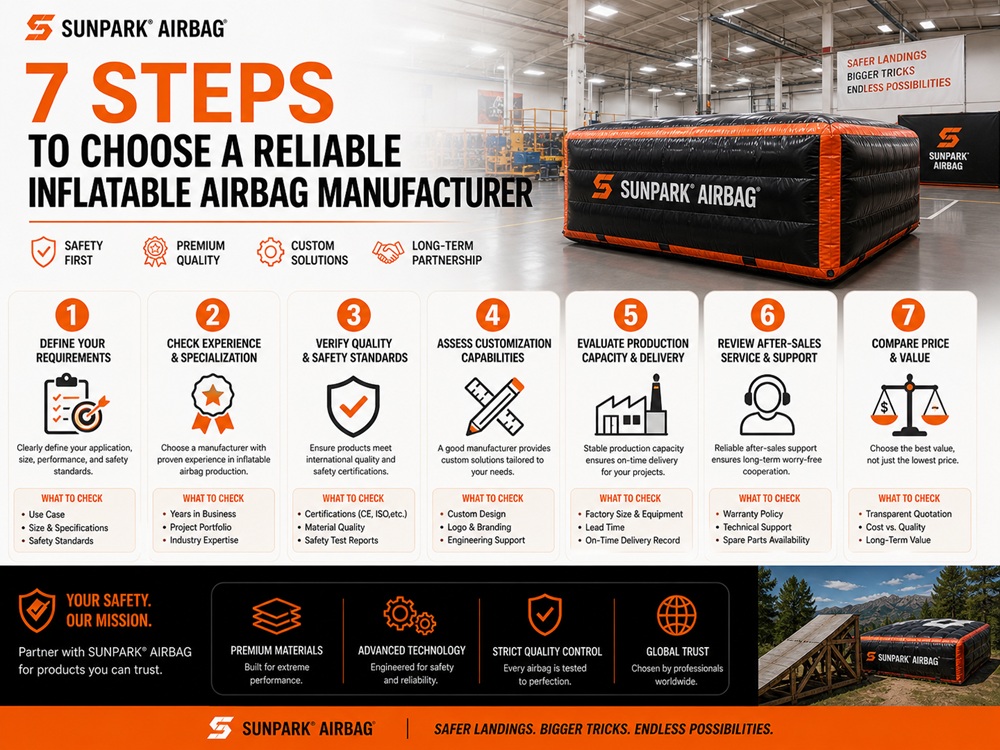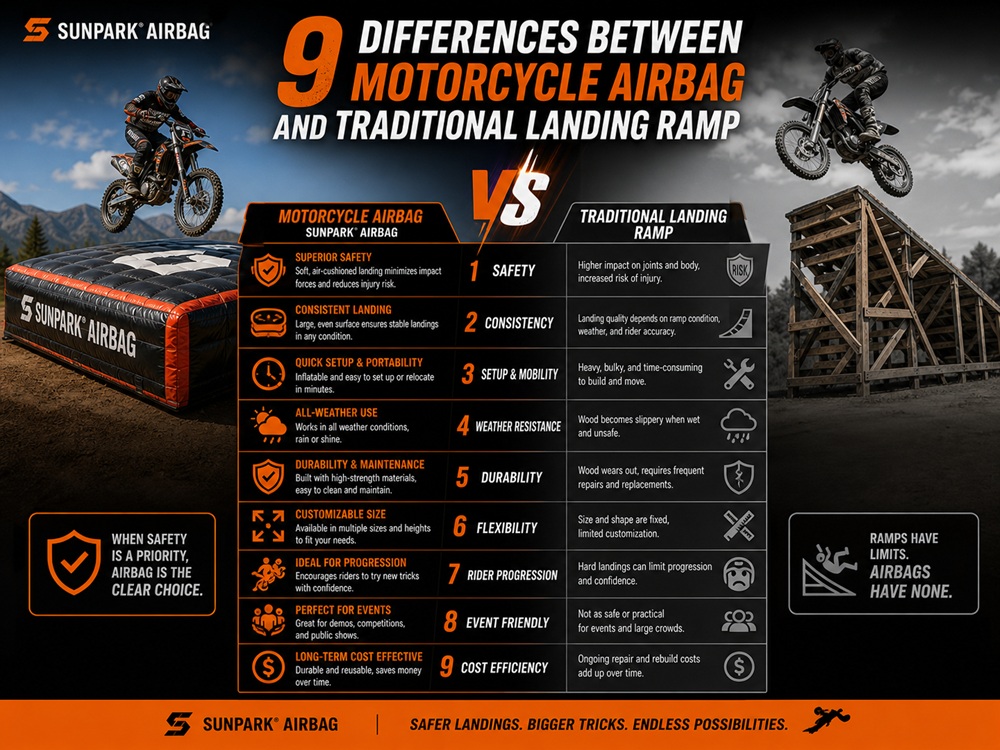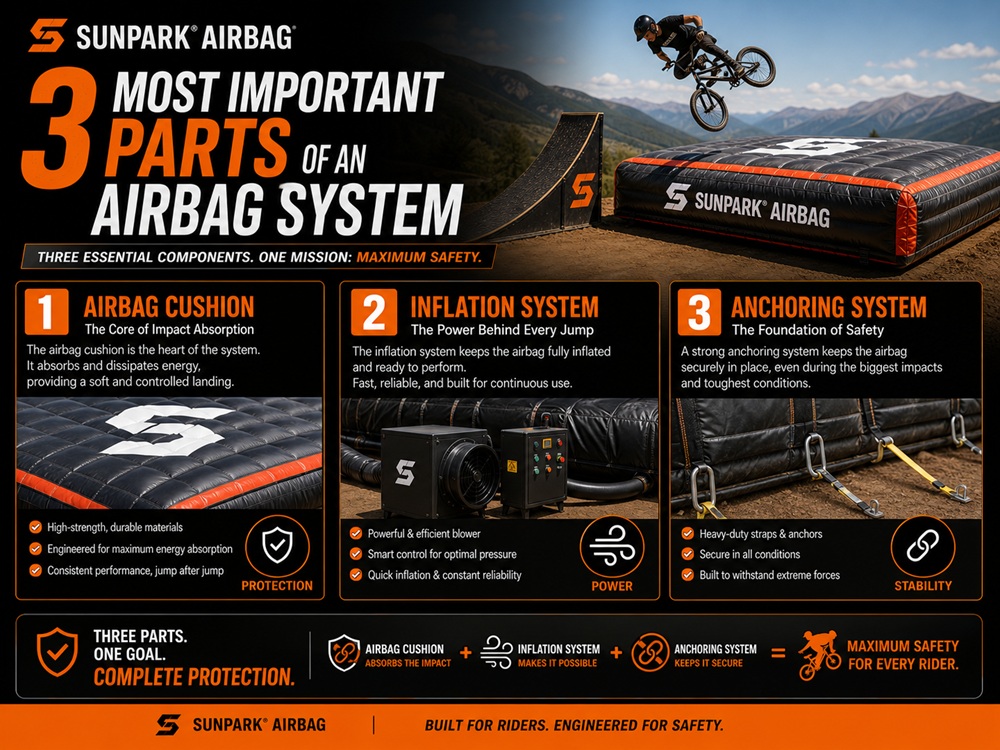
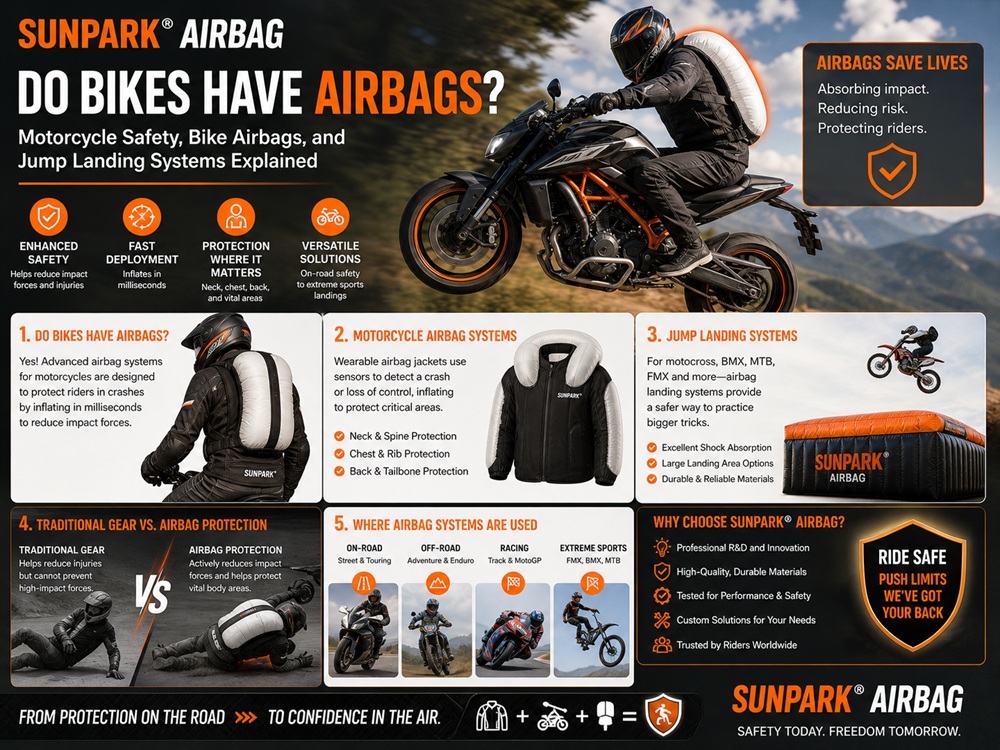
These are three different technologies serving different purposes. Buying a motorcycle airbag vest will not make a BMX landing safer in the same way that a properly designed landing airbag will, and an inflatable jump airbag is not a substitute for protective clothing or responsible riding. Understanding that distinction is the first step toward choosing the right protection.
1. What Does a Bike Airbag Actually Mean?
The phrase “bike airbag” can describe several products that look and operate very differently. Before comparing prices or buying equipment, identify the riding activity and the type of impact you are trying to manage.
Motorcycle airbag protection
A motorcycle airbag is generally a wearable vest or jacket, or an airbag system integrated into a motorcycle. Depending on the design, sensors or a tether detect a crash or a qualifying event and trigger rapid inflation. The inflated chamber is intended to help protect vulnerable areas such as the chest, back, shoulders, or neck region. Coverage and performance differ by product, so the manufacturer’s specifications matter.
These systems are intended for road riding, touring, commuting, or motorcycle sport. They do not eliminate the need for a certified helmet, abrasion-resistant clothing, gloves, boots, and appropriate riding behavior.
Bicycle and BMX landing airbags
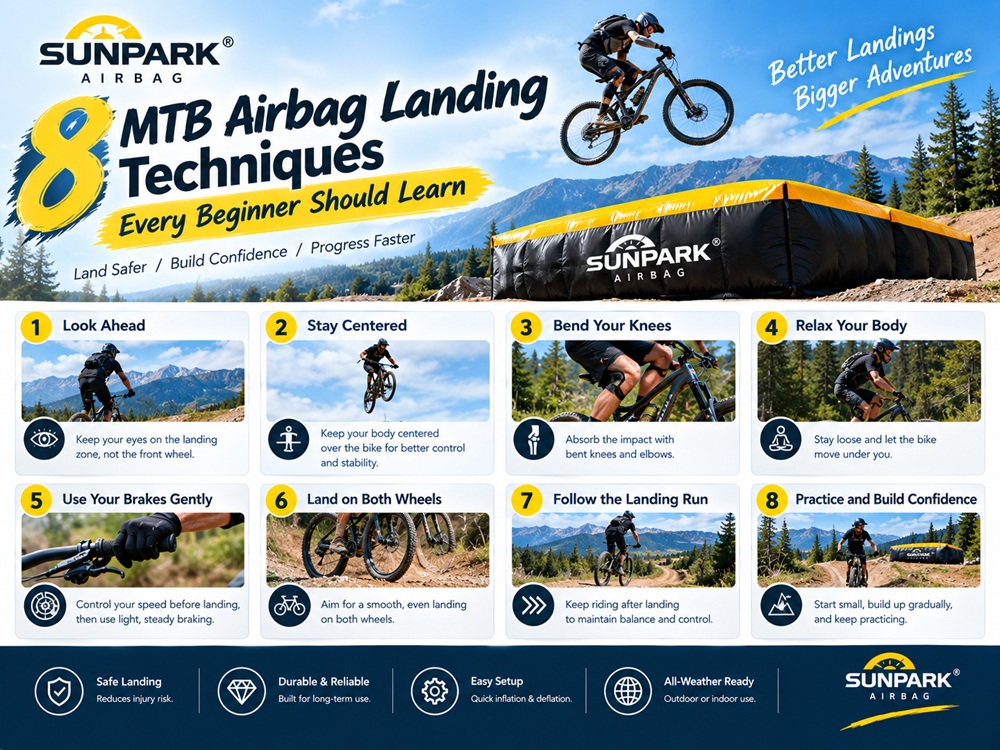
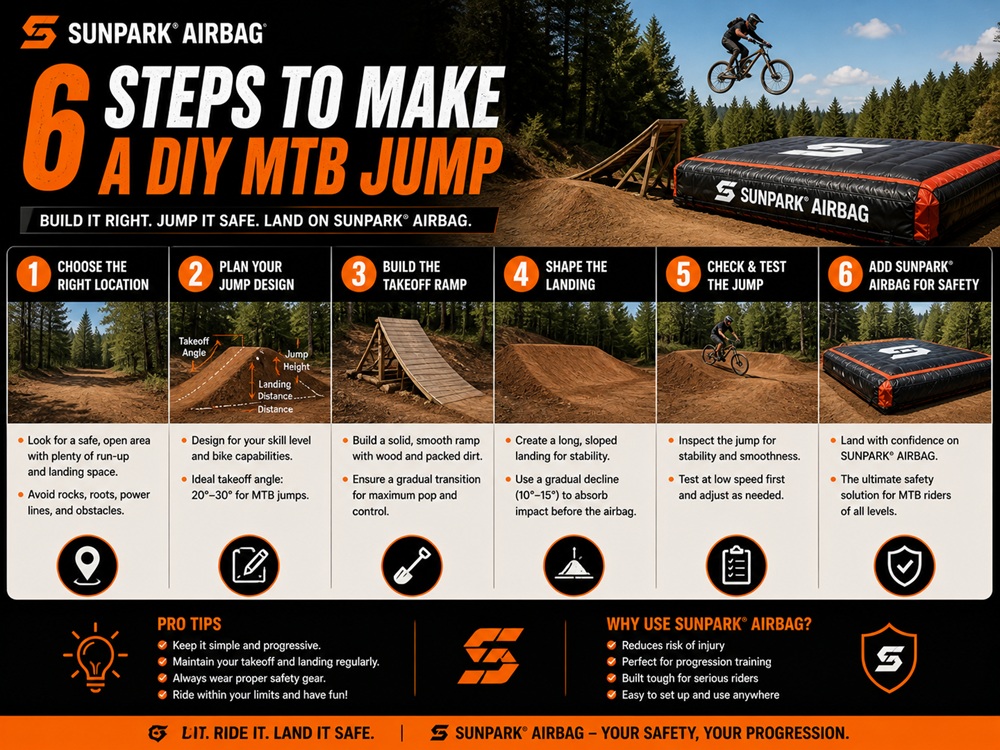
A bicycle jump airbag is a large inflatable surface placed at the end of a jump or stunt feature. Riders aim to land on it while practicing aerial tricks, rotations, or unfamiliar maneuvers. Unlike a wearable motorcycle airbag, it does not inflate around the rider during a crash. Instead, it provides a landing surface designed to absorb some impact energy and reduce the harshness of a landing when used correctly.
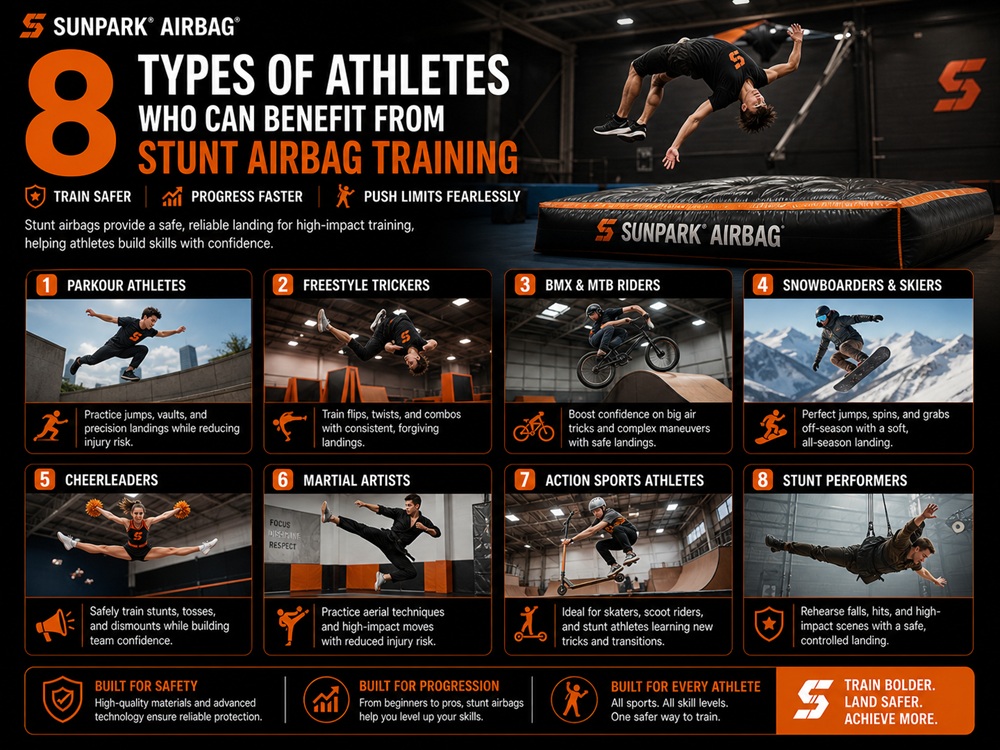
Facilities may use these systems for BMX, mountain biking, dirt jumping, slopestyle, freestyle training, and selected stunt activities. If you are building a training setup, start with a purpose-designed bike airbag landing system rather than assuming a generic inflatable mattress will provide the same performance.
Airbags are not the same as ordinary protective equipment
A helmet, knee pad, elbow pad, and body protector are worn by the rider. A landing airbag is part of the training environment. These products address different hazards and should not be treated as interchangeable. The right choice depends on whether you are protecting a rider during a road crash, reducing the severity of a training landing, or improving a supervised practice environment.
2. Three Types of Bike Airbag Systems
In practical terms, most searches about bike airbags lead to one of three categories. Each category has a different buying decision, installation requirement, and intended use.
| Airbag type | Typical application | How it is deployed | Main buying priority |
|---|---|---|---|
| Wearable motorcycle airbag vest or jacket | Road riding, touring, commuting, motorcycle sport | Electronic sensors or a mechanical tether, depending on the model | Coverage, activation method, fit, compatibility, maintenance |
| Integrated motorcycle airbag | Selected road or touring motorcycles | Built-in crash-detection and deployment system | Vehicle compatibility, system design, service requirements |
| Inflatable bicycle landing airbag | BMX, MTB, dirt jumps, freestyle and stunt training | Inflated in advance and positioned as a landing surface | Landing geometry, material durability, airflow design, anchoring and supervision |
For road riders, a wearable or integrated system may be worth considering because it travels with the rider. For a bike park, club, training center, or event operator, a landing airbag may provide more value because multiple riders can use the same supervised training facility. These are separate investments, and neither should be purchased based on the word “airbag” alone.
3. How Do Motorcycle Airbags Work?
Motorcycle airbag systems are designed to deploy when their activation conditions are met. Wearable electronic systems may use sensors and algorithms to recognize certain crash patterns, while tether-based products use a physical connection that pulls a trigger when the rider separates from the motorcycle with sufficient force. Integrated systems use their own vehicle-specific sensing and deployment arrangements.
What motorcycle airbags can help with
Depending on the system and crash circumstances, an airbag can add impact-absorbing coverage around parts of the upper body. This can be valuable for riders who spend significant time on the road, travel at higher speeds, or want an additional layer of protection beyond standard riding gear.
What motorcycle airbags cannot guarantee
No airbag prevents every injury. Deployment depends on the system’s design, activation conditions, correct fit, maintenance, and the nature of the incident. A product may not deploy in every fall or low-speed event, and an inflated airbag cannot remove all impact forces. Riders should read the product manual carefully and follow the manufacturer’s inspection, charging, servicing, and replacement instructions.
For road use, evaluate the whole protective setup rather than buying a vest in isolation. A well-fitting helmet and suitable protective clothing remain essential. If you ride a bicycle rather than a motorcycle, do not assume motorcycle airbag equipment is designed for your sport or will work with your riding position.
4. How Do Bike Jump Landing Airbags Work?
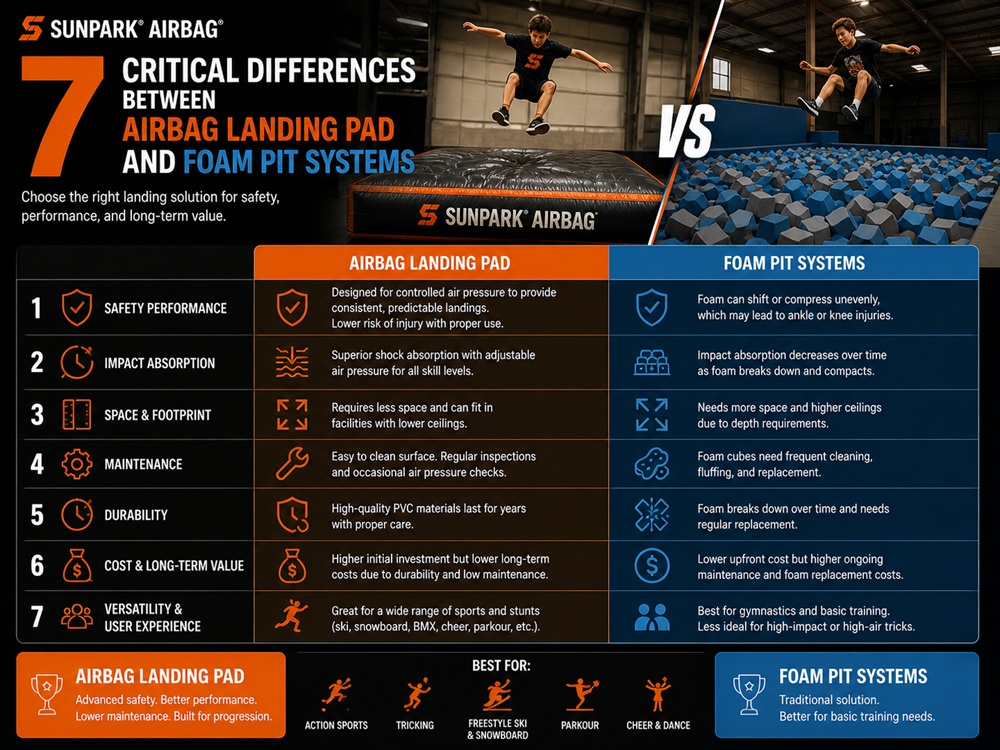
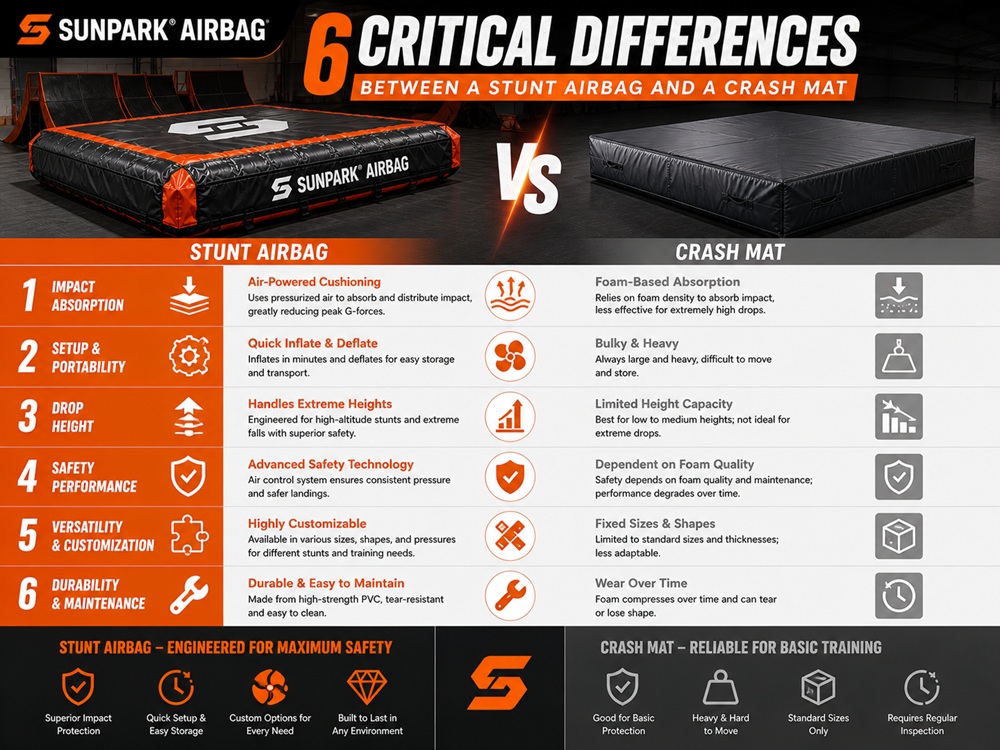
A bike jump landing airbag is inflated before use and positioned to receive riders coming off a ramp or jump. The surface and internal air system are designed to deform under landing loads, helping manage the impact instead of presenting the same rigid response as a hard landing surface. The actual result depends on the system’s design, inflation pressure, landing trajectory, rider mass, landing position, and maintenance condition.
Why the landing surface matters
A landing airbag is not simply a large bag filled with air. Its geometry, top-sheet construction, internal structure, air outlets or airflow controls, and anchoring all affect how it behaves under repeated landings. A system intended for small BMX practice may not be suitable for a large mountain bike jump or a high-energy stunt. The facility needs to match the airbag to the jump and the skill level of its users.
For mountain bikers, a dedicated mountain bike airbag landing guide can help frame the selection process. BMX operators should also consider the geometry and use case of a purpose-built BMX airbag landing instead of choosing by size or price alone.
Inflation, airflow, and daily inspection
Before each session, operators should follow the manufacturer’s procedures for inflation, blower operation, anchoring, surface inspection, and access control. Check for punctures, damaged seams, loose straps, abnormal pressure loss, and debris. Confirm that the landing zone is clear and that riders cannot land outside the intended area because of a poorly aligned ramp or incorrect approach.
Airbags need an operating plan, not just an installation plan. Staff should know how to stop use when a fault appears, how to isolate electrical blowers safely, and how to prevent riders from entering the landing zone while another person is jumping. A landing airbag can support training, but it does not make every jump safe.
5. Bike Airbag Systems Compared: Which Is Right for You?
The most useful comparison is not which airbag is universally best. It is which system fits the activity, the environment, and the people using it. The table below gives a practical starting point.
| Decision factor | Motorcycle wearable airbag | Integrated motorcycle airbag | Bicycle landing airbag |
|---|---|---|---|
| Best use | Individual road or track rider | Rider using a compatible motorcycle | Training venue, bike park, club, or event |
| Travels with the rider | Yes | Built into the motorcycle | No; installed at a designated jump |
| Needs a suitable bike or venue | Needs correct fit and riding compatibility | Yes, system-specific vehicle compatibility | Yes, a suitable ramp, landing zone and site layout |
| Routine checks | Activation system, condition, charge or service status as applicable | Vehicle system and manufacturer service schedule | Air pressure, blower, seams, top sheet, anchoring and landing area |
| Primary limitation | Cannot prevent every injury or deploy in every crash | Availability and compatibility are vehicle-specific | Only helps manage landings within a properly designed and supervised setup |
| Buying recommendation | Choose based on fit, coverage, deployment and servicing | Confirm exact model compatibility and service support | Specify the jump, landing trajectory, rider group, material and operating conditions |
For a single motorcycle rider, a wearable airbag may be a more practical investment than a fixed training system. For a BMX or mountain bike facility, a landing airbag may support repeatable practice across a group of riders. If the objective is learning tricks in a controlled environment, compare complete landing systems, not just the price of the inflatable surface.
6. Benefits and Limitations of Bike Airbags
Airbag technology is useful when its design matches the hazard. The mistake is treating it as a universal safety solution. The following table summarizes the practical trade-offs.
| Pros | Cons and limitations |
|---|---|
| Can add an impact-management layer beyond conventional equipment. | Cannot eliminate the risk of injury or guarantee a safe outcome. |
| Wearable motorcycle systems can accompany the rider across different routes. | Fit, compatibility, activation, servicing and replacement requirements vary. |
| Landing airbags can create a dedicated practice environment for jumps and tricks. | They require adequate space, a suitable ramp, correct setup and ongoing inspection. |
| Commercial landing systems can serve many users when managed correctly. | Blower operation, repairs, cleaning, storage and staff time add to the purchase cost. |
| Custom landing systems can be specified for different venues and riding activities. | Custom dimensions alone do not establish that a system is suitable for a particular jump. |
Is a bike airbag worth the cost?
For a road rider, the value of a wearable motorcycle airbag depends on riding frequency, exposure, budget, comfort, and whether the rider will use and maintain the system consistently. It is an additional layer of protection, not a replacement for other protective gear.
For a commercial bike park or training venue, a landing airbag may be worth the investment if it supports frequent supervised practice, attracts the intended users, and can be maintained within the operating budget. The return should be assessed against purchase price, blower power, staff time, inspection, repair, storage, transport, and downtime. A cheaper airbag that repeatedly needs repairs or is poorly matched to the jump may cost more over its useful life.
7. Who Should Use a Bike Airbag, and Who Does Not Need One?
Motorcycle riders who may benefit
Commuters, touring riders, and sport riders who want an additional layer of upper-body protection may consider a compatible wearable airbag. The product should fit correctly over the intended clothing, suit the rider’s motorcycle and riding style, and have clear deployment and maintenance instructions. Review independent product information and the manufacturer’s safety documentation before buying.
BMX and mountain bike riders who train jumps
Riders learning tricks, practicing aerial movements, or training in a managed facility may benefit from an airbag landing environment. Beginners should start with coached progression, suitable jump geometry, and a landing system intended for their activity. An airbag does not justify attempting jumps beyond one’s skill level.
Facility operators should review the requirements of the planned use, rider age and ability, session throughput, staff supervision, and weather exposure. For more context on the equipment category, see this overview of bike airbag landing systems.
Who may not need a dedicated landing airbag
A casual cyclist who rides paved paths and does not practice jumps generally does not need to purchase a bike landing airbag. A home rider who rarely jumps may be better served by appropriate protective equipment, skills instruction, and using a professionally managed training facility when practicing advanced maneuvers. Likewise, a motorcycle rider should not buy a bicycle landing airbag expecting it to protect them during road crashes.
8. How to Choose a Bike Landing Airbag: A Practical Buying Guide
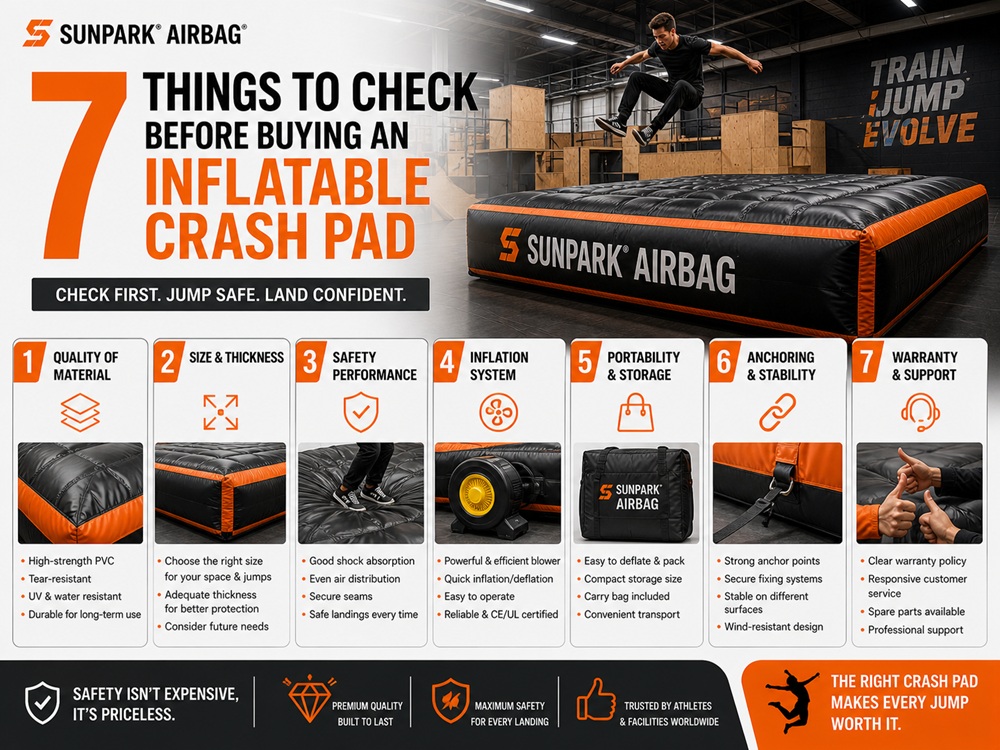
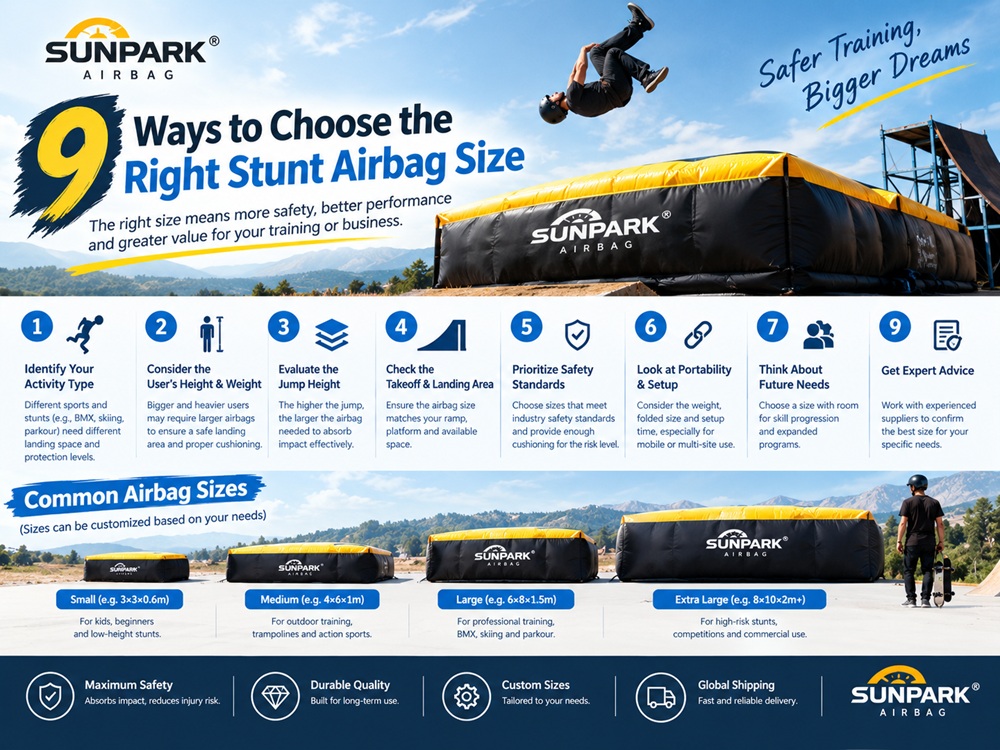
For commercial users, equipment selection should begin with a clear specification. Ask the supplier to explain how the proposed system matches the intended ramp, landing height, rider type, and training progression. Do not assume that two airbags with similar dimensions will behave identically.
1. Define the sport and landing scenario
Specify whether the airbag is for BMX, mountain biking, dirt jumping, freestyle, or stunt practice. Describe the ramp dimensions, expected trajectory, approximate rider group, typical landing positions, and whether the system will be used indoors or outdoors. A dedicated dirt bike jump landing airbag may suit a different operating scenario from a bicycle training system. Confirm suitability with the manufacturer rather than relying on the product name.
2. Review material and construction
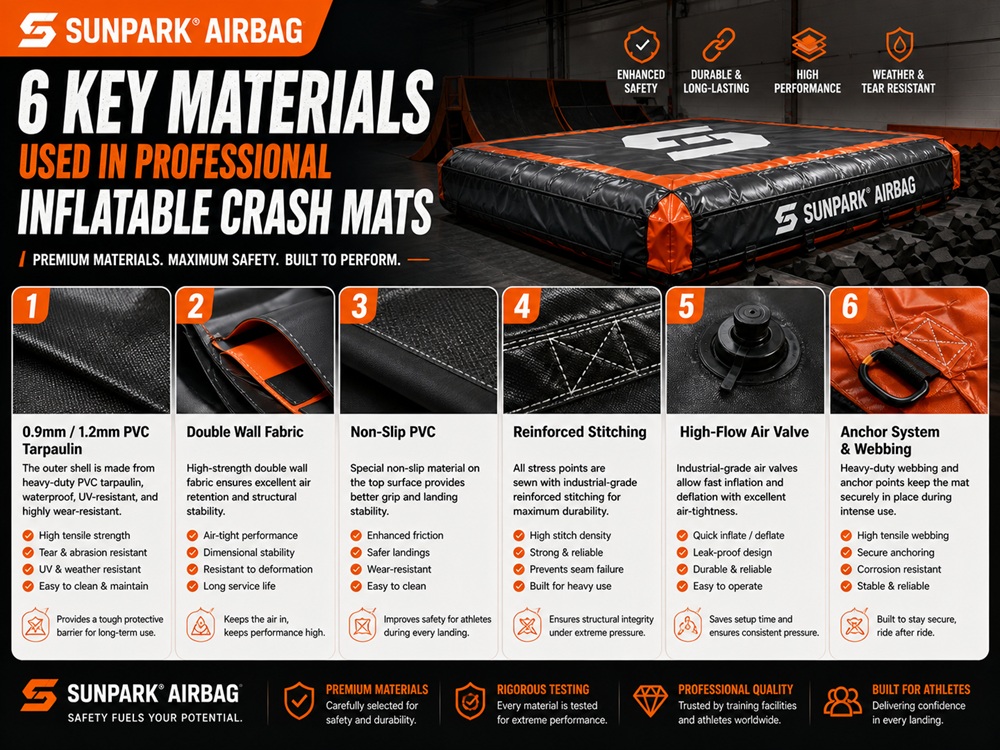
Material thickness is useful information, but it is not a complete measure of quality. Ask about the airbag body, top sheet, seam construction, reinforcement, abrasion resistance, UV exposure, water resistance, and repairability. For outdoor facilities, weather exposure and repeated friction can be major sources of wear. Request the applicable material specifications and warranty terms in writing.
3. Confirm the blower and airflow design
Ask which blower is supplied, what electrical supply it requires, how inflation and pressure are managed, and whether the system needs continuous airflow during operation. Confirm how the supplier expects operators to respond to a blower failure or unexpected loss of pressure. These are operating questions, not minor technical details.
4. Check anchoring, placement, and site requirements
The airbag should be installed according to the manufacturer’s layout and anchoring instructions. Consider the space around the landing zone, access routes, ramp alignment, nearby obstacles, drainage, and the effect of wind for outdoor use. A product that fits the available floor area may still be unsuitable if the jump trajectory or run-out zone is inadequate.
5. Compare the total cost of ownership
For commercial users, ask for a quote that identifies the airbag, blower, repair kit, carrying bag, printing, customization, packaging, delivery, installation guidance, warranty, and any recommended spare parts. Establish lead time, payment terms, shipping method, and the process for ordering replacement components.
Compare quotations on equivalent specifications. A low headline price is not meaningful if one supplier excludes the blower or offers a shorter warranty. We recommend evaluating the expected cost per operating season, not only the initial purchase price.
6. Evaluate the manufacturer, not just the product photos
A reliable supplier should be able to discuss the intended use, material choices, maintenance, repair procedures, and operating limitations. Ask for real product photographs, detailed specifications, production timelines, quality-control information, and references or examples relevant to your application. If a supplier cannot explain how the design matches your jump, do not treat a confident sales description as technical validation.
Sunparkairbag provides inflatable equipment for action-sports and training applications. Buyers can compare a stunt airbag landing solution with a bike-specific product based on their actual use case, but the final selection should be confirmed against the site design and intended riding activity.
9. Sunparkairbag Bike Jump Airbag: Product Details
For operators evaluating an inflatable landing setup, the Sunparkairbag Bike Jump Airbag is one option to review when specifying a training environment. The product is customizable in size, color, and printing, which can be useful for venues with defined space requirements or branding needs. Customization should follow the technical design decision rather than replace it.

Sunparkairbag Bike Jump Airbag
Material: 0.55 mm PVC tarpaulin for the airbag body and 0.9 mm PVC tarpaulin for the top sheet.
Material features: Described by the supplier as waterproof, flame-retardant, UV-protected, and lead- and phthalate-free. Request the applicable supporting documentation if these properties are required for your project.
Customization: Custom size and color, with digital, silk-screen, or UV printing options.
Accessories: Blower, repair kit, and heavy-duty carrying bag. Blowers are packed in strong boxes.
Production lead time: Approximately 15 working days, depending on airbag size and order quantity.
Price: Quoted according to specifications and order details; the supplier describes pricing as affordable and negotiable.
Workmanship: The supplier reports that its workers have more than five years of airbag-manufacturing experience.
When this product may be a good fit
This product is worth discussing if you operate a bike training facility, need a custom landing surface, or want to specify branded equipment for a controlled action-sports environment. Its customization options may help when standard dimensions do not fit the site.
Before placing an order, provide the supplier with your jump layout, expected rider group, intended operating conditions, available space, and any relevant technical requirements. Ask for confirmation of the recommended dimensions and setup, blower details, anchoring method, warranty, maintenance instructions, and delivery terms. The listed material thickness and accessories are useful starting points, but they do not independently establish suitability for every jump.
10. Common Bike Airbag Buying and Usage Mistakes
Mistake 1: Confusing motorcycle airbags with landing airbags
These products solve different problems. A wearable motorcycle airbag is intended to deploy around the rider under qualifying crash conditions. A bike jump airbag is a landing surface. Choose based on the activity, not the shared name.
Mistake 2: Assuming an airbag makes any jump safe
A landing airbag cannot compensate for a poorly designed ramp, excessive speed, a bad approach, or a jump beyond the rider’s ability. Use coached progression, appropriate site layout, supervision, and protective equipment.
Mistake 3: Buying based on dimensions alone
Length, width, and height do not tell the whole story. Construction, internal design, airflow, top-sheet behavior, landing geometry, anchoring, and operating instructions all affect suitability. Ask the manufacturer to confirm the application in writing.
Mistake 4: Ignoring maintenance and repair
Repeated use can wear the top sheet and seams. UV exposure, dirt, moisture, dragging, improper folding, and poor storage can shorten service life. Establish a documented inspection schedule, keep the repair kit accessible, and stop using the product if damage affects its safe operation.
Mistake 5: Comparing quotes with different inclusions
One quote may include a blower, carrying bag, repair kit, and custom printing, while another may cover only the inflatable structure. Compare like-for-like specifications and request a full landed-cost estimate. Include shipping, import duties where applicable, installation, electricity, staff time, and planned maintenance.
Mistake 6: Treating a supplier’s marketing claims as independent certification
Statements such as waterproof, flame-retardant, UV-protected, or suitable for a specific sport should be checked against the relevant product documentation. Ask which test methods or standards apply, what the test results cover, and whether the documentation applies to the exact materials supplied.
11. Expert Recommendation: Which Bike Airbag Should You Choose?
Our recommendation is straightforward: identify the riding activity first, then choose the protection system that matches the hazard.
- For motorcycle road riding: Consider a compatible wearable or integrated motorcycle airbag as an additional layer of protection. Prioritize correct fit, activation method, coverage, maintenance, and documented product guidance.
- For BMX or mountain bike jump training: Consider a purpose-designed landing airbag if the site, jump, supervision, and rider progression support its use. Do not substitute an ordinary inflatable mat for a system designed for the intended landing scenario.
- For bike parks and commercial training facilities: Request a technical quotation that covers dimensions, material construction, blower, anchoring, repair support, lead time, warranty, and delivery. Evaluate total operating cost rather than initial price alone.
- For casual cyclists: A dedicated landing airbag is generally unnecessary unless you regularly practice jumps in a suitable training environment. Focus first on a correctly fitted helmet, appropriate protective equipment, bicycle maintenance, and riding within your ability.
- For beginners: Use a supervised facility and learn basic skills before progressing to larger jumps or more complex tricks. An airbag is a training aid, not permission to skip skill development.
For commercial buyers, Sunparkairbag’s bike airbag landing equipment is a useful starting point for a product discussion. If your project involves other types of training, compare the requirements with an inflatable crash mat or big jump airbag system, while confirming that any alternative is designed for the specific application. Similar appearance does not mean equivalent performance.
12. Frequently Asked Questions
Do bikes have airbags like cars?
Most bicycles do not have built-in airbags like many passenger cars. Motorcycle airbag technology exists in wearable equipment and in selected integrated motorcycle systems. Bicycle jump airbags are different: they are inflatable landing surfaces used for supervised training rather than airbags installed in the bicycle.
Do bicycles have built-in airbags?
Built-in airbags are not standard equipment on ordinary bicycles. Riders who practice BMX, dirt jumps, or mountain bike tricks may encounter landing airbags at dedicated training venues. These are separate pieces of equipment positioned at the landing area.
Are motorcycle airbag vests worth it?
They may be worthwhile for riders who want an additional layer of protection and can select, fit, maintain, and use the system correctly. Value depends on riding conditions, product coverage, deployment design, budget, and the manufacturer’s maintenance requirements. An airbag vest does not replace a helmet or other protective riding gear.
Are bike jump airbags safe for beginners?
They can be useful in supervised training when the system, jump, and rider progression are appropriate. Beginners still need instruction, suitable protective equipment, and controlled progression. The presence of an airbag does not make a jump risk-free.
Can I use a normal inflatable mattress instead of a bike airbag?
No. A household inflatable mattress is not designed or validated for repeated bicycle jump landings. Its construction, airflow behavior, durability, dimensions, and stability may be unsuitable. Use equipment designed for the intended action-sports application and follow the manufacturer’s setup instructions.
How much does a bike jump airbag cost?
There is no reliable single price for all bike jump airbags. Cost depends on dimensions, construction, internal design, blower specifications, customization, accessories, shipping, and order quantity. Request a detailed quotation and compare the total delivered cost and operating requirements rather than relying on a headline estimate.
How long does it take to manufacture a custom bike jump airbag?
Sunparkairbag lists an approximate production time of 15 working days for its Bike Jump Airbag, depending on the product size and order quantity. Confirm the schedule for your specific specification, and ask whether artwork approval, testing, packaging, and shipping are included in the quoted timeline.
What should I check before using a landing airbag?
Follow the manufacturer’s checklist. At a minimum, inspect the surface, seams, inflation and blower operation, anchoring, surrounding landing zone, and any visible damage. Confirm the ramp alignment, weather conditions where relevant, supervision arrangements, and the correct procedure for stopping use if a fault occurs.
Do landing airbags prevent all BMX and mountain bike injuries?
No. Landing airbags may help manage impact during intended training use, but they cannot prevent all injuries or correct unsafe technique, unsuitable jump design, or excessive speed. Use them as one component of a broader safety plan.
References
- National Highway Traffic Safety Administration (NHTSA): Motorcycle Safety. Government guidance on motorcycle safety and protective practices.
- U.S. Consumer Product Safety Commission (CPSC): Bicycles. Consumer safety information relevant to bicycle use and injury prevention.
- Fédération Internationale de Motocyclisme (FIM). International motorcycle sport organization and resource for motorcycle sport rules and safety-related information.
Final takeaway: Bikes generally do not have built-in airbags in the same way cars do, but airbag technology is available for motorcycle riders and for bicycle jump training. Motorcycle airbags are wearable or integrated crash-protection systems; bike jump airbags are purpose-designed landing surfaces. Choose the type that matches your riding activity, verify the product’s intended use, and treat correct setup, maintenance, supervision, and conventional protective equipment as essential parts of the safety plan.