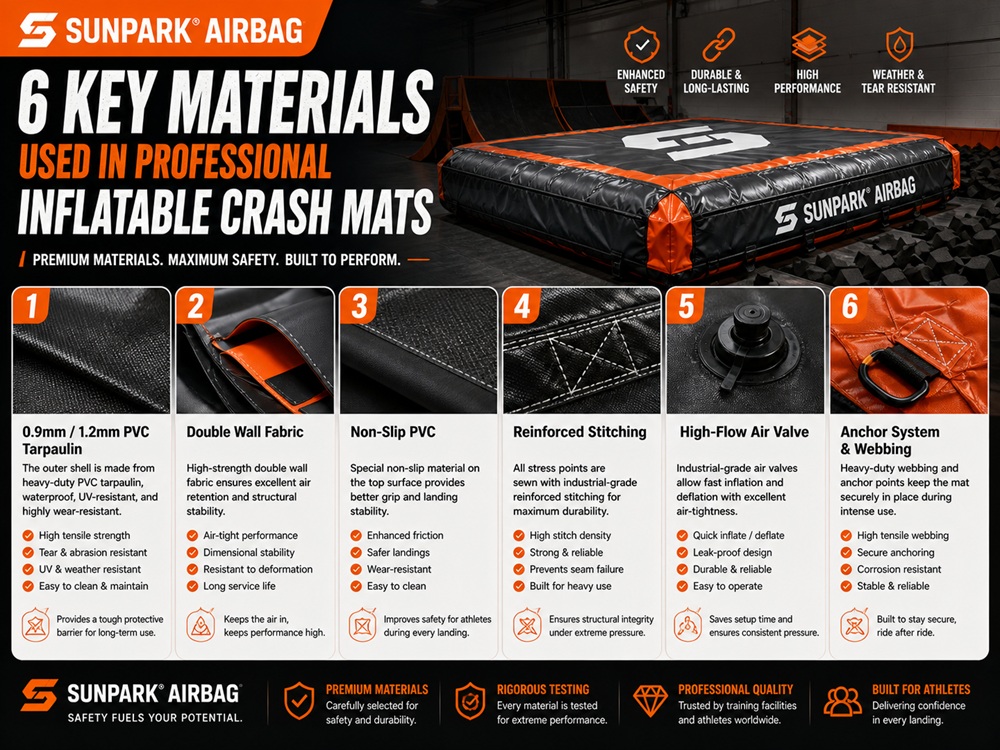
Specifying high-reliability impact pads requires looking past superficial vinyl colors and inspecting the physical chemical coatings, internal base weaves, tear resistance thresholds, and pneumatic release hardware. The core engineering behind professional inflatable crash mats relies on six essential materials: ultra-tough topsheet tarpaulins, high-tensile structural chamber vinyls, internal baffles, high-denier bonded sewing threads, high-tensile anchor harness straps, and calibrated mechanical air vents. We examine these primary materials from a practical manufacturing perspective, explaining where budget suppliers cut corners and how to make a safe, commercial-grade purchasing decision.
Quick Answer: What Materials Are Used in Professional Inflatable Crash Mats?
Professional inflatable impact pads utilize six specialized materials engineered to absorb extreme kinetic drop energy without blowing seams: 1) Heavy-duty 0.9mm (1000D / 30oz) PVC Tarpaulin for the friction-resistant, tear-proof protective topsheet; 2) Structural 0.55mm (18oz) PVC Tarpaulin featuring a dense 1000D x 1000D polyester scrim core for the lower dual-chamber containment body; 3) Internal open-air perforated baffles made of coated vinyl or high-tenacity Oxford cloth that meter pneumatic deceleration; 4) Bonded continuous-filament nylon/polyester threads (V-92 to V-138) sewn in double-to-quadruple interlocked lockstitch patterns; 5) Industrial nylon webbing and stainless steel 316-grade D-rings rated past 2,500 kg for ground anchoring; and 6) Calibrated hook-and-loop adjustable pressure relief air vents that expel air during dynamic rider compression. Skimping on any single layer leads to seam blowouts, bottoming-out injuries, or premature fabric failure.
How Inflatable Crash Mats Absorb Extreme Impact Energy
To evaluate the materials used in professional inflatable crash mats, facility directors must understand the physics of high-speed impact attenuation. Unlike a sealed trampoline bed that springs an athlete straight back upward, a professional inflatable crash mat functions as a pneumatic energy sink. The goal is progressive deceleration: slowing down the human body and sports gear from terminal velocities down to zero over an extended travel distance, keeping internal G-forces well below injury thresholds.
This is accomplished through a dual-chamber structural configuration. The lower base chamber operates at continuous positive pressure, preventing the athlete from bottoming out against the ground. The upper safety chamber acts as an adjustable compression pillow. When an athlete hits the upper topsheet, the air volume inside compresses rapidly. That trapped air is forced outward through calibrated mechanical side release vents and internal perforated baffles. The energy of the impact is converted into pneumatic displacement rather than an elastic trampoline bounce. Because this process exposes the fabric to intense air pressure spikes and heavy friction from bike tires, ski edges, and studded pedals, the underlying base textiles must deliver immense shear, tear, and tensile strength.
From our experience on training grounds, if the material used in the upper layer lacks sufficient thickness or puncture resistance, metal pedal pins and ski edges will slice through the outer vinyl. This results in rapid air loss and compromises structural safety. Using verified commercial materials ensures consistent progression, whether training at world-class freestyle facilities highlighted in our airbag jump locations guide or reviewing regional venues in the best snowboard airbag parks.
Quick Summary: The 6 Key Materials at a Glance
The table below provides a quick reference to the six essential materials used in professional inflatable crash mats, detailing their structural roles, technical ratings, and primary failure points prevented:
| Key Material Component | Standard Material Specification | Primary Engineering Role | Critical Failure Point Prevented |
|---|---|---|---|
| 1. Heavy-Duty Topsheet Tarpaulin | 0.9mm PVC (1000D x 1000D / 30oz) | Direct impact, sliding friction, puncture resistance | Slices from bike pedals, metal ski edges, friction burns |
| 2. Structural Airbag Chamber Tarpaulin | 0.55mm PVC (1000D / 18oz blockout) | Maintains structural body, pressure containment | Pneumatic chamber ruptures, seam creep, fabric blowouts |
| 3. Internal Flow-Control Baffles | Perforated 0.55mm PVC / 840D Oxford | Regulates air transfer between chambers; keeps shape | Ballooning deformation, unmetered pocket collapse |
| 4. High-Tenacity Industrial Thread | Bonded Nylon / Polyester (V-92 to V-138) | Multi-needle interlocked seam joins | Seam splitting during high-pressure impact surges |
| 5. High-Tensile Anchor Webbing & Rings | Seatbelt-grade Nylon + 316 Stainless D-Rings | Ground staking, wind ballast, tensioning | Airbag sliding off slopes, wind displacement, anchor tear-out |
| 6. Calibrated Pressure Relief Vents | Industrial hook-and-loop + reinforced mesh | Controls air exhaust velocity during compression | Dangerous trampoline rebound, hard bottoming out |
In-Depth Analysis: The 6 Key Materials Used in Professional Inflatable Crash Mats
1. Heavy-Duty 0.9mm PVC Wear Topsheet
The topmost layer of an impact mat takes direct punishment from equipment and athletes. A standard vinyl bounce-house fabric (typically 0.4mm to 0.45mm thick) will tear within days when hit by mountain bike tires, studded pedals, or sharp ski edges. Professional crash mats use a replaceable, heavy-duty 0.9mm (1000D x 1000D, 30oz/yd²) knife-coated polyvinyl chloride (PVC) tarpaulin.
In our testing, knife-coated PVC tarpaulin outperforms laminated alternatives. In cheap laminated materials, a plastic film is merely glued onto a loose polyester mesh; under high friction, the clear film peels away from the scrim in a process called delamination. A knife-coated tarpaulin embeds liquid PVC deep into the polyester weave under heat and pressure, creating an integrated composite that resists surface abrasion, prevents friction burn on human skin, and withstands harsh freeze-thaw cycles without cracking. For high-speed cycling runs, review our engineering breakdowns in the mountain bike airbag landing guide and the dedicated inflatable MTB airbag solutions review.
2. Structural 0.55mm PVC Chamber Tarpaulin
While the top sheet handles external abrasion, the lower chambers maintain structural stability. The main inflatable body utilizes high-grade 0.55mm (18oz/yd²) PVC tarpaulin. This textile features a high-density, high-tenacity polyester woven scrim core (typically 1000 Denier woven at 20×20 or 23×23 threads per square inch) coated on both sides with flame-retardant, UV-stabilized PVC.
Tensile and tear strengths are critical here. Professional 0.55mm tarpaulins withstand tensile loads exceeding 2,500 N/5cm and tear strengths above 300 N under ISO 13934-1 testing. This structural strength allows the lower base chamber to remain firm under constant high static pressure, ensuring that when an athlete lands off-balance, the bottom of the mat provides stable support without collapsing. This reliable foundation is essential whether setting up a massive Halfpipe Airbag or analyzing landing dynamics in our freestyle airbag guide.
3. Internal Flow-Control Baffles (Pneumatic Tuning)
An inflatable crash mat is not an empty hollow balloon. If it were built without internal partitions, blowing air inside would force it into a round sphere, and landing on one side would send all internal air to the opposite end, causing the landing zone to bottom out completely. The shape and compression curve of the mat are controlled by internal vertical and horizontal baffles.
These baffles are constructed from perforated 0.55mm PVC or high-tenacity 840D ripstop Oxford cloth, strategically welded and double-stitched between the internal walls. The precision-cut holes within the baffles act as metered pneumatic orifices. When a rider impacts the surface, air flows through these baffle vents at a calculated rate, controlling internal air transfer. This engineering preserves a flat landing surface while delivering smooth, progressive deceleration during heavy impacts.
4. Bonded Industrial Filaments and Reinforced Seam Chemistry
An inflatable is only as reliable as its seam connections. Standard consumer stitching uses light spun-polyester threads that rot when exposed to outdoor moisture and snap under pressure surges. Professional inflatable manufacturing mandates bonded continuous-filament nylon or polyester threads, typically sizing from V-92 up to V-138 (Tex 90 to Tex 135).
Bonded threads undergo a specialized resin treatment that bonds the filament plies together, preventing friction fraying during high-speed sewing through thick 0.9mm PVC. Critical stress seams—including internal baffle anchors and structural corners—are sewn using double-needle or quadruple-needle interlocked lockstitch patterns, delivering stitch densities of 4 to 5 stitches per inch. Furthermore, critical seams feature hot-air welded PVC reinforcing strips laid over the stitch lines to protect threads from moisture rot and mechanical abrasion.
5. High-Tensile Anchor Webbing and 316 Stainless Steel D-Rings
A giant inflatable landing mat presents a massive surface area to ambient winds. A light crosswind on an unsecured 50-foot landing bag can exert thousands of pounds of lateral force, dragging the unit off its landing hill. Structural anchoring hardware is a primary safety component.
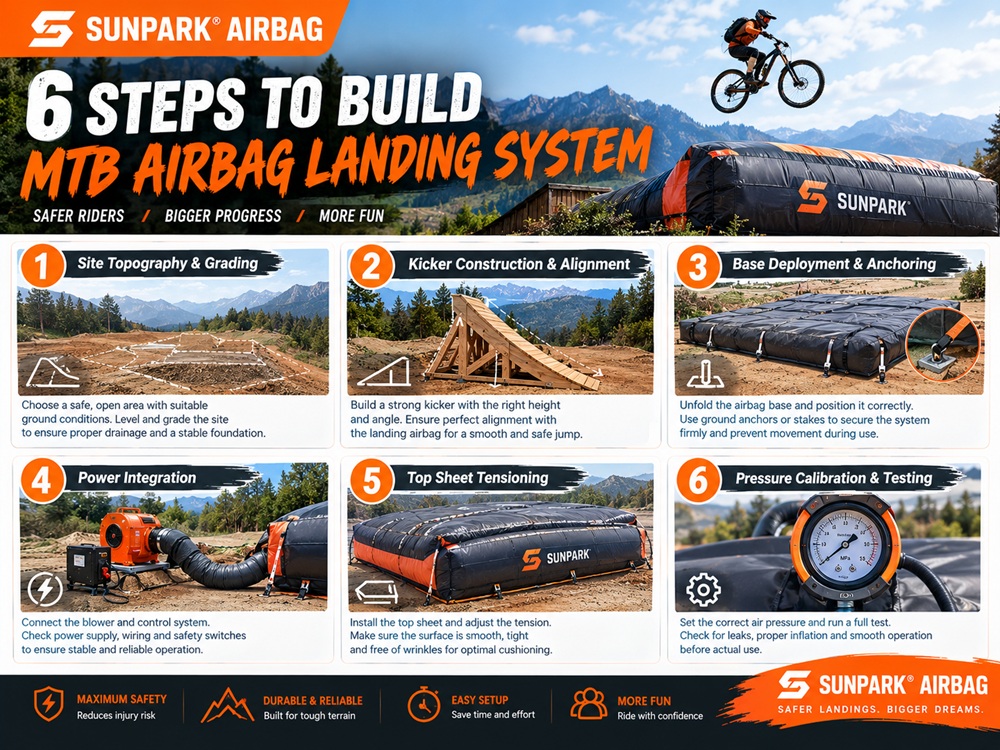
Commercial airbags use multi-ply seatbelt-grade nylon or polyester webbing boasting tensile break strengths of 2,500 kg to 4,500 kg (5,500 to 10,000 lbs). This webbing is stitched directly into the lower perimeter beams using wide load-spreading reinforcement patches. The tie-down points terminate in heavy 8mm to 10mm thick, drop-forged 316-grade marine stainless steel D-rings. Unlike cheap zinc-plated wire-formed rings that bend open under wind loads, forged stainless D-rings resist rust and hold fast when secured to ground stakes, earth anchors, or concrete ballast blocks on extreme slope terrains like those detailed in our MTB airbag landing system.
6. Calibrated Mechanical Pressure Relief Air Vents
The sixth key material component is the air exhaust venting system. A completely sealed vinyl envelope would act like an over-inflated tire, bouncing the rider back into the air with dangerous rebound force. Controlled air expulsion is what makes an airbag safe.
Professional bags use adjustable mechanical exhaust vents built with industrial-grade wide hook-and-loop fastening flaps, heavy vinyl sliding collars, and debris-blocking polyester mesh screens. Facility technicians adjust the vent openings based on rider weight and ambient temperature: open the vents wider for heavier mountain bike landings, or close them down for lighter gymnasts. This venting system ensures that air exhausts smoothly under dynamic load, providing comfortable, predictable landings every time.
Material Comparison Matrix: Professional Airbag vs. Cheap Inflatables vs. Foam Pits
To evaluate which landing setup matches your facility’s operational demands, review the physical and commercial metrics below:
| Evaluation Parameter | Professional Dual-Chamber Airbag | Budget Single-Chamber Inflatable | Traditional Open-Cell Foam Pit |
|---|---|---|---|
| Topsheet Fabric Spec | 0.9mm (1000D / 30oz) knife-coated PVC | 0.4mm (500D) laminated vinyl / Oxford | None (Exposed polyurethane cubes) |
| Chamber Air Control | Dual-chamber + adjustable exhaust vents | Single chamber; unmetered expulsion | Mechanical foam block compression only |
| Hygiene & Cleanliness | Impervious surface; wipe clean with disinfectant | Moderate; seams trap moisture | Poor; foam dust, sweat, and debris traps |
| Fire Retardancy Standard | Certified EN 13501-1 / NFPA 701 compliant | Uncertified or basic flame retardant | Severe fire hazard (polyurethane foam) |
| Expected Commercial Lifespan | 5 to 8+ years (Replaceable topsheet) | 1 to 2 seasons before seam failure | 1 to 2 years before foam crumbling |
| Hourly Throughput Rate | Rapid (Riders slide/walk off in 5 seconds) | Moderate to Slow | Extremely Slow (Struggling out of foam) |
Pros and Cons of Professional Inflatable Crash Mats
Weigh the operational advantages and engineering trade-offs of investing in a commercial-grade inflatable crash system:
| Operational Advantages (Pros) | Facility Demands & Constraints (Cons) |
|---|---|
| Superior Multi-Sport Safety: Absorbs high-energy drops from bikes, snowboards, and athletes without bottoming out. | Continuous Power Requirement: Requires reliable electrical blowers to maintain internal air pressure. |
| Replaceable Modular Topsheet: Heavy wear stays on the upper sheet, preserving the main airbag body for years. | Anchoring Discipline: Demands proper ground staking and wind ballast monitoring outdoors. |
| High Commercial Throughput: Athletes slide or ride off the smooth vinyl surface in seconds, keeping lines moving. | Higher Initial Capital Investment: Commercial 0.9mm PVC construction costs more upfront than cheap single-layer inflatables. |
| Zero Fire Hazards vs. Foam: Certified flame-retardant vinyl eliminates the massive fire risks of traditional foam pits. | Deflation & Storage Overhead: Heavy industrial PVC mats require dedicated hand trucks or forklifts to move when rolled. |
Who Needs Heavy-Duty Commercial Airbags vs. Basic Foam Systems
In our experience consulting with sports academies and commercial adventure parks, equipment specifications must match your operational environment and insurance requirements.
Who Needs Professional 0.9mm/0.55mm PVC Airbag Systems:
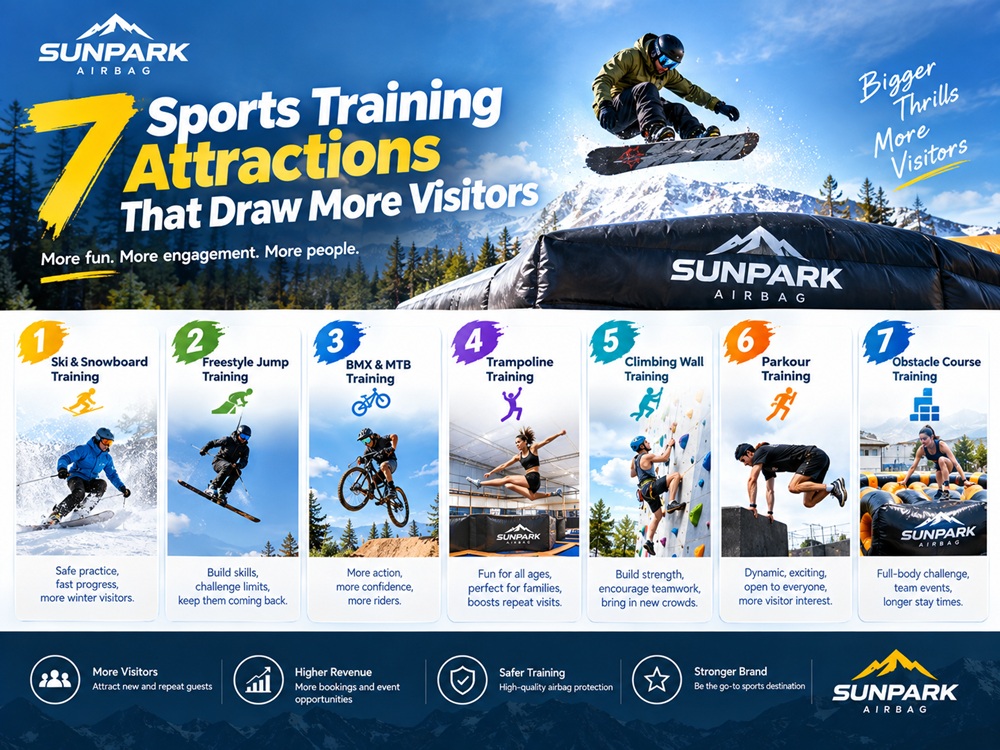
- Commercial Mountain Bike & Moto Parks: Training riders on heavy downhill bikes or dirt bikes demands the thick puncture resistance of 0.9mm PVC. Explore our dedicated landing airbag solutions and high-impact motorcycle airbag systems 2026 setups.
- Commercial Trampoline & Action Sports Parks: Transitioning away from dirty, fire-prone foam pits cuts insurance premiums and boosts hourly admissions. Evaluate operating economics in our reports on trampoline park construction cost and trampoline park owner income.
- Gymnastics & Cheerleading Facilities: High-repetition vault and dismount drills require smooth landing pads that reduce joint fatigue. Discover training solutions with our specialized gym airbag for training.
- Commercial Stunt & Freestyle Shows: Traveling stunt teams running high-drop shows demand reliable, fast-inflating gear like our inflatable jump airbag.
Who Can Use Simpler Foam or Basic Mats:
- Low-Impact Home Play Areas: Small children practicing forward rolls in living rooms need only lightweight folding EVA tumbling mats.
- Low-Elevation Bouldering Walls: Bouldering gyms with fall heights under 10 feet operate effectively using dense, dual-density bonded carpet-foam flooring.
Featured Commercial Equipment: Sunparkairbag Inflatable Crash Pad
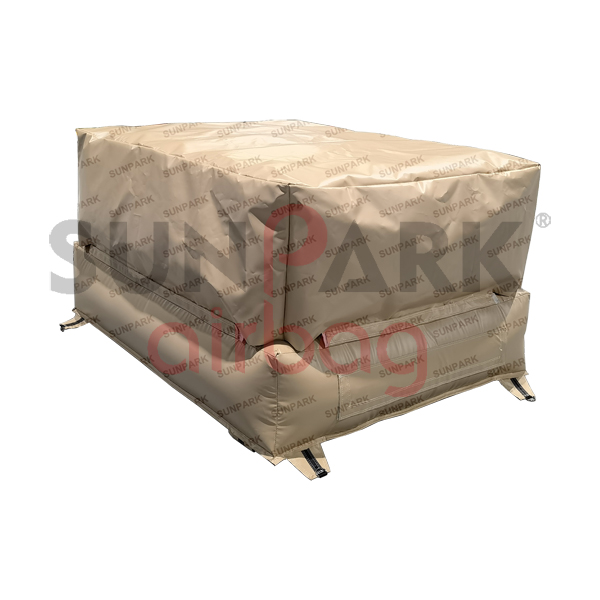
Constructed with medical-precision welding and heavy-duty materials, the Sunparkairbag Inflatable Crash Pad is engineered specifically for action sports parks, bike progression centers, and gymnastics facilities. Designed with a dual-chamber configuration and protected by an ultra-tough 0.9mm PVC top wear sheet, it delivers reliable impact absorption, high puncture resistance, and long-term durability across high-traffic operations.
View complete engineering specifications on the official Best Crash Pad for Sale product page.
Costly Mistakes Buyers Make When Sourcing Inflatable Airbags
In our field inspections of damaged landing bags, premature failures almost always stem from four common procurement shortcuts:
- Accepting Laminated PVC Instead of Knife-Coated Tarpaulin: Unscrupulous factories quote cheap prices by substituting laminated PVC for genuine knife-coated tarpaulin. Laminated PVC separates when wet or flexed repeatedly, causing the clear outer film to bubble and peel off the inner scrim within three months of daily use. Always specify knife-coated tarpaulins.
- Overlooking Internal Baffle Materials: Buyers often inspect the exterior vinyl while ignoring internal construction. Low-tier manufacturers sew internal baffles using thin, non-woven fabrics or scrap materials to cut costs. Under heavy drop impacts, these internal baffles rip loose, causing the mat to deform into an uncontrollable balloon that cannot support flat landings.
- Purchasing Single-Chamber Bouncy-Castle Builds for High Drops: Purchasing a single-chamber inflatable for action sports is an extreme safety liability. If a single-chamber bag loses power or an intake flap jams, the bag deflates completely. Professional mats mandate a sealed or independently pressurized lower chamber that stays rigid, keeping riders safe even during power disruptions.
- Ignoring UV and Cold-Crack Additive Ratings: Operating landing bags outdoors exposes vinyl to sunlight and winter temperatures. Standard commercial PVC turns brittle at freezing temperatures, cracking when flexed. Demand documentation confirming cold-crack resistance down to -20°C and UV stabilizer additives that prevent chalking and fading under direct summer sun.
Commercial Sourcing & Procurement Considerations for Facility Operators
Before issuing a deposit or approving factory production drawings, verify these four essential quality benchmarks with your supplier:
- Certified Fire Safety Compliance: Commercial indoor sports venues must comply with strict fire codes. Demand laboratory flammability test certificates verifying compliance with NFPA 701, DIN 4102 B1, or EN 13501-1 standards. Installing non-certified plastics will fail local fire marshal inspections.
- Chemical Safety & Phthalate Restrictions: Athletes make direct skin contact with landing sheets. Ensure all PVC coatings are certified lead-free, non-toxic, and free of restricted ortho-phthalates according to REACH (EU) and CPSIA (US) consumer safety regulations.
- Replaceable Topsheet Connection Architecture: A landing bag’s topsheet is a wearable component. Ensure it secures to the main chamber using heavy 2-inch to 4-inch wide hook-and-loop strips paired with reinforced perimeter bungee tensioners, allowing simple on-site replacement without retiring the main airbag body.
- Complete Factory Accessory Provisioning: Confirm that the purchase order includes matched commercial blowers (CE/UL certified), heavy-duty PVC transport storage bags, and an extensive repair kit containing spare 0.9mm/0.55mm material swatches, industrial vinyl adhesives, and seam needles.
Expert Recommendation and Purchasing Verdict
In most professional situations, we recommend treating your landing airbag as life-safety equipment rather than an ordinary gym mat. The money saved by buying a cheap, light-gauge inflatable from an unverified supplier will be lost many times over in seam repair downtime, torn topsheets, and catastrophic rider injuries.
If your facility operates an action sports progression setup, a commercial trampoline park, or an outdoor freestyle training ramp, insist on the proven dual-chamber standard: a heavy-duty 0.9mm knife-coated PVC topsheet for friction resistance, paired with a 0.55mm high-tenacity structural chamber body, bonded V-138 industrial stitching, and calibrated pressure relief venting. Sourcing directly from an established, specialized manufacturer like Sunparkairbag ensures you receive certified materials, master-level seam welding, and custom engineering that protects athletes and keeps your facility running safely season after season.
Frequently Asked Questions (FAQ)
What are the main materials used in professional inflatable crash mats?
Professional inflatable crash mats are built from six key materials: 1) Heavy-duty 0.9mm (30oz) knife-coated PVC tarpaulin for the protective topsheet; 2) Structural 0.55mm (18oz) PVC tarpaulin with a 1000D polyester scrim for the body; 3) Perforated internal airflow baffles; 4) Bonded continuous-filament nylon/polyester threads (V-92 to V-138); 5) Industrial seatbelt-grade nylon webbing with 316 stainless steel D-rings; and 6) Calibrated hook-and-loop adjustable exhaust vents.
Why is 0.9mm PVC tarpaulin used on the topsheet instead of standard vinyl?
The topsheet takes extreme abuse from sharp mountain bike pedals, knobby tires, metal ski edges, and sliding bodies. Standard commercial vinyl (0.4mm–0.5mm) tears easily under high shear forces. The 0.9mm knife-coated tarpaulin provides superior puncture resistance, tear strength, and sliding friction durability, protecting the primary inflatable chambers underneath.
How does an inflatable crash mat prevent an athlete from bottoming out?
Professional crash mats use a dual-chamber pneumatic design. The independent lower base chamber maintains continuous high pressure to create a firm safety floor. The softer upper chamber uses internal baffles and adjustable side relief vents that expel air at a controlled rate, providing smooth, progressive deceleration without bottoming out or bouncing the athlete back into the air.
Can professional inflatable landing mats be used outdoors in freezing winter conditions?
Yes, provided the PVC tarpaulin is formulated with cold-crack additives. High-grade commercial PVC tarpaulins maintain flexibility down to -20°C (-4°F), allowing snowboards and skis to land safely on snow without the vinyl cracking. Ensure that blower motors are kept dry and ice-free during sub-zero operation.
Why are inflatable crash mats replacing open-cell foam pits in modern gyms?
Inflatable crash mats offer significant advantages over foam pits: they eliminate toxic polyurethane foam dust that damages athlete lungs, remove the severe fire hazard associated with loose foam cubes, are easy to sanitize, and allow athletes to exit the landing zone in seconds, drastically increasing hourly training throughput.
Authoritative References
- ASTM International: Standard Practice for Design, Manufacture, Operation, and Maintenance of Inflatable Amusement Devices (ASTM F2374)
- International Organization for Standardization: ISO 13934-1 Tensile Properties and Tear Resistance of Coated Fabrics
- National Fire Protection Association (NFPA): Standard Methods of Fire Tests for Flame Propagation of Textiles and Films (NFPA 701)