An airbag landing system is not simply an inflatable cushion placed beneath a jump. Its ability to manage impact depends on geometry, internal pressure, venting behavior, material response, landing speed, athlete position, and the way the system is installed. Deep learning can help engineers analyze these interacting variables faster, identify promising design configurations, and reduce the number of expensive physical trials. But it cannot replace real-world testing or responsible safety engineering.
Direct Answer: What Does Deep Learning Do in Airbag Landing System Simulation?
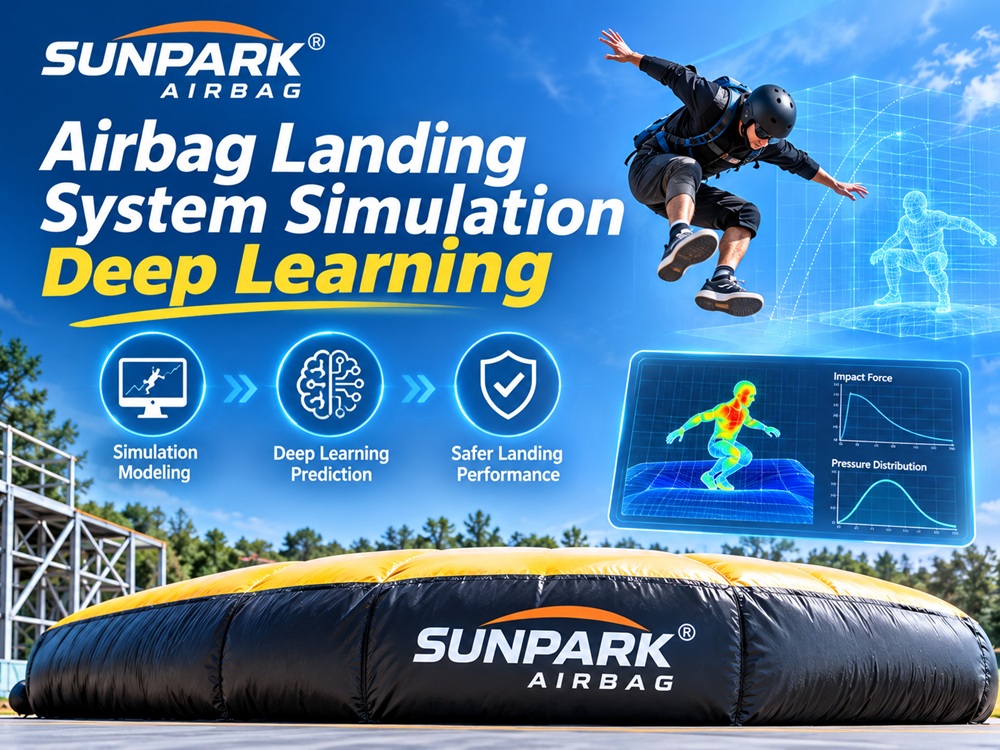
Airbag landing system simulation using deep learning combines numerical engineering models, impact-test data, and machine learning to predict how an inflatable landing structure responds to different landing conditions. Engineers first create or collect data from physical tests and validated numerical simulations. A neural network is then trained to estimate outputs such as impact acceleration, deformation, pressure response, and energy absorption for new combinations of input conditions.
The most useful approach is not to replace conventional engineering simulation with AI. It is to use finite element analysis (FEA) or another suitable physics-based model to generate and validate the underlying data, then use deep learning as a faster prediction tool for exploring a larger design space.
Quick Answer: Is deep learning useful for airbag landing system simulation?Yes, when it is used as a validated engineering support tool. Deep learning can accelerate impact-response prediction, compare design parameters, identify potentially problematic landing conditions, and support design optimization. The model is only as reliable as its training data, physical assumptions, and validation process. For sports airbags, spacecraft research provides a useful methodological example, but its numerical results cannot be transferred directly to athlete landing systems.
Quick Summary: Airbag Landing System Simulation Deep Learning
| Topic | What it means | Practical value |
|---|---|---|
| What it is | A combination of physics-based simulation and trained machine learning models. | Predicts impact behavior across multiple landing and design scenarios. |
| How it works | Generate simulation or test data, train a model, validate predictions, and explore design variations. | Reduces repetitive simulation work during design exploration. |
| Potential benefits | Faster prediction, parameter screening, optimization, and sensitivity analysis. | Helps engineers focus testing on promising configurations. |
| Limitations | Training-data dependence, uncertainty outside the training range, and model assumptions. | Cannot independently establish product safety. |
| Best users | Airbag manufacturers, engineering teams, research groups, and large sports facility developers. | Useful where many configurations or impact conditions must be assessed. |
| Who may not need it | Small facilities purchasing a standard, established airbag for a straightforward use case. | Conventional product selection and inspection may be more economical. |
| Common mistake | Treating AI predictions as proof of safe landing performance. | Can create false confidence if physical validation is skipped. |
| Buying consideration | Ask for the system’s intended use, design data, testing evidence, and operating instructions. | Connects simulation claims to the actual product and application. |
| Expert recommendation | Use AI to prioritize engineering decisions, then verify critical results physically. | Balances speed, cost, and responsible safety evaluation. |
1. What Is Airbag Landing System Simulation?
Airbag landing system simulation is the digital analysis of how an inflatable structure responds when an object or person impacts it. The objective is to understand how the system deforms, redistributes pressure, absorbs energy, and manages the forces transmitted through the landing interface.
Unlike a simple static pressure calculation, an impact event is dynamic. The landing object has mass and velocity. The inflatable structure changes shape. Internal air pressure changes as the system compresses, and some designs use vents or controlled air release to manage the response. The interaction between these factors determines the overall impact behavior.
How does an inflatable landing system absorb impact?
When an athlete or object lands on an inflatable airbag, the structure deforms under the applied load. The deformation changes the internal air volume and pressure distribution. Depending on the design, air may move through internal passages or escape through vents. The fabric structure stretches and transfers loads through seams, panels, and anchor points.
Impact management therefore depends on more than inflation pressure. A very firm airbag may produce a different landing response from a softer design, but simply lowering pressure is not automatically safer. Excessive compression, bottoming out, unstable deformation, or poor landing geometry can create other problems.
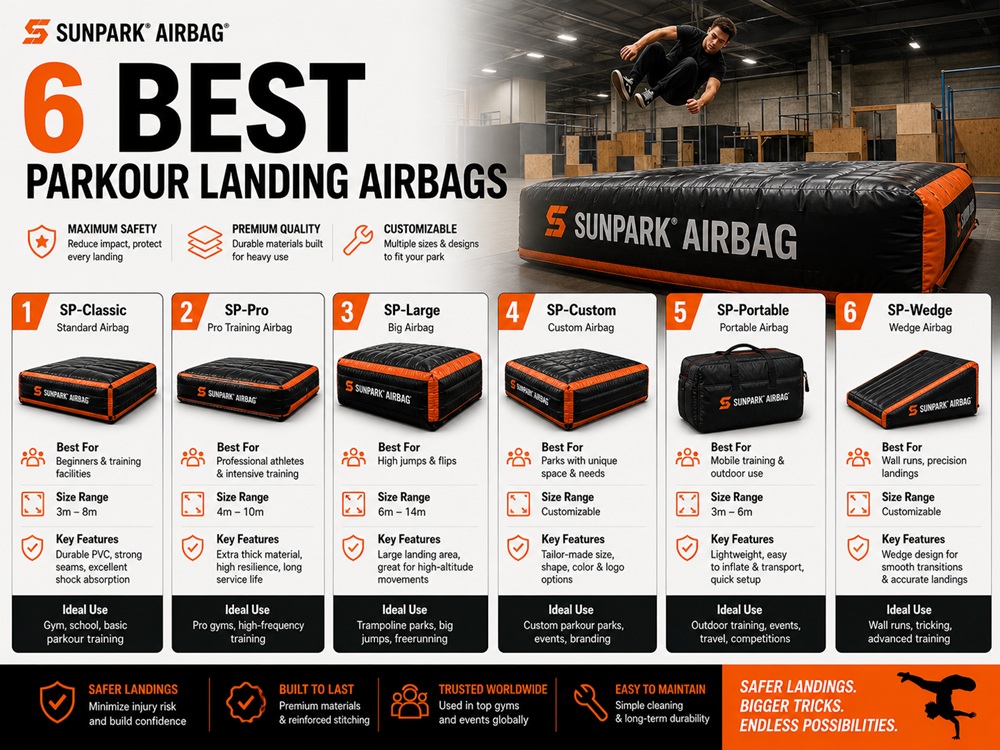
For practical product selection, the intended activity matters. A stunt airbag landing system is designed around different use conditions from a training mat or a recreational jump landing product.
Why simulate instead of relying only on physical testing?
Physical testing remains essential, but testing every possible combination of rider mass, landing speed, landing angle, air pressure, and airbag configuration can be expensive and time-consuming. Simulation allows engineers to investigate scenarios that may be difficult to reproduce repeatedly in a physical test environment.
For example, a manufacturer may want to compare several landing geometries under multiple impact speeds. A physics-based model can help evaluate those combinations before building and testing every prototype. A deep learning model trained on suitable simulation results can then make repeated predictions much faster.
2. How Deep Learning Works With Airbag Impact Simulation
Deep learning is a branch of machine learning that uses neural networks with multiple processing layers to identify patterns in data. In airbag landing system simulation, the network learns relationships between input parameters and impact-response outputs.
For example, the inputs may include landing velocity, object mass, initial air pressure, airbag geometry, and vent characteristics. The outputs may include acceleration over time, maximum deformation, pressure variation, or another defined engineering response.
Step 1: Build a physics-based simulation
Engineers first construct a numerical model of the landing system. Depending on the project, this may involve finite element analysis, fluid-structure interaction, computational fluid dynamics, or a simplified engineering model.
The model should represent the factors that materially affect the impact response. These can include fabric behavior, seam properties, air compressibility, vent flow, contact mechanics, and the mass and geometry of the landing object.
Step 2: Generate a structured dataset
The simulation is run under multiple input combinations. Each run produces a set of input conditions and corresponding output measurements. The resulting dataset becomes the training foundation for the deep learning model.
Data quality matters more than dataset size alone. If the numerical model uses unrealistic fabric properties or omits important venting behavior, a neural network may learn a highly consistent but physically misleading relationship.
Step 3: Train a neural network
A neural network is trained to map input conditions to predicted impact responses. Different model architectures are suitable for different tasks:
- Multilayer perceptrons (MLPs): Useful for learning relationships between structured input parameters and scalar outputs such as peak acceleration or maximum deformation.
- Convolutional neural networks (CNNs): Can be adapted to spatial or time-series patterns, including response profiles represented as structured arrays.
- Recurrent neural networks: Architectures such as LSTM models can be considered for sequential response data where temporal dependencies matter.
- Physics-informed neural networks: Can incorporate selected physical constraints or governing relationships, although they still require careful formulation and validation.
- Surrogate models: Approximate the outputs of a more computationally expensive simulation to accelerate design exploration.
Step 4: Validate predictions against independent data
The model must be tested using data that was not used during training. Engineers compare its predictions with independent numerical results and, where possible, physical impact tests.
For an impact-response model, comparing only one peak value is not enough. The shape and timing of the response curve may also matter. A model that predicts the peak acceleration correctly but misses the duration or shape of the impact event may be unsuitable for the intended engineering decision.
Step 5: Use the model to explore design options
After validation, the model can be used to screen new combinations of design variables within its demonstrated range. Engineers can identify configurations that deserve more detailed simulation or physical testing.
3. What Recent Research Demonstrates About Deep Learning and Airbag Landing Systems
A relevant example is the 2025 research paper, “Predicting and optimizing the impact responses of the airbag landing system by the simulation-based deep learning model,” published in Scientific Reports by Xinyi Shen and Caishan Liu.
The study examined a spacecraft soft-landing airbag system. The researchers developed a finite element model to generate impact-response data under different initial landing velocities and airbag parameters. They then trained a convolutional neural network to predict multiple acceleration time histories using parameters that included initial landing velocity, initial airbag pressure, and an overload threshold associated with venting.
The researchers reported good agreement between the trained model and finite element results, with a prediction speed approximately 100,000 times faster than the underlying simulation in their reported setup. They also combined the model with a multi-objective optimization algorithm to investigate inflation and venting strategies for different landing conditions.
This is an important demonstration of the potential of simulation-based deep learning: a computationally expensive impact model can be approximated by a trained model for faster prediction and design exploration.
For SUNPARK® AIRBAG customers, the practical lesson is not that a particular AI model can certify an airbag. It is that numerical modeling and data-driven analysis may help engineers investigate how an inflatable system responds under different design and operating conditions.
4. Eight Important Variables in Airbag Landing System Simulation
A simulation is only useful when it represents the variables that influence the actual landing event. For sports and stunt applications, the following parameters deserve particular attention.
1. Landing mass
The mass of the landing object or athlete affects the energy and force conditions that the system must manage. A model developed for one mass range should not automatically be trusted for a substantially different range.
For sports airbags, engineers may need to evaluate a representative range of user masses rather than a single nominal value. The selected range should reflect the intended users and operating rules.
2. Landing velocity
Landing velocity is a major input because impact energy changes with the square of velocity. A relatively small increase in speed can therefore create a substantial increase in the energy that must be managed.
For a simplified moving object, kinetic energy is expressed as:
E = 1/2 × m × v²
Here, m represents mass and v represents velocity. This equation is useful for understanding why speed matters, but it is not a complete model of a human landing. Body orientation, joint movement, contact area, and landing sequence also influence the event.
3. Landing angle and orientation
A centered, vertical impact is not the only scenario that matters. An athlete may contact the landing surface with a rotated body position, an angled trajectory, or an off-center landing. These variations can change the local deformation and load distribution.
Simulation should include relevant landing orientations where the system is intended to accommodate them. However, the model must not imply that every possible body position is safe simply because it can be simulated.
4. Initial air pressure
Initial pressure influences the starting stiffness and deformation behavior of an inflatable structure. It should be treated as a controlled design and operating parameter rather than a value that can be adjusted casually by users.
Pressure recommendations should come from the product manufacturer and the applicable operating instructions. A simulation result outside the tested pressure range is not a substitute for approved operating guidance.
5. Airbag geometry and internal structure
Overall length, width, height, landing-surface profile, internal chambers, baffles, and reinforcement layout can all affect deformation. A flat landing bag and an inclined landing ramp have different geometric and functional requirements.
For example, a airbag landing ramp system needs to be evaluated as an integrated launch-to-landing configuration. The ramp angle, transition, landing surface, and available runout space can influence the incoming trajectory and contact position.
6. Venting and airflow behavior
Some impact-attenuation designs use controlled air release to manage internal pressure and deformation. Vent size, location, flow resistance, and the response of the surrounding air chambers may affect the impact profile.
Engineers should avoid treating venting as a minor accessory. In a vented system, it may be a central part of the impact-management mechanism.
7. Fabric, seams, and structural properties
The inflatable structure is a flexible assembly, not a rigid container. Fabric tensile behavior, coating properties, seam strength, reinforcement, and local stress concentrations all influence how it responds under load.
A simulation that uses oversimplified material properties may produce inaccurate deformation or stress predictions. Material characterization and physical testing are therefore important when building a credible model.
8. Landing-surface condition and installation
Anchoring, ground support, slope, surrounding structures, and installation conditions can affect the behavior of the complete system. A product tested in one configuration should not automatically be assumed to perform identically when installed differently.
For a commercial facility, the model and the physical installation plan should be reviewed together. The landing product, access route, surrounding clearance, and operating environment all matter.
| Simulation variable | Possible model input | Potential response to evaluate | Practical implication |
|---|---|---|---|
| Landing mass | Mass range and distribution | Acceleration and deformation | Define the intended user or object range. |
| Landing velocity | Vertical and horizontal velocity components | Impact response over time | Consider realistic operating scenarios. |
| Landing orientation | Contact angle and position | Local deformation and load distribution | Assess relevant off-center conditions. |
| Initial pressure | Specified pressure range | Pressure and deformation response | Keep operating limits tied to manufacturer guidance. |
| Geometry | Dimensions and chamber arrangement | Contact and deformation patterns | Match the model to the actual product design. |
| Venting | Vent size and flow characteristics | Pressure release and response duration | Evaluate the complete airflow arrangement. |
| Material properties | Fabric, seam, and reinforcement data | Stress and strain distribution | Use measured or justified material inputs. |
| Installation | Support and anchoring conditions | System movement and stability | Validate the intended installed configuration. |
5. A Practical Deep Learning Simulation Workflow
For manufacturers and engineering teams, a disciplined workflow is more important than choosing the most fashionable AI architecture. We recommend the following process.
Stage 1: Define the engineering question
Start with a specific question. Are you trying to predict peak acceleration, compare two airbag geometries, investigate pressure sensitivity, evaluate venting options, or estimate deformation under a defined impact scenario?
Do not begin by asking AI to optimize every part of the system at once. A clearly defined engineering target makes it easier to select model inputs, outputs, and validation criteria.
Stage 2: Build the physical model
Create the numerical representation of the airbag and its operating environment. Depending on the required level of detail, the model may include nonlinear fabric behavior, contact, air compression, venting, and structural connections.
For complex inflatable structures, assumptions should be documented. If a component is modeled as rigid, simplified, or omitted, engineers need to understand how that assumption may affect the results.
Stage 3: Generate representative simulation data
Use a structured design of experiments to vary the important parameters. The dataset should cover the intended operating envelope and include combinations that test interactions between variables.
Randomly generating many similar cases is not necessarily better than carefully selecting a smaller set of informative cases. Engineers should ensure that the dataset includes meaningful variation in landing conditions and design parameters.
Stage 4: Train and compare candidate models
Begin with a baseline model. Then compare more complex neural network architectures where the data structure justifies them. A complicated model is not automatically more accurate or more useful.
For structured input-output relationships, an MLP may be sufficient. For response curves or structured time-series data, a CNN or recurrent architecture may be worth evaluating. The choice should be supported by independent validation results.
Stage 5: Evaluate errors and uncertainty
Compare predictions with held-out simulation cases and physical test data where available. Useful evaluation metrics may include mean absolute error, root mean squared error, maximum response error, and errors in the timing or shape of response curves.
For safety-relevant engineering decisions, a single average error score is inadequate. Engineers should examine where the model performs poorly, especially near the boundaries of the intended operating range.
Stage 6: Use optimization carefully
Once the model has been validated for its intended use, it can support design exploration. Multi-objective optimization may be useful when engineers need to balance competing goals such as impact response, deformation, structural loading, weight, and manufacturing complexity.
The optimization result should be treated as a candidate configuration. It still needs detailed engineering review and physical validation before it can become a production design.
6. Which AI and Simulation Methods Should Engineers Compare?
Deep learning is not the only method available. In some projects, a conventional simulation or simpler statistical model is more economical and easier to validate. The correct approach depends on the number of variables, computational cost, available data, and required prediction accuracy.
| Method | Primary role | Strengths | Limitations | When to use it |
|---|---|---|---|---|
| Finite element analysis | Physics-based structural and impact simulation | Can represent geometry, material behavior, contact, and deformation. | Detailed nonlinear models can be computationally expensive. | Detailed engineering analysis and reference data generation. |
| Computational fluid dynamics | Airflow and pressure analysis | Useful for studying flow paths and vent behavior. | May require complex coupling with structural deformation. | When airflow and venting materially affect performance. |
| Multilayer perceptron | Structured parameter-to-output prediction | Relatively straightforward for tabular engineering data. | May not naturally capture complex spatial or temporal patterns. | Predicting selected performance indicators. |
| Convolutional neural network | Pattern learning from structured arrays or response profiles | Can model relationships in structured data and time-series representations. | Requires suitable data representation and careful validation. | Predicting response curves or spatially structured outputs. |
| Recurrent neural network | Sequential response prediction | Designed to model temporal dependencies. | Training and stability can be challenging for some datasets. | When sequence history is important. |
| Surrogate model | Fast approximation of a detailed simulation | Can accelerate repeated design exploration. | Reliability is limited by its training domain and reference model. | Screening many candidate configurations. |
Our recommendation is to establish a dependable physics-based baseline first. If the detailed model is already fast enough for the design decisions being made, deep learning may add cost without delivering meaningful value. If hundreds or thousands of repeated evaluations are needed, a validated surrogate model may justify the additional development effort.
7. How Simulation Can Improve Airbag Landing System Design
Simulation becomes commercially useful when it helps engineers make better design decisions. The goal is not to produce impressive visualizations. It is to understand which design changes are worth prototyping and which assumptions need further investigation.
Compare landing-surface geometries
Different activities require different landing configurations. A flat landing area, inclined landing ramp, and large freestyle jump airbag do not have interchangeable geometry or use conditions.
Simulation can help compare design alternatives under defined impact scenarios. It may identify configurations that require closer investigation because of deformation patterns, contact location, or predicted response variation.
For example, a big jump airbag system should be evaluated in relation to its intended approach, jump trajectory, landing area, and installation environment rather than by its dimensions alone.
Investigate pressure and venting configurations
Engineers can use simulation to study how different pressure settings or vent characteristics influence the predicted impact response. This is useful for identifying sensitive parameters and understanding which settings require close manufacturing or operating control.
However, a model-generated optimum should never become an operating instruction without product-specific testing and manufacturer approval.
Identify structural design concerns
Structural simulation may help engineers investigate stress concentrations around seams, reinforcement zones, attachment points, and transitions between panels. This can guide prototype development and inspection priorities.
For heavy-duty applications, the engineering review should consider repeated use, cyclic loading, environmental exposure, and the maintenance regime. A single impact simulation cannot establish long-term durability.
Reduce unnecessary prototype iterations
When a validated surrogate model is available, engineers can screen design alternatives before investing in physical prototypes. This may reduce the number of low-value trials and shorten the early design exploration stage.
The commercial benefit is strongest when the project involves multiple variables, repeated design comparisons, and meaningful prototype costs. For a standard off-the-shelf airbag with no special engineering requirement, building a dedicated deep learning workflow may not be financially sensible.
8. Applying Deep Learning Simulation to Sports and Stunt Airbags
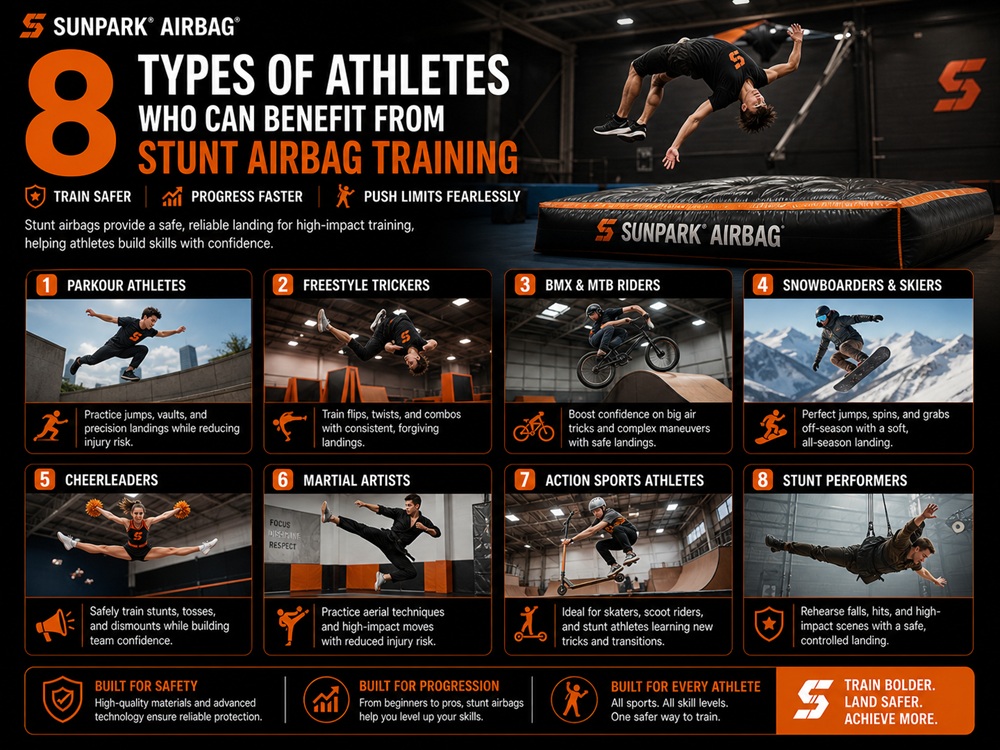
Sports airbags share the general principle of impact attenuation with other inflatable landing systems, but the application conditions are different. A sports airbag must be evaluated around athlete movement, approach speed, landing posture, equipment, skill level, and the operating environment.
It is important to distinguish between an airbag used for controlled skill progression and a system intended for a particular professional stunt or high-energy activity. Product design, supervision, landing geometry, and operating instructions must match the intended use.
Gymnastics and trampoline training
Gymnastics and trampoline facilities may use inflatable landing products to support selected training activities. Simulation could help investigate how geometry, pressure, and impact conditions influence the system’s response, but the model must reflect the actual equipment and intended movement.
Explore gymnastics airbag equipment when evaluating products for gymnastics-related training environments. The appropriate selection depends on the training objective, facility layout, and manufacturer guidance.
BMX and bike landing applications
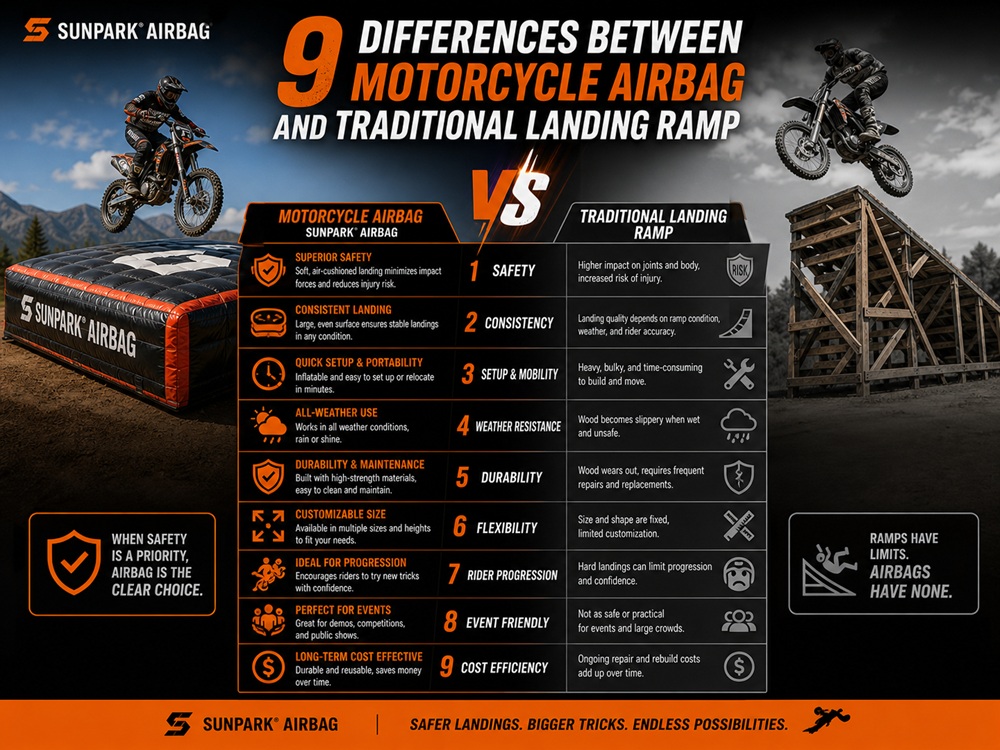
BMX and bike airbag landing systems involve approach speed, bicycle configuration, rider position, and landing trajectory. The impact is not simply a vertical drop of a rigid object. The rider and bicycle form a dynamic system, and their interaction with the landing surface matters.
For this reason, engineers should avoid training a model using only simplified vertical-impact data and then applying it to complex riding scenarios without additional validation.
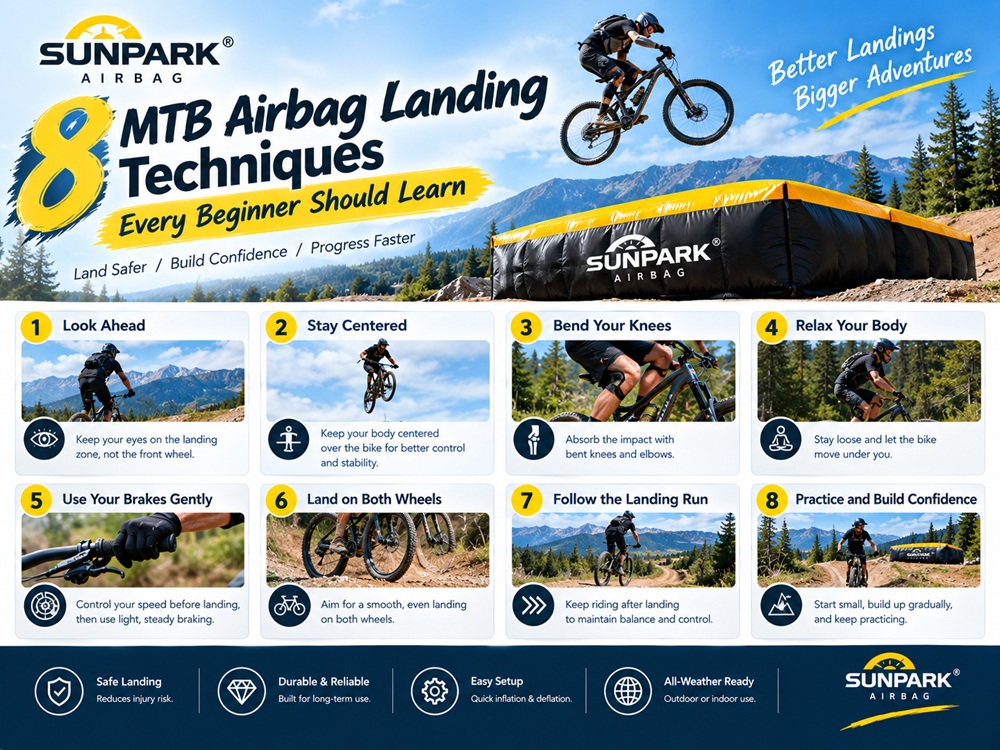
Review BMX airbag landing systems and bike airbag landing products in the context of the actual sport, jump configuration, and intended rider level.
Freestyle and stunt training
Freestyle and stunt environments can involve larger trajectories and more complex landing orientations. Product selection should consider the intended trick progression, takeoff geometry, landing zone, operating procedures, and professional supervision.
A inflatable jump airbag may be relevant for selected jump-training applications, while a halfpipe airbag is designed around a different facility configuration. Neither should be selected solely because it has a larger landing surface or a higher nominal pressure.
9. Limitations, Safety, and Common Misconceptions
Deep learning can make an engineering workflow faster, but speed should not be confused with certainty. A model can produce a prediction in milliseconds and still be wrong if the input conditions fall outside the data used to train it.
Misconception 1: More training data always means a safer design
More data can improve model coverage, but only when the data is relevant and technically credible. Thousands of simulation cases generated using an inaccurate material model will not automatically produce a reliable prediction.
Misconception 2: A low predicted peak acceleration proves the airbag is safe
Peak acceleration is only one possible response metric. Contact location, impact duration, body orientation, deformation, bottoming-out risk, structural loading, and other application-specific factors may also matter.
For human landing applications, injury risk cannot be reduced to one model output without appropriate biomechanical evidence and a validated assessment framework.
Misconception 3: A spacecraft landing model can be used directly for sports airbags
Spacecraft and sports landing systems differ in geometry, materials, loading, contact behavior, and the nature of the object being protected. Research methods can inform sports-airbag modeling, but the original model’s numerical results are not transferable without a new engineering model and validation program.
Misconception 4: AI can replace physical testing
It cannot. Physical testing is necessary to verify that the real product behaves as expected. It also helps identify effects that may not be fully represented in the numerical model, including material variation, manufacturing differences, installation conditions, and real-world wear.
Misconception 5: Every inflatable device follows the same safety standard
Standards have defined scopes and exclusions. For example, ASTM F2374 covers certain inflatable amusement devices but explicitly excludes some categories, including stunt-bag-style devices that require sudden air loss to perform their intended function. A manufacturer or facility should not claim that a product is compliant with a standard without checking whether that standard applies to the specific product.
10. How to Evaluate an Airbag Manufacturer’s Engineering and Simulation Capabilities
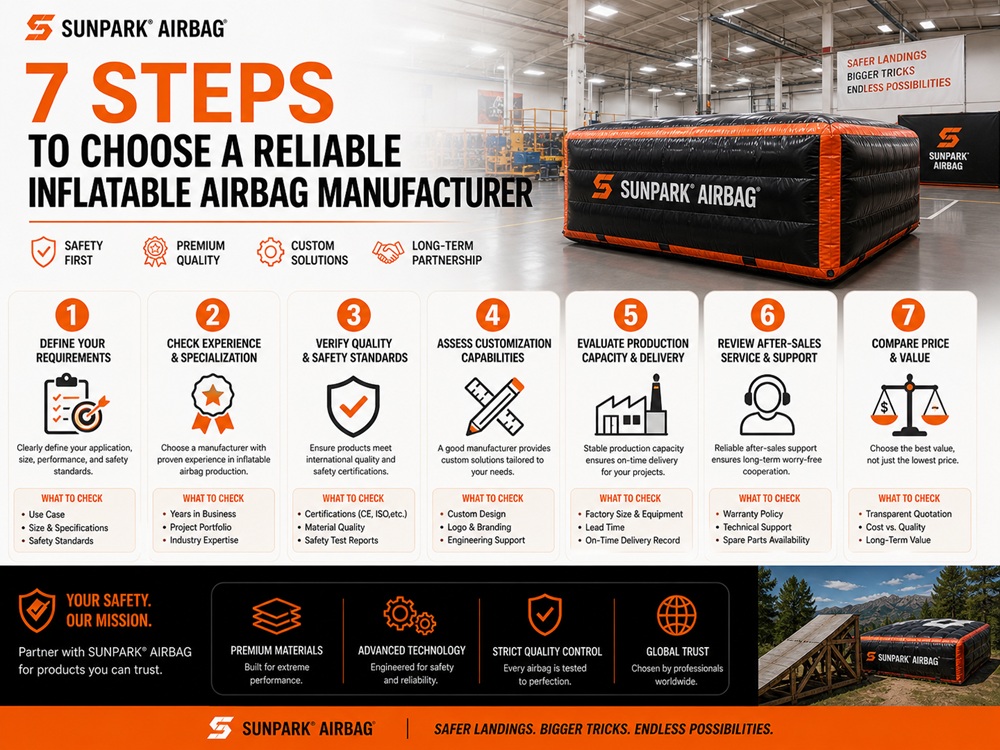
For a buyer, it is easy to be impressed by phrases such as AI-powered design, advanced simulation, or intelligent impact prediction. These terms are only useful when the manufacturer can explain what was modeled, which conditions were tested, and how the results connect to the actual product.
Questions worth asking a manufacturer
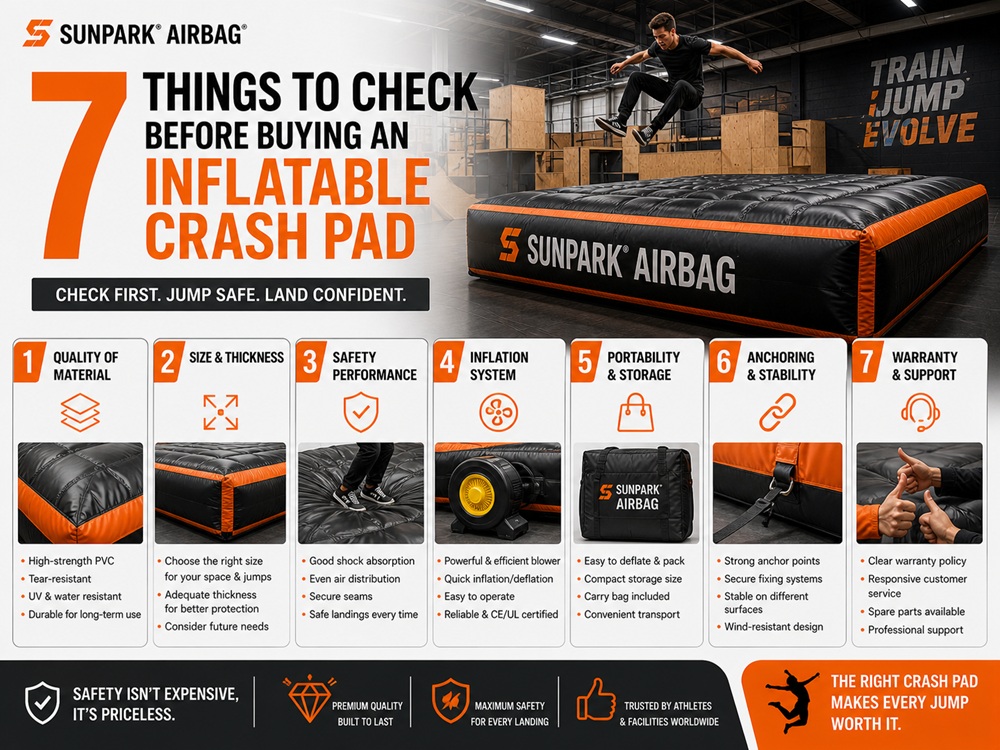
- What application is the product designed for? Confirm whether it is intended for BMX, skiing, gymnastics, stunt work, trampoline training, or another activity.
- What impact conditions were considered? Ask about the relevant mass, speed, landing orientation, and operating range.
- What physical testing has been completed? Request an explanation of the test setup, measurement method, and acceptance criteria.
- How is the inflatable structure constructed? Ask about fabric, seams, reinforcement, internal chambers, vents, and attachment arrangements.
- How is inflation pressure controlled? Confirm the specified operating pressure and how operators should monitor it.
- What maintenance is required? Ask about inspection frequency, repairs, wear, storage, and environmental limitations.
- Does the simulation represent the production design? A model of an early prototype is not necessarily representative of the final manufactured product.
- How are design changes validated? Confirm whether changes in geometry, materials, or venting trigger additional engineering review and testing.
Compare suppliers by engineering support, not marketing language
A supplier that can explain its product construction, intended use, inspection requirements, and limitations is more useful than one that relies on broad claims about advanced technology. For commercial users, product reliability and operational support should carry more weight than an impressive demonstration video.
When comparing an inflatable crash mat with a purpose-designed jump landing system, check whether the product is intended for the same activity and impact conditions. Similar appearance does not mean equivalent performance.
11. Is Deep Learning Simulation Worth the Investment?
The business case depends on how frequently the engineering team needs to evaluate different designs. A manufacturer developing multiple airbag configurations may benefit from a validated simulation-based prediction model. A small facility purchasing one standard landing product may not need access to any AI simulation platform.
| Project situation | Recommended approach | Cost-benefit reasoning |
|---|---|---|
| Buying a standard commercial airbag | Focus on product suitability, testing evidence, instructions, and support. | A custom AI model is unlikely to justify its development cost. |
| Developing a new landing geometry | Use engineering simulation and physical prototypes. | Early analysis can help reduce avoidable design iterations. |
| Comparing many pressure and vent configurations | Consider a validated surrogate model. | Repeated prediction may justify the model-development effort. |
| Launching a new product family | Combine simulation, prototype testing, and production validation. | Reusable engineering models may support multiple design projects. |
| Operating an existing sports facility | Follow manufacturer instructions and established inspection procedures. | Operational safety and maintenance usually matter more than AI modeling. |
| Researching advanced impact systems | Build a documented model with independent validation. | Research investment may be justified by the need for new engineering insight. |
When should you upgrade your engineering workflow?
Consider simulation-based deep learning when conventional analysis is becoming a bottleneck. Typical signs include repeated design comparisons, long simulation turnaround times, expensive prototype cycles, and a need to evaluate many interacting parameters.
Do not upgrade simply because AI is becoming popular. If the engineering team lacks reliable material data, a clear test protocol, or a validated numerical model, those fundamentals should be addressed first.
12. How SUNPARK® AIRBAG Approaches Airbag System Development
SUNPARK® AIRBAG focuses on inflatable airbag systems for extreme sports and leisure applications, including ski resorts, theme parks, sports facilities, and gymnastics environments. With more than 10 years of experience in the airbag industry, the company supplies products for training and recreational environments where athletes and riders need suitable facilities to practice and progress.
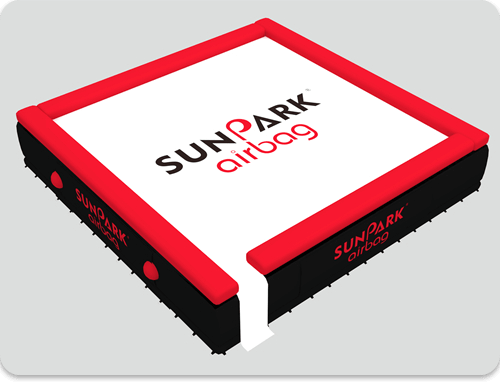
SUNPARK® AIRBAG – Explorer of Airbag Systems for Sports
SUNPARK® AIRBAG develops inflatable products for extreme sports and leisure applications, with product solutions for sports facilities, ski resorts, theme parks, and gymnastics environments.
Its product range includes stunt airbags, BMX landing systems, bike landing airbags, gymnastics airbags, and other inflatable landing solutions.
When evaluating a sports airbag, we recommend starting with the activity and facility rather than choosing a product based only on its size. The approach speed, expected landing trajectory, available installation space, user group, supervision, and operating frequency should all be considered.
For a new facility or a specialized project, share the intended activity, site dimensions, expected user profile, and operating requirements with the manufacturer. This gives the supplier a more useful basis for recommending an appropriate product configuration.
Expert Recommendation: A Practical Checklist Before Using or Buying an Airbag Landing System
Whether you are a facility owner, equipment buyer, sports coach, or product developer, the following checklist provides a practical starting point.
- Confirm the product is designed for the intended sport or activity.
- Check the manufacturer’s stated user restrictions and operating conditions.
- Review the installation layout, landing area, and surrounding clearance.
- Confirm the required inflation equipment and approved pressure range.
- Understand the role of vents, chambers, seams, and reinforcement in the product design.
- Request relevant physical test information and product documentation.
- Establish routine inspection, cleaning, storage, and repair procedures.
- Train operators to identify damage, abnormal pressure, and unsafe operating conditions.
- Do not treat a simulation result or AI-generated safety claim as a substitute for product validation.
- For custom development, use a staged process: specification, simulation, prototype, physical testing, revision, and production approval.
The strongest engineering approach is a combination of physics, data, and physical evidence. Deep learning can accelerate analysis, but reliable airbag performance still depends on sound design, suitable materials, manufacturing quality, correct installation, and disciplined operation.
Frequently Asked Questions About Airbag Landing System Simulation Deep Learning
1. What is airbag landing system simulation deep learning?
It is an engineering approach that combines numerical simulation with trained neural networks to predict how an inflatable landing system responds to different impact and design conditions. It can help estimate impact-response curves, deformation, and other defined performance outputs.
2. How does deep learning improve airbag landing system simulation?
Deep learning can learn relationships between simulation inputs and outputs. Once trained and validated, the model may predict selected responses much faster than repeatedly running a detailed numerical simulation. This can help engineers screen design options and investigate parameter sensitivity.
3. Can deep learning replace finite element analysis?
No. Finite element analysis can provide a physics-based representation of structural deformation, contact, and material behavior. Deep learning can approximate selected outputs from that model, but it depends on credible training data and validation. The two methods are generally more useful together than as direct substitutes.
4. What parameters affect an airbag landing system’s impact response?
Important parameters can include landing mass, velocity, landing angle, initial air pressure, airbag geometry, internal chamber design, vent characteristics, fabric and seam properties, and installation conditions. The relevant variables depend on the product and intended application.
5. Is the 2025 deep learning airbag research directly applicable to sports airbags?
No. The 2025 Scientific Reports study investigated a spacecraft soft-landing system. Its simulation and deep learning methodology may inform other airbag research, but its model, numerical results, and optimized parameters cannot be transferred directly to BMX, gymnastics, stunt, or other sports airbags without application-specific modeling and validation.
6. Can AI predict whether an airbag landing is safe?
AI can predict defined engineering outputs when trained and validated for the relevant conditions. It cannot independently guarantee that a landing is safe or eliminate injury risk. Product-specific physical testing, appropriate operating procedures, and qualified engineering review remain necessary.
7. Is deep learning simulation worth the cost for an airbag manufacturer?
It may be worthwhile when the manufacturer needs to compare many design configurations, reduce repeated simulation time, or support a continuing product-development program. For a single standard product with established specifications, conventional engineering analysis and physical testing may be more economical.
8. What should I ask an airbag manufacturer before buying?
Ask about intended use, user restrictions, product dimensions, construction materials, inflation requirements, installation, physical testing, inspection procedures, maintenance, and technical support. If the supplier refers to simulation or AI, ask which product configuration was modeled and how the predictions were validated.
References
- Shen, X. and Liu, C. (2025). Predicting and optimizing the impact responses of the airbag landing system by the simulation-based deep learning model. Scientific Reports, 15, Article 35164. This research demonstrates a simulation-based CNN approach for predicting spacecraft airbag landing responses.
- ASTM International. ASTM F2374: Standard Practice for Design, Manufacture, Operation, and Maintenance of Inflatable Amusement Devices. Review the scope and exclusions carefully before determining whether it applies to a particular inflatable product.
- International Ski and Snowboard Federation (FIS). FIS Code of Conduct for Training and Safety. Guidance on training safety, emergency procedures, and athlete protective equipment.
Final takeaway: Airbag landing system simulation deep learning offers a practical way to accelerate impact prediction and explore design alternatives, particularly when a project involves many interacting parameters. The most credible workflow starts with physics-based simulation, uses representative data to train a model, validates predictions independently, and confirms the final product through physical testing. For sports and stunt airbags, that distinction is essential: AI can support better engineering decisions, but the actual product, its intended activity, and its operating conditions must determine the final safety assessment.