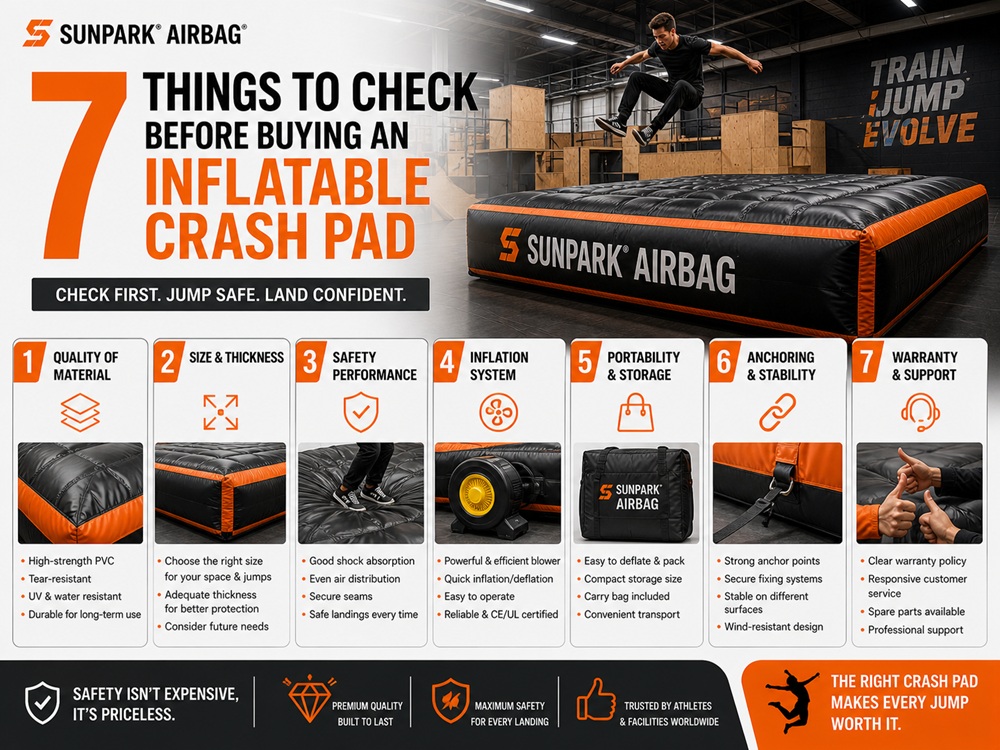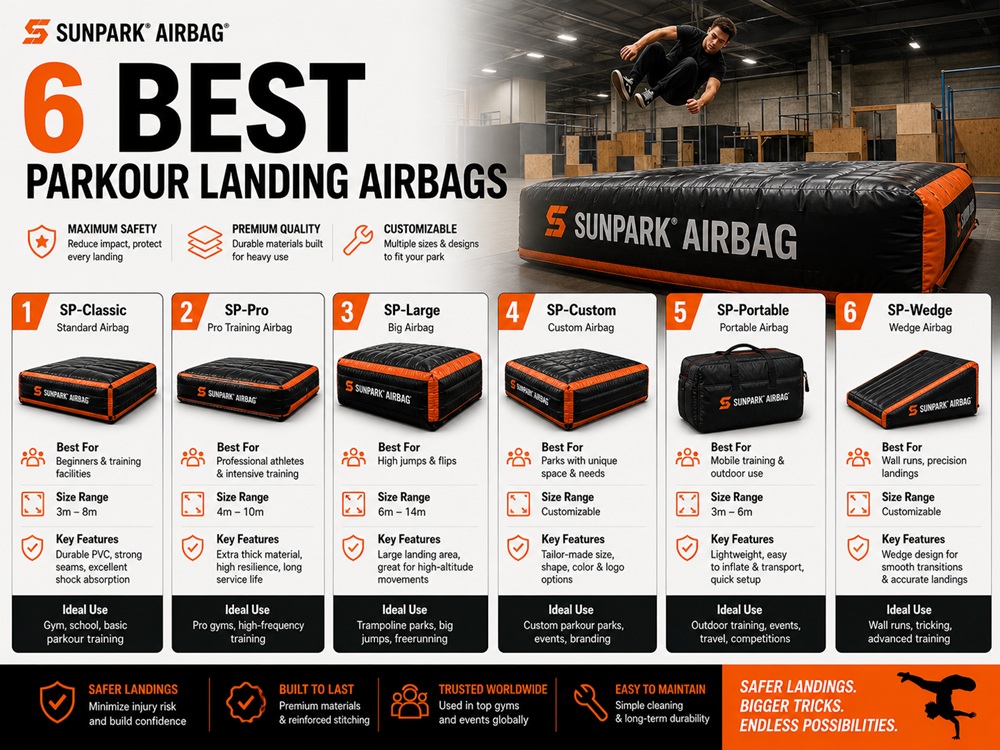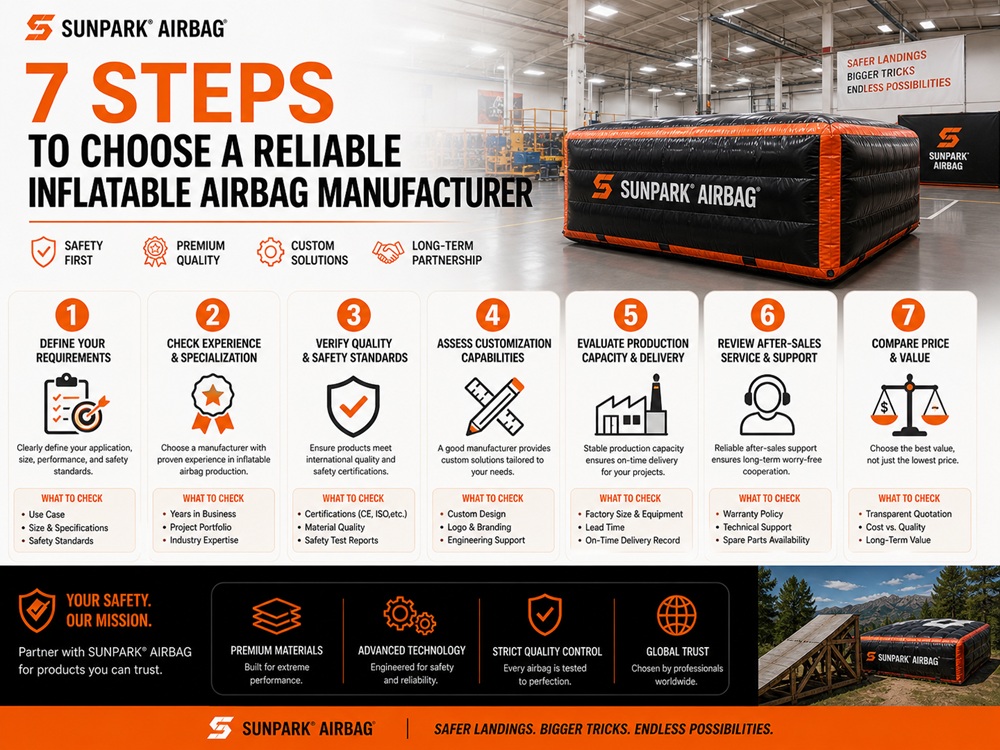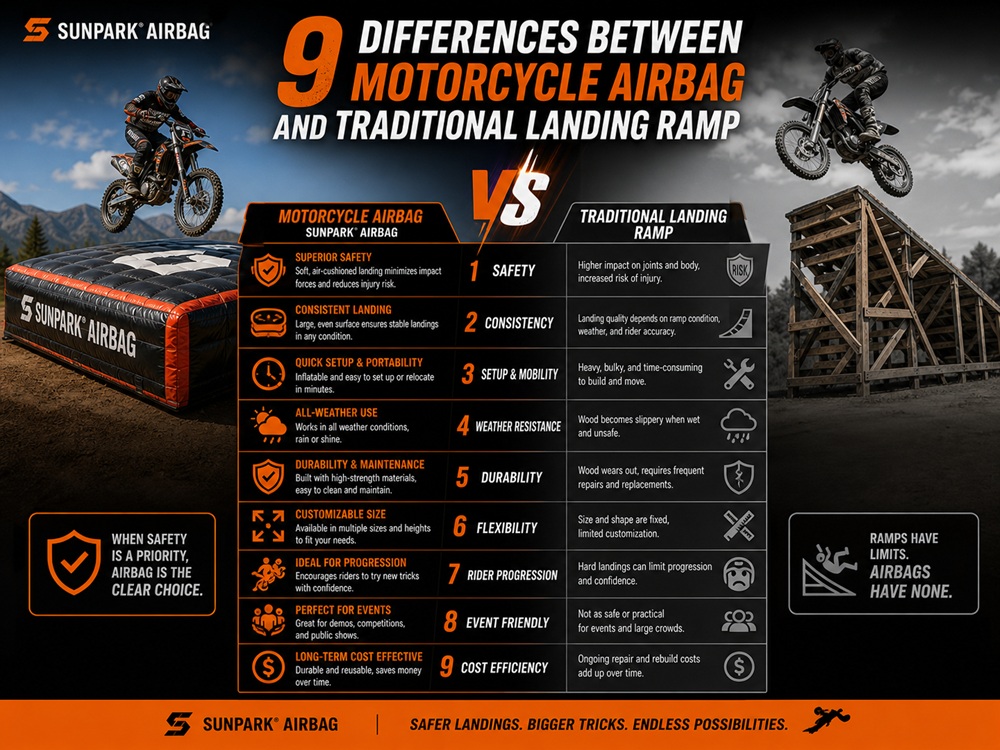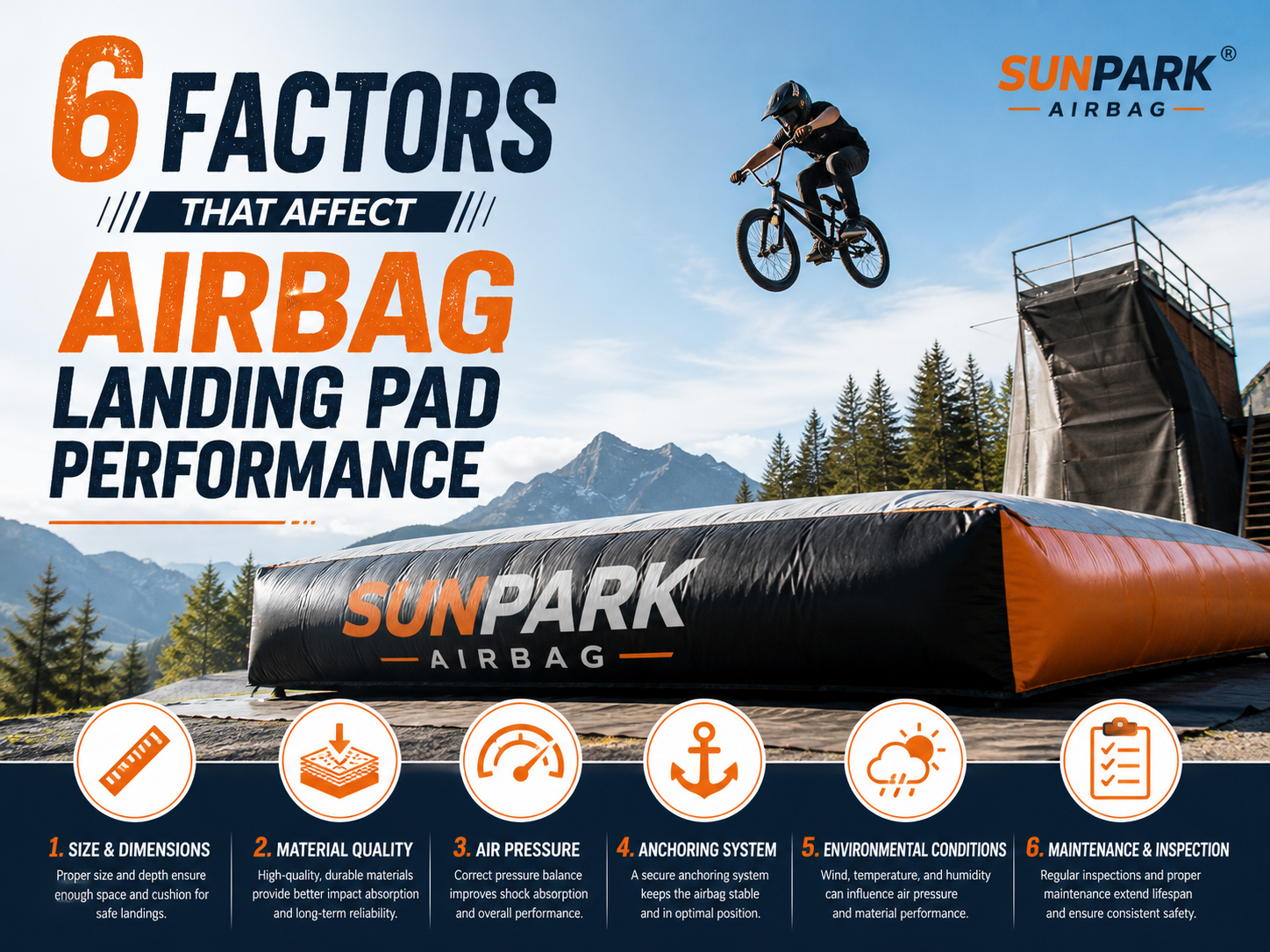
An airbag landing pad is only as effective as the system behind it. Two inflatable landing pads can look almost identical but perform very differently when a rider lands at speed, approaches from a different angle, or repeats a jump throughout a busy training session. The difference usually comes down to six practical factors: air pressure and venting, pad geometry, internal construction, material quality, installation conditions, and maintenance.
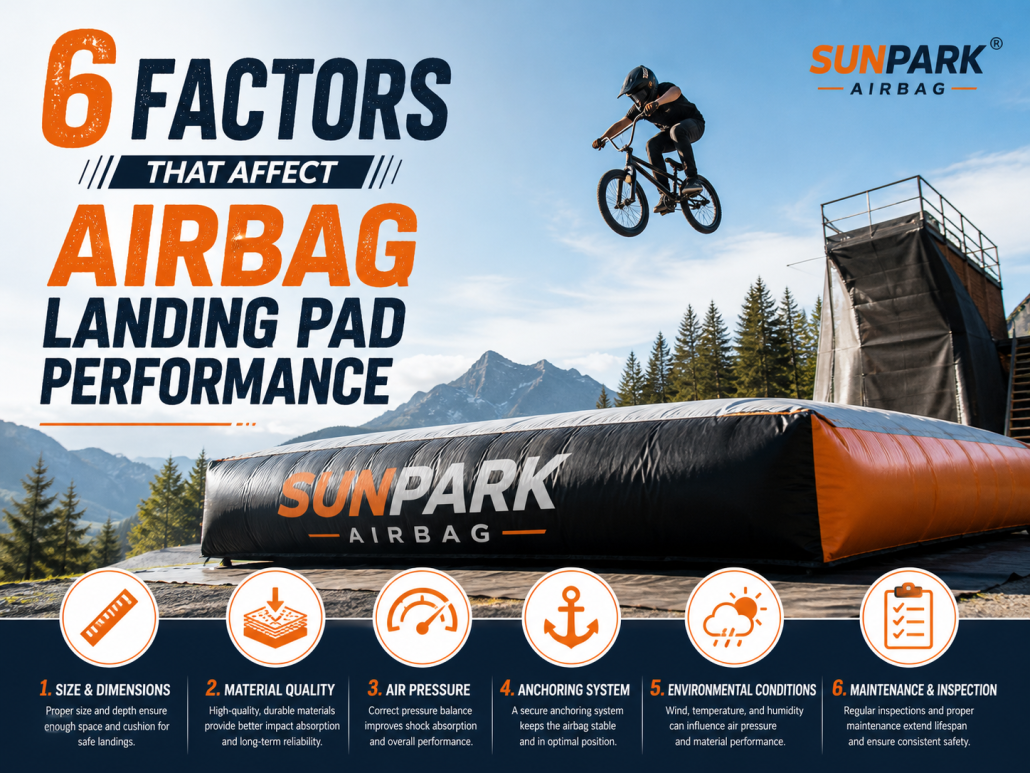
Quick Summary: Six Factors at a Glance
| Performance factor | What it influences | What operators should check |
|---|---|---|
| 1. Air pressure and airflow | Surface response, deformation, impact absorption, and recovery. | Pressure settings, blower capacity, vent design, leakage, and consistency. |
| 2. Landing pad geometry | Landing angle, usable area, rider positioning, and transition behavior. | Length, width, height, slope, landing zone, and jump alignment. |
| 3. Internal construction | How the pad deforms and distributes loads across its surface. | Chambers, baffles, internal partitions, reinforcement, and design suitability. |
| 4. Material and workmanship | Air retention, abrasion resistance, tear resistance, and service life. | Fabric specification, coating, seams, stitching or welding, and repairability. |
| 5. Installation and environment | Stability, operating consistency, and exposure-related deterioration. | Ground preparation, anchoring, drainage, wind exposure, temperature, and layout. |
| 6. Inspection and maintenance | Long-term reliability and repeatable operating conditions. | Leak checks, surface inspection, blower checks, cleaning, repairs, and records. |
What Is an Airbag Landing Pad?
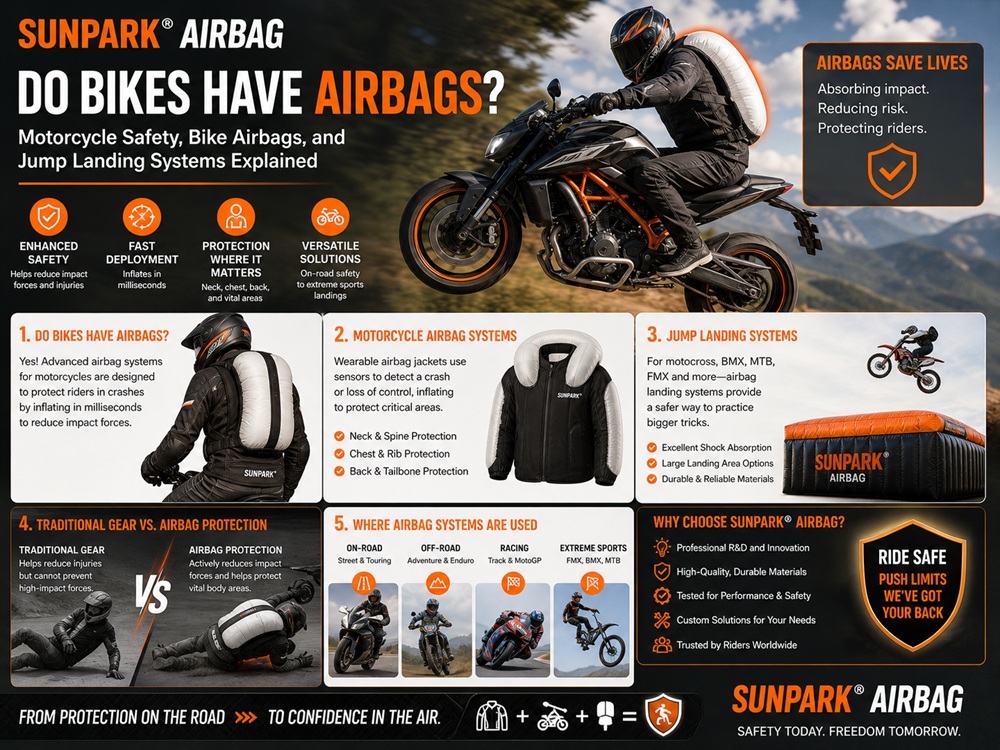
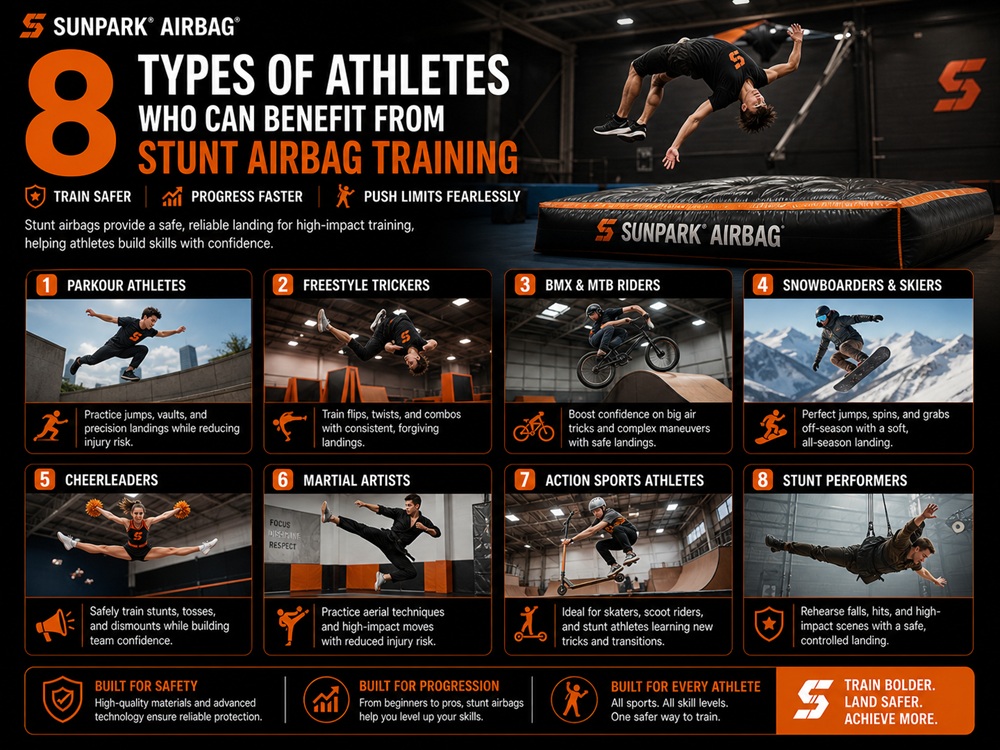
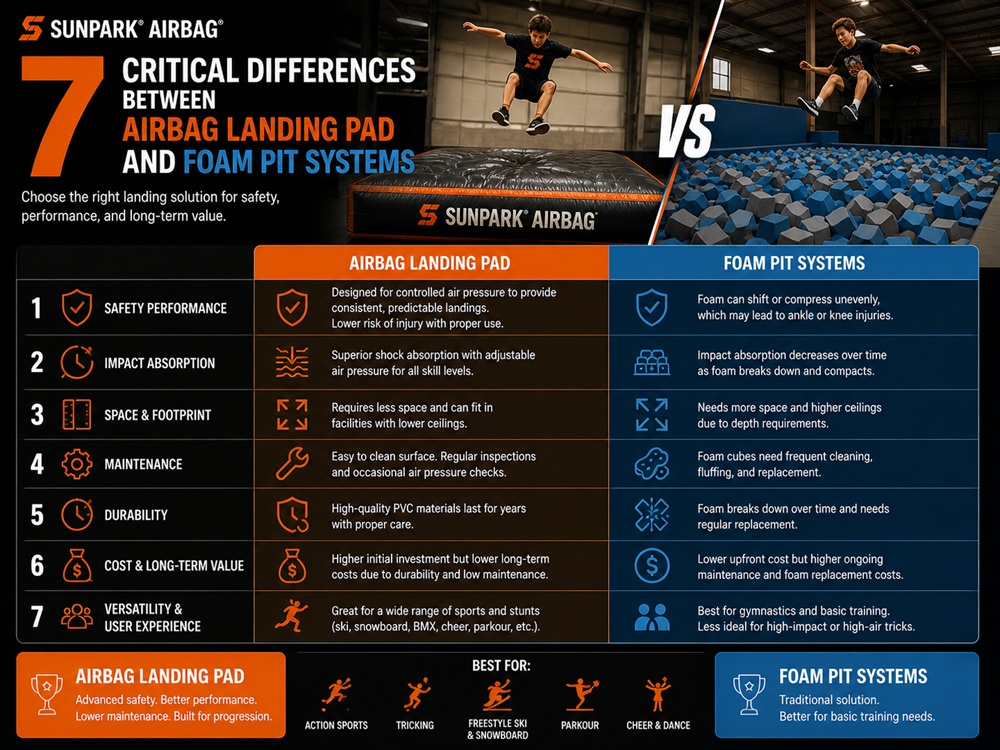
An airbag landing pad is an inflatable impact-management structure designed for activities such as freestyle skiing, snowboarding, BMX, mountain biking, skateboarding, gymnastics, and other sports training. It provides a deformable landing surface intended to help manage the forces generated when an athlete lands from a jump or aerial maneuver.
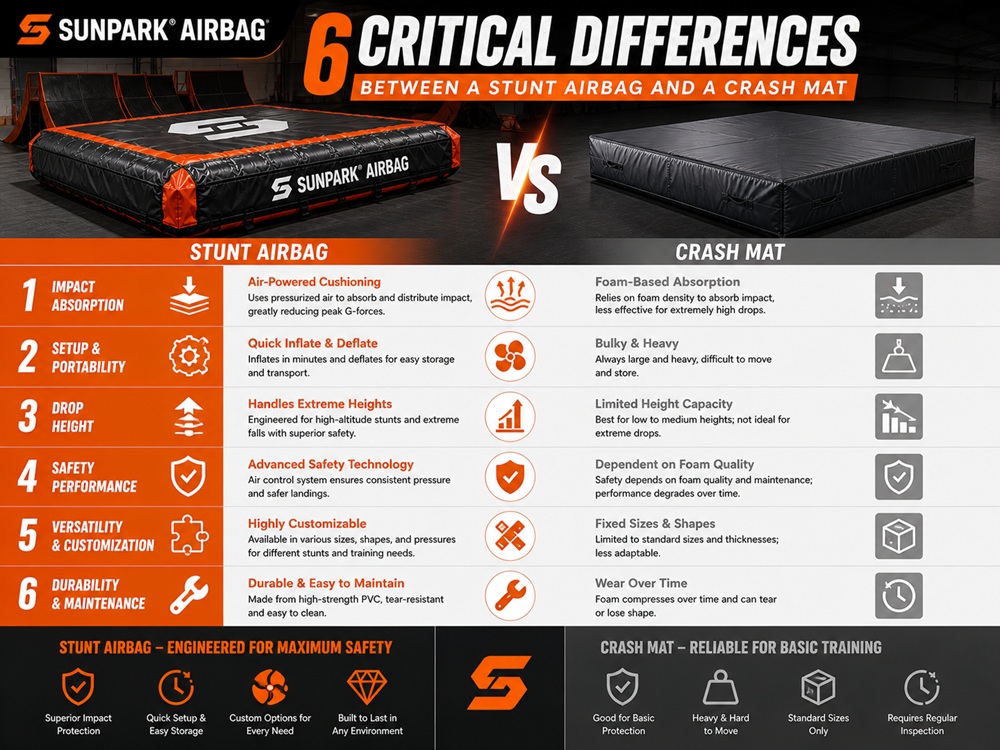
Unlike a rigid platform, an inflatable landing pad uses air pressure, fabric construction, and internal structural elements to control how the surface responds under load. The objective is not to make every landing soft regardless of the athlete’s speed or position. The objective is to create a predictable landing environment that is appropriate for the intended activity and operating conditions.
Different products serve different purposes. A training airbag for controlled gymnastics practice is not automatically suitable for a high-speed MTB jump. A freestyle snowboard landing system has different geometry and operating requirements from a recreational inflatable jump bag. Choosing the correct product category is therefore the first performance decision.
For operators comparing different designs, SUNPARK® AIRBAG provides landing airbag solutions for sports and leisure applications. The specification should always be matched to the actual landing scenario rather than selected by appearance alone.
How Does an Airbag Landing Pad Work?
When an athlete lands, the airbag surface deforms under the applied load. Air moves within the structure, and depending on the design, may pass through controlled vents or between connected chambers. The fabric and internal construction resist deformation while allowing the pad to change shape.
The resulting response depends on several interacting variables:
- Initial air condition: The starting pressure and airflow characteristics influence how the surface responds.
- Impact characteristics: Rider mass, speed, landing angle, body position, and contact area affect the load applied to the pad.
- Structural design: Internal partitions, baffles, and chamber arrangements influence deformation and air movement.
- Recovery: The pad must return to an appropriate operating condition before the next landing.
This is why a single specification such as total thickness cannot predict performance. A thicker pad with unsuitable airflow or geometry may perform worse for a particular activity than a properly engineered thinner system.
Factor 1: Air Pressure and Airflow Control
Air pressure and airflow are among the most important factors that affect airbag landing pad performance. They influence how the surface deforms under impact, how air is redistributed, and how quickly the system recovers for another landing.
A pad that is too firm for its intended application may not deform as expected. A pad with insufficient pressure or inadequate airflow control may lose its intended shape, become inconsistent, or fail to recover properly between repeated impacts. Neither extreme should be treated as a universal operating target.
Why pressure alone does not tell the whole story
Operators sometimes assume that adding more air automatically improves support. That is an oversimplification. Internal pressure, vent characteristics, blower output, chamber connections, fabric tension, and pad geometry work together. A system designed for controlled air release may behave very differently from a sealed or differently ventilated design.
For commercial facilities, consistency matters more than chasing a particular pressure number. Operators should follow the manufacturer’s specified operating range and use the recommended blower and airflow configuration. Do not adjust pressure based on guesswork or copy settings from another model.
What to check
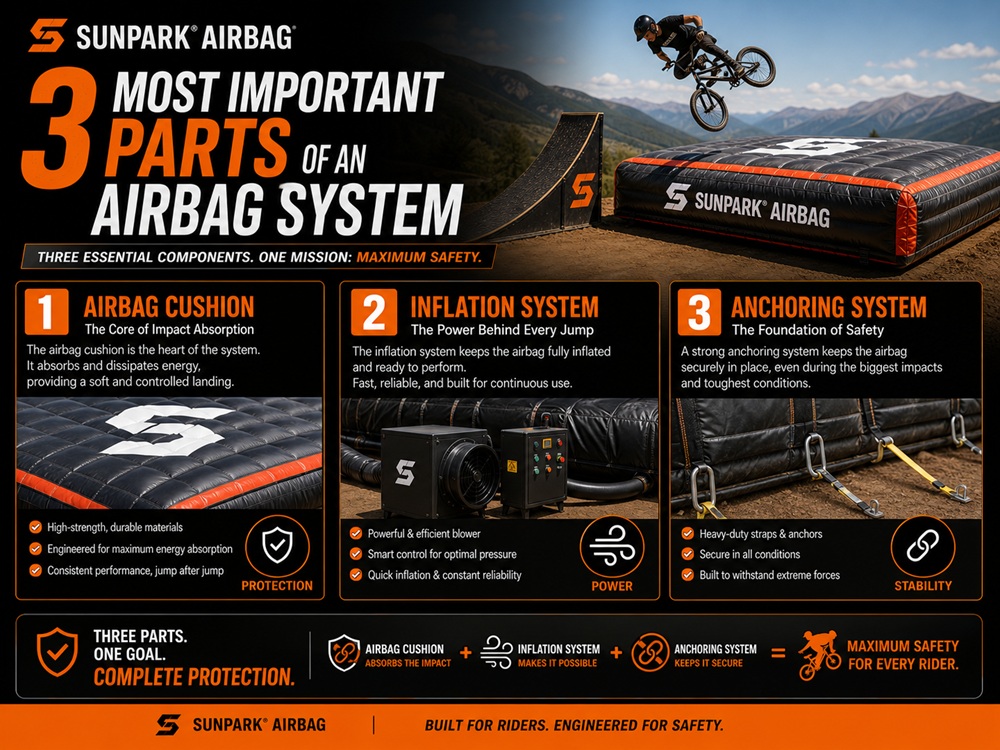
- Whether the blower is sized and configured for the specific airbag.
- Whether air inlets, vents, and connecting passages are clear.
- Whether the pad maintains its intended shape during normal use.
- Whether pressure and surface response remain consistent during repeated sessions.
- Whether leakage, damaged valves, or loose connections are affecting operation.
From our experience, an operator should investigate the complete airflow system before assuming that a change in surface feel requires a different product. A blower problem, blocked vent, or small leak can create performance symptoms that resemble a structural design issue.
Factor 2: Landing Pad Geometry and Dimensions
Landing geometry determines how the athlete approaches the surface, where the landing zone is located, and how the pad supports the intended jump trajectory. Length, width, height, slope, transition shape, and usable landing area all affect the practical performance of an airbag landing pad.
Length and width: usable area matters more than total size
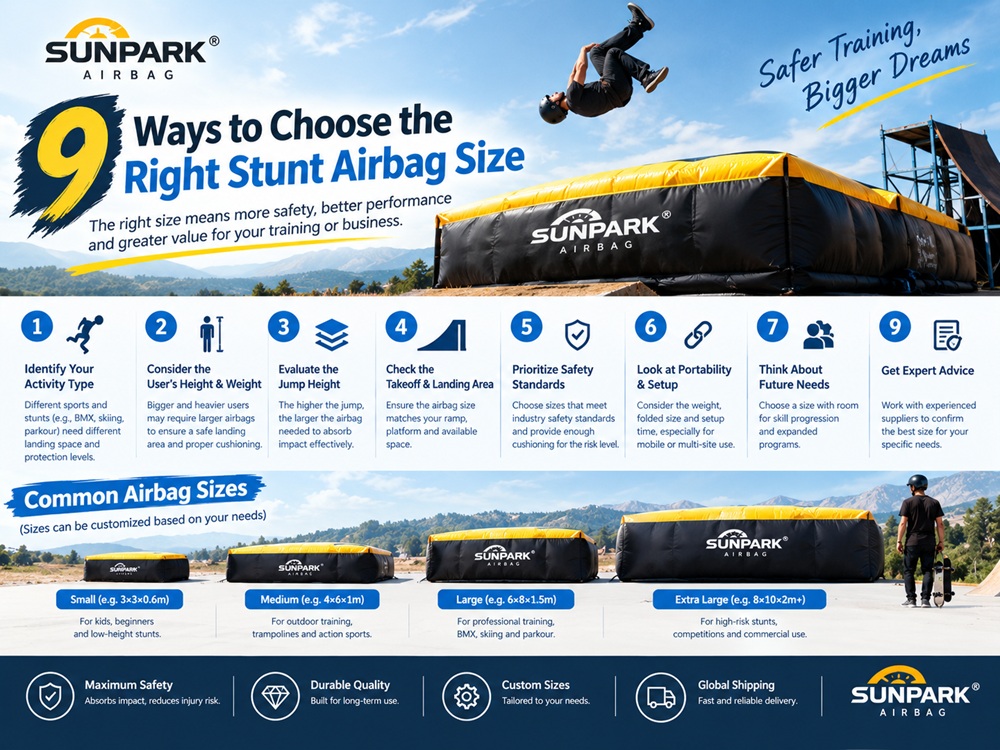
A large airbag is not necessarily a suitable airbag. The usable landing area must correspond to the takeoff distance, expected flight path, athlete skill level, and range of landing positions. If the pad is too narrow, a rider may land near an edge. If the landing zone is too short, the system may not provide the intended area for the planned maneuver.
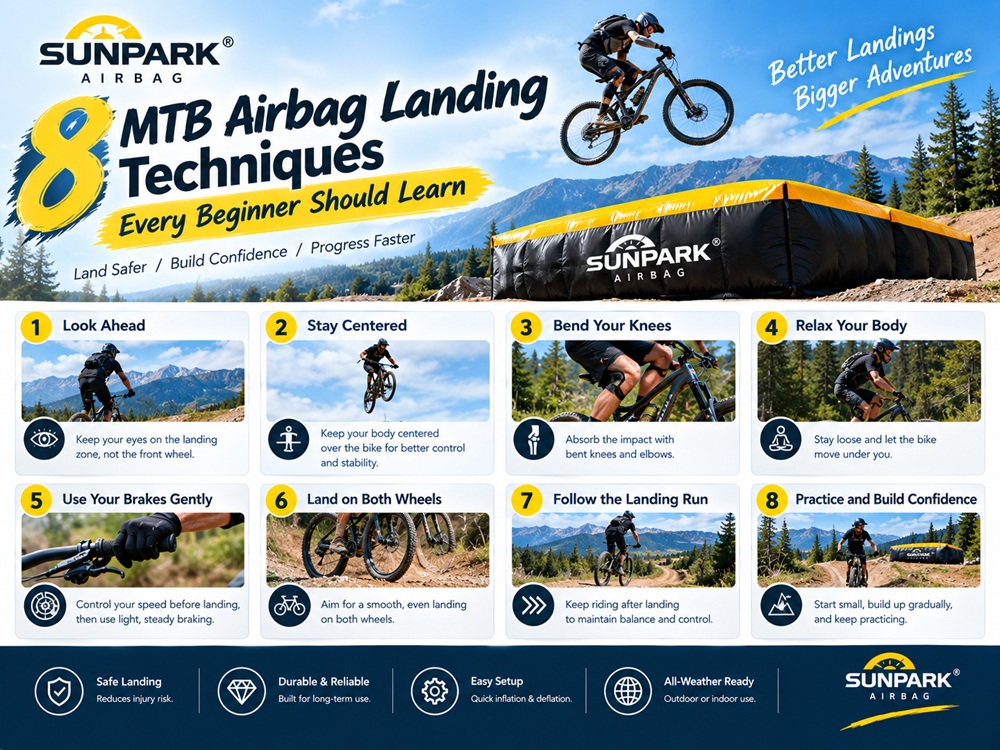
For MTB and BMX facilities, the approach, jump height, speed, and landing trajectory must be considered together. A landing pad should not be selected solely from a photograph or a general product dimension.
Slope and transition design
The slope of the landing surface affects how the athlete meets the pad. A landing angle that does not match the jump can create an awkward transition or encourage inconsistent contact. Snowboard and ski applications may require a different landing profile from a flat gymnastics training surface.
For this reason, we recommend sharing a site layout, jump profile, and expected user group with the manufacturer before finalizing dimensions. If the project is a commercial facility, allow space for approach, runout, supervision, access, and maintenance—not just the inflatable footprint.
Matching geometry to the sport
A MTB airbag landing system should be assessed around mountain-bike landing trajectories and the intended riding environment. A halfpipe airbag has a different geometry and application. These products should not be treated as interchangeable simply because both use inflatable structures.
Factor 3: Internal Construction and Chamber Design
The internal construction of an airbag landing pad determines how the structure holds its shape and responds when different areas are loaded. Two airbags made from similar outer materials can still behave differently because their internal architectures are not the same.
Depending on the product design, internal components may include partitions, baffles, connecting passages, reinforced zones, and separate or interconnected chambers. Their purpose is to support the intended geometry and manage deformation and airflow under use.
Why internal design affects impact response
When an athlete lands, the load is concentrated in a particular area rather than distributed evenly across the entire pad. The internal structure must respond to that localized loading while maintaining the overall landing shape. A design that is suitable for one sport or landing profile may not provide the desired behavior for another.
For repeated commercial use, internal construction also matters because the pad experiences many loading cycles. Reinforcement and construction quality should be considered alongside the initial landing feel.
Questions worth asking the manufacturer
- How is the internal structure configured for the intended sport?
- Which areas receive additional reinforcement?
- How does the design manage air movement during impact?
- Are there different configurations for different rider weights or skill levels?
- How are internal components inspected and repaired if necessary?
We recommend asking for a technical explanation rather than accepting vague descriptions such as “advanced air technology.” A reliable supplier should be able to explain how the construction relates to the specified application.
Factor 4: Material Quality and Manufacturing Workmanship
Fabric quality and manufacturing workmanship have a direct influence on air retention, abrasion resistance, tear resistance, and the service life of an airbag landing pad. This factor becomes especially important for outdoor facilities and commercial operators with frequent use.
Fabric selection
Inflatable sports equipment commonly uses coated technical fabrics selected for strength, flexibility, and resistance to environmental exposure. The actual performance depends on the complete material specification, including the base fabric, coating, thickness, construction, and suitability for the operating environment.
There is no single fabric specification that is automatically best for every landing airbag. A product used in a controlled indoor training center has different exposure conditions from one installed outdoors at a ski resort or action sports park.
Seams, joints, and reinforced areas
Seams and connections are critical because they join the material sections that maintain the inflatable structure. Poor workmanship can lead to air leakage, premature wear, or localized failure. Reinforcement should be appropriate for the load and movement expected in each area.
When evaluating a supplier, ask how seams are constructed, how quality is checked, and how repairs are handled. Do not judge durability solely by fabric thickness or a supplier’s use of words such as heavy-duty.
What commercial buyers should request
- Material specifications and relevant technical data.
- Information about seam construction and reinforcement.
- Quality inspection procedures and product documentation.
- Repair guidance and availability of replacement components.
- Warranty terms, exclusions, and recommended service conditions.
SUNPARK® AIRBAG has more than 10 years of experience supplying freestyle airbags for ski resorts, theme parks, sports facilities, and gymnastics facilities. Its sports airbag product range is designed for different extreme sports and leisure applications. Buyers should still confirm the exact material and construction specifications for the model being quoted.
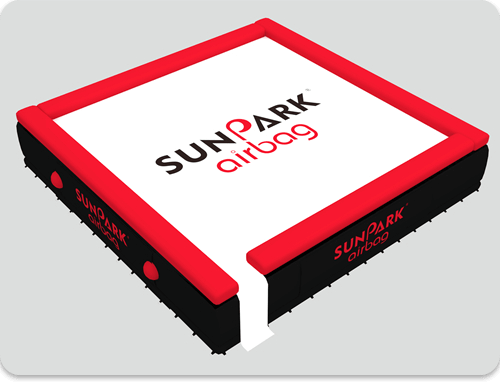
SUNPARK® AIRBAG develops inflatable landing products for extreme sports, training, and leisure applications.
Factor 5: Installation and Environmental Conditions
Even a well-designed airbag landing pad can perform inconsistently if it is installed incorrectly or exposed to conditions outside its intended operating range. Ground preparation, anchoring, drainage, wind, temperature, and surrounding obstacles all influence how the system operates.
Ground preparation and positioning
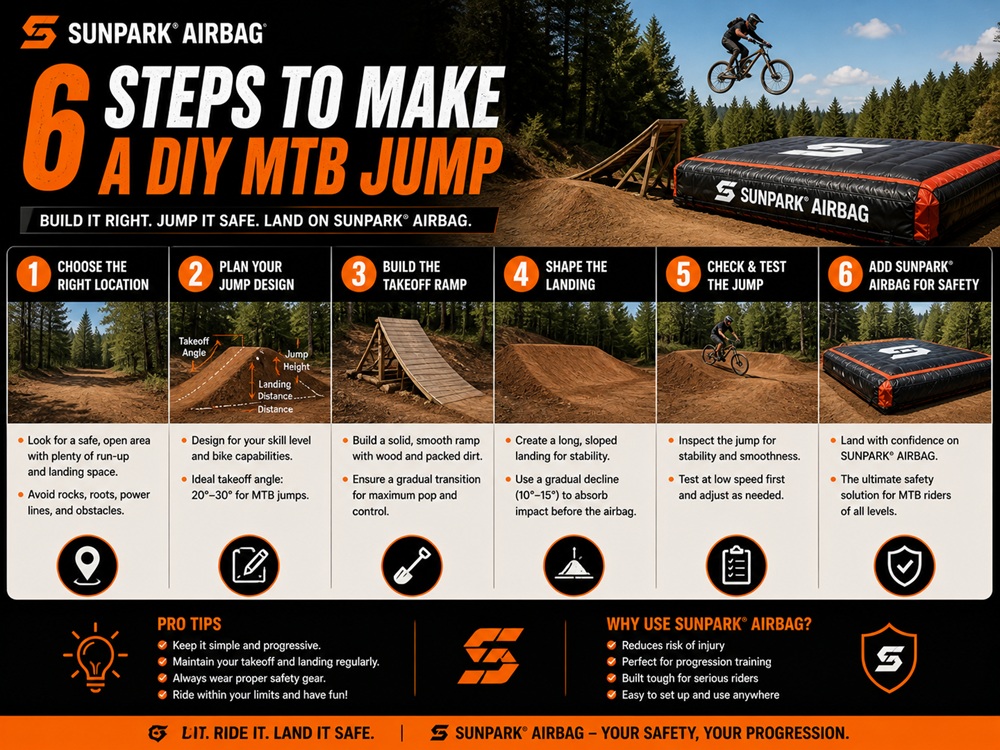
The installation surface should be suitable for the product and free from objects that could damage the fabric. Sharp edges, debris, uneven ground, and unsuitable contact surfaces can increase wear or create hazards. The pad must also be positioned according to the manufacturer’s instructions and the approved site layout.
Anchoring and wind exposure
Outdoor inflatable equipment must be evaluated for wind exposure and movement. Anchoring requirements depend on the product, installation location, and manufacturer guidance. Operators should never improvise an anchoring arrangement or assume that a heavy-looking airbag cannot move in strong wind.
Temperature, moisture, and UV exposure
Environmental conditions can affect fabric, coatings, air pressure, and operating consistency. Temperature changes can influence internal air conditions, while prolonged exposure to sunlight and moisture may contribute to material deterioration if the product is not designed or maintained for those conditions.
For outdoor installations, establish a documented weather-monitoring and shutdown procedure. Follow the manufacturer’s limits for wind, temperature, rain, snow, and other environmental conditions. If conditions exceed those limits, stop operation rather than trying to compensate with improvised adjustments.
Drainage and surrounding layout
Water accumulation around an installation can create access and maintenance problems. The site should provide suitable drainage and enough clearance for inspection, inflation equipment, user access, and emergency procedures. A well-planned layout is part of performance—not an optional finishing detail.
Factor 6: Inspection, Maintenance, and Operating Procedures
Airbag landing pad performance changes over time if equipment is not inspected and maintained. Repeated landings, transport, setup, exposure, and cleaning all place demands on the materials and components. A maintenance plan helps identify problems before they affect normal operation.
Pre-session inspections
Before each operating session, trained staff should check the pad’s condition and confirm that it is set up according to the manufacturer’s instructions. The inspection should cover the outer surface, seams, valves, blower connections, anchoring, and surrounding landing area.
Routine maintenance
- Check for punctures, abrasion, seam separation, and visible damage.
- Inspect valves, hoses, air inlets, and blower connections.
- Keep vents and airflow paths free from obstructions.
- Clean the surface using approved methods and materials.
- Allow the product to dry as instructed before storage.
- Record repairs, recurring faults, and inspection findings.
- Arrange professional inspection when damage or unusual performance is detected.
Monitor performance, not just appearance
A pad can look acceptable while still having a leak, inconsistent airflow, or a problem with an internal component. Operators should pay attention to changes in inflation time, surface response, recovery behavior, and unusual sounds. Any unexpected change should trigger an inspection and, where appropriate, suspension of use until the cause is identified.
For commercial facilities, a written inspection log is a practical investment. It helps staff follow consistent procedures and provides a record of repairs and recurring issues. It is much more useful than relying on memory or waiting for visible damage to become severe.
Airbag Landing Pad Performance: Comparison by Design and Application
Different inflatable landing products are built for different activities. The following comparison is a selection guide, not a claim that one category is universally safer or more durable than another.
| Airbag type | Typical application | Main design priority | Buyer should focus on |
|---|---|---|---|
| MTB landing airbag | Mountain biking and jump training. | Landing geometry, usable area, and compatibility with the jump trajectory. | Approach speed, landing profile, rider skill range, and outdoor installation. |
| Freestyle ski and snowboard airbag | Freestyle progression and aerial maneuver training. | Landing profile and sport-specific impact response. | Jump design, snow or resort environment, rider level, and operational controls. |
| Gymnastics training airbag | Controlled gymnastics and movement training. | Repeatable surface response for the intended training drills. | Training purpose, athlete level, indoor space, and supervision. |
| Stunt or jump airbag | Selected stunt, leisure, and action sports applications. | Application-specific dimensions and impact-management design. | Expected landing conditions, user limits, and site-specific setup. |
| Halfpipe airbag | Specialized halfpipe-related training applications. | Geometry that corresponds to the halfpipe environment. | Transition shape, installation layout, and sport-specific compatibility. |
Best Use Cases: Choosing the Right Airbag Landing System
Mountain bike and BMX training facilities
For MTB and BMX facilities, the landing trajectory and usable landing zone should drive the specification. Operators should provide the supplier with the jump dimensions, expected speed range, rider level, and site layout. A dedicated MTB airbag landing system is a more appropriate starting point than adapting an unrelated inflatable product.
For buyers comparing product options, our guide to inflatable MTB airbag solutions can help identify the design questions to discuss before requesting a quotation.
Ski resorts and snowboard training
Ski resorts need a system designed around freestyle training, site conditions, and the expected rider population. The installation should be planned with the takeoff and landing configuration, weather exposure, and operating procedures in mind. A specialized snowboard airbag park can offer useful reference points when comparing facility layouts and training concepts.
Gymnastics and indoor training centers
Indoor training facilities often prioritize repeatability, controlled access, and compatibility with other training equipment. A gym airbag for training should be selected according to the specific drills and athlete level, rather than assumed to be suitable for every gymnastics movement.
Theme parks and recreational jump facilities
Theme parks and leisure operators must consider throughput, supervision, access, cleaning, and maintenance in addition to landing performance. A recreational inflatable jump airbag should be specified around the intended activities and user restrictions. The facility’s operating model matters as much as the initial equipment purchase.
Common Mistakes That Reduce Airbag Landing Pad Performance
1. Choosing by price or size alone
A low quotation may exclude essential accessories, installation support, or suitable construction details. A large pad may also be poorly matched to the landing trajectory. Compare complete specifications and total project requirements.
2. Assuming more air means better performance
Excessive inflation is not a universal solution. Follow the specified operating range and investigate the blower, venting, and structural design before making adjustments.
3. Using the wrong airbag for the sport
A gymnastics airbag, MTB landing pad, and snowboard training system have different design requirements. Select the product based on its intended application and documented limitations.
4. Ignoring site conditions
Uneven ground, poor drainage, insufficient anchoring, and inadequate clearance can undermine an otherwise suitable product. Complete a site assessment before ordering.
5. Skipping routine inspections
Small punctures, damaged seams, and loose connections can become more serious if overlooked. Establish inspections before every session and scheduled maintenance throughout the operating season.
6. Treating an airbag as a guarantee against injury
An airbag does not replace coaching, correct technique, suitable progression, protective equipment, or supervision. Operators should communicate the product’s limitations and enforce activity-specific rules.
Buying Considerations: How to Choose a Reliable Airbag Manufacturer
For a commercial airbag project, choosing the manufacturer is as important as choosing the product category. The supplier should understand the sport, installation environment, expected usage, and performance requirements. A generic inflatable product quotation is not enough for a specialized landing system.
1. Confirm relevant manufacturing experience
Ask whether the manufacturer has supplied products for facilities similar to yours. Experience with ski resorts does not automatically prove experience with MTB installations, and experience with recreational inflatables does not establish suitability for professional sports training.
2. Request a project-specific specification
The quotation should identify dimensions, materials, internal construction, inflation system, accessories, operating requirements, and any installation-related components. If the project requires customization, request drawings or a layout for review before production.
3. Ask about testing and quality control
Ask how the manufacturer checks fabric, seams, valves, inflation performance, and finished-product condition. Request available inspection records and clarify which tests are performed on the quoted model. Avoid relying on unsupported statements such as “100% safe” or “unbreakable.”
4. Evaluate after-sales support
Commercial buyers should understand the repair process, spare-part availability, warranty scope, technical support, and recommended maintenance schedule. A supplier that disappears after delivery can create unnecessary downtime for a facility.
5. Compare total cost of ownership
The purchase price is only one part of the investment. Consider shipping, installation, blower operation, site preparation, staff training, maintenance, repairs, and expected replacement requirements. A slightly higher initial price may be justified if the supplier provides better technical support and a product more closely matched to the application.
6. Check documentation and communication
Request clear operating instructions, setup guidance, inspection procedures, and product-specific limitations. For international projects, confirm packaging, shipping arrangements, delivery schedule, and the process for handling issues after arrival.
Cost-Benefit Analysis: Is a Higher-Specification Landing Airbag Worth It?
For a facility that operates occasionally, a basic product that meets the actual training requirements may be sufficient. For a commercial park with frequent sessions, multiple users, and significant downtime costs, investing in appropriate construction, technical support, and maintenance planning can be more valuable.
We recommend comparing suppliers on a complete project basis rather than choosing the lowest unit price. Ask each supplier to quote against the same dimensions, operating requirements, accessories, and service expectations.
| Purchase approach | Potential advantage | Potential drawback | Our recommendation |
|---|---|---|---|
| Lowest initial price | Lower upfront investment. | May omit important specifications, support, or accessories. | Only consider when the product specification and service scope are fully comparable. |
| Application-specific design | Better alignment with the sport and landing layout. | May require more planning and a higher initial budget. | Preferred for dedicated training and commercial installations. |
| Higher-grade material and reinforcement | May improve resistance to wear under suitable conditions. | Does not automatically guarantee longer service life or better impact response. | Worth evaluating for frequent use and demanding environments. |
| Complete supply with support | Can simplify setup, maintenance, and troubleshooting. | Higher package price or additional service costs. | Often the better option for operators without in-house technical expertise. |
Why Consider SUNPARK® AIRBAG?
SUNPARK® AIRBAG focuses on inflatable systems for extreme sports and leisure applications. With more than 10 years of experience, the company supplies freestyle airbags for ski resorts, theme parks, sports facilities, and gymnastics facilities around the world.
The company’s product development approach is centered on improving its own airbag systems and supporting the changing needs of freestyle athletes, sports facilities, and recreational operators. Its products have been developed for professional riders, including world champion snowboarders, as well as trampoline parks and other training environments.
For buyers, the most useful next step is to provide the project details rather than request a generic product price. Share the intended sport, landing dimensions, jump profile, indoor or outdoor location, expected frequency of use, and user level. This gives the manufacturer a clearer basis for recommending a suitable configuration.
Explore the SUNPARK® AIRBAG product range to compare application categories and discuss a project-specific solution.
Expert Recommendation: Optimize the Whole System, Not One Specification
The six factors that affect airbag landing pad performance are connected. Air pressure cannot compensate for unsuitable geometry. Strong fabric cannot correct poor installation. A well-designed internal structure cannot deliver consistent results if the blower is incorrectly configured or maintenance is neglected.
Our recommendation is to work through the selection process in this order:
- Define the sport and landing scenario. Identify the activity, rider level, jump profile, expected speed, and landing trajectory.
- Confirm the required geometry. Specify the usable landing area, dimensions, slope, and installation footprint.
- Review the internal design and airflow system. Ask how the product is intended to deform and recover under the expected use conditions.
- Verify material and manufacturing details. Request relevant specifications, quality checks, and repair information.
- Plan installation and operating controls. Include ground preparation, anchoring, drainage, weather limits, supervision, and inspection procedures.
- Compare total ownership costs. Evaluate the product, accessories, shipping, support, maintenance, and expected operating demands together.
For beginners, a product matched to the intended activity and supported by clear setup instructions is more valuable than an unnecessarily complicated configuration. For commercial users and heavy-duty applications, we recommend prioritizing application-specific engineering, documented quality checks, service support, and a realistic maintenance plan.
The best airbag landing pad is not simply the softest, largest, or most expensive option. It is the system designed for the actual landing conditions and operated within its specified limits.
Frequently Asked Questions About Airbag Landing Pad Performance
1. What factors affect airbag landing pad performance the most?
The six main factors are air pressure and airflow, landing pad geometry, internal construction, material and manufacturing quality, installation and environmental conditions, and maintenance. These factors work together to influence deformation, impact response, recovery, and long-term consistency.
2. Does higher air pressure make an airbag landing pad safer?
No. Higher pressure does not automatically mean better impact management or safer operation. The correct operating condition depends on the product’s design, airflow system, and intended application. Follow the manufacturer’s specified settings and do not make unapproved adjustments.
3. Does a thicker landing airbag perform better?
Not necessarily. Thickness is only one design characteristic. Geometry, internal construction, air movement, material properties, and the athlete’s landing trajectory also affect performance. Choose a product based on the complete system specification.
4. How does landing pad size affect performance?
Length and width determine the usable landing area, while height and slope influence the landing profile. The dimensions should match the jump design, expected trajectory, rider skill level, and available installation space. A larger pad is not automatically more suitable.
5. What materials are used for airbag landing pads?
Sports airbags commonly use coated technical fabrics selected for strength, flexibility, air retention, and resistance to wear. The exact material and construction vary by product. Buyers should request the manufacturer’s material specification rather than rely on generic descriptions.
6. How often should an airbag landing pad be inspected?
Operators should perform a condition check before each operating session and follow the manufacturer’s schedule for routine maintenance. Inspections should include the fabric, seams, valves, blower connections, anchoring, and surrounding area. Any unexpected change in performance should be investigated.
7. Can an airbag landing pad be used outdoors?
Some products are designed for outdoor use, but suitability depends on the specific model, material, installation, and environmental limits. Wind, rain, temperature, drainage, and UV exposure must be considered. Follow the manufacturer’s instructions for anchoring and weather-related shutdown conditions.
8. What is the difference between an MTB airbag and a gymnastics airbag?
An MTB airbag is designed around mountain-bike jump trajectories and landing requirements. A gymnastics airbag is intended for particular indoor training activities. Their geometry, dimensions, and operating requirements may differ, so they should not be substituted without manufacturer confirmation.
9. How do I choose a reliable airbag landing pad manufacturer?
Review the manufacturer’s relevant project experience, product-specific specifications, material and seam quality controls, internal construction, inflation system, testing procedures, warranty, repair support, and documentation. Ask for a design matched to your sport and installation rather than accepting a generic quotation.
10. Is an airbag landing pad completely safe?
No. An airbag is an impact-management training product, not a guarantee against injury. Safe operation also depends on appropriate facility design, athlete progression, supervision, correct technique, equipment condition, and compliance with the manufacturer’s operating limits.
References
- ASTM International. ASTM F355 – Standard Test Method for Impact Attenuation of Playing Surface Systems, Other Protective Sport Systems, and Materials Used for Athletics, Recreation and Play. This standard provides a framework for measuring impact attenuation in specified test configurations; it should not be interpreted as automatic certification of an airbag landing pad. View ASTM F355.
- International Organization for Standardization. ISO 20957-1: Stationary Training Equipment — General Safety Requirements and Test Methods. Relevant as a general reference for applicable stationary training equipment; product-specific applicability should be confirmed. View ISO information.
- U.S. Consumer Product Safety Commission. Public Playground Safety Handbook. A reference for playground-related planning, inspection, and hazard awareness. It is not a product certification standard for sports landing airbags. Read the handbook.