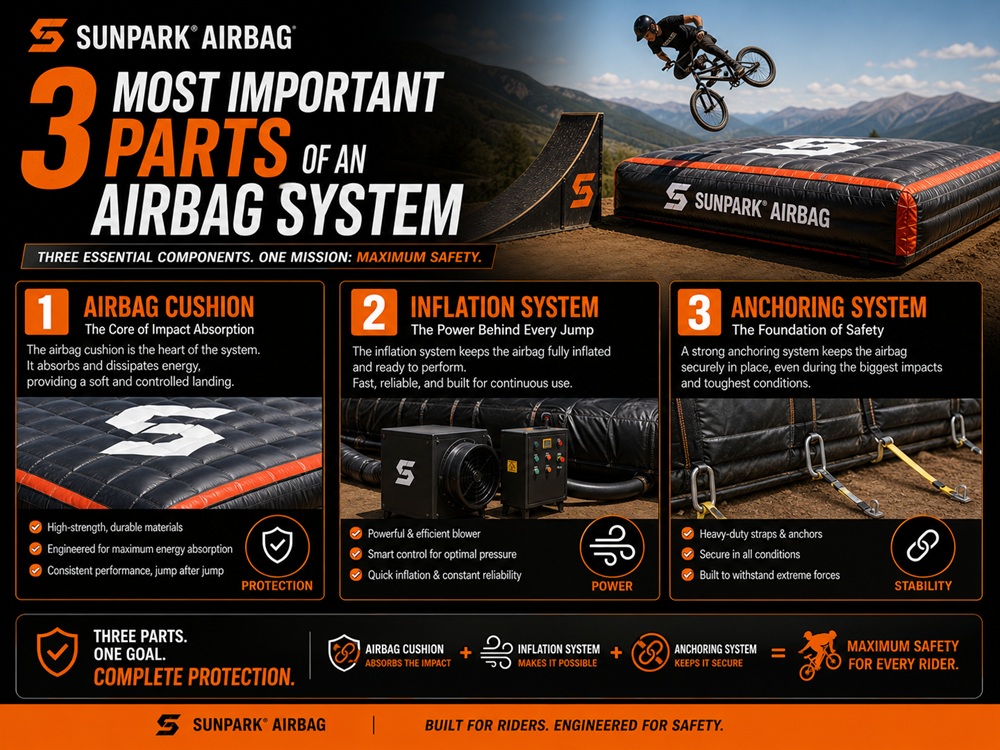
Quick Answer: The 3 Most Imp Parts of an Airbag System
In high-impact action sports, commercial freestyle progression, and stunt training, the three most imp parts of an airbag system are: (1) The Dual-Chamber Deceleration Core (an isolated, high-pressure lower safety cell that prevents bottoming out on the subfloor, combined with a progressive, low-pressure upper impact chamber); (2) The Continuous Airflow & Pressure Regulation System (commercial-grade constant-flow blowers paired with calibrated, adjustable air-relief exhaust vents to eliminate trampoline rebound); and (3) The Ballistic 0.9mm PVC Top Wear Sheet & Anchor Rigging Matrix (a low-friction, puncture-resistant sliding envelope and perimeter tie-down structure that absorbs tire, ski, and board friction while keeping the bag locked in place). Compromising on any of these three imp parts of an airbag system leads to seam ruptures, athlete ejections, and severe orthopedic injuries. Sourcing heavy-duty landing systems from certified manufacturers like Sunparkairbag ensures every structural component complies with rigorous commercial impact standards.
What It Is: The Structural Engineering of Impact Deceleration
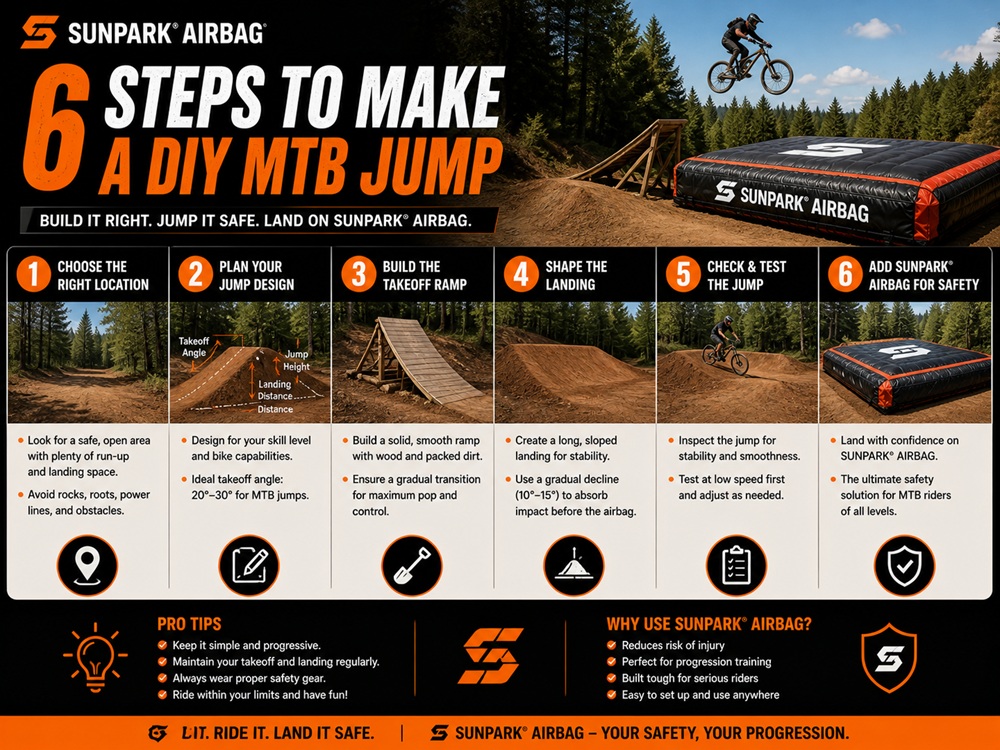
When engineering practitioners discuss the imp parts of an airbag system, we are examining a pneumatic deceleration cushion designed to manage massive kinetic energy ($KE = \frac{1}{2}mv^2$). In contrast to automotive safety cushions that utilize pyrotechnic chemical gas generators to deploy a single-use nylon bag in thirty milliseconds, commercial action sports systems—such as an MTB airbag landing system or an inflatable jump airbag—rely on open-loop, continuous-air displacement. These massive landing surfaces must catch 200-pound riders falling from heights of over twenty-five feet, decelerate them at sub-concussive G-force levels, allow them to slide or ride out safely, and immediately re-pressurize within seconds for the next athlete in line.
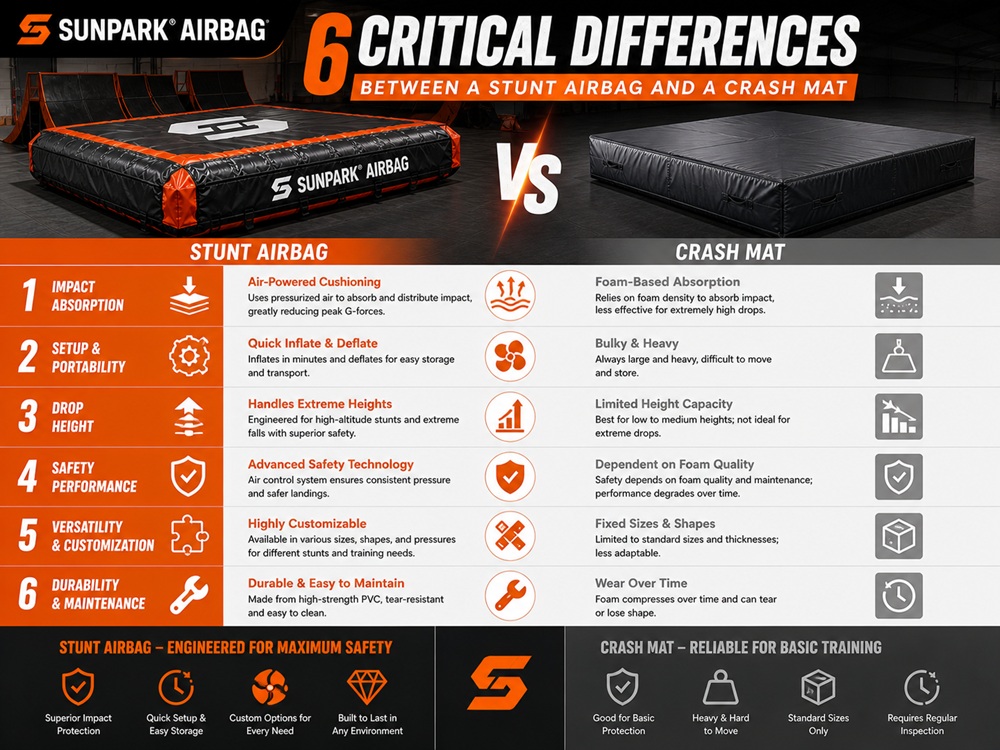
Achieving this repeatable performance requires precise synchronization among all imp parts of an airbag system. The air inside the bladder cannot remain static. If an inflatable bag is sealed like a pool raft, an impacting rider simply bounces violently off the surface, resulting in rotational whiplash and severe secondary ground collisions. Conversely, if the bag vents too rapidly without internal resistance, the rider punches straight through the air volume and strikes the asphalt, concrete, or packed dirt foundation below. True safety lies in progressive mechanical resistance, where the internal imp parts of an airbag system work in harmony to convert downward momentum into controlled fluid exhaustion.
From our experience building and testing these structures across worldwide bike parks, ski academies, and indoor adventure parks, failure to respect this kinetic balance is the number one cause of operational failure. High-performance facilities must treat the imp parts of an airbag system as an active mechanical assembly, not a passive piece of vinyl furniture.
Quick Summary Table: The 3 Most Imp Parts of an Airbag System
| Core Airbag System Part | Primary Material & Build Spec | Mechanical & Physical Function | Critical Failure Prevented | Commercial Maintenance Check |
|---|---|---|---|---|
| 1. Dual-Chamber Deceleration Core | 0.55mm (18oz) High-Tensile PVC Tarpaulin; welded internal bulkheads | Isolates high-pressure safety floor from low-pressure progressive landing cell | Bottoming-out against subfloor; catastrophic spinal compression | Internal baffle seam integrity, chamber pressure differentials |
| 2. Airflow & Pressure Regulation System | Continuous industrial centrifugal blowers; adjustable hook-and-loop / zipper relief vents | Delivers constant CFM air replenishment; expels metered air on impact | Violent trampoline rebound; structural seam blowouts | Blower intake obstruction, exhaust aperture calibration |
| 3. Ballistic Top Wear Sheet & Anchor Rigging | 0.9mm (32oz) Heavy-Duty PVC Tarpaulin; reinforced steel D-rings & webbing | Resists tire stud abrasion, ski edge cuts; locks chassis to earth against crosswinds | Puncturing internal air cells; wind-induced ground shift and tip-overs | Daily top sheet tear audits, anchor strap tension, UV checking |
The 3 Most Imp Parts of an Airbag System Detailed
1. The Dual-Chamber Deceleration Core (The Pneumatic Suspension Engine)
Among the primary imp parts of an airbag system, the dual-chamber core is the structural foundation that dictates whether a landing is plush or bone-jarring. Cheap, low-tier manufacturers cut costs by building single-cavity bladders. In our testing, single-cavity units are fundamentally unsafe for high-energy freestyle training. When an athlete hits a single-chamber bag, the air displaces laterally, causing the bag to balloon at the edges while the point of impact bottoms out against the ground.
In most professional situations, we mandate an engineered two-tier chamber architecture:
- The Lower Safety Floor (Fail-Safe Sub-Chamber): The bottom chamber operates at a slightly higher, firmer static pressure. Its sole engineering objective is to act as an un-breachable cushion. Even if an athlete takes a high-velocity flat landing directly onto the center of the bag, the upper chamber absorbs eighty percent of the energy while the lower chamber prevents the rider from ever contacting the hard subfloor.
- The Upper Dynamic Impact Chamber: Operating at a lower, carefully regulated pressure, the upper layer utilizes vertical internal baffled walls. These internal bulkheads feature calibrated pass-through holes that direct the displaced air laterally into exhaust ports. This design cradles the athlete progressively, slowing their downward velocity through a smooth, cushioned stroke rather than an abrupt halt.
Without this dual-tier layout, no matter how thick the external fabric is, the system cannot safely manage both low-weight novice drops and high-velocity professional impacts. The dual-chamber core stands uncontested as the most crucial of all imp parts of an airbag system.
2. The Continuous Airflow & Pressure Regulation System
Air inside a landing cushion is dynamic, which makes the air supply and exhaust assembly one of the most critical imp parts of an airbag system. Unlike inflatable paddleboards or vehicle tires that operate on static sealed pressure, commercial action sports airbags operate via an open, continuous-flow dynamic loop. Industrial centrifugal blowers continuously pump hundreds of cubic feet of ambient air per minute (CFM) into the chambers, maintaining baseline structural volume.
The true genius of this mechanical subsystem lies in the calibrated pressure-relief exhaust vents:
- Progressive Exhaust Displacement: When a rider lands on the bag, their physical mass instantly compresses the internal air volume. The pressure regulation vents—typically heavy-duty industrial zippers shielded beneath hook-and-loop protective flaps—force this pressurized air outward at a controlled rate. By exhausting air under resistance, the bag absorbs the kinetic energy of the impact rather than storing it as elastic potential energy.
- Elimination of the Trampoline Effect: If the air has nowhere to go, it compresses like a spring, launching the athlete back into the air uncontrollably. By properly tuning the exhaust apertures, the bag collapses under the rider, absorbs the G-forces, and stays flat until the rider rolls off.
- Rapid Re-Pressurization: The moment the athlete clears the top sheet, the continuous-flow blowers re-inflate the upper chamber to full operating volume within two to four seconds, making the system immediately ready for the next jumper in line.
Facility managers must realize that adjusting these exhaust vents is not an aesthetic choice; it is an active tuning protocol that must be calibrated according to ambient temperature, jumper body weight, and drop height. Monitoring these exhaust ports ensures that the imp parts of an airbag system operate at peak safety efficiency.
3. The Ballistic 0.9mm PVC Top Wear Sheet & Anchor Rigging Matrix
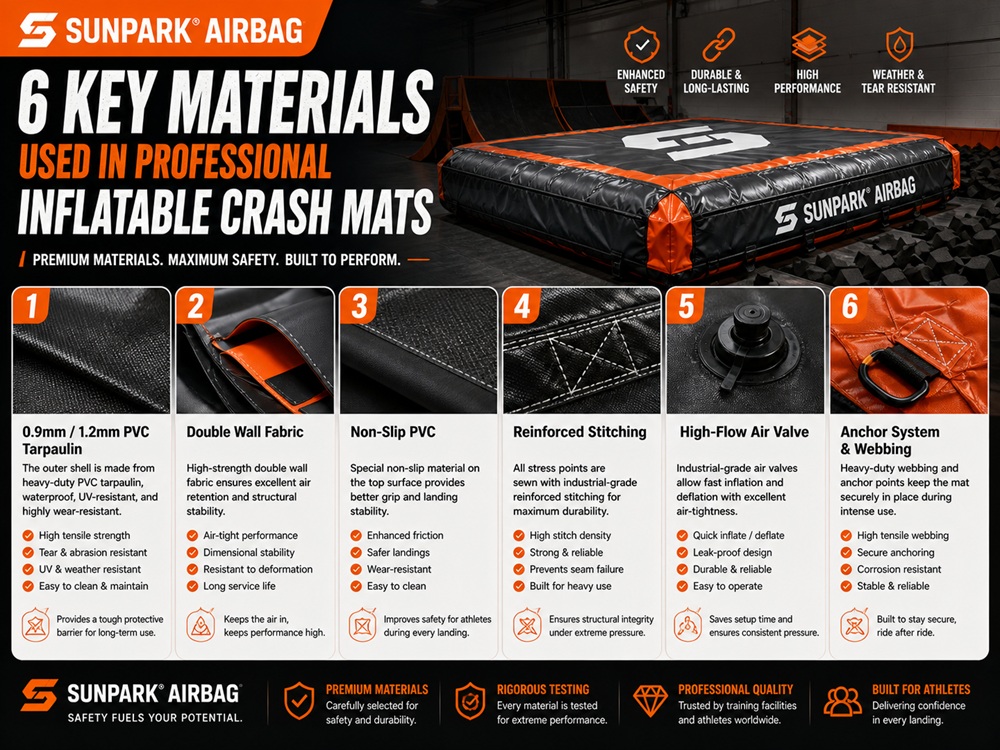
While the internal air cells provide pneumatic absorption, they are completely vulnerable to mechanical destruction without the third pillar among the imp parts of an airbag system: the heavy-duty external top wear sheet and its structural anchor rigging. The internal chambers are typically fabricated from flexible, airtight 0.55mm PVC tarpaulin. If an athlete lands on unprotected 0.55mm PVC with sharp bicycle pedals, studded mountain bike tires, or metal ski edges, the fabric will slice open instantly, causing explosive decompression.
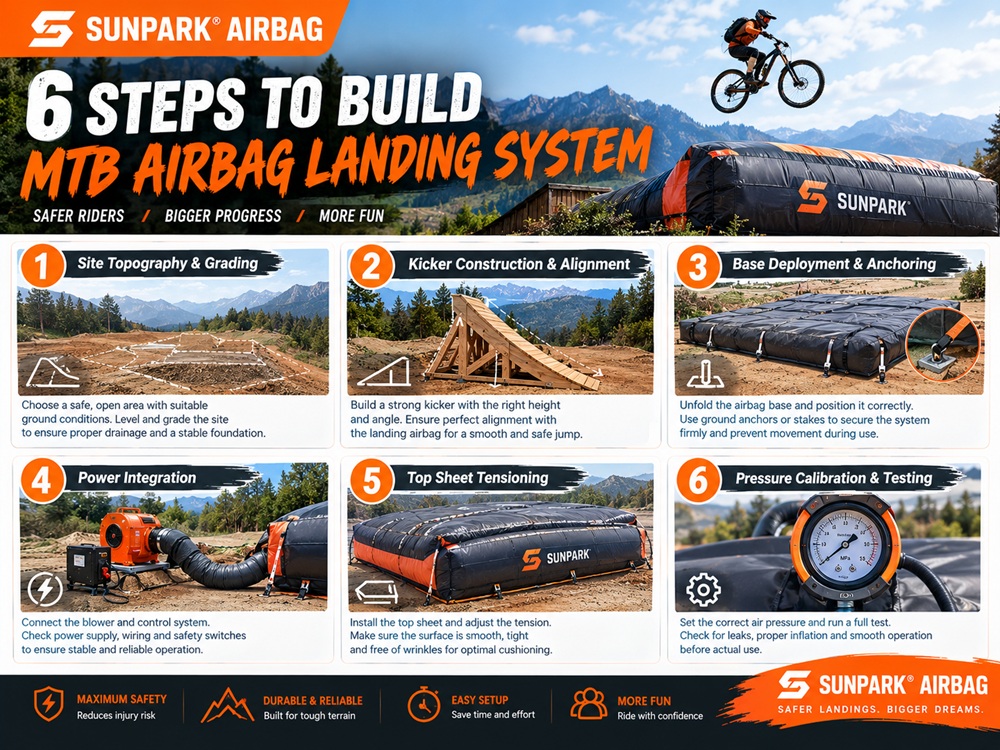
To eliminate this risk, professional landing airbags—such as those featured in our inflatable MTB airbag solutions and specialized landing airbag solutions—incorporate a detached, sacrificial 0.9mm (32oz) high-density PVC tarpaulin top sheet:
- Friction-Engineered Sliding Surface: The 0.9mm top sheet is treated with specialized UV-inhibiting, flame-retardant, and anti-static coatings. It provides a slick, low-friction surface that allows bike tires to roll away cleanly on inclined landing bags, or allows stunt performers to slide to a gentle stop without abrasive friction burns.
- Tensioned Perimeter Anchor Matrix: The top sheet is suspended over the air chambers and secured to the perimeter frame using heavy-duty bungee cords, high-grade seatbelt-style webbing, and multi-point reinforced stainless steel D-rings. This perimeter tension keeps the top sheet completely flat, preventing dangerous fabric bunching that could catch a bicycle front wheel or twist a rider’s ankle.
- Ground Anchoring Stability: An airbag catching high-speed riders absorbs massive horizontal shearing forces. The anchor rigging matrix links the entire inflatable chassis to heavy earth stakes, concrete deadmen, or high-capacity ballast sandbags. If this structural anchor matrix fails, a sudden crosswind or a heavy landing can shift the entire landing bag out of alignment with the jump ramp, resulting in catastrophic off-target landings.
Sourcing a rugged top sheet with a verified anchor matrix is vital for operational longevity. It shields the internal bladders from weather, punctures, and mechanical wear, proving its status as one of the most vital imp parts of an airbag system.
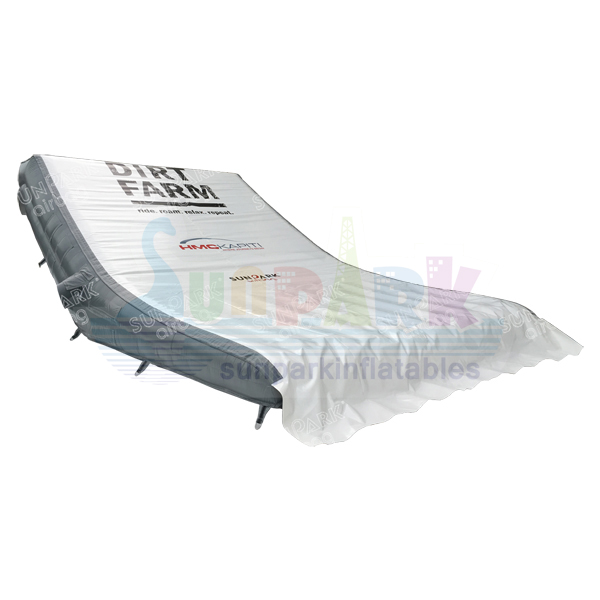
Commercial Equipment Spotlight: Sunparkairbag MTB Airbag Landing
When evaluating the physical execution of the imp parts of an airbag system, the Sunparkairbag MTB Airbag Landing stands as the industrial benchmark for action sports resorts, dirt-jump parks, and professional training centers worldwide.
| Chassis Construction | High-tensile 0.55mm PVC Tarpaulin (18oz) internal dual-chamber deceleration core |
| Top Wear Sheet | Ultra-durable 0.9mm PVC Tarpaulin (32oz); waterproof, flame-retardant, UV-protected, lead- and phthalate-free |
| Standard Dimensions | 8.5m × 4.5m × 1.0m (Fully customizable to match specific jump ramp heights and landing angles) |
| Air Supply Package | High-output commercial centrifugal blowers packed in reinforced protective transit cases |
| Included Hardware | Heavy-duty transit storage bag, comprehensive commercial patch repair kit, anchor webbing straps |
| Craftsmanship Standard | Welded baffled chambers executed by technicians with 5+ years of specialized high-pressure inflatable manufacturing experience |
Industry Recommendation: Discover the full engineering specifications on the Sunparkairbag Mountain Bike Airbag portal or browse our full fleet of specialized training systems, including our dedicated Halfpipe Airbag and commercial gym airbag for training setups.
How It Works: Fluid Aerodynamics and Dynamic Venting Physics
To fully appreciate how the imp parts of an airbag system work during active operation, we must trace the physics of an impact event from the microsecond of contact to complete recovery. When an athlete leaves a jump lip and misses their landing, their downward velocity converts into an intense kinetic shockwave upon touching the surface.
The sequence of mechanical protection unfolds through three fluid-dynamic stages:
- Primary Surface Dispersion: The rider strikes the tensioned 0.9mm top sheet. Because the sheet is mounted over an active air buffer, it does not act like a rigid membrane. Instead, it spreads the rider’s concentrated point of impact (such as a knee, shoulder, or bike tire) across a broader surface area, preventing localized punctures and distributing the load across multiple internal vertical baffled columns.
- Progressive Pneumatic Deceleration: As the rider sinks into the upper chamber, the internal air is compressed. Air naturally follows the path of least resistance, rushing through the perforated baffled interior walls toward the external zippered exhaust ports. The resistance generated as air is forced through these restricted orifices creates a cushioned braking force that gradually decelerates the rider’s body, keeping peak impact G-forces well below injury thresholds.
- Lower Chamber Hydraulic Isolation: If the impact is extraordinarily severe (such as a 220-pound rider dropping from twenty-five feet), the upper chamber may approach full compression. At this critical threshold, the completely isolated lower safety chamber engages. Because the lower chamber maintains a dedicated, higher static pressure, it acts as a pneumatic safety buffer that halts downward travel, ensuring the athlete’s body never makes contact with the hard terrain beneath the bag.
Once the athlete stands up and slides off the inclined landing, the pressure drop inside the upper chamber allows the continuous-output blowers to refill the air volume instantly. By coordinating these imp parts of an airbag system, the landing cushion provides repeatable, reliable protection jump after jump.
Core Benefits vs. Operational Limitations of Inflatable Systems
Core Benefits of Modern Airbag Systems:
- Drastic Reduction in Catastrophic Injuries: By replacing hard dirt landings with dynamic air deceleration, athletes can safely practice difficult rotational tricks with minimal fear of high-impact bone fractures or severe concussions.
- Accelerated Skill Progression: Riders who train on engineered landing bags learn new maneuvers up to five times faster than those training solely on dirt or snow, because minor errors result in a soft slide-out rather than a season-ending crash. Discover real-world training progression setups in our review of the best snowboard airbag parks.
- High Operational Cleanliness & Fire Safety: Unlike traditional foam pits that accumulate sweat, bacteria, dead skin cells, and highly flammable polyurethane dust, PVC airbags are non-porous, easy to sanitize, and fabricated from certified flame-retardant textiles.
- All-Weather Portability: A commercial landing bag can be deflated, rolled into a heavy-duty transport bag, and relocated between indoor training gyms and outdoor bike parks within an afternoon.
Operational Limitations to Plan For:
- Continuous Electrical Dependency: Because these are open-loop systems, they require an uninterrupted power supply to run commercial blowers. Operating in remote backcountry locations requires dedicated, clean-running portable generators.
- Wind Sensitivity: Large inflatable airbags act like giant sails in high winds. Operating in crosswinds exceeding twenty miles per hour requires shutting down sessions unless the chassis is secured to ground anchors with heavy-duty ballast.
- Routine Thermal Expansion Adjustments: Air density changes with ambient temperature. On hot summer afternoons, expanding air makes the bag firmer, requiring operators to open exhaust vents slightly. On cold mornings, vents must be tightened to maintain proper deceleration depth.
Direct Technical Comparison: Airbag Systems vs. Foam Pits vs. Resi-Ramps
| Performance Characteristic | Commercial Inflatable Airbag System | Traditional Polyurethane Foam Pit | Padded Resi-Mat Ramp |
|---|---|---|---|
| Deceleration Consistency | Exceptional; adjustable via relief exhaust vents | Variable; foam cubes pack down and deteriorate | Firm; high risk of wrist and ankle sprains |
| Rider Exit & Clear-Out Speed | Fast (3 to 6 seconds; rider slides or rolls away) | Extremely Slow (30 to 60 seconds of digging out) | Fast (Rider rolls down the firm padded slope) |
| Hourly Jumper Throughput | High (Up to 120 jumps per hour per lane) | Very Low (20 to 30 jumps per hour maximum) | High (Continuous roll-away traffic) |
| Hygiene & Biosecurity | High; non-porous PVC wipes clean with sanitizer | Extremely Poor; foam absorbs sweat, dust, and body oils | Moderate; vinyl covers can be disinfected |
| Fire Safety Compliance | Certified Flame-Retardant (NFPA 701 / B1 standard) | Severe Hazard; raw open-cell foam is highly flammable | Moderate to High; depends on internal foam specs |
| Maintenance Overhead | Low (Periodic top sheet cleaning and patch audits) | Extreme (Constant foam block replacement and fluffing) | Moderate (Replacing worn foam sub-layers and vinyl) |
Pros and Cons of Professional Landing Airbags
| Equipment Strategy | Operational Strengths (Pros) | Commercial Liabilities (Cons) |
|---|---|---|
| Dual-Chamber Airbag Systems (e.g., Sunparkairbag Solutions) |
|
|
| Single-Chamber Budget Inflatables (Low-Tier Generic Copies) |
|
|
Who Needs an Engineered Airbag System vs. Who Does Not
Every dollar spent outfitting an action sports park or private training compound must deliver safety, performance, and commercial return. Matching the equipment to your operational reality ensures you do not waste capital on under-engineered gear.
Who Must Invest in a Commercial Airbag System:
- Commercial Mountain Bike Parks & Freestyle Resorts: If you operate a public or ticketed facility where hundreds of riders hit jump lines daily, you cannot afford the liability of broken bones. Installing commercial-grade airbags designed around robust imp parts of an airbag system keeps customer satisfaction high and insurance premiums manageable. Operators exploring business cases can evaluate revenue metrics in our guide on trampoline park owner income.
- Action Sports Academies & Gymnastics Facilities: Training elite athletes to throw double-corks and quad-whips demands safe landing surfaces. Traditional foam pits require constant manual fluffing and pose severe hygiene concerns. Transitioning to inflatable landing systems streamlines training sessions and cuts maintenance overhead. Commercial park developers can cross-reference overall startup capital using our breakdown of trampoline park construction cost.
- Professional Stunt Teams & Film Production Companies: Stunt coordinators dropping performers from buildings or high cranes require verified deceleration performance. An engineered dual-chamber stunt bag provides absolute fail-safe deceleration that simple crash pads cannot match.
Who Should Choose Alternative Training Equipment:
- Casual Backyard Riders with Sub-Three-Foot Ramps: If you are simply jumping a small hardtail bicycle off a two-foot wooden kicker onto a grass lawn, spending thousands on a commercial dual-chamber airbag is unnecessary. A basic mulch landing or portable dirt pile is perfectly suited for low-velocity backyard fun. You can evaluate entry-level setups in our review of cheap MTB airbag options 2026.
- Pure Street BMX Riders Practicing Low-Speed Grinds: If your training consists of low-speed ledge grinds, manual balance, and flat-ground flatland tricks, landing airbags offer little value. You need asphalt, concrete ledges, and traditional skatepark architecture.
- Solo Athletes Needing Ultra-Light Personal Protection: If you need impact protection that travels with your body during street riding, explore personal wearable gear reviewed in our analysis of motorcycle airbag systems 2026 rather than large stationary landing cushions.
Costly Maintenance and Operation Mistakes Facility Owners Make
Field Service Warning: The most catastrophic mistake facility operators make is leaving the continuous blowers running during rainstorms without covered electrical connections, or folding up a damp airbag for winter storage. Storing PVC wet invites internal mold growth that rots seam stitching from the inside out, leading to sudden seam failure under load.
- Operating with Blocked or Starved Blower Air Intakes: Leaves, plastic trash bags, and clothing can get sucked against the wire safety mesh of your commercial blowers. Starving the blower cuts internal chamber pressure by half within seconds, turning a safe landing into a severe bottom-out impact. Always install protective intake cages and maintain a clean five-foot buffer zone around all blowers.
- Failing to Adjust Air Vents for Extreme Temperature Swings: Air expands when heated by the sun. An airbag tuned in the cool morning will become dangerously stiff by two in the afternoon under direct summer sunlight. If an operator does not open the secondary zipper vents to compensate for thermal expansion, the bag will act like a trampoline, launching riders back into the air. Always re-check firmness every three hours during hot events.
- Neglecting Proper Ground Anchor Ballast: Relying on a couple of light tent stakes to hold an eight-ton-impact landing bag is an extreme safety violation. In gusty conditions, an untethered airbag can catch wind and tumble across your park, injuring spectators and destroying property. Secure every single perimeter D-ring to heavy-duty helical earth augers or concrete blocks.
- Allowing Dirt and Gravel to Accumulate Under the Top Sheet: When riders land, river grit and sharp gravel can get tracked onto the top sheet and work their way between the wear sheet and the inner bladders. Under the repetitive friction of landing impacts, those trapped gravel stones act like sandpaper, grinding holes through the internal air cells. Unzip the top sheet weekly, vacuum out all debris, and wipe down the surfaces with a mild disinfectant. You can review structural lifespan metrics in our airbag lifespan and safety guide.
Essential Sourcing Checklist: PVC Denier, Stitching & Blower CFM
Before issuing a purchase order or signing a procurement contract with an equipment supplier, require documented engineering proof across these four technical criteria:
1. Verified Material Specifications: 0.55mm Core vs. 0.9mm Wear Layer
Demand certified laboratory material spec sheets confirming the fabric is true high-density Polyvinyl Chloride (PVC) tarpaulin reinforced with an internal 1000D polyester woven scrim. Settle for nothing less than 0.55mm (18oz) thickness for the internal baffled air cells, and mandate a heavy-duty 0.9mm (32oz) thickness for the removable top sheet. Ensure the material is independently certified to meet international flame-retardant standards (such as NFPA 701 or EN 13501-1) and includes UV-stabilizer additives to prevent sun embrittlement.
2. Seam Construction: High-Frequency Thermal Welding vs. Cheap Thread
Inspect the seam architecture. Low-tier inflatables rely on basic nylon needle-and-thread stitching. Needle stitching punches thousands of microscopic holes along every seam, allowing air to escape and weakening the structural integrity of the fabric. High-performance commercial airbags utilize high-frequency thermal radio-frequency (RF) welding to fuse the PVC sheets at a molecular level, reinforced with quad-stitching on high-stress tension tabs. Welded seams create airtight bonds that are physically stronger than the raw fabric itself.
3. Blower Sizing, Voltage Certification, and Redundant Fan Systems
Ensure the manufacturer supplies commercial-grade centrifugal blowers with verified airflow ratings (CFM) matched to the total cubic volume of the bag. Blowers must carry regional electrical safety marks (such as UL, CE, or SAA). For commercial jump parks, we strongly recommend purchasing a dual-blower setup where two synchronized units feed the bag simultaneously; if one circuit trips, the secondary blower maintains sufficient internal pressure to prevent rider injury while safety marshals clear the ramp. If you are scouting live locations to inspect commercial setups in person, review our airbag jump locations guide.
4. Custom Geometry and Drop-Height Engineering
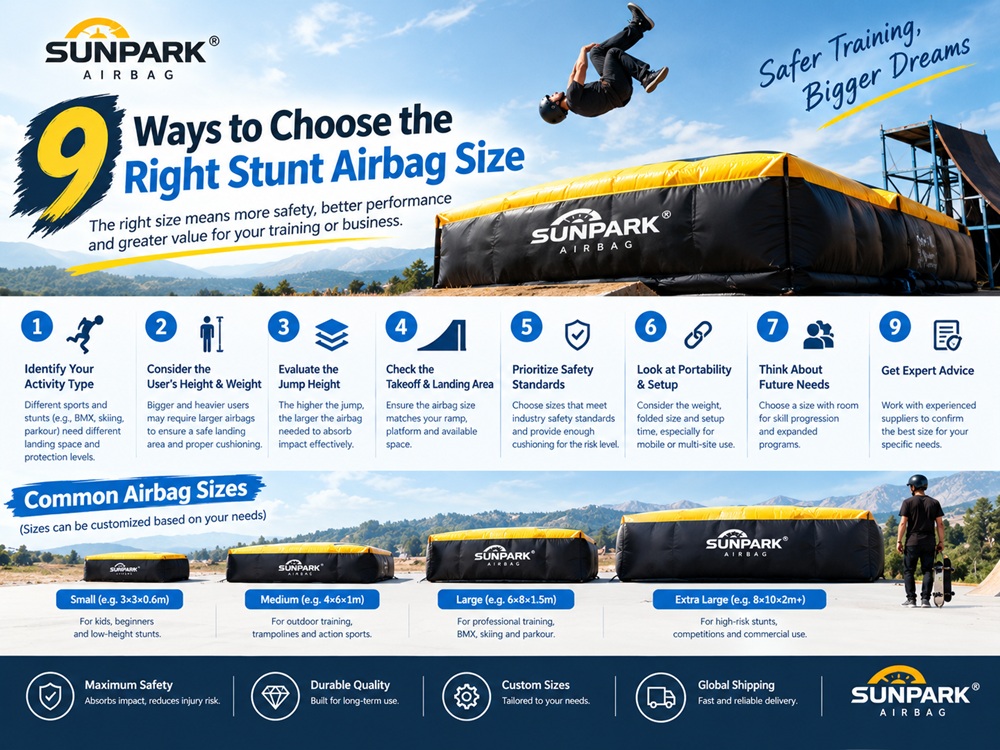
Never buy an off-the-shelf, one-size-fits-all landing bag for a custom dirt jump or ski hill. The bag’s landing angle, transition curve, and overall thickness must be engineered to match your ramp height and expected landing trajectory. An inclined landing airbag designed for mountain bikes typically features a sloped angle between 28 and 38 degrees, allowing riders to land smoothly on down-ramps and roll away cleanly, whereas stunt drop bags require flat, extra-deep deceleration zones.
Expert Sourcing Verdict & Procurement Recommendations
In our professional assessment across the global extreme sports and amusement park sectors, treating the imp parts of an airbag system as generic commodity items is the primary reason why budget facilities suffer catastrophic seam ruptures, athlete injuries, and devastating liability claims. Decelerating human bodies falling at highway speeds is a disciplined engineering problem that requires dedicated hardware.
If you are operating a commercial bike park, action sports camp, or gymnastics academy, you must prioritize structural safety over rock-bottom pricing. Never purchase single-chamber inflatables lacking isolated safety basements, and never accept lightweight 0.4mm vinyl fabrics. We recommend investing in a commercial-grade, dual-chamber landing platform built with a high-tensile 0.55mm PVC core, a sacrificial 0.9mm ballistic top wear sheet, and continuous high-CFM industrial blowers. Sourcing your landing hardware through proven engineering leaders like Sunparkairbag guarantees that all three imp parts of an airbag system are manufactured to institutional commercial standards, protecting your athletes, preserving your operational uptime, and building a world-class progression facility for years to come.
Frequently Asked Questions
The three most imp parts of an airbag system are: (1) The Dual-Chamber Deceleration Core, which isolates the fail-safe lower safety bed from the progressive upper impact cell; (2) The Continuous Airflow and Pressure Regulation System, consisting of industrial blowers and adjustable pressure relief vents; and (3) The Ballistic 0.9mm PVC Top Wear Sheet with its perimeter tension anchoring matrix, which protects the air cells and allows athletes to slide or ride away safely.
A single-chamber bag acts like a bounce house: when an athlete impacts the center, air displaces to the sides and creates a violent rebound, or the user punches straight through to the ground under heavy load. A dual-chamber system maintains a sealed, higher-pressure bottom safety chamber that guarantees the athlete never strikes the hard deck, while the upper chamber vents air progressively to absorb kinetic G-forces without trampoline rebound.
In commercial operations, the top sheet should be inspected daily for surface cuts and seam abrasion, with anchor straps and blower intakes checked before every session. While the heavy-duty 0.55mm PVC internal core lasts 5 to 8 years under proper maintenance, high-traffic top sheets typically require replacement every 2 to 4 years depending on friction cycles and UV exposure.
Engineered commercial landing airbags incorporate internal non-return check valves and maintain an isolated lower safety floor that holds residual pressure for several minutes following power loss. However, professional facilities install secondary backup blowers or dual-circuit generators to ensure uninterrupted airflow during live operational sessions.
Authoritative References & Amusement Safety Standards
- ASTM International: Standard Practice for Design, Manufacture, Installation, and Operation of Trampoline Courts and Inflatable Impact Attenuation Systems (ASTM F2970)
- European Committee for Standardization (CEN): Inflatable Play Equipment Safety Requirements and Test Methods (EN 14960)
- International Organization for Standardization (ISO): ISO 17842 Safety of Amusement Rides and Impact Mitigation Devices