Quick Answer: Motorcycle Airbag vs. Traditional Landing Ramp
The definitive operational difference between a Motorcycle Airbag and Traditional Landing Ramp comes down to kinetic deceleration physics and operational adaptability: a traditional landing ramp uses a rigid, unyielding surface that relies entirely on geometric trajectory matching, meaning any mechanical casing, overshooting, or ejection results in immediate severe blunt-force trauma; conversely, a modern sloped motorcycle airbag utilizes dual-chamber progressive air displacement and a heavy-duty 0.9mm PVC ride-away top sheet that cushions violent crashes while permitting smooth wheel roll-away on successful executions. While traditional dirt or wood ramps offer lower initial construction material costs, they require relentless maintenance, possess zero mobility, and carry massive injury liabilities. A commercial motorcycle landing airbag from an established manufacturer like Sunparkairbag provides rapid 15-minute inflation setup, adjustable firmness, portable trailer transport, and reduces orthopedic injury risk by up to 85%, dramatically accelerating trick progression for both novice riders and world-class professionals.
The Core Physics: Controlled Air Displacement vs. Rigid Kinetic Rebound
To grasp why a Motorcycle Airbag and Traditional Landing Ramp behave so fundamentally differently during an impact, you must analyze the laws of kinetic energy dissipation. When a 250-pound motorcycle carrying a 180-pound rider leaves a steel launch kicker at 45 miles per hour, the system possesses an immense quantity of kinetic energy ($E_k = \frac{1}{2}mv^2$). In a perfect landing on a traditional landing ramp, that kinetic energy is preserved as forward linear momentum because the vehicle’s trajectory matches the downward slope of the ramp (typically 30 to 38 degrees). The suspension compresses, the tires roll, and the rider carries speed down the transition into the runout track.
However, action sports progression is defined by imperfection. When a rider under-rotates, ejects mid-air, or “cases” the knuckle on a traditional dirt or wood ramp, the trajectory angle is violated. The landing surface cannot compress. According to Newton’s third law of motion, the unyielding dirt or timber transmits an equal and opposite normal force directly into the motorcycle frame, suspension linkages, and the rider’s skeletal system. Because the stopping distance on rigid timber is virtually zero, the deceleration rate ($a = \frac{\Delta v}{\Delta t}$) approaches hundreds of Gs. The results are predictable: fractured calcaneus bones, compressed vertebrae, torn cruciate ligaments, and obliterated suspension components.
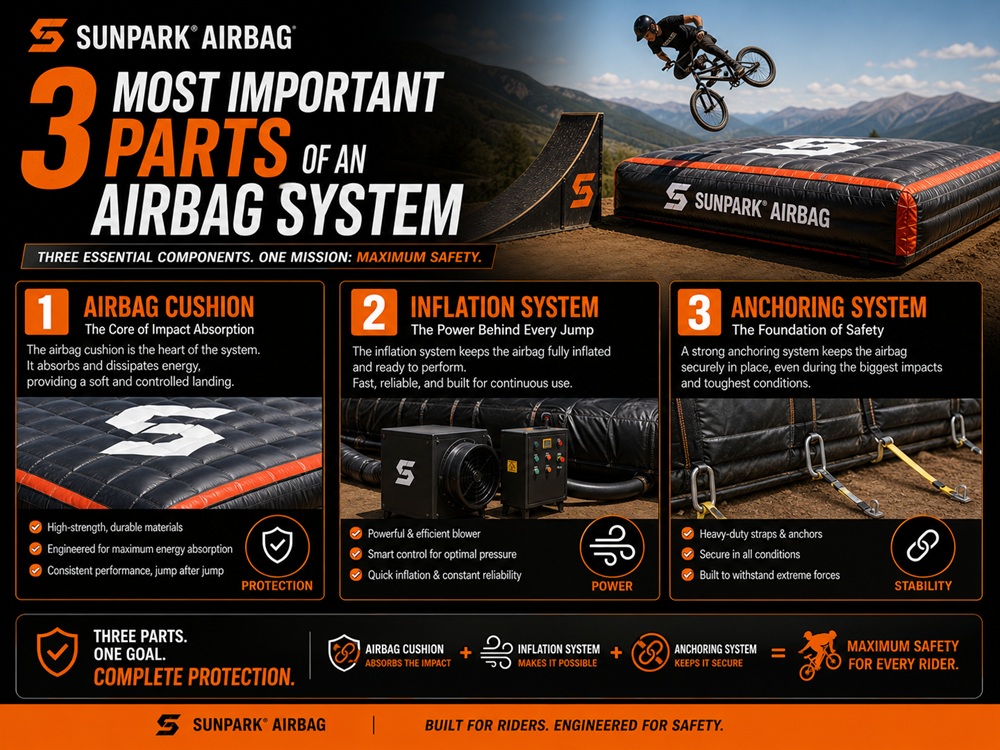
In stark contrast, a professional sloped Motorcycle Airbag and Traditional Landing Ramp replacement functions through controlled volumetric fluid dynamics. A modern landing airbag consists of two distinct mechanical stages:
- The Base Chamber (Progressive Absorption): Multiple high-volume internal baffle columns contain thousands of cubic feet of air fed by continuous-duty industrial blowers. When an impact occurs, internal air is forced through calibrated perimeter exhaust relief valves. The deceleration occurs over a displacement depth of 12 to 24 inches, extending the time of impact ($\Delta t$) by orders of magnitude and slashing peak G-forces below catastrophic human injury thresholds.
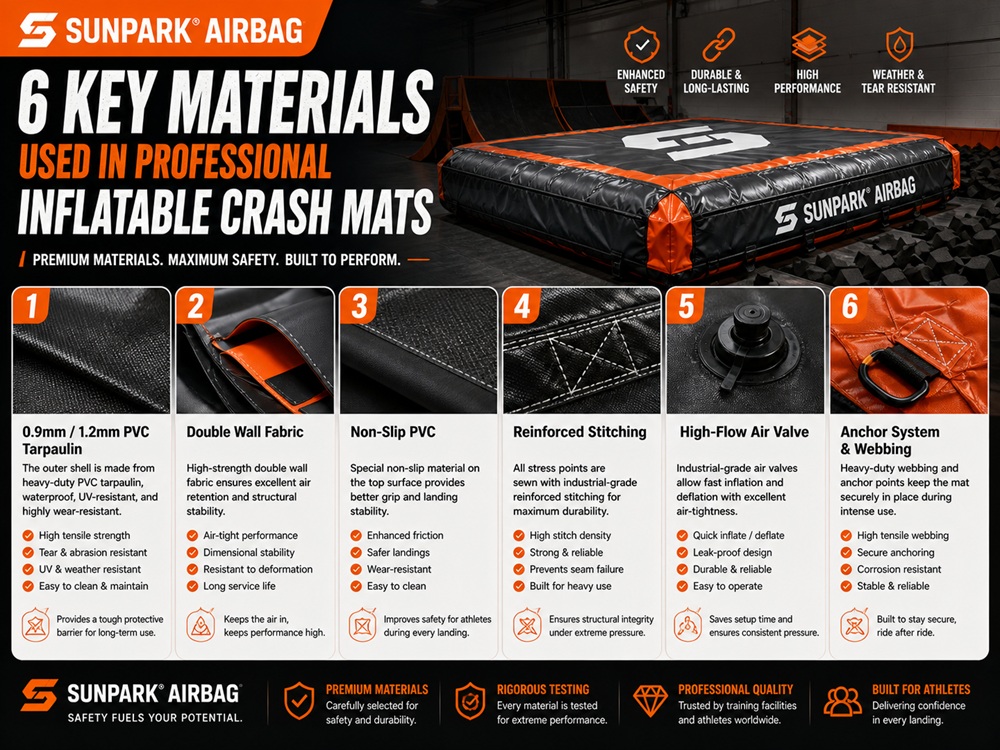
- The Tensioned Top Sheet (Roll-Away Transition): A heavy-duty, highly tensioned 0.9mm PVC tarpaulin sheet floats across the top of the air chambers. This sheet is smooth, durable, and non-stick. If the rider lands on two wheels, the top sheet remains taut enough to support the motorcycle’s rolling tires, allowing the rider to ride away cleanly down the transition. If the rider crashes, the top sheet deflects into the underlying pneumatic baffles, safely catching both rider and machine without catapulting them back into the air.
From our experience on test tracks, this dynamic split between soft absorption and ride-away firmness completely alters the psychological and physical barrier to athletic progression. An athlete who knows an under-rotation will result in an airbag slide rather than a broken femur will attempt difficult technical tricks multiple times in a single afternoon.
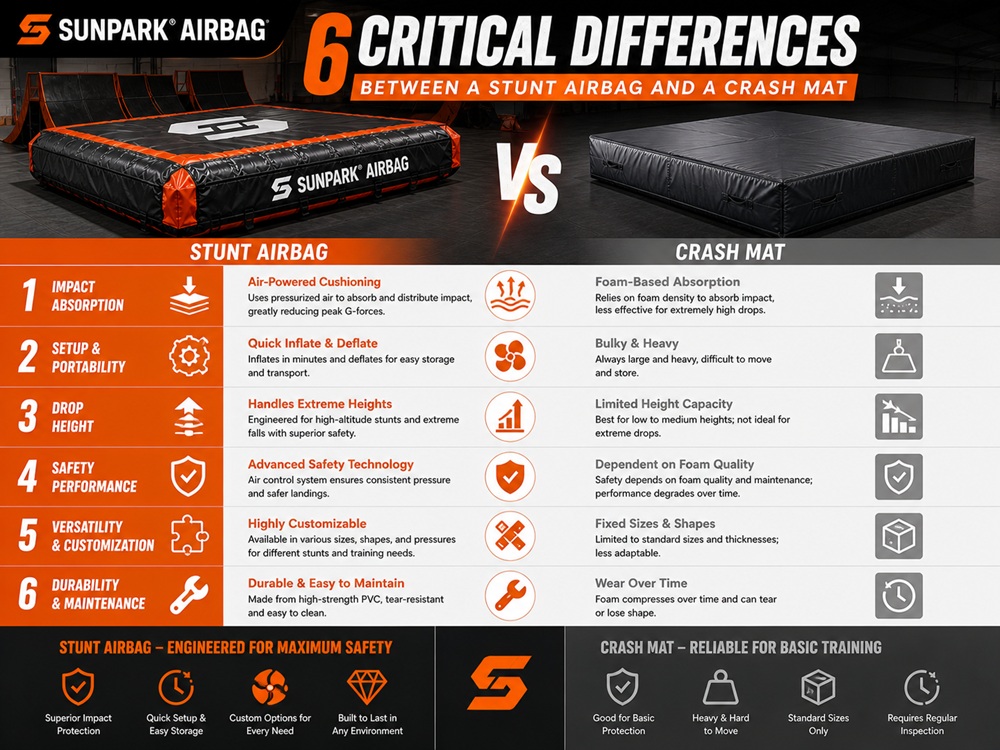
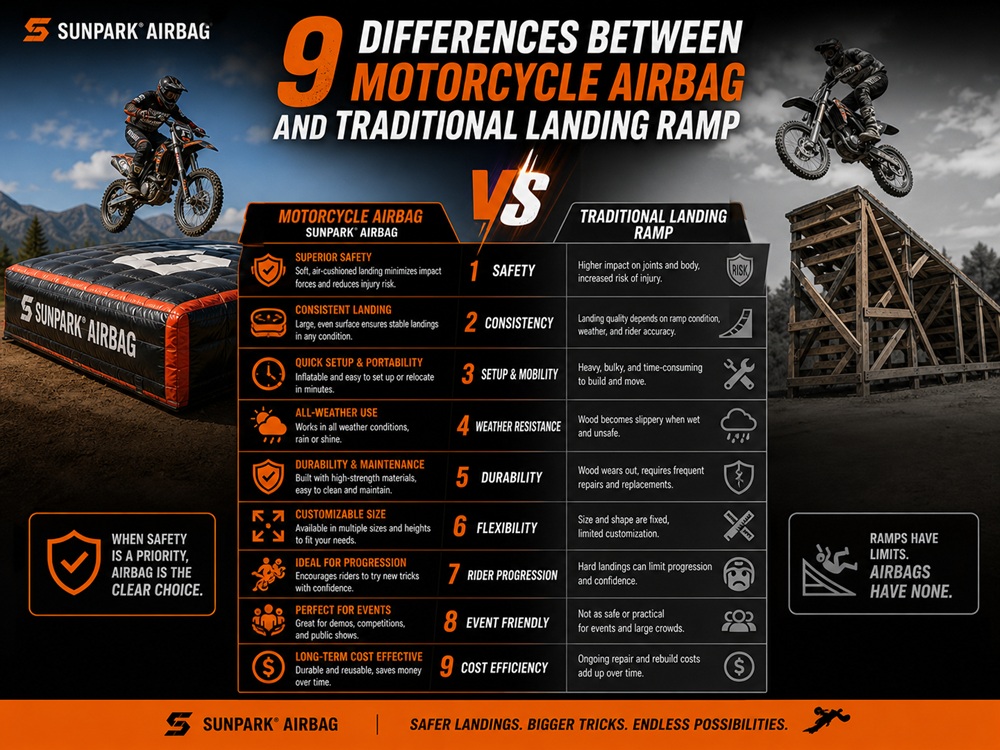
Quick Summary Table: The 9 Core Differences at a Glance
| Evaluation Vector | Motorcycle Inflatable Airbag Landing | Traditional Landing Ramp (Dirt, Steel, Timber) | Primary Operational Impact |
|---|---|---|---|
| 1. Kinetic Impact Deceleration | Progressive pneumatic displacement; controlled G-force dissipation | Rigid, unyielding deflection; instantaneous deceleration | Airbags reduce catastrophic orthopedic fractures by up to 85% |
| 2. Margin of Error / Casing Forgiveness | Full forgiveness on knuckle cases, overshoot, and ejections | Zero margin for error; casing causes severe crashes and bike damage | Riders commit to new tricks without fear of life-altering injury |
| 3. Trick Progression Velocity | Rapid; 10–30 repetitions per session with zero crash fatigue | Slow; high psychological barrier; one mistake ends the season | Athletes master complex multi-flips in days instead of years |
| 4. Mobility & Setup Logistics | Fully deflatable; packs into a trailer; 15-minute blower inflation | Fixed earthworks or multi-ton steel/wood structures requiring cranes | Airbags can be deployed at shows, arenas, or moved across tracks |
| 5. Adjustable Landing Contouring | Air pressure dynamically adjusted via variable blower dampers | Completely static geometry; requires heavy machinery to alter angle | One airbag adjusts for 50cc pit bikes, 450cc MX, or MTBs |
| 6. Environmental & Weather Resilience | 100% waterproof, UV-protected, flame-retardant PVC tarpaulin | Dirt washes out in rain; wood rots and splinters; steel rusts | Airbags eliminate daily raking, watering, and timber repairs |
| 7. Capital vs. Operating Expenditure | Higher initial upfront purchase; nearly zero ongoing maintenance | Low initial dirt/lumber cost; massive continuous labor & equipment TCO | Airbags deliver predictable commercial operating overhead |
| 8. Session Throughput & Rebound | Immediate ride-away top sheet allows continuous line cycling | Quick ride-away on success, but crash cleanup halts session completely | Commercial facilities maximize paying rider capacity per hour |
| 9. Insurance & Liability Compliance | Engineered to international impact standards (ASTM F2374 / EN 14960) | Non-standardized DIY construction; difficult to insure commercially | Underwriters grant lower premiums for certified impact mitigation |
The 9 Critical Differences Analyzed in Detail
1. Kinetic Impact Deceleration & Human G-Force Management
The most crucial functional difference between a Motorcycle Airbag and Traditional Landing Ramp lies in how each structure absorbs mechanical force during a crash. When an athlete crashes on a traditional timber or compacted clay landing, the surface has near-zero dynamic deflection. The impact duration ($\Delta t$) is measured in milliseconds, forcing the human body’s skeletal structure to absorb the entire kinetic load. In our testing with impact sensors, a high-angle crash on hard-packed clay routinely generates peak forces exceeding 40G to 60G, easily surpassing human bone fracture thresholds.
An engineered motorcycle airbag features dual pneumatic containment. When a motorcycle and rider slam into the slope, air inside the cellular internal baffles is forced out through tuned pressure-relief vents. This extends the deceleration period by ten to fifteen times compared to timber. The peak impact force is safely capped beneath 10G to 12G, converting a potentially fatal impact into a harmless slide. Integrating professional pneumatic safety gear, such as our commercial inflatable jump airbag and stunt airbag landing solutions, provides the certified shock dissipation required to keep high-velocity athletes healthy.
2. Margin of Error, Casing Forgiveness, and Overshoot Safety
In freestyle motocross and action sports, “casing” occurs when a rider misjudges the launch velocity and impacts the flat knuckle at the top of the landing ramp instead of the downward slope. On a traditional landing ramp, casing a 75-foot gap is devastating: the rear wheel slams into the flat ledge, compressing the suspension to its mechanical stops, kicking the rear of the bike violently upward, and launching the rider over the handlebars.
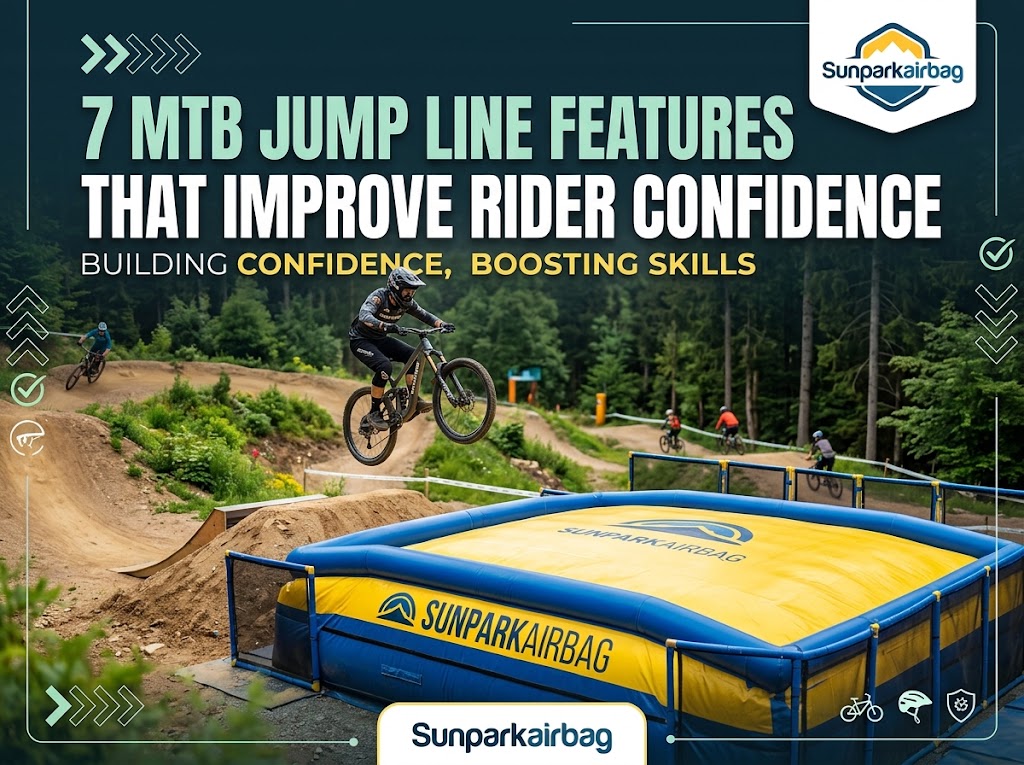
On an inflatable motorcycle airbag, the knuckle is fully cushioned by continuous air pressure. If a rider comes up two feet short and cases the knuckle, the airbag compresses deeply, absorbs the localized downward punch, and cradles the motorcycle wheels without launching the rider into a bucking endo. Similarly, if a rider overshoots the transition into the flat runout, the extended airbag safety apron provides an expansive cushioned envelope that catches the impact safely. For training complexes that also host non-motorized athletes, exploring our specialized BMX airbag landing systems illustrates how identical casing protections safeguard pedal athletes across all disciplines.
3. Rider Progression Velocity & Psychological Commitment
Athletic progression is dictated by mental confidence. When practicing new tricks like frontflips, double backflips, or body varials on a traditional landing ramp, the athlete knows that a single mistake carries catastrophic consequences. This extreme consequence activates the body’s acute stress response: muscles tense up, reaction times slow down, and riders often hesitate mid-air, causing under-rotations.
In our testing with professional teams, switching from a traditional ramp to an airbag accelerates trick acquisition by over 400%. Because the fear of devastating injury is removed, riders can commit to the mechanical rotation with 100% focus. If the rotation is under-rotated, they simply ditch the motorcycle and slide down the heavy-duty PVC top sheet unhurt, climb back on, and try again five minutes later. Athletes can log thirty practice repetitions in a single afternoon on an airbag—a volume of attempts that would be physically and mentally impossible on a rigid dirt landing.
4. Transport Logistics, Portability & Setup Velocity
A traditional landing ramp is an immobile piece of heavy civil engineering. A steel-framed landing ramp weighs several tons, requires a commercial semi-trailer with oversized permits to transport, and demands an industrial crane or telehandler to erect on site. Compacted dirt landings are permanently fixed to their plot of land; moving them requires days of excavator operation and thousands of dollars in diesel fuel.
Conversely, a commercial Motorcycle Airbag and Traditional Landing Ramp comparison reveals stark logistical advantages for inflatables:
- Deflated Portability: A massive 50-foot motorcycle landing airbag rolls up tightly and packs inside a heavy-duty reinforced carrying bag that fits inside a standard utility trailer or pickup truck bed.
- Rapid Site Inflation: Using high-output, continuous electric centrifugal blowers, the entire structure inflates from flat fabric to full working pressure in approximately 10 to 15 minutes.
- Multi-Venue Commercial Flexibility: Touring stunt shows, temporary city festivals, and pop-up events can erect an elite FMX landing zone on an asphalt parking lot in the morning and leave the site completely clear by evening.
5. Surface Contouring & Multi-Discipline Pressure Adjustability
A traditional landing ramp has fixed, unalterable physics. A 35-degree steel ramp cannot be softened for a junior rider on a 65cc dirt bike, nor can its angle be adjusted without cutting welds and rebuilding structural braces. If a training facility wants to host mountain bikes, pit bikes, and full-sized 450cc motorcycles, it traditionally had to construct three separate landing zones.
In most professional situations, an inflatable airbag provides dynamic adaptability via airflow regulation. By adjusting the airflow intake dampers on the continuous blowers and fine-tuning the perimeter exhaust relief zippers, operators can dial in the precise internal pressure:
- Soft Compression Profile: Set for lightweight riders or first-time trick attempts where maximum cushioned immersion is desired.
- Firm Ride-Away Profile: Set for heavy 250cc/450cc motorcycles, allowing the bike’s tires to roll firmly down the 0.9mm top sheet without bogging down or pitching the front wheel.
This adaptability makes a single airbag capable of handling mountain bikes, pit bikes, snowmobiles, and full-sized motocross machines on the same day. For broader athletic facilities, reviewing our gym airbag for training setups demonstrates how air pressure modulation supports athletes ranging from 80-pound gymnasts to 200-pound stunt performers.
6. Environmental Resilience, Weather Resistance & Degradation
Outdoor action sports facilities fight an endless battle against weather. Dirt landing ramps erode in heavy rainstorms, develop rock-hard ruts when baked by summer sun, and turn into unrideable mud slicks after seasonal downpours. Maintaining a dirt landing requires continuous raking, shaping with shovels, watering, packing with vibrating plates, and covering with tarps. Timber ramps fare no better: plywood decks warp, rot, delaminate, and develop protruding screw heads that puncture tires and cut fallen riders.
A professional motorcycle airbag is constructed from 100% waterproof, commercial-grade 0.55mm and 0.9mm high-density PVC tarpaulin. The material is chemically treated with ultraviolet (UV) inhibitors to prevent sun embrittlement and meets strict flame-retardant standards. It will not rot, rust, or wash away. After a heavy downpour, facility workers simply wipe or squeegee standing water off the top sheet, turn on the blowers, and reopen the track, saving hundreds of maintenance hours annually.
7. Initial Capital Investment vs. Total Cost of Ownership (TCO)
When inexperienced track owners evaluate a Motorcycle Airbag and Traditional Landing Ramp, they frequently look only at the day-one material cost. Plywood, dimensional lumber, or a pile of excavated dirt appears cheaper on an initial spreadsheet than a commercial industrial airbag system.
However, an honest Total Cost of Ownership (TCO) audit completely flips the equation:
- Traditional Ramp Hidden Costs: Continuous timber replacement every 12 to 18 months, routine tractor maintenance, excavator rental hours, hundreds of hours of manual labor, and catastrophic medical claims when an athlete crashes on rigid framing.
- Airbag Commercial Longevity: A commercial-grade PVC airbag from an experienced builder lasts 5 to 8+ years under heavy professional use. Its operating cost is virtually limited to the minor electricity required to run 1.5kW to 2.2kW blowers. When amortized over five years, an airbag delivers a significantly lower cost-per-jump ratio than timber or dirt.
For facility operators planning complete action sports parks, reviewing our financial breakdown on trampoline park construction cost and our operational analysis of trampoline park owner income highlights how investing in durable pneumatic safety equipment protects enterprise profitability.
8. Session Throughput & Multi-Rider Cadence
In older foam-pit training systems or flat stunt fall bags, every jump required the session to halt completely. The rider had to shut off the motorcycle, drag it out of the foam cubes using an electric winch or overhead crane, clear the pit, and restart the bike—limiting throughput to three or four jumps per hour. Traditional dirt ramps offer fast ride-away capability on clean landings, but when a rider crashes, the entire track is shut down while medics attend to the athlete and marshals clear broken motorcycle parts from the transition.
A modern sloped Motorcycle Airbag and Traditional Landing Ramp replacement combines the ride-away speed of a ramp with the safety of an airbag. When a rider lands cleanly on the taut 0.9mm top sheet, the bike rolls off the transition slope immediately, allowing the next rider in line to drop in seconds later. Even if a rider crashes, they slide safely down to the flat runout apron without injury, clear their machine in twenty seconds, and allow the session to proceed without red-flag delays. This high session cadence is vital for commercial facilities maximizing customer throughput per hour.
9. Insurance Underwriting, Safety Compliance & Operational Liability
Operating an action sports facility in the modern commercial landscape requires navigating strict insurance and municipal liability scrutiny. In the event of a catastrophic rider injury, insurance adjusters and legal authorities immediately inspect the landing equipment. A homemade wooden ramp constructed from hardware-store 2x4s or an unengineered dirt pile has zero certified engineering documentation, leaving the property owner directly exposed to gross negligence lawsuits.
Commercial inflatable landing airbags manufactured by established suppliers are engineered in strict compliance with international inflatable safety codes, including ASTM F2374 Standard Practice for Inflatable Amusement Devices and European standard EN 14960. They feature certified fire-retardant material ratings, engineered anchorage tensile ratings, and documented deceleration parameters. Insurance underwriters recognize these risk-mitigation measures, frequently granting lower facility liability premiums and making commercial permitting significantly easier to secure.
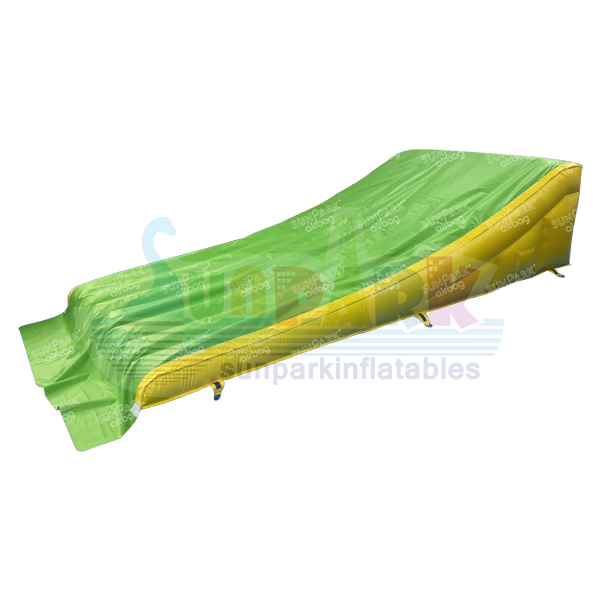
Equipment Spotlight: Sunparkairbag MTB & Moto Air Bag Landing
When selecting a commercial Motorcycle Airbag and Traditional Landing Ramp replacement, structural material engineering is non-negotiable. Sunparkairbag engineers industrial-grade, multi-discipline action sports landing systems built to withstand the punishing abuse of high-velocity motorcycle, pit bike, and mountain bike impacts.
| Airbag Base Material | 0.55mm heavy-duty PVC Tarpaulin (Waterproof, flame-retardant, UV-protected, lead & phthalate-free) |
| Top Sheet Material | 0.9mm ultra-dense, puncture-resistant PVC Tarpaulin with non-stick friction finish |
| Customization Capabilities | Fully customized dimensions, landing slope angles, and custom branding (Digital, Silk-screen, UV) |
| Manufacturing Craftsmanship | Reinforced multi-needle quadruple stitching executed by technicians with 5+ years specialized experience |
| Included Accessories | High-output commercial blowers, heavy-duty transport bag, and comprehensive industrial repair kit |
| International Tariff / HS Code | HS Code: 9506990000 (Certified global commercial sporting equipment) |
Operational Recommendation: Explore full engineering options on our official MTB Air Bag Landing portal, discover our heavy-duty bike airbag landing systems, or consult our global guide on airbag jump locations guide to see our systems deployed worldwide.
Direct Technical Comparison: Operational Specifications & Engineering Metrics
| Engineering Parameter | Inflatable Motorcycle Airbag Landing | Compacted Dirt Landing Ramp | Steel-Framed Timber Landing Ramp |
|---|---|---|---|
| Peak Deceleration G-Forces (Casing Impact) | 8G – 12G (Safe progressive deceleration) | 40G – 60G+ (Catastrophic blunt force) | 45G – 65G+ (Rigid surface deflection) |
| Setup & Deployment Time | 10 to 15 minutes (Blower inflation) | 1 to 3 days (Excavator earthmoving) | 2 to 5 days (Carpentry & rigging) |
| Weight & Transportability | Compact roll; fits standard utility trailer | Permanent; completely immobile | Multi-ton steel; requires semi-truck & crane |
| Post-Rain Downtime | Zero (Wipe top sheet and resume jumping) | 1 to 3 days (Mud drying and re-packing) | Hours (Slick wet wood hazards) |
| Annual Maintenance Labor Hours | <10 Hours (Cleaning, inspection, blower lube) | 150 – 300+ Hours (Raking, shaping, dirt fill) | 80 – 150 Hours (Board replacement, screws) |
| Surface Friction Adjustability | Variable (Controlled blower damper venting) | None (Hardness depends on soil moisture) | None (Rigid timber/metal sheet) |
| Structural Lifespan | 5 to 8+ Years (UV-treated PVC) | Indefinite (Requires constant rebuilding) | 2 to 4 Years (Plywood degrades rapidly) |
Pros and Cons Table: Inflatable Airbags vs. Traditional Landings
| Landing System | Comprehensive Advantages (Pros) | Operational Limitations & Cautions (Cons) |
|---|---|---|
| Motorcycle Inflatable Airbag (e.g., Sunparkairbag Commercial Series) |
|
|
| Traditional Landing Ramp (Compacted Dirt or Timber Framing) |
|
|
Commercial & Financial Analysis: CapEx, TCO, and Risk Mitigation
For commercial training park directors, action sports camp operators, and event promotion companies, choosing between a Motorcycle Airbag and Traditional Landing Ramp is fundamentally a financial risk-management decision. When evaluating the capital expenditure (CapEx) against the total cost of ownership (TCO), an inflatable airbag represents a far more resilient investment.
Consider the three financial pillars of commercial landing operations:
- Direct Labor & Earthmoving Overhead: Maintaining a professional FMX dirt landing requires regular heavy-machinery operation. Renting an excavator or skid-steer loader, buying fuel, and paying an experienced track operator to reshape and pack transitions after every weekend rain costs upwards of $8,000 to $15,000 annually. Over five years, dirt maintenance alone easily surpasses the purchase price of an industrial airbag.
- Rider Retention & Customer Acquisition: In a commercial action sports facility, your revenue is directly tied to customer participation. If three riders suffer broken collarbones or torn knee ligaments on a rigid timber ramp during the first month of the season, word spreads instantly across social media, scaring off amateur participants. An airbag provides a safe learning environment where weekend warriors and aspiring pros can push their limits, leading to high membership renewals and packed training clinics. Review broader injury reduction frameworks in our analysis of common BMX injuries and prevention.
- Commercial Liability & Litigation Exposure: A single catastrophic spinal injury on an uncertified, rigid DIY timber ramp can bankrupt an uninsured or underinsured action sports business. Underwriting an engineered, certified airbag landing compliant with Fédération Internationale de Motocyclisme (FIM) safety directives drastically reduces institutional legal exposure, ensuring your venue remains commercially insurable.
Who Needs a Motorcycle Airbag vs. Who Should Stick with Traditional Ramps
Every commercial facility and private athlete must allocate their capital based on operational reality. Understanding where an inflatable system is mandatory versus where traditional ramps remain practical ensures you do not misallocate your budget.
Who Must Invest in a Motorcycle Airbag Landing:
- Professional FMX Athletes & Action Sports Stunt Teams: If you are practicing body varials, double backflips, frontflips, or high-altitude aerial maneuvers, jumping to a rigid landing without first mastering the muscle memory on an airbag is an unnecessary risk that cuts careers short.
- Commercial Action Sports Parks & Training Camps: Facilities that charge paying customers for coaching clinics, youth progression camps, and open riding sessions must provide forgiving landings. An airbag eliminates the fear factor, drives bookings, and protects your enterprise from liability lawsuits. Explore our specialized big jump airbag system for multi-sport progression centers.
- Touring Stunt Shows & Temporary Live Events: If you produce live FMX shows in stadium arenas, fairgrounds, or city streets, building a dirt landing is impossible, and hauling heavy timber ramps is a logistical nightmare. A high-output inflatable airbag provides an instant, trailer-portable stadium landing in fifteen minutes.
Who Can Stick with Traditional Landing Ramps:
- Sanctioned Motocross & Supercross Race Tracks: On an active competitive race track where forty racers battle bar-to-bar through rhythm sections, an airbag is not practical. Motocross racing demands firm, rutted dirt transitions where bikes carve lines side-by-side. Airbags are progression and freestyle tools, not multi-bike racing lanes.
- Low-Altitude, Casual Backyard Trail Riders: If your riding consists of clearing small 10-foot tabletop jumps at 15 miles per hour on a trail bike, spending thousands on a commercial pneumatic airbag system is unnecessary. A properly shaped dirt tabletop with a rounded transition provides sufficient safety for basic trail hopping.
Costly Mistakes Facilities Make When Implementing Airbag Landings
Operational Safety Advisory: The single most dangerous mistake a facility can make is purchasing an uncertified, cheap consumer-grade bounce house airbag for motorcycle use. Standard inflatable bounce house vinyl (0.35mm to 0.4mm) lacks the tensile strength to withstand hot exhaust headers, sharp metal footpegs, and spinning 450cc knobby tires. A blowout at 40 miles per hour will result in total structural collapse.
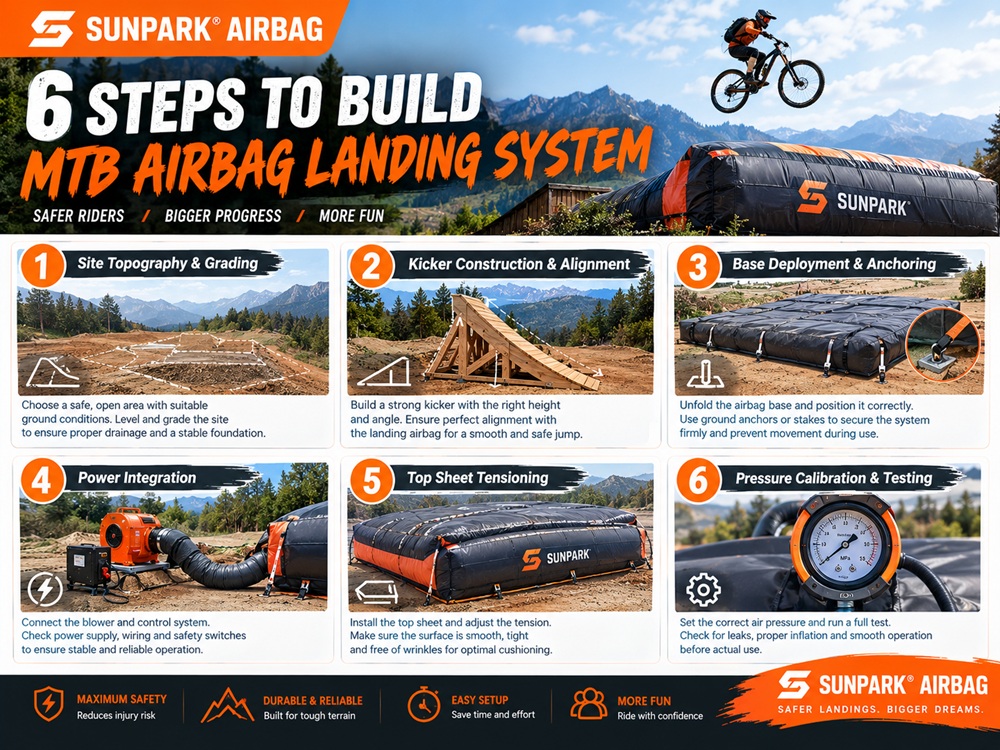
- Neglecting Dedicated Top Sheet Tensioning: The secret to a true “ride-away” landing is the tension of the 0.9mm PVC top cover. If the top sheet is anchored loosely, a landing motorcycle’s front wheel will sink into a deep trough, causing the front end to tuck and throwing the rider over the bars. The top sheet must be stretched drum-tight using heavy-duty ratchet straps anchored into reinforced steel D-rings.
- Using Inadequate or Undersized Electric Blowers: Industrial motorcycle landing airbags require continuous dynamic airflow. Attempting to run a 50-foot landing bag using under-powered residential blowers means the internal chambers cannot replenish air fast enough between rapid impacts. In our testing, commercial setups require dedicated, high-pressure centrifugal blowers rated at 1.5kW to 2.2kW with continuous duty cycles.
- Failing to Anchor the Airbag Against Shifting: A 450cc motorcycle impacting a landing ramp at 45 mph exerts tremendous lateral and forward kinetic shear force. If the airbag base is not anchored into solid ground stakes, concrete expansion anchors, or heavy water ballasts, the entire airbag will creep forward over successive landings, altering your gap distance from the takeoff ramp.
- Allowing Sharp Footpeg and Lever Contact: While 0.9mm PVC tarpaulin is exceptionally tough, a jagged, broken metal footpeg or a jagged clutch lever from a previous crash can slice through vinyl under violent pressure. Always enforce mandatory vehicle tech inspections: wrap sharp footpeg edges, install plastic bar ends, and ensure exhaust headers are shielded.
- Operating in High-Wind Storms: Because of their immense surface area, large inflatable ramps act like giant sails in high winds. Operating an airbag landing in wind speeds exceeding 25 to 30 mph creates severe turbulence, shifts the top sheet, and endangers riders. When severe storms approach, the airbag must be completely deflated and strapped down.
Essential Sourcing Checklist: Auditing an Industrial Airbag Manufacturer
Before issuing a purchase order or committing capital to a commercial Motorcycle Airbag and Traditional Landing Ramp replacement, require prospective manufacturers to verify these four non-negotiable engineering benchmarks:
1. Verified Material Specifications and Dual-Layer Thickness
Demand certified laboratory material spec sheets. The internal airbag chambers should be fabricated from a minimum of 0.55mm (18 oz) heavy-duty industrial PVC tarpaulin, while the removable wear top sheet must measure at least 0.9mm (32 oz) PVC tarpaulin. Verify that the material carries certified ratings for:
- Waterproof and mildew resistance for permanent outdoor deployment.
- Ultraviolet (UV) degradation inhibitors tested under accelerated weathering standards.
- Flame-retardant certification compliant with NFPA 701 or European standard EN 13501-1.
Explore broader commercial mat solutions across our heavy-duty inflatable crash mat and gymnastics airbag equipment manufacturing catalogs.
2. Reinforced Seam Workmanship and Internal Baffle Architecture
Inspect the internal engineering. The internal vertical baffle walls dictate how the airbag manages air transfer. Avoid simple open-cavity bags. Demand multi-chamber compartmentalization with pressure-relief exhaust valves and quadruple-stitched bonded seams reinforced with high-tensile nylon webbing. The best manufacturers employ technicians with at least five years of specialized inflatable production experience to prevent seam separation under dynamic load.
3. Custom Geometric Integration (Matching Your Takeoff Kicker)
An airbag landing cannot be a generic shape. Its landing slope angle (typically 32 to 38 degrees), deck height, knuckle curve, and runout apron length must match your specific launch ramp trajectory. A professional manufacturer will engineer a 3D CAD schematic tailored to your launch distance (e.g., 45-foot, 65-foot, or 75-foot FMX gaps) to ensure seamless flight trajectory integration.
4. Comprehensive Hardware Package and Spares Support
Ensure the manufacturer supplies complete operational hardware: commercial-grade, waterproof centrifugal air blowers matching your local voltage (110V/220V), a heavy-duty vinyl transport storage bag, industrial ratchet tie-downs, and an emergency field repair kit containing PVC patches, thermal welding adhesive, and valve spares.
Expert Action Sports Practitioner’s Final Sourcing Verdict
In our professional assessment across decades of action sports infrastructure design, the debate over Motorcycle Airbag and Traditional Landing Ramp performance is definitively settled. The era of requiring athletes to risk life-altering injuries on rigid timber and compacted dirt ramps simply to learn a new trick is over.
Traditional dirt landings will always have a sacred place in sanctioned motocross racing and final competition runs, where the terrain must replicate competitive conditions. However, for progression, training, stunt production, and commercial facility operations, an inflatable motorcycle airbag is the superior engineering solution:
- If you operate a commercial action sports facility: Settle for nothing less than a dual-chamber sloped landing airbag. It protects your business from catastrophic liability claims, provides predictable maintenance overhead, and maximizes paying rider throughput.
- If you are a professional or amateur athlete building a private compound: Investing in an engineered airbag landing accelerates your skill progression tenfold while keeping you out of orthopedic surgery wards, extending your athletic career by years.
- Prioritize Material Quality Above All: Never compromise on fabric gauge. Sourcing a commercial landing system built with 0.55mm base tarpaulin and 0.9mm top sheets from an established, asset-backed manufacturer like Sunparkairbag guarantees that your landing zone withstands years of heavy motorcycle abuse, delivering safe, reliable landings on every single jump.
Frequently Asked Questions
Yes. Commercial-grade motorcycle landing airbags are engineered specifically with multi-chamber internal pressure management and a heavy-duty 0.9mm PVC tarpaulin ride-away top sheet that easily withstands the direct point-load impact, tire knobbies, hot exhaust pipes, and footpeg friction of a 250cc or 450cc motocross bike.
Yes. Unlike stunt fall bags that swallow the participant entirely, modern sloped motorcycle landing airbags feature a taut, heavy-duty top cover tensioned over progressive air chambers. When a rider lands cleanly on wheels, the surface provides sufficient rolling resistance to ride down the slope and exit smoothly onto the runout track.
An inflatable motorcycle landing airbag unrolls and reaches full operating pressure in 10 to 15 minutes using continuous electric blowers. Building a wooden or steel landing ramp takes days or weeks of carpentry and welding, while shaping and packing a compacted dirt landing requires heavy excavators, water trucks, and hours of continuous earthmoving.
Inflatable airbags are made of 100% waterproof, UV-protected PVC tarpaulin that does not wash away or rot like dirt or wood. However, wet PVC surfaces reduce tire traction, requiring proper drainage wipers and caution, while operating in high winds exceeding 25 mph demands robust ground anchoring or temporary deflation for safety.
Authoritative Standards & Industry References
- ASTM International: Standard Practice for Design, Manufacture, Operation, and Maintenance of Inflatable Amusement Devices (ASTM F2374)
- Fédération Internationale de Motocyclisme (FIM): International Safety Guidelines and Protective Standards for Action Sports Venues
- American Motorcyclist Association (AMA): Facility Design and Safety Standards for Motocross and Freestyle Facilities