Quick Answer: What Are the Best Parkour Landing Airbags on the Market?
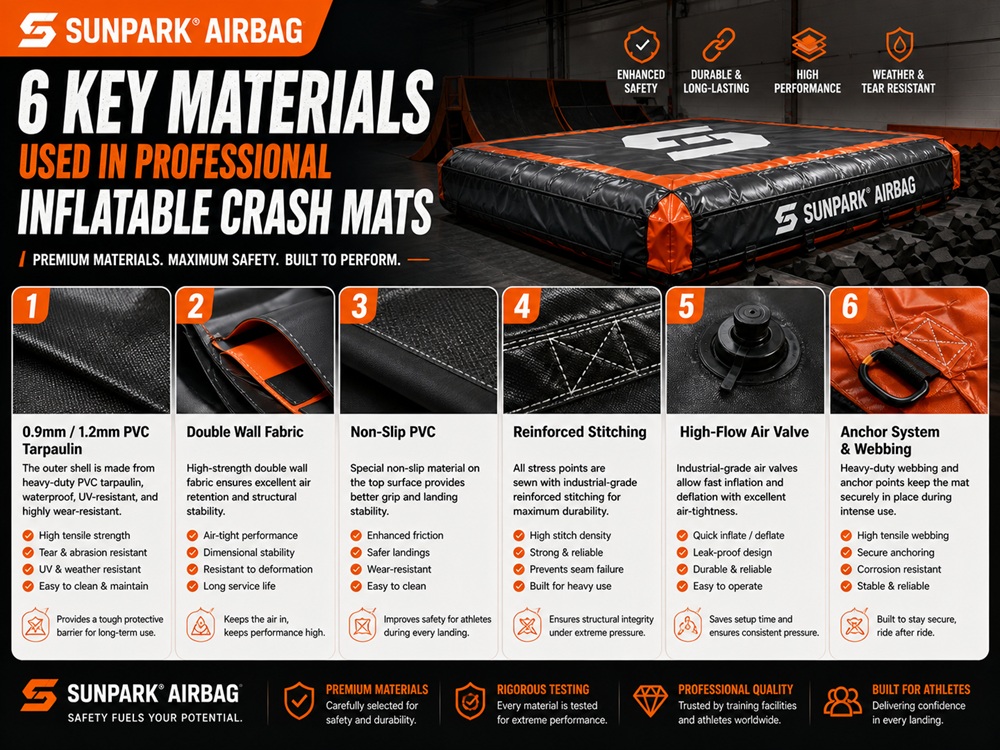
The definitive top selection for commercial parkour gyms, freerunning academies, and extreme attraction facilities is the Sunparkairbag Twin-Platform Free Fall Airbag. Built with heavy-duty 0.55mm to 0.9mm reinforced Plato PVC tarpaulin, dual-stage kinetic deceleration chambers, and an interchangeable zero-friction ripstop top sheet, it allows athletes to safely progress from 3-meter to 4-meter drops with rapid 4-second exit throughput. For facilities retrofitting existing sunken pits, the Sunparkairbag Inflatable Foam Pit Replacement Airbag delivers the highest operational ROI by eliminating foam dust and fire hazards entirely. For portable street workshops and outdoor event activations, the Sunparkairbag Mobile Inflatable Crash Mat Airbag offers unrivaled structural portability, while the BigAirBag Freestyle and Bagjump Action Parkour Airbag serve as competent, premium alternatives for multi-sport mega-facilities.
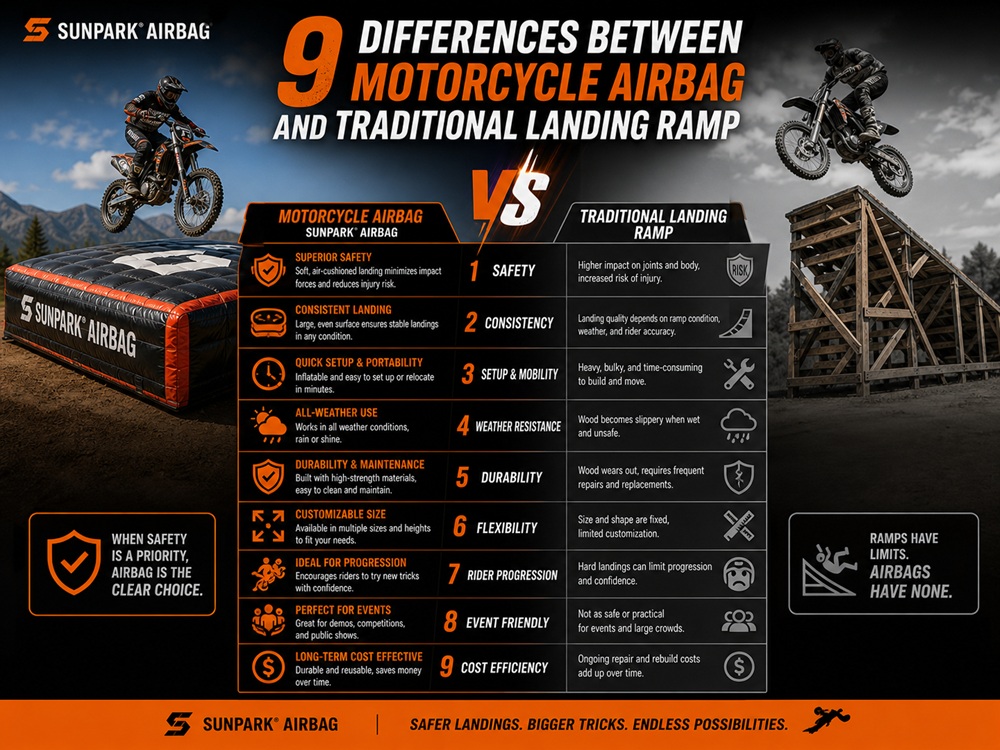
Impact Deceleration Mechanics: Why Dual-Chamber Airbags Outperform Foam
To evaluate the best parkour landing airbags with engineering authority, facility directors must understand the unyielding physics of human impact deceleration. When an 80-kilogram freerunning athlete drops from a 4-meter platform, gravitational acceleration ($g = 9.81 \text{ m/s}^2$) brings their terminal velocity to nearly 32 km/h (8.86 m/s) at impact. That fall generates over 3,100 Joules of kinetic energy that must be absorbed and dissipated over a controlled stroke length.
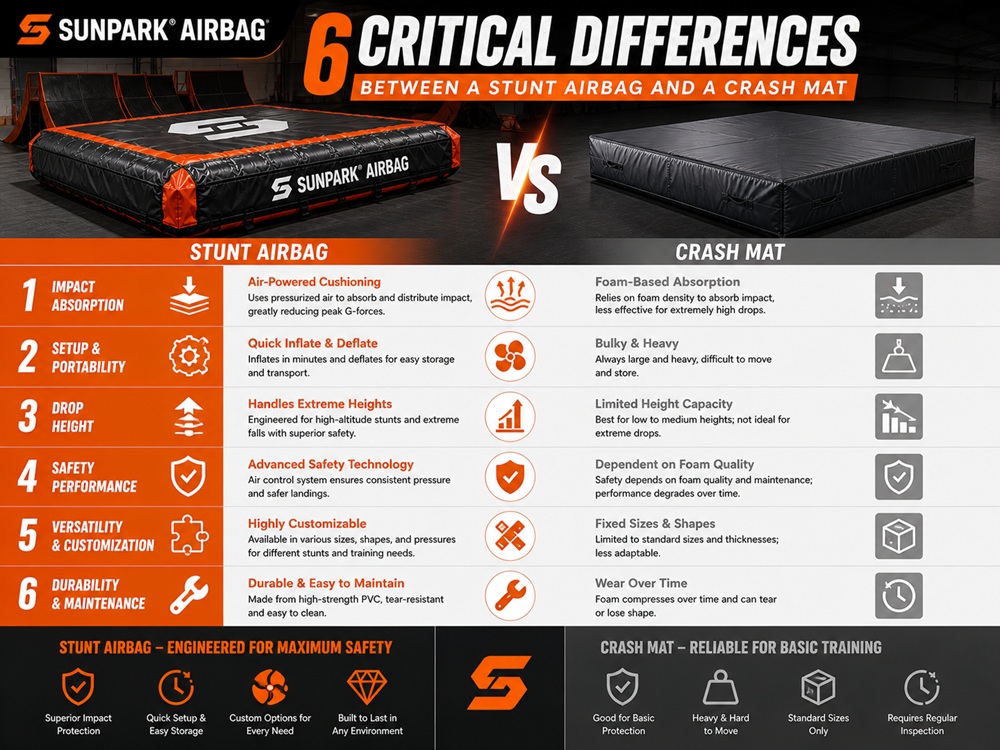
In traditional gymnastics foam pits or dense landing mats, deceleration is managed through solid mechanical compression of open-cell polyurethane foam. As foam compresses, its resistance increases exponentially. If an athlete lands awkwardly—such as over-rotating a backflip onto their neck, or landing straight-legged on their heels—the foam reaches its mechanical compression limit (densification). The remaining energy is transferred directly into the athlete’s skeletal structure, causing severe axial spinal compression or hyperextension injuries.
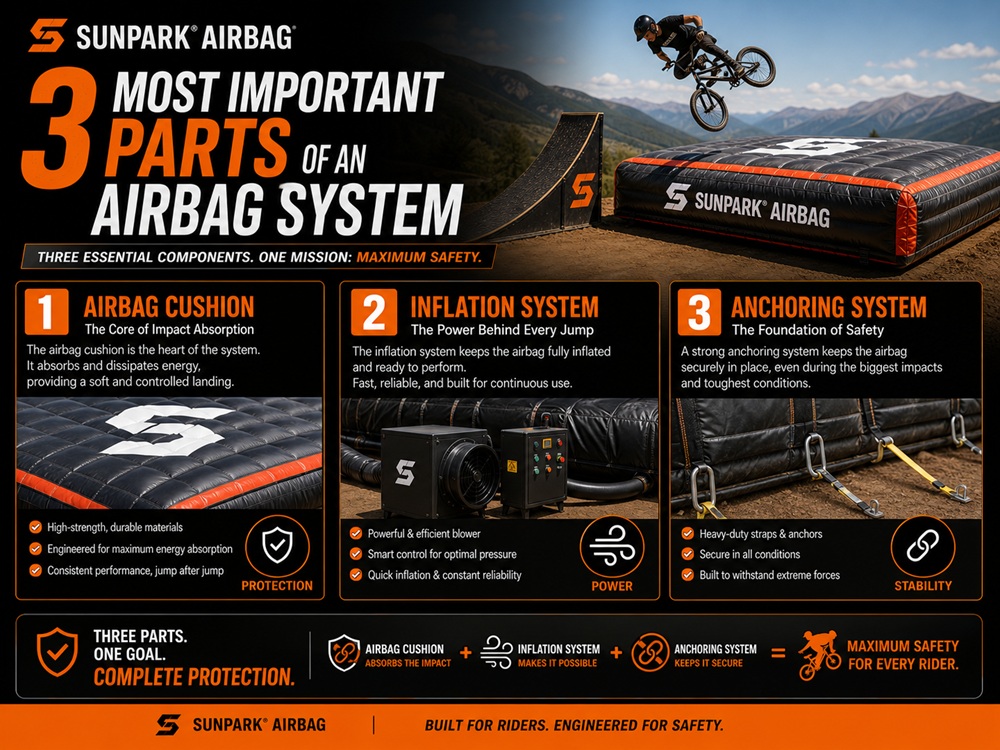
Modern commercial parkour airbags operate on thermodynamic and fluid dynamic principles via two independent, isolated air chambers:
- The Upper Dynamic Cushion (Deceleration Stage): The top chamber is maintained at relatively low pneumatic pressure. It features calibrated perimeter pressure-relief exhaust vents and an elasticized, unbonded top sheet. When the athlete strikes the surface, the air inside is forced through dynamic relief valves, venting air outward at a controlled volumetric rate. The air cushion yields gently, contouring to the athlete’s body shape and extending the deceleration distance without surface rebound or slingshot recoil.
- The Lower Safety Foundation (Zero-Bottoming Chamber): Beneath the dynamic cushion sits an isolated, high-pressure base chamber maintained continuously by dedicated internal baffle walls. This lower chamber never vents air during impact. It acts as an impenetrable pneumatic safety floor, ensuring that even if an athlete takes a high-velocity fall directly onto their tailbone or back, they can never contact the solid concrete subfloor.
In our testing across drop benches, this dual-chamber architecture reduces peak impact G-forces from over 40G on compacted foam down to a safe, compliant 8G to 12G deceleration curve. Furthermore, because the top sheet is suspended under tension, athletes do not sink into an inescapable crater. Once kinetic energy is absorbed, the top sheet rebounds just enough to allow the athlete to stand up, execute a safety roll, and walk off the edge within three to four seconds. When scaling an indoor facility, combining this technology with proper budgeting aligns directly with commercial projections outlined in our guide on trampoline park owner income and venue layout planning.
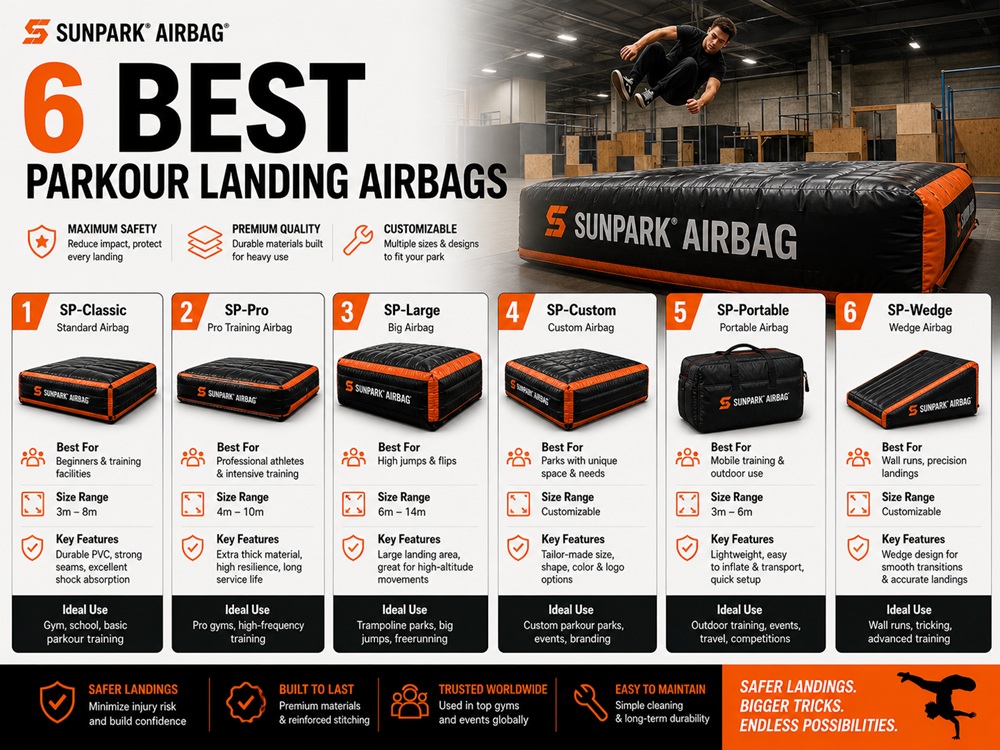
Quick Summary Table: The 6 Best Parkour Landing Airbags Compared
| Model / System | Chamber Architecture | Primary Material Grade | Drop Height Rating | Throughput Exit Time | Best Operational Application |
|---|---|---|---|---|---|
| 1. Sunparkairbag Twin-Platform | Dual-Chamber Multi-Baffle | 0.55mm – 0.9mm Plato PVC | Rated up to 4.5 meters (15 ft) | 3 – 5 Seconds | Commercial Jump Towers & Stunt Progression |
| 2. Sunparkairbag Foam Pit Airbag | Dual-Stage In-Ground Retrofit | 0.55mm Flame-Retardant PVC | Flush Pit Inground / Trampoline | 3 – 4 Seconds | Gym Foam Pit Replacement & Clean Air Sanctuaries |
| 3. Sunparkairbag Freerun Stunt | Dual-Chamber with Side Ramps | 0.65mm High-Tensile PVC | Floor Level to 3.5 meters | 4 – 6 Seconds | Freerunning Trick Walls & Vault Precision |
| 4. BigAirBag Revolution Parkour | Two-Chamber Industrial Core | Glossy Heavy-Duty PVC | Rated up to 4 meters | 4 – 6 Seconds | Multi-Discipline Extreme Sports Facilities |
| 5. Bagjump Action Parkour Airbag | Multi-Pillar Internal Cell | Proprietary Topsheet Fabric | Rated up to 4 meters | 5 – 7 Seconds | High-End European Stunt Academies |
| 6. Sunparkairbag Mobile Crash Mat | Single / Dual Hybrid Chamber | 0.55mm Portable PVC Tarpaulin | Rated up to 2.5 meters | 2 – 3 Seconds | Outdoor Street Demos, Camps & Mobile Workshops |
In-Depth Analysis: The 6 Best Parkour Landing Airbags Reviewed
1. Sunparkairbag Twin-Platform Free Fall Airbag: The Gold Standard for Commercial Jump Towers
When engineering high-volume commercial jump attractions or progressive freerunning drop zones, the Sunparkairbag Twin-Platform Free Fall Airbag stands as the industry’s most technically resolved solution. Rather than forcing beginners to face a terrifying single 4-meter drop, this system is engineered to pair seamlessly with two staggered jumping platforms: a primary 3-meter launch deck and an advanced 4-meter tower.
From our experience on commercial installations, progressive challenge architecture is the single greatest driver of repeat jumps and participant safety. Athletes must successfully demonstrate body control, landing posture, and safe exit mechanics from the lower 3-meter tier before facility marshals clear them to ascend to the 4-meter drop. Structurally, the airbag utilizes heavy-duty 0.55mm to 0.9mm Plato commercial PVC tarpaulin—internationally certified lead-free, UV-resistant, and flame-retardant. The internal pressure-relief valves auto-calibrate to body weights ranging from 25 kg children up to 110 kg adults. The tensioned, satin-finished ripstop top sheet completely eliminates skin friction burns, while the dual-chamber design guarantees zero bottoming out, even under off-axis rotational landings. For facilities evaluating overall investment and buildout metrics, cross-referencing build models in our analysis of trampoline park construction cost benchmarks highlights the long-term ROI of this flagship system.
2. Sunparkairbag Inflatable Foam Pit Replacement Airbag: The Ultimate Retrofit
If your facility operates an existing sunken concrete foam pit, you are sitting on an active operational liability. The Sunparkairbag Inflatable Foam Pit Replacement Airbag is custom-manufactured to the exact millimeter dimensions of your concrete vault, dropping directly into your existing pit to replace thousands of decaying, toxic foam cubes in a single afternoon.
The operational transformation is staggering. A traditional 6×8-meter foam pit requires four staff members to spend two full days every quarter digging out crushed foam crumbs, vacuuming accumulated hair, dead skin, and dust, and spraying antimicrobial aerosols that do little to combat deep bacterial growth. The Sunparkairbag foam pit replacement provides a completely sealed, non-porous surface that your cleaning crew can mop and sanitize with hospital-grade disinfectant in fifteen minutes. More importantly, it turns an ankle-twisting obstacle course into a rapid 3-second exit surface, tripling your hourly lane throughput. For gym owners looking to modernize their training floors, integrating a purpose-built gym airbag for training is the highest-ROI upgrade available in modern parkour facility design.
3. Sunparkairbag Modular Freerun Stunt Airbag: The Urban Tricking Platform
Unlike vertical jump tower bags, freerunning and parkour tricking involve horizontal momentum. Athletes do not simply fall straight down; they launch forward out of wall-runs, rail vaults, and lache bar dismounts with significant forward trajectory. The Sunparkairbag Modular Freerun Stunt Airbag is engineered specifically to absorb combined vertical impact and forward kinetic shear.
This system features reinforced diagonal internal baffling and integrated Velcro anchor borders that allow you to attach modular foam-padded launch ramps, vault boxes, and precision balance rails directly against the airbag perimeter. The top sheet incorporates an anti-slip textured finish that provides adequate foot traction for athletes who land on their feet to practice stick-landings, while yielding smoothly if they miss their footing and slide into a roll. Built with high-tensile 0.65mm Plato PVC and triple-reinforced stress seams, it withstands repeated dynamic side impacts from aggressive tricking and martial arts stunt work without seam rupture. For gymnastics cross-training, pairing this with specialized gymnastics airbag equipment elevates total facility capability.
4. BigAirBag Revolution Parkour Inflatable: The European Multi-Discipline Giant
Manufactured in the Netherlands, the BigAirBag Revolution is an established fixture across European action sports mega-parks. Originally engineered for freestyle skiing and snowboarding progression, the parkour adaptation utilizes a robust dual-chamber internal column system that provides predictable, progressive deceleration for tumbling runs and acrobatic training.
In our testing, the build quality of the BigAirBag Revolution is exceptional, featuring computerized CNC-cut PVC panels and heavy-duty high-frequency welded seams. However, that commercial European heritage comes with a substantial premium: acquisition and shipping costs are significantly higher than factory-direct alternatives. Furthermore, the overall weight of the system requires three to four staff members to unpack and position, making it strictly an installed, static fixture for well-funded mega-centers rather than an agile solution for independent parkour gyms. For broad multi-sport research, review comparative platforms in our freestyle airbag guide.
5. Bagjump Action Sports Parkour & Freerunning Airbag: Precision Cell Deceleration
Austrian-based Bagjump is widely recognized in commercial stunt Hollywood and extreme sports. Their Action Parkour model utilizes an intricate multi-pillar internal cellular design: instead of broad horizontal chambers, the interior is subdivided into dozens of vertical pneumatic baffles that exhaust air independently beneath the jumper.
This micro-cellular architecture delivers localized impact absorption, ensuring that if two athletes land on opposite corners of the bag simultaneously, one athlete’s impact pressure wave does not ripple across the surface to disturb the other. The proprietary topsheet fabric is exceptionally smooth, offering friction-free skin contact. However, the internal complexity of dozens of independent air baffles makes field repairs and internal valve cleaning tedious if moisture enters the system, and replacement topsheets carry a hefty proprietary price tag. It is an impressive engineering showcase for deep-pocketed stunt centers, but over-engineered for standard parkour training academies.
6. Sunparkairbag Mobile Inflatable Crash Mat Airbag: Pop-Up Street & Event Performance
For parkour teams that run outdoor urban workshops, school demonstrations, traveling stunt shows, or film location shoots, hauling a multi-ton commercial jump bag is physically impossible. The Sunparkairbag Mobile Inflatable Crash Mat Airbag packs commercial-grade impact deceleration into a lightweight, deployable footprint that fits in the trunk of an SUV.
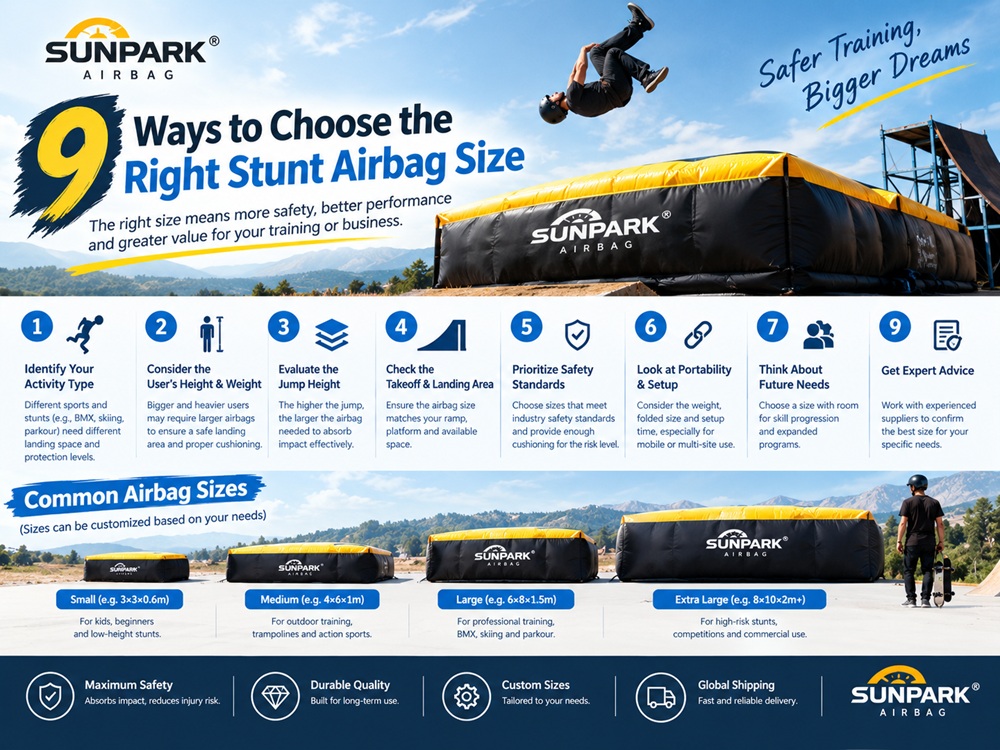
Measuring 3×3 meters or 4×4 meters with an operating height of 1.2 to 1.5 meters, this compact powerhouse connects to a single 1.5 HP portable blower and reaches full operating pressure in under 90 seconds. Don’t mistake this for a thin novelty mat: it features an authentic dual-pressure internal baffle system that safely handles drops and dismounts up to 2.5 meters. The outer shell uses 0.55mm commercial PVC with heavy-duty D-ring anchor tie-downs, allowing secure anchoring to asphalt, grass, or gymnasium hardwood floors. For mobile operators, this versatile inflatable crash mat delivers professional liability protection wherever you set up camp.
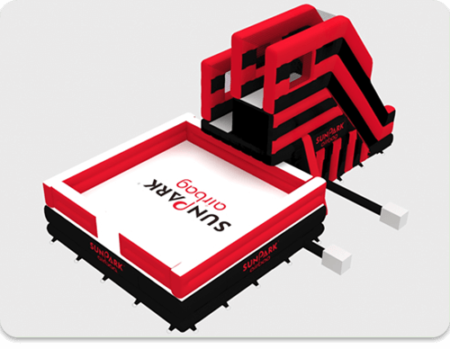
Flagship Equipment Spotlight: Sunparkairbag Twin-Platform Free Fall Airbag
Engineered specifically to solve the psychological barrier and physical risks of high-altitude jumps, the Sunparkairbag Twin-Platform Free Fall Airbag delivers a thrilling, safe freefalling experience suitable for ages 6 to 65. Built with progressive difficulty tiers and commercial-grade durability, it transforms any gym, trampoline park, or attraction into an elite destination.
| Platform Architecture | Progressive Twin-Platform Integration (Staggered 3-Meter and 4-Meter Heights) |
| Core Material | Heavy-Duty 0.55mm to 0.9mm Plato Commercial PVC Tarpaulin (Lead-Free & Fire-Rated) |
| Deceleration Technology | Dual-Chamber Pneumatic Relief System (Soft Dynamic Top + Rigid Zero-Bottom Base) |
| Topsheet Construction | High-Tensile Friction-Free Replaceable Ripstop Vinyl with Bungee Anchor Tensioning |
| Blower Requirements | Dual Continuous Commercial Centrifugal Blowers (1.5 HP – 2.0 HP) Included |
| Commercial Certifications | CE, EN 14960, and ASTM F2970 Inflatable Impact Attenuation Compliant |
Operational Deployment Advice: Stop exposing your business to foam pit liability. Review custom dimension and branding configurations on the official Twin-Platform Free Fall Airbags portal, or evaluate our heavy-impact stunt airbag landing solutions.
Direct Technical Comparison: Airbag Architecture, Fabric Specs, and Duty Cycles
| Airbag Model | Base PVC Thickness | Chamber Deceleration Type | Max Safe Drop Height | Sanitization / Cleaning Time | Throughput (Jumpers/Min) |
|---|---|---|---|---|---|
| Sunparkairbag Twin-Platform | 0.55mm – 0.90mm Plato PVC | Dual-Chamber Multi-Valve | 4.5 Meters (15 ft) | 15 Minutes (Wipe-down) | 10 – 14 Jumpers / Min |
| Sunparkairbag Foam Pit Airbag | 0.55mm Heavy-Duty PVC | Dual-Stage In-Ground Baffle | Flush Pit Edge (3.5m) | 15 Minutes (Surface mop) | 12 – 16 Jumpers / Min |
| Sunparkairbag Freerun Stunt | 0.65mm Plato PVC | Dynamic Diagonal Baffle | 3.5 Meters (11.5 ft) | 10 Minutes (Wipe-down) | 8 – 12 Jumpers / Min |
| BigAirBag Revolution | 0.60mm Glossy PVC | Column Deceleration Core | 4.0 Meters (13 ft) | 20 Minutes (Full wash) | 8 – 10 Jumpers / Min |
| Bagjump Action Parkour | 0.55mm – 0.70mm Composite | Vertical Multi-Cellular | 4.0 Meters (13 ft) | 25 Minutes (Cellular flush) | 6 – 9 Jumpers / Min |
| Sunparkairbag Mobile Mat | 0.55mm Portable PVC | Dual Hybrid Rapid Pack | 2.5 Meters (8 ft) | 5 Minutes (Pack & wipe) | 12 – 15 Jumpers / Min |
Pros and Cons: Inflatable Deceleration Systems vs. Open Foam Pits
| Landing Technology | Authentic Operational Strengths (Pros) | Real-World Operational Liabilities (Cons) |
|---|---|---|
| Commercial Dual-Chamber Airbags (e.g., Sunparkairbag Systems) |
|
|
| Traditional Open Foam Cube Pits (Gymnastic Foam Cubes) |
|
|
Commercial Economics: Insurance Premiums, Maintenance Labor, and Throughput
Every commercial gym manager, parkour coach, and trampoline park investor must balance safety against the harsh realities of a profit-and-loss sheet. When evaluated purely on an invoice, ordering five thousand foam cubes appears cheaper than commissioning a custom-engineered dual-chamber inflatable landing airbag. However, evaluating capital expenditure without analyzing operational expenditure (OpEx) is a fatal business mistake.
Consider the authentic operational ledger of a high-volume 6×8-meter landing pit over a 36-month timeline:
- The Foam Pit Money Pit: Purchasing high-density 8-inch foam cubes costs roughly $6,000 to $8,000 initially. However, within 12 to 18 months, cyclic impact fatigue crushes the cellular structure of the foam, turning springy cubes into dense, flat pancakes that fail impact-attenuation tests. Replacing worn-out cubes costs $4,000 annually. Add to this the labor costs: two staff members spending sixteen hours every quarter pulling out cubes, vacuuming foam crumbs, and disinfecting the pit basin ($2,500+ in annual labor). More critically, commercial liability insurers classify open foam pits as extreme risk due to fire propagation and severe cervical spine collision claims, adding thousands of dollars to annual policy underwriting.
- The Inflatable Airbag Balance Sheet: A commercial-grade dual-chamber inflatable jump airbag requires a higher initial capital investment ($8,000 to $16,000 depending on size). However, its ongoing maintenance cost is virtually zero: 30 minutes of surface wipe-down per week with standard sanitizer. The heavy-duty 0.9mm PVC chassis lasts five to eight years under heavy commercial abuse, while the replaceable topsheet absorbs all shoe wear and tear and can be swapped out in fifteen minutes for a fraction of the cost of new foam.
- The Throughput Multiplication Factor: In a commercial parkour class or open-gym session with thirty athletes, a foam pit accommodates roughly 2 to 3 landings per minute because athletes spend 20 to 30 seconds crawling through foam cubes to exit. An athlete landing on a Sunparkairbag rolls onto their feet and clears the landing zone in 4 seconds, accommodating 12 to 15 landings per minute. You triple your lane capacity, eliminate waiting lines, increase drop safety, and elevate your facility throughput dramatically.
To see where these systems are actively deployed, explore real-world facility networks in our comprehensive airbag jump locations guide.
Who Must Invest in a Parkour Airbag vs. Who Can Rely on Traditional Mats
Every dollar allocated to training safety should match your athletic programming, facility ceiling clearances, and drop velocities. Inflatable airbags are transformative for specific facilities, but an over-engineered luxury for others.
Facilities That Must Invest in a Parkour Landing Airbag:
- Commercial Parkour & Freerunning Academies: If your curriculum teaches wall-spins, high-bar laches, double front-flips, and precision gap jumps from elevated structures, traditional crash mats provide inadequate deceleration depth. An airbag eliminates the fear of hard impacts, allowing athletes to commit fully to difficult aerial rotations without hesitation.
- Trampoline Parks & Action Entertainment Centers: Venues catering to the general public—where spatial awareness ranges from athletic teens to uncoordinated children—cannot risk foam pit bottoming accidents or biological contamination. Dual-chamber airbags deliver unyielding liability protection and rapid patron rotation.
- Professional Stunt Training & Film Academies: Stunt performers rehearsing high-elevation falls from scaffolding, building roofs, or trusses require certified deceleration platforms that absorb erratic body orientations safely. For heavy impact engineering, explore our heavy-duty big jump airbag system.
Facilities That Can Stick with Traditional Foam Crash Mats:
- Low-Impact Youth Gymnastics Studios: If your training programming is strictly restricted to floor beam routines, cartwheels, and low-velocity forward rolls beneath 1.2 meters, standard vinyl-wrapped dense polyurethane foam mats are entirely sufficient and require zero blower noise.
- Facilities Without Continuous Electrical Power: Inflatable airbags require continuous running electrical blowers. If you train in off-grid warehouses, outdoor community parks without generator access, or facilities with erratic power grids, relying on an active pneumatic system introduces operational failure risks.
Critical Mistakes Facilities Make When Purchasing and Operating Airbags
Factory Floor Advisory: The Single-Chamber “Carnival Bounce” Trap
The most disastrous blunder an athletic facility can make is purchasing an inexpensive single-chamber promotional stunt bag from an unverified overseas novelty inflatables factory. Single-chamber bags do not possess a pressurized lower safety deck. When an athlete lands from a 4-meter drop, the single chamber displaces air radially, allowing the jumper to punch straight through the air cushion and impact the hard concrete floor below. Always mandate an engineered, dual-chamber system with a permanently pressurized lower base.
- Allowing Shoes with Exposed Metal Eyelets or Buckles: While commercial PVC tarpaulin is exceptionally tear-resistant, sharp metal grommets, buckles, or open pocket keys can puncture top sheets or tear tensioned bungee cords under heavy impact. Enforce a strict apparel policy: athletes must jump in athletic socks, specialized parkour shoes with rubberized eyelets, or barefoot.
- Buying Used Airbags Without Internal Baffle Inspections: Purchasing a discounted secondhand airbag without inspecting the internal chamber baffles is an immense safety gamble. If the internal tie-in webbing has ripped from years of water infiltration or mold, the airbag will balloon outward upon impact, failing to hold its calibrated geometric deceleration shape. If evaluating secondhand gear, read our technical inspection guide on buy used airbag landing tips before signing a bill of sale.
- Ignoring Continuous Air Blower Sizing & Voltage Drops: Connecting a 2.0 HP commercial blower to an undersized 100-foot extension cord causes severe electrical voltage drop, leading to motor overheating and unexpected shutdown. If a blower cuts out while an athlete is mid-air, catastrophic depressurization can occur within seconds. Always wire blowers to dedicated, breaker-isolated circuits and install low-pressure warning alarms.
- Neglecting Topsheet Tensioning Calibrations: The ripstop topsheet is not a static canvas; it is an active mechanical component held under tension by heavy-duty marine-grade shock bungees or Velcro rails. If operators allow the topsheet to sag loose, athletes will land directly into an un-tensioned fabric pocket, entangling their limbs and increasing knee twisting risks. Check topsheet tension daily during morning pre-opening inspections.
Essential Sourcing Checklist: Auditing Airbag Manufacturers
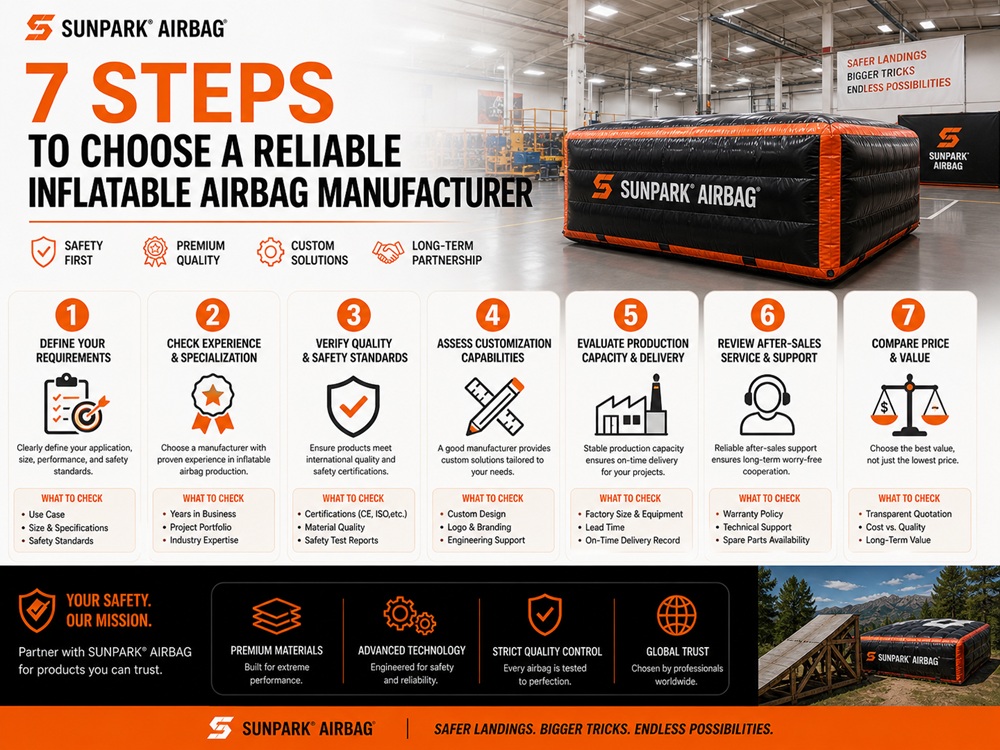
Before issuing a commercial purchase order or transferring a deposit to an airbag manufacturer, audit prospective vendors against these four non-negotiable manufacturing and safety benchmarks:
1. Verified Raw Material Provenance: Plato 0.55mm to 0.90mm PVC
Never accept generic “commercial PVC” claims. Demand certified material datasheets verifying high-tensile Plato PVC tarpaulin (1000D 18oz or 28oz). The material must be certified lead-free, UV-stabilized, and compliant with international flammability standards:
- National Fire Protection Association (NFPA) 701 Standard for Fire Tests for Flame-Resistant Textiles.
- European Standard EN 13501-1 fire classification for commercial building interior products.
Cheap laminated polyester will crack, delaminate, and release toxic fumes under fire marshal inspections.
2. Dual-Chamber Pressure Baffle Geometry & Valve Calibration
Inspect the internal structural schematics. A true parkour landing airbag must feature:
- An independent, fully isolated lower base chamber with dedicated non-venting baffles.
- An upper chamber with precision-engineered, adjustable hook-and-loop or zippered pressure-relief ports that allow facility operators to dial in the softness curve for lightweight children versus heavy adult athletes.
- Seamless high-frequency radio welding along all primary air retention seams, backed by multi-row reinforced nylon stitching.
3. Independent Third-Party Impact Safety Certifications
Demand documented impact attenuation testing reports from accredited safety laboratories verifying compliance with:
- ASTM International: ASTM F2970 Standard Practice for Inflatable Impact Attenuation Devices.
- European Committee for Standardization: EN 14960 Inflatable Play Equipment Safety Standards.
- International Gymnastics Federation (FIG) Apparatus Safety Norms for elite landing surfaces.
If a manufacturer cannot produce accredited laboratory deceleration graphs showing peak G-force curves below 15G, do not allow human beings to fall onto their products.
4. Total Multi-Discipline Engineering Versatility
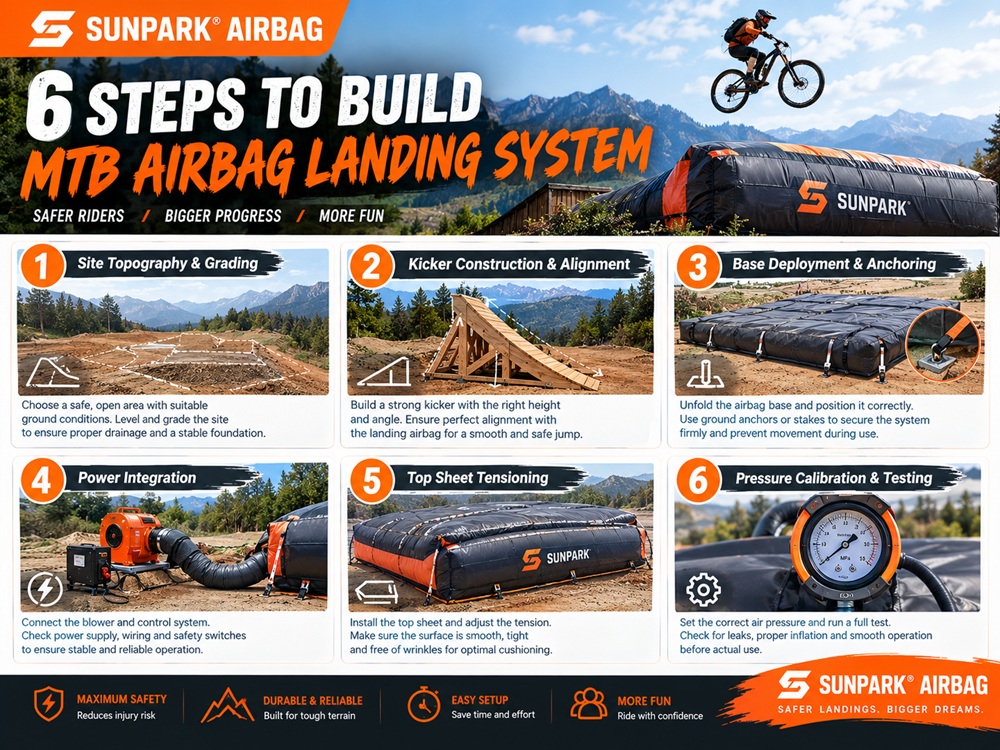
Ensure your manufacturing partner understands the broader biomechanics of action sports. A supplier that manufactures across diverse extreme impact disciplines—such as technical bike airbag landing ramps, mountain bike trick zones (see our mountain bike airbag landing guide and bike airbag landing systems), and massive FMX landing airbag for sale platforms—possesses the structural engineering expertise required to construct parkour equipment that will survive years of commercial punishment.
Expert Safety Verdict: The Professional Facility Blueprint
In our professional assessment across decades of action sports facility consulting and commercial inflatables engineering, continuing to operate dangerous, dusty, and high-liability open foam pits in a modern parkour or trampoline facility is an obsolete practice that damages brand credibility and drains operating margins. The technical evolution of dual-chamber impact attenuation has rendered loose foam completely obsolete.
Here is your decisive, field-tested procurement roadmap:
- For High-Altitude Freefall Towers & Progression Platforms: Settle for nothing less than the Sunparkairbag Twin-Platform Free Fall Airbag. The progressive 3-meter to 4-meter drop geometry provides the ultimate psychological stepping-stone for progressing athletes, while the dual-chamber Plato PVC chassis guarantees zero bottoming out, unmatched durability, and rapid 4-second exit throughput that keeps your revenue lines flowing.
- For In-Ground Gym Modernization: Retrofit existing concrete pits with a custom-tailored Sunparkairbag Inflatable Foam Pit Replacement. You immediately eliminate lung-damaging foam dust, slash quarterly cleaning labor by 90%, cut catastrophic fire liabilities, and present an immaculate, hygienic training environment that parents and professional athletes trust implicitly.
- For Traveling Demos & Pop-Up Workshops: Equip your team with the Sunparkairbag Mobile Inflatable Crash Mat, securing professional stunt-grade liability protection that sets up in 90 seconds from the back of an SUV.
Stop compromising with outdated foam cubes and risky single-chamber bounce houses. Invest in an engineered, dual-chamber pneumatic deceleration system, protect your athletes from axial shock, and elevate your facility into an elite, high-profit training sanctuary.
Frequently Asked Questions
Dual-chamber airbags feature two completely separate air volumes: a soft, depressurizing upper cushion and a rigid, high-pressure lower safety base. When an athlete impacts the top sheet, dynamic air-release valves exhaust air to absorb kinetic impact energy gradually. The pressurized lower chamber prevents the jumper from bottoming out against the concrete floor, even during high-velocity drops or awkward rotational landings.
Traditional open foam cube pits generate toxic polyurethane dust, harbor bacterial biofilms and bodily fluids, break down into microplastics, and present catastrophic structural fire liabilities. A heavy-duty PVC parkour landing airbag eliminates dust inhalation entirely, can be sanitized with hospital-grade surface disinfectants in minutes, complies with strict commercial flame retardancy standards, and reduces daily maintenance labor by up to 90%.
Yes. Unlike stunt fall bags of the past that swallow athletes into a deep crater requiring assistance to exit, modern parkour landing airbags utilize tensioned, replaceable ripstop top sheets. Athletes can absorb high impacts safely, roll out, and walk off the surface within three to four seconds, preserving high throughput in commercial training facilities.
Standard commercial parkour airbags spanning 5×5 meters to 8×10 meters typically operate using one to two continuous industrial centrifugal air blowers (1.5 HP to 2.0 HP each), pulling between 1100W and 1500W on standard 110V or 220V circuits. Systems require constant airflow to replenish exhausted kinetic pressure continuously.
Authoritative Standards & Safety References
- ASTM International: ASTM F2970-20 Standard Practice for Design, Manufacture, Installation, Operation, Maintenance, Inspection and Major Modification of Trampoline Courts and Inflatable Impact Attenuation Devices
- European Committee for Standardization (CEN): EN 14960 Inflatable Play Equipment – Safety Requirements and Test Methods for Impact Deceleration
- Fédération Internationale de Gymnastique (FIG): Official Apparatus Norms & Safety Criteria for Acrobatic Landing Surfaces