Mountain bike progression often comes down to one difficult decision: should a rider attempt a new trick, jump, or technical maneuver before feeling completely confident? Practice is essential, but repeatedly attempting unfamiliar skills on hard ground can make riders hesitate, limit experimentation, and increase the consequences of mistakes.
An MTB airbag offers a practical solution by providing an inflatable landing surface for selected mountain bike training activities. Riders can practice jumps, develop aerial awareness, experiment with new techniques, and become more familiar with landing movements in a controlled training environment.
However, an MTB airbag is not simply a large inflatable mattress. Its dimensions, landing geometry, inflation system, surface design, and intended riding discipline all influence how useful it will be. A poorly selected airbag can create additional training limitations rather than solve them.
From our experience developing airbags for extreme sports and leisure facilities, the greatest value comes from integrating the right landing system into a structured training program. This article explains nine practical ways an MTB airbag can improve mountain bike training, who benefits most, and what operators should consider before investing in one.
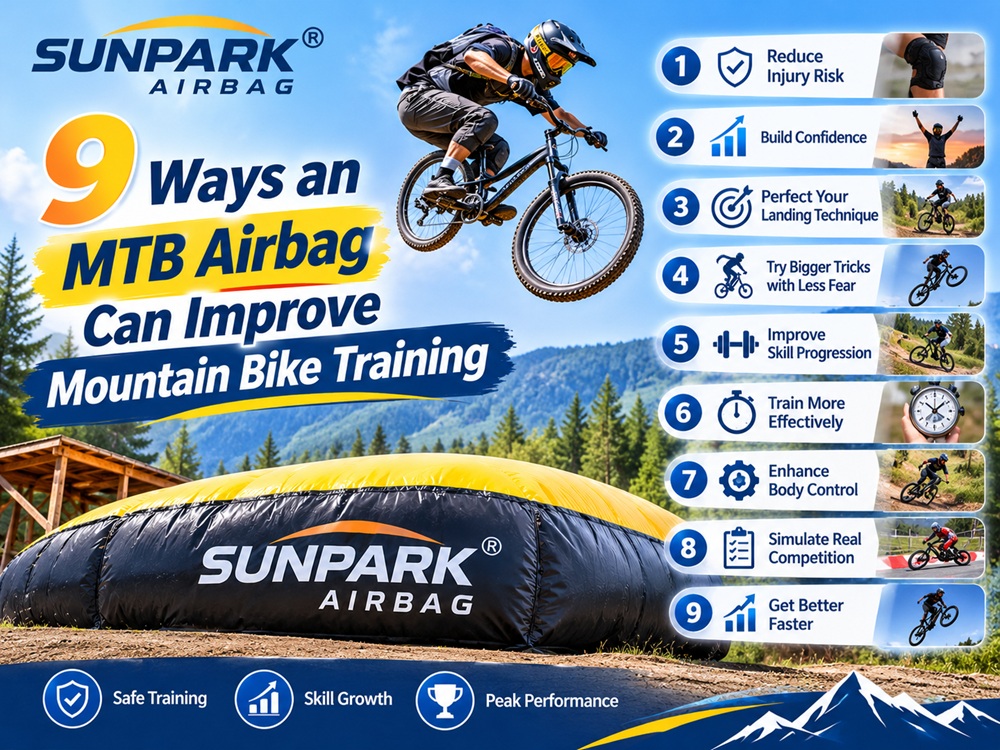
Quick Answer: How Can an MTB Airbag Improve Mountain Bike Training?
An MTB airbag improves mountain bike training by providing a purpose-designed inflatable landing surface for practicing selected jumps and aerial techniques. It can help riders increase practice opportunities, build confidence, evaluate body positioning, and progressively develop skills in a controlled environment.
- What it is: An inflatable landing system designed for mountain bike jump and trick training.
- How it works: An air-filled structure absorbs and distributes landing forces through its engineered chambers and surface configuration.
- Main benefits: More controlled practice, confidence development, technique repetition, and reduced exposure to hard-ground landings during suitable drills.
- Limitations: It does not eliminate injury risk, replace coaching, or reproduce every condition of a natural trail or competition landing.
- Who should use it: Bike parks, MTB training centers, freestyle facilities, coaches, and riders practicing suitable aerial skills.
- Who does not need it: Riders focused exclusively on ordinary trail riding or basic cycling skills without jump-training requirements.
- Common mistakes: Choosing an undersized landing system, ignoring approach geometry, and treating an airbag as a guarantee of safe landings.
- Buying considerations: Landing dimensions, air pressure management, construction, anchoring, maintenance, installation, and supplier support.
Our recommendation: For facilities that regularly teach or host MTB jump progression, an appropriately engineered MTB airbag can be a valuable training investment. It should complement coaching, protective equipment, and progressive skill development rather than replace them.
What Is an MTB Airbag and How Does It Work?
An MTB airbag is a large inflatable landing structure designed to provide a more forgiving landing surface for selected mountain bike jumps and freestyle training activities.
Unlike a conventional crash mat, an MTB airbag uses an engineered inflatable structure to manage the impact of a landing. Depending on the design, it may incorporate multiple air chambers, controlled pressure zones, reinforced fabric, specialized landing surfaces, and dedicated inflation equipment.
When a rider lands, the airbag deforms under the applied load. Air moves or compresses within the designed structure, allowing the landing surface to absorb and distribute some of the impact energy.
How an MTB Airbag Training System Is Configured
A typical MTB airbag installation may include:
- Approach ramp: Provides the takeoff geometry needed for the intended training activity.
- Landing surface: Receives the rider and is designed around the expected landing trajectory.
- Inflatable structure: Provides the air-filled volume and impact-management characteristics.
- Blower system: Maintains the operating pressure specified by the manufacturer.
- Anchoring system: Helps prevent unwanted movement during operation.
- Access and recovery area: Allows riders and staff to manage training sessions and clear the landing zone.
The configuration must match the intended bike, takeoff speed, jump height, rider skill level, and landing requirements. A system designed for one action-sports application should not automatically be assumed suitable for mountain bikes.
Quick Summary: 9 Ways an MTB Airbag Can Improve Mountain Bike Training
| Training Benefit | How It Helps | Best Application |
|---|---|---|
| 1. More practice repetition | Supports repeated attempts in a dedicated training environment. | Jump fundamentals and aerial drills |
| 2. Greater confidence | Can reduce hesitation associated with practicing over hard ground. | Intermediate rider progression |
| 3. Better body awareness | Provides opportunities to review body positioning and landing movements. | Jump technique development |
| 4. Freestyle trick development | Creates a more forgiving environment for selected aerial practice. | Advanced freestyle training |
| 5. Progressive learning | Allows skills to be introduced in a structured training sequence. | Coached skill development |
| 6. Technique evaluation | Provides a consistent landing area for observation and video review. | Coaching and performance analysis |
| 7. Training variety | Supports different drills and training session formats. | Dedicated MTB facilities |
| 8. Coaching efficiency | Creates a dedicated environment for demonstrations and supervised practice. | Group lessons and training camps |
| 9. Facility versatility | Can become an additional attraction and training resource. | Bike parks and commercial sports centers |
1. An MTB Airbag Allows Riders to Practice More Repeatedly
Mountain bike skills require repetition. A rider may understand the theory of jumping but still struggle to coordinate takeoff timing, bike control, body position, and landing preparation.
One of the most useful advantages of an MTB airbag is that it can provide a dedicated environment for repeating selected jump-training exercises.
Why Repetition Matters in MTB Training
Consider an intermediate rider learning to maintain a stable position during a jump. On a conventional dirt landing, an unsuccessful attempt may involve a hard impact, equipment damage, or a long recovery period before the next attempt.
On a properly designed and supervised MTB airbag setup, the rider can practice selected movements with a more forgiving landing surface. This may make it easier to schedule repeated drills and focus on individual technique elements.
Examples include:
- Practicing consistent takeoff posture.
- Maintaining a stable position in the air.
- Developing awareness of bike orientation.
- Learning to prepare for a landing.
- Reviewing the consistency of repeated attempts.
Why This Matters for Training Facilities
For commercial users, a dedicated landing system can support more structured training sessions. Coaches can organize drills around specific learning objectives instead of relying entirely on outdoor terrain conditions.
However, repetition should never mean rushing attempts. Riders need appropriate rest, instruction, and progressive difficulty.
2. An MTB Airbag Helps Riders Build Confidence Before Attempting Difficult Jumps
Confidence is an important part of mountain bike progression. Riders who are uncertain about landing consequences may hesitate during takeoff, interrupt their movement, or avoid attempting techniques they have already learned in theory.
An MTB airbag can help address some of this hesitation by changing the training environment.
Reduce the Psychological Barrier to Learning
For example, an intermediate rider may be comfortable riding normal trails but feel uncomfortable practicing a new aerial movement over a hard dirt landing.
A properly selected airbag training setup provides an alternative landing surface for suitable drills. The rider can focus on learning the movement while coaches monitor approach speed, body positioning, and overall execution.
This can help create a more manageable progression from basic jumping skills toward more advanced techniques.
Confidence Must Still Be Supported by Skill
An airbag should not encourage riders to attempt tricks beyond their current ability. Confidence without sufficient preparation can create dangerous decisions.
We recommend establishing clear prerequisites before moving to a more difficult exercise. Riders should understand the approach, takeoff mechanics, equipment requirements, and expected landing behavior.
For beginners, the initial objective should be controlled jumping fundamentals rather than advanced tricks.
3. An MTB Airbag Helps Riders Improve Body Position and Landing Awareness
Jumping is not simply about gaining height. A rider must coordinate the bicycle and body throughout takeoff, flight, and landing.
An MTB airbag can provide a consistent landing environment in which coaches can observe how riders approach and complete selected jump movements.
Focus on Three Important Training Stages
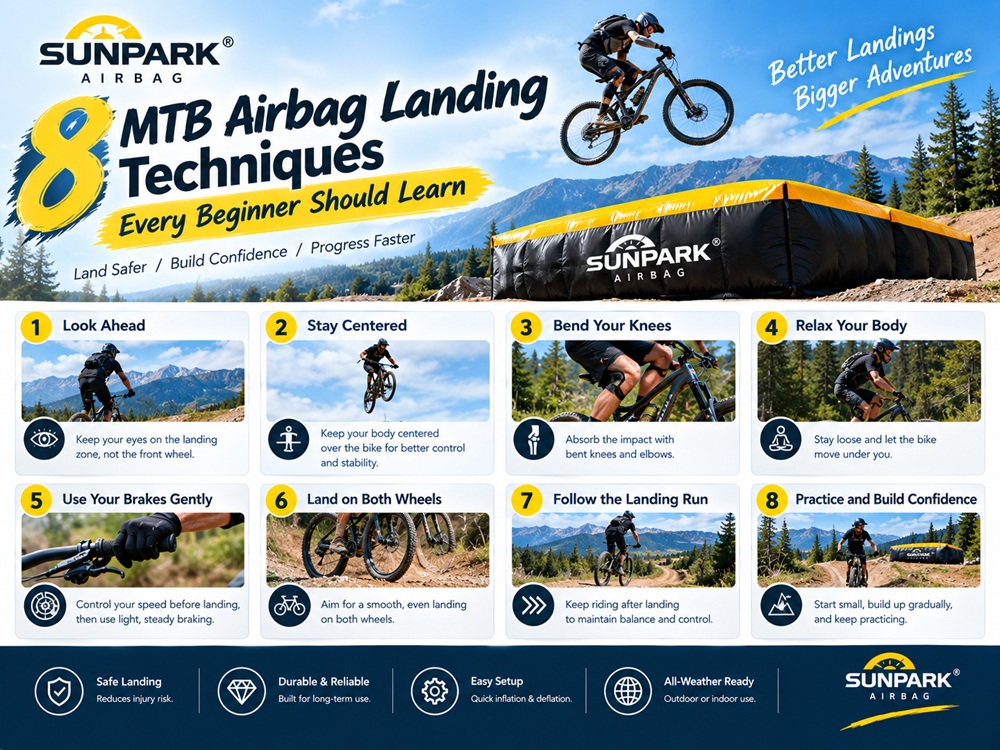
Takeoff: Riders need to develop consistent approach positioning and understand how their body movements influence the bike’s trajectory.
Flight: Riders should develop awareness of bike orientation, body balance, and the timing of movements in the air.
Landing preparation: Riders need to understand how to align the bicycle with the landing surface and maintain an appropriate body position.
The airbag provides an opportunity to observe these stages without depending exclusively on hard-ground landing practice.
Use Video Review to Identify Technique Problems
Coaches can record training attempts from different angles to review body position and bike movement.
For example, side-view footage may help identify inconsistent takeoff timing, while front-view footage may reveal unwanted lateral movement.
However, landing on an inflatable surface does not perfectly reproduce the feedback of a conventional dirt landing. Riders must eventually transfer their skills to the actual terrain where they intend to ride.
4. An MTB Airbag Supports the Learning of New Freestyle Tricks
Advanced mountain bike freestyle techniques often require riders to coordinate several movements while airborne. New tricks can involve rotation, changes in bike orientation, controlled separation from the bicycle, and precise timing.
For these activities, a suitable MTB airbag can provide an additional training option.
Useful Applications for Freestyle Riders
Depending on the system design, coaching setup, and rider experience, an airbag may be used for selected training activities involving:
- Basic aerial control exercises.
- Jump technique development.
- Body-position awareness.
- Progressive freestyle movement drills.
- Selected advanced trick-training exercises.
For advanced riders, the main advantage is the opportunity to work on specific movements in a dedicated environment rather than immediately transferring every new technique to hard terrain.
Choose a Purpose-Built Landing System
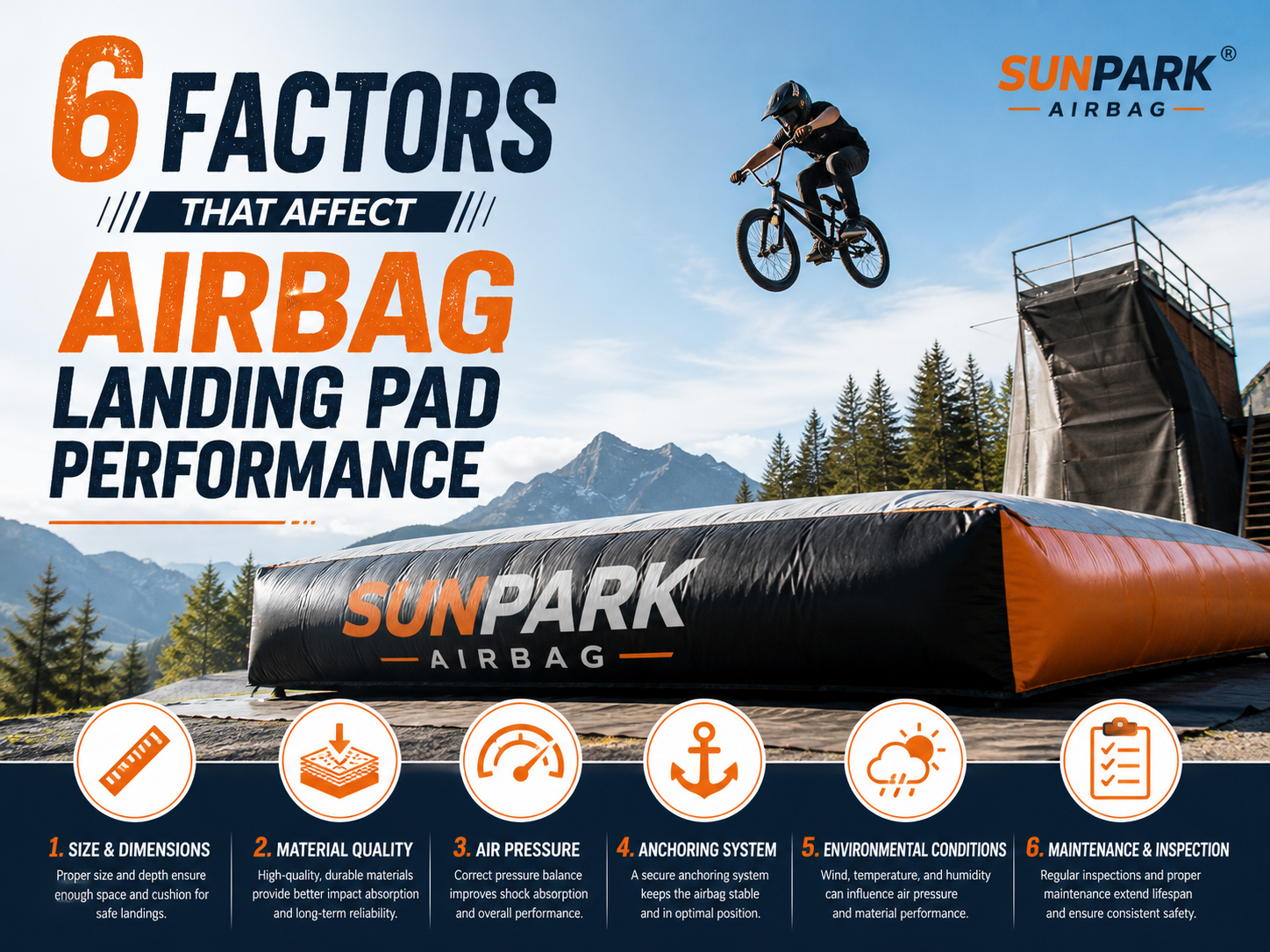
Not every inflatable airbag is designed to accommodate bicycles, bicycle components, and the landing trajectories associated with MTB jumps.
A gymnastics airbag, stunt airbag, and MTB airbag may have different surface geometry, internal construction, and intended operating conditions.
For example, a purpose-built MTB airbag landing system should be evaluated according to its intended bike applications, jump configuration, and manufacturer specifications.
We do not recommend choosing an airbag simply because its advertised dimensions appear large enough. The complete landing system must be suitable for the activity.
5. An MTB Airbag Makes Progressive Skill Development Easier to Organize
Effective mountain bike training should move from simple movements toward more complex skills. An MTB airbag can become one component of a structured progression program.
Build a Training Progression Around Rider Ability
Rather than allowing riders to attempt increasingly difficult jumps without preparation, coaches can organize sessions into stages.
| Training Stage | Primary Objective | Example Activities | Progression Requirement |
|---|---|---|---|
| Foundation | Understand basic jump mechanics | Approach positioning and controlled takeoff drills | Demonstrate consistent basic technique |
| Intermediate | Improve aerial awareness | Controlled jump and body-position exercises | Maintain stable and repeatable movements |
| Advanced | Develop more complex aerial movements | Selected freestyle drills | Coach approval and demonstrated prerequisites |
| Transfer | Apply learned techniques to real riding environments | Appropriate dirt jump and trail practice | Adapt to real terrain and landing conditions |
This structure helps coaches identify whether a rider is ready for the next exercise.
Why Progressive Training Is Better Than Random Attempts
Randomly increasing jump difficulty can lead to inconsistent learning and unnecessary exposure to risk.
A structured program makes it easier to track individual performance, identify technique weaknesses, and decide when a rider should move to another training environment.
For commercial training centers, this also makes lesson planning more repeatable across different instructors and rider groups.
6. An MTB Airbag Creates Better Opportunities for Technique Evaluation
One overlooked advantage of a dedicated MTB airbag is the ability to establish a relatively consistent landing environment for reviewing training attempts.
In outdoor riding, weather, terrain conditions, landing surfaces, and approach conditions may change from one session to another. A purpose-built training facility can control more of these variables.
Combine an Airbag With Video Analysis
Video analysis can help riders and coaches evaluate:
- Consistency of the approach.
- Takeoff timing.
- Bike orientation during flight.
- Body positioning.
- Landing preparation.
- Differences between successful and unsuccessful attempts.
For example, a coach may identify that a rider consistently approaches a jump with excessive lateral movement. By reviewing several attempts, the coach can identify patterns and adjust the training exercise.
Establish Objective Training Records
Training centers can maintain records of rider progression, coaching observations, and skill assessments.
These records are particularly useful for recurring lessons, development programs, and performance-oriented training groups.
It is important to remember that the airbag itself does not evaluate technique. Its value comes from providing a training environment that supports observation, feedback, and structured practice.
7. An MTB Airbag Adds Variety to Mountain Bike Training Sessions
Training programs become less effective when every session focuses on the same exercises without addressing different skill requirements.
An MTB airbag gives coaches another environment in which to organize suitable jump-related activities.
Build More Varied Training Sessions
A facility may combine airbag training with:
- Basic bike-handling exercises.
- Balance and control drills.
- Jump approach practice.
- Strength and conditioning.
- Outdoor riding sessions.
- Video-based performance reviews.
This approach allows coaches to separate technical development from general riding practice.
Use Different Equipment for Different Training Objectives
An MTB airbag should not be expected to replace every type of training equipment.
For example, a gym airbag for training may be appropriate for certain gym-based activities, while an inflatable crash mat may serve different controlled landing or general sports applications.
For mountain bike facilities, the key is to select equipment based on the intended activity rather than assuming that all inflatable products provide equivalent performance.
8. An MTB Airbag Can Improve Coaching and Group Training Efficiency
For mountain bike training facilities, coaching efficiency has a direct commercial impact.
Instructors need equipment and training areas that allow them to organize sessions, demonstrate techniques, observe riders, and manage participation.
Create a Dedicated Training Station
A permanent or appropriately installed MTB airbag can become a dedicated jump-training station.
Instead of relying exclusively on outdoor jump locations, a facility can schedule selected training exercises around a consistent setup.
This may be useful for:
- MTB coaching schools.
- Freestyle development programs.
- Private rider training.
- Sports camps.
- Bike park skill-development sessions.
Organize Group Training More Effectively
Coaches can divide participants into groups according to ability and training objectives.
One group may work on basic jump fundamentals, while another receives individual coaching or reviews previous attempts. All participants should remain under appropriate supervision, with controlled access to the landing area.
For commercial operators, this can make the airbag a useful addition to the facility’s training infrastructure.
Safety Management Still Determines Session Quality
Group training requires clear operating rules. Operators should manage rider spacing, landing-zone access, equipment inspection, and emergency procedures.
Only riders who meet the defined prerequisites should use the jump setup. The airbag should never be treated as a substitute for trained instructors or a documented operating procedure.
9. An MTB Airbag Makes a Mountain Bike Facility More Versatile
For bike park owners and sports facility operators, an MTB airbag can provide an additional training and recreational attraction.
Its value is not limited to individual rider progression. It may also help a facility develop new programs, attract freestyle enthusiasts, and diversify its activities.
Expand the Facility’s Training Services
Depending on the target market, operators may use an MTB airbag as part of:
- Beginner and intermediate jump courses.
- Advanced freestyle coaching.
- Seasonal training camps.
- Private training bookings.
- Special sports events.
- Demonstrations and promotional activities.
A well-planned facility can combine the airbag with conventional riding areas, coaching spaces, and other action-sports equipment.
Evaluate the Commercial Return
Before purchasing an MTB airbag, operators should estimate realistic utilization rather than relying on the attraction value alone.
Consider:
- Expected rider attendance.
- Available operating hours.
- Average session price.
- Staffing and supervision expenses.
- Inflation and electricity costs.
- Installation and maintenance costs.
- Seasonal demand and weather conditions.
Simple annual contribution formula:
Annual Training Revenue = Average Paid Sessions per Day × Average Revenue per Session × Operating Days per Year.
From this figure, subtract operating expenses, staffing, maintenance, insurance, marketing, and other facility costs to estimate the contribution generated by the installation.
For commercial users, an MTB airbag is most attractive when it supports regular scheduled training or paid activities rather than remaining an occasional-use attraction.
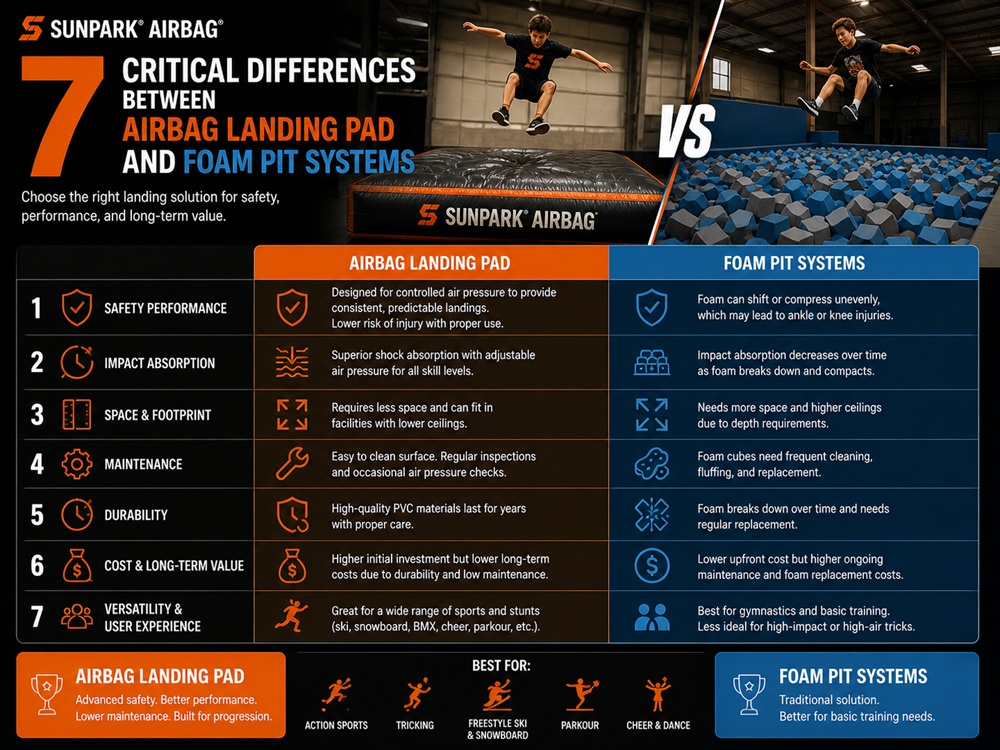
MTB Airbag vs Dirt Landing vs Foam Pit vs Inflatable Crash Mat
An MTB airbag is not the only option for mountain bike skill development. Each training surface has different characteristics, and the right choice depends on the activity, rider experience, available space, and operating budget.
| Training Surface | Main Advantage | Limitations | Best Application |
|---|---|---|---|
| MTB airbag | Purpose-designed inflatable landing environment for selected bike jump training | Requires correct setup, pressure management, anchoring, and maintenance | Dedicated MTB jump progression facilities |
| Dirt landing | Provides realistic riding conditions and terrain feedback | Surface conditions and impact characteristics vary; mistakes may have serious consequences | Real-world jump technique and riding transfer |
| Foam pit | Provides a loose landing medium for selected freestyle training | Requires space, cleaning, maintenance, and appropriate access arrangements | Specialized freestyle and indoor training facilities |
| Inflatable crash mat | Can support various controlled landing exercises | General-purpose designs may not be suitable for MTB jump trajectories | General sports and controlled impact training |
Which Training Surface Should You Choose?
Choose an MTB airbag when your facility regularly provides mountain bike jump training and needs a dedicated landing system designed for that application.
Choose dirt landings when the objective is to develop real-world riding skills and adapt to natural terrain. Dirt practice remains essential for transferring techniques into actual mountain biking environments.
Choose a foam pit when the facility specializes in certain freestyle movements and has the space and operational capacity to maintain a foam-based training environment.
Choose a general inflatable crash mat only when its specifications and intended use match the training activity. Do not assume that a general-purpose product can safely accommodate a mountain bike landing.
For facilities evaluating different inflatable products, SUNPARK® AIRBAG also offers other stunt airbag landing solutions and inflatable jump airbags for different sports applications.
Pros and Cons of Using an MTB Airbag for Mountain Bike Training
An MTB airbag offers clear training advantages, but it also introduces equipment, installation, and operating requirements. Buyers should consider both sides before making an investment.
| Advantages | Limitations |
|---|---|
| Provides a more forgiving landing surface for suitable training drills. | Does not eliminate the possibility of serious injury. |
| Supports repeated practice of selected jump techniques. | Incorrect technique can still create dangerous landings. |
| Can help riders develop confidence in a controlled environment. | Confidence must be supported by actual ability and coaching. |
| Creates opportunities for video review and technique feedback. | Airbag landings do not reproduce all dirt or trail conditions. |
| Can support commercial coaching programs and training camps. | Requires staffing, supervision, and operating procedures. |
| Provides an additional attraction for dedicated sports facilities. | Requires investment, maintenance, and suitable installation space. |
| Can be configured for specific training requirements. | Customization and transport may increase procurement complexity. |
Our assessment: The advantages are most relevant to dedicated training facilities, freestyle programs, and bike parks with regular jump-training demand. For an individual rider who only rides natural trails, the cost and space requirements may make an MTB airbag unnecessary.
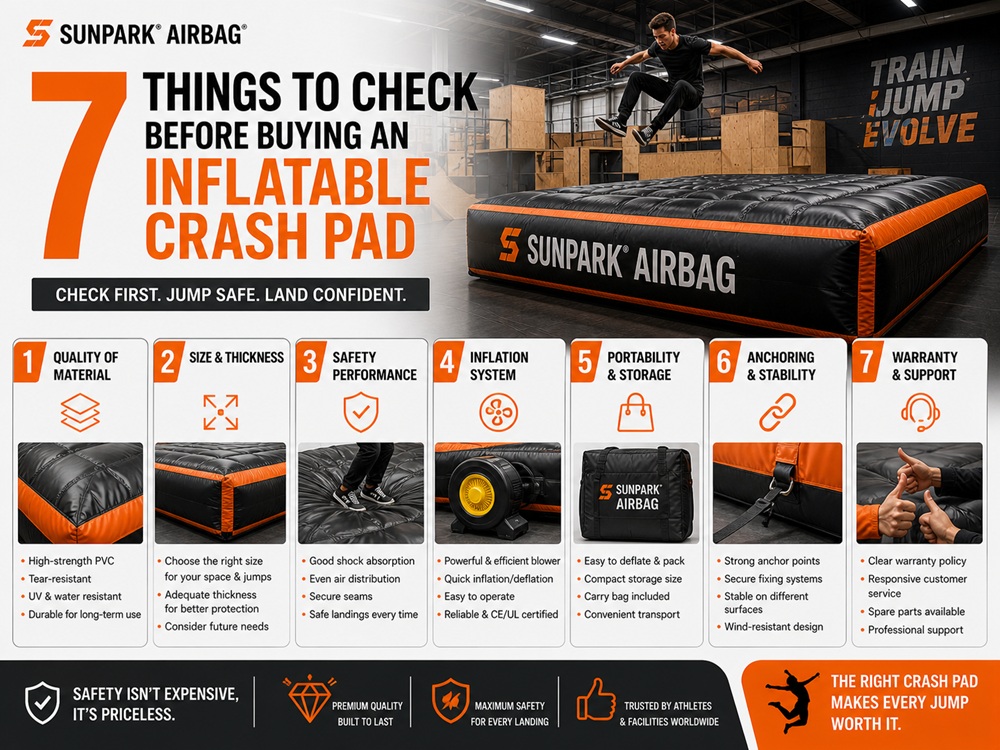
How to Choose the Right MTB Airbag for Your Training Facility
Choosing an MTB airbag is a technical purchasing decision. A product that looks impressive in promotional photographs may not match your actual jump configuration or training requirements.
We recommend evaluating the following factors before requesting a quotation.
1. Confirm the Intended Riding Application
Start by identifying the primary purpose of the installation.
Is the airbag intended for beginner jump training, intermediate skill development, advanced freestyle practice, or a commercial bike park?
Different applications require different landing configurations. The supplier should understand the intended bicycle type, takeoff characteristics, expected landing trajectory, and user skill level.
2. Evaluate Landing Dimensions
Landing dimensions should be considered in relation to the takeoff ramp and expected rider trajectory.
Important measurements include:
- Overall length and width.
- Landing surface geometry.
- Landing-zone usable area.
- Height and profile.
- Clearance around the structure.
- Required installation footprint.
Do not select an airbag solely because it has a larger landing area. The entire jump configuration must be engineered for the intended application.
3. Check Material Quality and Construction
Material selection influences durability, seam integrity, abrasion resistance, and maintenance requirements.
Ask the manufacturer about:
- Fabric type and material specifications.
- Coating and surface characteristics.
- Seam construction and reinforcement.
- Internal chamber design.
- Repair procedures.
- Expected maintenance requirements.
For commercial facilities, the supplier should explain how the product is intended to be inspected and maintained under regular use.
4. Understand the Inflation System
The blower system is an essential part of the installation.
Buyers should confirm the required blower specifications, power supply, operating pressure, airflow requirements, and whether continuous inflation is necessary.
Ask how the manufacturer recommends monitoring operating pressure and responding to blower interruptions.
Never assume that every MTB airbag uses the same pressure or inflation arrangement. Follow the specific product’s operating instructions.
5. Evaluate Anchoring and Installation Requirements
An MTB airbag must remain appropriately positioned during use.
Ask about ground preparation, anchoring points, installation procedures, environmental exposure, and required clearance zones.
Outdoor facilities should also consider wind exposure, drainage, weather protection, and site-specific installation conditions.
6. Request Samples of Technical Documentation
A professional manufacturer should provide clear product information and explain the intended application.
Request relevant documentation covering:
- Product dimensions and specifications.
- Material information.
- Blower requirements.
- Installation instructions.
- Operating and inspection procedures.
- Repair and maintenance guidance.
- Warranty terms.
For commercial projects, also discuss applicable product safety requirements, insurance expectations, and local facility regulations.
7. Compare Manufacturers Based on Technical Support
Price matters, but it should not be the only purchasing criterion.
A supplier that understands extreme sports applications may be better equipped to discuss installation, configuration, maintenance, and product customization.
For buyers comparing inflatable MTB airbag solutions, we recommend requesting a detailed technical quotation rather than comparing headline prices alone.
Ask whether the supplier can support project planning, custom dimensions, blower selection, shipping, installation guidance, and after-sales service.
8. Calculate Total Cost of Ownership
The purchase price is only one part of the investment.
Consider:
- Product manufacturing cost.
- International shipping and import duties.
- Site preparation and installation.
- Blower electricity consumption.
- Staffing and supervision.
- Routine inspection and maintenance.
- Replacement parts and repair costs.
- Expected utilization and operating revenue.
A cheaper product may become more expensive over time if it requires frequent repairs or does not suit the facility’s operating conditions.
Common Mistakes When Using an MTB Airbag for Training
1. Assuming an Airbag Makes Every Jump Safe
This is the most important misconception to avoid. An airbag can provide a more forgiving landing environment, but it cannot prevent every injury. Incorrect takeoff, collisions, unsuitable landing positions, and equipment failure remain serious concerns.
2. Using a General-Purpose Airbag for MTB Applications
Different sports require different landing characteristics. A gymnastics airbag or general inflatable mat should not be used for bicycle jump training unless the manufacturer explicitly confirms its suitability.
3. Ignoring the Relationship Between Takeoff and Landing
The landing system must match the jump geometry. A suitable landing surface cannot compensate for an incorrectly configured takeoff ramp or an unsuitable approach.
4. Choosing the Cheapest Available Product
Price comparisons that ignore construction, technical specifications, blower requirements, and support can lead to poor purchasing decisions.
If you are working with a restricted budget, review purpose-specific cheap MTB airbag options, but verify that each product actually meets your requirements.
5. Neglecting Inspection and Maintenance
Fabric damage, worn seams, blower problems, anchoring issues, and pressure irregularities can compromise the intended operation of the equipment.
Establish inspection procedures before opening the facility and follow the manufacturer’s maintenance instructions.
6. Allowing Riders to Progress Too Quickly
Riders should not attempt advanced tricks simply because the landing surface appears more forgiving. Coaching, skill prerequisites, protective equipment, and progressive learning remain essential.
7. Failing to Plan the Recovery Area
The landing zone is only one part of the facility layout. Operators also need controlled access, rider recovery space, clear circulation routes, and emergency access.
Our Expert Recommendation: Is an MTB Airbag Worth Buying?
Whether an MTB airbag is worth buying depends primarily on how frequently it will be used and whether the facility has a clear training purpose for it.
For Individual Riders
If you primarily ride trails and occasionally practice small jumps, purchasing a personal MTB airbag may not be the most economical decision.
Accessing an established training facility or supervised airbag session may offer better value than purchasing, installing, and maintaining your own equipment.
For Professional Coaches
An MTB airbag can be a useful addition when your coaching program regularly includes jump technique, aerial awareness, or selected freestyle training.
Before purchasing, consider whether the equipment will support enough sessions to justify its cost and whether the installation can be operated safely with your existing staff and facility layout.
For Bike Parks and Commercial Training Centers
For commercial facilities with consistent demand, a purpose-built MTB airbag may offer substantial operational value.
It can support structured lessons, rider progression programs, training camps, and additional paid activities. However, operators should prepare a complete business case that includes installation, maintenance, staffing, insurance, and utilization assumptions.
For Heavy-Duty and High-Frequency Applications
For facilities expecting regular daily use, construction quality, reinforced materials, reliable blower equipment, accessible repair procedures, and supplier support become especially important.
We recommend prioritizing long-term operating reliability over the lowest initial purchase price.
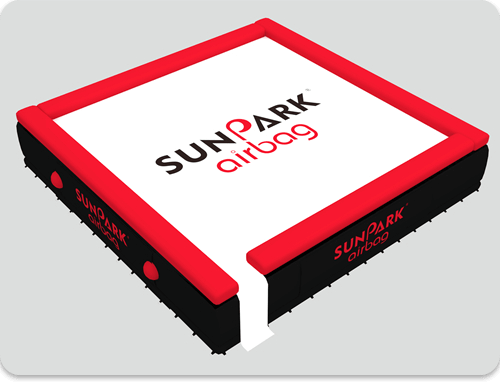
SUNPARK® AIRBAG: Airbag Solutions for Extreme Sports and Training Facilities
With more than 10 years of experience, SUNPARK® AIRBAG develops and manufactures freestyle airbags for ski resorts, theme parks, sports facilities, and gymnastics centers worldwide.
As extreme sports continue to develop, riders and professional sports facilities increasingly require dedicated training equipment that supports skill progression and more controlled practice environments.
SUNPARK® AIRBAG works with professional riders, world champion snowboarders, and trampoline parks, focusing on product development, manufacturing experience, and continuous improvement.
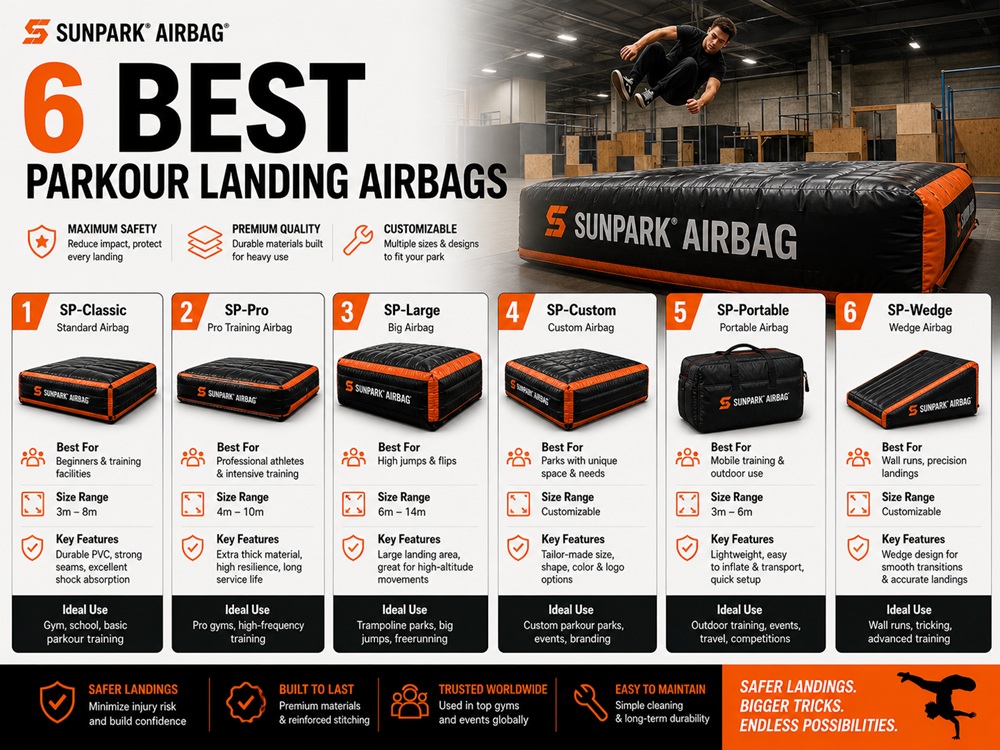
Its product range includes MTB landing systems, stunt airbags, gymnastics airbags, and other inflatable solutions for sports and leisure applications.
For facilities planning a new MTB training installation, the most important step is to define the application, landing dimensions, installation conditions, and operating requirements before selecting the product.
Final Thoughts
An MTB airbag can improve mountain bike training in nine important ways: increasing practice opportunities, supporting rider confidence, improving body awareness, facilitating selected freestyle drills, organizing progressive learning, enabling technique evaluation, adding training variety, supporting coaching programs, and expanding facility capabilities.
Its greatest value comes from providing a dedicated landing environment for specific training objectives. It does not replace real-world riding, qualified instruction, protective equipment, or appropriate safety procedures.
For individual riders, access to a professional training facility may be more practical than purchasing an airbag. For bike parks, coaching schools, and commercial sports centers, a properly selected MTB airbag can become a valuable long-term training asset.
Choose equipment based on technical suitability, construction quality, installation requirements, and total ownership cost. That is the difference between buying an inflatable attraction and investing in a functional mountain bike training system.
To discuss a dedicated MTB airbag installation, explore SUNPARK® AIRBAG MTB landing solutions and request specifications for your intended training application.
Frequently Asked Questions About MTB Airbag Training
1. What is an MTB airbag used for?
An MTB airbag is used for selected mountain bike jump and freestyle training activities. It provides an inflatable landing surface that can support controlled practice of jump technique, aerial awareness, and selected advanced movements. It is commonly considered by bike parks, coaches, and dedicated sports training facilities.
2. Can beginners use an MTB airbag?
Beginners may use a suitable MTB airbag under qualified supervision, provided they meet the manufacturer’s operating requirements and the coach has established appropriate skill prerequisites. Initial sessions should focus on basic bike control and controlled jump fundamentals rather than advanced tricks.
3. Does an MTB airbag prevent mountain bike injuries?
No. An MTB airbag does not eliminate injury risk. It can provide a more forgiving landing environment for suitable exercises, but riders may still experience injuries due to poor takeoff, incorrect body positioning, collisions, landing outside the intended area, or equipment problems.
4. Is an MTB airbag better than a dirt landing?
They serve different training purposes. An MTB airbag can support selected skill-development exercises in a dedicated environment, while dirt landings provide more realistic feedback for actual mountain biking. A complete training program should consider both controlled skill development and real-world riding practice.
5. Can an MTB airbag be used for freestyle tricks?
Yes, a suitably designed MTB airbag can support selected freestyle training activities. Its suitability depends on the landing configuration, rider experience, jump geometry, and manufacturer’s intended use. Advanced tricks should only be practiced with appropriate preparation and qualified supervision.
6. What size MTB airbag should I buy?
The correct size depends on the takeoff ramp, expected jump trajectory, rider skill level, landing requirements, and available installation space. Buyers should provide the manufacturer with project details and request a configuration recommendation instead of selecting a product based on dimensions alone.
7. How much does an MTB airbag cost?
The price depends on dimensions, material construction, internal design, blower specifications, customization, shipping, and installation requirements. Commercial buyers should request a complete quotation that includes equipment, accessories, transportation, installation guidance, and warranty terms.
8. What maintenance does an MTB airbag require?
Maintenance typically includes checking fabric condition, seams, anchoring points, inflation equipment, pressure management, and the landing surface. Operators should establish inspection schedules and follow the manufacturer’s instructions for cleaning, repairs, storage, and operating conditions.
9. Is an MTB airbag suitable for commercial bike parks?
Yes, it can be suitable for bike parks that offer regular jump training, coaching, or freestyle activities. However, operators should evaluate site dimensions, rider demand, staffing, installation requirements, maintenance costs, insurance, and applicable safety obligations before investing.
10. What should I look for when choosing an MTB airbag manufacturer?
Look for relevant extreme-sports manufacturing experience, suitable product configurations, durable materials, reliable inflation systems, clear installation documentation, customization capabilities, and after-sales support. Ask for technical specifications and confirm that the product is specifically intended for the mountain bike application you plan to operate.
References and Industry Resources
The following organizations provide authoritative information relevant to mountain bike safety, protective equipment, and sports facility risk management. These resources should complement, not replace, the specific operating instructions supplied with an MTB airbag.
- International Mountain Bicycling Association (IMBA) – Trail Building and Mountain Bike Resources.Provides resources relating to mountain bike trail development, riding environments, and responsible facility planning.
- ASTM International – Standards and Technical Committees.Provides access to technical standards relevant to sports equipment, recreational facilities, materials, and safety testing. Buyers should confirm which specific standards apply to their product and installation.
- U.S. Consumer Product Safety Commission (CPSC) – Bicycle Safety.Provides consumer guidance on bicycle safety, protective equipment, and riding practices.
https://www.cpsc.gov/Safety-Education/Safety-Guides/Sports-Fitness-and-Recreation/Bicycles