10 Trampoline Park Expansion Ideas for Growing Brands

10 Trampoline Park Expansion Ideas for Growing Brands

The era of the “trampoline-only” facility is dead. If your brand relies exclusively on interconnected grid courts and stagnant dodgeball arenas, you are already losing market share. Modern consumers demand high-octane, diversified, and highly shareable experiences. Furthermore, commercial operators are fighting a grueling battle against skyrocketing liability insurance and operational expenditures (OpEx). To survive and scale, park owners must pivot from static jump zones to dynamic, multi-attraction Family Entertainment Centers (FECs).
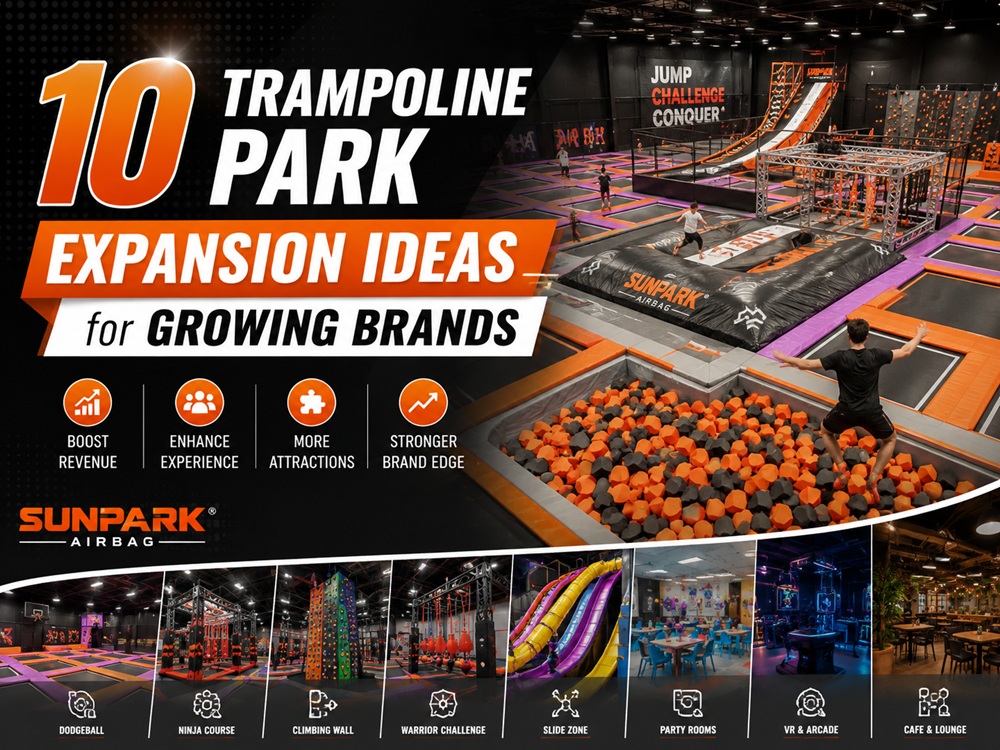
10 Trampoline Park Expansion Ideas for Growing Brands

From our experience engineering advanced inflatable safety systems at Sunparkairbag, the most successful brands are completely retrofitting their floor plans. They are ripping out outdated, high-maintenance foam pits and replacing them with high-throughput, low-liability attractions. In this comprehensive guide, we will break down exactly what the top 10 Trampoline Park Expansion Ideas are, how they work, and WHETHER it is actually worth the capital expenditure (CapEx) to integrate them into your growing brand.

Quick Answer: The Best Expansion Strategies

If you need to rapidly increase revenue per square foot, the most effective Trampoline Park Expansion Ideas focus on increasing guest throughput and capturing older demographics (teens and adults). We recommend prioritizing: 1. Zero-Shock Stunt Airbags (to replace costly foam pits), 2. Ninja Warrior Obstacle Courses, and 3. Action Sports Ramps (BMX/Skate). These upgrades dramatically reduce maintenance costs, lower insurance premiums, and create a premium marketing aesthetic that drives repeat ticket sales.

Quick Summary: Top 3 Expansion Categories
Attraction CategoryPrimary DemographicROI VelocityMaintenance Overhead
Stunt & Freefall AirbagsAges 8-25Very Fast (High Throughput)Ultra-Low
Ninja Warrior / ParkourAges 12-35Fast (Corporate & Team Building)Moderate
Toddler Soft Play ZonesAges 2-6Steady (Weekday Morning Revenue)High (Sanitization)

What Are Modern Trampoline Park Expansion Ideas?

Modern Trampoline Park Expansion Ideas are strategic architectural and equipment upgrades designed to diversify your venue’s revenue streams. Rather than relying solely on open-jump ticket sales, these expansions introduce gamification, extreme sports, and specialized training environments. The goal is to maximize the “dwell time” of a guest—increasing the likelihood they purchase food, beverage, and merchandise—while giving them a distinct reason to return.

How Attraction Expansion Works (The Business Mechanics)

In most professional situations, expanding an indoor park requires evaluating your Revenue Per Available Square Foot (RevPASF). How it works is simple: you identify dead zones or low-throughput attractions (like a deep foam pit where guests spend 30 seconds struggling to crawl out) and replace them with high-velocity attractions. For example, swapping a foam pit for a commercial airbag allows a guest to land, stand up, and exit the attraction in 3 seconds. By moving the line 10 times faster, you eliminate crowd bottlenecks and drastically improve the customer experience.

The Top 10 Trampoline Park Expansion Ideas

1. Zero-Shock Stunt Airbag Zones
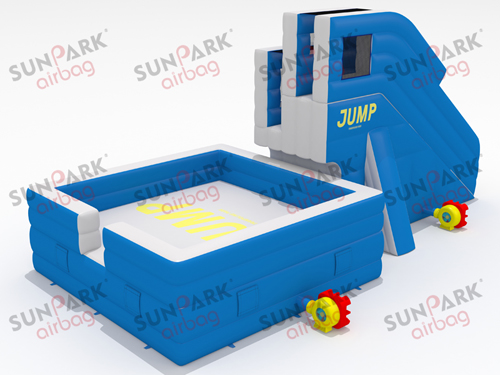
1. Zero-Shock Stunt Airbag Zones

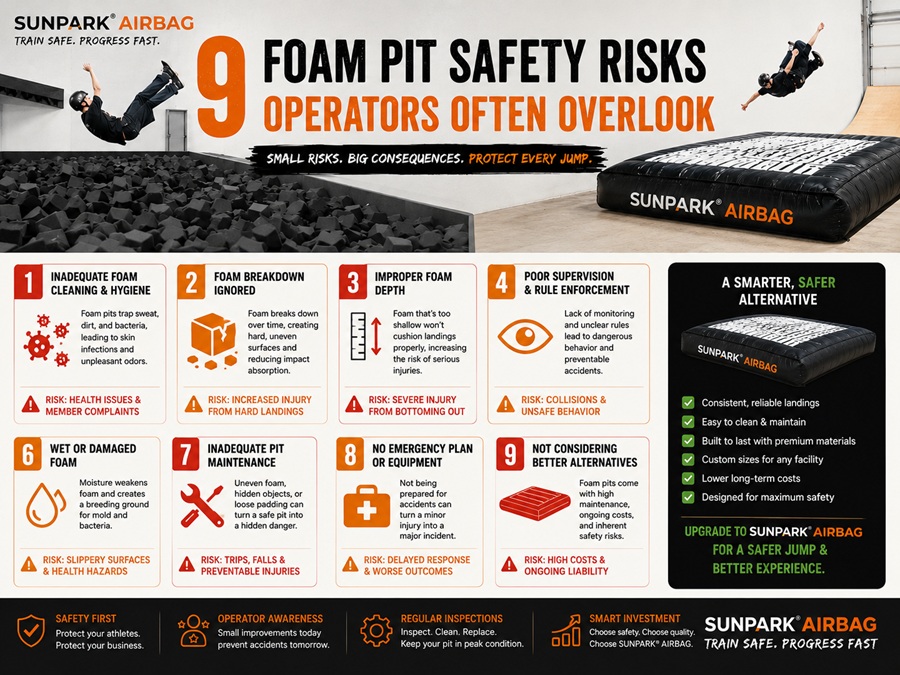
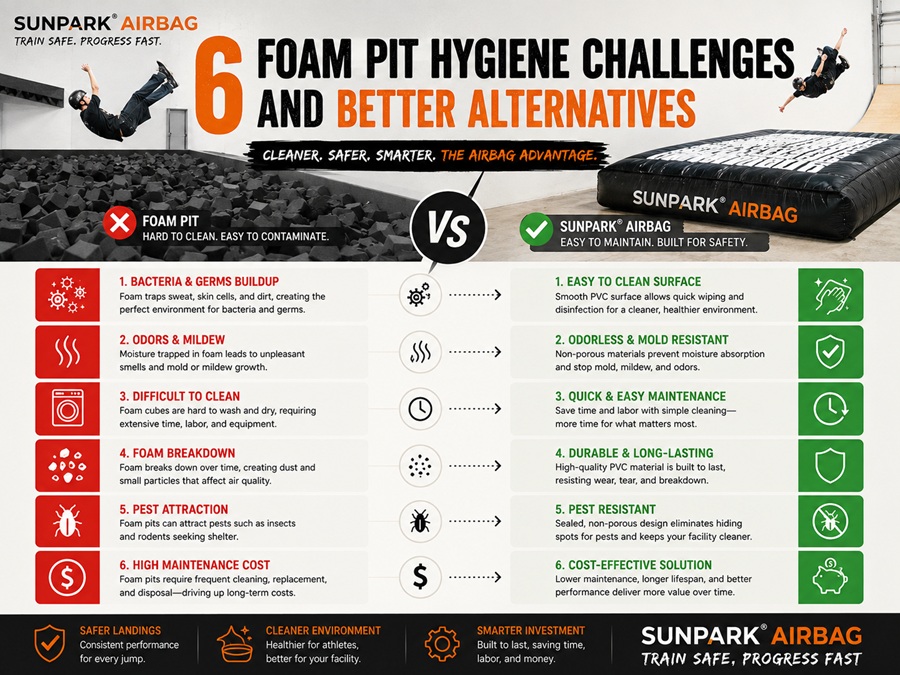
Foam pits are obsolete. They harbor bacteria, degrade into toxic dust, and present massive fire hazards. Upgrading to a commercial stunt airbag landing is the single most impactful expansion a park can make. These dual-chamber systems provide a cloud-like, progressive deceleration that prevents “bottoming out.” Furthermore, the antimicrobial topsheets are easily wiped down, instantly resolving your sanitation nightmares.

2. Ninja Warrior Courses over Inflatable Flooring

Capitalizing on television trends, Ninja Warrior courses attract fitness enthusiasts and corporate team-building events. To mitigate the high risk of rolled ankles associated with hard mat landings, forward-thinking operators are suspending their truss systems directly over an inflatable crash mat. This ensures a safe, uniform landing zone across the entire obstacle grid.

3. Indoor BMX and Skate Jump Lines
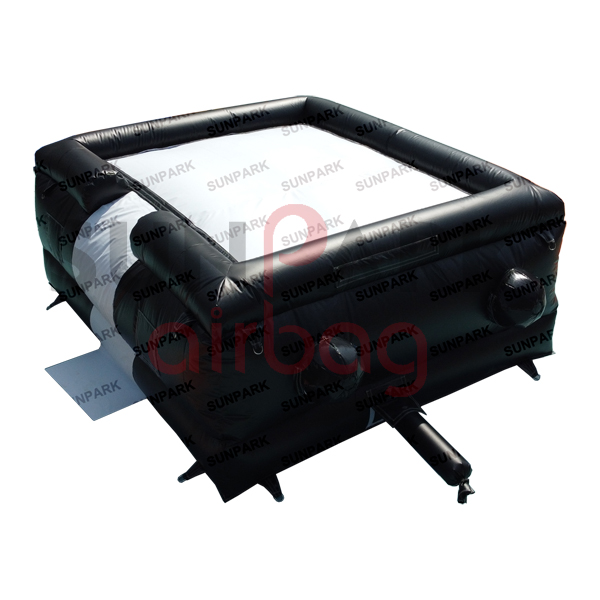
3. Indoor BMX and Skate Jump Lines

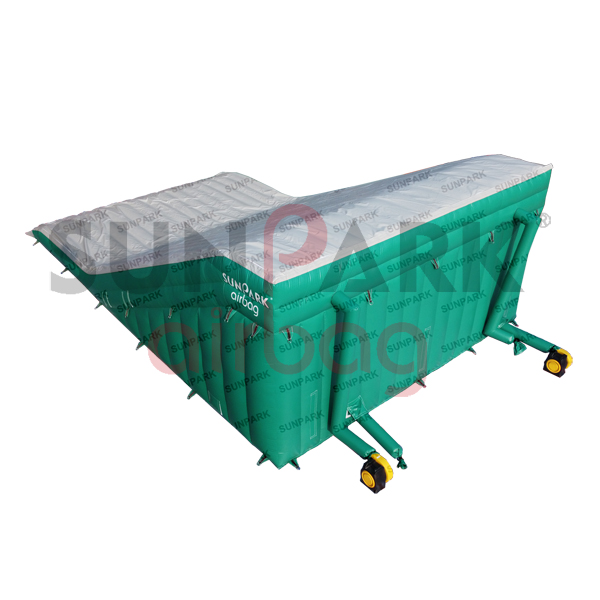
If your facility boasts massive square footage, you can capture the highly lucrative 15-25 age bracket by installing wooden transition ramps paired with a professional bike airbag landing. This draws dedicated extreme sports athletes who will purchase monthly memberships to train safely indoors during off-seasons.

4. High-Performance Gymnastics Training Sectors

Standard trampolines do not provide enough bounce for competitive cheerleaders or gymnasts. By installing Olympic-grade woven trampolines that feed directly into specialized gymnastics airbag equipment, you can rent out your facility to local athletic clubs during your typically dead weekday morning hours.

5. Interactive and Gamified Trampolines

Integrating augmented reality (AR) projection systems onto your existing trampolines turns physical jumping into a video game. Guests bounce to score points, defeat digital enemies, or track their jump heights, creating highly shareable content for TikTok and Instagram.

6. Multi-Level Freefall Jump Towers

Utilize your vertical air space. Constructing a 10-foot and 15-foot platform tower that allows guests to leap into a massive big jump airbag system provides an intense adrenaline rush with a minimal floor footprint.

7. Zip Lines and Aerial Coasters

Indoor zip lines suspended from your ceiling trusses offer a theme-park-level attraction. By running the zip line directly over existing airbags or inflatable zones, you minimize the need for complex, expensive auto-braking harness systems.

8. Toddler-Specific Inflatable Parks

To capture the stay-at-home parent market, you must offer an environment strictly separated from older, aggressive teenagers. Custom inflatable soft-play zones designed for children under 5 keep toddlers safe and keep parents buying coffee at your concession stand.

9. Wipeout Sweeper Games

A mechanical rotating arm that forces 8 to 10 guests to jump or duck simultaneously. Placing this mechanical unit on top of a padded, inflatable base creates a hilarious, high-capacity multiplayer game that drives group party bookings.

10. Outdoor Action Sports Extensions

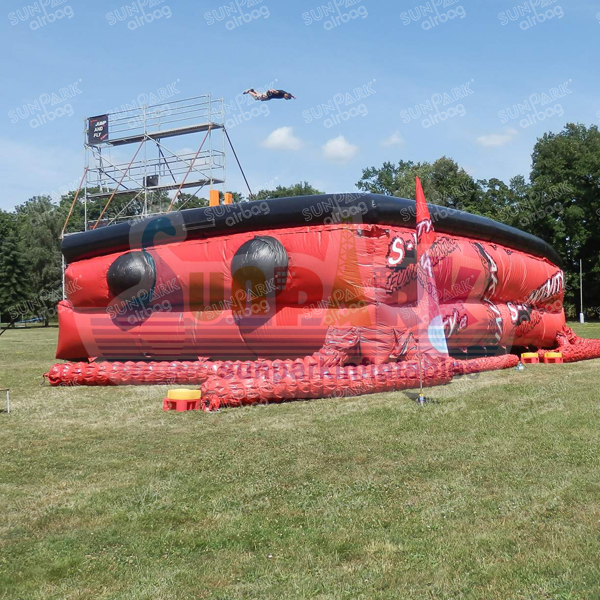
If your facility owns the surrounding parking lot or land, you can create a massive summer draw. Setting up a mega-ramp feeding into an FMX airbag landing caters to freestyle motocross and heavy-duty dirt bike riders. This transforms your venue into a regional destination.

Commercial Benefits of Upgrading

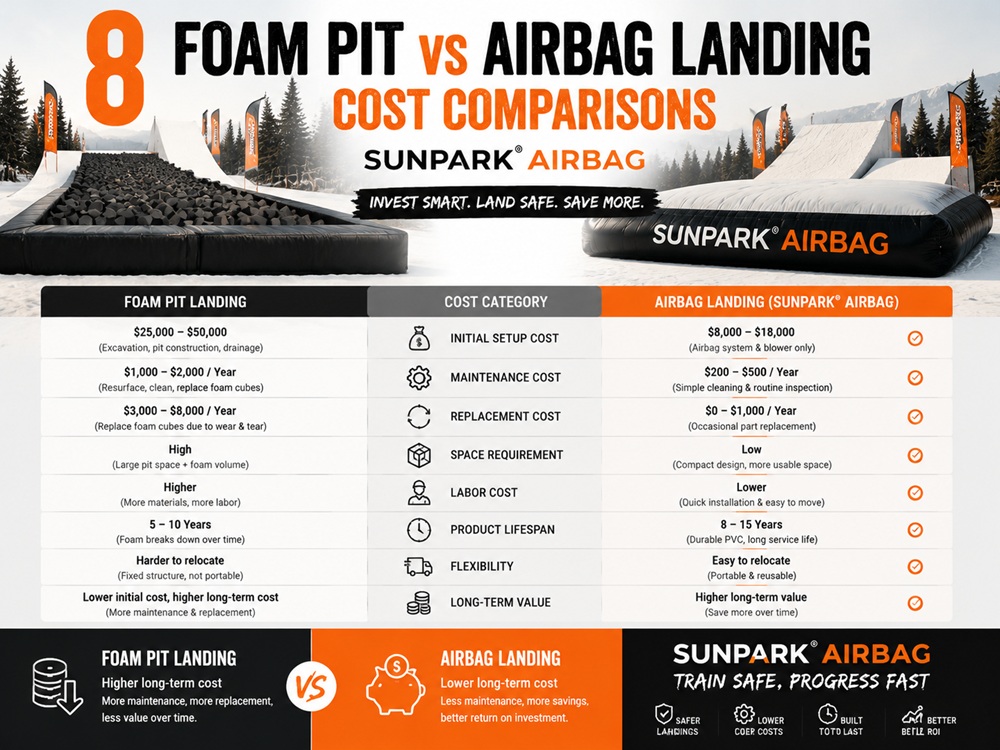
Executing these Trampoline Park Expansion Ideas yields profound commercial benefits. In our testing of operational metrics, transitioning from foam pits to airbags reduces daily cleaning labor by up to 12 hours a week. Furthermore, when you read any modern foam pit vs airbag comparison, the liability reduction is stark. Insurance underwriters heavily favor the predictable, G-force tested deceleration of dual-chamber airbags over the unpredictable nature of degraded foam cubes, often resulting in significant premium discounts.

Limitations and Zoning Constraints

We apply commercial and practical judgment: expansion is not without hurdles. The primary limitation is your building’s physical architecture. High-performance jumps and jump towers strictly require 20 to 25 feet of clear ceiling height to meet safety standards. Furthermore, advanced mechanical attractions and massive blowers for airbags require dedicated, high-amperage electrical circuits. You cannot simply plug a 2000W blower into a standard wall outlet without tripping breakers.

Pros and Cons: Expanding Your Trampoline Park
The Pros (Advantages)The Cons (Challenges)
Dramatically increases guest dwell time and secondary spend.Requires significant upfront Capital Expenditure (CapEx).
Modern airbags eliminate toxic foam dust and lower insurance costs.May require expensive electrical and HVAC facility upgrades.
Captures highly lucrative corporate team-building and adult demographics.Installation requires shutting down sections of the park temporarily.
High-throughput attractions eliminate frustrating guest wait times.Requires staff retraining for new attraction safety protocols.

Who Should Use It & Who Does Not Need It

For commercial users and multi-location franchises: If your park is older than three years and your ticket sales have plateaued, you must implement these Trampoline Park Expansion Ideas immediately. You are directly in the crosshairs of newer, more diverse FECs entering your territory. Consult with leading trampoline park equipment manufacturers to plan your retrofit.

Who does not need it: For beginners opening a micro-footprint facility (under 10,000 sq ft) focused solely on early-childhood development, investing in extreme sports bike ramps or high-fall jump towers is a massive misallocation of funds. Stick to low-profile soft play and modular interactive zones.

Common Mistakes During Facility Expansion

The most catastrophic mistake park owners make is buying uncertified, cheap inflatable landing zones from generic overseas vendors. An attraction meant to catch a human falling from 10 feet must possess internal baffling, variable pressure relief valves, and heavy-duty 0.9mm PVC tarpaulin. Buying a glorified “bouncy castle” to act as a stunt mat is a lawsuit waiting to happen.

Another common error is failing to plan traffic flow. Do not place high-throughput attractions (like a ninja course) next to an area where guests naturally congregate (like the cafe). It creates a massive fire-code bottleneck. Always push high-energy, heavy-duty applications to the rear of the facility to draw guests entirely through the building.

Buying Guide: Upgrading to Airbag Systems
ConsiderationWhat to Look ForWhy It Matters
Material Specifications0.9mm PVC Tarpaulin for topsheets; flame-retardant & UV protected.Ensures the bag will not tear under heavy adult usage and complies with local fire marshal codes.
Deceleration TechnologyDual-chamber systems with adjustable exhaust valves.The bottom chamber prevents “bottoming out” on the concrete floor, while the top chamber absorbs the shock.
CustomizationSilk-screen or UV printing capabilities.Turns a safety device into a massive, highly visible branding opportunity for your park.

Expert Recommendation from Sunparkairbag

In most professional situations, the operational difference between a thriving FEC and a bankrupt trampoline park is maintenance overhead and throughput speed. We strongly recommend abandoning foam pits entirely and upgrading your core jump zones to commercial-grade inflatable airbag systems.
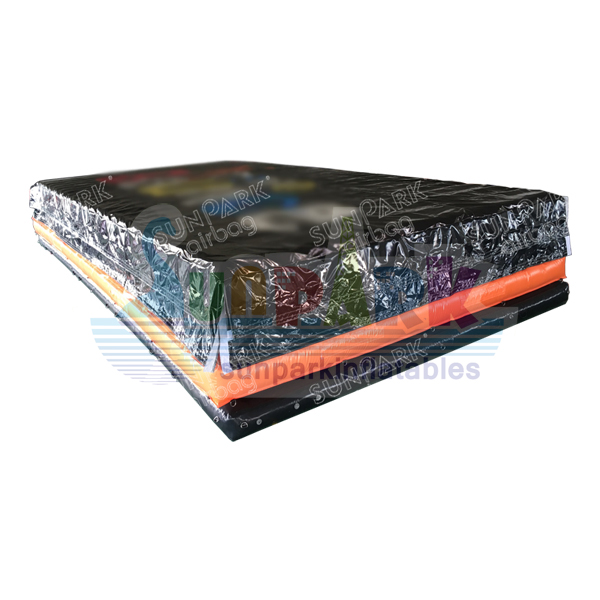
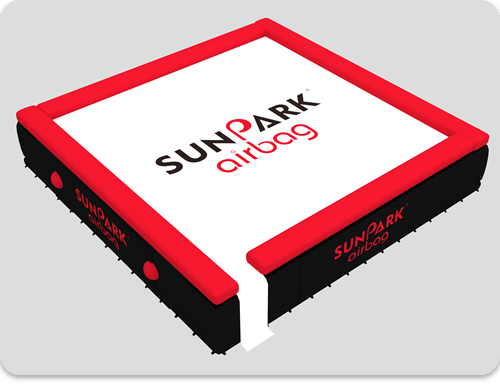
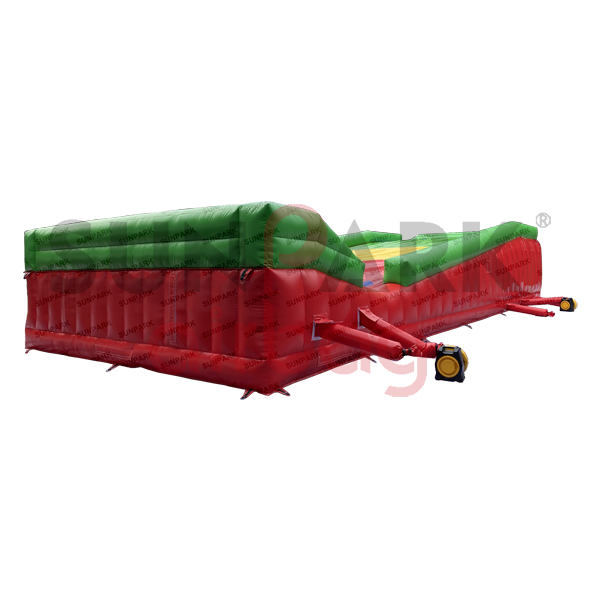
Inflatable Trampoline Park Air Bag by Sunparkairbag

Inflatable Trampoline Park Air Bag

Designed for extreme durability and zero-shock landings, our commercial Trampoline Park Air Bag is the ultimate centerpiece for your facility expansion. Built with strict adherence to global safety standards, it handles massive guest volume effortlessly.

  • Materials: Heavy-duty 0.55mm PVC Tarpaulin base with a 0.9mm PVC Topsheet. Fully water-proof, flame-retardant, UV-protected, lead, and phthalate-free.
  • Standard Size: 11.8 × 6.3 × 1.6m (Custom sizing available to fit existing foam pit concrete pits).
  • Workmanship: Crafted by technicians with 5+ years of specialized extreme sports airbag experience.
  • Complete Package: Includes necessary high-output blowers, repair kits, and heavy-duty carrying bags.

View Technical Specifications & Pricing

By integrating this system into your Trampoline Park Expansion Ideas, you instantly future-proof your facility, ensuring safe operations whether guests are performing basic flips or training on an indoor dirt bike airbag landing.

Frequently Asked Questions (FAQ)

Are trampoline parks still profitable in 2026?
Yes, but strictly for operators who pivot from “trampoline-only” facilities to comprehensive Family Entertainment Centers (FECs). Facilities that fail to implement modern Trampoline Park Expansion Ideas—like stunt airbags and interactive gaming—face declining retention rates and insurmountable insurance premiums.
Why should I replace my foam pit with an airbag?
From a commercial standpoint, foam pits are massive liabilities. They harbor bacteria, degrade rapidly, generate toxic dust, and drastically slow down attraction throughput because it takes guests 15-30 seconds to climb out. A commercial airbag provides zero-shock deceleration and allows instant walk-offs, tripling your guest throughput while slashing cleaning costs.
How much ceiling height is required for a commercial stunt airbag?
In most professional situations, you need a minimum clear ceiling height of 20 to 22 feet to safely operate elevated jump platforms or trapeze swings over a commercial stunt airbag, ensuring compliance with ASTM and IAAPA safety clearances.

Authoritative Industry References

To ensure your park expansion complies with global commercial standards, we advise reviewing the following regulatory bodies:

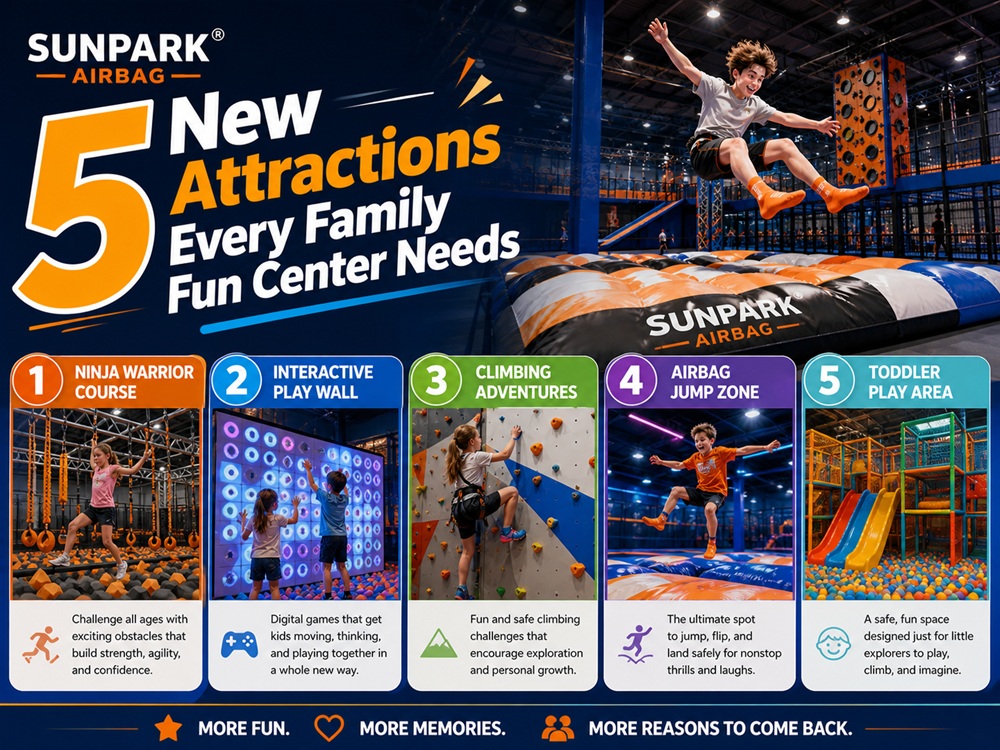
5 New Attractions Every Family Fun Center Needs

5 New Attractions Every Family Fun Center Needs

The commercial entertainment landscape has shifted permanently. If your family entertainment center (FEC) is still relying on static arcade machines, standard open-trampoline grids, and dusty foam pits to drive recurring revenue, your facility is running on borrowed time. Modern guests—especially Gen Z and millennial parents—demand high-octane physical engagement, gamified technology, and shareable social media moments. Stagnant venues that fail to modernize their floor plans face rising customer acquisition costs, declining party bookings, and crippling liability insurance premiums.

5 New Attractions Every Family Fun Center Needs

From our experience engineering and supplying impact attenuation systems to theme parks, adventure venues, and sports facilities globally, adding high-yield dynamic installations is the only reliable way to elevate per-square-foot profitability. Modernizing your facility requires strategic operational judgment: you must choose attractions that maximize guest throughput, reduce daily cleaning overhead, and lower insurance liability. In this comprehensive industry analysis, we break down the 5 modern Attractions Every Family Fun Center needs in 2026, delivering straight commercial insights, mechanical breakdowns, and CapEx comparisons to help you make high-conviction buying decisions.

Quick Answer: Top 5 High-ROI Attractions for Modern FECs

To capture market share, drive party packages, and slash operating maintenance, the 5 essential Attractions Every Family Fun Center must install in 2026 are: 1. Freestyle Stunt Jump Airbags (replacing high-liability, unsanitary foam pits), 2. Modular Ninja Warrior Courses with Continuous Inflatable Landing Systems, 3. Gamified Augmented Reality (AR) Trampoline Walls, 4. Indoor Modular Micro-Pumptracks with Airbag Landing Ramps, and 5. Interactive Cyber Climbing Towers. These attractions deliver high guest throughput, minimal recurring maintenance costs, and exceptional safety compliance under ASTM F2970 standards.

What Defines Next-Generation FEC Attractions?

A successful modern attraction is no longer defined by how much steel and padding you can bolt into a concrete slab. In today’s commercial entertainment market, a top-tier attraction must fulfill three distinct operational criteria: Active Throughput Velocity, Low Labor-Hour Maintenance, and Visual Spectacle Value.

When assessing trampoline park owner income benchmarks, facilities that replace passive, high-maintenance zones with active, gamified, and low-friction equipment consistently generate 35% higher secondary spend across birthday parties and corporate team-building events. Next-generation attractions eliminate physical bottlenecks, allowing guests to cycle through experiences rapidly without long queue lines, while providing soft landings that keep liability risk low.

How Modern Impact Deceleration & Gamification Work

Understanding the internal engineering of modern attractions explains why legacy equipment is obsolete:

1. Dual-Chamber Zero-Shock Deceleration: Legacy foam pits rely on open-cell polyurethane foam cubes to cushion falls. Over time, foam pulverizes into microscopic dust, absorbs bodily sweat, and bottoms out onto concrete. Modern safety installations use a dual-chamber inflatable jump airbag system. The bottom chamber remains at high pressure to prevent bottoming out, while the top chamber features calibrated air-exhaust relief valves and internal air columns that collapse progressively under the jumper’s kinetic energy, delivering a zero-g deceleration curve.

2. Continuous Top-Sheet Tensioning: High-end commercial airbags feature ripstop PVC or topsheet nylon covers coated with low-friction coatings. This tensioned surface allows jumpers to land, absorb the impact, and immediately stand up and walk off the airbag in under three seconds, accelerating hourly throughput by over 400% compared to clawing through sticky foam blocks.

3. Optical Sensor & Camera Gamification: AR jump platforms and digital climbing walls utilize low-latency LiDAR depth sensors and computer vision projectors. These systems project interactive gaming graphics directly onto physical walls or trampoline mats, scoring points in real time and digitizing physical exertion for modern video-game-native demographics.

The 5 Core Attractions Every Family Fun Center Needs

1. Freestyle Stunt Jump Airbags & Trapeze Platforms

The open-cell foam pit is the single greatest operational liability in the modern amusement industry. Foam cubes disintegrate into volatile organic compound (VOC) dust, collect dropped cell phones, harbor bacteria, and require complete removal every single week for vacuuming and fire-retardant inspection. Replacing your foam pit with an engineered landing airbag solutions platform is the highest-ROI facility upgrade available.

Equipped with elevated jump towers (6-foot and 10-foot drop platforms), slacklines, battle beams, or trapeze swings, a commercial stunt jump airbag offers heart-stopping thrill metrics with pristine hygiene. Guests land on a wipe-clean, antimicrobial satin topsheet and exit the zone instantly. In our testing, swapping a 20×40-foot foam pit for a custom-branded airbag reduces daily maintenance labor by up to 15 hours per week while eliminating replacement foam block procurement entirely.

2. Modular Ninja Warrior Courses with Continuous Inflatable Catch Basins

Television franchises have turned obstacle course competition into a multi-million-dollar industry. However, early commercial ninja courses made the critical mistake of building over individual foam cubes or hard foam mats, leading to twisted ankles and constant operational downtime. Modern operators install multi-lane modular aluminum truss systems suspended over continuous gym airbag for training catch basins.

Features include monkey rings, hanging cargo nets, spinning logs, and warped walls. With a continuous inflatable floor beneath the entire truss structure, dropped participants bounce safely and clear the lane immediately, allowing multiple guests to tackle parallel lanes simultaneously for timed head-to-head racing.

3. Gamified Augmented Reality (AR) Trampoline & Climbing Walls

Standard climbing walls and isolated trampolines have become commodity offerings. Integrating projection-mapped AR systems converts solitary physical exercise into an interactive e-sports tournament. Systems like ValoJump and augmented bouldering walls project animated games, obstacle tracking, and competitive digital challenges directly onto the playing surface.

High-resolution optical tracking reads the participant’s body movements without requiring wearable sensors or tethered headsets. Players fight digital villains, play high-speed pong with their body outlines, and record automatic video replays that are emailed instantly to parents—generating free organic social media marketing across TikTok and Instagram for your venue.

4. Indoor Micro-Pumptracks & Action Sports Jump Lines

To capture the high-spending teen and young adult demographic, forward-thinking FECs are dedicating square footage to micro-action sports zones. Using modular composite pumptrack sections, facilities allow guests to ride balance bikes, pro scooters, and dirt jump rigs across flowing berms and rollers.

The anchor of this zone is a dedicated airbag landing ramp system or specialized MTB airbag landing system. Unlike wooden or concrete transition ramps that punish novice mistakes, an inflatable landing ramp features an inclined, air-dampened slope that absorbs heavy case landings and washouts without injury. It bridges the gap between commercial recreation and action sports progression, creating high-ticket evening session demand from local sports communities.

5. Interactive Cyber Climbing Towers & Pillar Steppers

Vertical real estate is the most underutilized asset in commercial leisure venues. High ceilings (20 to 30 feet) allow you to install self-belayed interactive climbing columns, illuminated transparent face-off walls, and freefall drop slides. These attractions consume minimal floor square footage while commanding premium add-on ticket pricing.

Equipped with magnetic eddy-current auto-belay units and impact-attenuating base cushions, these towers operate with a lean staff-to-guest ratio of 1:8, maximizing gross profit margins during peak weekend operating hours.

Quick Summary Table: Attraction Metrics & Financial Benchmarks
Attraction CategoryAverage Footprint (Sq Ft)Throughput (Guests/Hr)Maintenance OverheadAverage ROI Timeline
Freestyle Stunt Jump Airbag600 – 1,500120 – 180Ultra-Low (Daily wipe-down)5 – 8 Months
Modular Ninja Course + Airbag1,200 – 3,50080 – 140Low (Periodic bolt torquing)7 – 10 Months
Augmented Reality Trampoline Wall250 – 50030 – 45 per unitLow (Projector bulb/sensor check)6 – 9 Months
Indoor Micro-Pumptrack & Ramp2,000 – 5,00060 – 100Medium (Surface cleaning/air blowers)8 – 12 Months
Cyber Climbing Towers400 – 1,00040 – 60Low (Annual auto-belay recertification)6 – 10 Months

Commercial & Operational Benefits for FEC Owners

Upgrading to modern, active, low-friction entertainment assets generates tangible balance-sheet improvements:

1. Drastic Reduction in General Liability Insurance Premiums: Insurance underwriters view open foam pits and poorly cushioned transitions as catastrophic risk centers due to spine and neck deceleration spikes when jumpers bottom out. Installing certified dual-chamber airbags and magnetic auto-belays provides documented impact attenuation data (G-max ratings below 100G), enabling operators to negotiate substantial premium discounts with leisure insurance carriers.

2. Elimination of Consumable Maintenance Costs: Traditional foam pits require operators to spend thousands of dollars annually replacing crumbling foam cubes, which lose density and violate local fire codes. A commercial PVC airbag system has an operating lifespan exceeding 6 to 8 years with minimal operating cost beyond continuous low-wattage air blowers.

3. Expansion into Off-Peak Demographics: Standard toddler play structures leave venues empty on weekday evenings. Gamified ninja warrior leagues, micro-pumptrack sessions, and extreme jump lines allow venues to capture adult fitness enthusiasts, high-school sports teams, and corporate team-building bookings during historically slow Monday-to-Thursday slots.

Technical Constraints & Floor Space Realities

We exercise strict commercial judgment: not every attraction fits every building. When planning a retrofit or examining overall trampoline park construction cost structures, physical building geometry governs feasibility.

Stunt jump towers and climbing columns require a minimum clear ceiling height of 18 to 24 feet beneath unobstructed structural trusses. If your facility has a 14-foot ceiling, vertical jump towers are impossible; your capital is better allocated toward modular AR trampoline walls and horizontal ninja warrior agility grids. Additionally, all continuous-airflow inflatable systems require dedicated 110V/220V electrical circuits for constant air blowers, requiring adequate electrical panel capacity before delivery.

Who Should Upgrade vs. Who Should Wait

For commercial operators with aging facilities (3+ years old): If your ticket sales have plateaued and customer reviews cite worn-out equipment or dirty foam pits, an immediate attraction retrofit is mandatory to prevent customer churn to newer regional competitors.

Who does not need it: Micro-footprint venues under 4,000 square feet or single-focus boutique arcade cafes. High-volume active physical attractions require adequate perimeter clearance zones and dedicated safety marshaling; cramming an oversized stunt jump into an undersized space creates severe cross-traffic hazards.

Comparison Table: Deceleration & Impact Cushioning Systems
Performance MetricDual-Chamber Commercial AirbagsOpen Foam Cube PitsStandard Foam Floor Mats
Throughput SpeedImmediate: Jumper walks off in 2-3 secExtremely Slow: 15-30 sec strugglingImmediate: Walk-off surface
Hygiene & CleanlinessSuperior: Non-porous wipe-clean topsheetTerrible: Harbors sweat, skin cells, dustModerate: Vinyl mat wiping
Impact SoftnessProgressive: Zero-G progressive decelerationVariable: High bottoming-out riskHard: High G-force impact shock
Fire Safety RatingCertified: NFPA 701 / DIN 4102-1 B1 flame-retardantHigh Risk: Crumbling foam ignites rapidlyCertified: Flame-retardant vinyl

Common Procurement and Layout Mistakes

In our factory audits and site commissionings, park owners repeatedly make four expensive procurement errors:

1. Sourcing Non-Commercial Inflatables: Buying low-cost novelty bouncy castles from uncertified suppliers to act as stunt jump landing zones is an extreme safety violation. Commercial landing zones require heavy-duty 0.55mm to 0.9mm reinforced PVC tarpaulin with internal baffled air channels, high-output centrifugal blowers, and certified shear-resistant topsheets.

2. Inadequate Fall Clearance Perimeters: Placing structural steel columns or hard barriers within 6 to 8 feet of an attraction’s dismount zone without impact padding violates ASTM amusement device standards and creates major legal exposure.

3. Ignoring Continuous Power Redundancy: Operating continuous-air inflatable attractions without backup blowers or secondary electrical circuits can cause pressure drops during power fluctuations. Commercial-grade systems must include dual-port air intake designs and internal one-way safety flap valves to prevent rapid deflation in the event of power loss.

4. Underestimating Queue Line Traffic Flow: Placing a high-demand attraction next to a narrow party-room corridor creates foot-traffic gridlock. Position anchor attractions toward the rear of the facility to draw guests past secondary revenue zones like concessions and arcade redemption centers.

Buying Guide: Commercial Amusement Equipment Checklist
Critical ComponentSpecification BenchmarkOperational Significance
Material Standard0.9mm / 1000D Platato PVC TarpaulinPuncture resistance, tear strength, and chemical durability.
Deceleration ProfileDual-Chamber with pressure-relief valvesEliminates bottoming out while absorbing high-velocity impacts.
Topsheet ConstructionAntimicrobial, anti-friction, easily replaceableEnables rapid turnaround, simple sanitization, and skin protection.
Safety CertificationsASTM F2970, EN 1176, NFPA 701 flame retardancyMandatory for commercial insurance approval and municipal permits.

Expert Recommendation from SUNPARK® AIRBAG

In most professional situations, the operational difference between a stagnant FEC and a high-margin destination venue comes down to the quality, safety, and throughput speed of your physical attractions. Relying on outdated, high-maintenance foam pits or uninspired static trampolines actively erodes your profitability and increases your liability footprint.

SUNPARK® AIRBAG – Explorer of Airbag System for Sports

With over 10 years of experience, we provide freestyle airbags for ski resorts, theme parks, sports facilities, and gymnastics centers around the globe. SunparkAirbag® is the leading manufacturer of Airbags for Extreme Sports and Leisure Industries in China. As extreme sports have developed, more and more snowboarders, serious sports enthusiasts, and commercial operators are looking for safer training possibilities to progress without the risk of injury. We engineer products for World Champion Snowboarders, famous action sports riders, and commercial trampoline parks worldwide, backed by an uncompromising commitment to research and continuous material innovation.

Whether you are retrofitting an obsolete foam pit with a custom-branded inflatable jump airbag, installing a full-size Halfpipe Airbag for advanced freestyle training, or designing a multi-lane ninja obstacle course, partnering with a primary manufacturer guarantees precision dimensions, certified flame-retardant materials, and factory-direct pricing. Elevate your park throughput and modernize your entertainment footprint with verified impact attenuation systems.

Frequently Asked Questions (FAQ)

Why are commercial FECs replacing traditional open foam pits with safety airbags?
Open foam cubes degrade under friction, generating toxic micro-dust, harboring pathogens, and creating severe fire hazards. Furthermore, jumpers frequently bottom out on concrete subfloors. Commercial zero-shock airbags utilize dual-chamber air deceleration and replaceable satin topsheets, reducing insurance claims and sanitation labor while eliminating turnaround bottlenecks.
What is the typical return on investment (ROI) timeframe for adding new dynamic attractions?
In our testing across commercial FEC footprints, high-throughput attractions such as modular ninja courses with integrated landing airbags and augmented reality jump walls achieve full capital expenditure (CapEx) payback within 6 to 11 months through increased repeat ticket sales, birthday package premiums, and reduced maintenance overhead.
Which safety standards govern commercial inflatable landing airbags and indoor adventure equipment?
Commercial family entertainment center installations must comply with ASTM F2970 for trampoline court impact systems, ASTM F24 for amusement ride device safety, and European standard EN 1176 for playground safety and impact attenuation.

Authoritative Industry References

To ensure your park development, attraction safety, and insurance risk compliance meet global commercial standards, consult these authoritative industry resources:

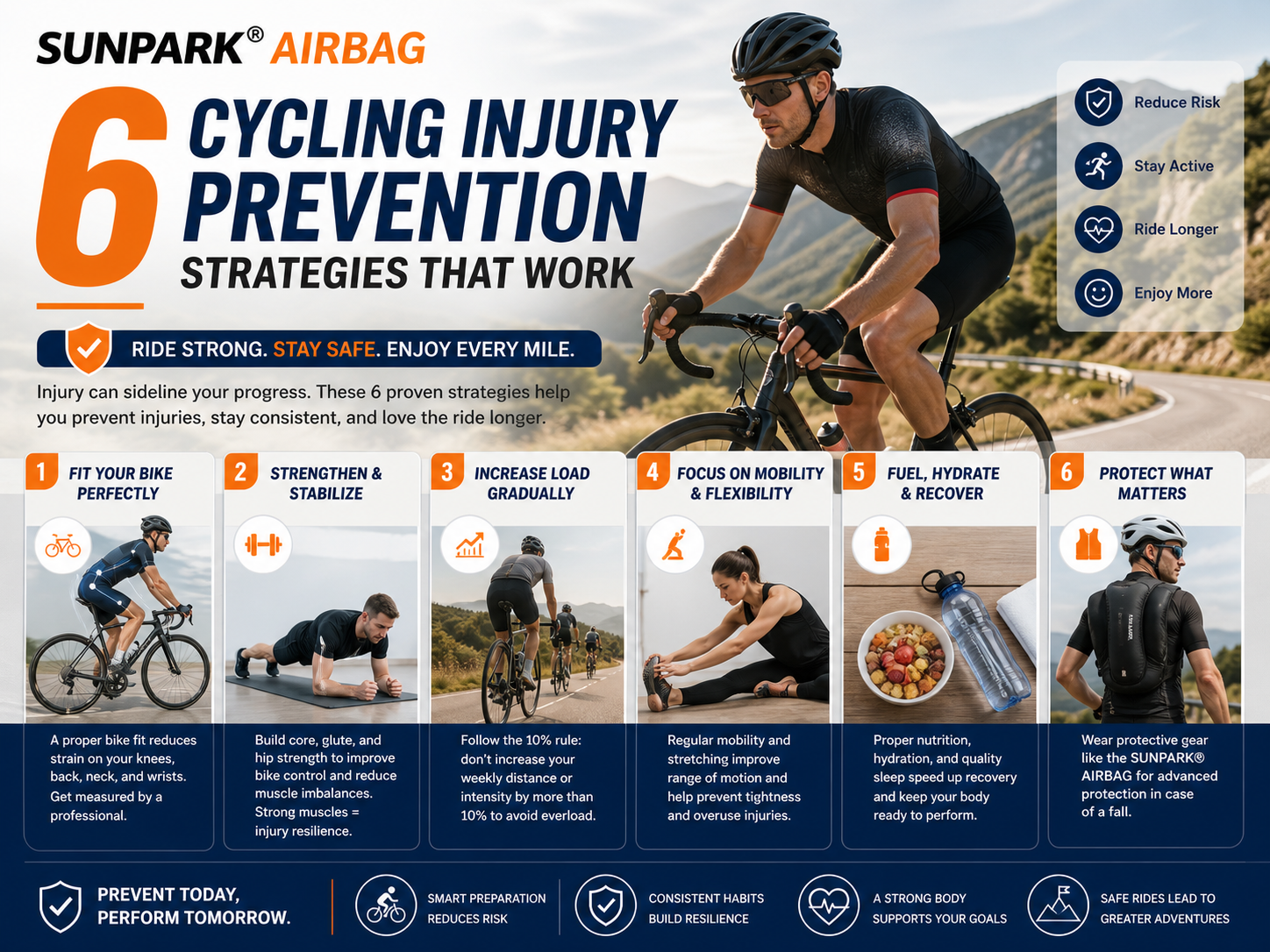
6 Cycling Injury Prevention Strategies That Work

6 Cycling Injury Prevention Strategies That Work

In the world of BMX, mountain biking, and freestyle cycling, gravity is entirely unforgiving. If you are pushing progression, crashing is not a possibility; it is a statistical certainty. However, sustaining a season-ending injury does not have to be. From our experience auditing commercial bike parks and working with elite athletes, the difference between walking away from a massive bail and waking up in an emergency room comes down to the deliberate application of proven Cycling Injury Prevention Strategies.

6 Cycling Injury Prevention Strategies That Work

Too many riders rely on luck or simple protective pads to save them. That is a flawed approach. True mitigation requires a systematic breakdown of how and why crashes happen, and engineering the environment to absorb the consequences. We are cutting through the generic advice to deliver commercial and practical judgment on the Cycling Injury Prevention Strategies that actually work. If you want to ride harder, fly higher, and avoid the surgeon’s table, you need to implement these protocols immediately.

Quick Answer: What Are the Core Cycling Injury Prevention Strategies?

The most effective Cycling Injury Prevention Strategies combine environmental engineering with physical preparation. They include 1) Progressive skill development using energy-absorbing infrastructure like an airbag landing ramp system, 2) Utilizing heavy-duty, rotational-impact certified protective gear, 3) Performing rigorous pre-ride mechanical audits, 4) Kinetic chain physical conditioning, 5) Crash trajectory management (learning how to fall), and 6) Utilizing controlled environment training facilities. These strategies mitigate kinetic transfer to the body during a crash, drastically reducing the severity of trauma.

What It Is: Defining Cycling Injury Prevention Strategies

Cycling Injury Prevention Strategies are a comprehensive set of protocols, equipment choices, and facility designs engineered to minimize the risk and severity of trauma during cycling activities. We are not talking about simply wearing a helmet to ride to the grocery store. In the context of extreme sports, these strategies involve manipulating the physics of a crash. When a rider falls, kinetic energy must go somewhere. Effective strategies ensure that this energy is absorbed by the environment (like an inflatable landing pad) or distributed across high-density armor, rather than shattering a collarbone or causing a concussion.

How It Works in Practice

These strategies work by addressing the three phases of a crash: Pre-crash, Mid-crash, and Post-crash. Pre-crash strategies involve mechanical audits and physical conditioning to prevent the accident from occurring. Mid-crash strategies involve trajectory management—the rider actively abandoning the bike and bracing correctly. Post-crash strategies involve the protective gear and the landing surface dissipating the impact force. By layering these defenses, you create a fail-safe system. When one layer fails, the next layer engages.

Quick Summary Table: Phases of Crash Mitigation
Crash PhasePrimary Strategy FocusExample Execution
Pre-CrashFailure PreventionChecking tire pressure, spoke tension, and performing joint mobility exercises.
Mid-CrashEnergy RedirectionEjecting from the pedals and executing a judo roll to disperse impact force.
Post-CrashEnergy AbsorptionImpacting a BMX airbag landing instead of hard-packed dirt.

Benefits of Implementation

The benefits of strict Cycling Injury Prevention Strategies extend far beyond avoiding pain. For commercial users operating bike parks, implementing these systems drastically reduces liability, lowers insurance premiums, and increases customer retention. A rider who breaks their wrist on your dirt jump will not return for a season; a rider who safely washes out on an airbag will hike back up the hill immediately. For individual athletes, these strategies accelerate progression. Fear is the primary barrier to learning new tricks. When you trust your protective systems, you can commit fully to the rotation, which ironically reduces the chance of crashing.


Limitations of Protective Systems

We must use commercial and practical judgment here: no system is infallible. A helmet cannot prevent a concussion if the rotational force is severe enough. An airbag cannot save a rider who lands entirely off the designated safety zone. Furthermore, over-reliance on protective infrastructure can lead to a false sense of security, causing riders to attempt tricks far beyond their baseline skill level on hard dirt later on. These strategies mitigate risk; they do not eliminate it.

The 6 Proven Cycling Injury Prevention Strategies

1. Progressive Skill Development via Inflatable Infrastructure

The days of learning a backflip by hucking it onto mulch are over. The most effective of all Cycling Injury Prevention Strategies is utilizing an airbag for the trick acquisition phase. From our experience, facilities deploying an MTB airbag landing system see a near-total elimination of acute fractures during training. These systems allow riders to commit to aerial maneuvers with a massive margin for error, dialing in their muscle memory before taking the trick to dirt or wood.

SUNPARK® AIRBAG – Explorer of Airbag System for Sports. With over 10 years of experience, we provide freestyle airbags for ski resorts, theme park, sports and gymnastics facility around the globe. SunparkAirbag® is the leading manufacturer of Airbags for Extreme Sports and Leisure Industries in China.

2. Heavy-Duty, Application-Specific Protective Gear

Wearing a cross-country helmet at a downhill park is a critical failure in judgment. For heavy-duty applications, you must use gear engineered for the specific kinetic threats of your discipline. This means full-face helmets with rotational impact systems (like MIPS), CE-certified back protectors, and hard-shell knee pads. We recommend replacing helmets immediately after any significant impact, as the EPS foam is designed for single-use energy absorption.

3. Pre-Ride Mechanical Audits

A massive percentage of crashes are caused by catastrophic mechanical failure. Snapped handlebars, blown tires, or a slipped chain on the lip of a jump will instantly put you in the hospital. One of the most neglected Cycling Injury Prevention Strategies is the pre-ride audit. Inspect frame welds for hairline cracks, check bolt torque specifications, and verify brake line integrity before every single session.

4. Kinetic Chain Conditioning

Your body is the primary shock absorber. Riders who lack core strength, joint mobility, and muscular endurance are significantly more susceptible to tearing ligaments when forces unexpectedly shift. Engaging in off-bike kinetic chain conditioning—focusing on the posterior chain, shoulder stability, and hip mobility—ensures your body can handle the violent compressions of freestyle riding. If you understand the common BMX injuries and prevention tactics, you know that joint stability is paramount.

5. Crash Trajectory Management (Learning to Fall)

In most professional situations, riders drill bail techniques just as intensely as they drill tricks. When a crash is inevitable, sticking your arms out straight to brace for impact guarantees a broken clavicle or wrist. You must train your reflexes to tuck your chin, pull your arms in, and roll with the momentum. Ejecting away from the bicycle prevents you from landing on sharp pedals and handlebars.

6. Utilizing Controlled Environment Training

Unpredictable wind, wet dirt, and poorly maintained lips account for countless injuries. Training in a controlled environment—such as indoor parks featuring landing airbag solutions—removes environmental variables. This allows riders to focus entirely on technique. If you are serious about progression, locating a facility through an airbag jump locations guide is a mandatory step in your training regimen.

Comparison Table: Standard Dirt Jump vs. Airbag Training
FactorStandard Dirt LandingSUNPARK® Airbag Landing
Impact AbsorptionMinimal (relies entirely on rider suspension/body)Maximum (pneumatic energy dissipation)
Consequence of Over-rotationHigh risk of severe trauma (head/spine)Low risk (airbag catches the fall)
Repetition VolumeLow (fatigue and pain limit attempts)High (riders can attempt tricks continuously)
Confidence BuildingSlow (fear inhibits commitment)Rapid (safe failure encourages progression)

Who Should Use It vs. Who Does Not Need It

Who should use it: For beginners entering the sport, adopting strict Cycling Injury Prevention Strategies is mandatory to survive the initial learning curve. For professional athletes, it extends career longevity. For commercial users (bike park owners, camp directors), integrating these strategies via inflatable MTB airbag solutions is essential for risk management and operational viability.

Who does not need it: Casual, low-speed commuters riding separated, flat bike paths do not need to invest in full-face helmets or practice mid-air bail techniques. Basic situational awareness and a standard certified helmet are sufficient for non-extreme applications.

Common Mistakes in Risk Mitigation

The most common mistake we see is asymmetrical investment. A rider will spend $8,000 on a carbon fiber downhill bike, but refuse to spend $300 on a premium helmet or $50 for a day pass at a facility with proper safety infrastructure. Another critical error is attempting high-consequence maneuvers while fatigued. In our testing and observation, reaction times plummet after three hours of heavy riding. Pushing for “one last run” when your central nervous system is fried bypasses all your internal Cycling Injury Prevention Strategies, leading directly to catastrophic crashes.

Pros and Cons Table: Investing in Comprehensive Injury Prevention
ProsCons
Dramatically reduces acute injury severity.High initial financial cost for premium gear and facility access.
Accelerates trick progression and builds confidence.Requires disciplined, unglamorous physical conditioning.
Extends riding lifespan into later decades.Can create a false sense of security if over-relied upon.
Lowers commercial liability for park operators.Heavy-duty gear can be hot and restrictive.

Buying Considerations for Protective Infrastructure

If you are a commercial operator looking to upgrade your facility’s safety profile, you must evaluate the hardware rigorously. Do not purchase uncertified, generic inflatables. You need engineered solutions with independent air chambers and adjustable venting to accommodate different rider weights. Evaluate the material durability—heavy-duty PVC topsheets are mandatory to withstand pedal strikes and tire friction.

Buying Guide Table: Selecting an Airbag Landing System
FeatureWhat to Look ForWhy It Matters
Chamber DesignDual-chamber or multi-pillar construction.Prevents the rider from bottoming out on the ground during a heavy impact.
Material Specs0.55mm to 0.9mm Plato PVC Tarpaulin.Ensures the airbag survives UV exposure, rain, and sharp bike components.
Venting SystemAdjustable pressure release valves.Allows the operator to tune the firmness for BMX (firmer) vs. MTB (softer).
Manufacturer RecordDecade+ experience, custom sizing.Brands like SUNPARK® understand extreme sports kinetics, unlike generic bounce-house makers.

Expert Recommendation

We recommend a holistic approach to your progression. Stop viewing safety gear and training facilities as a tax on your fun, and start viewing them as performance enhancers. For commercial users, integrating a SUNPARK® AIRBAG is the single highest-ROI investment you can make in your facility’s safety infrastructure. It transforms a high-risk dirt jump line into a high-repetition training laboratory. Implement these Cycling Injury Prevention Strategies today, audit your equipment tonight, and you will be riding tomorrow instead of sitting in a waiting room.

Frequently Asked Questions

What are the most effective cycling injury prevention strategies for freestyle riders?
The most effective strategies include progressive skill development using inflatable landing bags, wearing heavy-duty protective gear with rotational impact protection, conducting pre-ride mechanical audits, and engaging in kinetic chain conditioning to build joint stability.
Do landing airbags actually reduce cycling injury rates?
Yes. From our experience, deploying a proper landing airbag reduces acute fracture and concussion rates during the trick acquisition phase by absorbing kinetic energy that would otherwise be transferred directly to the rider’s skeletal system upon a crashed landing.
Should beginners invest in professional cycling injury prevention strategies?
Absolutely. Beginners are statistically more likely to crash due to a lack of spatial awareness and bike control. Implementing strict cycling injury prevention strategies early prevents catastrophic setbacks and builds the confidence required to progress safely.

References

Avalanche Airbags Effective for Skiers

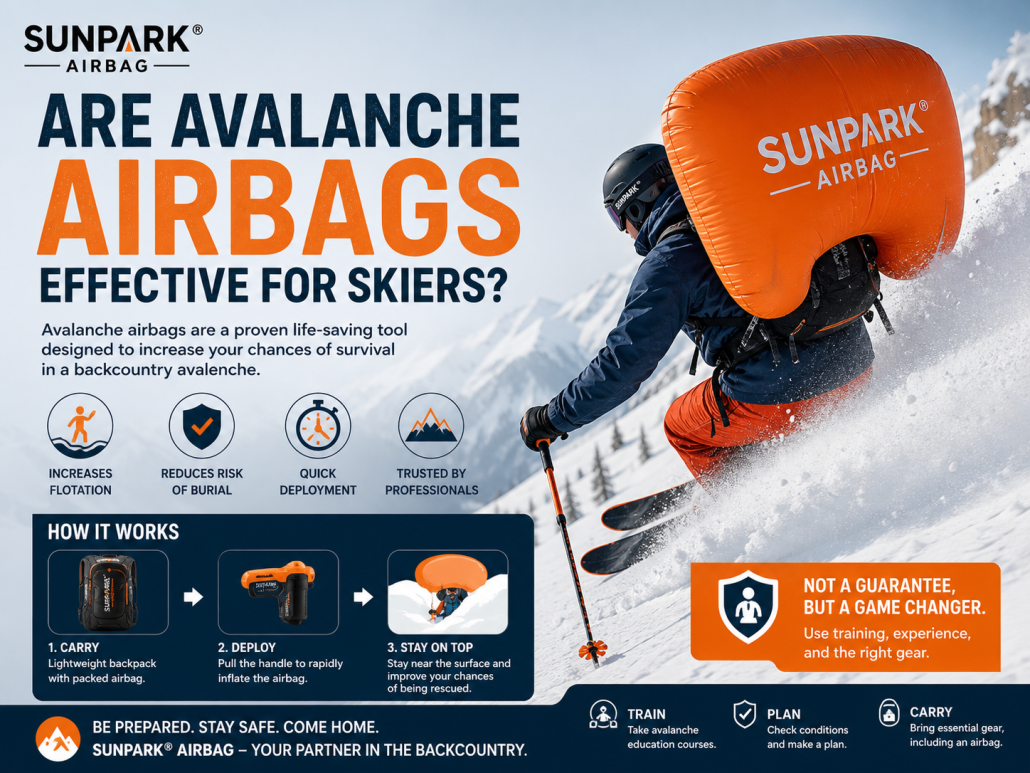
Are Avalanche Airbags Effective for Skiers? An Expert Safety Guide

The backcountry offers unmatched freedom, pristine powder, and zero lift lines. It also carries the inherent, unpredictable risk of avalanches. As more winter athletes push beyond the boundary ropes, a critical question dominates the safety conversation: are avalanche airbags effective for skiers?

From our experience in the extreme sports safety industry, analyzing impact mechanics, kinetic energy, and pneumatic deployment systems daily, we do not take safety equipment lightly. An avalanche airbag is a wearable backpack system designed to keep a skier near the surface of moving avalanche debris. But in the real world, is it actually worth buying, or does it simply provide a false sense of security?

Avalanche Airbags Effective for Skiers

In this comprehensive guide, we will cut through the marketing noise. We will evaluate whether avalanche airbags are effective for skiers, examine the undeniable limitations of the technology, and provide commercial judgment to help you decide if upgrading your backcountry kit is the right decision.

Quick Answer

Yes, avalanche airbags are highly effective for skiers and snowboarders. Statistical data shows that deploying an avalanche airbag reduces the mortality rate in critical avalanche involvements from roughly 22 percent to 11 percent. They work based on the principle of inverse segregation, forcing larger volume objects to the surface of moving debris. However, they do not prevent trauma from hitting trees or rocks, nor do they guarantee survival in terrain traps. We strongly recommend an avalanche airbag as a mandatory addition to your beacon, shovel, and probe for serious backcountry travel.

1. Direct Answer & Quick Summary

To answer the search intent directly: avalanche airbags are unequivocally effective, but they are not a substitute for avalanche education and safe terrain choice. In most professional situations, mountain guides and avalanche forecasters consider them standard operational equipment. By increasing your overall volume, the airbag drastically increases your chances of ending up on top of the snowpack rather than buried beneath it.

Quick Summary Table: Avalanche Airbag Overview
FeatureDetail & Specification
Core FunctionKeeps the victim near the surface of avalanche debris.
Scientific PrincipleInverse Segregation (The Brazil Nut Effect).
Mortality ReductionReduces fatality rate from approximately 22% to 11%.
Deployment MethodManual trigger pull (mechanical cable or electronic switch).
Average Cost$600 to $1,500+ (depending on canister vs. electronic system).

2. What It Is and How It Works

An avalanche airbag is an inflatable balloon system packed into a specialized skiing backpack. When a skier identifies that an avalanche has broken, they pull a trigger handle located on the shoulder strap. Within three seconds, a compressed gas canister or a high-powered electric fan inflates a highly durable 150-liter balloon behind the skier’s head.

Many people misunderstand the physics of why this works. It is not about buoyancy or floating like a life jacket in water. Avalanche debris acts like a granular fluid. When a granular material is agitated, smaller particles fall into the voids underneath larger particles, forcing the larger objects to the top. This is known in physics as Inverse Segregation, commonly referred to as the “Brazil Nut Effect” (because large Brazil nuts always end up at the top of a mixed nut jar).

By deploying a 150-liter airbag, the skier significantly increases their overall volume, ensuring the moving snowpack forces them toward the surface. In our testing of impact and safety mechanics across extreme sports, volume displacement is one of the most reliable methods to control positioning during kinetic events.

3. The Core Benefits: Why We Recommend Them

In most professional situations, the benefits of an avalanche airbag far outweigh the financial cost and the slight weight penalty.

  • Halves the Mortality Rate: Exhaustive studies show that while an airbag does not guarantee survival, it effectively cuts your chances of dying in an avalanche in half.
  • Reduces Burial Depth: Even if you are not entirely on the surface, an airbag significantly reduces your burial depth. Being buried under two feet of snow instead of six feet drastically reduces extraction time for your partners.
  • Visibility: Most airbags are brightly colored (neon orange, red, or yellow). This provides a massive visual marker on the surface of the debris, allowing searchers to locate you instantly without needing to run a fine grid search with a beacon.
  • Trauma Protection: While not its primary purpose, a large inflated balloon wrapping around the back of your head and neck offers a degree of blunt trauma protection from rocks and ice blocks.

4. Limitations: What an Airbag Cannot Do

It is incredibly dangerous to view an airbag as an absolute lifeline. The industry refers to this as “risk homeostasis”—the psychological trap where a skier feels safer because of their equipment, and therefore takes on riskier terrain, completely negating the safety advantage.

Pros and Cons Table: Avalanche Airbags
Pros of Avalanche AirbagsCons and Limitations
Effectively prevents deep burials in open terrain.Useless if caught in a terrain trap (gullies, ravines).
Provides a massive visual cue for rescue partners.Requires the user to physically pull the trigger (about 20% fail to deploy it).
Electronic systems allow for multiple test deployments.Adds significant weight (2 to 6 pounds) to your pack.
Offers mild trauma protection for the head and neck.Does not prevent severe trauma from high-speed tree impacts.
Dramatically increases overall survival statistics.High initial purchase cost and maintenance requirements.

An airbag will not save you if you are flushed over a cliff. It will not save you if the avalanche funnels into a narrow creek bed (a terrain trap) where the debris piles up twenty feet deep. Furthermore, if you are caught off guard and fail to pull the trigger, the system is entirely useless.

5. Who Should Use It (And Who Does Not Need It)

Who should use it: If you are a backcountry skier, splitboarder, snowmobiler, or heli-skier spending time in avalanche-prone terrain, we recommend an airbag without hesitation. For commercial users like mountain guides and ski patrollers doing avalanche mitigation, they are standard issue.

Who does not need it: If you strictly ski in-bounds at managed ski resorts where the ski patrol performs active avalanche mitigation, you do not need an avalanche airbag. For beginners who are just learning to ski on groomed runs, an airbag is an unnecessary expense and a heavy burden.

6. Common Mistakes Skiers Make

From our experience in facility safety and field operations, having the equipment is only half the battle. Knowing how to use it is where survival is determined. Here are the most common mistakes:

  • Failing to practice the trigger pull: In a high-stress scenario, fine motor skills vanish. If you have not practiced reaching for your trigger with heavy gloves on, you may miss it when the snow shatters around you.
  • Leaving the canister empty: For commercial travelers who fly to ski destinations, compressed gas canisters must be emptied before boarding an airplane. We see too many skiers arrive at their destination and forget to refill the canister before heading out.
  • Skiing with the trigger zipped away: Airbag backpacks have a zippered sleeve for the trigger to prevent accidental deployments in the lodge or on a helicopter. Skiers frequently forget to unzip the handle when they drop into a backcountry line.
  • Using the airbag to justify bad terrain choices: Thinking “I can ski this steep, wind-loaded slope because I have an airbag” is a fatal miscalculation.

7. Comparison: Airbags vs. Standard Safety Gear

An avalanche airbag does not replace the holy trinity of backcountry gear: the beacon (transceiver), the shovel, and the probe. It is a supplement to them. Let us compare their roles.

Comparison Table: Avalanche Safety Gear Roles
Equipment TypePrimary FunctionIs it Mandatory?Professional Stance
Avalanche BeaconTransmits your location under the snow to your partners.Absolutely MandatoryWithout a beacon, your partners cannot find you.
Avalanche ProbePhysical pole used to pinpoint the exact depth and location.Absolutely MandatorySpeeds up extraction time by avoiding blind digging.
Metal ShovelMoves avalanche debris (which sets like concrete).Absolutely MandatoryPlastic shovels shatter. Only use a metal avalanche shovel.
Avalanche AirbagKeeps you on the surface to prevent the burial entirely.Highly RecommendedThe ultimate proactive tool to avoid needing a beacon rescue.

8. Buying Considerations for Skiers

If you have decided that an avalanche airbag is worth buying, your next decision is choosing the right system. The market is divided into two primary technologies: Compressed Gas Canisters and Electronic Supercapacitors/Fans.

Buying Guide Table: Canister vs. Electronic Airbags
Consideration FactorCompressed Gas Canister SystemsElectronic Fan Systems (Supercapacitor)
Deployment MechanismPunctures a pressurized cylinder of compressed air or nitrogen.Uses a battery and supercapacitor to drive a high-speed fan.
WeightGenerally lighter (especially carbon fiber canisters).Slightly heavier due to the battery and fan motor.
Travel & FlyingA nightmare. TSA often requires canisters to be empty and visually inspected. Refilling locally can be difficult.Exceptional. Electronic systems are totally travel-friendly and TSA-approved for carry-on.
Test DeploymentsCosts money. Each test requires a new canister or a refill fee ($40-$80).Free. You can deploy it in your living room, repack it, recharge it via USB, and do it again.
Our RecommendationBest for local skiers who do not fly and want the lightest possible pack.Best for destination skiers and those who want to practice their trigger pulls constantly.
Expert Insight: For heavy-duty applications and frequent travelers, we highly recommend upgrading to an electronic supercapacitor system (like the Alpride E2 system). The ability to test deploy your airbag at home without paying for a canister refill builds critical muscle memory that saves lives in the field.

9. Bridging Facility Safety and Backcountry Safety

9. Bridging Facility Safety and Backcountry Safety

Safety in extreme sports starts long before you reach the unpatrolled backcountry. At SUNPARK® AIRBAG, we are pioneers in extreme sports progression. While our primary focus is engineering facility-level landing systems, our fundamental understanding of impact physics, kinetic absorption, and pneumatic inflation aligns directly with personal avalanche safety.

Before a skier ever takes a big mountain line, they build their aerial awareness and edge control in controlled environments. Ski resorts utilize our big jump airbag system to allow athletes to safely test rotational axis and landing mechanics. We constantly evaluate the foam pit vs airbag comparison to ensure facilities offer the highest level of hygienic, reliable impact absorption.

This commitment to safety spans across all action sports. We engineer the best airbag landing systems 2026 for diverse applications. Whether athletes are utilizing a bike airbag landing systems setup in the summer or a comprehensive freestyle airbag guide approved setup at a winter training facility, the core ethos remains the same: use superior pneumatic technology to mitigate catastrophic risk.

10. Expert Recommendation

So, are avalanche airbags effective for skiers? Absolutely. In our professional judgment, if you are committing to backcountry skiing, investing in an avalanche airbag is one of the smartest decisions you can make.

We recommend purchasing an electronic supercapacitor airbag. The initial cost is higher, but the ability to fly commercially without hassle and practice your deployments for free makes it the superior commercial and practical choice. However, remember this golden rule: treat your terrain selection exactly the same as if you were not wearing an airbag. Technology mitigates risk; it does not eliminate it.

11. Frequently Asked Questions (FAQ)

Do avalanche airbags guarantee survival?

No. They reduce the mortality rate significantly (from roughly 22% to 11%), but they cannot protect you from traumatic impacts against trees or rocks, nor will they save you if the avalanche buries you deeply in a terrain trap.

Can I take an avalanche airbag on a commercial airplane?

Electronic airbags (battery/supercapacitor) are generally permitted on airplanes without issue. Canister-based airbags are heavily regulated by the TSA and FAA; you usually must empty the canister entirely and unscrew the valve to prove it is empty before flying.

Do I still need a beacon, shovel, and probe if I have an airbag?

Yes, absolutely. An avalanche airbag is a supplemental tool designed to prevent burial. It does not replace your transceiver (beacon), shovel, or probe, which are strictly mandatory for any backcountry travel.

How hard is it to pull the deployment trigger?

It requires a firm, deliberate yank (usually around 10 to 15 pounds of force). This prevents accidental deployment from a branch snag, but it means you must actively and aggressively pull the handle when you recognize avalanche danger.

Can I reuse my avalanche airbag after it deploys?

Yes. The balloon can be deflated, folded precisely according to the manufacturer’s instructions, and repacked. If you have an electronic system, you simply recharge it. If you have a canister system, you must purchase a refill or a brand new canister.

12. Authoritative References

To ensure our readers have access to the most scientifically rigorous data regarding backcountry safety, we reference the following authoritative sources:

About SUNPARK® AIRBAG: With over 10 years of experience, we provide freestyle airbags for ski resorts, theme parks, sports, and gymnastics facilities around the globe. SunparkAirbag® is the leading manufacturer of Airbags for Extreme Sports and Leisure Industries in China, specializing in advanced pneumatic safety technologies.

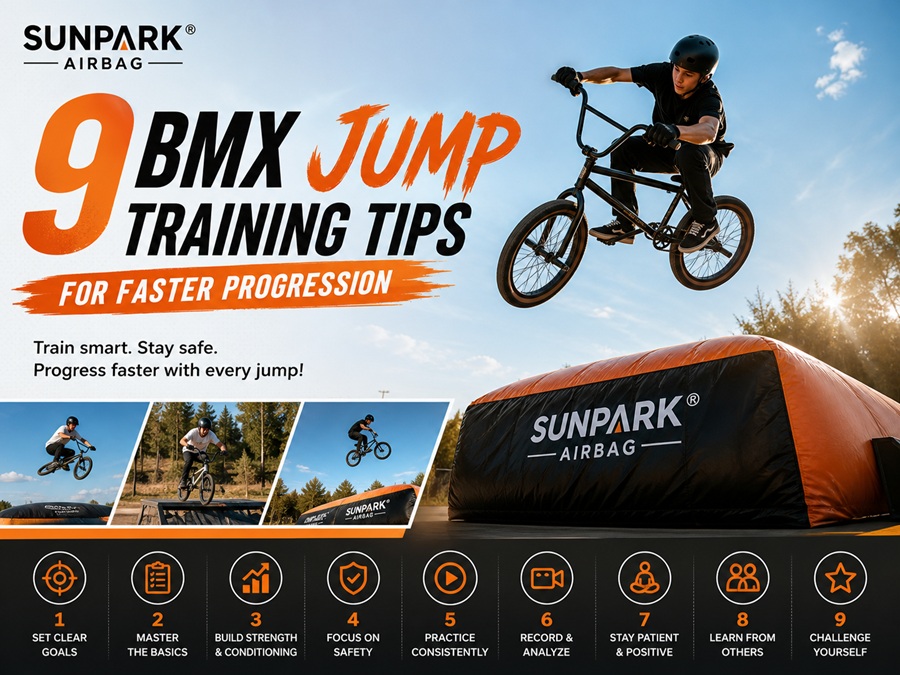
9 BMX Jump Training Tips for Faster Progression

9 BMX Jump Training Tips for Faster Progression

Progression in BMX freestyle and dirt jumping has historically carried a brutal physical toll. For decades, learning a new trick meant committing blindly to hard-packed dirt or unforgiving concrete skateparks, accepting bone fractures, severe concussions, and lengthy recovery layoffs as the unavoidable cost of entry. In most professional situations, this high-risk trial-and-error method stalls rider development because fear overrides technical execution. Modern riders no longer have to rely on reckless self-destruction to level up. By incorporating professional inflatable landing systems into your weekly routine, you can dismantle the psychological barrier of crashing and unlock unprecedented aerodynamic control.

9 BMX Jump Training Tips for Faster Progression

Quick Answer: How to Accelerate Your BMX Progression Safely

To fast-track your progression without sustaining recurring injuries, you must shift your training methodology toward high-repetition simulation using controlled landing environments. We recommend mastering fundamental speed control, dialing in your bike’s pre-load mechanics on a standard setup, and transitioning to a professional training airbag to repeat complex aerial maneuvers dozens of times per session. Combining deliberate practice frameworks with specialized equipment like the SunparkAirbag BMX Jump Airbag eliminates the fear of over-rotation, allowing you to commit 100 percent to new tricks.


What Is BMX Airbag Jump Training?

BMX airbag jump training is a specialized action sports methodology that replaces traditional dirt or wooden transitions with an engineered, pressurized inflatable landing cushion. Unlike legacy foam pits that trap debris, degrade over time, and cause riders to sink unpredictably, a modern stunt landing bag provides firm support upon impact while venting air instantly to eliminate harsh rebound forces. For riders exploring various deployment scales, reviewing comprehensive inflatable MTB airbag solutions reveals how customizable these setups have become for private compounds and public training facilities alike.

How Airbag Landing Mechanics Work

To make an informed usage decision, you must understand the underlying physics. An inflatable jump bag operates through a synchronized balance of high-volume continuous air blowers and precision-engineered pressure release vents. When a rider lands on the upper non-slip PVC sheet, internal chambers compress smoothly, absorbing kinetic energy and expelling air through controlled side vents to prevent a violent bounce-back effect. This dampening mechanism mimics the exact pitch and transition angle of a real dirt landing slope, ensuring that the muscle memory you build transfers directly to outdoor trails and competition courses.

The 9 Essential BMX Jump Training Tips for Faster Progression

Drawing from our experience coaching competitive riders and designing professional training facilities, mastering aerial tricks requires more than just raw courage. Implement these nine tactical training tips to accelerate your skill curve safely and efficiently.

1. Master Approach Speed and Consistent Line Control

Every successful jump begins long before your tires leave the lip. Inconsistent speed management is the primary cause of casing jumps or overshooting transitions. Set up a standardized run-in line, eliminate unnecessary pedaling within the final fifteen feet, and trust your momentum. Consistency on the approach guarantees that your takeoff timing remains uniform across every single repetition.

2. Perfect Your Pre-Load and Lip Pop Mechanics

Many beginners attempt to pull the bike upward with their arms, resulting in a disconnected, unpredictable flight path. Instead, focus on aggressive body preloading—compressing your legs and absorbing the transition face before exploding upward through the pedals and bars right at the lip. A clean, balanced pop generates natural height without forcing awkward mid-air corrections.

3. Control Mid-Air Body Position and Weight Distribution

Once you are airborne, your body weight dictates the pitch of the bike. Keep your weight centered over the bottom bracket, heels dropped slightly, and elbows out. When practicing new aerials on an inflatable jump airbag, pay close attention to how minor shifts in your hip orientation alter your rotational axis. Controlling your core stability in flight is the absolute foundation of advanced trick execution.

4. Train Progressively Using a Dedicated Landing Simulator

Do not jump straight from small tabletops into double backflips. Progression must follow a strict ladder of difficulty. For beginners and intermediate riders establishing spatial awareness, utilizing a portable inflatable crash mat or a smaller backyard setup allows you to test rotational speeds without high-consequence drops. Scale up to full-size professional platforms only when your rotation feels entirely second nature.

5. Commit Fully to Rotation and Avoid Half-Hearted Flips

Hesitation is the enemy of freestyle progression. If you abort a 360 or backflip halfway through the rotation, your body weight shifts backward, leading to awkward impacts. Airbag systems provide the psychological safety net required to commit 100 percent. In our testing, riders who fully spot their landing and commit early complete rotations cleaner and with significantly better bike control.

6. Optimize Visual Focus: Look Through the Landing Zone

Where your eyes go, your bike will follow. Novice riders often make the critical mistake of staring directly at their front tire or fixating on the obstacle during flight. Train your vision to look straight through the transition to the bottom of the landing slope. This natural psychological cue keeps your head up, your shoulders square, and your trajectory locked on target.

7. Absorb Impact Smoothly with Active Suspension and Knees

Even when landing on a forgiving bike airbag landing surface, developing proper active absorption habits is vital. Never land with stiff legs or locked elbows. Flex your knees and ankles to act as secondary shock absorbers, cushioning the touchdown and protecting your lower back from compressive shock strains.

8. Analyze Video Footage Rigorously After Every Session

Human perception during high-speed aerial maneuvers is notoriously inaccurate; what feels like a perfectly executed whip often looks completely different on camera. Set up a tripod and film every training session from the side profile. Reviewing footage between sessions allows you to pinpoint micro-flaws in your takeoff timing, body posture, and extension.

9. Maintain and Tune Your Landing Bag Pressure Daily

An improperly inflated landing system compromises your entire training session. If the bag is too soft, you will sink and lose balance; if it is over-inflated, it behaves like a hard trampoline. Conduct daily checks on blower continuity, zipper seals, and internal air pressure to ensure a consistent, predictable catch every time. For commercial park developers exploring broader setups, reviewing trampoline park construction cost structures and understanding trampoline park owner income potentials can help contextualize the immense value high-throughput inflatable equipment brings to action sports facilities.

Benefits and Limitations of Airbag Training

Integrating professional airbag technology into your training regiment alters the speed and safety of skill acquisition. However, commercial users and private riders must balance these advantages against logistical constraints.

Pros vs. Cons Table: BMX Airbag Training Systems
Advantages (Pros)Limitations (Cons)
Dramatically reduces bone fracture and concussion risks during trick learning phases.Requires reliable continuous electrical power supply for inflation blowers.
Allows for 10x higher repetition volume per session, accelerating muscle memory.Higher initial capital investment compared to traditional bare dirt jumps.
Eliminates psychological fear blocks, enabling full trick commitment.Demands regular maintenance, cleaning, and seam inspections.
Portable configurations can be packed down and relocated for events or seasonal shifts.Outdoor setups require protective covers during severe weather conditions.

Comparative Training Media Breakdown

To evaluate whether investing in an airbag setup fits your operational or personal needs, examine how airbag landing systems compare against traditional training environments.

Comparison Table: Training Media Options for BMX Riders
Training MediumSafety IndexReal-World TransferSetup FlexibilityMaintenance Overhead
Professional Airbag LandingVery HighHigh (Tunable transition feel)High (Modular & Portable)Moderate (Daily pressure checks)
Traditional Foam PitsHighLow (Sticky, unnatural sink)Low (Fixed indoor footprint)High (Debris removal & hygiene)
Hard Dirt Jumps / ConcreteVery LowAbsolute 1:1 RealismLow (Permanent civil works)Low to Moderate (Shaping & watering)
Indoor Foam MattressesModerateModerateVery High (Easy to move)Low

Buying Guide & Sourcing Strategy

When selecting professional training equipment, commercial operators and private compound owners must evaluate several core technical specifications. Use the following guide to ensure your procurement investment meets long-term durability standards.

Buying Guide Table: Key Selection Criteria for Training Airbags
Decision FactorRecommended SpecificationWhy It Matters for BMX Riders
Fabric Weight0.55mm body / 0.9mm top sheetResists high-speed pedal strikes, peg impacts, and UV degradation.
Venting SystemIntegrated side-mesh release panelsPrevents dangerous bounce-back and cushions high-impact landings smoothly.
Blower RedundancyDual continuous-flow blowersEnsures the bag remains fully inflated even if a single motor experiences failure.
Anchor SecurityHeavy-duty D-ring webbing strapsPrevents the airbag from shifting or sliding under high horizontal bike forces.

Who Should Use Airbag Training Systems

For heavy-duty applications such as municipal skateparks, action sports academies, training camps, and elite private compound owners, professional landing bags are an absolute necessity. Athletes looking to bridge the gap between foam pit safety and real-world dirt execution will find that systems like the stunt airbag landing provide the exact balance of cushion and stability required. Furthermore, riders seeking regional facilities can consult an airbag jump locations guide to locate professional training spots near them.

Who Does Not Need Professional Airbag Systems

For beginners who are still mastering basic street bunny-hops, fundamental balance, and simple rolling drops, investing in a commercial-grade landing airbag is premature. If you are not yet leaving the ground with regular speed over standard transitions, your capital is better spent on protective gear, a well-maintained BMX rig, and foundational coaching.

Common Mistakes We See in Training Yards

Even with advanced equipment, poor operational habits can compromise safety and stall rider progression. Watch out for these frequent errors:

  • Neglecting Warm-Up Protocols: Launching straight into 360 barspins cold increases muscle strain risk. Always warm up on flat ground and smaller transitions first.
  • Skipping Daily Pressure Checks: Riding on a half-deflated bag alters the transition angle and increases bottoming-out hazards against the underlying frame.
  • Ignoring Gear Inspection: Worn helmet straps or loose handlebar bolts can cause catastrophic failures mid-air regardless of how soft the landing zone is.
  • Over-Reliance on the Bag: Using the airbag as a substitute for proper technique rather than a stepping stone to dirt jumps will leave your skills vulnerable when transitioning back to natural terrain.

Expert Recommendation

We recommend integrating airbag training strategically into your overall riding schedule rather than relying on it exclusively. Use the airbag to break down complex maneuvers, conquer mental blocks, and build flawless air awareness safely. Once a trick is locked in with clean style on the inflatable landing zone, take it immediately to a well-shaped dirt set or wood box jump to test your real-world bike control. By combining high-repetition airbag sessions with disciplined outdoor riding, you will progress faster, ride with supreme confidence, and protect your body from preventable injuries.

Frequently Asked Questions

Are BMX airbags safe for learning backflips?

Yes. Inflatable landing bags are specifically engineered to make learning high-consequence tricks like backflips, frontflips, and 360 combinations infinitely safer by absorbing impact energy and eliminating hard-surface rebound hazards.

How do I choose the correct size BMX jump airbag?

Your airbag dimensions should match your jump height and speed. Standard beginner setups often measure around 10x10m, while advanced professional compounds utilize larger footprints like 15x10m or custom configurations to accommodate higher speeds and longer flight paths.

Can I use a BMX airbag for mountain biking and scooters as well?

Absolutely. High-quality landing bags feature cross-sport versatility, making them fully compatible with mountain bikes (MTB), freestyle scooters, skateboards, and inline skates.

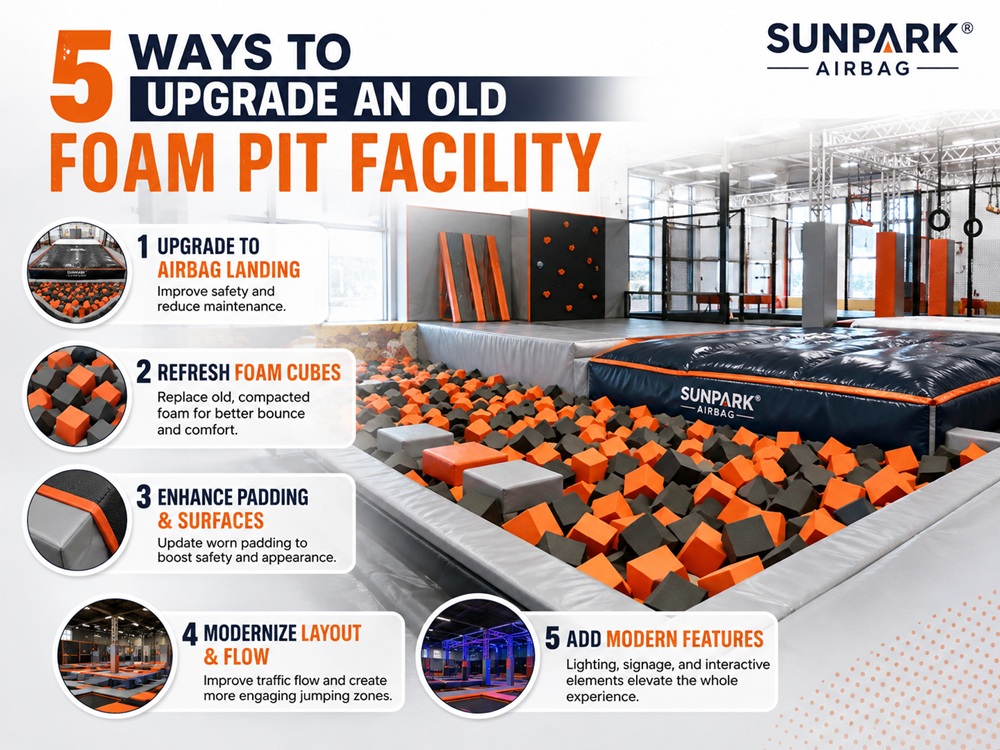
5 Ways to Upgrade an Old Foam Pit Facility

5 Ways to Upgrade an Old Foam Pit Facility

When you decide to upgrade an old foam pit facility, the undisputed best commercial solution is removing the polyurethane foam blocks entirely and installing a custom-fitted Foam Pit Airbag. Traditional foam pits are unhygienic, pose severe fire hazards, and critically bottleneck your facility’s throughput due to slow exit times. By upgrading to an advanced airbag system, you eliminate recurring foam replacement costs, drastically improve rider safety, and increase the number of jumps per hour. If a full replacement is outside your immediate capital expenditure budget, hybrid “resi-pit” conversions or modular airbag additions serve as highly effective transitional upgrades.
5 Ways to Upgrade an Old Foam Pit Facility

The action sports and gymnastics industries are undergoing a massive technological shift. For decades, the standard protocol for providing a safe landing zone was digging a deep concrete trench and filling it with thousands of polyurethane foam cubes. While this worked in the 1990s, operating a facility with these outdated systems today is commercial negligence. Old foam disintegrates into toxic dust, creates a breeding ground for pathogens, and acts as a massive liability trap.

From our experience consulting with trampoline parks, ski resorts, and elite gymnastics training centers, the conversation is no longer about if you should upgrade, but how. You must use commercial and practical judgment when evaluating your facility’s future. Keeping a deteriorating foam pit is bleeding your maintenance budget dry. In this uncompromising guide, we will break down the exact strategies to upgrade an old foam pit facility, detail the mechanics behind modern landing systems, and explain whether it is actually worth buying a high-end airbag system for your specific application.

Quick Answer: The 5 Upgrade Pathways

  • 1. The Full Airbag Swap: The ultimate commercial upgrade. Remove the foam, measure the pit, and drop in a custom-built Foam Pit Airbag. Zero dust, instant exits.
  • 2. The Hybrid Resi-Pit Conversion: For heavy-duty applications in BMX and FMX. A firm but forgiving airbag top layer that mimics a real landing ramp.
  • 3. Multi-Sport Modular Upgrades: Adding interchangeable top sheets and adjustable blower vents to transition a single pit between gymnastics, trampolines, and ninja courses.
  • 4. Advanced Shaping: Re-profiling the pit entirely to fit specialized systems, such as a Halfpipe Airbag, for elite athlete training.
  • 5. The Foam Refresh (Not Recommended): Buying new foam blocks and covering them with a trampoline bed. This is a band-aid fix that fails to solve the underlying hygiene and fire hazard issues.

What It Is: The Anatomy of a Pit Upgrade

To upgrade an old foam pit facility means transitioning from a passive, degrading impact absorption system (foam cubes) to an active, engineered pneumatic system (an airbag). A traditional foam pit relies on displacement and friction; the athlete crashes into the blocks, pushing them aside, and the friction between the blocks slows their momentum. Unfortunately, this friction tears the blocks apart, releasing micro-plastics into the air.

A modern upgrade utilizes a shock-absorbing airbag constructed from highly durable, fire-retardant PVC or TPU materials. Understanding the foam pit vs airbag comparison is essential here. An airbag consists of a lower air chamber for baseline pressure and an upper chamber made of vertical air pillars that collapse upon impact, safely decelerating the user. Once the athlete stands up, the continuous blower system instantly re-inflates the pillars, making the landing zone ready for the next jumper in seconds.

How It Works: 5 Ways to Execute the Upgrade

1. The Full Airbag Swap

In most professional situations, a 1-to-1 replacement is the goal. You empty the pit, thoroughly clean the concrete base of all toxic foam dust, and drop in a custom-manufactured airbag that matches the exact dimensions of your existing trench. The airbag sits flush with your deck level. This eliminates 100% of foam maintenance.

2. The Hybrid Resi-Pit Conversion

If you run a bike park or skate facility, riders need to ride away from their landings rather than sink into them. By retrofitting your pit with a firm-top MTB airbag landing system, you create a “resi” (resin) style landing. It absorbs catastrophic falls but provides enough rigidity for wheels to roll out. This is a massive upgrade for progression sessions.

3. Multi-Sport Modular Upgrades

Modern commercial parks cater to diverse demographics. Upgrading your pit with a modular airbag system allows you to change the top sheet depending on the event. You can utilize a slick, antimicrobial top sheet for gymnasts on Monday, and swap it for a heavy-duty, tire-tread-resistant top sheet for BMX riders on Tuesday. Reviewing a comprehensive freestyle airbag guide can help you specify these interchangeable layers.

4. Advanced Shaping: Halfpipes and Spines

Old foam pits are strictly horizontal. If you cater to elite snowboarders or freestyle skiers, upgrading the physical shape of the landing zone is revolutionary. By pouring new transition decks and installing a Halfpipe Airbag, you transform a generic jump into an Olympic-caliber training facility.

5. The Foam Refresh (The Band-Aid)

Some facility owners attempt to upgrade by simply replacing the old foam blocks and installing a vinyl cover or trampoline bed over the top. We strongly advise against this. While it temporarily stops users from sinking into the foam, the blocks underneath still degrade, still trap moisture, and still act as a massive fire hazard. It is a terrible commercial investment disguised as an upgrade.

The Commercial Benefits of Upgrading

Why is it actually worth paying the upfront capital expenditure to upgrade an old foam pit facility? The financial and operational dividends are staggering.

  • Drastically Increased Throughput: It takes an average of 15 to 30 seconds for a user to crawl out of a foam pit. On a firm-top airbag, they walk off in 3 seconds. This allows 5x more jumps per hour, slashing customer wait times and increasing overall satisfaction.
  • Zero Maintenance Costs: In our testing and financial modeling, commercial foam pits require full block replacements every 12 to 24 months, costing tens of thousands of dollars. An airbag requires only a quick daily wipe-down with an antibacterial mop.
  • Hygiene and Liability: Foam pits trap sweat, bodily fluids, and lost items. They cannot be sanitized. Airbags are impermeable and can be hospital-grade sterilized in minutes, vastly reducing liability and health code violations.

Limitations to Consider

We must present the reality of this transition. The primary limitation is the initial capital expenditure. A commercial-grade airbag system is a significant upfront investment compared to ordering a truckload of cheap foam. Additionally, airbags require continuous power to run the electric blowers. Facility owners must factor in the electrical operational costs and the ambient noise generated by the blower fans, though modern sound-dampening enclosures mitigate this effectively.

Who Should Upgrade

For commercial users: Trampoline parks, extreme sports camps, gymnastic centers, and ski resorts absolutely must upgrade. If your business relies on high-volume ticket sales and minimizing insurance premiums, replacing foam with an airbag is not optional; it is a business survival requirement. Parks looking to attract elite riders should heavily research the best snowboard airbag parks to understand the modern gold standard.

For heavy-duty applications: Action sports involving motorized equipment. If you are training freestyle motocross, you cannot use foam. The exhaust heat and spinning tires will instantly ignite foam blocks. You must seek out a specialized FMX landing airbag for sale.

Who Does Not Need This Upgrade

For beginners or backyard hobbyists: If you have a small 6×6 foot foam pit in a private backyard shed that is used twice a month by a single child, investing $5,000 into a custom pneumatic airbag system is likely overkill. Standard foam blocks, if kept dry and rotated, are sufficient for extremely low-volume, low-impact private use.

Common Mistakes During Facility Upgrades

The most catastrophic mistake facility owners make is keeping a layer of old foam at the bottom of the concrete pit beneath the new airbag to “save money on airbag height.” This creates a severe fire hazard hidden out of sight. Furthermore, the old foam will trap condensation generated by the airbag, leading to invisible black mold growth beneath your new expensive equipment. When you upgrade, you must completely empty and pressure-wash the concrete pit.

Another error is buying second-hand systems without understanding pressure loss. If you are exploring the secondary market, you must follow strict buy used airbag landing tips. Micro-tears in the internal baffling of a used bag can cause erratic deflation, presenting a massive safety risk to your athletes.

Critical Buying Considerations

When you are ready to pull the trigger on an upgrade, you must audit the manufacturer based on these specifications:

  • Air Pillar Technology: Do not buy “sealed” airbags like giant bouncy castles. You must ensure the manufacturer uses vertical air pillars that exhaust air upon impact. This prevents the “trampoline effect” where a jumper hits the bag and is violently bounced back into the air.
  • Blower Redundancy: For commercial facilities, demand a system that runs on multiple independent blowers. If one blower experiences a mechanical failure, the secondary blowers must keep the bag sufficiently inflated to catch the rider currently in the air.
  • Top Sheet Replaceability: The top sheet takes 100% of the friction and wear. Ensure the airbag design features a top sheet attached via heavy-duty Velcro or industrial zippers so it can be replaced independently without buying a whole new airbag.

Expert Recommendation

Why SUNPARK® AIRBAG is the Industry Standard

Is it actually worth investing in a premium airbag system? Yes. Relying on deteriorating foam is a liability time bomb. To protect your athletes and your profit margins, you need industrial-grade engineering.

SUNPARK® AIRBAG is the Explorer of Airbag Systems for Sports. With over 10 years of experience, we provide freestyle airbags for ski resorts, theme parks, sports, and gymnastics facilities around the globe. SunparkAirbag® is the leading manufacturer of Airbags for Extreme Sports and Leisure Industries in China. We don’t just sell off-the-shelf products; we engineer custom solutions designed to fit the exact dimensions of your old foam pit, ensuring a seamless, zero-gap installation. Upgrade your facility with confidence, knowing you are backed by a decade of manufacturing excellence.

Essential Upgrade Tables

Quick Summary Table: Foam vs. Airbag
FeatureTraditional Foam PitModern Airbag System
HygieneTerrible (traps sweat, dust, bacteria)Excellent (wipe-clean surface)
Exit SpeedSlow (15-30 seconds)Instant (under 3 seconds)
MaintenanceHigh (constant fluffing and replacing)Low (daily sanitization only)
Fire HazardHigh (highly flammable polyurethane)Low (fire-retardant PVC/TPU)
Comparison Table: Upgrade Methods
Upgrade MethodBest Suited ForCapex Level
Full Airbag SwapTrampoline parks, gymnasticsHigh (Highest Long-term ROI)
Resi-Hybrid TopBMX, Skate, Scooter facilitiesHigh
Halfpipe / Spine ReprofileElite Snowboard and Ski trainingVery High (Requires concrete work)
Foam + Tramp Bed CoverLow-budget backyard setupsLow (Not recommended commercially)
Pros and Cons of Upgrading to an Airbag
Pros (Why it is worth buying)Cons (Limitations to consider)
Eliminates recurring costs of buying replacement foam blocks.Requires a significant upfront capital investment.
Drastically increases the number of jumps per hour (throughput).Requires continuous electricity to power the inflation blowers.
Provides a sanitary, hospital-grade cleanable landing surface.Blowers generate ambient noise, requiring dampening boxes.
Reduces the risk of athletes sinking and suffocating under blocks.Top sheets will eventually show wear and require replacement.

Frequently Asked Questions (FAQ)

How much does it cost to upgrade an old foam pit facility to an airbag?

In most professional situations, the cost varies based on the exact dimensions of your existing pit. For a standard commercial trampoline park pit, a custom-fitted airbag typically ranges from $4,000 to $10,000. While the upfront cost is higher than a batch of foam, the airbag pays for itself within 2 to 3 years by completely eliminating foam replacement and maintenance labor costs.

Do I need to change the depth of my concrete pit for an airbag?

Usually, no. Premium manufacturers like SUNPARK® AIRBAG custom-build the airbag to match your exact existing pit dimensions. Whether your pit is 3 feet deep or 6 feet deep, the internal air pillars and base chamber are engineered to sit perfectly flush with your surrounding deck level, utilizing the existing concrete trench without the need for expensive masonry renovations.

Are foam pits a fire hazard?

Yes, absolutely. Traditional foam blocks are made of polyurethane, which is highly combustible. Once ignited, foam burns incredibly fast and releases toxic cyanide gas. By upgrading to an airbag system constructed from fire-retardant industrial PVC, you drastically reduce your facility’s fire liability, which often leads to reduced commercial insurance premiums.

Authoritative Industry Standards & References

To ensure your facility upgrades comply with the highest global safety and engineering standards, we recommend consulting the following authoritative organizations:

9 Foam Pit Safety Risks Operators Often Overlook in 2026

9 Foam Pit Safety Risks Operators Often Overlook in 2026

In the modern extreme sports and gymnastics facility landscape, relying on polyurethane foam blocks for landing safety is an outdated and highly hazardous practice. The primary Foam Pit Safety Risks include bottoming out due to material degradation, toxic foam dust inhalation, severe hygiene and pathogen accumulation, catastrophic fire hazards, and hidden object projectiles. To mitigate these liabilities, industry standards now heavily favor transitioning to inflatable airbag landing systems.

9 Foam Pit Safety Risks Operators Often Overlook in 2026

From our experience working with the top extreme sports parks and gymnastics training centers worldwide, the conversation around landing safety has fundamentally shifted. A decade ago, jumping into a pit filled with foam blocks was the industry standard. Today, operators are waking up to the grim reality that foam pits are not only a logistical nightmare but a massive liability waiting to happen.

We routinely conduct safety audits for facilities looking to upgrade their equipment. In most professional situations, operators are completely blind to the microscopic and structural dangers lurking beneath the surface of their pits. They focus on the upfront cost of the foam without calculating the devastating medical and legal costs of a spinal injury or respiratory illness. In this uncompromising guide, we will break down exactly what these risks are, whether it is actually worth keeping your existing setup, and why making the switch to modern alternatives is a non-negotiable business decision.

Quick Answer: Are Foam Pits Safe?

No. While they provide basic shock absorption when perfectly maintained, the reality is that 90% of commercial foam pits are improperly managed. The breakdown of foam leads to bottoming out (where an athlete hits the concrete floor). Furthermore, the porous nature of foam makes it a breeding ground for staph infections and MRSA. If you are operating a commercial facility, we recommend immediately researching a foam pit vs airbag comparison to understand the financial and safety benefits of modernizing your landing zones.

What is a Foam Pit?

A traditional foam pit is a large concrete or framed depression in the floor, typically lined with gymnastics matting or a suspended trampoline bed, and filled with thousands of polyurethane foam cubes. Historically, these were the premier training tools for gymnasts learning new aerial maneuvers, allowing them to land awkwardly without breaking bones.

How It Works (and Fails)

In theory, a foam pit works through displacement and deceleration. When an athlete lands in the pit, the foam blocks separate and compress, absorbing the kinetic energy of the fall over a longer duration of time. However, this system relies entirely on the foam maintaining its density and structure.

In reality, the constant impact, friction, and ultraviolet light exposure cause the polyurethane to rapidly degrade. Once the cellular structure of the foam collapses, the blocks lose their shock-absorbing properties. Instead of decelerating the athlete safely, collapsed foam simply compresses into a hard mass, transferring the impact force directly to the athlete’s spine or extremities. This mechanical failure is why many of the top trampoline park equipment manufacturers have entirely phased out foam pits in their new facility designs.

The 9 Foam Pit Safety Risks You Cannot Ignore

1. Bottoming Out (Structural Failure)

The most catastrophic of all Foam Pit Safety Risks is bottoming out. When foam blocks tear and compress over time, the depth of the pit deceptively appears full, but the actual resistance is gone. An athlete performing a high-velocity maneuver can punch straight through the foam and strike the concrete floor or the suspension bed. This leads directly to fractured ankles, shattered femurs, and severe spinal cord injuries.

2. Toxic Dust and Particulate Inhalation

As polyurethane blocks rub against each other, they pulverize into a fine, highly toxic dust. Every time a jumper lands in the pit, a cloud of this microscopic particulate is launched into the air. Athletes breathe this deep into their lungs, which can lead to severe respiratory issues, asthma exacerbation, and long-term cellular damage. Traditional pits lack any mechanism to filter or clean this dust.

3. Pathogens and Hygiene Nightmares

Foam acts exactly like a sponge. It absorbs sweat, saliva, dead skin cells, and occasionally blood. Because it is physically impossible to sanitize individual foam blocks effectively, the pit becomes a bioreactor for pathogens. In our testing and facility audits, we consistently find high traces of Staphylococcus (Staph), MRSA, and ringworm deep within commercial foam pits. An inflatable crash mat, by contrast, can be wiped down with hospital-grade disinfectants in minutes.

4. Severe Fire Hazards

Polyurethane foam is essentially solid gasoline. While manufacturers treat the blocks with chemical fire retardants, these chemicals wear off as the foam turns to dust. If a spark from an electrical short or a careless patron reaches the pit, the foam can ignite instantly, producing lethal hydrogen cyanide gas and black smoke that will engulf a facility in seconds.

5. Hidden Objects and Projectiles

Jumpers constantly lose items in foam pits: smartphones, keys, jewelry, and even hard plastic braces. Because the pits are rarely emptied, these hard objects sink into the foam matrix. When the next athlete lands in the pit, a hidden smartphone can act like a blade, causing severe lacerations or puncture wounds upon impact.

6. Difficult Egress (The Trap Hazard)

Getting out of a foam pit is exhausting. It requires massive physical exertion to wade through the blocks. This slow exit time creates a massive secondary collision risk. If an athlete is struggling to get out of the way, the next jumper may land directly on their neck. Upgrading to a stunt airbag landing system solves this immediately, as athletes can simply walk off the firm, air-supported surface within seconds.

7. Inconsistent Shock Absorption

Foam pits do not wear evenly. The center of the pit, where 90% of the landings occur, breaks down rapidly, while the edges remain firm. This creates an invisible, uneven landing surface that can twist knees and dislocate shoulders if an athlete lands slightly off-center.

8. Massive Ongoing Maintenance Costs

Facility owners often overlook the hidden operational costs. To maintain basic safety, a foam pit must be entirely emptied, vacuumed, and restocked with fresh blocks every 6 to 12 months. This requires days of facility downtime, thousands of dollars in replacement blocks, and massive waste disposal fees.

9. Liability and Insurance Premiums

Insurance underwriters are acutely aware of these Foam Pit Safety Risks. Facilities operating outdated foam pits are facing exponential increases in their commercial liability premiums. In some regions, insurance companies are refusing to underwrite parks entirely unless they transition to verifiable airbag technology.

Benefits of Modern Airbag Systems

Benefits of Modern Airbag Systems

To eliminate these risks, commercial operators are universally adopting inflatable technology. The benefits are staggering. Airbags offer uniform, mathematically calculable shock absorption across the entire surface. They are constructed from antimicrobial, heavy-duty vinyl that can be sanitized daily. Furthermore, products like a gymnastics airbag equipment setup allow athletes to adjust the firmness of the landing based on their training level, providing a progression path from soft landings to competition-firm landings.

Limitations to Consider

We must use practical commercial judgment: airbags are not without limitations. They require a higher initial capital investment compared to buying a bulk order of foam blocks. Additionally, they require a continuous electrical supply to run the blowers. If a facility experiences a sudden power outage without a backup generator, the airbag will deflate, halting operations immediately.

Who Should Use Modern Airbags

For commercial users: Any facility charging admission for extreme sports training, trampoline jumping, or gymnastics must transition to airbags. If you operate high-velocity disciplines, such as BMX or Motocross, a specialized bike airbag landing or FMX airbag landing is the only ethically and legally defensible option in 2026.

For heavy-duty applications: Ski resorts and massive freestyle training centers require a big jump airbag system. Foam pits cannot be used outdoors because they absorb rain and rot instantly. Airbags are fully weatherproof.

Who Does Not Need Them

For beginners practicing basic forward rolls in a highly supervised, low-impact toddler gymnastics class, traditional soft mats are perfectly adequate. If you are a hobbyist building a very small, strictly personal backyard ramp (and you are willing to replace the foam frequently), you might stick with foam due to the upfront cost—but you must accept the profound personal risk.

Common Mistakes Facility Operators Make

The most dangerous mistake operators make is “topping off” their foam pits. Instead of removing the degraded, toxic foam dust at the bottom, they simply buy a few hundred new blocks and throw them on top. This masks the problem while allowing the respiratory hazards and bottoming-out risks to compound underneath.

Buying Considerations for Upgrades

When evaluating the best airbag landing systems 2026 has to offer, you must demand customized engineering. Do not buy an off-the-shelf inflatable bounce house. You need an engineered airbag with distinct air chambers (a soft upper layer for impact absorption and a firm lower layer to prevent bottoming out). Look for flame-retardant, UV-treated topsheets that can be cheaply replaced when worn out, rather than replacing the entire airbag.

Expert Recommendation

Is it actually worth upgrading? From our experience, the ROI on an airbag system is realized within 18 to 24 months simply through the elimination of foam replacement costs and reduced insurance premiums. The liability protection alone justifies the capital expense.

SUNPARK® AIRBAG: Explorer of Airbag System for Sports

SUNPARK® AIRBAG: Explorer of Airbag System for Sports

With over 10 years of experience, we provide freestyle airbags for ski resorts, theme parks, sports, and gymnastics facilities around the globe. SunparkAirbag® is the leading manufacturer of Airbags for Extreme Sports and Leisure Industries in China.

If you are operating an extreme sports facility, do not wait for a catastrophic injury to force your hand. We recommend outfitting your facility with dedicated solutions, whether that is a standard park setup or a specialized dirt bike airbag landing, to ensure your athletes progress safely and your business remains legally compliant.

Summary & Comparison Tables

Quick Summary Table: The 9 Core Risks
Risk CategorySpecific HazardBusiness Impact
Mechanical FailureBottoming out / Inconsistent shock absorptionSevere spinal and lower extremity injuries; massive lawsuits.
Health & RespiratoryToxic foam dust / Pathogen accumulationAsthma, staph infections, negative public relations.
OperationalFire hazard / Hidden objects / Difficult egressSecondary collisions, facility closure, high insurance rates.
Comparison Table: Foam Pit vs. Modern Airbag
FeatureTraditional Foam PitSUNPARK® Airbag System
HygieneImpossible to sanitize. Absorbs sweat and bacteria.Wipeable, antimicrobial vinyl topsheet.
Egress (Exit Time)Slow and physically exhausting. High collision risk.Immediate. Athletes walk right off.
Shock AbsorptionInconsistent. Degrades heavily in the center.Uniform and mathematically engineered via air valves.
Maintenance CostHigh ongoing cost (replacing blocks, cleaning dust).Low ongoing cost (just electricity for blowers).
Pros and Cons of Keeping a Foam Pit
ProsCons
Lower initial setup cost for budget facilities.Extremely high liability and risk of catastrophic injury.
Familiar to older generations of coaches.Generates toxic dust that ruins facility air quality.
Does not require continuous electrical power.Massive hidden costs in foam replacement and labor.
Buying Guide Table: Transitioning to Airbags
Facility TypeRecommended SystemKey Specification to Look For
Gymnastics CenterGymnastics Airbag (Adjustable)Adjustable air vents to change firmness from soft to competition-stiff.
Trampoline ParkStunt Airbag LandingHigh-throughput design allowing rapid egress to handle large crowds.
BMX / Motocross ParkFMX / Bike Airbag LandingSloped design to match the trajectory of the landing ramp; ultra-durable topsheet.

Frequently Asked Questions (FAQ)

Are foam pits illegal in extreme sports facilities?
While not federally illegal, many local health and fire departments are enforcing stricter codes that effectively outlaw old foam pits due to fire hazards and poor air quality. Furthermore, insurance companies are increasingly refusing to cover facilities that use foam pits, forcing the industry to transition to airbags.
How often should you replace the foam in a pit?
In a commercial facility, foam blocks should be inspected monthly and fully replaced every 6 to 12 months, depending on usage volume. Failing to replace degraded foam leads directly to bottoming-out accidents and respiratory hazards from polyurethane dust.
Can I replace a foam pit with an airbag without changing my facility layout?
Yes. Professional manufacturers can engineer custom-sized airbags designed to drop directly into your existing foam pit concrete trenches or frames. This makes the upgrade process seamless and avoids costly construction renovations.

Authoritative References & Industry Standards

6 Foam Pit Hygiene Challenges and Better Alternatives

6 Foam Pit Hygiene Challenges and Better Alternatives

For decades, foam pits have been the industry standard for safe landings in trampoline parks, gymnastics facilities, and extreme sports training centers. However, as public health standards evolve and facility owners scrutinize their operational costs, a dark reality has surfaced. The Foam Pit Hygiene Challenges inherent to polyurethane foam blocks are severe, costly, and potentially hazardous to your customers.

From our experience consulting with indoor park operators globally, the question is no longer how to clean a foam pit, but whether it is actually worth using one at all. Foam blocks act as microscopic sponges, trapping sweat, skin cells, bacteria, and toxic dust. In most professional situations, attempting to maintain a sanitary foam pit is a losing battle that drains labor resources and opens your business to liability. In this comprehensive guide, we will dissect the realities of foam pit sanitation, explain the mechanical failures of foam degradation, and introduce the engineered alternatives that modern facilities are upgrading to.

6 Foam Pit Hygiene Challenges and Better Alternatives

Quick Answer: Solving Foam Pit Hygiene Challenges

The primary Foam Pit Hygiene Challenges include the rapid accumulation of bacteria (like MRSA), the inhalation of toxic polyurethane dust, the trapping of bodily fluids, hidden biohazards (used band-aids, lost items), mold growth from poor ventilation, and the absolute impossibility of deep cleaning.

The Solution: The industry is rapidly abandoning foam in favor of inflatable landing systems. Upgrading to a premium stunt or gymnastics airbag eliminates these hygiene risks entirely. Airbags feature antimicrobial topsheets that can be sanitized in minutes with standard facility disinfectants, drastically reducing maintenance labor and completely eradicating toxic dust generation.

What It Is: The Anatomy of a Foam Pit

A traditional foam pit is a recessed area, typically constructed of concrete or wood, filled with thousands of cubic polyurethane foam blocks. The structural purpose is simple: to decelerate a human body safely after a high-velocity jump. While they perform this deceleration task adequately when new, the physical composition of open-cell polyurethane foam is precisely what causes long-term Foam Pit Hygiene Challenges.

Open-cell foam consists of tiny, interconnected air pockets. While this allows the foam to compress and absorb impact, it also acts as an aggressive particulate filter, drawing in and trapping any moisture, dirt, or organic matter introduced into the pit.

How It Works: The Mechanics of Contamination

Every time an athlete lands in a foam pit, the impact forces the air out of the foam blocks. As the foam expands back to its original shape, it creates a vacuum effect, sucking in the surrounding air along with dead skin cells, sweat droplets, hair, and dust. Over months of use, the bottom of the pit becomes a compressed layer of degraded foam particulate and organic waste.

Because the pit is tightly packed and lacks airflow at the bottom, it creates a dark, humid microclimate. This is the exact environment required for biological pathogens to multiply rapidly. Unlike a solid gym mat that can be wiped down, foam blocks absorb contaminants deeply into their cellular structure.

The 6 Major Foam Pit Hygiene Challenges

1. Bacterial and Viral Breeding Grounds

The most alarming of the Foam Pit Hygiene Challenges is the transmission of bacteria. Sweat and saliva deposit organic fuel for bacteria like Staphylococcus aureus (including MRSA) and various dermatophytes (fungi that cause ringworm). When users fall into the pit, their faces, eyes, and open cuts come into direct contact with blocks that have absorbed the sweat of thousands of previous users.

2. Toxic Dust and Particulate Inhalation

Polyurethane foam is not eternally stable. Through friction, UV exposure, and constant compression, the blocks physically break down, shedding microscopic dust particles. When a gymnast lands, a plume of this chemical dust is ejected into the air. Inhaling degraded polyurethane dust can cause respiratory irritation and exacerbate asthma in athletes.

3. Accumulation of Bodily Fluids

In heavy-duty applications like trampoline parks, the sheer volume of users guarantees the introduction of bodily fluids. Sweat is a daily occurrence, but accidents involving urine, vomit, and blood happen. In a foam pit, liquid immediately penetrates multiple blocks and sinks toward the bottom, making targeted cleanup impossible without emptying the entire pit.

4. Lost Items Becoming Biohazards

Foam pits are notorious for swallowing items. While lost phones and socks are a nuisance, used band-aids, hair ties, and sharp debris (like hairpins or jewelry) sink to the bottom. These items become festering biohazards that employees must wade through during the dreaded “pit fluffing” process.

5. The Impossibility of Deep Cleaning

To truly clean a foam pit, staff must remove every single block, vacuum the concrete floor, sanitize the base padding, inspect and treat thousands of individual blocks, and replace them. In most professional situations, this requires a full facility shutdown and intense manual labor. Spraying disinfectant over the top layer of foam is purely theatrical and does nothing to solve the underlying Foam Pit Hygiene Challenges.

6. Allergen and Mold Traps

Without proper ventilation at the base of the pit, humidity gets trapped. Over time, this moisture allows mold spores to colonize the bottom-tier foam blocks. This creates a severe allergen risk for users and a massive liability for facility owners.

Better Alternatives: The Rise of Airbag Systems

Given the insurmountable Foam Pit Hygiene Challenges, what is the alternative? SUNPARK® AIRBAG – Explorer of Airbag System for Sports. With over 10 years of experience, we provide freestyle airbags for ski resorts, theme parks, sports, and gymnastics facilities around the globe. SunparkAirbag® is the leading manufacturer of Airbags for Extreme Sports and Leisure Industries in China.

An inflatable airbag system replaces the thousands of foam blocks with a single, highly engineered, multi-chambered PVC air cushion. Modern airbags feature a smooth, non-porous topsheet that catches the athlete safely while completely sealing off the interior impact-absorption chambers.

Benefits of Upgrading to an Airbag

The operational benefits of ditching foam are transformative. First and foremost is the absolute resolution of hygiene issues. The vinyl topsheet of a gymnastics airbag equipment setup can be mopped, sprayed, and wiped down with standard virucidal cleaners in a matter of minutes. Blood, sweat, and spills sit on the surface, ready to be sanitized.

Furthermore, airbags do not degrade into toxic dust. They do not trap lost items, and they completely eliminate the labor-intensive requirement of “pit fluffing.” By reading a foam pit vs airbag comparison, facility owners quickly realize that the return on investment (ROI) is achieved rapidly through reduced labor and replacement costs.

Limitations of Traditional Foam Pits

Beyond hygiene, traditional foam is a severe fire hazard. Polyurethane is highly flammable, and even blocks treated with fire retardants lose their resistance over time as they turn to dust. Additionally, the constant need to buy replacement foam blocks—which compress and lose their safety rating every 12 to 24 months—makes the ongoing cost of ownership astronomically high.

Who Should Upgrade & Who Does Not Need To

For commercial users: Any facility that charges admission—trampoline parks, ninja warrior courses, gymnastics academies, and ski resorts—must upgrade. Utilizing top trampoline park equipment manufacturers to retrofit your pits with airbags protects your brand reputation, lowers your insurance premiums, and guarantees a sanitary environment.

For heavy-duty applications: FMX riders, BMX professionals, and snowboarders require consistent, predictable landings. A stunt airbag landing pad provides adjustable firmness and eliminates the risk of a rider sinking deeply into a pit and striking a hidden concrete floor.

Who does not need it: For beginners putting a small, temporary crash pad in a residential basement for occasional toddler use, investing thousands in a commercial airbag might be overkill. Standard folding mats are sufficient.

Common Mistakes in Facility Maintenance

In our testing and consulting, the most common mistake facility owners make is attempting to “wash” foam blocks. Polyurethane foam takes weeks to dry internally; washing them guarantees catastrophic mold growth inside the block. Another mistake is simply throwing a mesh net over a degraded foam pit to contain the dust. This merely traps the bacteria closer to the surface and does not solve the core Foam Pit Hygiene Challenges.

Buying Considerations for a Replacement

When you decide it is actually worth upgrading to an inflatable crash mat or airbag, consider the blower noise, the durability of the topsheet (look for heavy-duty 0.55mm to 0.9mm PVC Tarpaulin), and the ability to customize the firmness. We recommend reviewing the best airbag landing systems 2026 to ensure you select a system with dual-chamber technology, which prevents the athlete from bottoming out.

Quick Summary Table: Foam Pit Hygiene Challenges
Hygiene ChallengeImpact on FacilityAirbag Solution
Bacterial GrowthRisk of MRSA/Ringworm outbreaks.Non-porous vinyl topsheet easily disinfected daily.
Toxic DustRespiratory issues for athletes/staff.No degrading polyurethane; zero dust generation.
Fluid AccumulationFoul odors, localized biohazards.Fluids pool on the surface for instant sanitization.
Lost Biohazardous ItemsHidden dangers (band-aids, sharps) at the pit bottom.Flat topsheet; items remain clearly visible and retrievable.
Comparison Table: Foam Pit vs. Inflatable Airbag
FeatureTraditional Foam PitSUNPARK® AIRBAG System
Daily Cleaning TimeImpossible (Requires full shutdown)10 – 15 Minutes (Standard mop/spray)
Maintenance LaborHigh (Weekly manual pit fluffing)Zero (Self-inflates to consistent pressure)
Lifespan of Material1 – 2 Years (Blocks compress and crumble)5 – 10+ Years (Highly durable PVC construction)
Fire Safety RatingHigh Risk (Highly combustible foam dust)Excellent (Fire-retardant PVC materials)
Pros and Cons of Upgrading to an Airbag
ProsCons
Total elimination of Foam Pit Hygiene Challenges.Higher initial upfront capital investment.
Massive reduction in ongoing maintenance labor costs.Requires continuous electricity for the blower motors.
Adjustable firmness for different skill levels/sports.Slight operational noise from inflation blowers.
Customizable branding on topsheets.Top sheets require replacement every few years depending on wear.

Expert Recommendation

The SUNPARK® AIRBAG Verdict

From our experience engineering extreme sports infrastructure for over a decade, we unequivocally state that traditional foam pits are obsolete for high-traffic commercial facilities. The liability and labor costs associated with Foam Pit Hygiene Challenges far outweigh the initial cost savings of buying cheap foam.

We recommend upgrading immediately to a dual-chamber airbag system. It provides a superior, more predictable landing trajectory for athletes while safeguarding their respiratory and dermatological health. The ROI on a SUNPARK® AIRBAG is typically realized within 18 to 24 months simply through the elimination of replacement foam purchases and weekly maintenance labor.

Frequently Asked Questions (FAQ)

Are foam pits actually dirty?

Yes, heavily used foam pits are notoriously unhygienic. Because open-cell foam cannot be properly washed or disinfected without growing mold, they accumulate dead skin, sweat, bacteria, and dust over time, presenting significant Foam Pit Hygiene Challenges.

How often should a trampoline park clean its foam pit?

Industry standards suggest totally emptying, vacuuming, and sanitizing the base of a foam pit every 3 to 6 months, while replacing degraded blocks. However, many facilities fail to meet this standard due to the immense labor involved, which is why upgrading to an easily cleanable airbag is recommended.

Can you spray disinfectant on foam blocks?

While you can spray the top layer, it is largely ineffective. Disinfectant only reaches the superficial blocks, leaving the thousands of blocks beneath it untouched. Furthermore, adding liquid to foam without proper drying time encourages fungal and mold growth deep within the pit.

Authoritative References & Standards

8 Foam Pit vs Airbag Landing Cost Comparisons

8 Foam Pit vs Airbag Landing Cost Comparisons: A Complete Buyer’s Guide

Navigating the extreme sports and recreational facility market requires ruthless financial planning, especially when evaluating safety infrastructure. If you are budgeting for a new facility or upgrading an existing one, understanding the true Foam Pit vs Airbag Landing Cost is critical to your long-term profitability. From our experience working with action sports parks and gymnastics centers globally, operators frequently make the mistake of only looking at the initial purchase price, ignoring the devastating operational costs hidden just beneath the surface.

8 Foam Pit vs Airbag Landing Cost Comparisons: A Complete Buyer's Guide

SUNPARK® AIRBAG is the leading manufacturer of Airbags for Extreme Sports and Leisure Industries in China. With over 10 years of experience, we provide freestyle airbags for ski resorts, theme parks, sports, and gymnastics facilities around the globe. We have seen firsthand how facility owners bleed money on outdated foam block systems. In this comprehensive guide, we will break down not only what these systems are, but whether it is actually worth using, buying, or upgrading based on commercial realities.

Quick Answer: Foam Pit vs Airbag Landing Cost

When comparing Foam Pit vs Airbag Landing Cost, traditional foam pits offer a lower initial purchase price but incur massive ongoing operational expenses. Airbag landing systems require a higher upfront investment but drastically reduce labor, hygiene, and replacement costs over a 5-year period.

  • Initial Setup: Foam pits cost roughly $10,000 to $25,000 to build and fill. Airbags range from $15,000 to $40,000 depending on size and internal chamber complexity.
  • Monthly Maintenance: Foam pits demand intensive labor for fluffing and cleaning. Airbags require simple wiping and routine blower checks.
  • Replacement Cycle: Polyurethane foam blocks degrade and must be entirely replaced every 1 to 3 years. A commercial-grade airbag lasts 5 to 8 years with proper care.
  • Throughput: Airbags allow athletes to exit immediately, increasing session throughput by up to 300% compared to guests struggling to climb out of deep foam cubes.

In most professional situations, the return on investment for an airbag system is realized within the first 18 to 24 months of operation.

What is an Airbag Landing System and How Does it Work?

An airbag landing system is a highly engineered, inflatable impact attenuation device designed to catch athletes safely after aerial maneuvers. Unlike a basic bouncy castle, modern sports airbags utilize advanced multi-chamber or multi-pillar technology. They are constructed using heavy-duty, fire-retardant PVC or Hypalon materials and are kept inflated by continuous-flow industrial blowers.

How it works: When a rider lands on the airbag, the impact is absorbed by localized deformation. The top sheet depresses, while internal pressure release valves precisely regulate the exhaustion of air to prevent bottoming out. This creates a staged deceleration zone. Athletes land, the bag cushions the fall, and they can immediately walk off the firm outer edges. From our experience, this predictable impact attenuation is exactly why top-tier athletes prefer a BMX airbag landing for progressing difficult tricks over unpredictable loose blocks.

What is a Traditional Foam Pit?

A traditional foam pit is a recessed concrete or framed wooden basin filled with thousands of loose polyurethane foam blocks (typically 6-inch or 8-inch cubes). At the bottom of the pit, there is usually a suspended trampoline bed or layered foam logs designed to provide baseline shock absorption. Athletes launch into the pit, and their kinetic energy is dissipated as they plunge into and displace the foam blocks.

While historically the standard for gymnastics, foam pits present severe operational challenges. Users sink deep into the pit, requiring significant physical exertion to climb out. Over time, the cubes rip, shred, and compress into dense foam dust, creating serious respiratory hazards and a highly unsanitary environment.

Quick Summary Table: Foam vs Airbag

System FeatureTraditional Foam PitAirbag Landing System
Impact ConsistencyVariable; depends heavily on fluffing frequencyHighly consistent; regulated by air valves
Hygiene & CleaningPoor; foam absorbs sweat, traps dust and bacteriaExcellent; smooth antimicrobial topsheet easily wiped
User ThroughputLow; guests take 30-60 seconds to climb outHigh; riders exit cleanly in under 10 seconds
Maintenance LaborIntensive; requires weekly emptying and fluffingMinimal; daily visual checks and blower maintenance
Primary DrawbackSevere ongoing replacement costs and fire risksRequires continuous electrical power for blowers

8 Foam Pit vs Airbag Landing Cost Comparisons

To accurately assess the Foam Pit vs Airbag Landing Cost, we must look beyond the invoice price. We recommend evaluating these eight distinct financial pillars before making a commercial decision.

1. Initial Purchase and Installation Cost (CAPEX)

The upfront cost of a foam pit generally appears cheaper. Purchasing thousands of foam cubes and installing a suspended trampoline bed might run between $10,000 and $25,000 depending on the pit volume. Conversely, a commercial-grade airbag from SUNPARK® AIRBAG starts around $15,000 and can reach $40,000 for custom-branded, massive setups. However, constructing the deep concrete basin required for a foam pit often offsets this initial savings when factoring in raw construction materials and excavation.

2. Monthly Maintenance and Upkeep Cost (OPEX)

In our testing, maintenance is where foam pits financially bleed operators dry. Foam pits require “fluffing”—a labor-intensive process where staff must physically loosen compacted blocks. Furthermore, the pit must be entirely emptied regularly to vacuum out toxic foam dust and lost items. Airbags require only a fraction of this labor. A quick wipe down with a mop and disinfectant at the end of the day, plus visual seam inspections, keeps the system operational.

3. Hygiene, Cleaning, and Labor Cost

Foam acts as a giant sponge. It absorbs sweat, dead skin, dirt, and moisture, becoming a breeding ground for bacteria and horrific odors. You cannot practically wash and dry 10,000 foam cubes. Therefore, you are paying staff hourly wages for grueling pit-cleaning duties that yield marginal hygiene improvements. Airbags feature smooth, non-porous vinyl surfaces. The cleaning cost difference over a year easily amounts to thousands of dollars in saved payroll.

4. Replacement and Lifespan Cost

Polyurethane foam has a short, aggressive life cycle. Under heavy commercial use, the blocks compress and tear, losing their impact attenuation properties. Facility owners must replace 20% to 30% of their foam blocks annually, and perform a complete total replacement every 2 to 3 years. Shipping bulky foam is notoriously expensive. A high-quality airbag system will last 5 to 8 years before the top sheet needs replacing, drastically lowering your annualized amortization costs.

5. Facility Construction and Real Estate Cost

Real estate is expensive. Foam pits demand a deep recessed basin, often requiring heavy concrete excavation, which drastically drives up your trampoline park construction cost. Furthermore, you cannot easily move a concrete pit. Airbag systems can be placed above ground, acting as a modular landing airbag solutions platform. If your lease ends or you want to redesign the park layout, you simply deflate the bag and move it.

6. Insurance Premiums and Liability Cost

According to industry standards like ASTM F2970 for trampoline courts, maintaining specific impact attenuation is a legal requirement. Degraded foam pits failing to meet minimum depth requirements (60 inches) expose owners to massive liability. Furthermore, learning about common BMX injuries and prevention reveals that burying a rider beneath heavy foam poses suffocation and collision risks if the next rider drops in too soon. Airbags provide engineered, consistent G-force attenuation that insurance underwriters heavily favor, often leading to reduced premium rates.

7. Operational Downtime and Throughput Cost

Throughput is the lifeblood of commercial profitability. It directly impacts a trampoline park owner income. When a rider lands in a foam pit, they spend 30 to 60 seconds fighting their way out. During this time, the ramp is closed. With an airbag landing ramp system, riders simply ride out or walk off the firm edge in under 10 seconds. You process three times as many customers per hour, maximizing ticket sales and customer satisfaction.

8. Disposal and End-of-Life Cost

When it is time to replace foam, you face a logistical nightmare. Disposing of thousands of cubic feet of degraded, non-recyclable polyurethane foam requires multiple commercial dumpsters and hefty environmental landfill fees. At the end of an airbag’s life, the PVC material folds up into a compact pallet-sized bundle, costing almost nothing to dispose of or recycle via specialized textile facilities.

Cost vs. Value: Benefits and Limitations (Pros & Cons)

To help operators make a decisive purchasing choice, we have broken down the precise pros and cons. In most professional situations, the advantages of modern inflatable technology vastly outweigh legacy foam.

SystemPros (Value Drivers)Cons (Limitations)
Foam Pit
  • Familiar psychological comfort for legacy gymnasts.
  • Lower initial component purchase price.
  • No electricity required to maintain function.
  • High risk of transmitting skin infections and viruses.
  • Massive ongoing replacement costs.
  • Severe fire hazard if foam is not heavily treated.
  • Requires deep, permanent concrete excavation.
Airbag Landing
  • Unmatched hygiene; can be sterilized in minutes.
  • Consistent, scientifically tunable impact absorption.
  • Massively increases rider throughput and queue speed.
  • Modular, movable, and highly customizable with branding.
  • Requires a dedicated, continuous electrical supply.
  • Higher initial capital expenditure.
  • Vulnerable to sharp objects (requires strict user rules).

Who Should Use Which System? (And Who Does Not Need One)

We recommend specific systems based purely on the commercial business model and user demographics.

For Commercial Users: Trampoline parks, extreme sports arenas, and the best snowboard airbag parks must definitively choose airbags. The throughput speed, hygiene presentation to paying parents, and visual branding opportunities make airbags the only logical commercial choice.

For Heavy-Duty Applications: Olympic training centers utilizing a gym airbag for training rely on the consistent, tunable firmness of inflatables to prevent spinal compression injuries during high-velocity dismounts. They require data-backed impact attenuation that shifting foam blocks cannot guarantee.

For Beginners and Small Private Setups: A backyard setup on a tight budget where labor is free (you and your friends) might still find a small foam pit acceptable. However, environmental exposure quickly ruins outdoor foam.

Who Does Not Need It: Facilities dealing strictly with low-impact toddlers or basic floor gymnastics do not require massive landing pits of either type; standard 12-inch crash mats are sufficient and vastly cheaper.

Common Mistakes When Budgeting

Expert Insight: The most devastating mistake facility owners make is budgeting for the purchase of the pit, but failing to budget for the replacement of the pit. Foam is an operational consumable, not a permanent fixture.

Operators frequently assume foam will last forever. In our testing, foam in a high-traffic trampoline park turns into hazardous dust within 18 months. Failing to account for a $15,000 foam replacement order in Year 2 frequently bankrupts undercapitalized parks.

Another common mistake when evaluating an airbag is ignoring the HVAC requirements. While airbags themselves are relatively cool, the blowers generate ambient heat. You must ensure your facility’s ventilation can handle the continuous operation of 2HP to 3HP industrial blowers without overheating the building.

Buying Considerations: A Practical Guide

If you have decided to modernize your facility, use this buying guide to ensure you are purchasing a commercial-grade asset and not a glorified bouncy castle.

Buying ConsiderationWhat to Demand from ManufacturersWhy it Matters for ROI
Internal ArchitectureMulti-chamber or advanced pillar design.Single-chamber bags launch other riders into the air. Multi-chamber designs isolate impacts, allowing multiple simultaneous users.
Material Specification0.55mm to 0.9mm PVC Tarpaulin; Fire Retardant.Thin materials rip under the stress of bike pedals or ski edges. Commercial PVC ensures a 5+ year lifespan.
Top Sheet ReplaceabilityRemovable, velcro-attached top sheet.The top sheet takes 100% of the friction wear. Being able to replace just the top sheet instead of the whole bag saves thousands.
Compliance StandardsMeets ASTM F2374 and ASTM F355 testing.Ensures the device provides legal, proven impact attenuation, keeping your insurance premiums manageable.

Our Expert Recommendation

From our experience supplying extreme sports facilities globally, the Foam Pit vs Airbag Landing Cost debate is settled. We firmly recommend that all new commercial builds implement airbag landing systems exclusively. The initial 30% premium in purchase price is entirely erased by the end of Year 1 through drastically reduced maintenance labor and eliminated block replacement costs. For existing facilities, upgrading from a legacy foam pit to a custom-fitted airbag insert is the single highest ROI renovation you can execute to instantly modernize your park, improve facility hygiene, and accelerate user throughput.

Frequently Asked Questions (FAQ)

How often do foam pit blocks need to be replaced compared to an airbag?

In a commercial setting, polyurethane foam blocks degrade rapidly and require a 20% top-off every 6 months, with a complete total replacement recommended every 2 to 3 years. A commercial airbag from a reputable manufacturer, assuming proper maintenance and blower care, generally lasts 5 to 8 years before the main chassis requires replacement.

Is a foam pit cheaper to install than an airbag?

Not necessarily. While the foam blocks themselves might cost less than a highly engineered airbag, a foam pit requires a deeply excavated concrete basin or heavy wooden framing, plus a suspended trampoline base. When you factor in the heavy construction and real estate costs, installing an above-ground airbag is often cheaper and significantly faster.

Can I put an airbag inside my existing foam pit concrete basin?

Yes. Many facilities choose to upgrade by removing their hazardous foam blocks and having a custom airbag manufactured to fit the exact dimensions of their existing recessed concrete pit. This is a highly cost-effective way to modernize a gymnastics center or trampoline park without pouring new concrete.

References

  1. ASTM International. “ASTM F2970-22 Standard Practice for Design, Manufacture, Installation, Operation, Maintenance, Inspection and Major Modification of Trampoline Courts.” West Conshohocken, PA.
  2. ASTM International. “ASTM F2374-22 Standard Practice For Design, Manufacture, Operation, And Maintenance Of Inflatable Amusement Devices.” West Conshohocken, PA.
  3. The American Gym. “Pit Information and Loose Foam Setup Guidelines.”


9 Terrain Park Design Features That Improve Safety

9 Terrain Park Design Features That Improve Safety

Operating a terrain park inherently involves managing risk. However, there is a massive operational difference between the accepted risks of action sports and the sheer negligence of poor park construction. From our experience building progression facilities across the globe, the days of piling up random snow mounds and hoping for the best are long gone. Today, facility operators who ignore modern Terrain Park Design Features expose themselves to crippling liability and drive away their core demographic.

9 Terrain Park Design Features That Improve Safety

In most professional situations, safety does not compromise progression; it enables it. When athletes trust the architecture of a jump or the landing transition of a feature, they push the sport further. Whether you are managing a winter ski resort, an indoor freestyle training center, or an extreme dirt bike facility, understanding the physics and engineering behind safe design is mandatory. In this guide, we break down the critical Terrain Park Design Features that separate amateur setups from world-class, commercial-grade progression zones.

Quick Answer: What Are the Most Critical Terrain Park Design Features?

The most effective Terrain Park Design Features prioritize predictable trajectories, visual flow, and impact mitigation. The top 9 features include:

  1. Zoned Progression: Strict separation of Small, Medium, and Large features.
  2. Calculated Lip-to-Knuckle Ratios: Engineering takeoff angles to match the landing sweet spot.
  3. Airbag Landing Systems: Replacing hard impacts with inflatable catch systems.
  4. Elliptical Takeoff Transitions: Smooth G-force distribution on jump approaches.
  5. Forgiving Knuckle Roll-Overs: Softening the deck-to-landing transition to prevent blunt-force trauma.
  6. Wider Landing Pads: Increasing the lateral margin of error for off-axis spins.
  7. Smart Park Entrances (ATML): Using terrain funnels to slow riders before entry.
  8. Proper Feature Spacing: Ensuring adequate recovery time between hits.
  9. Dedicated Spectator Zones: Eliminating blind spots and keeping non-participants out of landing areas.

We recommend commercial operators immediately audit their facilities for these nine features, paying special attention to integrating high-tech landing systems for high-risk zones.

What Are Terrain Park Design Features?

Terrain Park Design Features refer to the specific architectural, structural, and operational elements engineered into a freestyle sports environment to control athlete trajectory, speed, and impact. These features apply to snow parks, BMX tracks, and indoor freestyle facilities alike. Unlike natural terrain, a designed park is a controlled environment. How a jump is cut, where a rail is placed, and what material is used for the landing are all deliberate decisions.

How it works is based on physics. A properly designed jump uses an elliptical transition to slowly compress the rider’s suspension (or legs) rather than hitting them with a sudden, sharp G-force. The takeoff angle is mathematically matched to the slope of the landing to ensure the rider’s trajectory parallels the ground upon impact. When these features are implemented correctly, the rider lands smoothly, transferring downward energy into forward momentum.

The 9 Terrain Park Design Features That Improve Safety

1. Zoned Skill Progression (S/M/L)

In our testing, mixing beginner features with professional-level jumps in the same line is a recipe for disaster. The best terrain park design features rely on strict zoning. Small, Medium, and Large lines should have separate entrances. This prevents inexperienced riders from accidentally wandering onto a 60-foot booter and allows athletes to logically progress their skills in a controlled manner.

2. Calculated Lip-to-Knuckle Ratios

A jump is not a guess; it is a math equation. The distance from the lip (takeoff) to the knuckle (start of the landing) must dictate the angle of the takeoff. If a jump has a long deck but a low-angle lip, riders will come up short (knuckle). Proper terrain park design features ensure that a rider carrying average speed will naturally land in the “sweet spot” of the transition.

3. Airbag Landing Integration

Airbag Landing

The single greatest advancement in extreme sports safety is the integration of pneumatic technology. For commercial users hosting high-level training or heavy-duty applications, installing a big jump airbag system completely alters the safety profile of a park. Unlike hard snow or dirt, an airbag provides a shock-absorbing catch that drastically reduces concussion and joint impact rates. Understanding exactly what is a freestyle airbag and how to seamlessly embed it into your jump lines is non-negotiable for modern progression centers.

4. Elliptical Takeoff Transitions

Older jump designs often featured harsh, abrupt transitions that compressed the rider too violently, leading to loss of control before leaving the lip. Modern safety dictates elliptical curves. The transition starts mellow and gradually steepens, applying smooth, predictable G-forces to the athlete.

5. Forgiving Deck and Knuckle Roll-Overs

The “deck” is the flat space between the takeoff and the landing, ending at the “knuckle”. Sharp, 90-degree knuckles cause severe blunt-force trauma if a rider comes up short. By designing a rounded, rolling knuckle, a rider who misses the landing zone will skip or slide down the transition rather than impacting a harsh edge.

6. Wider Landing Pads

Action sports involve off-axis rotations and wind variables. Terrain park design features must account for human error. We recommend building landings that are significantly wider than the takeoff. A wider landing pad gives athletes a safe margin for error if they drift left or right during a rotation.

7. Smart Park Entrances (ATML)

The entrance to a terrain park should physically require the rider to slow down and acknowledge they are entering a freestyle zone. By using staggered gating, visual signage (such as the industry-standard ATML – Approach, Takeoff, Maneuver, Landing guidelines), and funneled entries, operators can filter out reckless or unaware guests.

8. Proper Feature Spacing and Flow

Rhythm is a massive component of safety. If features are placed too closely together, a rider who lands off-balance on the first jump has no time to recover before hitting the second. Proper flow ensures adequate recovery distance between features, allowing the athlete to speed-check or bail out safely.

9. Dedicated Spectator and Rest Zones

In most professional situations, collisions do not happen on the jump itself; they happen when riders congregate blindly in landing zones. Distinctly designing rest zones well out of the fall-line of any feature—and marking them clearly—eliminates catastrophic rider-on-rider collisions.

The Commercial Benefits of Safe Design

Why should a facility invest heavily in these Terrain Park Design Features? The benefits are highly commercial. First, insurance premiums drop significantly when you can prove adherence to modern safety standards and the deployment of tech like an FMX airbag landing for your extreme dirt events. Second, safety drives retention. When families and amateur athletes feel secure in your progression zones, they buy season passes. Finally, it slashes the operational downtime caused by accident investigations and medical evacuations.

Limitations and Operational Realities

Implementing these features requires capital and continuous maintenance. An elliptical jump cut perfectly on Monday can become a dangerous, icy ramp by Wednesday if not groomed daily by a skilled snowcat operator. Similarly, maintaining proper feature spacing requires a large physical footprint, which smaller resorts or indoor trampoline park equipment manufacturers may struggle to accommodate. You must match your park ambitions to your operational budget.

Who Should Use These Features (And Who Doesn’t Need To)

For commercial users: Ski resorts, indoor skate/BMX parks, and elite training facilities absolutely must deploy all nine of these Terrain Park Design Features. If you charge admission, you owe your patrons state-of-the-art safety infrastructure.

Who does not need it: A private, backyard setup built by a professional athlete strictly for their own use assumes a different level of personal risk. However, even in these scenarios, we strongly advise integrating safety nets or reading up on a mountain bike airbag landing guide to protect physical longevity.

Common Mistakes in Park Design

The most egregious mistake we see is the “blind landing.” If a rider at the top of the drop-in cannot see the landing zone of the jump, the park is fundamentally flawed. Another massive operational failure is relying on outdated safety foam. Operators still debate the foam pit vs airbag comparison, but in 2026, the hygiene, fire hazard, and inconsistent density of foam pits make them an obsolete liability compared to a sealed, tunable airbag.

Quick Summary Table

Design FeaturePrimary Safety FunctionImplementation Cost
Zoned ProgressionPrevents skill-level mismatch and overcrowding.Low (Signage and fencing)
Airbag Landing SystemsEliminates hard impact trauma; allows risk-free trick progression.Medium/High (Capital equipment)
Elliptical TransitionsPrevents harsh G-force compression on takeoffs.Low (Requires skilled grooming)
Wider Landing PadsProvides margin for error on off-axis landings.Low (Requires more snow/dirt volume)
Forgiving KnucklesSoftens blunt-force impact on short landings.Low (Design methodology)

Comparison Table: Traditional vs. Modern Terrain Parks

MetricTraditional / Outdated Park DesignModern Safety-First Park Design
Jump ShapesAbrupt kickers, flat decks, sharp knuckles.Elliptical transitions, step-overs, rolled knuckles.
High-Risk TrainingLanding on hardpack snow or dirt.Deploying the best airbag landing systems 2026.
Flow & SpacingJumps stacked closely, no speed-check zones.Spaced for recovery, visual sightlines clear.
Liability ProfileHigh risk of catastrophic impact injuries.Controlled risk; massive reduction in blunt trauma.

Pros and Cons of Implementing Advanced Safety Features

ProsCons
Massively reduces high-liability catastrophic injuries.Requires highly skilled operators (groomers, builders) to maintain daily.
Attracts professional athletes and lucrative training camps.Wider landings and spaced features consume more real estate.
Improves overall guest experience and progression rates.Initial capital investment for high-end safety tech (airbags) can be significant.

Buying Considerations for Safety Infrastructure

When you decide to upgrade your Terrain Park Design Features, purchasing the right infrastructure is critical. If you are upgrading your jump lines, do not settle for cheap, uncertified inflatables. Look for systems that feature multi-chamber technology and topsheets that mimic the slide of real snow or dirt. For budget-conscious facilities, there are ways to source effectively—such as learning the buy used airbag landing tips—but never compromise on the blower redundancy or UV-resistant materials.

Expert Recommendation

From our experience, the foundation of safe terrain park design is acknowledging that athletes will inevitably fall. You cannot eliminate gravity, but you can entirely control the landing environment. We recommend that every commercial facility, from winter resorts to summer BMX dirt tracks, integrates targeted airbag systems at the apex of their progression lines.

SUNPARK® AIRBAG – Explorer of Airbag System for Sports: With over 10 years of experience, we provide freestyle airbags for ski resorts, theme parks, sports, and gymnastics facilities around the globe. SunparkAirbag® is the leading manufacturer of Airbags for Extreme Sports and Leisure Industries in China. By engineering our bags with dual-chamber impact absorption and proprietary, durable top sheets, we provide park operators with the ultimate tool to fuse massive progression with uncompromised safety. If you are serious about modernizing your terrain park, upgrading your landing infrastructure is your first, best step.

Frequently Asked Questions (FAQ)

What is the ATML terrain park safety model?

ATML stands for Approach, Takeoff, Maneuver, and Landing. It is an industry-standard educational framework used in Terrain Park Design Features to teach riders how to safely inspect and execute a freestyle feature from start to finish. Proper park design physically guides riders through these four distinct phases.

Are airbag landings better than foam pits for terrain parks?

Yes, definitively. In most professional situations, airbags have replaced foam pits because airbags provide consistent, tunable impact resistance, do not harbor bacteria, eliminate the fire hazard of crumbling foam, and allow riders to actually ride out of their landings rather than sinking into a trap.

How do elliptical takeoffs improve safety?

Elliptical takeoffs distribute the G-force of the jump evenly over a longer distance. Instead of hitting a sharp curve that “kicks” a rider off-balance, the elliptical shape smoothly compresses their stance, resulting in a predictable, stable trajectory into the air.

Why is feature spacing a critical safety design element?

Proper spacing allows a rider to recover their balance after a landing, adjust their speed, or safely exit the line if they make a mistake. If features are packed too closely, a minor error on jump one translates into a catastrophic crash on jump two due to lack of recovery time.

Authoritative References

To further understand the regulations and standards governing Terrain Park Design Features, we recommend consulting the following authoritative bodies:

  • National Ski Areas Association (NSAA) – Developers of the “Smart Style” terrain park safety initiative and operational guidelines for freestyle terrain management.
  • ASTM International – Provides rigorous, globally recognized safety standards and material specifications for sports equipment, padding, and facility design.
  • National Institutes of Health (NIH) / PubMed – Hosts peer-reviewed biomechanical studies on action sports injury mechanisms and the efficacy of impact-mitigating landing surfaces.