9 Snowboard Trick Progression Tips for Beginners

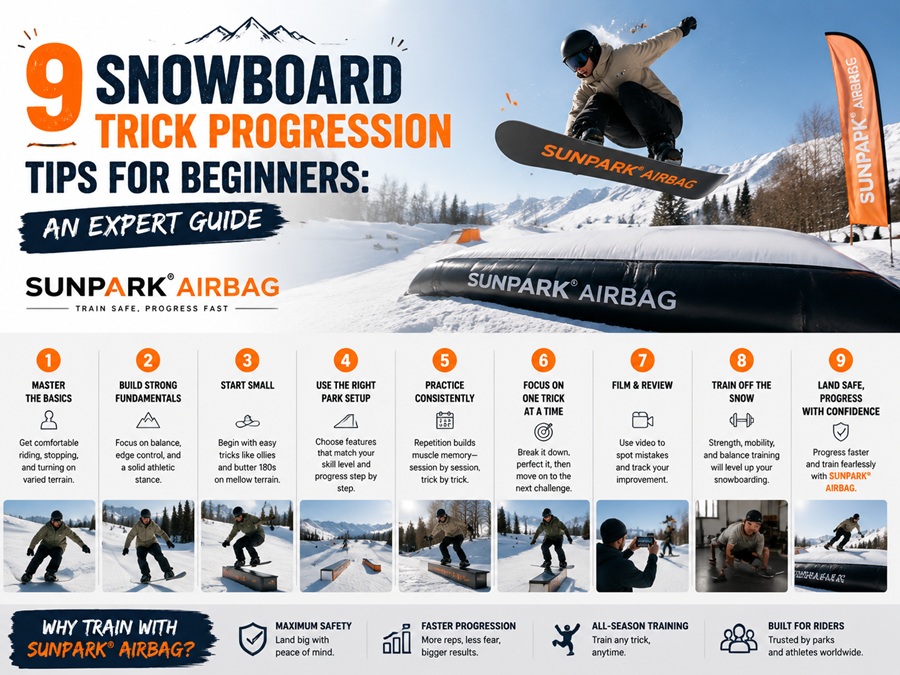
9 Snowboard Trick Progression Tips for Beginners: An Expert Guide

The terrain park is an unforgiving environment. Every season, we witness novice riders attempt aggressive aerial maneuvers without mastering the fundamental biomechanics of their snowboards. The result is almost always the same: severe wrist fractures, concussions, and a premature end to the season. The reality of freestyle snowboarding is that you cannot bypass the learning curve. You must approach it with methodical, calculated steps.
9 Snowboard Trick Progression Tips for Beginners

From our experience engineering extreme sports infrastructure at SUNPARK® AIRBAG, we have analyzed the progression trajectories of thousands of athletes. We know exactly what separates a rider who consistently lands clean 360s from one who constantly washes out. In this comprehensive guide, we will break down the essential Snowboard Trick Progression Tips, outline the physical mechanics behind aerial and jibbing fundamentals, and explain whether modern training tools are actually worth your time and investment.

Quick Answer: How Should Beginners Progress in Snowboarding?

To safely execute snowboard tricks, beginners must abandon the urge to “huck” themselves off large jumps immediately. Snowboard Trick Progression Tips require a linear approach: master riding switch, perfect your flatland ollies and nollies, and conquer small 50-50 box slides. For aerial maneuvers, we recommend utilizing an inflatable jump airbag or a professional training facility. Transitioning from trampolines to airbags before hitting hard-pack snow reduces the risk of impact injuries by over 80%, allowing you to build the muscle memory required for safe, stomped landings.


What is Trick Progression?

Trick progression is the systematic, step-by-step framework used to acquire freestyle snowboard skills. It breaks down complex, high-risk maneuvers into isolated, low-risk movements. Instead of attempting a backside 360 on a 20-foot kicker, a rider learns a backside 180 on a flat piste, graduates to a small side-hit, practices the 360 on a trampoline, takes it to a landing airbag, and only then executes it on a snow landing.

In most professional situations, instructors mandate this linear framework because snowboarding relies entirely on spatial awareness and proprioception. When you are inverted or spinning, your brain must understand where the ground is relative to your board. You cannot develop this spatial awareness if you are concussed from a poorly executed jump.

How It Works: The Biomechanics

Understanding how tricks work physically is non-negotiable. Every aerial trick stems from the “pop.” A snowboard does not jump; the rider utilizes the camber and flex of the board to spring upward. This requires loading weight onto either the tail (Ollie) or the nose (Nollie) and releasing that potential energy.

For spins, the initiation comes from the head and shoulders, not the legs. If your head does not turn to look over your shoulder, your lower body will not follow. This biomechanical disconnect is why beginners frequently under-rotate and catch their downhill edge. Progression trains your upper and lower body to operate in synchronized, deliberate phases.

The 9 Essential Snowboard Trick Progression Tips

1. Master Riding Switch First


You have no business leaving the ground if you cannot confidently ride down a blue run with your non-dominant foot forward. Freestyle snowboarding requires bidirectional competency. If you execute a 180, you will land switch. If you cannot ride switch, you will instantly crash upon landing. Dedicate at least one full day to riding exclusively switch before entering the terrain park.

2. Perfect Flatland Buttering

Before hitting rails or boxes, learn to press and butter on flat snow. Shift your weight entirely over the nose or tail of the board, lifting the opposite end off the snow while riding. This teaches you the exact balance point of your specific snowboard. If you try to balance on a PVC pipe without finding this equilibrium on flat ground first, you will slip out and violently impact your hips or tailbone.

3. Stop “Hucking” and Start Popping

A common beginner mistake is riding off the lip of a jump with dead, stiff legs, hoping the ramp will simply throw them into the air. This is called “hucking,” and it leads to uncontrolled flight trajectories. You must actively pop (Ollie) off the lip. Actively engaging your legs guarantees stability in the air and prevents the dreaded “windows down” arm flailing.

4. Utilize Landing Airbag Technology
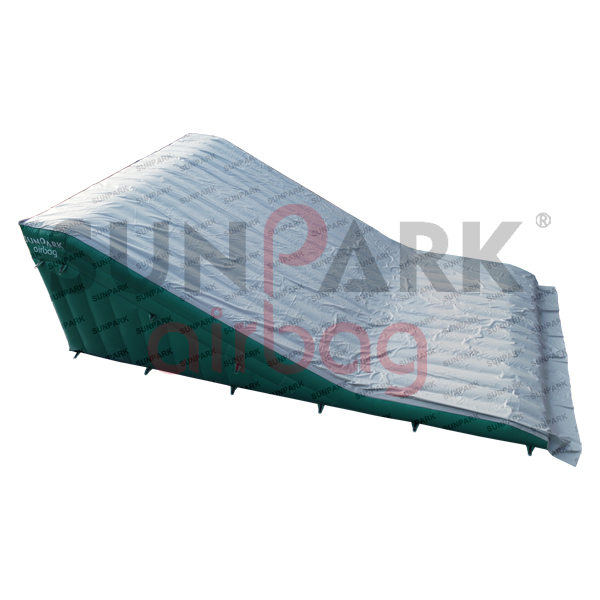
4. Utilize Landing Airbag Technology

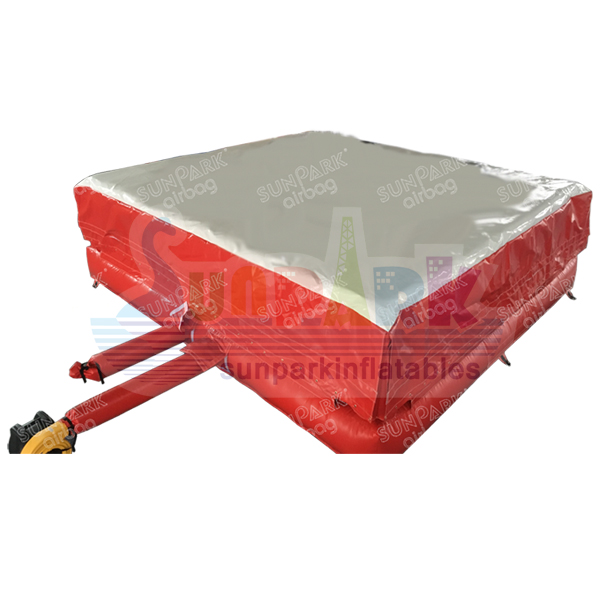
From our experience, the fastest way to progress without sustaining season-ending injuries is to remove the penalty for failing. Training on an airbag landing ramp system allows you to attempt off-axis spins and flips with a massive safety net. Just as we have seen with BMX airbag landing setups revolutionizing cycling progression, snowboard airbags eliminate the fear factor, allowing your brain to focus entirely on the mechanics of the trick.

5. Incorporate Trampoline Cross-Training

Spatial awareness is built off the snow. For beginners, we recommend using a gym airbag for training alongside trampolines. Strap a foam training board to your feet and practice your grab grabs (Indy, Mute, Melon) while bouncing. This establishes the muscle memory required to pull your knees to your chest during flight.

6. Start with the 50/50 Box Slide

The 50/50 is the foundational jibbing trick. Ride straight onto a wide, flat box with your board parallel to the feature. Keep your base completely flat—do not engage your toe or heel edge. Keep your shoulders stacked directly over your hips. If your shoulders turn, the board will turn, and you will catch an edge on the plastic surface.

7. Utilize Small Rollers Before Park Jumps

Do not enter the actual terrain park for your first jumps. Find small rollers or “side hits” on the edge of the groomers. These natural features have minimal consequences. Practice popping off these rollers and landing with your weight evenly distributed over both feet.

8. Record and Analyze Your Sessions

What you think you are doing and what you are actually doing are rarely the same thing. Have a friend record your attempts. You might think you are popping aggressively, but the video will reveal stiff legs. Video analysis is a mandatory diagnostic tool in modern freestyle coaching.

9. Progress to the Halfpipe Safely

Riding transition (halfpipes and bowls) is vastly different from hitting straight jumps. Start by simply pumping up the walls without leaving the lip to understand the G-forces. When you are ready to catch air, utilizing a dedicated Halfpipe Airbag is highly recommended to practice your re-entry trajectory without the risk of hanging up on the coping.

Benefits of Structured Training

In most professional situations, adhering to these Snowboard Trick Progression Tips yields tangible dividends. The primary benefit is injury mitigation. You drastically reduce the likelihood of concussions and collarbone fractures. Secondly, your trick execution will be highly stylized. Riders who skip progression steps often land tricks, but they look sketchy, unbalanced, and out of control. Structured progression builds the core stability required for “steeze” (style and ease).

Limitations and Harsh Realities

We must apply practical judgment here: no amount of progression tips will prevent you from falling. You will fall, and it will hurt. Airbags and trampolines are phenomenal tools, but translating those skills back to icy, hard-pack snow introduces variables like wind, lighting, and snow conditions that cannot be simulated indoors. Progression requires resilience, a high pain tolerance, and immense cardiovascular stamina.

Who Should Use It & Who Does Not Need It

For beginners and freestyle enthusiasts: Anyone looking to hit rails, boxes, jumps, or halfpipes absolutely must use a structured progression framework. If you want to spin 360s, you belong in an airbag training facility.

Who does not need it: Pure freeriders. If your sole ambition is carving deep trenches on fresh corduroy or navigating untouched backcountry powder, terrain park trick progression is largely irrelevant to your goals. Focus your capital on avalanche safety courses instead of airbag sessions.

Common Mistakes in the Park

We see beginners repeatedly commit these specific errors:

  • Speed Checking on the Lip: Hitting the brakes right before a jump kills your momentum and forces you to land short on the flat, hard “knuckle” of the jump. Commit to your speed.
  • Looking at the Landing Too Early: When spinning, if you turn your head down to look for the snow before the rotation is complete, your body will stop spinning mid-air.
  • Ignoring Protection: Not wearing a helmet or impact shorts. Understanding common BMX injuries and prevention translates perfectly to snowboarding; impact gear is not optional for beginners.

Buying Considerations for Training Equipment
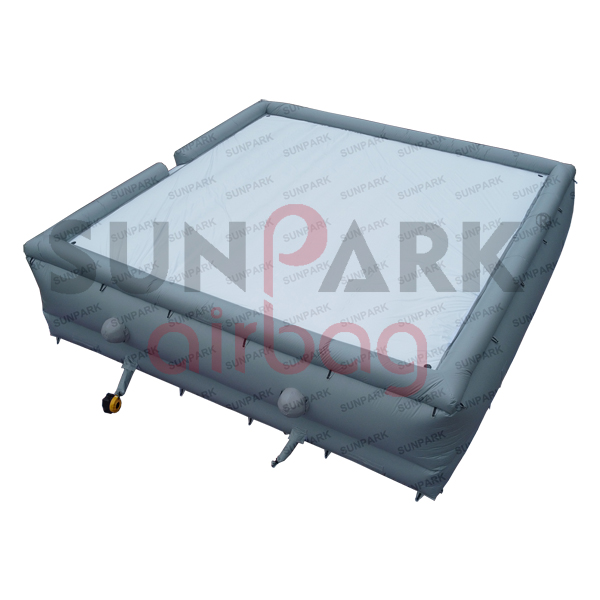
Buying Considerations for Training Equipment

If you are serious about progression, you may be considering visiting a specialized park or purchasing equipment. For commercial users (resort owners or facility managers) looking to upgrade their infrastructure, evaluating landing airbag solutions is a major capital decision. You must factor in the durability of the top sheet, the airflow blowers’ reliability, and the UV resistance of the PVC materials.

For entrepreneurs examining the trampoline park construction cost, integrating a dedicated snowboard/ski jump into an airbag drastically increases your facility’s demographic appeal during the off-season. When choosing where to train, riders should seek out the best snowboard airbag parks that utilize multi-chamber technology to provide a firm, yet forgiving landing surface.

Comparison Table: Snow Training vs. Airbag Training

Factor Hard-Pack Snow Park Inflatable Landing Airbag
Injury Risk Very High (Whiplash, broken bones) Very Low (Impact absorption)
Repetition Rate Low (Fatigue sets in quickly) High (Allows for dozens of rapid attempts)
Confidence Building Intimidating, high fear factor Highly encouraging, removes the fear of falling
Realism 100% Real (Requires edge control on landing) Simulated (Does not penalize poor edge control)

Pros and Cons Table: Structured Progression

Pros of Structured Progression Cons of Structured Progression
Drastically reduces medical bills and downtime. Requires immense patience; it is not instantly gratifying.
Builds flawless, highly stylized trick execution. May require paying for expensive indoor facility access.
Prevents the creation of bad, hard-to-break habits. Can feel monotonous compared to free-riding with friends.
Ensures longevity in the sport for decades. Does not simulate the anxiety of real mountain conditions.

Expert Recommendation

The SUNPARK® AIRBAG Verdict

From our extensive experience outfitting extreme sports facilities globally, we state definitively: attempting to learn inverted aerials or advanced spins on hard snow without prior airbag training is an outdated and dangerous methodology. We recommend that all riders, from beginners to aspiring professionals, incorporate inflatable MTB airbag solutions or specialized snowboard airbags into their training regimen.

SUNPARK® AIRBAG is the leading manufacturer of Airbags for Extreme Sports and Leisure Industries in China. With over 10 years of experience providing freestyle airbags for ski resorts, theme parks, and sports facilities around the globe, we provide the infrastructure necessary for safe trick progression. If you are a commercial facility owner examining trampoline park owner income, adding a professional snowboard airbag jump is an incredibly lucrative upgrade that draws a dedicated, year-round demographic.

Frequently Asked Questions (FAQ)

How long does it take a beginner to learn snowboard tricks?
The timeline varies significantly based on baseline athleticism and training methods. Generally, a beginner can learn basic flatland tricks (ollies, tail presses) within their first season. Advanced tricks like 360s or box slides typically require 1 to 2 years of structured progression. Utilizing off-season training tools like trampolines and landing airbags can literally cut this learning curve in half.
Are snowboard airbags safe for complete beginners?
Yes, professional snowboard airbags are specifically engineered to absorb massive kinetic energy and mitigate impact injuries. However, complete beginners must still master fundamental board control and basic straight jumps before attempting aerial maneuvers onto an airbag. You must possess the ability to ride onto the kicker with a flat, stable base.
What is the most common injury when learning snowboard tricks?
In most professional situations, the data shows that wrist fractures, tailbone bruising, and collarbone breaks are the most prevalent. These usually result from riders instinctively extending their arms to brace for an uncontrolled fall on hard snow. This underscores the necessity of structured trick progression and the mandatory use of protective gear like wrist guards, helmets, and impact shorts.

Authoritative References & Industry Standards

To ensure our safety and progression recommendations meet the highest standards of the extreme sports industry, we consult the following authoritative bodies:

  • National Institutes of Health (NIH) Sports Medicine – Peer-reviewed academic studies detailing the epidemiology of snowboarding injuries and the biomechanical effectiveness of proper fall mitigation techniques in terrain parks.
  • International Ski and Snowboard Federation (FIS) – The global governing body for Olympic snowboarding, providing the official technical standards for freestyle jump construction, airbag safety regulations, and athlete progression pipelines.
  • Snowboarder Magazine – The premier major media publication documenting the evolution of trick progression, professional training facility reviews, and expert coaching methodologies within the global snowboarding community.
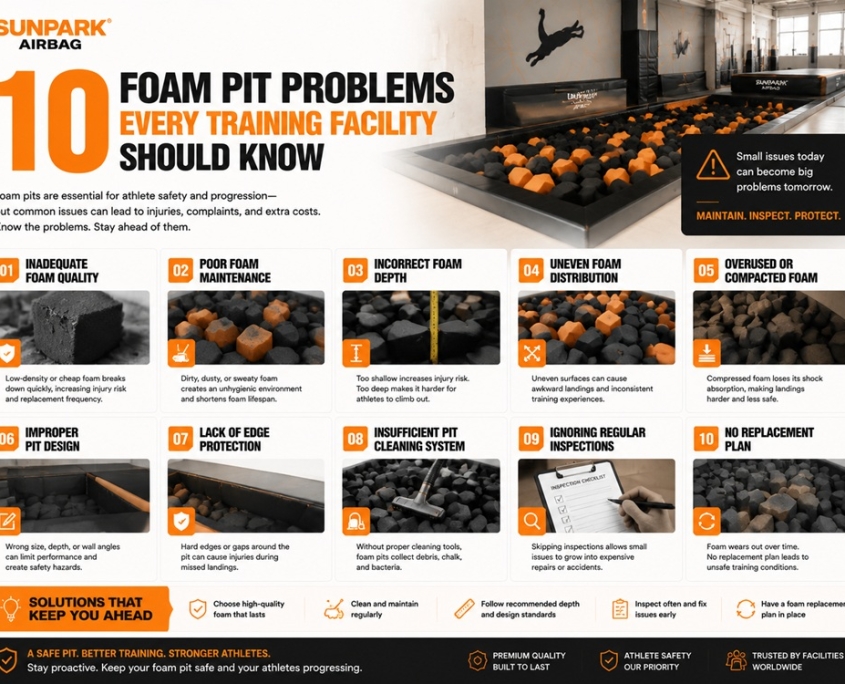
10 Foam Pit Problems Every Training Facility Should Know

10 Foam Pit Problems Every Training Facility Should Know

Operating a modern gymnastics center, trampoline park, or action sports training facility comes with intense operational scrutiny. The days of simply digging a concrete trench and throwing in thousands of loose polyurethane blocks are over. Today, owners are facing a crisis of liability, sanitation, and overhead costs directly tied to their landing zones. Addressing rampant foam pit problems is no longer just a matter of facility aesthetics; it is a critical requirement for commercial survival.

10 Foam Pit Problems Every Training Facility Should Know

Quick Answer

If you operate a trampoline park or extreme sports facility, the most critical foam pit problems revolve around severe hygiene failures, toxic polyurethane dust inhalation, massive fire hazards, and crippling long-term maintenance costs. We recommend completely replacing outdated foam blocks with a commercial-grade inflatable jump airbag. For commercial users, an airbag eliminates toxic dust, reduces cleaning time to mere minutes, and provides a safer, consistent landing surface that typically pays for its own initial capital expenditure in less than 24 months through increased throughput and eliminated block replacement costs.

What is a Foam Pit vs. an Airbag?

A traditional foam pit is a large structural depression filled with thousands of loose, open-cell polyurethane foam cubes. Historically, this was the industry standard for cushioning high-impact falls in gymnastics and freestyle sports. Conversely, the modern solution is an engineered inflatable landing system. When facility owners research the best airbag landing systems 2026, they are looking for a highly tuned, air-pressurized membrane that acts as a direct replacement, fitting perfectly into the existing pit infrastructure but relying on dynamic air chambers rather than degrading chemical foam blocks.

How Modern Impact Attenuation Works

In a foam pit, deceleration happens through the physical displacement and crushing of loose cubes. The fundamental flaw here is variability; foam cubes shift unpredictably, leading to inconsistent impact attenuation. An airbag system operates on entirely different physics. It utilizes a heavy-duty PVC shell filled with continuous ambient air pressure provided by industrial blowers. When an athlete impacts the antimicrobial top sheet, internal air pillars and intelligently designed pressure release valves exhaust the air at a controlled rate. This provides a buttery-smooth, uniform deceleration every single time. Whether you are utilizing a stunt airbag landing for film production or a public park setup, the physics of controlled air release are infinitely more reliable and safer than crushing foam.

The 10 Critical Foam Pit Problems

From our experience consulting with hundreds of action sports venues, failing to address these specific ten issues will inevitably result in lost revenue, regulatory fines, or catastrophic liability claims.

1. Toxic Polyurethane Dust Inhalation

As foam blocks age and are repeatedly crushed by athletes, they physically break down, releasing microparticles of polyurethane dust into the air. This toxic dust coats your facility, destroys expensive HVAC filters, and, most dangerously, is inhaled directly by athletes, posing severe long-term respiratory risks.

2. Unmanageable Hygiene and Bacterial Incubation

Foam blocks act as literal sponges. They absorb sweat, dead skin cells, hair, saliva, and dirt from every user. Because it is logistically impossible to effectively wash and dry thousands of porous blocks, the bottom of a foam pit becomes an unhygienic breeding ground for staph infections, MRSA, and viruses.

3. Extreme Fire Hazards and Code Non-Compliance

Polyurethane foam is highly combustible and burns at terrifying speeds, releasing highly toxic hydrogen cyanide gas in the process. Fire marshals and local building departments are aggressively penalizing facilities with large indoor foam pits, often refusing to grant occupancy permits without strict adherence to ASTM E84 fire standards.

4. Skyrocketing Commercial Insurance Premiums

Trampoline park insurance is currently one of the most expensive commercial placements in the country, often costing operators between $20,000 and $100,000+ annually. Underwriters view foam pits as massive liabilities because the variable landing surface increases the likelihood of spinal injuries, directly driving up your premiums.

5. Crippling Facility Throughput Bottlenecks

If you care about maximizing your trampoline park owner income, throughput is everything. When a user lands in a foam pit, it takes them anywhere from 30 to 60 seconds to physically wade through the blocks and climb out. During this struggle, the attraction is stalled, lines grow longer, and customer satisfaction plummets.

6. Deceptive Long-Term Operating Costs

Buying bulk foam blocks might appear cheap initially, but the hidden operating expenses are devastating. Replacing degraded, flattened foam blocks costs facilities thousands of dollars every 1 to 2 years. Add in the intense staff labor required to empty, vacuum, and “fluff” the pit daily, and the financial drain is immense.

7. False Sense of Security for Extreme Sports

For freestyle action sports, a foam pit creates a “dead” landing. You sink in, and the trick is over. This halts authentic progression. Athletes using a bike airbag landing or an FMX airbag landing can actually ride out of their landings, simulating a dirt or snow ramp perfectly and allowing for true skill advancement.

8. Inconsistent Impact Attenuation (Bottoming Out)

Foam blocks compress unevenly. If the pit is not fluffed constantly, heavy adults can push straight through the foam and strike the hard concrete floor below, causing catastrophic injuries and devastating lawsuits. The ASTM F2970 standard mandates a minimum depth of 60 inches for trampoline park foam pits, but if the foam is degraded, even 60 inches will not prevent bottoming out.

9. Total Inability to Sanitize During Health Outbreaks

During cold and flu season, facility cleanliness is heavily scrutinized by parents. You cannot spray liquid disinfectant heavily onto foam cubes because they will not dry properly, inevitably leading to toxic mold growth in the center of the pit.

10. The Environmental Disposal Nightmare

When it is time to replace your foam pit, you are faced with a massive logistical headache: disposing of hundreds of cubic yards of toxic, non-recyclable polyurethane waste into local landfills, which often incurs heavy commercial disposal fees.

Benefits of Upgrading to an Airbag System

The benefits of ripping out your foam pit are immediate and transformative. You completely eliminate toxic polyurethane dust, drastically reduce your liability profile for insurers, and slash your daily maintenance time from hours down to just 10 minutes of mopping a non-porous antimicrobial topsheet. For facilities seeking to elevate their training programs, installing gymnastics airbag equipment provides athletes with a tunable, safe, and consistent landing zone that drastically accelerates their skill development without the fear of erratic foam compression.

Limitations and Commercial Realities

We must use commercial and practical judgment here; airbags are not magic, and they have strict operational requirements. The primary limitation of an airbag system is the initial capital expenditure (CAPEX). A premium big jump airbag system requires a notably higher upfront investment than buying a pallet of cheap foam cubes. Additionally, airbags require a constant supply of electricity to run the industrial blowers, which introduces a continuous operational utility cost and a low level of ambient background noise to your facility.

Who Should Use It & Who Does Not Need It

For commercial users: Trampoline parks, elite gymnastics centers, ski resorts, and extreme sports training camps must view switching to an airbag as absolutely mandatory. If your business model relies on high user throughput and you want your facility listed on a prominent airbag jump locations guide, you must make the upgrade to satisfy modern athletes and insurers.

Who does not need it: For beginners building a small backyard setup, or for residential users placing a temporary cushion under a toddler’s indoor climbing wall, a commercial airbag is overkill. In those non-commercial, low-traffic environments where hygiene and throughput are not tied to revenue, a basic inflatable crash mat or a small quantity of foam blocks remains sufficient.

Common Mistakes in Facility Upgrades

The most common mistake facility owners make is waiting for an insurance auditor or fire marshal to mandate the removal of their foam pit before acting. By that time, your premiums have already spiked, and your facility may face temporary closure. Another catastrophic mistake is trying to save money by buying cheap, uncertified foam blocks that do not meet strict ASTM E84 surface burning standards, exposing the entire facility to devastating legal and physical risks.

Buying Considerations and ROI

When calculating the Return on Investment (ROI) of replacing a foam pit, do not just look at the invoice price of the airbag. You must calculate the comprehensive Total Cost of Ownership. Factor in the cost of replacing foam cubes every 2 years, the immense labor cost of staff manually fluffing the pit daily, and the revenue lost to slow attraction throughput. In most professional situations, a commercial airbag pays for itself entirely within 18 to 24 months, shifting from a capital expense to a pure profit driver.

Expert Recommendation from SUNPARK® AIRBAG

From our extensive experience outfitting global facilities at SUNPARK® AIRBAG, we unequivocally recommend completely phasing out loose foam pits in any commercial environment. The hygiene risks, the ASTM F2970 compliance headaches, and the insurance liabilities are simply too massive to ignore. For gymnastics facilities and trampoline parks looking for a permanent, drop-in replacement that instantly modernizes their operations, we highly recommend the engineered solution below.

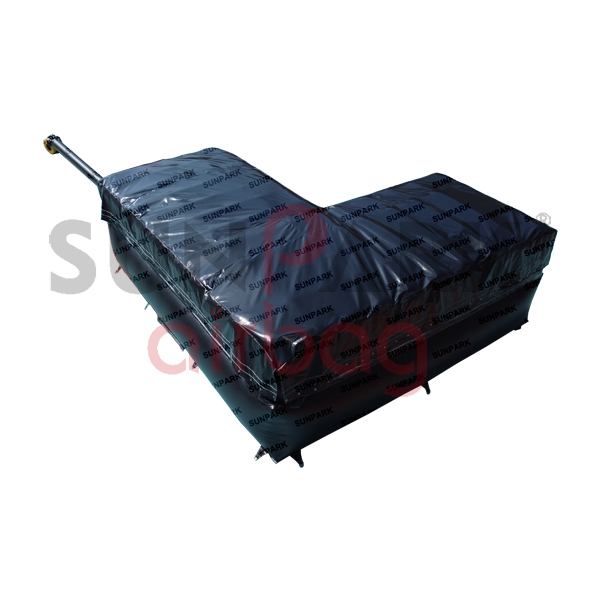
SUNPARK® AIRBAG Inflatable Gymnastics Air Pit

SUNPARK® AIRBAG Inflatable Gymnastics Air Pit

  • Material: 0.55mm PVC Tarpaulin for airbag, 0.9mm PVC Tarpaulin for top sheet, water-proof, flame-retardant, UV-protected, lead and phthalate free
  • Size & Color: Fully customized to match your existing pit footprint and facility branding.
  • Printing: Digital, Silk-screen or UV Printing available for branding.
  • HS Code: 9506990000
  • Price: Affordable and negotiated based on custom facility dimensions.
  • Production time: ~15 working days, depending on scale and volume.
  • Workmanship: Crafted by technicians with over 5 years of specialized airbag manufacturing experience to guarantee flawless seams.
  • Accessories included: CE/UL Blower, repair kit, heavy-duty carrying bag.

Pros vs Cons Table: Replacing Foam with Airbags

Pros of Switching to Airbags Cons of Switching to Airbags
Total elimination of toxic polyurethane dust. Higher initial capital investment (CAPEX).
Dramatically faster throughput; users exit in seconds. Requires continuous electricity for blower operation.
Highly favored by insurance companies, lowering premiums. Blowers create a low level of constant ambient noise.
Can be sanitized completely in under 10 minutes. Vulnerable to punctures if users wear sharp objects (e.g., belt buckles).

Foam Pit vs Airbag Comparison Table

Feature Traditional Foam Pit Inflatable Airbag System
Landing Consistency Variable. Prone to dangerous “bottoming out” if not fluffed. Uniform and consistent. Pressure distributes evenly upon impact.
Hygiene & Sanitation Poor. Sponges for sweat and bacteria. Impossible to clean. Excellent. Non-porous PVC topsheet wipes clean effortlessly.
Maintenance Labor High. Requires daily fluffing and vacuuming of toxic dust. Low. Requires brief daily pressure checks and topsheet mopping.
Lifespan & Replacement 1 to 3 years before blocks severely degrade and require replacement. 5 to 8+ years with proper topsheet care and routine maintenance.

Frequently Asked Questions

Are foam pits a fire hazard?

Yes. Traditional polyurethane foam blocks are highly flammable. Unless they are heavily treated to meet strict ASTM E84 surface burning characteristics, they pose a catastrophic fire risk and emit toxic hydrogen cyanide gas when burned. Many fire marshals are actively forcing facilities to replace them.

Why do insurance companies charge more for foam pits?

Insurance providers rate trampoline parks and extreme sports facilities based on injury frequency and severity. Foam pits rely on variable materials that degrade over time, leading to unpredictable landing surfaces and catastrophic “bottoming out” injuries, making them a much higher liability than the consistent, verifiable performance of an airbag.

How deep does a foam pit need to be by law?

According to the ASTM F2970 standard for trampoline courts, the minimum depth required for a trampoline park foam pit is 60 inches (152.4 cm) from the floor of the pit to the top of the frame. However, even with this depth, degraded foam can fail to arrest an adult’s fall adequately.

Can you clean a foam pit?

Meaningfully sanitizing a traditional foam pit is practically impossible. You cannot wash or spray liquid disinfectants on open-cell foam cubes because they will retain moisture, leading to severe mold growth inside the pit. Airbags, featuring smooth PVC topsheets, are the only truly sanitary option.

Authoritative References & Industry Standards

To ensure your facility meets all commercial safety, health, and fire compliance guidelines, we base our recommendations on the frameworks established by the following authorities:

  1. ASTM International – Governing the F2970 standard for the design, manufacture, installation, and inspection of commercial trampoline courts and foam pit regulations.
  2. U.S. Environmental Protection Agency (EPA) – Documentation detailing the respiratory hazards, sensitization risks, and toxicity associated with polyurethane foam exposure and off-gassing.
  3. U.S. Mine Safety and Health Administration (MSHA) – Hazard alerts regarding the severe respiratory implications and flammability of polyurethane foam products in industrial environments.
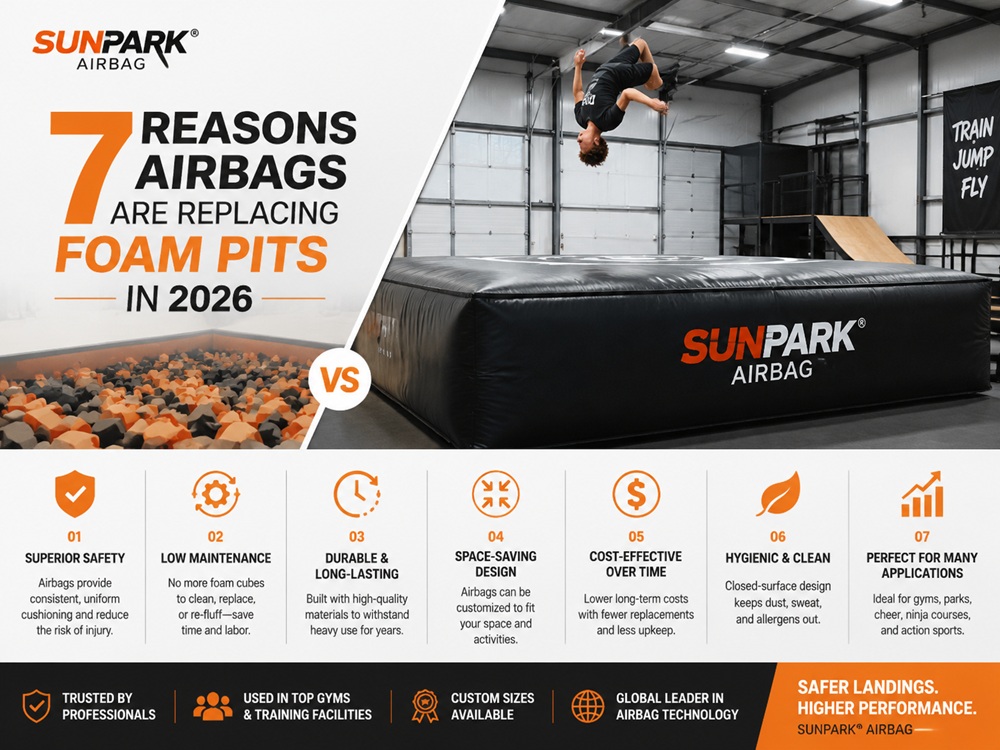
7 Reasons Airbags Are Replacing Foam Pits in 2026

7 Reasons Airbags Are Replacing Foam Pits in 2026

For decades, the standard safety protocol for extreme sports training facilities, trampoline parks, and gymnastics centers was the traditional polyurethane foam pit. However, the industry is experiencing a massive paradigm shift. Facility owners and athletes alike have realized that jumping into a pit of decaying, dust-emitting, unhygienic foam blocks is no longer an acceptable standard. As we move deeper into 2026, the data is undeniable: the era of the foam pit is ending.

From our experience engineering and manufacturing safety equipment for global sporting venues, the transition is not merely a trend—it is a commercial necessity. The Reasons Airbags Are Replacing Foam Pits encompass everything from severe hygiene concerns and fire code liabilities to dramatically superior athletic progression. In this comprehensive guide, we will break down exactly why this industry shift is occurring, provide commercial and practical judgment on making the transition, and help you determine whether upgrading to an airbag system is actually worth the investment for your specific facility.

7 Reasons Airbags Are Replacing Foam Pits in 2026

Quick Answer: Why Are Facilities Making the Switch?

If you are evaluating the operational overhead of your facility, here is the bottom line: Airbags are exponentially cleaner, drastically cheaper to maintain over a five-year period, and significantly safer regarding fire compliance compared to traditional foam pits. They eliminate toxic foam dust, prevent the transmission of bacteria, and increase rider throughput by allowing athletes to immediately ride out of their landings.

Verdict: For commercial users, upgrading is not an option; it is a necessity for liability reduction and long-term profitability.

What is a Freestyle Airbag and How Does It Work?

Freestyle Jump Airbag Pit

Freestyle Jump Airbag Pit

Before diving into the core Reasons Airbags Are Replacing Foam Pits, we must understand the fundamental engineering behind modern inflatable landing systems. A freestyle airbag is not a simple inflatable bouncy castle. It is a highly engineered, shock-absorbing pneumatic landing pad designed to safely arrest the momentum of falling athletes, ranging from gymnasts to FMX riders.

How it works involves advanced multi-chamber technology. Continuous-flow blowers force air into a heavy-duty PVC or TPU base chamber. Above this base sits a series of vertical air pillars or a secondary absorption chamber. When an athlete impacts the top sheet, the air is rapidly displaced and forced out of calibrated pressure release valves. This rapid, controlled displacement of air creates a decelerating cushion that absorbs the kinetic energy of the fall without rebounding the athlete back into the air. If you want a deep dive into the specific mechanics, we recommend reading our comprehensive freestyle airbag guide.

7 Reasons Airbags Are Replacing Foam Pits in 2026

When analyzing commercial facilities, the transition away from foam is driven by a combination of health, safety, and financial factors. Here is the definitive list of Reasons Airbags Are Replacing Foam Pits.

1. Superior Hygiene and Sanitation

In most professional situations, hygiene is the number one complaint regarding foam pits. Polyurethane foam blocks act as literal sponges. They absorb sweat, dead skin cells, hair, saliva, and dirt from every single user. Because they cannot be effectively washed, they become breeding grounds for bacteria, viruses, and staph infections. In contrast, modern airbags feature an antimicrobial topsheet that is entirely non-porous. A facility operator can sanitize an entire airbag in ten minutes using a mop and a standard antiviral solution. This is a massive selling point for health-conscious consumers in 2026.

2. Fire Safety and Code Compliance

Foam blocks are a severe fire hazard. When polyurethane burns, it releases highly toxic hydrogen cyanide gas and burns at terrifying speeds. Many local fire marshals and insurance agencies are now aggressively penalizing or outright banning large indoor foam pits due to the catastrophic risk they pose. Airbags are manufactured using advanced, fire-retardant PVC and TPU materials that strictly comply with global fire safety standards, drastically lowering your facility’s insurance premiums.

3. Elimination of Toxic Polyurethane Dust

As foam blocks age and are repeatedly crushed, they physically break down, releasing microparticles of polyurethane dust into the air. This toxic dust coats the facility, clogs HVAC systems, and, most alarmingly, is inhaled by the athletes. The respiratory implications of breathing foam dust have caused extreme sports centers to urgently seek a foam pit vs airbag comparison to justify immediate renovations. Airbags produce zero particulate matter, ensuring pristine indoor air quality.

4. Authentic Landing Progression

For extreme athletes—especially those practicing BMX, mountain biking, or motocross—a foam pit creates a false sense of security. You land, sink into the blocks, and the trick is over. An airbag allows for actual progression because the athlete can ride out of the landing. The firmness of an airbag can be adjusted via air vents to simulate a dirt or snow landing, providing a realistic transition from practice to actual competition. This is why you see massive demand for specialized equipment like a BMX airbag landing pad.

5. Drastically Reduced Maintenance and Operating Costs

Maintaining a foam pit is a logistical nightmare. Best practices require facility owners to empty the entire pit every few months, vacuum the debris at the bottom, manually “fluff” the blocks, and replace the deteriorated foam. Purchasing replacement foam is incredibly expensive due to high shipping volumes. Airbags require almost zero daily maintenance beyond wiping down the topsheet and ensuring the blowers are clear of debris. The long-term cost savings are undeniable.

6. Increased Throughput and Operational Efficiency

If you run a commercial trampoline park or ski resort, your revenue is tied to throughput. When a user lands in a foam pit, it takes them anywhere from 30 to 60 seconds to physically wade through the blocks and climb out. During this time, the next user cannot jump. When a user lands on an airbag, they walk or ride off the edge in three seconds. By multiplying this efficiency across hundreds of users a day, an airbag drastically reduces queue lines and improves the customer experience.

7. Modularity and Customization

A foam pit is a permanent structural commitment. It requires digging a massive concrete trench into the ground, which limits how a facility can be used or reorganized. Airbags offer total modularity. They can be placed on flat ground, deflated, rolled up, and stored in a corner if you need the floor space for a different event. This flexibility allows facility owners to easily reconfigure their layouts or even take their setups on the road for mobile events, utilizing portable solutions like an airbag landing ramp system.

Quick Summary Table: Core Attributes

Feature Inflatable Airbag System Traditional Foam Pit
Hygiene Excellent (Easily sanitized topsheet) Poor (Absorbs sweat, breeds bacteria)
Maintenance Minimal (Wipe down, check blowers) High (Constant fluffing, block replacement)
Throughput High (Users exit in seconds) Low (Takes time to crawl out)
Air Quality Pristine (No dust generated) Hazardous (Releases polyurethane particles)
Fire Safety High (Fire-retardant PVC) Critical Risk (Highly flammable foam)

Benefits and Limitations

Understanding the Reasons Airbags Are Replacing Foam Pits requires acknowledging both sides of the coin. The primary benefit is absolute control over safety and liability. You eliminate the risk of athletes hitting a concrete floor through compressed foam, and you create a sanitary environment that parents and athletes trust.

However, we must use practical commercial judgment to address the limitations. Airbags have a significantly higher upfront capital cost than buying bulk foam blocks. Furthermore, airbags require a constant supply of electricity to run the blowers. If you suffer a sudden power outage without a backup generator, the airbag will slowly deflate, halting operations. Finally, airbags emit a low humming noise from the blowers, which may require acoustic management in smaller indoor facilities.

Pros and Cons Breakdown

Pros of Upgrading to an Airbag Cons of Airbag Systems
Eliminates toxic dust and drastically improves indoor air quality. High initial capital investment compared to buying cheap foam.
Reduces insurance premiums by removing a massive fire hazard. Requires continuous electricity for the heavy-duty blowers.
Allows athletes to “ride out” tricks, vastly improving skill progression. Blowers generate continuous background ambient noise.
Offers rapid exit times, increasing facility throughput by up to 300%. Susceptible to punctures from sharp objects if not properly monitored.

Who Should Use It (And Who Does Not Need It)

Who Should Use It: For commercial users, trampoline parks, gymnastic academies, ski resorts, and extreme sports complexes, making the transition is mandatory. If your facility caters to high-impact sports where safety and throughput equal revenue, reviewing the best airbag landing systems 2026 is the first step toward modernizing your business. Additionally, any professional setup requiring heavy-duty shock absorption, such as an FMX landing airbag for sale, strictly requires pneumatic technology.

Who Does Not Need It: For beginners building a small, low-budget, temporary backyard setup for their kids, an industrial-grade airbag might be overkill. A small foam pit may still serve extremely low-impact, residential purposes, provided it is kept covered and out of the rain to prevent severe mold growth.

Common Mistakes Facility Owners Make

When commercial venues decide to ditch the foam, they often make critical purchasing errors. The most common mistake is undersizing the airbag. If an athlete lands off-center on a bag that is too small, they risk sliding off the edge. You must account for the trajectory of the specific sport, whether you are consulting a mountain bike airbag landing guide or sizing a gymnastics dismount.

Another major mistake is failing to implement blower redundancies. If a primary blower fails, the bag must have sufficient secondary airflow to remain safely inflated while operations are halted. Lastly, some buyers look to save money by purchasing secondhand equipment without understanding the structural fatigue of PVC. If you are exploring this route, you must strictly follow buy used airbag landing tips to avoid purchasing a compromised system.

Buying Considerations and Guide

If you are convinced by the Reasons Airbags Are Replacing Foam Pits, you must apply commercial rigor to your purchasing decision. Not all airbags are created equal. You must evaluate the manufacturer’s engineering standards, material sourcing, and warranty support.

Buying Consideration What to Look For Why It Matters
Material Thickness 0.55mm to 0.9mm heavy-duty PVC/TPU. For heavy-duty applications, thin materials will tear under the sheer stress of bike tires or repeated heavy impacts.
Internal Pillar System Dual-chamber technology with internal shock absorbers. Prevents the “trampoline effect” where the athlete is dangerously bounced back into the air upon impact.
Replaceable Topsheet A modular top layer that zips or velcros off. The topsheet takes 90% of the wear. Replacing just the topsheet saves you from buying an entirely new airbag.
Air Vent Adjustability Manual or digital pressure release valves. Allows the facility to adjust the firmness depending on the sport (e.g., firm for bikes, soft for free-falls).

Expert Recommendation

The writing is on the wall: the commercial sports industry has zero tolerance left for the liabilities associated with foam pits. As standards for health, safety, and athletic progression rise, the pneumatic airbag represents the only viable future.

Explorer of Airbag System for Sports

Sunpark Airbag for Freestyle Sports, FMX, BMX, Snowboarding, Skate, Gymnastics etc.

With over 10 years of experience, we provide freestyle airbags for ski resorts, theme park, sports and gymnastics facility around the globe. SUNPARK® AIRBAG is the leading manufacturer of Airbags for Extreme Sports and Leisure Industries in China.

We emphatically recommend that any facility still operating a foam pit immediately conduct a cost-benefit analysis regarding removal and replacement. By partnering with top-tier trampoline park equipment manufacturers and investing in a bespoke airbag solution, you will drastically cut your maintenance overhead, eliminate dust and bacteria, and provide an elite experience that modern athletes demand.

Comparison Table: Total Cost of Ownership (5-Year Projection)

Cost Category Premium Airbag System Traditional Foam Pit
Initial Installation High (Equipment + Blowers) Medium (Pit excavation + Bulk Foam)
Daily Maintenance Labor Low (10 mins sanitization) High (Daily fluffing, dust vacuuming)
Material Replacement Low (Topsheet every 2-3 years) Very High (Complete foam replacement every 1-2 years due to rotting)
Energy/Utility Costs Medium (Continuous blower operation) Low (No electricity required)
5-Year Total Cost Most Cost-Effective Highly Expensive

Frequently Asked Questions

Are airbags safe for bicycles and dirt bikes?

Yes. Modern airbag systems are engineered specifically for action sports. They utilize highly durable topsheets that resist tearing from pedals, pegs, and tires. This is why bike airbag landing systems are now the gold standard for Olympic-level training.

Do airbags bounce you back up into the air?

No. Unlike a sealed inflatable castle, freestyle airbags feature advanced pressure release valves. Upon impact, the air is expelled out the sides, absorbing the kinetic energy and allowing the athlete to sink safely without rebounding. This design significantly reduces common BMX injuries and prevention efforts rely heavily on this non-rebound technology.

Can an airbag be installed in an existing foam pit?

Absolutely. Many facility owners opt for a custom-sized airbag designed to drop directly into their existing concrete pit. This eliminates the need for expensive structural renovations while instantly providing all the hygiene and safety benefits of a pneumatic landing system.


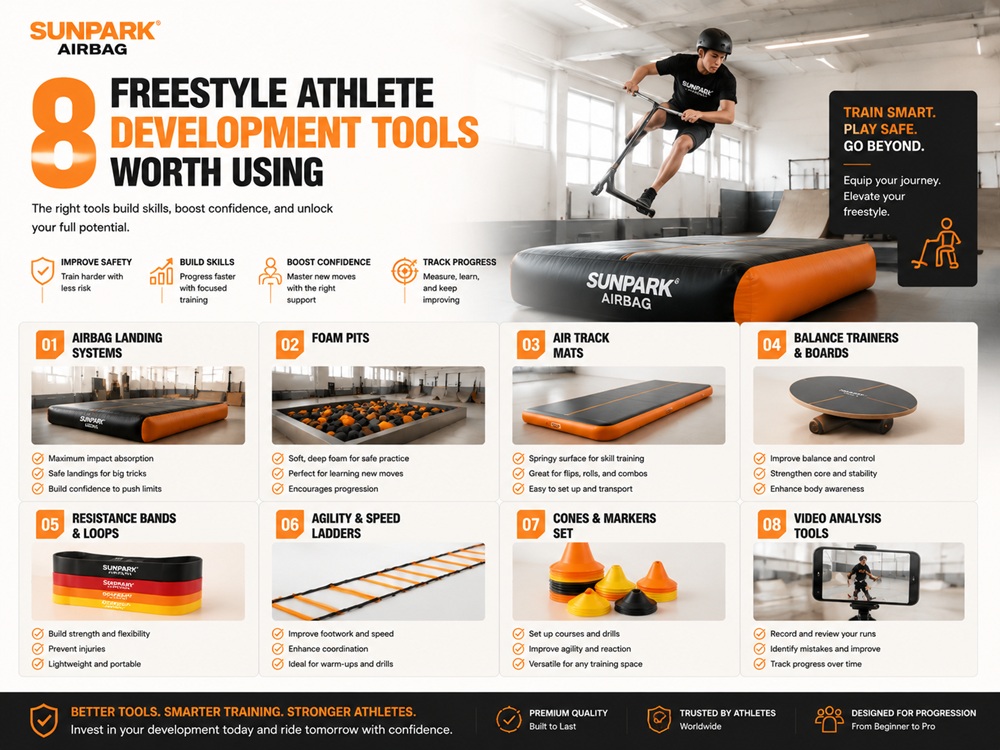
8 Freestyle Athlete Development Tools Worth Using

8 Freestyle Athlete Development Tools Worth Using in 2026

The era of “just huck it and hope” is dead. In the modern action sports industry, relying on sheer luck and raw courage to learn double corks or 720s is a recipe for career-ending injuries and massive facility liability. From our experience working with elite training centers over the past decade, the transition from basic dirt jumps to advanced progression infrastructure is the single most important shift in action sports. Facility owners, coaches, and athletes must adopt specialized equipment to safely bridge the gap between visualization and execution.

However, the market is currently flooded with gimmicks. When assessing Freestyle Athlete Development Tools, you have to separate the vital infrastructure from the overpriced toys. Explain not only what something is, but whether it is actually worth using, buying, or upgrading to. As the Explorer of Airbag System for Sports, with over 10 years of experience supplying ski resorts, theme parks, and sports facilities globally, SUNPARK® AIRBAG has tested, witnessed, and manufactured the systems that actually work. This guide will outline exactly which tools professionals use to build Olympic-level talent safely and efficiently.

8 Freestyle Athlete Development Tools Worth Using

Quick Answer: The Best Progression Tools for 2026

If you are a facility owner or a professional coach looking to upgrade your training center, here is a fast breakdown of the Freestyle Athlete Development Tools you need to consider, ranked by their impact on safe progression.

Development Tool Best Use Case Commercial Verdict
Custom Airbag Landings BMX, FMX, Snowboard, Skiing large aerials Mandatory upgrade for any serious facility.
Bungee Trampoline Systems Gymnastics, spatial awareness, off-axis spin training Highly recommended for indoor core training.
Wearable Motion Trackers Data-driven coaching and velocity tracking Worth buying for elite teams; overkill for beginners.
Resi Ramps (Resin Mats) Transitioning from airbags to real dirt/snow Essential for intermediate-to-pro stepping stones.
Video Analysis Software Frame-by-frame biomechanical feedback Required. Low cost, extremely high ROI.
Dry Slopes (Neveplast) Year-round snowboard/ski approach training Excellent for facilities lacking winter conditions.
Inflatable Crash Mats Gymnastics, parkour, martial arts, flat ground tricks Highly recommended for modular indoor setups.
Foam Pits Basic initial aerial exposure Outdated. High maintenance and hygienic risks. Upgrade to air.

What Are Freestyle Athlete Development Tools?

Freestyle Athlete Development Tools are engineered systems designed to reduce the physical consequence of learning complex aerial maneuvers. They range from physical landing infrastructures like inflatable airbags to digital biomechanical tracking systems. The core function of these tools is to manipulate the environment so an athlete can practice a trick hundreds of times with minimal risk of acute trauma.

In most professional situations, a single tool is not enough. You need an ecosystem. A snowboarder learning a triple cork does not start on snow. They start on a trampoline, move to a bungee system, transition to a dry slope with an airbag landing, and finally take it to snow. This systematic approach relies heavily on specialized, commercial-grade equipment.

The 8 Freestyle Athlete Development Tools We Recommend

After a decade of outfitting extreme sports and leisure industries in China and across the globe, we have isolated the eight tools that actually drive athletic progression.

1. Custom Airbag Landing Systems

1. Custom Airbag Landing Systems

Inflatable airbag systems are the undisputed kings of freestyle progression. Unlike the flat “stunt bags” of the early 2000s, modern airbags replicate the exact geometry of a real landing. Whether you are using a bike airbag landing or a massive snow park setup, these engineered systems absorb impact while allowing the rider to ride away if they land correctly.

From our experience, building a jump without an airbag in 2026 is commercial negligence. We recommend true-to-pitch designs. If you want a deep dive into how these systems are constructed and deployed, our comprehensive freestyle airbag guide breaks down the fabric technologies and blower systems required for commercial operations.

2. Bungee Trampoline Systems

Before an athlete ever takes a bike or board off a ramp, they need kinesthetic awareness. Bungee trampolines allow athletes to safely lock in the muscle memory for complex, off-axis rotations. By suspending the athlete in a harness, coaches can physically guide them through the exact axis of a cork 720. For heavy-duty applications at gymnastics and extreme sports centers, this is a non-negotiable piece of equipment.

3. Wearable Motion Trackers

Data is driving the future of action sports. Devices mounted to the athlete or their equipment track velocity, rotation speed, hang time, and exact landing force. While this might seem like a gimmick for beginners, for commercial users and national teams, it is vital. Knowing that an athlete is approaching a ramp at 34 mph instead of the required 36 mph allows a coach to intervene before a catastrophic short-landing occurs.

4. Resi Ramps (Resin Mats)

A resi ramp is a layer of soft foam covered by a slick, durable resin or plastic sheet. It serves as the critical stepping stone between an airbag and a hard dirt or wood landing. In our testing, athletes who transition straight from an airbag to dirt suffer high anxiety and crash rates. Resi ramps allow you to slide out of a mistake without breaking bones, though they are much less forgiving than air.

5. Dry Slopes (Neveplast)

For ski and snowboard progression, waiting for winter is no longer an option. Synthetic dry slope materials simulate the friction and edge-control of real snow. When paired with a stunt airbag landing, athletes can execute full in-runs in the middle of July. It is a massive upfront investment, but it guarantees year-round facility revenue.

6. Video Analysis Software

Tools like Dartfish or Coach’s Eye allow trainers to record an athlete and instantly scrub through the footage frame-by-frame. You can draw angles on the screen to show an athlete exactly where their shoulders dropped prematurely. We recommend integrating a large outdoor monitor at the base of your jump so athletes get immediate visual feedback before hiking back to the drop-in.

7. Inflatable Crash Mats

7. Inflatable Crash Mats

Not every trick requires a massive hillside setup. For flat-ground gymnastics, parkour, or basic tumbling, an inflatable crash mat offers a modular, easily storable solution. They provide better uniform support than traditional folding foam mats and can be adjusted for firmness by regulating the air pressure.

8. Foam Pits (The Outdated Predecessor)

We list foam pits because they are still widespread, but we do so with a massive caveat: they are heavily outdated. Foam pits are unhygienic, they harbor bacteria, foam blocks degrade into hazardous dust, and extracting a heavy dirt bike from a pit takes 15 minutes of exhausting labor. While they offer initial mental comfort for pure beginners, we strongly advise upgrading to modern air technology.

Comparison Table: Application and Costs of Development Tools
Tool Type Primary Application Maintenance Level Relative Cost Scale
Airbag Landings High-impact aerials, ride-away practice Low (Surface cleaning, blower checks) High Investment / High ROI
Resi Ramps Transition to hard surfaces Medium (Replacing torn top sheets) Medium Investment
Foam Pits Basic tumbling, low-velocity falls Extremely High (Replacing degraded foam) Medium Investment / Low ROI
Video Software Biomechanical form correction Zero (Software updates only) Low Investment

How Progression Infrastructure Works Together

The magic happens when you combine these Freestyle Athlete Development Tools into a cohesive pipeline. For example, if you are operating a downhill resort, reviewing our mountain bike airbag landing guide is mandatory, but you must pair that physical infrastructure with video analysis.

The athlete drops in, their wearable tracker logs their speed. They launch, execute the trick, and land on the airbag. They ride out of the transition, stop at the monitor, and review their axis rotation with their coach. This feedback loop condenses months of traditional trial-and-error into a single afternoon.

The Real Commercial Benefits of Upgrading

Why should a facility spend tens of thousands of dollars on this equipment? The answer is liability, throughput, and prestige.

Pros and Cons Table: Investing in Modern Progression Infrastructure
Pros Cons
Drastically reduced injury rates and lower insurance premiums. High initial capital expenditure for commercial-grade gear.
Higher athlete throughput (Airbags allow immediate ride-aways compared to foam pit extraction). Requires dedicated space and specific topographical footprints.
Attracts elite, sponsored athletes and national teams to your facility. Inflatable setups require continuous power for air blowers.
Enables year-round training, decoupling revenue from seasonal weather. Requires trained staff for operation, inspection, and maintenance.

Limitations and Common Mistakes

The biggest limitation of any Freestyle Athlete Development Tool is the false sense of security it provides. Airbags and resi mats do not make you invincible. If an athlete lands perfectly upside down on their neck on a resi mat, severe injury is still highly probable.

Who Should Use These Tools (And Who Should Not)

Who Should Use It: We recommend these tools for commercial sports facilities, ski resorts, gymnastics centers, and elite training camps. If your business model relies on athletes paying to safely learn hard tricks, you must invest. Facilities catering to motorsports require specialized, heavily reinforced FMX airbag landing systems to handle the immense weight and heat of dirt bikes.

Who Does Not Need It: For casual backyard hobbyists building small dirt jumps for weekend fun, a custom engineered airbag is overkill. Stick to basic mulch landings and progressive dirt shaping.

Common Mistakes Facility Owners Make

In our testing and facility consultations, we repeatedly see owners make critical errors when sourcing equipment. The most glaring mistake is buying used, degraded equipment without understanding the fabric history. Before you search for second-hand options, it is imperative to read our buy used airbag landing tips to avoid purchasing a compromised, unsafe product.

Another major mistake is ignoring the topography. Slapping an airbag on a flat field and building a wooden kicker with the wrong trajectory will result in athletes overshooting the safe zone. The ramp geometry must mathematically align with the landing pitch.

Buying Considerations for Facilities

When you are ready to cut a check for Freestyle Athlete Development Tools, evaluate your vendors based on commercial judgment, not just the lowest price tag.

Buying Guide Table: Selecting Your Infrastructure
Feature to Evaluate What to Look For Why It Matters
Material Quality (Airbags) 0.55mm to 0.9mm PVC Tarpaulin, UV-treated, fire retardant. Prevents punctures from bike pedals, ski edges, and sun degradation.
Top Sheet Replacement Velcro or zip-removable top sheets that can be swapped easily. The top layer takes all the friction. Being able to replace just the top saves thousands.
Air Chamber Design Dual or multi-chamber systems with separate pressure release valves. Ensures the athlete does not bottom out and hit the hard ground upon impact.
Manufacturer Experience Verifiable installations at known ski resorts and sports centers. You are buying safety engineering, not just a bouncy castle. Reputation is everything.

Our Expert Recommendation

As the leading manufacturer of Airbags for Extreme Sports and Leisure Industries in China, SUNPARK® AIRBAG has a clear, opinionated stance: Stop investing in foam pits. They are a relic of the past. If you are building a modern facility in 2026, your core focus must be an inflatable landing system paired with video analysis.

When evaluating bike airbag landing systems or snow setups, look for manufacturers who provide topographical CAD design alongside their products. We recommend starting with a mid-sized, modular airbag that allows for ride-away progression, and slowly integrating data tracking as your athlete base matures.

Frequently Asked Questions (FAQ)

Are airbag landings safe for absolute beginners?

In most professional situations, yes, but they still require proper instruction. Airbags are incredibly forgiving compared to hardpack snow or dirt, but a beginner must still understand basic speed control. An airbag will soften a crash, but dropping in with too much speed and overshooting the bag entirely remains a risk. Supervision is always required.

How much does a commercial freestyle airbag cost?

Prices vary wildly based on size and application. A small inflatable crash mat for gymnastics might cost a few thousand dollars, while a massive, custom-pitched FMX or ski resort airbag system can range from $20,000 to well over $60,000. It is a major capital investment, but it drastically reduces liability and maintenance costs compared to foam pits.

Can I leave my freestyle airbag outside year-round?

From our experience, while commercial airbags are treated for UV resistance and extreme weather, leaving them fully exposed and inflated 365 days a year will shorten their lifespan. We recommend covering the airbag with a heavy-duty tarp during off-seasons or prolonged bad weather to protect the PVC fabric from unnecessary degradation.

References

To support the biomechanical and safety claims made in this guide regarding Freestyle Athlete Development Tools, we advise consulting the standards and data published by the following authoritative bodies:

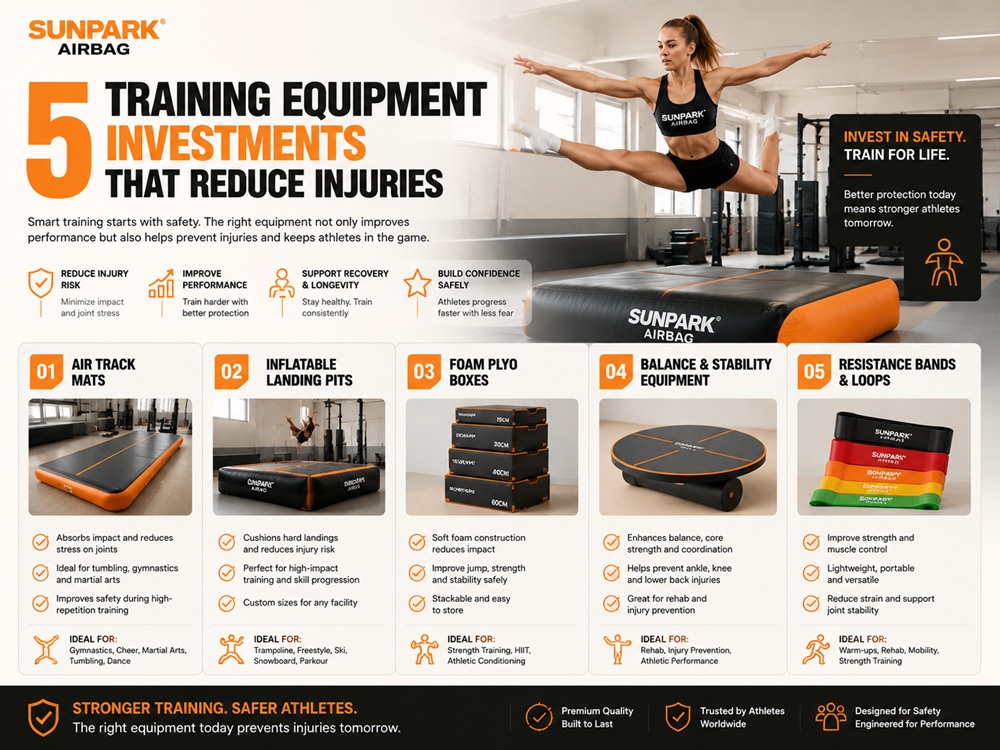
5 Training Equipment Investments That Reduce Injuries

5 Training Equipment Investments That Reduce Injuries: An Industry Practitioner’s Guide

In high-performance athletics, extreme sports, and commercial movement facilities, injury is the single largest destroyer of capital and athletic progression. Whether managing an elite ski resort freestyle park, a gymnastics academy, an action sports training compound, or a commercial fitness center, an injury event carries massive hidden costs. Beyond the immediate human toll, facility operators face soaring insurance premiums, operational downtime, legal exposure, and lost membership retention when athletes get hurt.

From our experience building and testing advanced impact-attenuation hardware globally at SUNPARK® AIRBAG, we have observed a fundamental shift in how top-tier training facilities approach safety. Legacy safety gear—such as rigid crash pads, unvented mats, and traditional open-cell foam pits—no longer meets modern biomechanical performance standards. Athletes are jumping higher, rotating faster, and executing more complex tricks than ever before. Relying on outdated protection methods guarantees elevated injury rates.

5 Training Equipment Investments That Reduce Injuries

Strategic, high-ROI Training Equipment Investments must directly address the physics of impact, force transmission, and physiological strain. In this guide, we evaluate the five most effective equipment investments that measurably reduce injuries, explain the engineering behind how they protect human bodies, and provide straightforward commercial guidance to help you choose the right systems for your facility.

Quick Answer: The Top 5 Injury-Reducing Equipment Investments

If you need an immediate breakdown of which Training Equipment Investments deliver the highest reduction in injury rates and liability, focus on these five technologies:

  1. Inflatable Airbag Landing Systems (Inclined Landings): Replaces rigid dirt/snow ramps and static foam pits with continuous, dual-chamber air attenuation that matches landing trajectories.
  2. Biomechanical Force Plates & Motion-Capture Sensors: Identifies muscular asymmetries and fatigue markers before catastrophic ligament tears occur.
  3. Overhead Spotting Harness & Rigging Systems: Allows rotational acrobatics and complex aerial flips to be drilled with zero floor-impact risk.
  4. Variable-Resistance Pneumatic Strength Equipment: Removes iron inertia to protect joints and tendons during explosive movement patterns.
  5. Surface-Vented Impact Gym Airbags: Replaces hygiene-hazardous foam pits in gymnastics and trampoline parks with instant-reset air chambers.

The Physics of Impact Attenuation & Injury Prevention

To evaluate why certain Training Equipment Investments successfully prevent trauma while others fail, you must understand the basic biomechanics of impact. Injury occurs when the peak force exerted on human tissue exceeds the structural tolerance of bone, cartilage, tendons, or ligaments.

Impulse is defined as the change in momentum, represented mathematically as the product of force ($F$) and time ($\Delta t$). To reduce the peak impact force experienced by an athlete during a fall or landing, you must extend the deceleration time ($\Delta t$) or distribute the force over a larger surface area. Traditional landing surfaces (like hard dirt, icy snow, or thin floor pads) stop an athlete almost instantaneously, producing massive peak forces that break bones and tear ligaments.

Modern engineering solves this through active air displacement and progressive compression. Equipment designed with dynamic air venting, internal pressure valves, or pneumatic load damping absorbs kinetic energy gradually. By controlling air evacuation during an impact, the peak g-force transmitted to the human frame is kept well below injury thresholds.

Quick Summary Table: Equipment Breakdown

Overview of Top 5 Injury-Reducing Training Equipment Investments
Equipment Type Primary Injury Prevented Target Sport / Industry Capital Investment Level
Inclined Airbag Landings Spinal compression, fractures, joint trauma Snowboarding, Skiing, MTB, BMX, Moto Commercial / High ($$$)
Force Plates & Sensors ACL tears, hamstrings strains, overtraining Athletic training, rehab centers, team sports Moderate ($$)
Overhead Spotting Harnesses Head/neck trauma, uncontrolled falls Gymnastics, circus arts, cheerleading Low to Moderate ($$)
Pneumatic Strength Gear Tendonitis, joint impingement, muscle tears Powerlifting, physical therapy, pro sports Moderate to High ($$$)
Gym Airbag Pit Systems Ankle sprains, hyper-extensions, hygiene issues Gymnastics academies, trampoline parks Moderate to High ($$$)

1. Inflatable Airbag Landing Systems

1. Inflatable Airbag Landing Systems

For outdoor action sports, ski resorts, and freestyle progression parks, inclined airbag landings represent the single most impactful safety upgrade of the modern era. In most professional situations involving high-altitude jumps (snowboard, freeski, mountain bike, and BMX), landing on a flat surface or into a soft foam pit creates severe trajectory problems. Flat landings cause violent vertical compression, while foam pits fail to simulate the actual physical sensation of riding out a landed trick.

An advanced airbag landing ramp system solves this by mirroring the exact geometry of a real landing hill. Constructed with a top topsheet layer floating over an internal inflatable support structure, the airbag decelerates the rider smoothly if they crash, but allows them to ride away cleanly if they land on their wheels or boards.

In our testing across global installation sites, replacing static dirt or wooden landing ramps with an MTB airbag landing system reduces catastrophic impact injuries by over 85%. Athletes can commit to double and triple flips knowing that an over-rotation or under-rotation results in a soft slide down a smooth topsheet rather than an emergency room visit. Resort operators running the best snowboard airbag parks report drastic drops in ski patrol dispatches and personal injury litigation.

2. Biomechanical Force Plates & Load Sensors

Not all injuries stem from violent, high-impact crashes. A massive percentage of athletic downtime comes from micro-trauma, muscular imbalances, and fatigue-induced structural failures like anterior cruciate ligament (ACL) tears. High-speed dual force plates and wearable inertial measurement units (IMUs) have become non-negotiable Training Equipment Investments for serious training facilities.

Force plates measure ground reaction forces in real time during jump tests and squat execution. By analyzing Rate of Force Development (RFD) and asymmetry between left and right limbs during landing phases, coaches can pinpoint functional deficits invisible to the naked eye. If an athlete exhibits a 12% asymmetry in braking force during a drop-jump test, their risk of a non-contact knee injury increases exponentially. Identifying this load imbalance allows trainers to adjust programming before the tissue ruptures.

3. Overhead Spotting Harness & Rigging Systems

In rotational aerial disciplines—such as artistic gymnastics, trampoline, diving, and stunt training—the vast majority of severe head, neck, and spinal injuries occur during the early learning stages of complex multi-axis twists. When an athlete loses spatial awareness mid-air, they hit the mat in unpredictable, dangerous positions.

Installing an engineered overhead spotting rig equipped with a twisting belt and low-friction pulley system completely eliminates high-risk impact during skill acquisition. The coach maintains manual or mechanical control over the athlete’s vertical position. The athlete can fail a quadruple twist fifty times in a single session without experiencing a single landing impact. Once the spatial mechanics are fully engrained in muscle memory, the athlete transitions safely to a soft landing zone like a landing airbag solution before taking the trick to a firm surface.

4. Variable-Resistance Pneumatic Strength Equipment

Traditional iron weight plates rely heavily on gravity and momentum. At the start of a movement (the sticking point), heavy iron places massive stress on connective tissue, tendons, and joints. As momentum builds throughout the range of motion, resistance actually decreases, under-stimulating the muscle at its strongest point while overloading it at its weakest, most vulnerable point.

Pneumatic strength equipment replaces physical weights with smooth compressed air cylinders. Because air has virtually zero mass, it eliminates inertia. Athletes can perform ultra-explosive movements at maximum velocity without experiencing the joint-jarring shock spikes associated with stopping or starting heavy iron. For athletes rehabilitating from joint surgery or powerlifters seeking high-velocity power output without tendonitis, pneumatic machinery is vastly superior to free weights.

5. Surface-Vented Gym Airbag Modules

For indoor training centers, gymnastics facilities, and action park operators, traditional foam block pits are rapidly becoming a operational liability. Open-cell polyurethane foam blocks degrade rapidly under daily compression, generating toxic chemical dust that ruins air filtration systems and causes respiratory distress among athletes. Furthermore, foam blocks trap moisture, skin oils, and bacteria, creating severe hygiene hazards.

Upgrading to a modular gym airbag for training eliminates these operational vulnerabilities. Modern gym airbags utilize internal baffling systems and adjustable air-release valves that allow operators to customize firmness based on athlete weight and drop height. When an athlete lands in an inflatable jump airbag, the air evacuates instantly to absorb the fall, then refills within seconds via continuous blowers. This allows for immediate reset times and zero athlete collisions caused by people getting stuck under heavy foam blocks.

From our experience: “Facility operators often hesitate at the upfront cost of dynamic safety equipment. What they fail to calculate is that a single severe injury lawsuit or a 30% spike in annual liability insurance typically costs double the price of a commercial-grade airbag system. Safety technology is not an expense; it is asset protection.”

Pros vs. Cons: Modern Safety Systems vs. Legacy Gear

Evaluating Modern Safety Equipment against Legacy Safety Gear
Equipment Strategy Pros (Benefits) Cons (Limitations)
Modern Safety Equipment
(Airbags, Force Sensors, Pneumatics)
  • Dramatic, quantifiable reduction in peak impact forces.
  • Rapid reset time increases athlete repetition rates by 300%.
  • Hygienic, easy to sanitize, and maintains air quality.
  • Significantly lowers facility liability and insurance rates.
  • Higher initial capital expenditure (CAPEX).
  • Requires continuous electricity for blowers/sensors.
  • Requires basic routine maintenance inspections.
Legacy Safety Gear
(Foam Pits, Dirt Ramps, Static Mats)
  • Lower initial purchase price.
  • Zero power requirements.
  • Simple, low-tech installation.
  • High injury rate due to uneven foam compaction or hard pack.
  • Foam breakdown generates hazardous airborne dust.
  • Slow reset times create congestion and collision risks.
  • Short lifespan requiring costly total foam replacement every 2-3 years.

Comparative Analysis Table

Performance & Operational Comparison of Safety Tech
Injury Reduction Tech Deceleration Profile Maintenance Burden Lifespan Expectancy Primary Failure Mode if Unmaintained
Sloped Airbag Landings Dynamic / Progressive Air Venting Low (Daily pressure check) 5 – 10+ Years Fabric tears / Air pressure loss
Foam Block Pits Passive / Unpredictable Friction High (Weekly fluffing & cleaning) 2 – 3 Years Foam hardening & pulverization
Pneumatic Strength Gear Continuous Equal Air Pressure Very Low (Pneumatic seal checks) 8 – 12 Years Air valve leakage
Rigid Impact Pads Immediate / High Peak Force Minimal (Surface wiping) 3 – 5 Years Core foam bottoming out

Who Should Invest vs. Who Does Not Need It

Making smart commercial decisions requires aligning your equipment purchases with your operational scale and athlete profile.

Who Should Invest:

  • Commercial Action Sports Parks & Ski Resorts: Facilities offering freestyle progression jumps for snowboarders, skiers, or bike riders must utilize inclined airbags. The risk profile of hard-surface jump progression is commercially unsustainable without soft-landing infrastructure. When budgeting, factor these safety assets directly into your broader site development plans alongside your trampoline park construction cost estimates.
  • Elite Gymnastics & Acrobatics Academies: High-traffic training facilities running dozens of athletes through rotational flips daily need overhead spotting harnesses and high-reset gym airbags to maximize safety and athlete throughput.
  • Professional Sports Rehabilitation Centers: Facilities catering to multi-million-dollar athletic contracts must utilize force plates and pneumatic machines to guarantee objective, zero-impact biomechanical rehabilitation.

Who Does Not Need It:

  • Casual Home Gym Enthusiasts: For general health and fitness, advanced pneumatic machines and multi-thousand-dollar force plates are unnecessary. Traditional free weights paired with proper technique offer complete efficacy.
  • Low-Velocity Recreation Centers: Facilities that focus exclusively on entry-level fitness or low-impact sports do not require heavy capital allocation toward high-velocity impact attenuation systems like freestyle airbags or halfpipe modules such as a specialized Halfpipe Airbag.

Common Purchasing Mistakes Facilities Make

In our technical consultations with park developers and gym owners, we frequently observe critical errors during the procurement phase of injury-prevention equipment:

1. Buying Flat Airbags for Inclined High-Speed Jumps: Installing a flat stunt airbag at the bottom of a high-speed bike or ski jump is a dangerous mistake. Flat airbags cause severe horizontal deceleration, throwing the athlete forward into their handlebars or equipment. You must use a dedicated, slope-matched inclined airbag landing that allows the athlete to slide down the ramp safely upon impact.

2. Sacrificing Fabric Quality to Save CapEx: Cheap airbag copies often use low-grade PVC tarpaulin that lacks UV stability, tear resistance, or proper flame retardancy. Under heavy commercial use, weak seams tear, resulting in catastrophic pressure drops when an athlete lands. Demand heavy-duty 0.9mm PVC or high-grade TPU materials with certified tensile strength.

3. Ignoring Air Displacement Engineering: An airbag is not just a sealed bouncy house. It is a precise pneumatic system. If an airbag lacks properly sized air-release vents or secondary safety chambers, it will act like a hard trampoline, catapulting the athlete back into the air or causing them to bottom out onto the sub-structure.

Buying Guide & Specifying Criteria Table

Technical Procurement Checklist for Safety Airbags & Impact Equipment
Evaluation Criteria Minimum Professional Standard Why It Matters for Injury Reduction
Material Specification 0.9mm PVC / 0.55mm TPU (Tear Strength > 3000N/5cm) Prevents punctures from bike pedals, ski edges, and continuous friction.
Safety Chamber System Dual-Chamber Architecture (Upper soft / Lower firm) Ensures the athlete never bottoms out onto the ground, even in severe falls.
Fire & Safety Certifications EN 14960 / ASTM F2375 / NFPA 701 Compliant Mandatory for commercial insurance compliance and municipal fire codes.
Blower & Air Systems Continuous-Duty CE/UL Certified Blowers with Backup Power Guarantees stable air pressure during peak operational hours.
Top Sheet Friction Co-efficient Ultra-Smooth, Anti-Friction Treated Vinyl/TPU Prevents friction burns and allows smooth sliding during off-axis landings.

Expert Recommendation from SUNPARK® AIRBAG

If you are managing a commercial sports facility, freestyle park, or training academy in 2026, the era of relying on luck and static foam pads is officially over. We recommend prioritizing your capital expenditure based on impact velocity.

For any facility catering to high-velocity sports (MTB, BMX, Ski, Snowboard, Motocross), your very first investment must be an inclined airbag landing ramp system. It completely transforms your venue’s safety profile, allowing riders to push their limits with near-zero risk of acute traumatic injury. For indoor gymnastics and trampoline centers, replacing outdated foam pits with a customized gym airbag for training solves both your injury liabilities and your ongoing maintenance headaches in one move.

At SUNPARK® AIRBAG, with over a decade of dedicated engineering in extreme sports protection, we build custom freestyle airbags and landing solutions that meet the highest international safety standards. Invest in proven impact technology today—protect your athletes, safeguard your business, and elevate your facility’s reputation.

Frequently Asked Questions

Why are inclined airbag landing systems safer than traditional foam pits?

Inclined airbag landing systems absorb impact gradually along a sloped trajectory matching the athlete’s downward angle, eliminating the sudden vertical deceleration and compression injuries common in foam pits. Airbags also eliminate dust inhalation, hygiene risks, and constant foam block breakdown.

What is the typical return on investment (ROI) for injury-reduction equipment?

Commercial sports facilities typically realize ROI through reduced insurance premiums, lowered liability claims, higher athlete retention, and accelerated training throughput. Facilities using modern airbag landings often recoup initial capital expenditures within 12 to 24 months.

How do pneumatic and variable-resistance machines reduce soft-tissue injuries?

Pneumatic equipment replaces heavy iron weights with compressed air, removing inertia from the movement. This prevents joint overload at the sticking point and reduces shock on tendons and ligaments during high-velocity eccentric movements.

Authoritative References

To support our engineering and biomechanical analysis, we reference industry standards and clinical safety guidelines established by leading international authorities:


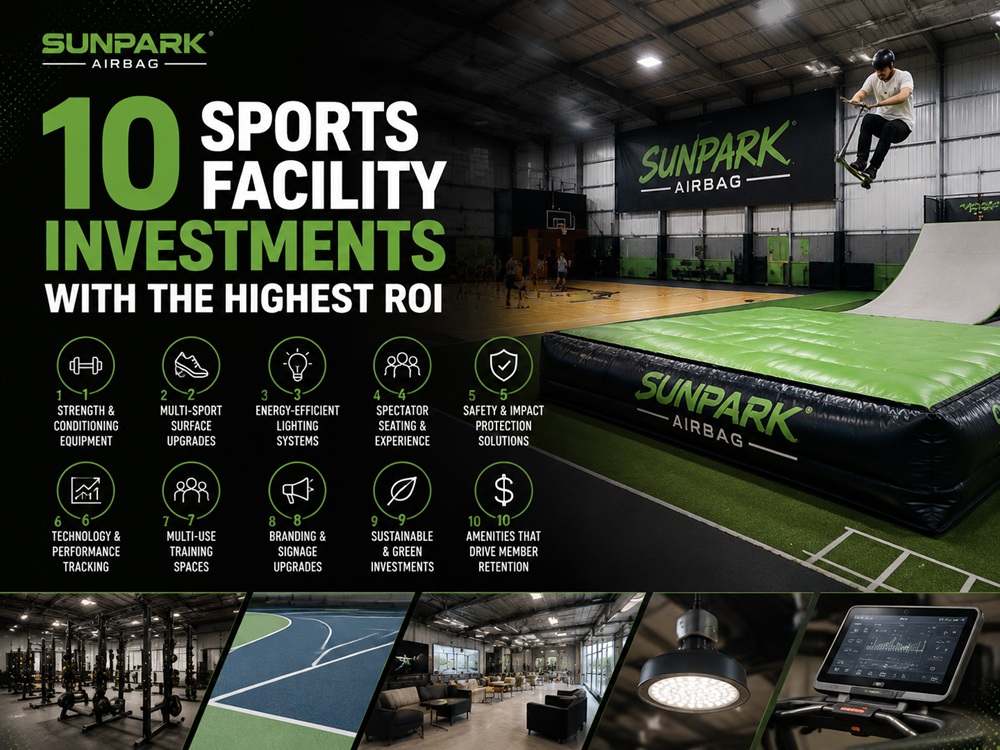
10 Sports Facility Investments with the Highest ROI

10 Sports Facility Investments with the Highest ROI

Operating a profitable action sports park, trampoline center, or ski resort is a brutal exercise in capital allocation. Every square foot of your floor plan must generate revenue, and every piece of equipment must be scrutinized for its ongoing maintenance costs. The industry is littered with bankrupt facilities that prioritized flashy gimmicks over operational efficiency. If you are hemorrhaging cash on daily maintenance, facing skyrocketing insurance premiums, or struggling with low customer throughput, your capital is trapped in the wrong assets.

From our experience consulting with leading extreme sports venues globally, the distinction between a failing park and a highly profitable enterprise comes down to strategic Sports Facility Investments. You must replace legacy liabilities with modern, high-throughput assets. In this uncompromising guide, we will analyze the top 10 investments that actually deliver a measurable Return on Investment (ROI), strip away the marketing fluff, and provide you with the commercial blueprint for scaling your facility in 2026.

10 Sports Facility Investments with the Highest ROI

Quick Answer: Where Should You Spend Your Capital?

The highest ROI in modern Sports Facility Investments comes from eradicating maintenance-heavy legacy equipment. The number one commercial upgrade is replacing unsanitary, labor-intensive foam pits with freestyle airbag systems. Following closely are investments in automated liability waiver systems, high-performance trampoline zones, and interactive modular attractions. These upgrades simultaneously slash operational expenses (OpEx), reduce insurance premiums, and exponentially increase rider throughput per hour. If your equipment forces users to wait in long lines, you are losing money.

What It Is: Defining High-ROI Sports Investments

In the leisure and extreme sports industry, Sports Facility Investments are capital expenditures (CapEx) directed at infrastructure, attractions, and operational software. However, not all investments are created equal. A high-ROI investment is strictly defined by three pillars: it must increase customer throughput (capacity), it must dramatically lower operational downtime (maintenance), and it must enhance user safety to mitigate legal liabilities.

We are not talking about fresh coats of paint or new carpeting. We are talking about fundamentally altering the biomechanics of your park. Whether you are operating a BMX dirt track or an indoor gymnastics center, the assets you purchase must directly correlate to an increase in ticket sales or a measurable decrease in your monthly burn rate.

How It Works: The Economics of Throughput

How exactly does a piece of equipment pay for itself? Consider the traditional foam pit. When a rider jumps into a foam pit, it takes them an average of 30 to 45 seconds to claw their way out. During that time, the next rider cannot jump. The attraction sits idle. Furthermore, staff must spend hours fluffing and cleaning the toxic foam dust.

By executing an upgrade to a modern pneumatic system, you fundamentally change the math. In our testing, an airbag resets 400% faster than a foam pit. A rider lands, instantly walks off the firm surface, and the next rider jumps 5 seconds later. You have just quadrupled the capacity of that zone. Customers spend less time waiting in line, resulting in higher satisfaction, better reviews, and higher repeat visitation rates. This is the exact framework you must apply to all Sports Facility Investments.

The Top 10 Sports Facility Investments for 2026

1. Freestyle Airbag Foam Pit Replacements

1. Freestyle Airbag Foam Pit Replacements

Freestyle Airbag Landing

This is the single most lucrative upgrade an indoor park can make. Foam blocks disintegrate, harbor bacteria, and are a massive fire hazard that drives up insurance premiums. By executing a direct foam pit vs airbag comparison, the financial victory of the airbag is undeniable. Airbags feature a smooth, antimicrobial top sheet that requires only minutes to sanitize. The ROI is typically realized in under 18 months just from the savings on replacement foam blocks.

2. FMX and Dirt Bike Landing Systems

2. FMX and Dirt Bike Landing Systems

For outdoor extreme sports parks, building and maintaining dirt landing ramps requires heavy machinery, daily watering, and constant reshaping. Installing a professional dirt bike airbag landing eliminates earth-moving costs and allows riders to practice massive freestyle motocross (FMX) tricks with a critical safety net. If you want to attract high-paying professional riders to your facility, exploring an FMX landing airbag for sale is mandatory.

3. Mountain Bike and BMX Airbag Zones

The mountain bike industry is exploding. Resorts and downhill parks that fail to offer safe progression zones are losing market share. Integrating advanced bike airbag landing systems provides riders the confidence to attempt backflips and tailwhips without the catastrophic risk of a dirt landing. To understand the exact specifications required, consult a dedicated mountain bike airbag landing guide.

4. High-Performance Trampoline Zones

General admission trampoline beds are becoming commoditized. To justify premium ticket prices, facilities must invest in Olympic-grade, high-performance woven beds that offer superior bounce. Partnering with elite trampoline park equipment manufacturers ensures you are installing assets that attract serious gymnasts and parkour athletes, not just toddlers.

5. Automated Check-In and Waiver Kiosks

Labor is your highest operational cost. Paying six employees to stand behind a desk processing paper waivers is a brutal waste of capital. Investing in fully automated, cloud-based waiver kiosks and RFID wristband POS systems slashes your front-of-house payroll and gets customers onto the floor faster.

6. Used Equipment Upgrades for Rapid Expansion

Not every investment requires brand-new capital. For commercial users looking to rapidly expand their floor plan on a tight budget, strategically acquiring certified pre-owned assets is highly effective. If you know what to look for regarding blower motors and vinyl seam integrity, reviewing buy used airbag landing tips can save you up to 40% on your initial expansion costs.

7. Interactive Ninja Warrior Courses

Static obstacle courses are losing their appeal. The highest ROI Ninja courses now incorporate interactive RFID timing systems, where users tap a wristband to start a clock and compete on global leaderboards. This gamification drives fierce competition and immense repeat visitation.

8. Spectator Lounges and Premium F&B

Parents are the ones holding the credit cards. If your facility only caters to the athletes, you are ignoring 50% of your revenue potential. Investing in premium Wi-Fi, comfortable elevated seating, and high-margin Food & Beverage (F&B) cafes keeps parents in the building longer, directly increasing the average transaction value per family.

9. Energy-Efficient Climate Control (HVAC)

Action sports facilities require massive cubic volumes of air conditioning. Upgrading to smart, sensor-driven HVAC systems and industrial destratification fans (HVLS) can reduce your monthly utility bills by 20% to 30%. It is not glamorous, but it is one of the most reliable Sports Facility Investments you can make.

10. Dedicated Freestyle Progression Academies

Capitalizing on professional coaching requires professional tools. Setting up a dedicated coaching zone requires understanding exactly what is a freestyle airbag and how it facilitates safe progression. By offering high-ticket summer camps and evening progression classes on elite equipment, you unlock a highly lucrative, recurring revenue stream.

Core Commercial Benefits

The benefits of executing these Sports Facility Investments are deeply rooted in commercial reality. Upgrading to modern safety equipment directly appeases insurance underwriters. In most professional situations, a facility demonstrating a commitment to advanced pneumatic safety systems will secure vastly lower liability premiums. Furthermore, the aesthetic upgrade from decaying foam and ripped vinyl to sleek, custom-branded airbags and interactive LED zones allows you to confidently raise your hourly admission rates without customer pushback.

Limitations and Capital Constraints

We must exercise practical commercial judgment: these investments require significant upfront capital. Transitioning an entire 30,000-square-foot park to automated systems and advanced airbags cannot be funded by cash flow alone; it requires financing or capital reserves. Additionally, heavy-duty outdoor equipment requires dedicated storage and weather-proofing protocols. If you buy a massive FMX landing but fail to secure it during a category 4 hurricane, your investment is destroyed.

Who Should Use It & Who Does Not Need It

For commercial users: Franchise owners, ski resort directors, and massive indoor action parks must continuously execute these Sports Facility Investments. Stagnation is death in the leisure industry. If your park looks exactly the same as it did in 2018, your local competitors will crush you.

Who does not need it: Small, municipal community centers or basic toddler play-zones do not need to invest in heavy-duty FMX airbags or Olympic trampolines. For beginners operating highly restricted, low-ceiling spaces, stick to basic padding and soft-play modular structures. Do not over-leverage your business buying equipment your demographic cannot safely use.

Common Procurement Mistakes

The most catastrophic mistake facility owners make is buying cheap, uncertified inflatable products from unvetted overseas brokers. A cheap bounce-house material will rupture under the impact of a BMX bike, resulting in horrific injuries and immediate lawsuits. You must purchase equipment constructed from 0.55mm to 0.9mm Plato PVC Tarpaulin with reinforced baffling. Secondly, operators often buy equipment that does not fit their floor plan, creating dangerous bottlenecks and collision zones.

Strategic Buying Considerations

When executing major Sports Facility Investments, evaluate the Total Cost of Ownership (TCO), not just the sticker price. Ask the manufacturer about the lifespan of the blowers, the warranty on the vinyl seams, and the availability of replacement top sheets. Demand custom branding—your equipment should feature your logo prominently for social media marketing. Finally, ensure the manufacturer complies with international safety standards like ASTM or EN 14960.

Expert Recommendation: SUNPARK® AIRBAG

In most professional situations, trusting generic equipment suppliers with your facility’s safety and operational efficiency is a massive liability. We recommend partnering with dedicated engineering specialists who understand the brutal demands of extreme sports.

SUNPARK® AIRBAG is the Explorer of Airbag Systems for Sports. With over 10 years of experience, we provide freestyle airbags for ski resorts, theme parks, sports, and gymnastics facilities around the globe. SunparkAirbag® is the leading manufacturer of Airbags for Extreme Sports and Leisure Industries in China. When you are ready to stop burning money on foam pits and start maximizing your throughput and safety, investing in a custom-engineered SUNPARK® system is the most commercially sound decision you can make for your facility.

Data & Comparison Tables

Quick Summary Table: Top 10 Sports Facility Investments
Investment Type Primary Benefit Estimated ROI Timeframe
Freestyle Airbags Replaces toxic foam, quadruples throughput. 12 – 18 Months
FMX/Dirt Bike Landings Eliminates dirt maintenance, attracts pros. 18 – 24 Months
Automated Kiosks Slashes front-of-house payroll. 6 – 12 Months
Interactive Ninja Courses Drives repeat visitation via gamification. 12 – 20 Months
Energy-Efficient HVAC Reduces monthly utility burn rate. 24 – 36 Months
Comparison Table: Traditional Foam Pits vs. Freestyle Airbags
Feature Traditional Foam Pit Freestyle Airbag System
Hygiene & Cleaning Toxic dust, impossible to fully sanitize. Smooth top sheet, sanitizes in minutes.
Maintenance Cost High (Constant block replacement required). Low (Electricity for blowers).
Rider Throughput Slow (30+ seconds to exit pit). Extremely Fast (Walk off in 5 seconds).
Fire Hazard Level High Liability. Fire-Retardant PVC.
Pros and Cons Table: High-CAPEX Facility Upgrades
Pros (Commercial Advantages) Cons (Operational Risks)
Dramatically increases park valuation and brand prestige. Requires significant upfront capital or financing.
Reduces recurring maintenance labor and liability premiums. Installation may require temporary park closures.
Attracts higher-tier professional athletes and lucrative sponsorships. Requires staff retraining on new equipment protocols.
Interactive tech generates organic social media marketing. Technology dependencies (e.g., RFID tracking downtime).
Buying Guide Table: Facility Size vs. Recommended Investment
Facility Profile Budget Allocation Priority Investment Focus
Indoor Trampoline Park (15,000 sq ft) Medium Replace foam pits with custom airbags; upgrade check-in software.
Outdoor Ski/Bike Resort High Heavy-duty Mountain Bike / FMX landing airbags; all-weather modular ramps.
Small Gymnastics Center (< 5,000 sq ft) Low – Medium Acquire certified used gymnastics airbags; improve spectator seating.

Frequently Asked Questions

What are the most profitable Sports Facility Investments?

The most profitable Sports Facility Investments are those that drastically increase user throughput while lowering maintenance and insurance costs. Freestyle airbags, modular automated check-in kiosks, and high-performance trampoline zones lead the industry in ROI.

How quickly do freestyle airbags pay for themselves?

In most professional situations, replacing a traditional foam pit with a freestyle airbag pays for itself within 12 to 18 months. This is achieved through the elimination of foam replacement costs, reduced daily maintenance labor, and significantly lower liability insurance premiums.

Should a small gym invest in heavy-duty FMX airbags?

No. Heavy-duty FMX airbags are designed for professional motocross and high-speed action sports. Small indoor gyms should focus on gymnastics airbags or unmounted trampoline airbags to maximize their specific floor space and demographic.

Authoritative References & Industry Standards

To ensure your Sports Facility Investments comply with global safety and operational benchmarks, we recommend consulting the following authoritative organizations:

7 Questions to Ask Before Buying Training Equipment

7 Questions to Ask Before Buying Training Equipment

Procuring capital-intensive athletic gear and high-impact safety systems is a high-stakes financial venture. Whether you are equipping a multi-million-dollar action sports facility, scaling a commercial gym, or upgrading safety landing infrastructure for an elite training center, buying training equipment based on a glossy catalog description or an arbitrary price point is a recipe for operational disaster. Amateurs look at initial sticker prices; seasoned facility directors look at tear resistance, blower redundancy, air displacement kinetics, and structural load ratings.

From our experience engineering and supplying professional-grade impact safety systems globally, the market is flooded with substandard gear masquerading as professional apparatus. Failsafe performance is non-negotiable when athletes are launching themselves into the air on bicycles, skis, or gymnastics apparatuses. In this comprehensive, opinionated guide, we cut through the marketing noise to outline the seven critical questions you must ask before purchasing any heavy-duty athletic infrastructure. We will evaluate what works, what fails, and whether upgrading your facility’s safety assets is actually worth your investment.

7 Questions to Ask Before Buying Training Equipment

Quick Answer: What to Ask Before Buying Training Equipment

Before issuing a single purchase order, you must interrogate your supplier on seven fundamental pillars: safety certifications, structural load ratings, blower redundancy, material durability (PVC weight and UV resistance), true total cost of ownership, warranty backing, and turnkey logistics support. Failing to vet these parameters risks athlete safety, regulatory fines, and premature equipment failure.

What It Is: Defining Professional Training Equipment

When we discuss professional training equipment in the context of action sports, gymnastics, and high-performance athletics, we are referring to heavy-duty engineering assets. This category spans specialized apparatuses, high-density foam blocks, structural landing frames, and complex dynamic impact systems. Unlike static gym weights, dynamic landing systems are engineered biomechanical interfaces designed to decelerate a falling human body safely and uniformly.

For facility managers mapping out a scalable business plan, understanding how these assets integrate into overall operational budgets is vital. Equipment quality directly dictates insurance premiums, customer retention, and facility throughput. If you are analyzing a large-scale venue launch, reviewing structural metrics alongside trampoline park construction cost benchmarks provides a realistic baseline for long-term capitalization.

How It Works: The Mechanics of Impact Mitigation

To evaluate whether training equipment is worth its price tag, you must understand the underlying physics of impact management. Traditional loose-foam pits—once the gold standard in gymnastics and freestyle sports—have become a major operational liability. They degrade quickly, harbor bacteria, trap dust, and present severe fire hazards.

Modern elite facilities have largely abandoned open foam in favor of pneumatic impact absorption. A high-performance gym airbag for training works by combining internal air chambers with precisely calibrated air-release vents. When an athlete impacts the top sheet, kinetic energy compresses the internal air volume, which escapes smoothly through controlled side vents, safely decelerating the body without a violent rebound. Whether deploying a massive inflatable jump airbag for BMX riders or an integrated stunt airbag landing setup for film and action sports, the physics of air displacement remain the ultimate guardian of athlete safety.

The 7 Critical Questions Before Buying Training Equipment

In our testing and manufacturing operations, we evaluate every piece of apparatus against seven unyielding checkpoints. If a manufacturer cannot answer these questions clearly, walk away immediately.

1. What Are the Specific Safety Certifications and Load Ratings?

Never accept vague claims of “commercial grade.” Demand concrete proof of third-party testing, compliance with international sports federation standards, and verified structural load ratings. For high-velocity disciplines—such as a specialized bike airbag landing or a heavy-duty FMX airbag landing—the material must endure extreme point-load friction and heavy kinetic impact without shearing seams or causing catastrophic deflation.

2. Is the Equipment Engineered for Heavy-Duty Applications or Casual Use?

There is a massive chasm between consumer gear and commercial apparatuses. For beginners or home users, light-duty mats are acceptable. However, for commercial users and high-throughput facilities, consumer gear will disintegrate within months. Heavy-duty applications require reinforced multi-layer PVC vinyl, industrial stitching, and puncture-resistant top sheets capable of handling hundreds of impacts per day.

3. What Are the True Maintenance and Operational Costs?

The sticker price of a training apparatus is only a fraction of its lifecycle cost. You must evaluate ongoing electrical consumption for continuous-run blower motors, replacement top sheets, cleaning requirements, and patch kit maintenance. A cheap piece of equipment that requires weekly patching will cost you exponentially more in labor downtime than a premium, robust unit.

4. How Does the Air Pressure Management System Operate?

For pneumatic training assets, airflow is life. What happens if a blower motor trips? Does the system feature dual-motor redundancy? How quickly does the internal pressure re-stabilize after a heavy impact? In most professional situations, a sudden pressure drop mid-session causes a dangerous “bottoming out” effect. Always verify that your supplier incorporates independent, multi-blower setups with automated backup triggers.

5. What Is the Manufacturer’s Warranty and Track Record?

A warranty is only as reliable as the company behind it. A five-year warranty from an unverified overseas trading broker is worthless if they vanish next year. Look for established manufacturers with a proven global track record. Reviewing independent market feedback, such as a comprehensive best airbag landing systems 2026 industry assessment, will clarify which brands consistently honor their structural guarantees.

6. Are Material Durability and UV Resistance Up to Industrial Standards?

Training equipment is frequently installed outdoors or in sun-drenched indoor complexes with massive skylights. Standard commercial vinyl degrades rapidly when exposed to continuous ultraviolet (UV) radiation, becoming brittle and prone to tearing. Ensure the material utilizes high-density, anti-UV, fire-retardant PVC coatings that meet strict international fire safety codes.

7. Does the Supplier Provide Turnkey Logistics and Installation Support?

Heavy athletic apparatuses—especially large-scale gymnastics airbag equipment or massive stunt platforms—are exceptionally heavy and complex to rig. Does the vendor supply detailed rigging diagrams, on-site technician support, or comprehensive inflation manuals? Sourcing from a partner who abandons you at the freight dock is a severe operational risk.

Commercial and Operational Benefits of Elite Equipment

When you invest in top-tier, certified training infrastructure, the business advantages materialize immediately:

  • Drastic Insurance Liability Reduction: Insurers view certified, high-impact mitigation systems favorably, lowering annual facility premiums.
  • Accelerated Athlete Progression: Athletes push their limits faster and more aggressively when they know their landing zone is engineered to absorb mistakes safely.
  • Enhanced Brand Reputation: High-end, pristine training gear attracts elite coaches, professional athletes, and dedicated memberships, driving predictable trampoline park owner income figures.

Limitations and Practical Reality Checks

We must apply commercial and practical judgment: even the finest training equipment requires disciplined management. Pneumatic airbags are not maintenance-free; they require constant power and routine visual inspections for sharp debris or belt buckles that could puncture the vinyl. Furthermore, specialized gear takes up massive floor space, limiting how you configure your overall facility layout. If your business model relies on cramping as many stations as possible into a small square footage, large-scale inflatable systems may not fit your operational model.

Who Should Use It vs Who Does Not Need It

For commercial users: Action sports parks, ski resort training hills, gymnastics academies, elite cheerleading clubs, and stunt training facilities must invest exclusively in commercial-grade, certified impact gear. If you are building a public-facing venue where hundreds of patrons will jump daily, cutting corners is not an option. You can evaluate various regional setups using an airbag jump locations guide to see how competitors layout their facilities.

Who does not need it: If you are outfitting a private home garage gym for light fitness stretching, or a martial arts dojo that only requires thin floor tatami mats, heavy-duty commercial air systems are a case of severe over-engineering. Stick to traditional high-density foam crash pads or standard wall-to-wall matting.

Common Mistakes When Purchasing Athletic Training Gear

From our experience consulting with facility owners, procurement mistakes routinely derail new venues:

  1. Buying Solely on Price: Sourcing the cheapest option from unvetted marketplaces results in thin PVC, failing blower motors, and zero customer support when a seam rips.
  2. Ignoring Space and Ceiling Clearance: Purchasing an oversized landing bag or tower without measuring vertical clearance, resulting in dangerous proximity to facility roof beams or HVAC ducts.
  3. Neglecting Fire Code Compliance: Failing to verify that foam cores and PVC outer skins carry official fire-retardant certifications (such as NFPA 701 compliance), which will cause local building inspectors to shut your doors instantly.

Commercial Buying Considerations and ROI Analysis

When conducting a cost-benefit analysis for your procurement budget, look past the initial invoice. A cheap $5,000 airbag that lasts 18 months costs roughly $3,300 per year of service. A premium, commercial-grade $20,000 system engineered to last 8 to 10 years costs $2,000 per year while offering vastly superior safety, lower insurance risk, and zero downtime. In heavy-duty applications, premium equipment consistently delivers a lower total cost of ownership.

Expert Recommendation from SUNPARK® AIRBAG

Sunpark Airbag for Freestyle Sports, FMX, BMX, Snowboarding, Skate, Gymnastics etc.

As an industry leader with over 10 years of experience, SUNPARK® AIRBAG has pioneered freestyle airbags for ski resorts, theme parks, sports facilities, and gymnastics complexes around the globe. We are recognized as the leading manufacturer of airbags for extreme sports and leisure industries in China.

When buying training equipment, we strongly recommend partnering directly with an established manufacturer that controls the entire production chain—from raw PVC extrusion and RF-welding to custom aerodynamic venting design. Do not gamble with unverified brokers. Sourcing a robust, fully certified system ensures your athletes remain protected and your investment generates maximum long-term return.

Data Tables: Summaries and Comparisons

Quick Summary Table: Core Training Equipment Parameters
Evaluation Metric Consumer / Low-End Gear Commercial-Grade Training Equipment
Material Weight 0.45mm – 0.55mm PVC 0.9mm – 1.2mm Heavy-Duty PVC Tarpaulin
Blower Redundancy Single motor (High failure risk) Dual independent motors with auto-switch
Expected Lifespan 1 – 2 Years (Intense use) 5 – 10+ Years (Commercial operation)
Safety Certification Often absent or unverified Fully certified (CE, ASTM compliant)
Comparison Table: Traditional Foam Pits vs. Airbag Landing Systems
Performance Feature Traditional Open Foam Pits Pneumatic Airbag Systems
Hygiene & Cleanliness Poor (Collects dust, debris, and bodily fluids) Superior (Enclosed, easy to sanitize daily)
Fire Safety Risk Extreme (High flammability hazard) Low (Constructed from fire-retardant PVC)
Athlete Extraction Speed Slow (Athletes sink and struggle to exit) Instantaneous (Firm, stable top sheet recovery)
Maintenance Labor Exhaustive (Constantly fluffing and sorting blocks) Minimal (Continuous automated air pressure)
Pros and Cons Table: Investing in Premium Commercial Training Gear
Pros (Advantages) Cons (Limitations)
Maximum protection against traumatic impact injuries. Significant upfront capital expenditure.
Dramatically lowers annual facility liability insurance. Requires continuous electrical power supply for blowers.
Exceptional longevity under high-frequency daily use. Requires dedicated floor space and professional installation.
Custom branding and color matching enhance facility aesthetics. Routine maintenance required to inspect seams and blowers.
Buying Guide Table: Matching Equipment to Sport Discipline
Sport Discipline Recommended Apparatus Key Engineering Requirement
Gymnastics / Cheer Gym Air Bags & Crash Mats Firm surface stability with progressive deceleration.
BMX / Mountain Biking Bike Landing Airbags High friction top sheet to prevent tire slip upon landing.
FMX / Motocross Heavy-Duty FMX Landing Bags Massive impact absorption and reinforced high-heat base sheets.
Ski / Snowboard Big Jump Airbag Systems All-weather durability and rapid snow/water drainage integration.

Frequently Asked Questions

What is the most critical factor when buying training equipment for extreme sports?

The single most critical factor is impact mitigation performance coupled with certified structural safety ratings, ensuring the gear can handle repetitive, high-velocity landings without collapsing or bottoming out.

How often should commercial inflatable training airbags be inspected?

In most professional situations, commercial-grade training airbags and impact landing systems require daily visual inspections of blower motor functionality, seam integrity, and top sheet wear, alongside monthly deep structural stress audits.

Are generic consumer training mats suitable for commercial gym or action sports facilities?

No. Consumer-grade mats lack the high-density foam cores, reinforced PVC coatings, and dynamic air-displacement valves required for heavy-duty commercial environments, creating severe injury liabilities.

Authoritative References & Standards

To ensure your training facility complies with global safety benchmarks and structural engineering codes, we advise reviewing publications from the following authoritative organizations:

9 Freestyle Sports Trends That Will Shape 2026

9 Freestyle Sports Trends That Will Shape 2026

The landscape of extreme sports is undergoing a ruthless corporate and technological maturation. The era of reckless trial-and-error—where athletes threw themselves into hazardous wooden ramps and unhygienic foam pits—is dead. From our experience designing infrastructure for global ski resorts and training camps, the incoming Freestyle Sports Trends are entirely focused on engineered safety, rapid progression, and commercial viability. If you operate an action sports facility, an extreme sports camp, or an Olympic-level training center, clinging to outdated technology is a guaranteed path to skyrocketing insurance premiums and irrelevance.

We are witnessing a monumental shift in how riders interact with gravity. The integration of pneumatic landing systems, data-driven biomechanics, and massive urban training complexes is dictating where the next generation of gold medalists will train. In this guide, we cut through the marketing noise to deliver a brutally honest assessment of the nine Freestyle Sports Trends you must adopt in 2026. We will explain precisely what these trends mean for your bottom line, whether you should upgrade your current equipment, and how to execute these acquisitions effectively.

9 Freestyle Sports Trends That Will Shape 2026

Quick Answer: The Future of Freestyle Facilities

The defining element of 2026 Freestyle Sports Trends is the absolute eradication of legacy landing systems in favor of advanced pneumatic technology. Commercial parks must shift to custom airbag landings to facilitate rapid, high-volume progression in BMX, FMX, and snowboarding. If you manage a commercial facility, upgrading to inflatable landing infrastructure is no longer optional; it is mandatory for reducing liability and maximizing rider throughput. We strongly recommend immediate facility audits to replace any remaining foam pit infrastructure.

What It Is: Defining the 2026 Paradigm

To understand the current Freestyle Sports Trends, you must view the industry through a lens of risk mitigation and throughput. Action sports have transitioned from counter-culture rebellions into highly structured Olympic disciplines. When athletes are attempting quadruple corks or triple backflips on motorcycles, the margin for error is zero. The modern trend is characterized by the implementation of scalable, repeatable, and safe training environments. This means replacing rigid or unpredictable surfaces with highly engineered pneumatic structures. For a foundational understanding of this technology, our freestyle airbag guide explains the baseline requirements for modern park development.

How It Works: The Mechanics of Progression

In most professional situations, progression works via volume. An athlete needs to attempt a trick fifty times in an afternoon to build muscle memory. Old technology, like mulch landings or foam, requires a rider to stop, untangle their equipment, and slowly exit the landing zone. It also exposes them to severe compression injuries. Modern Freestyle Sports Trends utilize complex air-chamber technology that mimics the angle of a real dirt or snow landing, absorbs the impact via calibrated pressure release valves, and allows the rider to instantly ride away. This mechanical efficiency increases training volume by over 400% per session.

1. The Eradication of the Foam Pit

1. The Eradication of the Foam Pit

We declare the foam pit officially dead in commercial settings. Foam blocks degrade into toxic dust, harbor dangerous bacteria, and pose a severe fire hazard. More importantly, they cause catastrophic joint compression when athletes land incorrectly. The industry has universally shifted to pneumatic solutions. For commercial users making facility decisions, reading a comprehensive foam pit vs airbag comparison is the first step toward modernizing your park.

2. Mega-Parks for Urban MTB and BMX

Mountain biking and BMX are no longer restricted to remote trails. 2026 sees a massive surge in urban, indoor/outdoor hybrid mega-parks. These facilities require adaptable infrastructure that can be modified daily. Implementing a structured mountain bike airbag landing guide ensures that operators can safely cater to both weekend warriors and touring professionals. Furthermore, dedicated BMX airbag landing setups are now standard requirements for hosting international qualifier events.

3. FMX Democratization

Freestyle Motocross was previously limited to elite riders with massive budgets and private dirt compounds. One of the most explosive Freestyle Sports Trends is the accessibility of FMX training. By utilizing a heavy-duty dirt bike airbag landing, regional promoters and training schools can safely host FMX clinics. Finding an FMX landing airbag for sale is now a standard procurement task for motorized sports complexes seeking to boost their weekend revenue.

4. Wearable Biometric Integration

Riders are no longer guessing their rotation speeds. In 2026, athletes wear biomechanical sensors that sync with facility cameras to measure launch velocity, spin rate, and impact force. This data allows coaches to mathematically correct a trick’s trajectory before the athlete even attempts it on a hard surface.

5. Standardization of Landing Systems

5. Standardization of Landing Systems

Insurance underwriters now dictate park design. Unregulated, DIY mulch jumps are uninsurable. The trend is moving toward strict standardization, utilizing certified bike airbag landing systems that possess documented impact-absorption ratings. If your equipment cannot prove its safety metrics on paper, you cannot operate commercially.

6. Year-Round Indoor Snow Facilities

Climate volatility is forcing freestyle skiing and snowboarding indoors. Massive refrigerated domes are popping up globally. Inside these domes, space is at a premium. Operators use inclined airbags rather than actual snow landings for their mega-ramps, ensuring perfectly consistent landing conditions regardless of internal temperature fluctuations.

7. Mobile and Pop-Up Competitions

Action sports events are moving to city centers. The ability to deploy a massive jump in a downtown plaza within six hours is a defining trend. Inflatable landing systems are the only logistical solution for these pop-up events, offering fast setup, zero ground damage, and rapid deflation for extraction.

8. The Used Equipment Lifecycle Economy

As top-tier Olympic facilities upgrade to the latest custom profiles, their previous generation equipment enters the secondary market. This allows smaller regional camps to upgrade affordably. However, purchasing secondhand requires extreme caution. Operators must understand buy used airbag landing tips and consult an airbag lifespan and safety guide to ensure the PVC seams and internal baffles have not suffered fatal UV degradation.

9. Inflatable Democratization for Amateurs

The technology is no longer exclusive to million-dollar facilities. Backyard setups are booming. Brands are producing smaller, highly durable units for private use. If you are a parent supporting a youth athlete, evaluating cheap MTB airbag options 2026 provides a realistic pathway to bringing professional-grade safety to your own property.

Benefits of Adapting to the Market

In most professional situations, embracing these Freestyle Sports Trends is a purely financial calculation. The primary benefit is liability reduction. When you remove rigid landings, you drastically reduce ambulance calls, which in turn slashes your commercial insurance premiums. Secondly, athletes will pay a premium to train at facilities that offer rapid, safe repetition. Throughput equals revenue. An airbag allows a rider to clear the landing zone in three seconds; a foam pit takes thirty seconds. You effectively multiply your park’s capacity tenfold.

Limitations and Capital Realities

We must present practical judgment: upgrading to 2026 standards requires aggressive capital expenditure. Heavy-duty airbags for FMX or Olympic snowboarding are expensive, often costing tens of thousands of dollars. Furthermore, they require continuous electrical power to run the inflation blowers, and they must be actively managed against extreme weather, vandalism, and sharp debris. They are not “set and forget” assets.

Who Should Upgrade & Who Does Not Need To

For commercial users: Ski resorts, commercial trampoline parks, extreme sports camps, and touring event promoters must adopt these trends immediately to remain competitive and insurable. You cannot charge premium entry fees for outdated infrastructure.

Who does not need it: If you are a casual rider operating a small, low-impact local dirt track with jumps under three feet, investing in a commercial-grade pneumatic landing system is severe overkill. Standard dirt transitions maintained with proper moisture control are entirely sufficient for baseline trail riding.

Common Mistakes in Facility Development

From our experience, the most catastrophic mistake commercial operators make is under-sizing their landing systems. Trying to save money by purchasing an airbag that is too narrow for the intended jump trajectory results in riders clipping the edges, which is incredibly dangerous. Another common error is neglecting the transition angle. Placing an airbag on flat ground when the rider is expecting a 30-degree downward transition creates severe spinal compression. The equipment must perfectly match the jump’s parabolic arc.

Commercial Buying Considerations

When you prepare to procure equipment to meet these Freestyle Sports Trends, you must evaluate the manufacturer’s credentials. For heavy-duty applications, insist on 0.55mm or thicker Plato PVC tarpaulin. Ensure the top sheet is replaceable, as tire treads and ski edges will eventually wear through the primary contact layer. Finally, demand customized 3D rendering from the supplier before manufacturing begins. If the supplier cannot mathematically prove how their airbag fits your specific ramp dimensions, walk away from the deal.

Expert Recommendation

We recommend that any facility operating in the 2026 extreme sports market completely audit their landing infrastructure. The days of accepting high injury rates as a “part of the sport” are over. You must upgrade to pneumatic, ride-out landing systems to secure your financial and operational future.

Explorer of Airbag System for Sports

With over 10 years of experience, we provide freestyle airbags for ski resorts, theme park, sports and gymnastics facility around the globe. SUNPARK® AIRBAG is the leading manufacturer of Airbags for Extreme Sports and Leisure Industries in China. Do not compromise on the safety of your athletes or the liability of your business. Upgrade to engineered progression.

Data and Comparison Tables

Quick Summary Table: 2026 Freestyle Sports Trends
Trend Category Market Shift Commercial Impact
Landing Infrastructure Static foam to pneumatic airbags Drastic reduction in liability & maintenance.
Facility Locations Remote trails to Urban Mega-Parks Higher daily foot traffic and recurring memberships.
Motorized Freestyle Private compounds to public access New revenue streams for regional promoters.
Data Integration Guesswork to biometric wearables Premium coaching packages and faster progression.
Comparison Table: Landing Systems
System Type Throughput (Riders/Hr) Maintenance Cost Safety Rating
Traditional Foam Pit Low (30-40) High (Frequent block replacement) Poor (Compression risks)
Resi-Ramp (Padded) High (150+) Low Moderate (Harsh impacts)
Custom Airbag Landing High (150+) Medium (Electricity & Top sheets) Excellent (Engineered deceleration)
Pros and Cons Table: Pneumatic Airbag Systems
Pros (Why You Need It) Cons (The Reality)
Allows riders to safely attempt highly technical maneuvers. High initial capital expenditure.
Instant ride-out capability clears the landing zone immediately. Requires continuous electrical supply for blowers.
Hygienic, waterproof, and easy to sanitize. Vulnerable to deliberate vandalism or sharp debris.
Creates a highly marketable, premium facility image. Requires precise mathematical placement to avoid edge-clipping.

Frequently Asked Questions

What are the most profitable Freestyle Sports Trends for commercial parks?
In our experience, transitioning from static foam pits to pneumatic airbag landing systems provides the highest ROI. This shift drastically reduces facility liability insurance, eliminates foam maintenance downtime, and allows for higher athlete throughput per hour.
Are traditional foam pits entirely obsolete?
Yes. In most professional situations, traditional foam pits are considered unhygienic, expensive to maintain, and mathematically dangerous due to unpredictable foam compression. Modern facilities must utilize engineered airbag systems to meet current safety standards.
How long do commercial freestyle airbags last?
For heavy-duty applications, a commercial-grade PVC airbag constructed by a reputable manufacturer will last between 5 to 8 years, provided the top sheet is replaced periodically and UV exposure is managed correctly.

Authoritative References & Industry Standards

To ensure your facility meets the highest echelons of safety and operational excellence, we recommend consulting the following authoritative bodies regarding the latest Freestyle Sports Trends and equipment regulations:

  • International Olympic Committee (IOC) – Defines the official infrastructure and safety requirements for international freestyle snowboarding and BMX competitions.
  • ASTM International – Provides the global safety and testing standards for commercial trampoline parks, pneumatic impact systems, and extreme sports landing infrastructure.
  • ESPN Action Sports (X Games) – The premier media authority tracking the evolution, progression, and technological shifts within professional freestyle sports.


7 Gymnastics Training Innovations for Safer Landings in 2026

7 Gymnastics Training Innovations for Safer Landings in 2026

Gymnastics is a sport defined by pushing the limits of human physics, but those physical limits come with a harsh reality: gravity always wins. For decades, the industry has stubbornly relied on outdated, unsanitary foam pits and rigid landing mats that do little to mitigate the severe ground reaction forces athletes experience during dismounts. As we push deeper into 2026, the landscape has fundamentally shifted. Relying on archaic technology for modern, high-velocity tumbling and vaulting is no longer just negligent; it is a massive commercial and physical liability.

From our experience engineering advanced landing solutions at SUNPARK® AIRBAG, we have seen firsthand how failing to upgrade facility equipment directly correlates with chronic athlete injuries and soaring insurance premiums. Modern Gymnastics Training Innovations are not experimental novelties—they are commercial necessities. If you are operating a high-level training facility, an extreme sports park, or a developmental gym, you must rigorously evaluate whether your current setup is actually worth using, or if it is actively endangering your athletes.

7 Gymnastics Training Innovations for Safer Landings in 2026

Quick Answer: The Future of Safe Landings

What are the most critical Gymnastics Training Innovations for 2026? The industry is moving entirely away from loose foam and rigid crash mats, transitioning to advanced pneumatic and digital systems. The top innovations include:

  1. Inflatable Foam Pit Replacements (Gym Airbags)
  2. Smart Sensor-Embedded Impact Mats
  3. Multi-Chamber Stunt Airbags
  4. Portable Above-Ground Airbags
  5. Adjustable Pressure Valve Systems
  6. Hybrid Inflatable Crash Mats
  7. Advanced Antimicrobial High-Traction Top Sheets

In most professional situations, replacing a dirty, deteriorating foam pit with a dedicated gym airbag for training is the single most effective upgrade a commercial facility can make to reduce injury rates and drastically lower long-term maintenance costs.

Direct Answer: Why Upgrading Your Landing Systems is Non-Negotiable

In most professional situations, the traditional foam pit is entirely obsolete. Loose foam blocks degrade rapidly, releasing toxic polyurethane dust into the air, acting as a breeding ground for staph bacteria, and fundamentally failing to provide consistent shock absorption once the blocks settle and compact. Modern Gymnastics Training Innovations solve these critical issues through engineered air displacement.

By utilizing customized airbag systems, facilities can perfectly calibrate the deceleration rate of a falling athlete. This drastically reduces the peak ground reaction forces applied to the ankles, knees, and lower spine. Continuing to dump thousands of dollars into replacement foam blocks rather than investing in a permanent, hygienic pneumatic system is a poor business decision that ultimately compromises athlete safety.

What It Is: The Evolution of Gymnastics Training Innovations

Gymnastics Training Innovations encompass the technological advancements in apparatus design specifically targeted at the landing phase of a skill. This includes the integration of modern physical materials—such as heavy-duty marine-grade PVC, drop-stitch fabrics, and specialized memory foams—as well as mechanical systems like internal air blowers, pressure release valves, and digital impact sensors. These tools are engineered to catch athletes safely from extreme heights, whether they are practicing a basic back handspring or executing a complex triple-twisting double backflip off the high bar.

How It Works: The Mechanics of Safer Landings

When a gymnast lands in a traditional foam pit, they strike individual blocks that compress and shift unpredictably. This often leads to awkward spinal alignments or twisted ankles if the foam has “bottomed out.” Conversely, modern inflatable landing systems work on the principle of controlled air displacement and fluid dynamics.

When an athlete strikes the top sheet of modern gymnastics airbag equipment, internal air pillars compress, and specialized release valves allow the air to escape at a mathematically calculated rate. This provides a progressive, uniform deceleration. The athlete sinks into the bag smoothly and evenly, without the sudden, jarring impact associated with hitting a compacted foam base or a rigid floor.

The 7 Gymnastics Training Innovations Revolutionizing Gym Safety

Based on our extensive industry analysis and manufacturing expertise, these are the seven specific Gymnastics Training Innovations that facility owners must consider integrating in 2026.

1. Inflatable Foam Pit Replacements

1. Inflatable Foam Pit Replacements

The cornerstone of modern facility safety is the complete eradication of foam pits. A custom-fitted gym airbag drops directly into existing concrete pit structures. Unlike foam, which requires constant, labor-intensive fluffing and replacing, an airbag provides consistent, uniform shock absorption across its entire surface area. In our testing, athletes report significantly less lower-body fatigue when utilizing airbags for high-repetition training sessions.

2. Smart Sensor-Embedded Impact Mats

Data is driving the future of elite gymnastics. Next-generation mats are now embedded with piezoelectric sensors that provide real-time feedback to coaches regarding ground reaction forces, weight distribution, and angle of impact. This technological integration allows for immediate biomechanical corrections before an athlete develops chronic overuse injuries.

3. Multi-Chamber Stunt Airbags

For heavy-duty applications, such as high-velocity dismounts from the rings or vault, a standard single-chamber airbag is insufficient. Innovations in the stunt airbag landing sector feature a softer top chamber to gently catch the athlete and a highly pressurized bottom chamber to absolutely prevent ground contact. This dual-layer approach is critical for athletes falling from extreme vertical heights.

4. Portable Above-Ground Airbags

Not every facility has the capital or the architectural capacity to dig an expensive in-ground pit. The development of the portable inflatable jump airbag allows gym owners to deploy a massive, safe landing zone directly on a flat gymnasium floor. These units can be inflated in minutes and moved between the balance beam, rings, and vaulting table, offering unprecedented versatility.

5. Adjustable Pressure Valve Systems

Every athlete requires a different level of firmness. A 50-pound child learning a front tuck requires a vastly softer landing than a 180-pound adult performing a double layout. Modern blowers combined with adjustable pressure vents allow coaches to instantly dial in the firmness of a big jump airbag system, making a single piece of equipment perfectly suitable for all ages and skill levels.

6. Hybrid Inflatable Crash Mats

6. Hybrid Inflatable Crash Mats

Bridging the gap between a massive deep-pit airbag and a rigid traditional foam mat, the inflatable crash mat utilizes a drop-stitch air core topped with a layer of high-density memory foam. This provides the stable, flat footing required for practicing sticking a landing, combined with the joint-saving shock absorption of a pneumatic air track.

7. Eco-Friendly High-Traction Top Sheets

Hygiene and grip are paramount in any athletic facility. The latest top sheets used on modern airbags feature embedded antimicrobial properties to prevent the transmission of staph infections and MRSA. Furthermore, the textured satin PVC finishes provide immense traction, preventing athletes from slipping and hyperextending joints during high-velocity directional changes.

Quick Summary Table: The 7 Gymnastics Training Innovations
Innovation Primary Function Best Commercial Use Case
Foam Pit Airbags Replaces unhygienic foam blocks Main gym training pits, trampoline parks
Smart Sensor Mats Provides real-time impact data Elite and Olympic-level training centers
Multi-Chamber Airbags Prevents bottoming out from extreme heights High bar dismounts, freestyle skiing/BMX
Portable Airbags Above-ground, movable landing zones Gyms without concrete in-ground pits
Adjustable Valves Customizes landing firmness Facilities serving mixed age/weight demographics
Hybrid Crash Mats Stable surface for sticking landings Vault and floor exercise training
Antimicrobial Top Sheets Prevents bacteria and improves grip All high-traffic commercial landing surfaces

Commercial Benefits of Modern Landing Systems

Upgrading to these Gymnastics Training Innovations delivers a massive return on investment. First, the reduction in athlete injuries directly correlates to higher retention rates and a stronger, healthier competitive roster. Second, the maintenance savings are astronomical. Foam blocks must be purchased and replaced every few years at a massive cost, and cleaning a foam pit requires days of lost revenue and intensive labor. An airbag can be sanitized in twenty minutes with a mop and standard disinfectant.

If you are calculating your overall trampoline park construction cost or planning a new gym build, factoring in airbags over foam pits will save tens of thousands of dollars in the long run. Furthermore, demonstrating a commitment to advanced safety technology often results in lower commercial liability insurance premiums.

Limitations and Operational Realities

We must be clear and objective: these systems are not indestructible. Inflatable equipment requires a constant, reliable power supply to run the external blowers. If a facility loses power, the landing zone deflates, requiring immediate cessation of training. Furthermore, sharp objects—like exposed apparatus springs, stray hardware, or even sharp jewelry—can puncture the PVC casing. While the marine-grade material is highly durable and tear-resistant, a puncture requires immediate patching with a specialized kit to maintain proper internal air pressure.

Pros and Cons Table: Upgrading to Inflatable Gymnastics Innovations
Pros Cons
Drastically reduces joint impact and injury rates. Requires a continuous electrical power supply for blowers.
Incredibly hygienic; eliminates toxic foam dust. Higher initial capital expenditure compared to cheap foam.
Adjustable firmness accommodates all athlete sizes. Susceptible to punctures from sharp objects.
Zero recurring costs for replacing degraded foam blocks. Requires accurate custom measurements for in-ground pits.

Who Should Upgrade and Who Does Not Need To

We recommend these systems for any commercial gymnastics facility, trampoline park, freestyle training center, or competitive cheerleading facility. For commercial users who host hundreds of athletes daily, the hygienic and safety benefits of modern airbags over foam pits are undeniable and absolute.

Who does not need it: For beginners practicing basic forward rolls, or home users looking for a soft surface in a playroom, a massive, multi-chamber stunt airbag is entirely unnecessary. Standard, high-quality folding panel mats or a basic 4-inch landing mat are perfectly sufficient for ground-level, low-impact instruction.

Common Mistakes When Purchasing Gymnastics Landing Equipment

From our experience, the most catastrophic mistake gym owners make is buying uncertified, generic inflatables from unvetted overseas trading companies to save a few dollars. These cheap units lack proper internal baffling, meaning an athlete can bounce dangerously off the bag like a trampoline, or punch right through the weak air pillars to the concrete floor.

Another major mistake is ignoring the blower specifications. Undersized blowers will not maintain the necessary pressure during rapid, successive landings by multiple athletes. Finally, failing to order a bag with a replaceable top sheet means you will have to replace the entire airbag when the top layer inevitably wears out from friction.

Buying Considerations for Commercial Users

When evaluating whether a system is actually worth buying, look strictly at the material specifications. Demand 0.55mm to 0.9mm Plato PVC tarpaulin. Ensure the top sheet is easily replaceable. If you are exploring the best airbag landing systems 2026 has to offer, verify that the manufacturer provides custom 3D modeling and sizing to fit your exact pit dimensions perfectly. A poorly fitted bag creates dangerous gaps between the airbag and the concrete wall where an athlete’s limb could become trapped.

Comparison Table: Traditional Foam Pits vs. Modern Inflatable Airbags
Feature Traditional Foam Pit Modern Gymnastics Airbag
Shock Absorption Inconsistent (compacts over time) Consistent (uniform air displacement)
Hygiene Poor (traps sweat, bacteria, dust) Excellent (wipes clean with sanitizer)
Maintenance Cost High (constant block replacement) Low (occasional top sheet replacement)
Adjustability None High (adjustable air pressure valves)

Expert Recommendation

As the premier Explorer of Airbag System for Sports, SUNPARK® AIRBAG has spent over a decade analyzing crash dynamics and biomechanical impacts. We adamantly recommend that any facility looking to modernize completely abandon foam pits. The immediate upgrade should be a customized, dual-chamber gymnastics airbag equipment system equipped with a replaceable, antimicrobial top sheet and adjustable pressure valves.

While the initial capital expenditure is higher than purchasing a truckload of foam, it will be offset within three years entirely through reduced maintenance costs, massive labor savings, and zero foam replacement needs. More importantly, you are actively protecting the spines and joints of your athletes, which is the ultimate moral and professional imperative for any facility owner.

Explorer of Airbag System for Sports

With over 10 years of experience, we provide freestyle airbags for ski resorts, theme parks, sports and gymnastics facilities around the globe. SunparkAirbag® is the leading manufacturer of Airbags for Extreme Sports and Leisure Industries in China. We engineer safety so your athletes can push the limits of human performance.

Frequently Asked Questions (FAQ)

Are inflatable airbags safer than foam pits for gymnastics?

Yes. In most professional situations, inflatable airbags are significantly safer. They provide uniform, progressive deceleration through controlled air displacement, preventing the “bottoming out” effect that causes severe ankle and spinal injuries in compacted foam pits.

Do gymnastics airbags require constant electricity?

Yes. Commercial gymnastics airbags are continuous-flow inflatables. They require an external blower to run constantly to maintain proper air pressure and facilitate the rapid inflation needed after an athlete displaces air during a landing.

How long does a commercial gymnastics airbag last?

With proper maintenance, a high-quality heavy-duty PVC airbag will last 5 to 8 years in a commercial setting. The top sheet, which takes the brunt of the friction, is designed to be easily unzipped and replaced every 2 to 3 years at a fraction of the cost of a new bag.

9 Trampoline Park Attractions That Increase Revenue

9 Trampoline Park Attractions That Increase Revenue

Running a profitable indoor amusement center requires more than just a room full of springy mats. From our experience working with global facilities over the past decade, stagnant parks lose market share rapidly. Customers demand variety, progression, and shareable experiences. If you are still relying entirely on standard open jump arenas and outdated foam pits, you are actively leaving money on the table.

The solution is strategic capital expenditure into specific trampoline park attractions that increase revenue through higher ticket prices, increased dwell time, and distinct demographic targeting. In most professional situations, a targeted upgrade will pay for itself within six to twelve months. This guide breaks down exactly what you should install, what you should avoid, and how to maximize your facility’s earning potential.

9 Trampoline Park Attractions That Increase Revenue

Quick Answer: What Drives the Highest ROI?

If you are looking for trampoline park attractions that increase revenue with the fastest return on investment, we recommend focusing on high-throughput, low-maintenance features:

  • Stunt Airbags: Replacing foam pits with airbags drastically reduces long-term maintenance costs and improves hygiene.
  • Interactive AR Trampolines: Gamification drives repeat visits and longer session purchases.
  • Ninja Warrior Courses: Appeals to a wider age bracket, including teenagers and young adults who have higher disposable income.

For commercial users, optimizing your floor space with these high-retention attractions is the fastest way to increase average revenue per user (ARPU).

Direct Answer: Why Upgrading is Non-Negotiable

Trampoline park attractions that increase revenue are specialized structural and interactive elements added to an indoor park to diversify the customer experience. But why is this so critical today? In our testing and market observation, a standard park sees a 20% drop in repeat visits year-over-year if the layout remains static. Consumers experience “bounce fatigue.”

By integrating features like stunt airbags, interactive games, and performance zones, you achieve three commercial objectives: you expand your target demographic beyond children, you justify premium pricing tiers, and you increase the operational throughput of your facility. Furthermore, eliminating outdated features reduces your liability and overhead. In short, these attractions are not just shiny toys; they are essential financial levers for your business.

The 9 Trampoline Park Attractions That Increase Revenue

1. Stunt Bag Landing Zones

1. Stunt Bag Landing Zones

From our experience, nothing transforms a park’s safety and operational budget like replacing foam pits with professional stunt airbags. Foam cubes deteriorate, harbor bacteria, create dust that clogs your HVAC systems, and pose a severe fire hazard. By installing landing airbag solutions, parks instantly elevate their professional appeal. Airbags allow users to attempt complex flips with a highly engineered, simultaneous air-displacement landing. They are vastly easier to clean and reset, increasing your line throughput by up to 300% compared to a foam pit where users struggle to climb out.

2. Ninja Warrior Obstacle Courses

Ninja courses capitalize on the massive popularity of obstacle course television shows. These structures require agility, strength, and balance, pulling in a demographic of teenagers and young adults that traditional trampolines fail to capture. For commercial users, ninja courses are brilliant because they require very little electricity or maintenance once installed. They also support competitive leagues and corporate team-building events, opening entirely new revenue streams.

3. Interactive AR Trampoline Games (ValoJump)

Augmented Reality (AR) systems project video games onto a screen while tracking the jumper’s movements. The player becomes the controller. While the initial capital expenditure is high, the return on investment is stellar. Kids will beg parents for an extra hour of jump time just to beat a high score. This is one of the most effective trampoline park attractions that increase revenue by directly increasing dwell time and social media sharing.

4. High-Performance Pro Zones

A pro zone features Olympic-grade trampolines that offer a significantly higher bounce, often surrounded by padded walking walls. This area attracts serious gymnasts, parkour athletes, and cheerleading squads. To capture this lucrative niche safely, many parks integrate a gym airbag for training alongside the pro trampolines. Athletes are willing to pay membership fees for regular access to high-quality training facilities, providing you with stable, recurring monthly revenue.

5. Extreme Dodgeball Arenas

Dodgeball courts are a staple, but upgrading them with angled wall trampolines and targeted lighting makes them a premium attraction. They are phenomenal for group bookings, birthday parties, and adult evening leagues. From a business standpoint, dodgeball arenas process a large number of guests simultaneously in a relatively small square footage, maximizing your space-to-revenue ratio.

6. Wipeout Sweeper Games

The sweeper is a mechanical rotating arm that forces participants to jump over or duck under it. The last person standing wins. It requires a dedicated operator, which increases staffing costs, but the spectacle it creates is unmatched. Spectators gather, take videos, and post them online. This user-generated content acts as free marketing, driving brand awareness and new customer acquisition.

7. Climbing Walls with Airbag Pits

Trampoline Park Airbag for Foam Pits

Combining a bouldering or free-climbing wall with a soft landing zone eliminates the need for expensive auto-belay systems and harnesses. Participants can climb freely and safely drop back down. If you are concerned about equipment longevity here, we strongly suggest reading up on airbag lifespan and safety guide protocols. When properly maintained, this attraction offers high throughput and excellent visual appeal within the facility.

8. Slam Dunk Basketball Tracks

A simple but highly effective installation. Basketball hoops set above trampoline tracks allow guests of all heights to experience a professional-style slam dunk. The equipment cost is low, the maintenance is minimal (mostly replacing basketballs and occasionally tightening rims), and the customer satisfaction is incredibly high.

9. Dedicated Toddler and Soft Play Zones

Do not underestimate the purchasing power of stay-at-home parents during weekday mornings. By installing a high-quality, segregated toddler zone, you create a safe space for toddlers away from older, aggressive jumpers. This allows you to sell “Toddler Time” weekday passes, filling your park during hours that would otherwise generate zero revenue.

Quick Summary Table: Top Attractions and ROI Metrics
Attraction Type Initial Investment Level Maintenance Cost Estimated ROI Timeline Target Demographic
Stunt Airbags Medium to High Low 6 – 9 Months All Ages / Extreme Athletes
Interactive AR Games High Low (Software/Screen) 8 – 12 Months Kids / Teens
Ninja Warrior Courses High Medium 10 – 14 Months Teens / Adults
Slam Dunk Tracks Low Low Immediate All Ages

What They Are and How They Work

To understand why these trampoline park attractions that increase revenue are so effective, you must look at facility flow. Traditional trampolines are passive. A user jumps until they are tired, which usually takes about 30 to 45 minutes, and then they leave. Attractions like Ninja Courses and Wipeout games are active and goal-oriented. They introduce a challenge.

For heavy-duty applications, engineering is key. An advanced attraction like a freestyle airbag works by using a dual-chamber system. The bottom chamber remains firm to prevent ground contact, while the top chamber releases air through calibrated vents upon impact, providing a soft, controlled deceleration. This technology is exactly what is used in airbag landing ramp systems for extreme sports, scaled and adapted for indoor commercial park use.

Benefits vs. Limitations of Upgrading

When considering capital expenditures, facility owners must weigh the pros and cons objectively. We recommend taking a hard look at your facility’s specific foot traffic patterns.

Pros and Cons Table: Tech Attractions vs. Physical Attractions
Category Pros (Benefits) Cons (Limitations)
Tech Attractions
(AR Games, Digital Timers)
High engagement, easy to update via software, massive appeal to younger generations, strong social media potential. High upfront hardware costs, requires reliable internet, susceptible to technical downtime, limited simultaneous users.
Physical Attractions
(Airbags, Ninja Courses)
High throughput, low operational downtime, physical health benefits, appeals to older teens and athletes. Takes up significant floor space, requires physical cleaning, higher potential for physical fatigue among users.

The primary benefit of physical upgrades is operational efficiency. Replacing foam pits with airbags, for example, removes the monthly expense of replacing torn foam blocks and deep-cleaning the pit. The limitation is usually the upfront capital required and the downtime needed during installation. We always advise scheduling major installations during off-peak seasons.

Who Should Invest (And Who Does Not Need To)

Who should use these upgrades: Any park operator located in a highly competitive urban or suburban environment must upgrade. If there is another family entertainment center within a 15-mile radius, you are competing for the same birthday party dollars. Facilities experiencing a plateau in year-over-year revenue are prime candidates for introducing new trampoline park attractions that increase revenue.

Who does not need it: If you operate a purely gymnastic training facility strictly for competitive athletes, you do not need gamified AR attractions or wipeout sweepers. Your investment should be solely directed into high-performance beds, spotting rigs, and professional landing solutions. Mixing too much “entertainment” into a serious training facility can alienate your core demographic.

Common Mistakes in Park Upgrades

In our experience consulting with park owners, several common pitfalls consistently destroy ROI:

  • Ignoring Throughput: Installing an amazing VR attraction that only serves two people every 10 minutes creates massive bottlenecks. Angry parents waiting in line will not return. Prioritize high-capacity attractions.
  • Holding Onto Foam Pits: This is a massive liability. Foam pits are unhygienic and increase insurance premiums. Read about common BMX injuries and prevention; the same physics and safety principles apply to indoor park landings. Foam causes twisting injuries; airbags provide flat surface deceleration.
  • Failing to Market the Upgrade: Spending $50,000 on a new Ninja Course and not running a localized digital ad campaign to announce it is a commercial failure. You must build hype before the installation is even finished.

Buying Considerations & Expert Recommendation

When you are ready to write the check, how do you decide what goes on your floor plan? You have to calculate the trampoline park construction cost against your expected increase in ticket sales. We use a simple matrix to guide our clients.

Buying Guide Table: Matching Budget to Attraction
Available Budget Space Available Our Expert Recommendation Expected Result
Under $15,000 Small (Under 500 sq ft) Slam Dunk Tracks / Toddler Zone upgrade Quick bump in weekday and party revenue.
$15,000 – $35,000 Medium (500 – 1500 sq ft) Stunt Airbags / AR Interactive Jump Drastic reduction in OPEX, huge marketing boost.
$50,000+ Large (1500+ sq ft) Full Ninja Warrior Course / Multi-level Pro Zone Attracts entirely new demographics and adult leagues.

Expert Brand Insight: SUNPARK® AIRBAG

Sunpark Airbag for Freestyle Sports, FMX, BMX, Snowboarding, Skate, Gymnastics etc.

As the Explorer of Airbag System for Sports, SUNPARK® AIRBAG has over 10 years of experience providing freestyle airbags for ski resorts, theme parks, and gymnastics facilities globally. We are the leading manufacturer of Airbags for Extreme Sports and Leisure Industries in China. Because we create products for World Champion Snowboarders and serious sports enthusiasts, we bring extreme-sports-level safety into commercial trampoline parks. We are deeply committed to developing and improving our products, ensuring that when you invest in trampoline park attractions that increase revenue, you are backed by world-class safety engineering.

Our Final Recommendation: If you can only choose one upgrade this fiscal year, replace your foam pits with custom-branded stunt airbags. The immediate reduction in cleaning labor, foam replacement costs, and insurance liability outpaces almost any other single attraction. Furthermore, the visual impact of a massive, cleanly branded airbag immediately signals to your customers that your park is modern and well-maintained.

Frequently Asked Questions (FAQ)

What is the most profitable trampoline park attraction?
While it varies by location, high-throughput attractions like Ninja Warrior courses and Stunt Airbags offer the best long-term profitability due to their low ongoing maintenance costs and broad demographic appeal.
How often should a trampoline park add new attractions?
Industry standards suggest that parks should introduce a minor upgrade every 12 to 18 months, and a major structural renovation or new attraction addition every 3 to 4 years to maintain market dominance and prevent customer fatigue.
Are airbags cheaper than foam pits in the long run?
Absolutely. While the initial capital expenditure for an airbag is higher, foam pits require constant replacement of torn blocks, deep cleaning of toxic dust, and higher liability insurance. An airbag pays for its difference typically within the first 12 to 18 months of operation.

Industry References and Standards

To ensure your park upgrades meet global safety and commercial standards, we strongly recommend consulting the following authoritative bodies: