In high-performance athletics, extreme sports, and commercial movement facilities, injury is the single largest destroyer of capital and athletic progression. Whether managing an elite ski resort freestyle park, a gymnastics academy, an action sports training compound, or a commercial fitness center, an injury event carries massive hidden costs. Beyond the immediate human toll, facility operators face soaring insurance premiums, operational downtime, legal exposure, and lost membership retention when athletes get hurt.
From our experience building and testing advanced impact-attenuation hardware globally at SUNPARK® AIRBAG, we have observed a fundamental shift in how top-tier training facilities approach safety. Legacy safety gear—such as rigid crash pads, unvented mats, and traditional open-cell foam pits—no longer meets modern biomechanical performance standards. Athletes are jumping higher, rotating faster, and executing more complex tricks than ever before. Relying on outdated protection methods guarantees elevated injury rates.
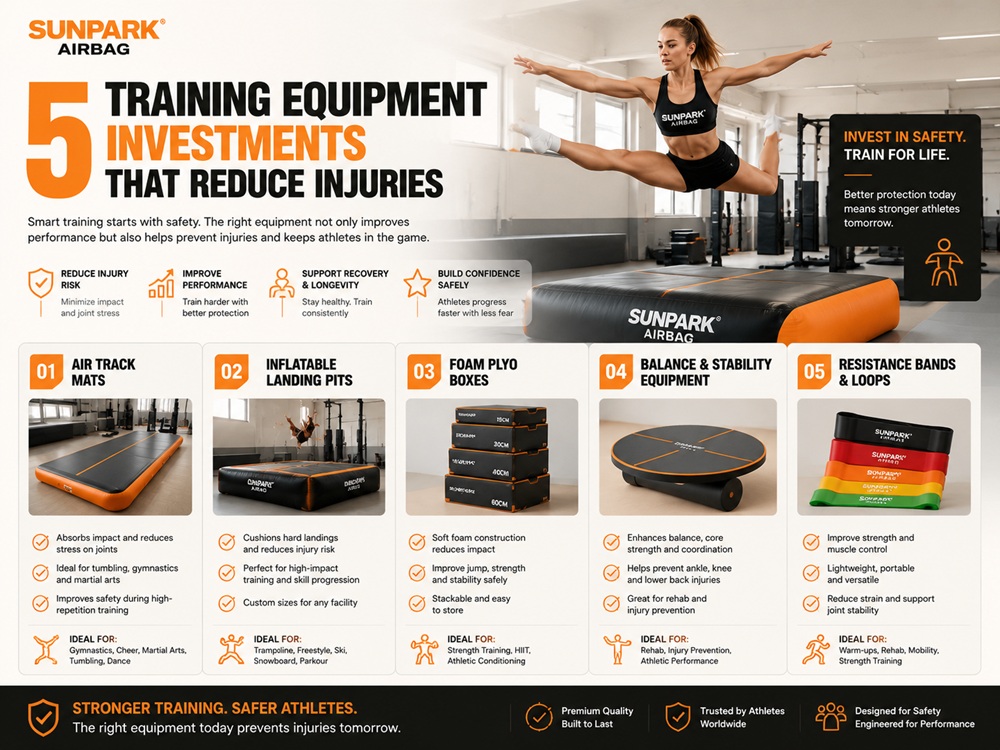
Strategic, high-ROI Training Equipment Investments must directly address the physics of impact, force transmission, and physiological strain. In this guide, we evaluate the five most effective equipment investments that measurably reduce injuries, explain the engineering behind how they protect human bodies, and provide straightforward commercial guidance to help you choose the right systems for your facility.
Quick Answer: The Top 5 Injury-Reducing Equipment Investments
If you need an immediate breakdown of which Training Equipment Investments deliver the highest reduction in injury rates and liability, focus on these five technologies:
- Inflatable Airbag Landing Systems (Inclined Landings): Replaces rigid dirt/snow ramps and static foam pits with continuous, dual-chamber air attenuation that matches landing trajectories.
- Biomechanical Force Plates & Motion-Capture Sensors: Identifies muscular asymmetries and fatigue markers before catastrophic ligament tears occur.
- Overhead Spotting Harness & Rigging Systems: Allows rotational acrobatics and complex aerial flips to be drilled with zero floor-impact risk.
- Variable-Resistance Pneumatic Strength Equipment: Removes iron inertia to protect joints and tendons during explosive movement patterns.
- Surface-Vented Impact Gym Airbags: Replaces hygiene-hazardous foam pits in gymnastics and trampoline parks with instant-reset air chambers.
The Physics of Impact Attenuation & Injury Prevention
To evaluate why certain Training Equipment Investments successfully prevent trauma while others fail, you must understand the basic biomechanics of impact. Injury occurs when the peak force exerted on human tissue exceeds the structural tolerance of bone, cartilage, tendons, or ligaments.
Impulse is defined as the change in momentum, represented mathematically as the product of force ($F$) and time ($\Delta t$). To reduce the peak impact force experienced by an athlete during a fall or landing, you must extend the deceleration time ($\Delta t$) or distribute the force over a larger surface area. Traditional landing surfaces (like hard dirt, icy snow, or thin floor pads) stop an athlete almost instantaneously, producing massive peak forces that break bones and tear ligaments.
Modern engineering solves this through active air displacement and progressive compression. Equipment designed with dynamic air venting, internal pressure valves, or pneumatic load damping absorbs kinetic energy gradually. By controlling air evacuation during an impact, the peak g-force transmitted to the human frame is kept well below injury thresholds.
Quick Summary Table: Equipment Breakdown
| Equipment Type | Primary Injury Prevented | Target Sport / Industry | Capital Investment Level |
|---|---|---|---|
| Inclined Airbag Landings | Spinal compression, fractures, joint trauma | Snowboarding, Skiing, MTB, BMX, Moto | Commercial / High ($$$) |
| Force Plates & Sensors | ACL tears, hamstrings strains, overtraining | Athletic training, rehab centers, team sports | Moderate ($$) |
| Overhead Spotting Harnesses | Head/neck trauma, uncontrolled falls | Gymnastics, circus arts, cheerleading | Low to Moderate ($$) |
| Pneumatic Strength Gear | Tendonitis, joint impingement, muscle tears | Powerlifting, physical therapy, pro sports | Moderate to High ($$$) |
| Gym Airbag Pit Systems | Ankle sprains, hyper-extensions, hygiene issues | Gymnastics academies, trampoline parks | Moderate to High ($$$) |
1. Inflatable Airbag Landing Systems
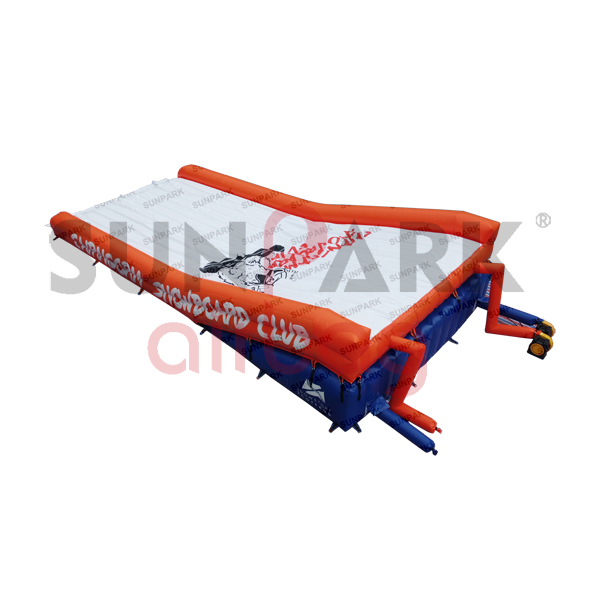
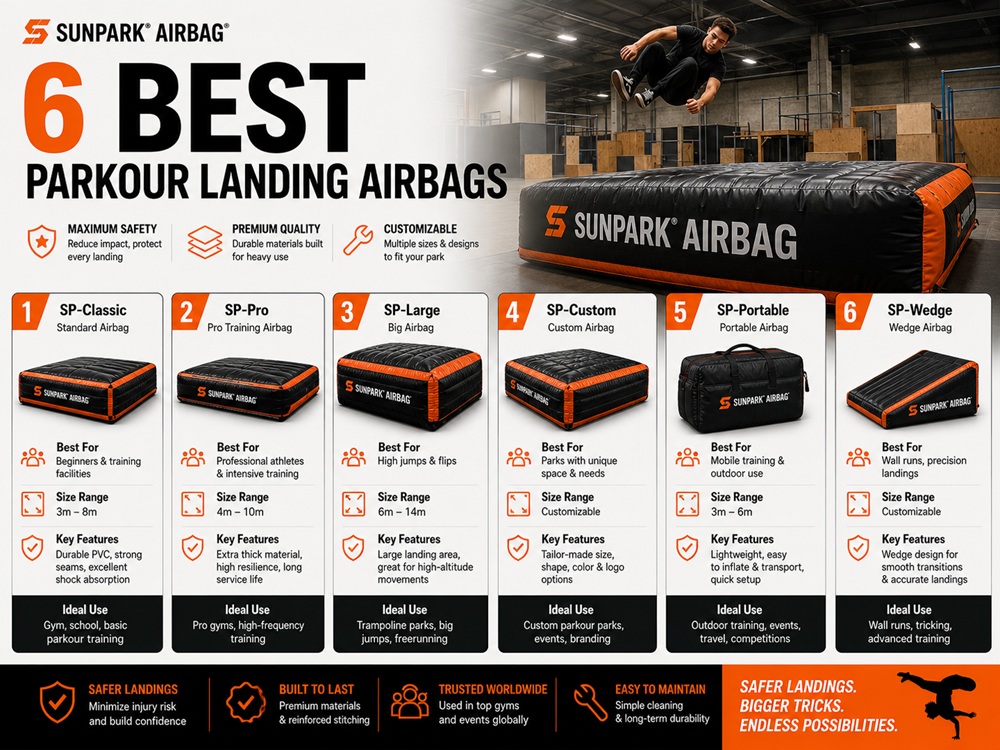
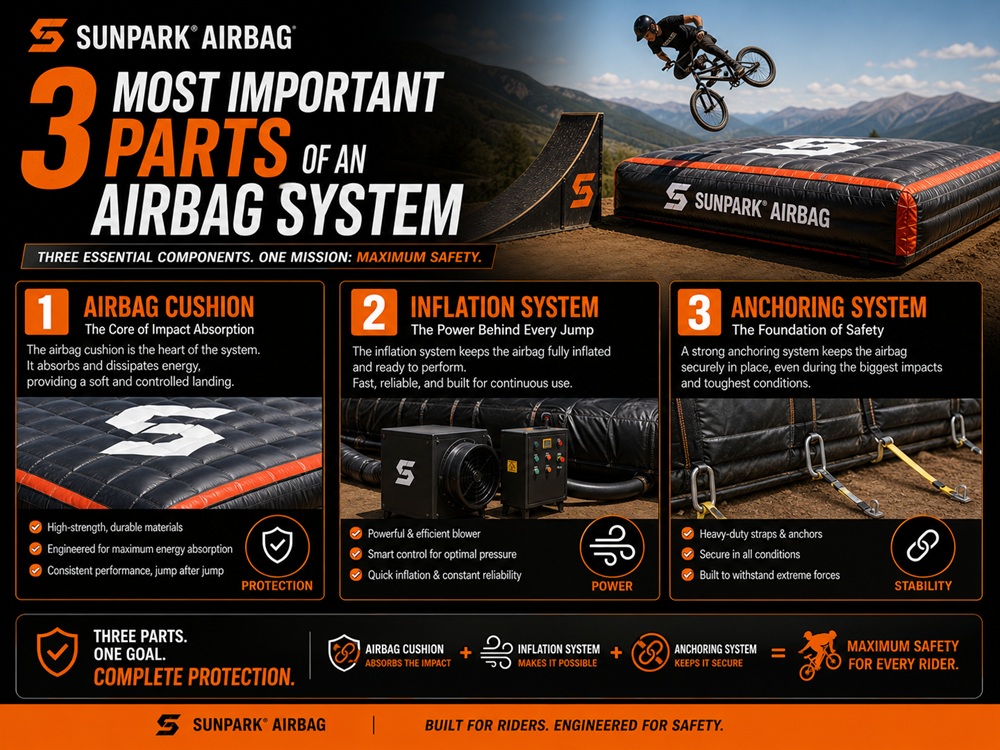
For outdoor action sports, ski resorts, and freestyle progression parks, inclined airbag landings represent the single most impactful safety upgrade of the modern era. In most professional situations involving high-altitude jumps (snowboard, freeski, mountain bike, and BMX), landing on a flat surface or into a soft foam pit creates severe trajectory problems. Flat landings cause violent vertical compression, while foam pits fail to simulate the actual physical sensation of riding out a landed trick.
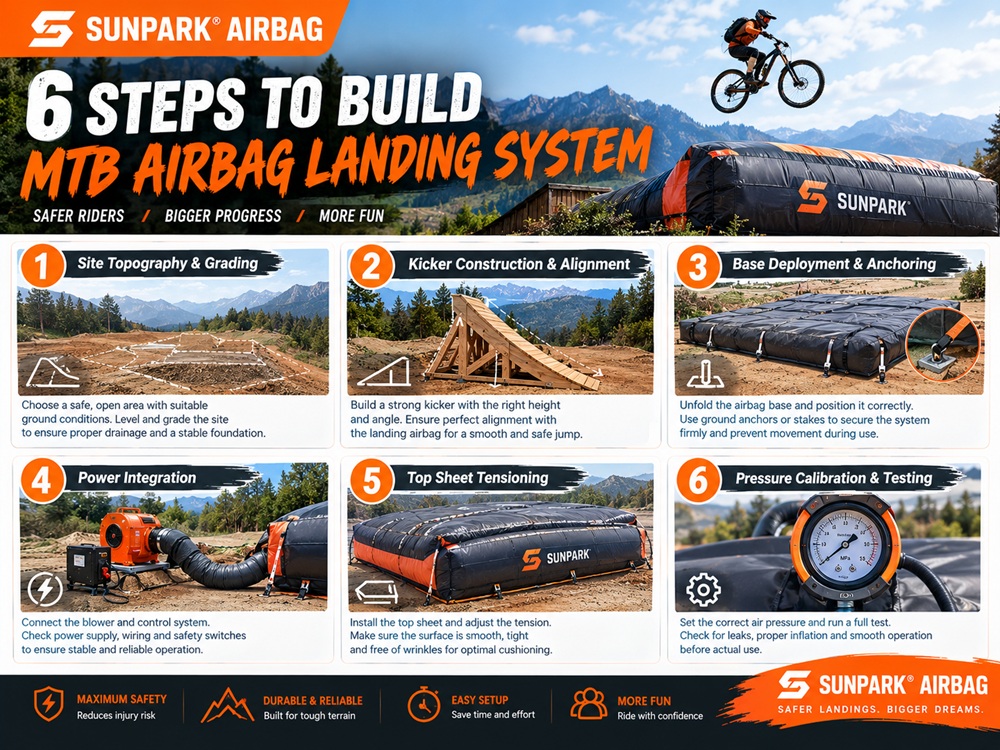
An advanced airbag landing ramp system solves this by mirroring the exact geometry of a real landing hill. Constructed with a top topsheet layer floating over an internal inflatable support structure, the airbag decelerates the rider smoothly if they crash, but allows them to ride away cleanly if they land on their wheels or boards.
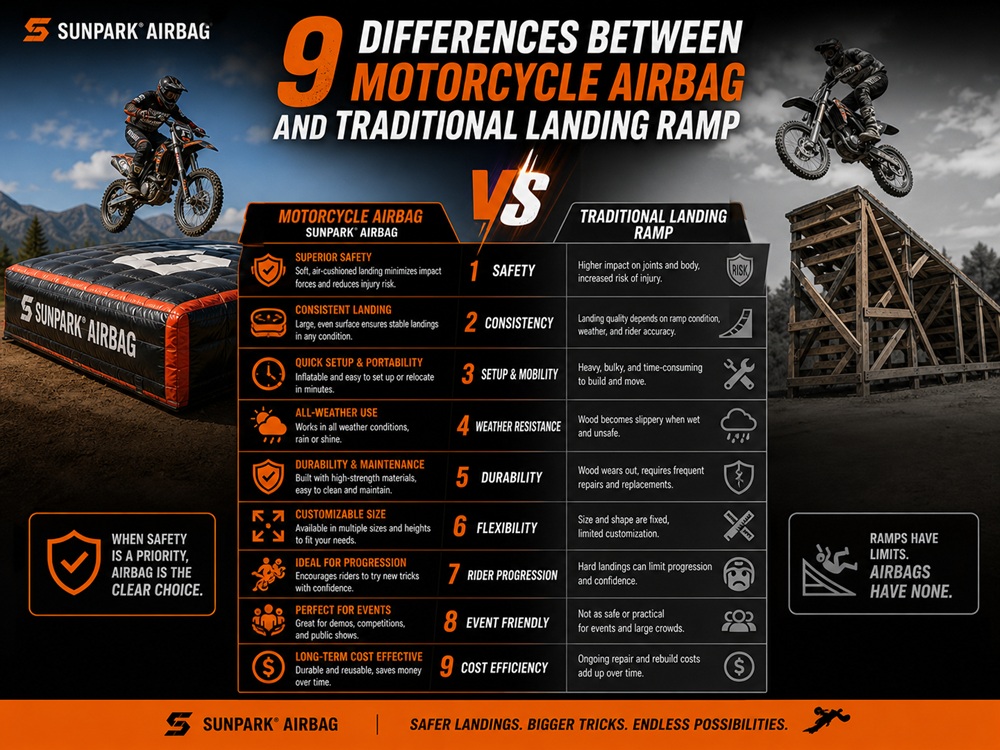
In our testing across global installation sites, replacing static dirt or wooden landing ramps with an MTB airbag landing system reduces catastrophic impact injuries by over 85%. Athletes can commit to double and triple flips knowing that an over-rotation or under-rotation results in a soft slide down a smooth topsheet rather than an emergency room visit. Resort operators running the best snowboard airbag parks report drastic drops in ski patrol dispatches and personal injury litigation.
2. Biomechanical Force Plates & Load Sensors
Not all injuries stem from violent, high-impact crashes. A massive percentage of athletic downtime comes from micro-trauma, muscular imbalances, and fatigue-induced structural failures like anterior cruciate ligament (ACL) tears. High-speed dual force plates and wearable inertial measurement units (IMUs) have become non-negotiable Training Equipment Investments for serious training facilities.
Force plates measure ground reaction forces in real time during jump tests and squat execution. By analyzing Rate of Force Development (RFD) and asymmetry between left and right limbs during landing phases, coaches can pinpoint functional deficits invisible to the naked eye. If an athlete exhibits a 12% asymmetry in braking force during a drop-jump test, their risk of a non-contact knee injury increases exponentially. Identifying this load imbalance allows trainers to adjust programming before the tissue ruptures.
3. Overhead Spotting Harness & Rigging Systems
In rotational aerial disciplines—such as artistic gymnastics, trampoline, diving, and stunt training—the vast majority of severe head, neck, and spinal injuries occur during the early learning stages of complex multi-axis twists. When an athlete loses spatial awareness mid-air, they hit the mat in unpredictable, dangerous positions.
Installing an engineered overhead spotting rig equipped with a twisting belt and low-friction pulley system completely eliminates high-risk impact during skill acquisition. The coach maintains manual or mechanical control over the athlete’s vertical position. The athlete can fail a quadruple twist fifty times in a single session without experiencing a single landing impact. Once the spatial mechanics are fully engrained in muscle memory, the athlete transitions safely to a soft landing zone like a landing airbag solution before taking the trick to a firm surface.
4. Variable-Resistance Pneumatic Strength Equipment
Traditional iron weight plates rely heavily on gravity and momentum. At the start of a movement (the sticking point), heavy iron places massive stress on connective tissue, tendons, and joints. As momentum builds throughout the range of motion, resistance actually decreases, under-stimulating the muscle at its strongest point while overloading it at its weakest, most vulnerable point.
Pneumatic strength equipment replaces physical weights with smooth compressed air cylinders. Because air has virtually zero mass, it eliminates inertia. Athletes can perform ultra-explosive movements at maximum velocity without experiencing the joint-jarring shock spikes associated with stopping or starting heavy iron. For athletes rehabilitating from joint surgery or powerlifters seeking high-velocity power output without tendonitis, pneumatic machinery is vastly superior to free weights.
5. Surface-Vented Gym Airbag Modules
For indoor training centers, gymnastics facilities, and action park operators, traditional foam block pits are rapidly becoming a operational liability. Open-cell polyurethane foam blocks degrade rapidly under daily compression, generating toxic chemical dust that ruins air filtration systems and causes respiratory distress among athletes. Furthermore, foam blocks trap moisture, skin oils, and bacteria, creating severe hygiene hazards.
Upgrading to a modular gym airbag for training eliminates these operational vulnerabilities. Modern gym airbags utilize internal baffling systems and adjustable air-release valves that allow operators to customize firmness based on athlete weight and drop height. When an athlete lands in an inflatable jump airbag, the air evacuates instantly to absorb the fall, then refills within seconds via continuous blowers. This allows for immediate reset times and zero athlete collisions caused by people getting stuck under heavy foam blocks.
From our experience: “Facility operators often hesitate at the upfront cost of dynamic safety equipment. What they fail to calculate is that a single severe injury lawsuit or a 30% spike in annual liability insurance typically costs double the price of a commercial-grade airbag system. Safety technology is not an expense; it is asset protection.”
Pros vs. Cons: Modern Safety Systems vs. Legacy Gear
| Equipment Strategy | Pros (Benefits) | Cons (Limitations) |
|---|---|---|
| Modern Safety Equipment (Airbags, Force Sensors, Pneumatics) |
|
|
| Legacy Safety Gear (Foam Pits, Dirt Ramps, Static Mats) |
|
|
Comparative Analysis Table
| Injury Reduction Tech | Deceleration Profile | Maintenance Burden | Lifespan Expectancy | Primary Failure Mode if Unmaintained |
|---|---|---|---|---|
| Sloped Airbag Landings | Dynamic / Progressive Air Venting | Low (Daily pressure check) | 5 – 10+ Years | Fabric tears / Air pressure loss |
| Foam Block Pits | Passive / Unpredictable Friction | High (Weekly fluffing & cleaning) | 2 – 3 Years | Foam hardening & pulverization |
| Pneumatic Strength Gear | Continuous Equal Air Pressure | Very Low (Pneumatic seal checks) | 8 – 12 Years | Air valve leakage |
| Rigid Impact Pads | Immediate / High Peak Force | Minimal (Surface wiping) | 3 – 5 Years | Core foam bottoming out |
Who Should Invest vs. Who Does Not Need It
Making smart commercial decisions requires aligning your equipment purchases with your operational scale and athlete profile.
Who Should Invest:
- Commercial Action Sports Parks & Ski Resorts: Facilities offering freestyle progression jumps for snowboarders, skiers, or bike riders must utilize inclined airbags. The risk profile of hard-surface jump progression is commercially unsustainable without soft-landing infrastructure. When budgeting, factor these safety assets directly into your broader site development plans alongside your trampoline park construction cost estimates.
- Elite Gymnastics & Acrobatics Academies: High-traffic training facilities running dozens of athletes through rotational flips daily need overhead spotting harnesses and high-reset gym airbags to maximize safety and athlete throughput.
- Professional Sports Rehabilitation Centers: Facilities catering to multi-million-dollar athletic contracts must utilize force plates and pneumatic machines to guarantee objective, zero-impact biomechanical rehabilitation.
Who Does Not Need It:
- Casual Home Gym Enthusiasts: For general health and fitness, advanced pneumatic machines and multi-thousand-dollar force plates are unnecessary. Traditional free weights paired with proper technique offer complete efficacy.
- Low-Velocity Recreation Centers: Facilities that focus exclusively on entry-level fitness or low-impact sports do not require heavy capital allocation toward high-velocity impact attenuation systems like freestyle airbags or halfpipe modules such as a specialized Halfpipe Airbag.
Common Purchasing Mistakes Facilities Make
In our technical consultations with park developers and gym owners, we frequently observe critical errors during the procurement phase of injury-prevention equipment:
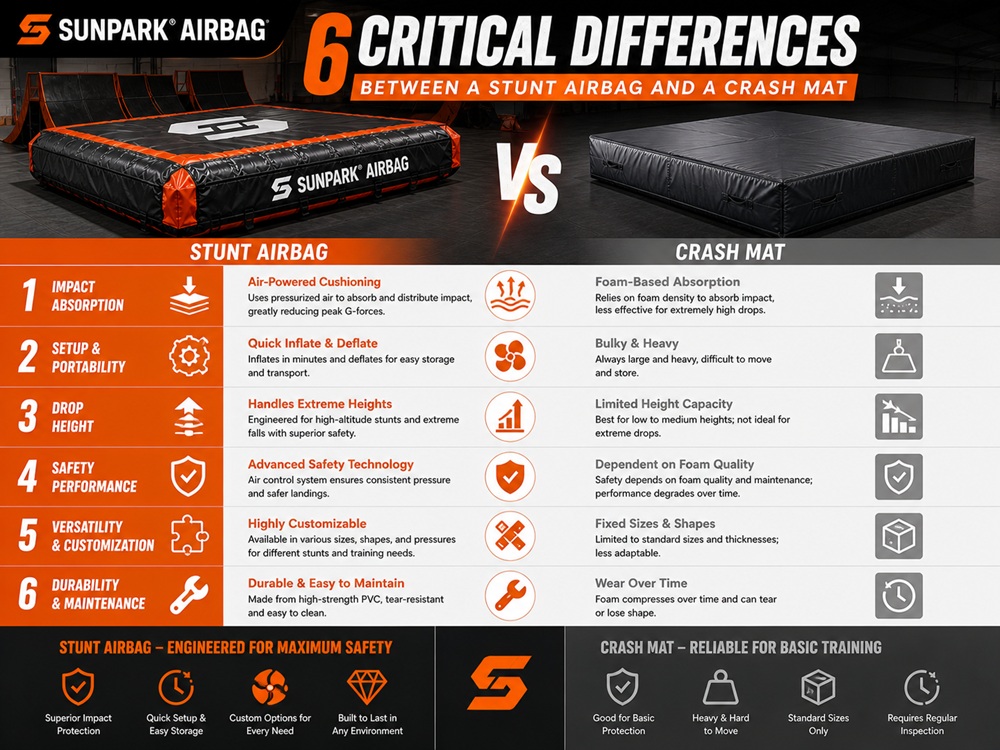
1. Buying Flat Airbags for Inclined High-Speed Jumps: Installing a flat stunt airbag at the bottom of a high-speed bike or ski jump is a dangerous mistake. Flat airbags cause severe horizontal deceleration, throwing the athlete forward into their handlebars or equipment. You must use a dedicated, slope-matched inclined airbag landing that allows the athlete to slide down the ramp safely upon impact.
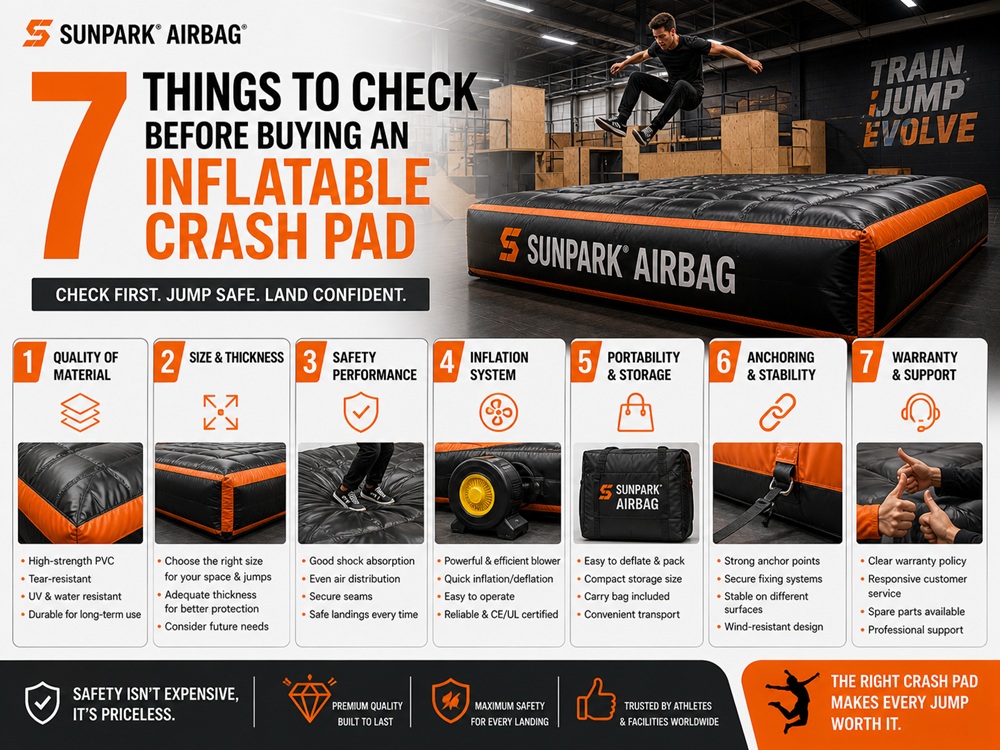
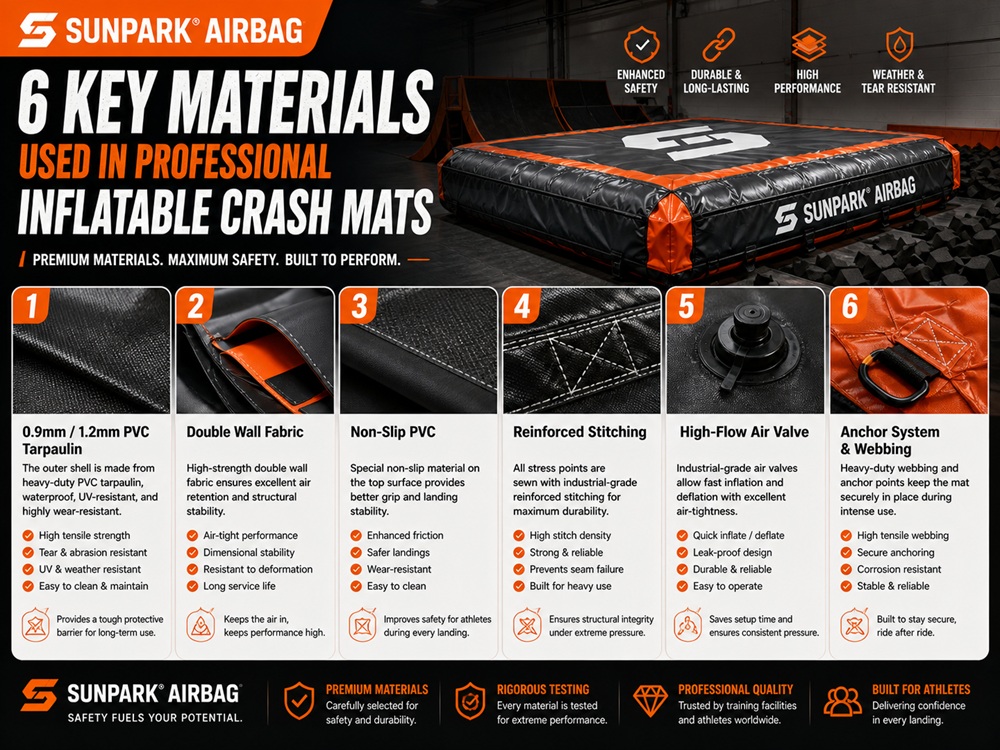
2. Sacrificing Fabric Quality to Save CapEx: Cheap airbag copies often use low-grade PVC tarpaulin that lacks UV stability, tear resistance, or proper flame retardancy. Under heavy commercial use, weak seams tear, resulting in catastrophic pressure drops when an athlete lands. Demand heavy-duty 0.9mm PVC or high-grade TPU materials with certified tensile strength.
3. Ignoring Air Displacement Engineering: An airbag is not just a sealed bouncy house. It is a precise pneumatic system. If an airbag lacks properly sized air-release vents or secondary safety chambers, it will act like a hard trampoline, catapulting the athlete back into the air or causing them to bottom out onto the sub-structure.
Buying Guide & Specifying Criteria Table
| Evaluation Criteria | Minimum Professional Standard | Why It Matters for Injury Reduction |
|---|---|---|
| Material Specification | 0.9mm PVC / 0.55mm TPU (Tear Strength > 3000N/5cm) | Prevents punctures from bike pedals, ski edges, and continuous friction. |
| Safety Chamber System | Dual-Chamber Architecture (Upper soft / Lower firm) | Ensures the athlete never bottoms out onto the ground, even in severe falls. |
| Fire & Safety Certifications | EN 14960 / ASTM F2375 / NFPA 701 Compliant | Mandatory for commercial insurance compliance and municipal fire codes. |
| Blower & Air Systems | Continuous-Duty CE/UL Certified Blowers with Backup Power | Guarantees stable air pressure during peak operational hours. |
| Top Sheet Friction Co-efficient | Ultra-Smooth, Anti-Friction Treated Vinyl/TPU | Prevents friction burns and allows smooth sliding during off-axis landings. |
Expert Recommendation from SUNPARK® AIRBAG
If you are managing a commercial sports facility, freestyle park, or training academy in 2026, the era of relying on luck and static foam pads is officially over. We recommend prioritizing your capital expenditure based on impact velocity.
For any facility catering to high-velocity sports (MTB, BMX, Ski, Snowboard, Motocross), your very first investment must be an inclined airbag landing ramp system. It completely transforms your venue’s safety profile, allowing riders to push their limits with near-zero risk of acute traumatic injury. For indoor gymnastics and trampoline centers, replacing outdated foam pits with a customized gym airbag for training solves both your injury liabilities and your ongoing maintenance headaches in one move.
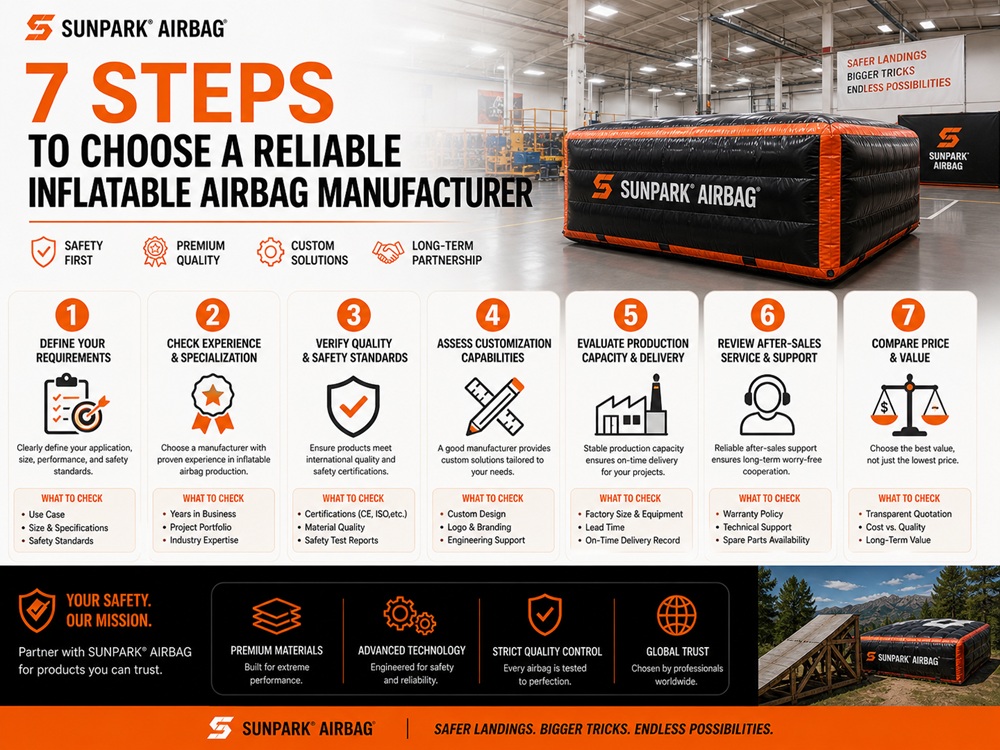
At SUNPARK® AIRBAG, with over a decade of dedicated engineering in extreme sports protection, we build custom freestyle airbags and landing solutions that meet the highest international safety standards. Invest in proven impact technology today—protect your athletes, safeguard your business, and elevate your facility’s reputation.
Frequently Asked Questions
Inclined airbag landing systems absorb impact gradually along a sloped trajectory matching the athlete’s downward angle, eliminating the sudden vertical deceleration and compression injuries common in foam pits. Airbags also eliminate dust inhalation, hygiene risks, and constant foam block breakdown.
Commercial sports facilities typically realize ROI through reduced insurance premiums, lowered liability claims, higher athlete retention, and accelerated training throughput. Facilities using modern airbag landings often recoup initial capital expenditures within 12 to 24 months.
Pneumatic equipment replaces heavy iron weights with compressed air, removing inertia from the movement. This prevents joint overload at the sticking point and reduces shock on tendons and ligaments during high-velocity eccentric movements.
Authoritative References
To support our engineering and biomechanical analysis, we reference industry standards and clinical safety guidelines established by leading international authorities:
- ASTM International – Standard Practice for Inflatable Amusement Devices (ASTM F2375): Setting global engineering criteria for dynamic impact absorption and structural integrity in sports inflatables.
- National Center for Biotechnology Information (NCBI) – Biomechanics of Impact and Traumatic Injury Prevention in Extreme Sports: Peer-reviewed clinical research analyzing peak g-force reduction during controlled air displacement landings.
- International Organization for Standardization (ISO) – ISO 20957 Safety Requirements for Stationary Training Equipment: International manufacturing and load-testing benchmarks for commercial gym and training hardware.