The landscape of extreme sports has evolved aggressively. A decade ago, learning a double backflip meant launching into a treacherous, bacteria-infested foam pit and hoping you didn’t land on a hidden bike peg. Today, the standards for progression have shifted. If you are operating an extreme sports park, training facility, or even a backyard compound, utilizing outdated safety methods is no longer just a physical risk—it is commercial negligence. The correct selection of BMX training equipments dictates not only how fast a rider learns, but whether they walk away from a crash.
From our experience at SunparkAirbag, we have seen facilities drastically reduce their insurance liabilities and riders exponentially accelerate their trick progression simply by upgrading their safety infrastructure. In this comprehensive guide, we tear down the industry myths and provide an unfiltered, practitioner-level analysis of the top 6 BMX training equipments you absolutely need for safety’s sake. We will explain commercial buying considerations, biomechanical benefits, and exactly why legacy foam setups are dead.
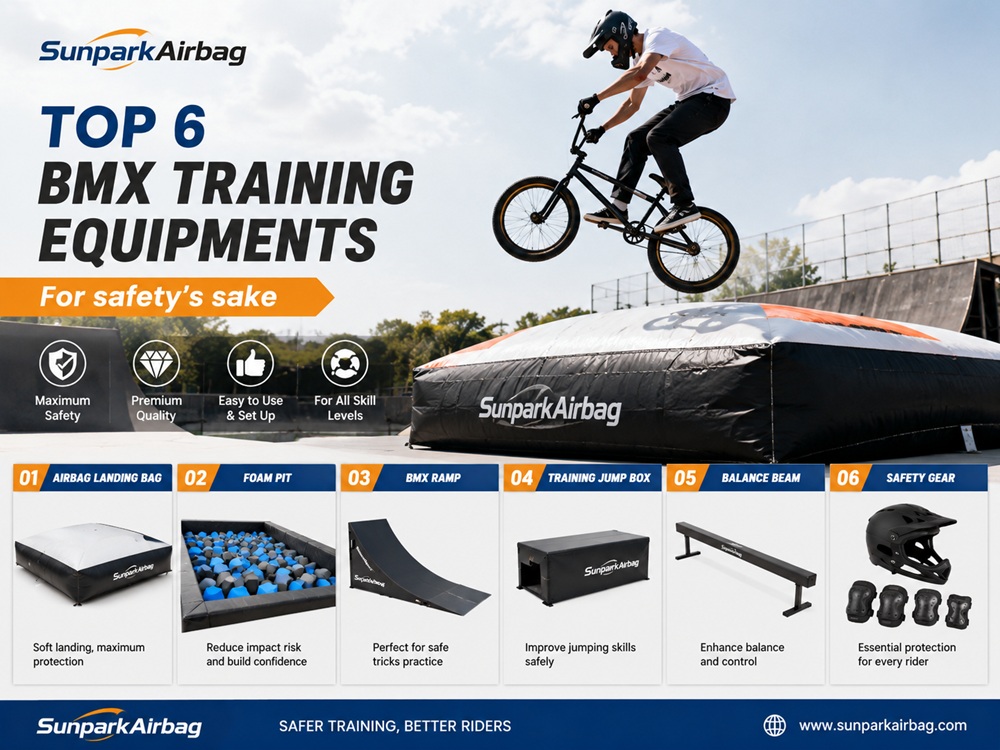
Quick Answer
The top 6 BMX training equipments for maximum safety and progression are: 1) Inflatable BMX Jump Airbags, 2) MIPS-Equipped Full Face Helmets, 3) D3O Impact-Reactive Pads, 4) Inflatable Crash Mats, 5) Rigid Ankle Braces, and 6) Resi-Ramps. In most professional situations, we recommend prioritizing an airbag landing system over traditional foam pits. Airbags displace kinetic energy dynamically, prevent riders from becoming entangled with their bikes upon impact, and eliminate the severe hygiene and fire risks associated with foam blocks. If you are a commercial park owner or a serious athlete, upgrading to a specialized bike airbag landing is the single highest-ROI safety investment you can make in 2026.
Table of Contents
- What Are BMX Training Equipments?
- How Modern BMX Safety Gear Works
- The Top 6 BMX Training Equipments You Need
- Benefits of Premium BMX Training Equipments
- Limitations and What Gear Cannot Fix
- Who Should Use It vs. Who Does Not Need It
- Common Mistakes When Buying BMX Training Equipments
- Commercial Buying Considerations
- Expert Recommendation
- Essential Comparison Tables
- The Bottom Line
- Frequently Asked Questions (FAQs)
What Are BMX Training Equipments?
In the context of extreme sports, BMX training equipments encompass the entire ecosystem of gear and infrastructure designed to mitigate blunt force trauma, rotational impacts, and abrasive injuries during trick progression. This category extends far beyond a simple helmet. It includes the landing infrastructure (airbags, crash mats), wearable impact-reactive polymers, and structural joint supports.
Historically, training equipment was rudimentary. Today, it is highly engineered. Commercial facilities are shifting heavily toward pneumatic (air-based) catch systems. Reviewing a detailed foam pit vs airbag comparison clearly shows that modern BMX training equipments focus on predictable energy displacement rather than chaotic foam compression.
How Modern BMX Safety Gear Works
To understand why specific gear is necessary, you must understand the biomechanics of a crash. When a rider bails on a 15-foot quarter pipe, they carry immense kinetic energy. The goal of top-tier BMX training equipments is to stretch the duration of that impact over a longer period of milliseconds, effectively lowering the peak G-force exerted on the human skeleton and brain.
For example, modern landing airbags utilize a dual-chamber pneumatic system. The upper chamber acts as a soft “catch zone” that yields to the rider’s weight, while the lower “safety zone” maintains high air pressure to ensure the rider never bottoms out against the hard ground. Similarly, wearable technology like D3O padding remains flexible during normal riding but locks its molecular structure instantly upon impact, distributing the localized force across the entire pad.
The Top 6 BMX Training Equipments You Need
1. Inflatable BMX Jump Airbags
This is the cornerstone of modern trick progression. Foam pits are a biohazard and a fire risk; they are entirely obsolete for serious commercial applications. If you want riders to safely attempt multi-rotation tricks, you need an engineered airbag. Our premier solution at SunparkAirbag is the industry standard for safe landings.
SunparkAirbag BMX Jump Airbag
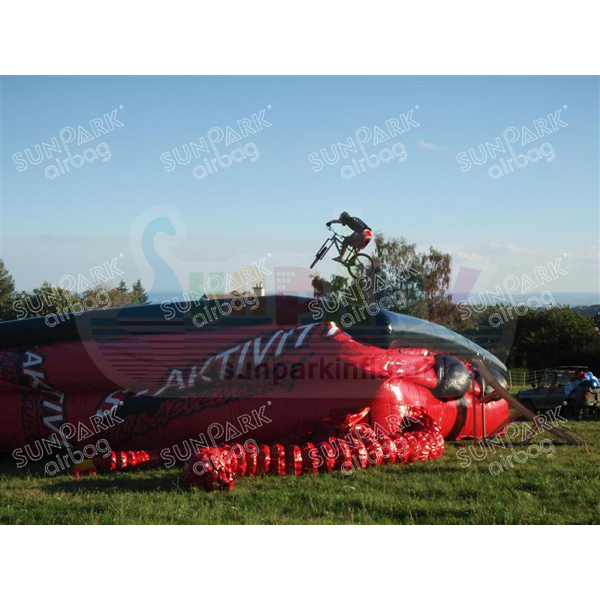
Engineered for relentless commercial use, this airbag features a proprietary dual-chamber design that allows for incredibly soft landings without the risk of bottoming out. The top sheet is highly durable, designed to withstand the sharp impact of bike pedals, pegs, and chainrings.
| Material | 0.55mm PVC Tarpaulin for airbag, 0.9mm PVC Tarpaulin for top sheet (Water-proof, flame-retardant, UV-protected, lead and phthalate free) |
|---|---|
| Size | 15x10x3.5m (Regular sizes: 10x10x3m, 15x15x3m or fully customized) |
| Printing | Digital, Silk-screen or UV Printing |
| Package / Accessories | Blower, repair kit, heavy-duty carrying bag. Blowers packed in strong boxes. |
| Production Time | Approx. 10 working days |
2. MIPS-Equipped Full Face Helmets
A standard EPS foam helmet is no longer sufficient. The absolute minimum standard for BMX training equipments now dictates Multi-Directional Impact Protection Systems (MIPS). MIPS uses a slip-plane technology inside the helmet to reduce rotational forces transferred to the brain during angled impacts, which are incredibly common in BMX bails.
3. D3O Impact-Reactive Pads
Heavy, rigid plastic knee pads restrict movement and alter pedaling biomechanics. The integration of D3O (a non-Newtonian fluid polymer) into knee and elbow guards allows riders to wear ultra-slim, flexible pads under their pants. Upon impact, the material instantly hardens, absorbing the shock before returning to a flexible state.
4. Inflatable Crash Mats
For flatland progression, rail hops, or indoor park setups, a full-scale jump airbag might be overkill. In these scenarios, an inflatable crash mat is critical. These high-pressure, drop-stitch mats provide a firm but forgiving surface that saves ankles and wrists from concrete impacts during technical street trick training.
5. Rigid Low-Profile Ankle Braces
Tailwhips and crank flips result in violent pedal strikes to the malleolus (ankle bone) and severe inversion sprains. A rigid, lace-up ankle brace with plastic lateral inserts fits inside a standard skate shoe and acts as a mechanical stop to prevent rolling the ankle during an awkward landing.
6. Resi-Ramps
A resi-ramp is a hybrid training tool consisting of layers of foam covered by a heavy-duty, slick plastic top sheet. It bridges the gap between landing into an airbag and landing on hard wood or concrete. Riders can ride out of their landings on a resi, making it the final step in progression before taking a trick to a real ramp.
Benefits of Premium BMX Training Equipments
Investing in the highest tier of BMX training equipments yields massive dividends. For the athlete, it completely removes the psychological barrier of fear. When a rider knows a stunt airbag landing is waiting for them, they commit fully to the rotation rather than bailing mid-air, which paradoxically makes the trick safer.
For commercial operators, the benefits are purely financial. Upgrading from foam to air drastically reduces insurance premiums, eliminates the massive recurring cost of replacing shredded foam blocks, and draws elite riders to your facility. For a deep dive into top commercial options, review the best airbag landing systems 2026.
Limitations and What Gear Cannot Fix
Even the best BMX training equipments cannot replace fundamental bike control. A massive limitation we see is “airbag heroes”—riders who learn double flips into an airbag but lack the basic transition skills to pump a quarter pipe. Airbags forgive poor landing angles; wooden ramps do not.
Additionally, large inflatable systems have environmental limitations. High-wind outdoor environments require heavy anchoring systems. If winds exceed safe operational limits, even a premium FMX airbag landing must be deflated to prevent accidents.
Who Should Use It vs. Who Does Not Need It
For commercial users and park operators: If you run a high-volume extreme sports park, investing in premium airbags and mandatory MIPS helmet rules is absolutely non-negotiable. You are liable for the infrastructure you provide.
For heavy-duty applications: Professional action sports tours (like Nitro Circus) require custom-sized, heavily reinforced airbags designed to take the impact of 250lb dirt bikes. For these scenarios, always consult a manufacturer directly rather than buying off-the-shelf.
Who does not need it: Casual commuters or pump-track beginners do not need to invest thousands of dollars in an inflatable landing system. A solid helmet and basic knee pads are sufficient for low-impact, ground-level riding.
Common Mistakes When Buying BMX Training Equipments
The most catastrophic mistake facility owners make is purchasing cheap, unbranded airbags made with thin 0.40mm PVC. A BMX bike has sharp metal pedals, axle pegs, and chainrings. A thin airbag will tear within weeks. You must insist on a 0.9mm top sheet.
Another severe mistake is buying second-hand safety gear without inspection. A helmet that has taken a hard hit is structurally compromised, even if it looks fine. Similarly, if you are looking to save money on park infrastructure, you must thoroughly vet the equipment. We strongly advise reading buy used airbag landing tips before purchasing a second-hand inflatable.
Commercial Buying Considerations
When selecting BMX training equipments for a facility, prioritize customizability and material certification. Is the PVC lead and phthalate-free? Does the manufacturer offer UV-protected tarpaulin for outdoor setups? Does the equipment come with heavy-duty blowers and a reliable repair kit? We also recommend checking if the manufacturer has a proven track record, akin to the top trampoline park equipment manufacturers, ensuring they understand high-traffic commercial abuse.
Expert Recommendation
From our experience, if you are forced to allocate a limited budget, put 80% of your capital into your landing infrastructure. We recommend the SunparkAirbag BMX Jump Airbag because it addresses the core issue of extreme sports: gravity. You can wear the best pads in the world, but falling 20 feet onto concrete will break bones. An engineered, dual-chamber airbag practically eliminates blunt force trauma to the spine and skull during training, allowing riders to walk away from catastrophic bails.
Essential Comparison Tables
| Equipment Type | Primary Function | Priority Level |
|---|---|---|
| Inflatable Airbag Landing | High-altitude impact absorption for major trick progression. | Critical / Essential |
| MIPS Helmet | Reduces rotational brain injury during crashes. | Non-Negotiable |
| D3O Pads | Joint protection without sacrificing mobility. | Highly Recommended |
| Resi-Ramp | Transitioning tricks from airbag to hard wood. | Recommended for Advanced Riders |
| Feature | Inflatable Airbags | Traditional Foam Pits |
|---|---|---|
| Impact Dispersion | Predictable, smooth yielding. Rider does not sink deep. | Unpredictable. Rider can hit the bottom if foam is degraded. |
| Hygiene & Maintenance | Easy to wipe down. No dust. Low maintenance. | Biohazard. Collects sweat, blood, and highly flammable foam dust. |
| Exit Time | Rider rides/walks off instantly. High throughput. | Takes minutes to crawl out. Slows down park operations. |
| Bike Entanglement | Low risk. Bike bounces away from the rider. | High risk. Bike and rider fall into the same hole, causing impalement risks. |
The Bottom Line
You cannot cheat physics, but you can engineer a safer way to crash. The modern standard for BMX training equipments dictates a proactive approach to safety. Discard the uncertified helmets, bulldoze the rotting foam pits, and invest in technology that actually protects human physiology. By outfitting your riders and facilities with MIPS helmets, impact-reactive armor, and heavy-duty inflatable landing systems, you guarantee a training environment where progression thrives and catastrophic injuries plummet. Do not compromise on materials—insist on commercial-grade, UV-protected, 0.9mm PVC airbag systems to secure both your athletes and your liability.
Frequently Asked Questions (FAQs)
Why is a foam pit considered dangerous compared to an airbag?
Foam pits break down rapidly over time. As foam degrades, it loses its ability to absorb impact, allowing riders to crash through to the hard floor below. Furthermore, foam blocks trap the rider and the bike in the same hole, frequently leading to injuries where the rider lands directly on their own handlebars or pedals. Airbags provide a firm surface tension that causes the bike to bounce away from the rider.
What does MIPS mean on a BMX helmet?
MIPS stands for Multi-Directional Impact Protection System. It is a low-friction layer integrated into the helmet designed to reduce rotational motion transferred to the brain from angled impacts to the head. It is a critical piece of modern BMX training equipments.
How thick should the material on a BMX airbag be?
For commercial use, the main body of the airbag should be constructed from at least 0.55mm PVC tarpaulin. However, the top sheet—which takes the direct, abrasive hits from tires and pedals—must be a minimum of 0.9mm heavy-duty PVC to prevent punctures.
Can I leave an inflatable BMX airbag outside year-round?
Yes, provided it is manufactured correctly. Premium airbags use UV-protected, water-proof, and flame-retardant materials. However, proper anchoring is required to prevent wind damage, and blowers must be protected from direct water exposure during heavy storms.
Authoritative Industry References
- U.S. Consumer Product Safety Commission (CPSC): Federal safety standards and testing protocols for bicycle helmets. CPSC Bicycle Safety Standards
- Virginia Tech Helmet Ratings: Independent, rigorous biomechanical testing and rating of modern action sports and bicycle helmets, including MIPS efficacy. Virginia Tech Biomechanics Research
- USA BMX (The Sanctioning Body of BMX): Official rulebook detailing mandatory safety apparel, helmet certifications, and track safety infrastructure for sanctioned racing and training. USA BMX Gear Regulations