Choosing an airbag landing pad is not simply a matter of finding the largest inflatable landing surface or the lowest equipment price. The right system must match the sport, jump height, rider speed, landing trajectory, available space, and frequency of use. A pad designed for beginner gymnastics practice is not automatically suitable for mountain biking, freestyle skiing, snowboarding, or FMX training.
From our experience in sports airbag systems, the most expensive mistake is buying equipment around a product photograph rather than the actual landing scenario. A landing pad that is too small, poorly matched to the approach, difficult to maintain, or unsuitable for the rider’s progression level can create operational problems and undermine the purpose of the investment.
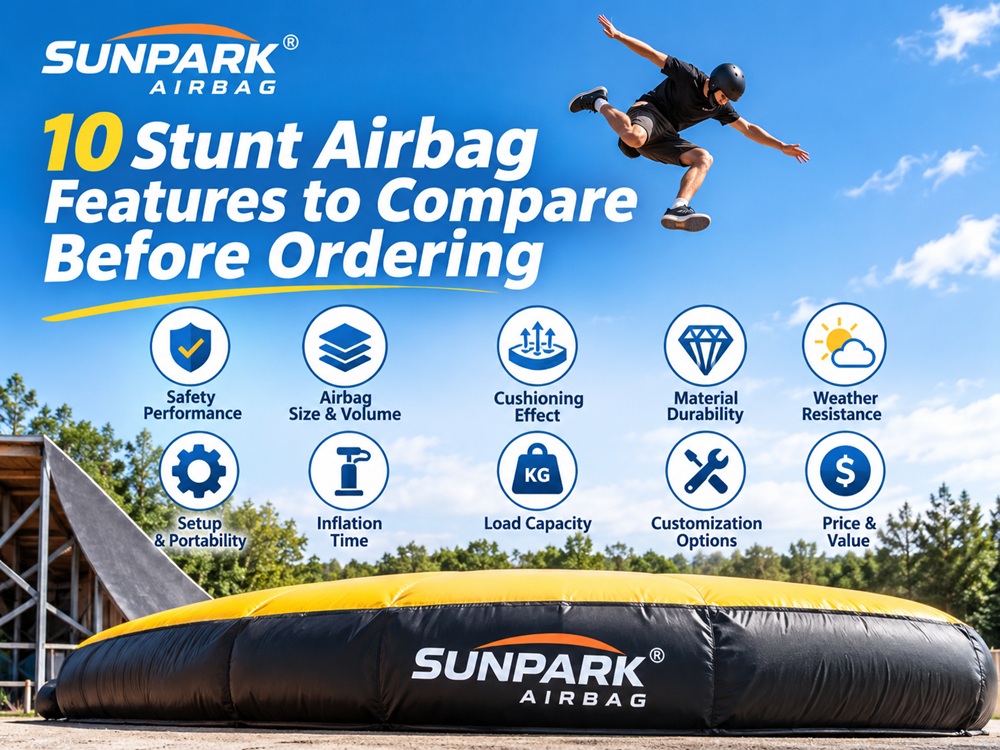
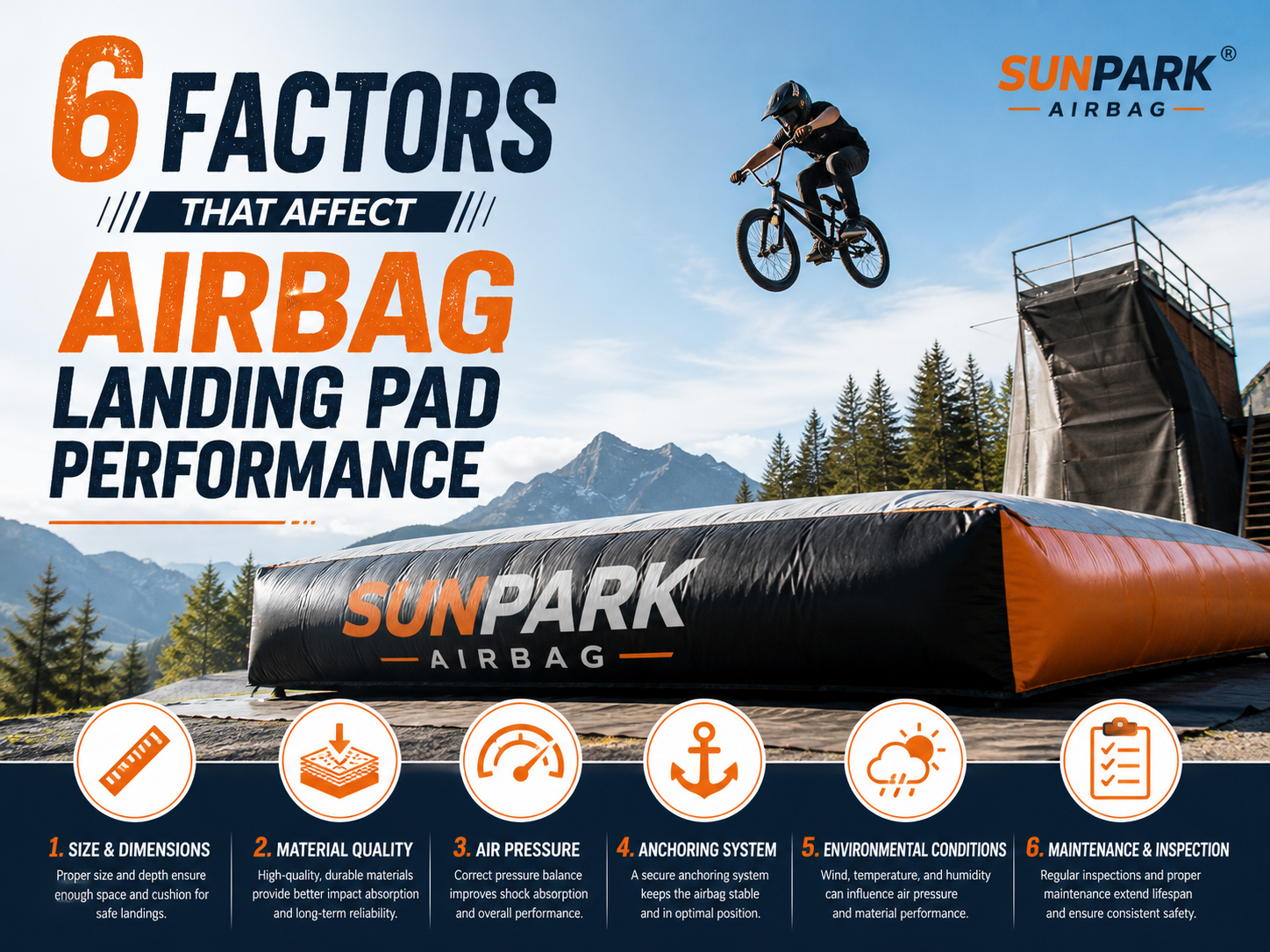
This guide explains the 10 most important considerations when choosing an airbag landing pad, including safety design, dimensions, inflation systems, materials, installation, maintenance, and supplier support. It is written for sports facility owners, ski resorts, bike parks, trampoline parks, training centers, and individual operators planning a serious airbag installation.
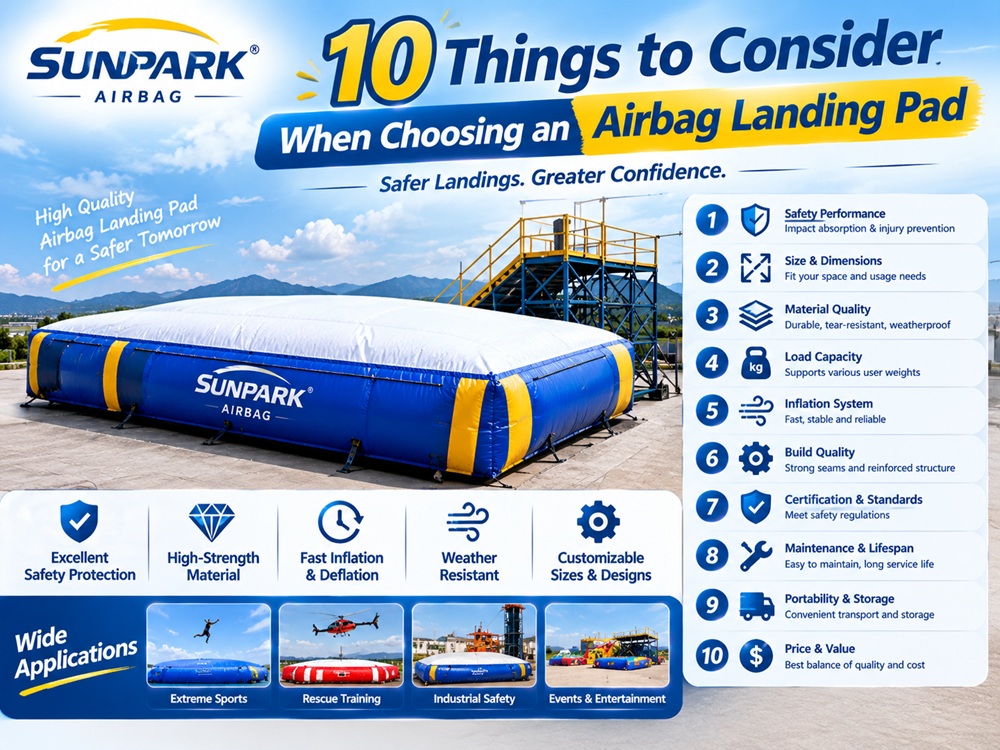
Quick Answer: What Should You Look for in an Airbag Landing Pad?
- Sport compatibility: Choose a system specifically engineered for your activity, such as MTB, skiing, snowboarding, gymnastics, or FMX.
- Landing dimensions: Match the landing area to the jump height, speed, trajectory, and rider skill level.
- Impact management: Evaluate the airbag’s internal structure, pressure behavior, landing depth, and recovery characteristics.
- Inflation system: Check blower capacity, airflow design, backup arrangements, and operating requirements.
- Material durability: Review fabric strength, seams, abrasion resistance, UV exposure, and weather suitability.
- Installation and anchoring: Confirm site preparation, access, drainage, anchoring, and operating clearances.
- Maintenance and support: Consider inspection procedures, repair options, spare parts, and manufacturer assistance.
Our recommendation: Select the landing system based on a documented site and sport assessment, not just size or price. Ask the manufacturer to explain the intended use, operating limits, installation requirements, inspection schedule, and rider progression plan before placing an order.
How to Choose an Airbag Landing Pad: Start With the Landing Scenario
Before comparing models, define what the airbag will actually be used for. A landing pad for a mountain bike jump has different design demands from a gymnastics airbag or a snowboard freestyle landing system. Rider speed, takeoff geometry, landing angle, equipment weight, and the possibility of off-center landings all affect the required design.
We recommend preparing a basic project brief with the following information:
- Sport and intended maneuvers.
- Jump height, takeoff geometry, and expected landing trajectory.
- Typical approach speed and rider or athlete profile.
- Expected daily users and operating hours.
- Indoor or outdoor installation environment.
- Available footprint, access route, and ground conditions.
- Whether the installation is permanent, seasonal, or mobile.
Give this information to the manufacturer before requesting a quotation. If a supplier recommends a product without asking about the sport, geometry, and installation conditions, the recommendation is not sufficiently developed for a commercial purchase.
What Is an Airbag Landing Pad and How Does It Work?
An airbag landing pad is an inflatable sports landing system designed to provide a deformable landing surface for athletes practicing jumps, tricks, and aerial maneuvers. It is used in activities such as freestyle skiing, snowboarding, mountain biking, BMX, FMX, gymnastics, and selected leisure attractions.
Unlike a rigid landing platform, an airbag uses an engineered inflatable structure to deform under impact. Depending on its design, air moves through internal chambers, vents, or other airflow features as the athlete lands. The system is intended to manage impact and provide a more forgiving practice environment than many hard landing surfaces.
How an airbag landing system works
A typical system includes an inflatable body, internal structural or airflow components, an inflation unit, connection points, and anchoring or installation accessories. The blower supplies air to maintain the system’s operating condition. When an athlete lands, the airbag deforms and manages air displacement according to its design.
Different sports airbags use different configurations. A freestyle landing airbag may have a shaped landing profile, while a gymnastics airbag may be designed for repeated training activities and a more controlled indoor environment. A mountain bike landing system must account for approach speed, bike and rider trajectory, landing angle, and the consequences of an off-center landing.
1. Choose the Right Airbag Landing Pad for Your Sport
This is the first decision and the one we would never compromise. Airbag landing pads are not universal products. The geometry and construction suitable for one activity may not provide the right landing behavior for another.
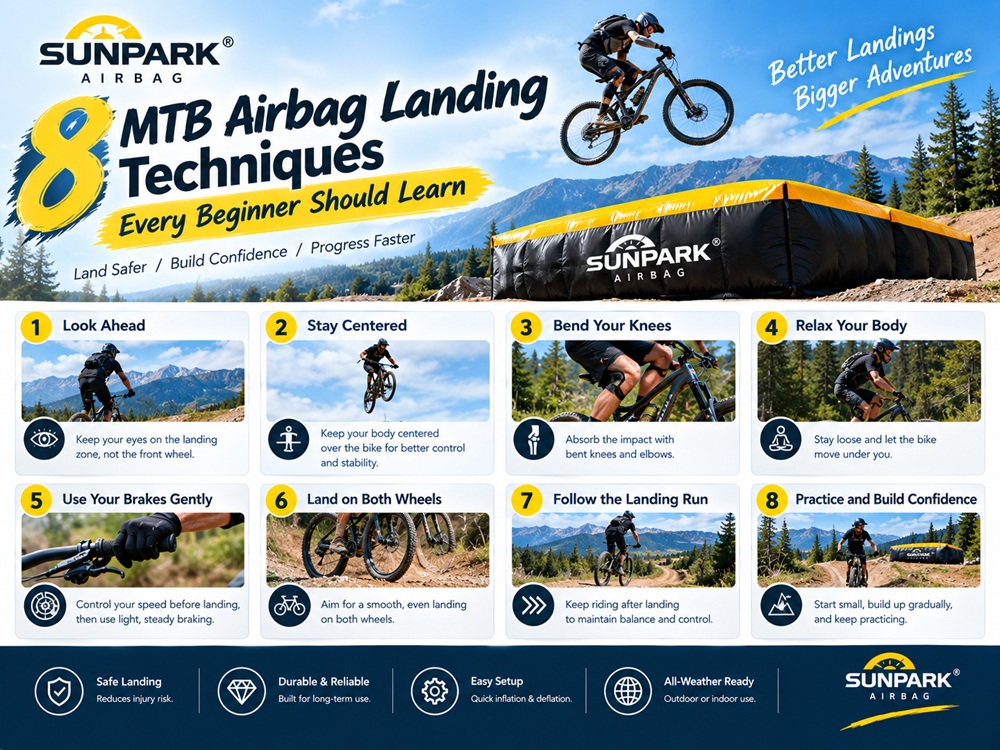
Mountain biking and BMX
Mountain bike and BMX landing systems must account for the rider’s speed, bike dimensions, jump trajectory, and landing position. The landing area should be selected around the actual jump design, including the expected range of rider movement and the consequences of landing short, long, or off-center.
For a bike park or training facility, consider a dedicated MTB airbag landing system rather than assuming a general inflatable mat will provide the right geometry. Our mountain bike airbag landing guide provides further context on selecting a setup for this sport.
Skiing and snowboarding
Freestyle ski and snowboard airbags need to match the approach, takeoff, expected aerial movement, and landing slope. A system used at a ski resort may also face seasonal weather, outdoor installation, snow management, and higher daily operating demands.
For these applications, explore a dedicated halfpipe airbag or a sport-specific freestyle landing system. The design should be assessed against the resort’s terrain and the level of athletes using it.
Gymnastics and trampoline training
Gymnastics and trampoline facilities often need a different configuration from outdoor action-sports landing systems. Consider training frequency, indoor space, athlete age and ability, access for instructors, and the specific movements being practiced. A gym airbag for training may be a better starting point for this environment.
FMX and motorcycle stunt training
FMX applications involve substantial speed, motorcycle mass, and specialized jump geometry. These systems require a carefully engineered setup, professional installation planning, and a formal operating procedure. Do not select an FMX landing airbag by comparing its dimensions with a smaller recreational product.
See our information on an FMX landing airbag when planning a dedicated motorcycle stunt training facility.
2. Check Landing Dimensions and Coverage
Size is one of the most visible specifications, but it is not enough to compare length, width, and height in isolation. The landing area must suit the actual jump trajectory and provide appropriate coverage for the expected landing zone.
Evaluate the complete landing area
Consider the approach speed, takeoff point, jump distance, landing angle, and likely range of athlete movement. The required dimensions should be determined with the jump designer, facility operator, and airbag manufacturer. A larger surface may provide more coverage, but it does not automatically correct poor jump geometry or an unsuitable landing profile.
Account for skill progression
Beginner training and advanced freestyle practice may require different operating configurations. A facility should consider how athletes will progress, what maneuvers are permitted, and whether the landing system can accommodate the planned progression without changing its approved use.
Plan for the area around the airbag
The installation footprint should include more than the inflatable body. Allow space for approach and takeoff structures, access for staff, blower equipment, anchoring, inspection, and safe movement around the system. Also consider emergency access and the route for moving or replacing equipment.
For a facility researching locations and operating environments, our airbag jump locations guide can help explain the range of settings where sports airbags are used.
3. Evaluate Impact Absorption and Internal Design
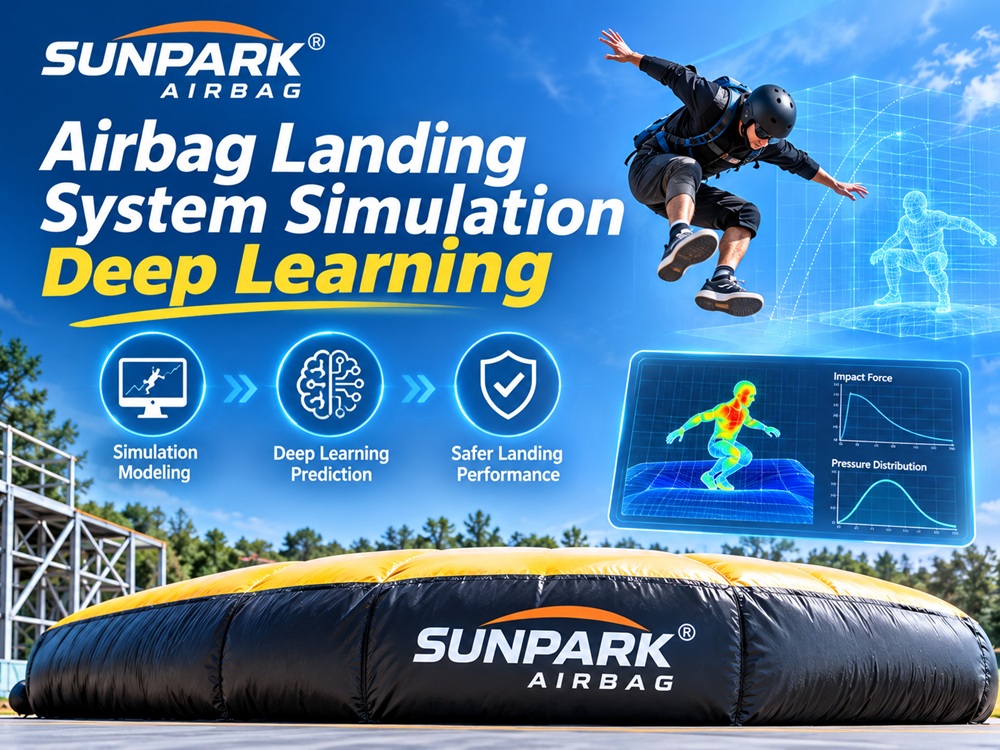
The internal design is more important than a product’s external appearance. A landing airbag must be engineered to manage the impact conditions expected in its intended sport. Different designs may use internal chambers, baffles, vents, layered structures, or other airflow-management features.
Ask how the system manages air during landing
When an athlete lands, the airbag deforms and air moves within or out of the system according to its design. The relationship between air volume, pressure, venting, internal construction, and landing geometry affects how the system responds. A supplier should be able to explain the design principles and the operating conditions for the model being quoted.
Check the intended landing profile
A landing pad should not be judged only by how soft it feels when someone presses it by hand. That is not a meaningful substitute for evaluating the system under the intended loading conditions. Ask for product-specific technical information, recommended operating parameters, and any available test or validation documentation.
Consider recovery between users
Commercial facilities may have repeated landings throughout the day. Recovery behavior and operational consistency matter because the system needs to return to its intended operating condition between uses. Ask the manufacturer about recommended operating pressure or inflation settings, blower operation, inspection intervals, and any restrictions on continuous use.
For a broader introduction to the technology, read our freestyle airbag guide.
4. Understand Inflation and Airflow Requirements
An airbag landing pad is only as practical as its inflation system. The blower, airflow path, electrical supply, operating environment, and maintenance access all affect daily use. A low-cost airbag with an unsuitable inflation setup can become an expensive operational problem.
Blower capacity and compatibility
Ask the manufacturer to specify the recommended blower configuration for the selected airbag. Do not choose a blower based on a generic power rating or assume that a larger motor is always better. The correct setup depends on the system’s design, air volume, pressure requirements, airflow characteristics, and operating conditions.
Continuous operation and backup planning
For commercial facilities, understand whether the blower is intended for continuous operation and what monitoring or backup arrangements are recommended. Ask what operators should do if power is interrupted, airflow changes, or the blower stops unexpectedly.
Noise, power, and placement
Blower noise can affect visitor experience, coaching communication, and nearby businesses. Power requirements may influence installation cost, particularly at outdoor or temporary sites. Plan the equipment location so that staff can inspect it and maintain safe access without interfering with the landing area.
5. Inspect Materials and Construction Quality
Sports airbags are exposed to repeated loading, movement, friction, handling, and sometimes harsh outdoor conditions. Material selection and manufacturing quality influence service life, repair needs, and operating reliability.
Fabric strength and abrasion resistance
Ask what fabric is used and whether its strength and coating are appropriate for the intended sport. The outer surface may encounter footwear, bike tires, equipment, dust, and repeated contact. Abrasion resistance is especially relevant for facilities with high daily use.
Seams, joints, and reinforced areas
Inspect the quality of seams, welded or bonded joints where applicable, reinforced corners, handles, connection points, and anchoring areas. These details are easy to overlook in product photographs but matter during transport, installation, and repeated operation.
UV, moisture, and temperature exposure
Outdoor installations need materials and construction suitable for the local environment. Sun exposure, moisture, temperature variation, dust, and storage conditions can affect product life. Ask the manufacturer about the operating environment, storage instructions, cleaning methods, and restrictions during severe weather.
Repairability matters
Even well-made equipment may need repairs during its service life. Confirm whether repair materials and instructions are available, which damage can be repaired on-site, and which repairs require manufacturer support. For a commercial facility, the availability of replacement components can be more important than a small initial price difference.
6. Consider Installation, Anchoring, and Site Conditions
A suitable airbag can still perform poorly as a facility investment if the site is not prepared correctly. Ground conditions, drainage, access, wind exposure, nearby structures, and approach geometry all affect installation planning.
Indoor installation
Indoor sites should be checked for ceiling height, floor loading where relevant, ventilation, electrical access, fire and building requirements, and safe circulation around the equipment. The installation should not obstruct emergency exits or create hazards for staff and visitors.
Outdoor installation
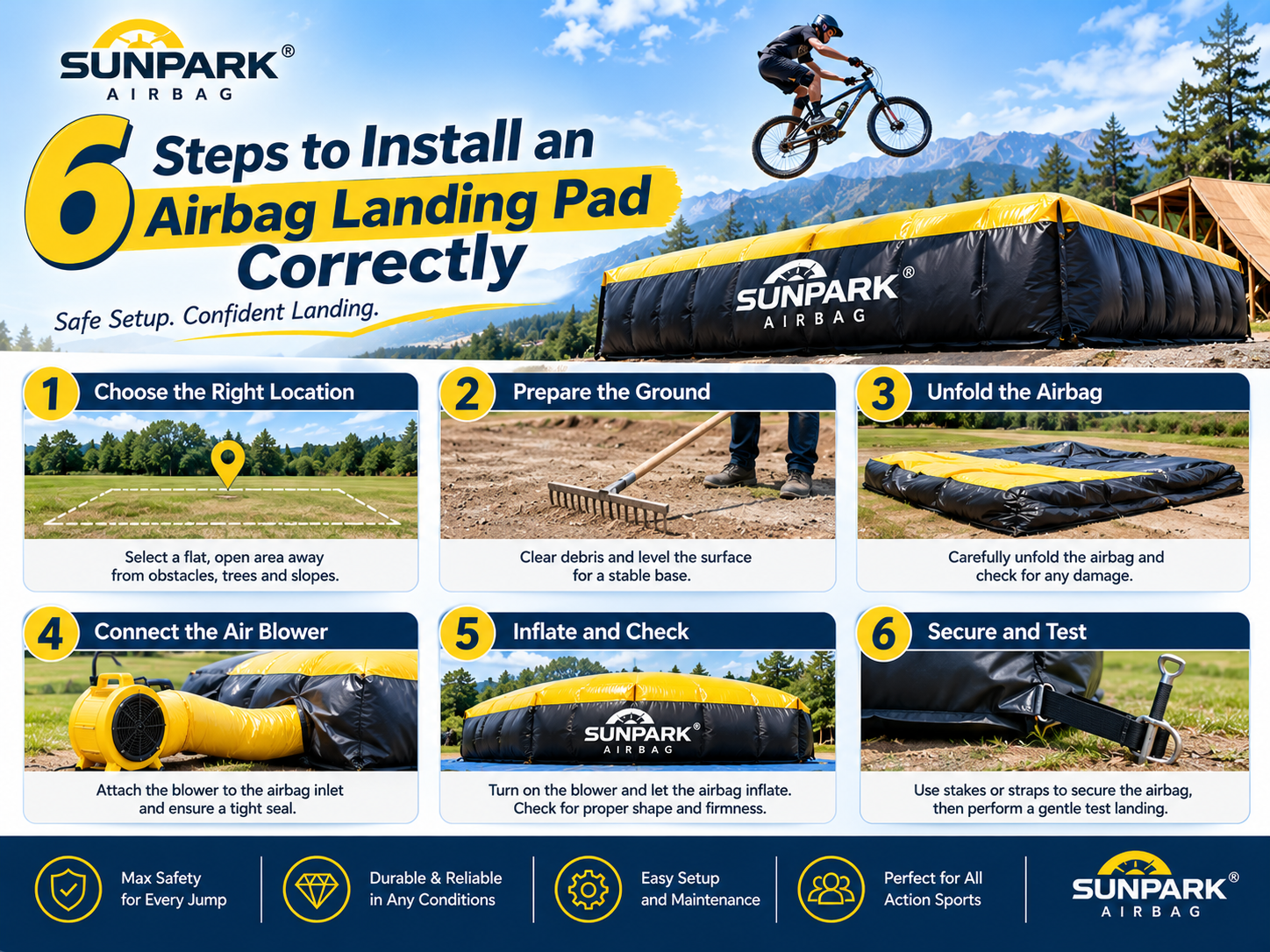
Outdoor installations require additional attention to anchoring, ground preparation, drainage, weather exposure, and environmental operating limits. Wind can be a serious concern for large inflatable structures. Follow the manufacturer’s instructions for anchoring and weather-related shutdown conditions.
Permanent versus temporary installation
A permanent installation may justify dedicated foundations, access routes, electrical infrastructure, and storage arrangements. A temporary or mobile setup needs a practical plan for transport, setup, takedown, inspection, and storage. Make sure the product is designed for the installation model you intend to use.
If the project involves a complete action-sports facility, consider how the airbag integrates with the rest of the site. The landing airbag solutions overview is a useful starting point for comparing landing system applications.
7. Review Safety Procedures and Operating Limits
Safety cannot be evaluated by the airbag alone. The takeoff, approach, rider behavior, coaching, weather, operating condition, and landing system all form part of the overall risk picture. An airbag is one element in a managed training environment, not a replacement for competent supervision or appropriate progression.
Define who is allowed to use the system
Set clear rules for age, experience, equipment, supervision, and permitted maneuvers. Beginners should not be encouraged to attempt advanced tricks simply because the landing surface is inflatable. A progression plan should start with appropriate skills and increase difficulty only when the athlete and facility are ready.
Establish pre-use inspection routines
Operators should inspect the airbag and its surrounding area before opening. The inspection should follow the manufacturer’s checklist and may include the outer fabric, seams, air connections, blower, anchoring, surface condition, and signs of abnormal deformation or damage.
Prepare for abnormal conditions
Staff should know how to respond to blower failure, power interruption, visible damage, changing weather, or an incident involving an athlete. Define when the system must be closed, who has authority to stop operations, and how the equipment is returned to service after inspection.
For facilities comparing different sports and equipment categories, our guide to inflatable MTB airbag solutions provides additional application context.
8. Calculate Maintenance and Operating Costs
The purchase price is only one part of the total cost of owning an airbag landing pad. Commercial buyers should estimate the cost of installation, power, staff time, inspections, cleaning, repairs, storage, and eventual replacement.
Understand routine maintenance
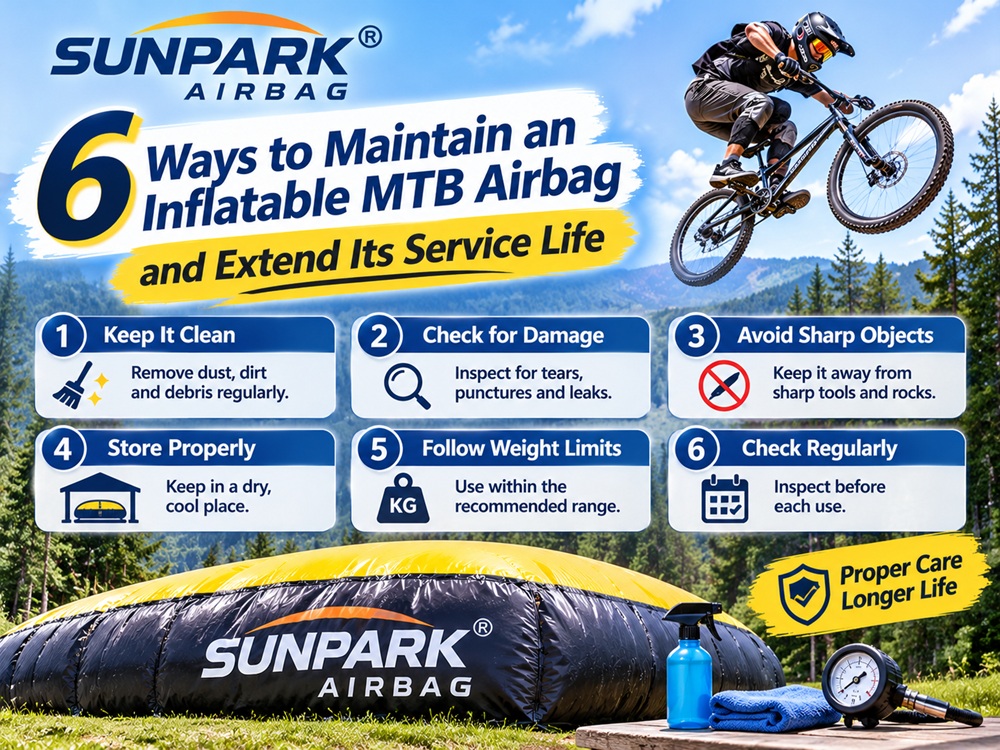
Ask the manufacturer for a written maintenance schedule. It should explain how often to inspect the fabric, seams, air connections, blower, anchoring, and other components. Also ask which cleaning products are suitable and how the airbag should be dried and stored.
Estimate downtime costs
For a ski resort, bike park, or trampoline facility, downtime can mean lost operating hours and disappointed customers. A product that is slightly more expensive but easier to inspect, repair, and support may provide better long-term value.
Compare total cost of ownership
Calculate the expected cost over the planned service period rather than comparing quotations only at purchase. Include blower electricity consumption, staffing, inspections, consumables, repairs, replacement parts, transport, and storage. Ask the supplier which components are included in the quotation and which are optional.
Facilities planning a larger attraction should also consider the airbag as one part of the wider business investment. Our article on trampoline park construction costs discusses broader facility budgeting considerations.
9. Check Customization and Future Upgrade Options
Not every facility has the same site dimensions, jump configuration, branding needs, or operating model. A manufacturer that can discuss customization may help create a more practical installation than a standard product selected without considering the site.
Useful customization options
- Dimensions and overall landing configuration suited to the project.
- Sport-specific geometry and integration with the takeoff structure.
- Color and branding options for commercial facilities.
- Blower and connection arrangements compatible with the site.
- Anchoring and installation accessories appropriate to the environment.
- Transport, storage, and handling features for mobile installations.
Customization should not be treated as a cosmetic upgrade only. Changes to dimensions, internal construction, airflow, or connections may affect the system’s operating characteristics. Require the manufacturer to confirm that the customized design remains appropriate for the intended application.
Plan for future use
If your facility may expand or add new sports, discuss upgrade options before purchase. Ask whether the landing system can be integrated into a larger setup, whether additional accessories are available, and what changes would require a new technical assessment.
For operators looking at different airbag configurations, our inflatable crash mat and inflatable jump airbag product pages provide examples of different equipment categories. These products should not be treated as interchangeable; confirm their intended uses before selecting one.
10. Evaluate Manufacturer Experience and After-Sales Support
A sports airbag is a technical product. The manufacturer’s experience, engineering communication, quality control, and support after delivery can have a major effect on the success of the project.
Look for relevant application experience
Do not evaluate a manufacturer only by the number of products shown in its catalogue. Ask whether it has supplied systems for the same sport, similar site conditions, and comparable operating frequency. A supplier with experience in gymnastics may not automatically have the right expertise for an FMX landing system.
Ask technical questions before ordering
A capable supplier should be able to discuss product dimensions, intended application, operating requirements, blower configuration, installation, maintenance, and limitations. Ask for drawings, specifications, setup instructions, and relevant documentation. If the supplier avoids technical questions or gives vague assurances, treat that as a warning sign.
Check support and spare parts
Confirm warranty coverage, repair procedures, spare-part availability, technical response arrangements, and whether installation guidance is included. For international projects, clarify shipping, customs documentation, delivery terms, and who is responsible for on-site setup.
Ask for evidence, not broad promises
Request project references or case examples where available. Ask what the product was designed for and whether the reference application is comparable to yours. Claims such as “professional quality” or “safe for all sports” are not substitutes for technical documentation and a suitable operating plan.
Airbag Landing Pad Types Compared: Which One Should You Choose?
Different airbag categories serve different training purposes. The following comparison helps narrow the product type before you request a detailed design or quotation.
| Airbag Type | Typical Application | Key Selection Priority | Best-Fit Buyer | Important Caution |
|---|---|---|---|---|
| MTB / BMX landing airbag | Mountain bike and BMX jump training | Jump trajectory, landing coverage, bike and rider dynamics | Bike parks, training centers, action-sports facilities | Must be matched to the actual jump design and rider progression |
| Freestyle ski / snowboard airbag | Freestyle progression and aerial training | Takeoff integration, landing profile, outdoor conditions | Ski resorts, snow parks, freestyle training venues | Seasonal weather and terrain conditions require planning |
| Gymnastics airbag | Gymnastics and controlled indoor training | Training movement, athlete level, indoor footprint | Gymnastics clubs and sports facilities | Not automatically suitable for high-speed action-sports jumps |
| FMX landing airbag | Motorcycle freestyle and stunt training | Motorcycle mass, approach speed, jump geometry, specialist design | Professional stunt facilities and dedicated training venues | Requires specialist assessment and strict operating controls |
| General inflatable crash mat | Selected recreational or training activities | Intended impact type, dimensions, and use restrictions | Facilities with compatible low-risk applications | Do not assume it replaces a sport-specific landing system |
For most commercial buyers, the best choice is the model designed for the primary sport and the actual installation. A multi-purpose product may look attractive from a purchasing perspective, but it is only a good investment if the manufacturer confirms that its design supports every intended application.
Pros and Cons of Buying an Airbag Landing Pad
An airbag landing pad can be a valuable addition to a sports facility, but it is not the right investment for every operator. The benefits are strongest when the system is integrated into a structured training program and managed by staff who understand its operating requirements.
| Pros | Cons and Limitations |
|---|---|
| Provides a deformable landing surface for selected training activities. | Does not eliminate injury risk or replace coaching and risk assessment. |
| Can support progressive practice of aerial skills in a controlled setup. | Requires appropriate jump design, supervision, and user progression rules. |
| Can attract athletes and visitors to specialist sports facilities. | Initial purchase, installation, and operating costs can be significant. |
| Can be configured for different sports and facility requirements. | Sport-specific designs are not automatically interchangeable. |
| May be suitable for permanent, seasonal, or selected mobile installations. | Outdoor use requires attention to wind, weather, anchoring, and storage. |
| Can create new training and commercial opportunities for resorts and parks. | Blower operation, inspections, maintenance, and repairs require ongoing resources. |
Airbag Landing Pad Buying Checklist and Cost-Benefit Analysis
Before requesting final quotations, use the following checklist to make sure you are comparing complete and technically suitable systems.
| Buying Question | What to Confirm | Why It Matters |
|---|---|---|
| Is the product designed for my sport? | Intended activity, rider profile, and approved application | Prevents selecting an unsuitable product category |
| Are the dimensions suitable? | Landing area, profile, approach, and site footprint | Ensures the system fits the planned jump and installation |
| How is impact managed? | Internal design, airflow behavior, and operating parameters | Helps evaluate whether the system matches the intended use |
| What equipment is included? | Blower, hoses, connectors, anchoring, accessories | Prevents incomplete quotations and unexpected costs |
| Can it handle the environment? | Indoor/outdoor suitability, UV, moisture, wind, temperature | Reduces installation and service-life risks |
| What maintenance is required? | Inspection schedule, cleaning, repair, spare parts | Helps forecast operating costs and downtime |
| What support is provided? | Installation guidance, warranty, technical support | Improves long-term ownership and service planning |
| Can the design be customized? | Dimensions, configuration, branding, site integration | Allows the system to fit the project rather than forcing the project to fit a standard product |
How to compare quotations fairly
When comparing suppliers, make sure each quotation covers the same product scope. One supplier may quote only the inflatable body, while another includes the blower, accessories, and installation guidance. Comparing the totals without checking the scope can lead to a misleading purchasing decision.
Calculate the expected cost over the planned operating period. Include purchase price, shipping, import costs, site preparation, power, staffing, inspection, maintenance, and repair. Then compare those costs with the expected use of the system, such as training sessions, visitor capacity, seasonal operating days, and potential revenue.
When is upgrading worth it?
Upgrade when the current system no longer fits the facility’s actual sport, capacity, operating conditions, or maintenance requirements. Examples include adding a dedicated airbag for a new sport, replacing an aging system with a more suitable design, or improving the installation to address recurring operational limitations.
Do not upgrade solely because a newer model has a larger footprint or more features. A meaningful upgrade should improve a measurable part of the operation, such as application suitability, setup efficiency, maintainability, or the ability to support a planned training program.
Common Mistakes When Choosing an Airbag Landing Pad
Choosing by price instead of application
The lowest quotation may exclude important accessories, technical support, or installation requirements. Compare the complete system and its intended use before judging value.
Assuming bigger always means safer
Dimensions matter, but a larger airbag is not automatically suitable for a particular jump. Geometry, internal design, operating conditions, and rider trajectory must be considered together.
Buying a general inflatable mat for a specialist sport
A recreational crash mat should not be assumed to provide the design characteristics required for MTB, snowboarding, or FMX. Confirm the manufacturer’s intended application in writing.
Ignoring the blower and power supply
The airbag and inflation system must be evaluated as one operating setup. Confirm power requirements, equipment placement, and response procedures for interruptions.
Overlooking installation and weather
Outdoor sites need suitable anchoring, drainage, weather monitoring, and shutdown procedures. Indoor sites still require adequate space, access, and facility planning.
Assuming an airbag removes the need for coaching
Airbags can support training progression, but they do not replace skill development, supervision, suitable equipment, or risk management. A facility should establish clear user rules before opening the system.
Failing to plan maintenance
Without routine inspections and a repair plan, minor damage can become a source of downtime. Ask for maintenance documentation before purchase, not after delivery.
Who Should Use an Airbag Landing Pad?
Airbag landing systems are most useful for operators with a clear training or commercial purpose and the ability to manage the equipment properly.
Good candidates
- Ski resorts and snow parks: Facilities developing structured freestyle training or progression areas.
- Mountain bike and BMX parks: Operators building dedicated jump-training areas with appropriate design and supervision.
- Gymnastics and trampoline facilities: Centers that need a suitable inflatable training surface for defined movements.
- Professional training venues: Organizations with experienced coaches, planned progression, and documented operating procedures.
- Theme parks and action-sports attractions: Businesses with trained staff, site-specific risk management, and a suitable customer experience plan.
Who may not need one?
A casual user with no suitable installation area, no trained supervision, or no defined training purpose may not benefit from purchasing a full airbag landing system. A small facility with limited usage may find the total cost and maintenance burden difficult to justify. In those situations, using an established facility with suitable equipment may be more practical than owning a system.
Expert Recommendation: Buy the Right System, Not Just an Inflatable Product
When choosing an airbag landing pad, we recommend following a clear order of priority:
- Define the sport and training objective. Establish what athletes will do and what the system is expected to support.
- Assess the jump and site geometry. Confirm the approach, takeoff, landing trajectory, available footprint, and environmental conditions.
- Choose a sport-specific design. Avoid treating a general crash mat as a substitute for a specialist landing airbag.
- Review technical details. Ask about internal construction, airflow, blower requirements, materials, and operating limits.
- Plan installation and operation. Include anchoring, access, supervision, inspections, maintenance, and emergency procedures.
- Evaluate the manufacturer. Look for relevant experience, clear documentation, customization capability, and after-sales support.
- Compare total ownership cost. Consider the complete system and its expected service requirements, not only the initial quotation.
For beginners planning a small training facility, start with a clearly defined application and a manageable operating plan. For commercial users, prioritize durability, technical documentation, service support, and the ability to maintain consistent operating conditions. For heavy-duty applications such as MTB or FMX, require sport-specific engineering input and a professional site assessment before approving the design.
Why Consider SUNPARK® AIRBAG?
SUNPARK® AIRBAG has more than 10 years of experience developing freestyle airbags for ski resorts, theme parks, sports facilities, and gymnastics facilities around the world. The company focuses on airbag systems for extreme sports and leisure industries, with products used by professional riders, world champion snowboarders, and trampoline parks.
As extreme sports continue to develop, athletes and facility operators need training equipment that supports skill progression while fitting the demands of each sport. SUNPARK® AIRBAG focuses on developing and improving its products and provides solutions for different sports and leisure applications.
For buyers, the most useful next step is to share the project details rather than request a generic quotation. Explain your sport, jump dimensions, site conditions, expected users, and installation plan so the proposed system can be evaluated against the actual application.
Explore the SUNPARK® AIRBAG product range to review available airbag systems and identify the category that best matches your project.
Frequently Asked Questions About Choosing an Airbag Landing Pad
1. What is the most important factor when choosing an airbag landing pad?
The most important factor is matching the airbag to the sport and landing scenario. Jump geometry, approach speed, athlete profile, landing trajectory, and site conditions should determine the design. Size and price should be considered only after application suitability has been established.
2. Are all airbag landing pads suitable for every sport?
No. MTB, BMX, freestyle skiing, snowboarding, gymnastics, and FMX have different landing requirements. A system designed for one sport should not be used for another unless the manufacturer confirms that the design and operating limits are appropriate.
3. How large should an airbag landing pad be?
There is no universal size. Dimensions depend on jump height, approach speed, takeoff geometry, landing trajectory, athlete skill level, and the available site footprint. The manufacturer and competent project professionals should assess the required dimensions for the specific installation.
4. Does an airbag landing pad prevent injuries?
No landing system can guarantee injury prevention. An airbag is designed to provide a deformable training surface for suitable applications, but injury risk remains. Proper jump design, coaching, athlete progression, equipment inspection, and operating procedures are still essential.
5. What is the difference between an airbag landing pad and an inflatable crash mat?
The terms can describe different product categories. A specialist landing airbag may have sport-specific geometry and internal airflow design, while a general inflatable crash mat may be intended for different training or recreational activities. Buyers should confirm the intended application and technical limitations rather than relying on product names.
6. Do airbag landing pads need a blower running continuously?
Operating requirements depend on the airbag design. Some systems require a blower to maintain their intended operating condition, while others may use different configurations. Follow the manufacturer’s instructions and confirm blower capacity, power requirements, and procedures for interruptions before purchase.
7. Can an airbag landing pad be installed outdoors?
Some systems are designed for outdoor use, but suitability depends on the materials, anchoring, drainage, weather exposure, and manufacturer operating limits. Wind and severe weather can create significant risks for inflatable structures. Outdoor installations need a site-specific plan and clear shutdown procedures.
8. How do I maintain an airbag landing pad?
Maintenance normally includes regular inspection of the fabric, seams, connections, blower, anchoring, and surrounding area, as well as appropriate cleaning and storage. The exact schedule and repair procedures should come from the manufacturer. Operators should document inspections and remove damaged equipment from service when required.
9. Is a customized airbag landing pad worth the extra cost?
Customization is worthwhile when it improves the fit with the site’s geometry, sport requirements, installation conditions, or operating needs. It is less valuable when changes are only cosmetic. Any modification to dimensions, internal construction, or airflow should be reviewed by the manufacturer for its effect on system performance and operating limits.
10. What should I ask an airbag manufacturer before ordering?
Ask about intended sports, dimensions, internal design, blower requirements, materials, installation, anchoring, operating limits, inspection, repairs, warranty, spare parts, delivery, and technical support. Also request drawings and documentation relevant to your project. A reliable supplier should be able to explain the system’s capabilities and limitations clearly.
References
These authoritative resources provide additional context for risk assessment, inflatable structure safety, and sports facility operation. They do not replace the product-specific instructions and technical documentation supplied by the airbag manufacturer.
- ASTM International – Standards development organization with technical standards relevant to materials, testing, and product evaluation. Confirm the specific standard applicable to the selected product and use case.
- U.S. Consumer Product Safety Commission – Sports, Fitness and Recreation Safety – Consumer and recreational safety information relevant to planning and managing sports activities.
- UK Health and Safety Executive – Leisure and Entertainment Safety – Guidance on managing health and safety risks in leisure and entertainment environments.