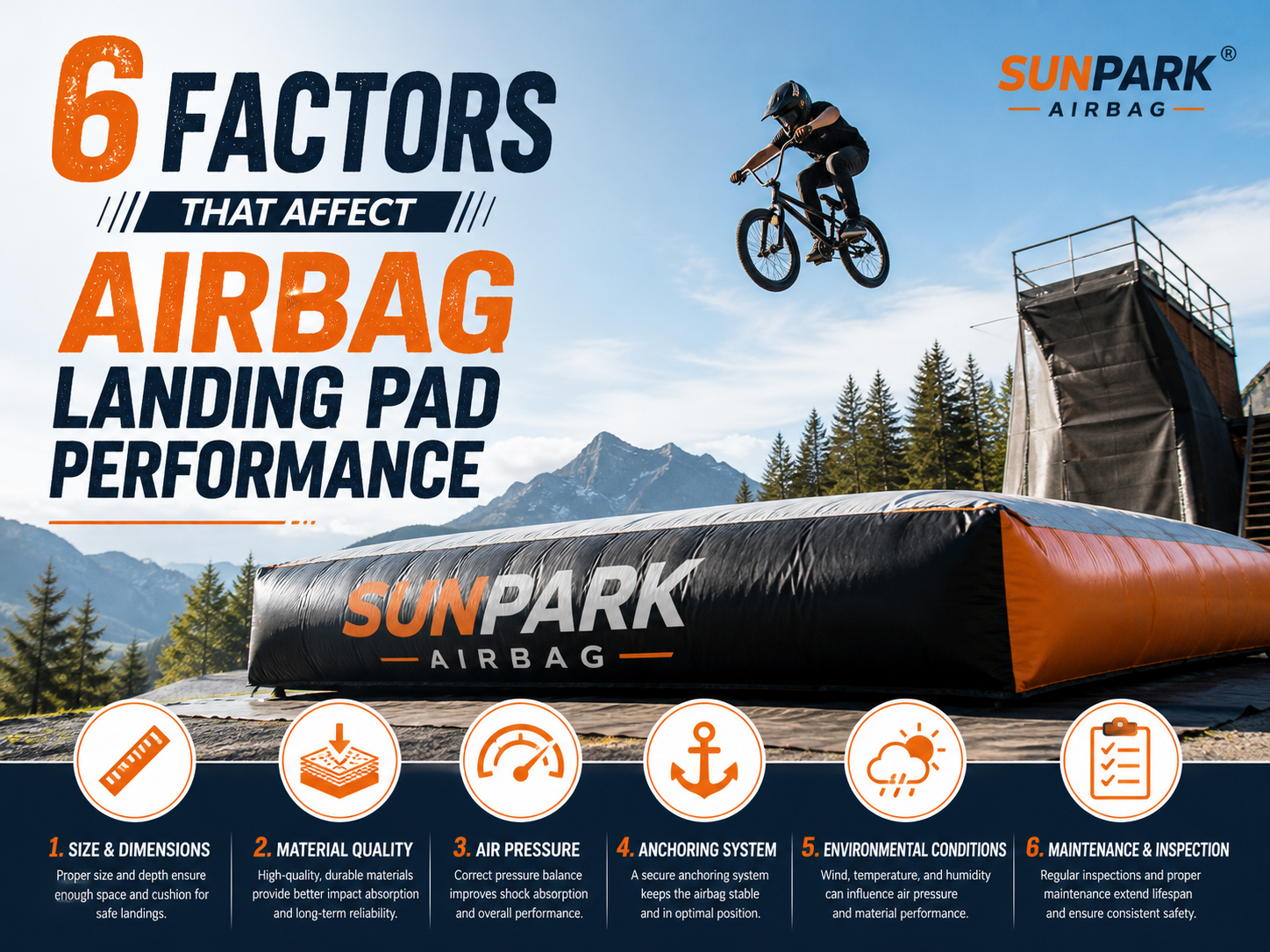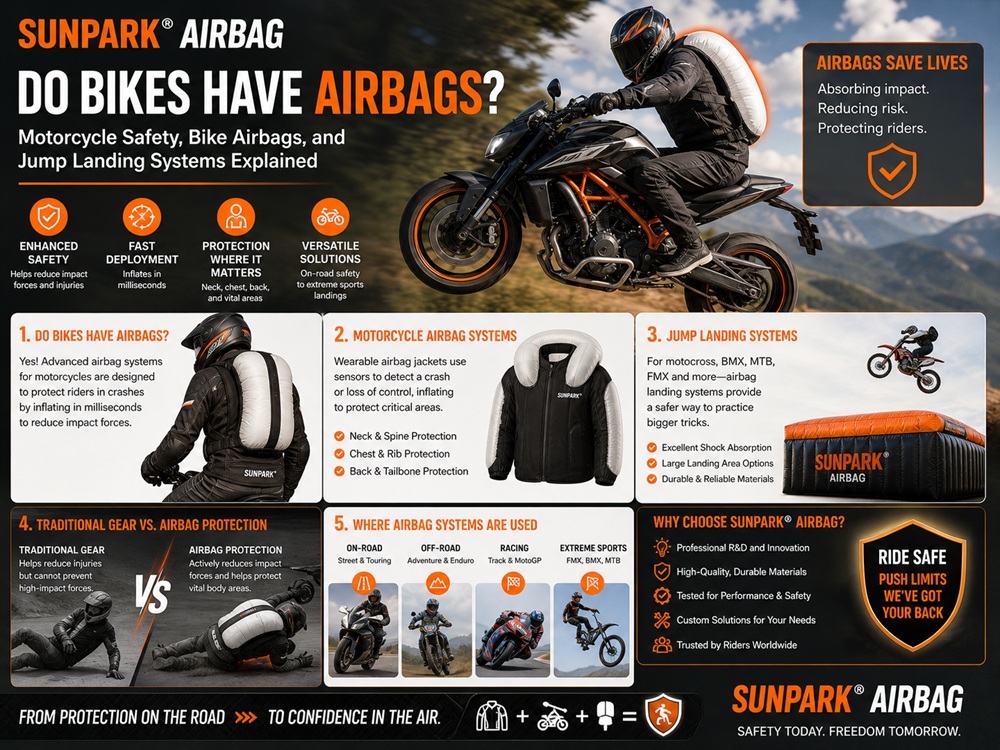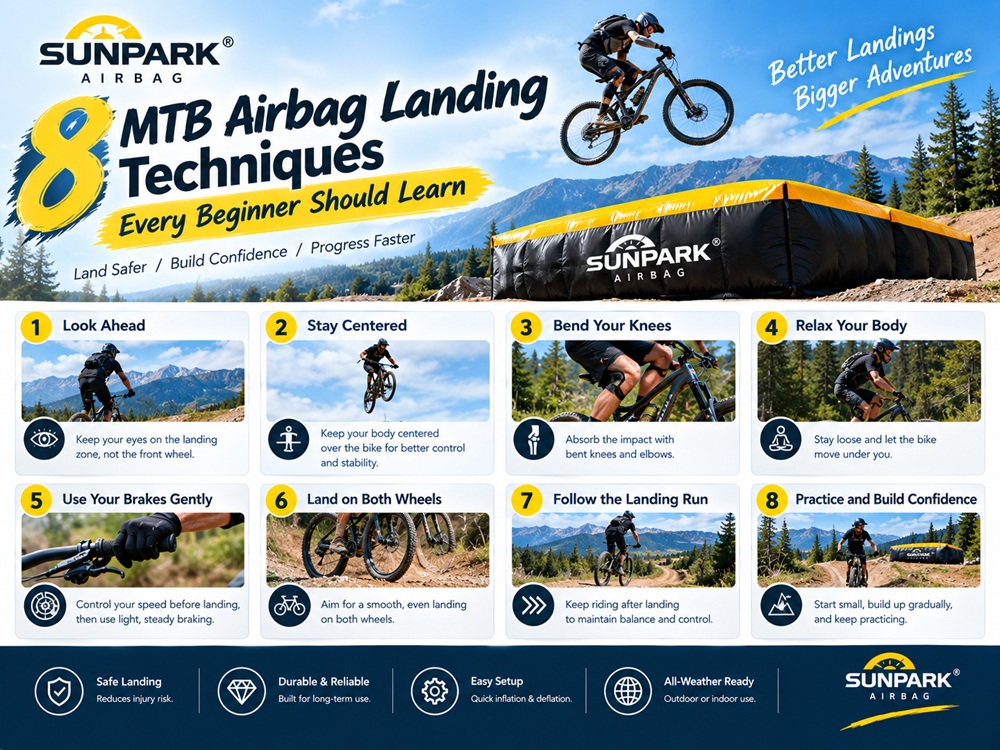
An airbag landing pad is not automatically safe just because it is inflatable. In professional stunt training, FMX practice, mountain biking, gymnastics, and freestyle sports, landing safety depends on much more than the size or thickness of the airbag. Correct installation, pressure management, surface inspection, approach control, landing technique, and trained supervision all determine whether the system performs as intended.
This guide explains nine essential Airbag Landing Pad Safety Rules for professional training facilities. We focus on practical inspection procedures, athlete management, equipment selection, and the decisions that facility owners and coaches should make before allowing training to begin.
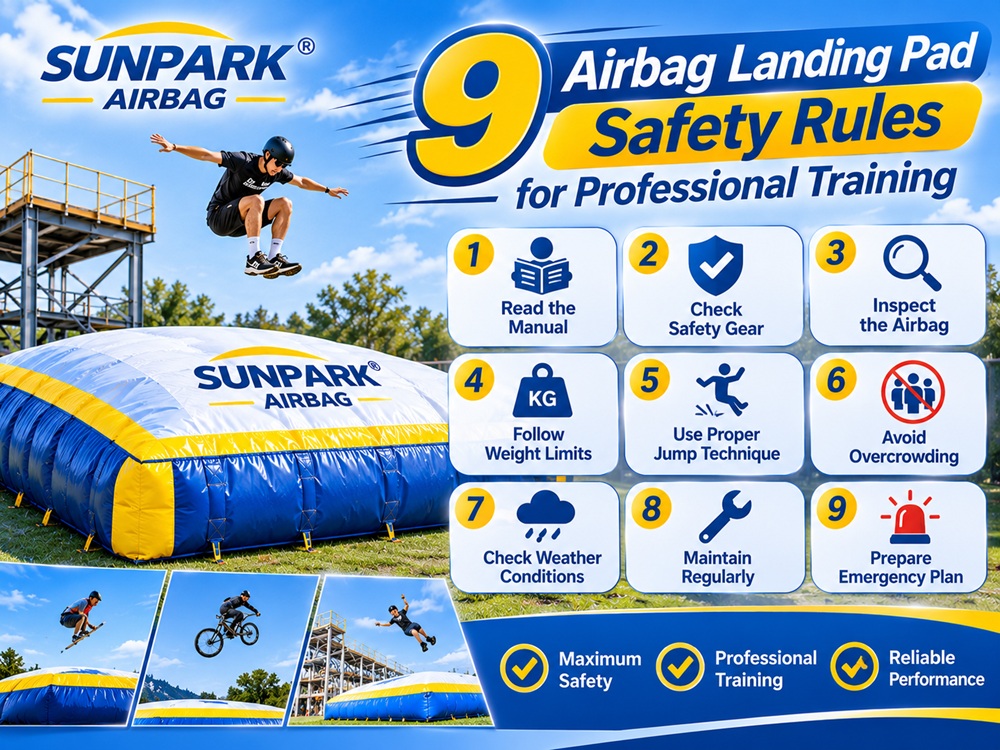
Quick Answer: What Are the Essential Airbag Landing Pad Safety Rules?
The nine most important safety rules are to inspect the landing surface, verify inflation and pressure, secure the installation area, check the approach and landing geometry, establish athlete skill requirements, use qualified supervision, control training progression, monitor environmental conditions, and maintain a documented inspection routine.
- What it is: A set of operating and inspection procedures designed to reduce preventable hazards when using inflatable landing systems.
- How it works: Coaches and operators verify equipment condition, inflation, placement, athlete readiness, and training conditions before and during use.
- Benefits: More consistent training conditions, improved hazard recognition, better equipment care, and controlled skill progression.
- Limitations: An airbag cannot eliminate injury risk or compensate for incorrect technique, excessive speed, unsuitable equipment, or poor supervision.
- Who should use it: Professional sports facilities, FMX training centers, bike parks, ski resorts, gymnastics centers, and organized stunt-training environments.
- Who does not need it: Anyone using a conventional landing surface that is not an inflatable airbag system. However, equivalent activity-specific safety procedures are still necessary.
- Common mistakes: Ignoring pressure changes, allowing unauthorized adjustments, overlooking seams, and assuming every athlete can use the same landing configuration.
- Buying considerations: Intended sport, impact characteristics, dimensions, material strength, inflation system, anchoring, repairability, and manufacturer support.
- Expert recommendation: Establish a written pre-use inspection and operating checklist, and select an airbag designed specifically for the intended sport and skill level.
Quick Summary: Nine Airbag Landing Pad Safety Rules
| Rule | Safety Requirement | What Operators Should Check | Priority |
|---|---|---|---|
| 1 | Inspect the landing surface | Tears, punctures, seams, contamination, and wear | Before every session |
| 2 | Maintain correct inflation | Manufacturer-specified pressure and airflow | Before and during operation |
| 3 | Secure the installation | Anchoring, ground conditions, and surrounding clearance | Before use |
| 4 | Verify landing geometry | Approach angle, landing position, and transition area | Before each training setup |
| 5 | Match equipment to the sport | Airbag design, dimensions, and intended impact characteristics | During procurement |
| 6 | Use qualified supervision | Coach experience, communication, and emergency readiness | Throughout training |
| 7 | Control progression | Athlete readiness, skill level, and trick complexity | Every training stage |
| 8 | Monitor environmental conditions | Wind, temperature, moisture, and ground stability | Before and during operation |
| 9 | Maintain and document equipment | Repairs, blower condition, inspections, and incident records | Ongoing |
Understanding Airbag Landing Pad Safety in Professional Training
An airbag landing pad is an inflatable impact-management system designed for specific sports and training activities. Depending on its construction, internal chambers, airflow design, and geometry, it can provide a landing surface that supports controlled practice of selected movements and maneuvers.
Unlike a conventional rigid surface, an airbag uses internal air volume and material deformation to manage impact. Its performance depends on its design and operating condition. Different products are engineered for different impact patterns, athlete weights, approach speeds, and sports.
Why Professional Facilities Need Written Safety Rules
Consider a bike park operating an inflatable landing system for multiple athletes throughout the day. The first session may involve experienced riders practicing familiar movements. Later, beginners may use the same equipment under different conditions.
Without a documented inspection and training procedure, operators can overlook pressure changes, surface damage, unauthorized equipment adjustments, or inappropriate skill progression.
Professional training therefore requires two separate forms of risk management:
- Equipment safety: Ensuring that the airbag, blower, anchoring, landing surface, and supporting components remain within the manufacturer’s operating requirements.
- Training safety: Ensuring that athletes, coaches, approach conditions, and selected maneuvers are appropriate for the facility and equipment.
Both are essential. A properly maintained airbag cannot make an unsuitable stunt safe, and excellent coaching cannot compensate for damaged or incorrectly configured equipment.
Rule 1: Inspect the Entire Landing Surface Before Every Training Session
A visual inspection should be the first operational step before an airbag landing pad is opened for training. Operators should never assume that equipment is ready simply because it was functioning correctly during the previous session.
What Should Be Inspected?
- Outer fabric for cuts, punctures, abrasion, and unusual wear.
- Seams and reinforced connection points for separation or damage.
- Inflation ports, valves, hoses, and blower connections for leaks or loose fittings.
- Landing surface for foreign objects, sharp debris, mud, oil, and other contamination.
- Sidewalls and perimeter areas for visible deformation or damage.
- Internal structural components where accessible and permitted by the manufacturer’s inspection procedure.
Pay particular attention to areas that receive repeated concentrated impacts. A landing surface may look acceptable from a distance while showing localized wear in high-use zones.
Why Small Defects Matter
A small puncture can affect airflow and pressure stability. A damaged seam may deteriorate further under repeated loading. Contamination can also change surface conditions and create avoidable hazards.
For facilities using a dedicated stunt airbag landing system, inspection procedures should reflect the product’s intended impact zones and operating configuration.
Rule 2: Maintain Correct Inflation and Air Pressure
Inflation management is one of the most important Airbag Landing Pad Safety Rules. The internal pressure and airflow characteristics influence how the system responds when an athlete lands.
Underinflation, overinflation, airflow restriction, and unstable blower operation can all affect the intended performance of an inflatable landing system.
Why Correct Pressure Matters
An airbag is designed around a specific operating configuration. If its pressure falls outside the manufacturer’s requirements, the landing surface may not respond as intended.
For example, a system with insufficient inflation may develop excessive deformation or fail to maintain its specified geometry. Excessive pressure may also change the impact response and place unnecessary stress on materials and seams.
Professional Inflation Checklist
- Identify the manufacturer’s specified operating pressure or inflation procedure.
- Check that the blower is suitable for the system.
- Inspect air hoses, valves, connectors, and electrical supply.
- Allow the system to reach its specified operating condition before use.
- Verify that pressure and surface geometry remain within approved limits.
- Monitor for abnormal pressure changes during training.
Do not use a universal pressure setting for every airbag. Different designs have different internal structures, chamber configurations, and operating requirements.
Operators should not increase pressure simply because the landing feels softer or harder than expected. Any adjustment must follow the manufacturer’s instructions and be verified through an appropriate operating procedure.
Rule 3: Secure the Installation and Surrounding Area
A professional airbag landing pad must be installed on a suitable surface with the correct anchoring and clearance. Equipment movement, unstable ground, and obstacles around the landing area can introduce hazards even when the airbag itself is in good condition.
Check the Ground Before Installation
Inspect the ground for sharp objects, uneven surfaces, drainage problems, and conditions that could damage the airbag underside. The installation surface should meet the manufacturer’s requirements for support and stability.
Secure the Airbag Correctly
Use the designated anchoring points and approved securing equipment. Anchoring arrangements must account for the airbag design and the environmental conditions of the site.
Do not improvise attachment methods or use unsuitable ropes, weights, or fastening hardware. Incorrect securing can place unexpected loads on the fabric and connection points.
Establish a Controlled Safety Perimeter
The landing area should have clear boundaries. Spectators, waiting athletes, staff, and equipment should remain outside restricted zones unless their presence is required and controlled by the operating procedure.
Check that the approach route and landing perimeter are free from obstacles. Also establish an appropriate route for athletes to leave the landing area without interfering with the next attempt.
For facilities comparing different configurations, a dedicated inflatable crash mat may be suitable for certain controlled training activities, but it should not be treated as interchangeable with a purpose-built stunt landing system.
Rule 4: Check Landing Geometry and Approach Alignment
Correct landing geometry is essential for professional training. The relationship between the takeoff point, flight path, landing surface, and surrounding clearance determines whether the athlete can approach the intended landing zone consistently.
Evaluate the Complete Approach
Before training begins, coaches and operators should assess:
- Takeoff ramp or launch structure condition.
- Approach surface traction and consistency.
- Expected speed and trajectory for the planned maneuver.
- Airbag position relative to the intended landing path.
- Landing surface dimensions and usable impact zone.
- Potential contact with surrounding structures.
- Safe exit and recovery routes.
Do Not Assume a Larger Airbag Solves Every Landing Problem
Increasing the landing pad dimensions may provide additional coverage, but it does not automatically correct an unsuitable trajectory or poorly aligned installation.
For example, a motorcycle rider approaching an FMX landing system has different speed, vehicle mass, and trajectory considerations from a mountain bike rider. The landing configuration must be designed and assessed for the intended activity.
We recommend that professional facilities use a documented setup procedure and obtain qualified technical input when changing ramp geometry, landing position, or aircraft-like launch trajectories used in specialized stunt environments.
Rule 5: Match the Airbag to the Sport and Athlete
Not all airbag landing pads are designed for the same impact conditions. One of the most expensive procurement mistakes is choosing equipment based primarily on dimensions or price while ignoring the sport-specific requirements.
Different Sports Require Different Landing Solutions
FMX, mountain biking, skiing, snowboarding, gymnastics, and freestyle stunt training involve different combinations of speed, athlete mass, equipment geometry, impact orientation, and landing technique.
A gymnastics landing airbag should not automatically be used for high-speed motorcycle training. Likewise, a system intended for bike jumps should not be assumed suitable for every stunt or gymnastics activity.
| Sport or Activity | Typical Equipment Requirement | Main Selection Consideration |
|---|---|---|
| FMX and motocross | Purpose-designed motorcycle landing airbag | Vehicle and rider impact conditions, landing geometry, and structural design |
| Mountain biking | Bike-specific landing airbag | Approach speed, bike trajectory, landing zone, and rider progression |
| Gymnastics | Gymnastics training airbag | Skill level, training movement, and surface response |
| Skiing and snowboarding | Freestyle snow-sport landing airbag | Jump configuration, seasonal environment, and landing geometry |
| General stunt training | Purpose-designed stunt landing system | Impact type, performer requirements, and manufacturer-approved use |
For cycling facilities, review a dedicated bike airbag landing system rather than selecting a general-purpose inflatable mat.
Gymnastics facilities should also consider purpose-built gymnastics airbag equipment with specifications aligned to the training activity.
Consider Athlete Weight and Skill Level
The manufacturer’s operating limits should cover the intended athlete population and training configuration. Ask for documented weight limits, approved applications, and any restrictions concerning repeated impacts or specific maneuvers.
For commercial facilities, these details should be part of the purchasing specification rather than discussed only after installation.
Rule 6: Require Qualified Supervision and Clear Communication
An airbag landing pad is a training tool, not an autonomous safety system. Professional training requires qualified supervision and clear communication between athletes, coaches, and equipment operators.
Assign Clear Responsibilities
Before opening a training session, identify who is responsible for:
- Pre-use equipment inspection.
- Inflation and blower operation.
- Takeoff and landing area control.
- Athlete readiness and progression approval.
- Stopping training when conditions become unsafe.
- Emergency response and incident documentation.
Use a Consistent Communication Protocol
Athletes should understand when the landing zone is clear, when a training attempt is authorized, and when the system is closed. Use agreed verbal or visual signals appropriate to the facility.
Never allow multiple athletes to enter a shared landing zone simultaneously unless the system and activity have been specifically designed and approved for that use.
Prepare for Emergencies
Staff should know how to stop training, isolate equipment power where necessary, contact emergency services, and provide assistance within their training and certification.
Emergency access should remain unobstructed. First-aid resources and communication equipment should be available according to the facility’s risk assessment.
Rule 7: Progress Training Gradually and Avoid Unnecessary Risk
One of the most common mistakes in extreme sports training is attempting advanced maneuvers before the athlete has developed the necessary technique and control.
Airbag landing systems can support skill development, but they do not remove the physical risks associated with rotation, speed, awkward landings, or equipment-related accidents.
Build Training Around Athlete Readiness
A professional progression plan should consider:
- Previous experience with the specific sport.
- Demonstrated control of basic movements.
- Consistency of approach and takeoff technique.
- Understanding of the landing configuration.
- Physical readiness and fatigue.
- Coach approval for progression to more demanding maneuvers.
Do Not Use the Airbag as Permission to Attempt Any Trick
An inflatable landing surface may change the consequences of certain landing errors, but it does not eliminate the risk of head, neck, spinal, or limb injuries. The athlete can still experience dangerous impacts or leave the intended landing area entirely.
Coaches should set progression limits based on skill, conditions, and the manufacturer’s intended use of the equipment.
For facilities developing freestyle programs, our freestyle airbag training guide provides additional context on the role of inflatable landing equipment in skill development.
Rule 8: Monitor Weather and Environmental Conditions
Outdoor airbag training introduces environmental variables that indoor facilities may not encounter. Wind, rain, temperature, ground moisture, and changing site conditions can affect both the equipment and athlete performance.
Wind Conditions
Wind can affect exposed inflatable equipment, especially during installation and operation. The acceptable operating limits depend on the airbag design, anchoring configuration, and manufacturer’s instructions.
Do not assume that a fully inflated airbag is automatically secure in strong or changing wind. Follow the manufacturer’s wind restrictions and stop operation when conditions exceed approved limits.
Temperature and Moisture
Temperature changes can affect internal air pressure and material behavior. Operators should monitor the system according to the manufacturer’s recommendations, particularly when outdoor conditions change significantly throughout the day.
Moisture can also affect access routes, takeoff surfaces, surrounding ground, and the landing surface itself. Ensure that drainage and cleaning procedures are suitable for the installation.
Environmental Inspection Checklist
- Check weather forecasts before outdoor sessions.
- Assess actual wind conditions at the installation site.
- Inspect ground stability and drainage.
- Check for moisture, ice, or contamination.
- Confirm the equipment remains within specified operating limits.
- Reassess conditions when weather changes during training.
For seasonal sports facilities, environmental suitability should be part of the equipment specification from the beginning, not an operational problem discovered after purchase.
Rule 9: Establish Maintenance, Repair, and Emergency Procedures
Professional airbag equipment experiences repeated loading, material movement, inflation cycles, transportation, and environmental exposure. A maintenance program is therefore essential for long-term operational reliability.
Daily and Routine Maintenance
After each session, inspect the landing surface for visible damage and remove contamination using approved cleaning methods. Check inflation equipment, electrical connections, hoses, valves, and anchoring hardware.
Record any abnormal behavior, including unusual air loss, inconsistent inflation, blower noise, or visible material deformation.
Repair Procedures
Do not use improvised patches, adhesives, or repair materials without confirming compatibility with the manufacturer’s specifications.
Repairs should be completed using approved materials and methods. Structural damage, seam separation, or recurring air leakage may require professional assessment before the system can return to service.
Maintain Equipment Records
A professional facility should maintain records covering:
- Equipment model and identification information.
- Installation and inspection dates.
- Pre-use inspection results.
- Maintenance and repair history.
- Blower and electrical system checks.
- Incidents and corrective actions.
- Manufacturer recommendations and approved modifications.
These records help operators identify recurring problems and make informed replacement decisions.
Know When to Retire Equipment
Repeated repairs do not necessarily make an old airbag economical or safe. If the material, seams, or structural components no longer meet the manufacturer’s requirements, replacement may be the more responsible decision.
Airbag Landing Pad vs Foam Pit vs Traditional Landing Mat
Choosing an airbag landing pad involves comparing it with other training surfaces. The best solution depends on the sport, impact requirements, facility layout, usage frequency, and maintenance resources.
| Comparison Factor | Airbag Landing Pad | Foam Pit | Traditional Landing Mat |
|---|---|---|---|
| Landing design | Inflatable impact-management system | Loose or structured foam filling | Foam-based mat construction |
| Installation | Requires inflation and suitable anchoring | Requires a dedicated pit structure and filling | Generally straightforward placement |
| Space requirements | Depends on sport and system dimensions | Requires sufficient pit depth and surrounding structure | Depends on mat dimensions and training activity |
| Maintenance | Fabric, seams, blower, valves, and inflation checks | Foam condition, contamination, and pit maintenance | Surface, cover, and foam condition |
| Mobility | Many systems can be deflated and transported | Generally fixed installation | Often portable |
| Training applications | Sport-specific freestyle, stunt, and landing practice | Selected gymnastics and freestyle activities | General gym and floor-based training |
| Best purchasing consideration | Impact characteristics and approved sport application | Pit design, foam quality, and maintenance | Mat thickness, density, and intended use |
An airbag landing pad is often attractive for facilities that need a portable, sport-specific landing system. A foam pit may be more appropriate for a permanent installation with a suitable structure. Traditional landing mats are useful for lower-height training activities but should not be substituted for specialized equipment in high-energy stunt applications.
Read our detailed foam pit vs airbag comparison before deciding which system best fits your facility.
Pros and Cons of Professional Airbag Landing Pads
Airbag landing pads offer useful advantages, but buyers should evaluate them against the real demands of their training programs.
| Advantages | Limitations |
|---|---|
| Can support structured progression for selected freestyle and stunt training activities. | Does not eliminate injury risk or replace proper coaching. |
| Many designs can be deflated and transported. | Requires suitable inflation equipment and operating procedures. |
| Can be configured for sport-specific landing applications. | Not every airbag is compatible with every sport. |
| Can support repeated training when correctly operated and maintained. | Repeated impact and environmental exposure create maintenance requirements. |
| Can reduce dependence on some permanent landing structures. | Still requires sufficient space, anchoring, and suitable ground conditions. |
| Can be integrated into professional sports training facilities. | Initial investment and replacement costs vary by size and construction. |
Commercial assessment: An airbag is worth buying when it supports a clearly defined training program and provides a practical operational advantage over available alternatives. It is not worth purchasing simply because it appears more advanced than a traditional mat.
How to Choose a Professional Airbag Landing Pad
For commercial buyers, the purchasing decision should start with the intended sport and training environment. A product that looks suitable in a photograph may have entirely different operating limitations from what your facility requires.
1. Identify the Intended Sport
Define whether the system will be used for FMX, motocross, mountain biking, gymnastics, skiing, snowboarding, or general stunt training.
Ask the manufacturer to confirm that the proposed model is designed for the specific activity, impact conditions, and athlete or vehicle configuration.
2. Evaluate Dimensions and Landing Geometry
Compare usable landing dimensions rather than relying only on the total external footprint. Check the length, width, height, landing slope, sidewall design, and positioning requirements.
Ensure that the equipment is appropriate for the intended approach speed and trajectory. Have the complete installation reviewed by qualified personnel before use.
3. Examine Material and Construction Quality
Ask about the fabric specification, reinforcement, seam construction, abrasion resistance, repair methods, and quality-control procedures.
Do not judge material quality solely by advertised thickness. Fabric construction, coating, reinforcement, and manufacturing consistency all matter.
4. Check the Inflation System
Confirm the blower configuration, electrical requirements, airflow specifications, pressure-control arrangements, and maintenance needs.
Ask whether the system is designed for continuous airflow, sealed operation, or another inflation architecture. The operating procedure should match the actual design.
5. Request Testing and Documentation
Professional suppliers should provide relevant product specifications, installation instructions, operating limitations, maintenance procedures, and warranty information.
Where testing or certifications are claimed, request the exact document, test scope, issuing organization, and applicable product model. A generic certificate should not be treated as evidence that every use configuration is safe.
6. Compare Total Cost of Ownership
The purchase price should be considered alongside transportation, installation, blower equipment, electricity, storage, repairs, replacement parts, inspection time, and staff training.
For a high-volume sports facility, a more durable and serviceable airbag may provide better long-term value than a cheaper system that requires frequent repairs or extended downtime.
7. Evaluate Manufacturer Support
Ask about technical assistance, spare parts, repair materials, replacement availability, customization, and response times.
For international buyers, also confirm packaging dimensions, shipping arrangements, delivery lead times, installation support, and warranty coverage.
Facilities researching industry suppliers can review our guide to trampoline park equipment manufacturers for additional procurement considerations.
Five Common Airbag Landing Pad Safety Mistakes to Avoid
1. Using One Airbag for Multiple Sports Without Approval
Different sports produce different impact conditions. A system designed for gymnastics should not automatically be used for high-speed FMX or mountain bike landings. Always verify the manufacturer’s approved application.
2. Ignoring Pressure Changes During Training
Inflation conditions can change due to temperature, airflow restrictions, equipment faults, and system design. Follow the specified monitoring procedure rather than relying on appearance alone.
3. Skipping the Pre-Session Inspection
Busy commercial facilities may be tempted to start training immediately after setup. This is a poor operational decision. A documented inspection should be completed before every session.
4. Allowing Athletes to Attempt Advanced Maneuvers Too Early
An airbag does not make every trick appropriate for every athlete. Coaches must establish progression criteria and retain the authority to stop an attempt.
5. Buying Based Only on Price
Cheap equipment may appear attractive, but poor material quality, inadequate technical support, or unsuitable construction can create higher long-term costs.
Compare technical specifications, intended use, warranty, repairability, and manufacturer experience before making a purchasing decision.
Expert Recommendations: Building a Safer Professional Training Program
For professional facilities, we recommend treating the airbag as one component of a complete training safety system. The most reliable approach combines appropriate equipment, competent supervision, athlete progression, and documented maintenance.
For Beginners
Start with basic movements and controlled training conditions. Use only equipment approved for the activity, and work under qualified supervision. Do not move to more advanced maneuvers simply because the landing surface is inflatable.
For Commercial Training Facilities
Establish a written opening checklist, equipment inspection schedule, operator responsibilities, athlete access rules, and emergency response procedure. Keep records of maintenance and any unusual equipment behavior.
For High-Volume Sports Parks
Prioritize durable construction, clear operating documentation, efficient setup, available replacement parts, and manufacturer support. Standardize procedures across shifts so that safety does not depend on one experienced employee being present.
For FMX and Heavy-Duty Stunt Applications
Use a purpose-designed system with verified suitability for the intended vehicle, athlete, landing configuration, and impact conditions. Have qualified specialists review the installation, takeoff arrangement, approach path, and operating limitations.
SUNPARK® AIRBAG: Professional Airbag Systems for Extreme Sports and Training Facilities
SUNPARK® AIRBAG is a specialist manufacturer of inflatable airbag systems for extreme sports and leisure industries in China.
With over 10 years of experience, SUNPARK® AIRBAG provides freestyle airbags for ski resorts, theme parks, sports facilities, gymnastics centers, and trampoline parks worldwide.
As extreme sports continue to develop, athletes and professional training organizations increasingly need equipment that supports structured skill progression and controlled practice environments. SUNPARK® AIRBAG focuses on developing and improving its products for professional applications, including equipment created for world champion snowboarders, established riders, and trampoline park operators.
Its product range includes stunt airbags, bike landing airbags, FMX landing systems, gymnastics airbags, inflatable crash mats, and other specialized inflatable training solutions.
When selecting equipment, buyers should discuss the intended sport, athlete or vehicle configuration, landing geometry, installation environment, operating requirements, and maintenance expectations with the manufacturer.
Explore SUNPARK® AIRBAG products and professional landing systems to identify a suitable solution for your training facility.
Frequently Asked Questions About Airbag Landing Pad Safety Rules
1. What are the most important Airbag Landing Pad Safety Rules?
The nine essential rules are to inspect the surface, maintain manufacturer-specified inflation, secure the installation, check landing geometry, use sport-specific equipment, provide qualified supervision, control athlete progression, monitor environmental conditions, and follow documented maintenance procedures.
2. How often should an airbag landing pad be inspected?
Operators should complete a documented pre-use inspection before every training session. Additional inspections should follow the manufacturer’s maintenance schedule and take place after transportation, unusual impacts, suspected damage, or abnormal inflation behavior.
3. Can an airbag landing pad prevent sports injuries?
No landing system can guarantee injury prevention. An airbag may provide a purpose-designed impact-management surface for selected activities, but athletes can still experience serious injuries due to poor technique, excessive speed, awkward landings, or equipment failure. Proper coaching and risk management remain essential.
4. What is the correct air pressure for an inflatable landing pad?
There is no universal pressure setting for all airbag landing pads. The correct operating pressure or inflation condition depends on the specific product design. Always follow the manufacturer’s documented requirements and use the approved monitoring and adjustment procedure.
5. Can one airbag landing pad be used for FMX, mountain biking, and gymnastics?
Not automatically. These activities have different impact characteristics, equipment configurations, and landing requirements. Choose an airbag specifically designed and approved for the intended application, and obtain manufacturer confirmation before using it for another sport.
6. What should be checked before opening an airbag training facility?
Inspect the landing surface, seams, valves, hoses, blower, electrical connections, anchoring, ground conditions, approach area, and surrounding safety perimeter. Confirm that inflation conditions meet the manufacturer’s requirements and that trained staff are available.
7. Are airbag landing pads suitable for professional FMX training?
Purpose-designed FMX landing airbags can be used in professional training environments when the system is appropriate for the motorcycle and rider configuration. Buyers should verify approved impact conditions, dimensions, installation requirements, operating limits, and manufacturer support before purchase.
8. How long does a professional airbag landing pad last?
Service life depends on material quality, manufacturing, frequency of use, transportation, environmental exposure, maintenance, and repair history. Follow the manufacturer’s inspection and replacement recommendations rather than relying on a universal lifespan estimate.
9. What is better: an airbag landing pad or a foam pit?
An airbag may be preferable when a facility needs a sport-specific inflatable system that can potentially be deflated and transported. A foam pit may be better for certain permanent training installations. The correct choice depends on the sport, impact requirements, available space, maintenance capacity, and total ownership cost.
10. What should I ask an airbag manufacturer before buying?
Ask about intended sports, approved applications, dimensions, materials, construction, inflation requirements, anchoring, testing documentation, maintenance, repair procedures, warranty, spare parts, and technical support. Also request confirmation that the proposed configuration is suitable for your athletes and training environment.
References and Professional Safety Resources
The following authoritative resources provide relevant guidance for managing sports equipment, recreational facilities, and occupational safety. They should be used alongside the specific operating and maintenance instructions supplied with the airbag system.
- ASTM International.
ASTM F355 – Standard Test Method for Impact Attenuation of Playing Surface Systems and Materials.
A relevant testing framework for evaluating impact attenuation characteristics of specified playing surfaces and materials. It should not be interpreted as automatic certification of an airbag landing system.
View ASTM F355. - U.S. Consumer Product Safety Commission (CPSC).
Public Playground Safety Handbook.
Provides safety guidance on impact-related hazards, surfacing, equipment layout, and inspection principles for playground environments. Its provisions should be applied only where relevant to the facility and equipment.
Read the CPSC handbook. - U.S. Occupational Safety and Health Administration (OSHA).
Recommended Practices for Safety and Health Programs.
Provides guidance on hazard identification, management leadership, worker participation, training, and continuous safety improvement.
Review OSHA safety management guidance.