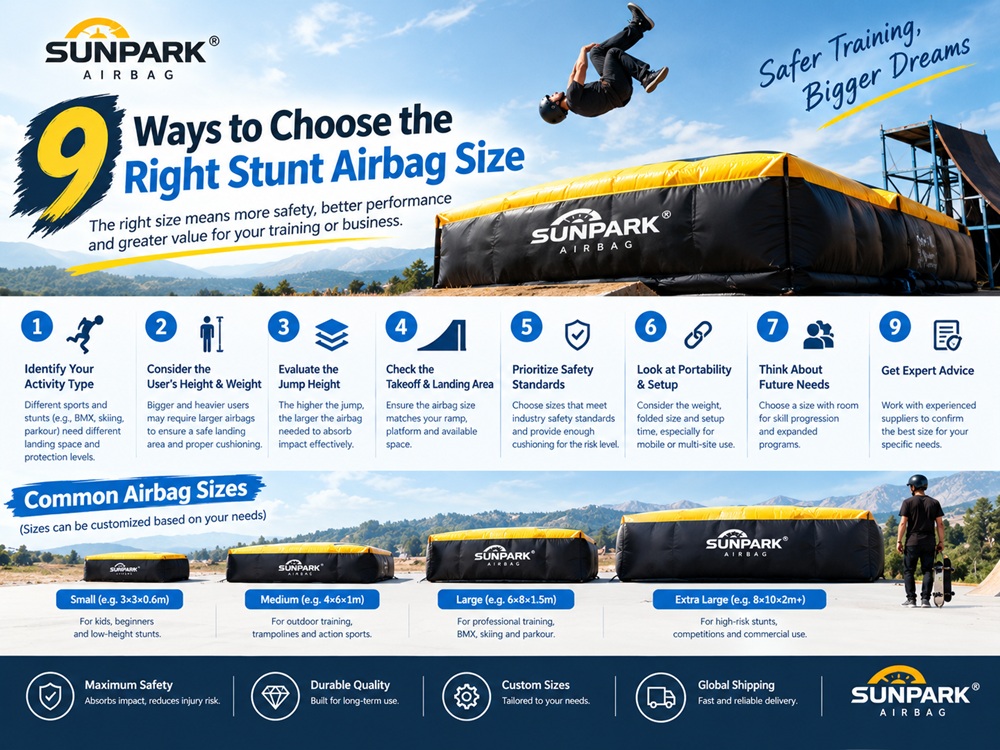
In the high-stakes industry of extreme sports, trampoline parks, and ski resorts, liability is the silent killer of profitability. We see commercial operators every day obsess over ticket sales and marketing, while actively ignoring the structural integrity and compliance of their equipment. When a catastrophic injury occurs on an uncertified stunt airbag landing or inside a deteriorating foam pit, your insurance underwriter will immediately request your compliance documentation. If you cannot produce valid Sports Facility Safety Certifications, your coverage will be voided, and your business will not survive the resulting litigation.
From our experience engineering advanced pneumatic safety systems at SUNPARK® AIRBAG, we know that generic equipment sourced from unverified trading companies is a ticking time bomb. The global standard for extreme sports safety is not subjective; it is dictated by rigorous, objective testing protocols created by independent engineering bodies. In this comprehensive guide, we will aggressively dissect the 8 essential safety certifications every commercial operator must demand. We will explain not only what these acronyms mean, but whether a specific certification is actually worth prioritizing when upgrading your facility architecture.
Quick Answer: The Certifications You Cannot Ignore
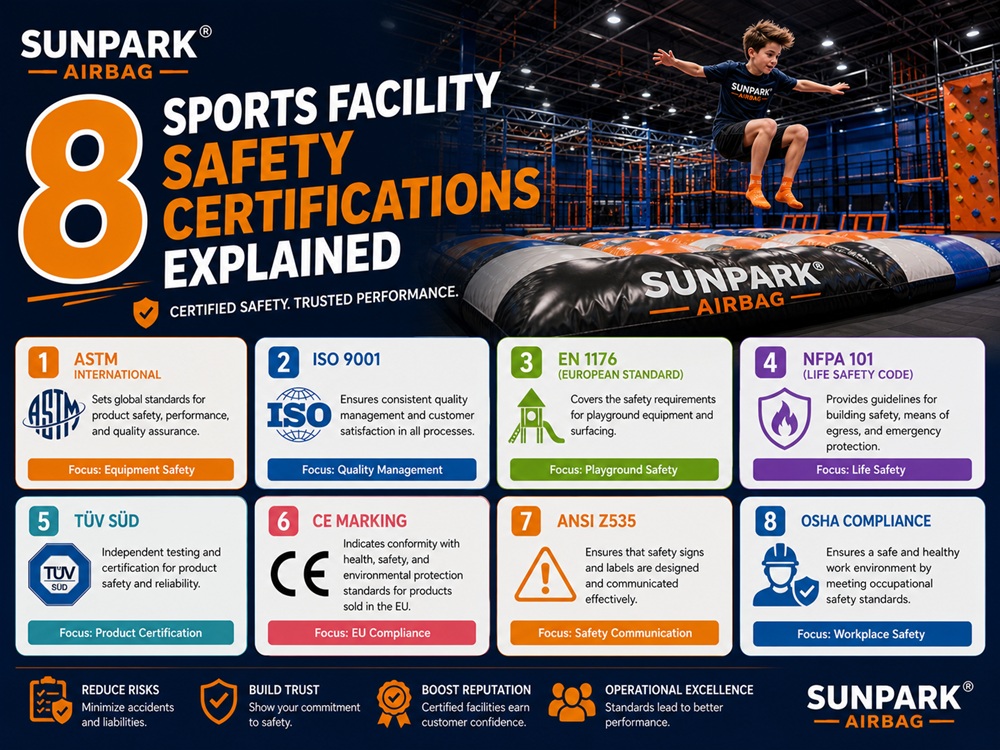
Sports Facility Safety Certifications are rigorous, standardized testing protocols that verify the structural integrity, non-toxicity, and fire resistance of sports equipment. The 8 critical certifications are: 1) ASTM F2970 (Trampoline & Adventure Park Standards), 2) EN 14960 (European Inflatable Equipment Safety), 3) TÜV SÜD Certification (Global Quality Mark), 4) ISO 9001 (Manufacturing Quality Management), 5) NFPA 101 / EN 13501-1 (Fire Retardancy Codes), 6) CE Marking (European Health & Safety), 7) REACH Compliance (Material Toxicity), and 8) IATP Compliance (International Association of Trampoline Parks). In most professional situations, we recommend exclusively purchasing equipment that carries TÜV SÜD and ASTM compliance, as these are the gold standards demanded by commercial liability insurers.
Table of Contents
- What Are Sports Facility Safety Certifications?
- The 8 Critical Safety Certifications Explained
- How Certification Testing Actually Works
- The Commercial Benefits of Certified Equipment
- Limitations and Hidden Costs
- Who Should Use It & Who Does Not Need It
- Common Procurement Mistakes
- Strategic Buying Considerations
- Essential Comparison Tables
- Expert Recommendation from SUNPARK®
- Frequently Asked Questions (FAQ)
What Are Sports Facility Safety Certifications?
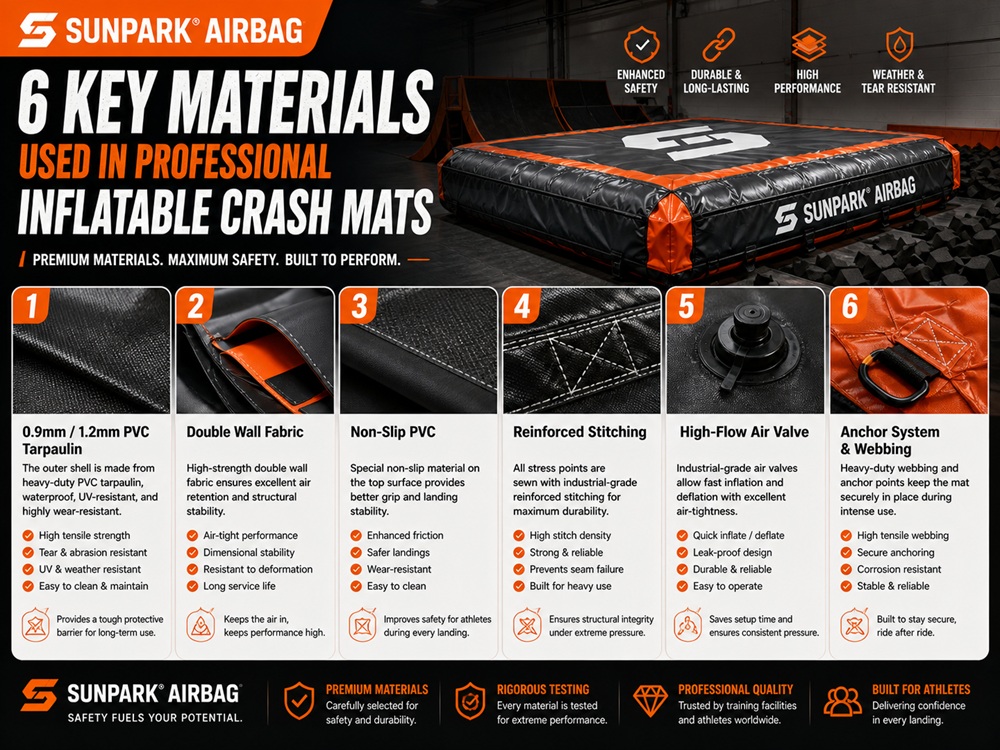
Safety certifications are independent, third-party engineering audits. They are not internal quality checks conducted by the factory; they are ruthless physical evaluations performed by organizations like ASTM International or TÜV SÜD. When evaluating an inflatable crash mat, the certification body tests the tearing strength of the PVC, the burst pressure of the seams, the toxicity of the dyes, and the self-extinguishing properties of the material when exposed to an open flame.
A certified product carries a legally binding document stating that the equipment will perform exactly as engineered under extreme, repetitive dynamic loads. If you are operating a facility with a big jump airbag system, these certifications are the only barrier standing between your business and a gross negligence lawsuit.
The 8 Critical Safety Certifications Explained
1. ASTM F2970 / ASTM F2374 (North American Standards)
ASTM International sets the benchmark for indoor trampoline courts and inflatable amusement devices. These standards dictate operational procedures, redundant blower requirements for airbags, and patron clearance zones. If you operate in the United States, ASTM compliance is non-negotiable for securing commercial liability insurance.
2. EN 14960 (European Norm for Inflatable Equipment)
This is the European equivalent of ASTM for inflatables. EN 14960 strictly regulates the physical design of equipment—preventing entrapment hazards (where a limb or head could get stuck), dictating minimum blower pressure, and requiring specific anchor point strengths. Whether you are installing a gymnastics airbag equipment setup or a commercial bounce house, EN 14960 guarantees structural safety.
3. TÜV SÜD Certification
TÜV SÜD is a globally recognized German testing agency. A TÜV mark on a product means the manufacturer’s claims have been independently verified through exhaustive physical stress testing. It is the ultimate seal of quality. When consulting trampoline park equipment manufacturers, demand to see their TÜV certificates.
4. ISO 9001 (Quality Management Systems)
ISO 9001 does not test the product; it tests the factory. It ensures that the manufacturer has a consistent, documented process for building equipment. A factory with ISO 9001 certification will not accidentally use weak thread on a Tuesday because they ran out of the commercial-grade thread they used on Monday.
5. NFPA 101 / EN 13501-1 (Fire Safety Codes)
This is where traditional foam pits fail catastrophically. The National Fire Protection Association (NFPA) Life Safety Code requires materials to resist ignition and prevent flame spread. Polyurethane foam blocks are highly flammable and emit toxic cyanide gas when burned. We strongly advocate abandoning foam pits. By consulting a foam pit vs airbag comparison, you will see that premium airbags are manufactured from fire-retardant PVC that self-extinguishes, easily passing fire marshal inspections.
6. IATP Compliance (International Association of Trampoline Parks)
The IATP doesn’t issue engineering certificates, but they enforce a strict code of conduct and design guidelines for their members. IATP-compliant parks must use equipment that meets ASTM or EN standards. Joining the IATP and adhering to their facility guidelines significantly lowers your insurance premiums.
7. CE Marking
The CE mark indicates conformity with health, safety, and environmental protection standards for products sold within the European Economic Area (EEA). If you are buying a FMX airbag landing system, the internal blowers must carry CE certification to ensure they won’t short-circuit or cause electrical fires.
8. REACH / RoHS Compliance
These European certifications regulate chemical toxicity. Sports equipment involves heavy skin contact. If a manufacturer uses cheap, unauthorized plasticizers (phthalates) in their PVC, it can cause severe allergic reactions or long-term health issues for athletes. REACH compliance guarantees the vinyl is non-toxic and skin-safe.
How Certification Testing Actually Works
In most professional situations, a manufacturer submits their product to a lab. For a dirt bike airbag landing, engineers will perform drop tests using heavy weights to simulate the kinetic energy of a 250lb motorcycle and rider falling from 40 feet. They test the pressure relief valves to ensure they vent air fast enough to prevent a hard bounce, but slow enough to prevent the rider from bottoming out against the concrete floor. Only after passing these violent dynamic tests is the certificate issued.
The Commercial Benefits of Certified Equipment
The ROI of buying certified equipment is immediate. First, it drastically reduces your annual insurance premiums. Insurers view uncertified equipment as an unacceptable risk and will either deny coverage or charge exorbitant rates. Second, it guarantees uptime. Certified equipment uses 0.55mm to 0.9mm reinforced Plato PVC with double-welded seams, meaning you won’t have to shut down your bike airbag landing for constant patch repairs.
Limitations and Hidden Costs
We must apply commercial and practical judgment: certifications cost money. A manufacturer spends tens of thousands of dollars auditing their products. Therefore, a TÜV-certified airbag will inherently cost more upfront than a generic uncertified bag found on a discount wholesale website. If your capital is highly constrained, you might be tempted to cut corners, but doing so shifts the financial burden from your procurement budget directly to your legal liability budget.
Who Should Use It & Who Does Not Need It
For commercial users and extreme sports facilities: Ski resorts, BMX training facilities, gymnastics academies, and trampoline parks absolutely must use equipment backed by ASTM, EN, and TÜV certifications. Your operational survival depends on it.
Who does not need it: If you are a private hobbyist buying a small inflatable mat for your backyard, you do not strictly require commercial-grade ASTM documentation. However, you should still demand fire-retardant and non-toxic (REACH) materials to protect your family.
Common Procurement Mistakes
In our testing and market observation, the most devastating mistake buyers make is assuming a “CE” sticker means the entire product is safe. Unscrupulous manufacturers will slap a CE sticker on the electrical air blower and claim the entire airbag is certified. You must demand the testing report for the actual PVC structure, not just the fan.
Another major error occurs when facilities attempt to buy used airbag landing systems. Certifications belong to the original structural integrity of the bag. A used bag with UV degradation, compromised seams, and internal baffle damage no longer performs to the certified standard, exposing the new owner to massive risk.
Strategic Buying Considerations
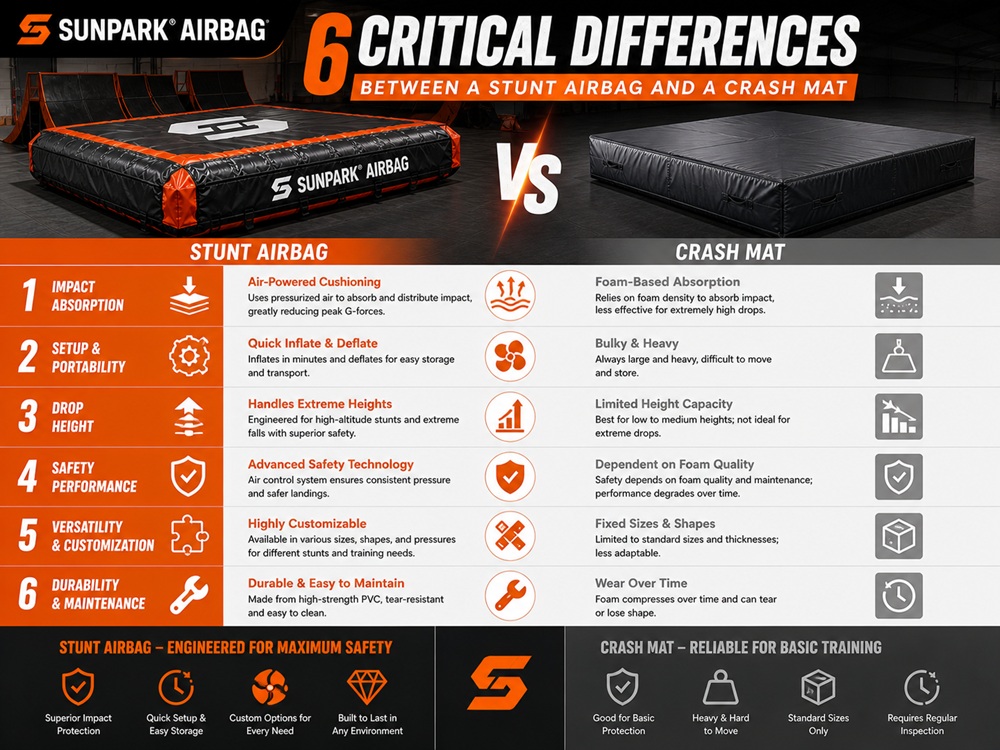
When upgrading your facility, look beyond the initial purchase price. Factor in the cost of maintenance, hygiene, and fire code compliance. Traditional foam pits require constant replacement of disintegrated foam, harbor dangerous bacteria (MRSA/Staph), and fail fire inspections. By reviewing the best airbag landing systems 2026, you will see that pneumatic airbags feature antimicrobial top sheets, require zero consumable replacement parts, and are inherently fire-resistant.
Essential Comparison Tables
| Certification | Region / Authority | What It Tests For |
|---|---|---|
| ASTM F2970 | North America | Trampoline court design, operation, and structural safety. |
| EN 14960 | Europe | Inflatable equipment safety, entrapment hazards, blower capacity. |
| NFPA 101 | United States (Fire Marshal) | Material flammability, smoke toxicity, and fire retardancy. |
| TÜV SÜD | Global (Germany) | Rigorous independent stress and performance validation. |
| Feature | Certified Pneumatic Airbag | Traditional Foam Pit |
|---|---|---|
| Fire Safety Compliance | Passes NFPA / EN 13501-1 (Self-extinguishing) | Fails (Highly flammable, toxic smoke) |
| Hygiene Standards | Antimicrobial top sheet, easily sanitized daily | Absorbs sweat, harbors bacteria, impossible to clean |
| Insurance Approval | Preferred by underwriters; lowers premiums | Increasingly denied coverage due to spinal injury risks |
| Maintenance Cost | Low (Occasional top-sheet replacement) | High (Constant replacement of degraded foam blocks) |
| The Pros (Advantages) | The Cons (Disadvantages) |
|---|---|
| Absolute legal protection in the event of a patron injury. | Higher initial capital expenditure. |
| Drastic reduction in commercial liability insurance premiums. | Limits your supplier options to premium manufacturers. |
| Equipment lifespan is significantly longer (5-10 years). | Requires adherence to strict maintenance logs and daily checks. |
Expert Recommendation from SUNPARK® AIRBAG
In most professional situations, attempting to save a few thousand dollars by purchasing uncertified extreme sports equipment is the fastest way to bankrupt a facility. Fire marshals and insurance underwriters are actively shutting down parks that rely on outdated, non-compliant safety nets. We strongly recommend completely eliminating foam pits and upgrading exclusively to ASTM and EN-compliant pneumatic airbag systems.
As industry pioneers, we engineer safety directly into the fabric of our products.
By partnering with a verified manufacturer like SUNPARK®, you guarantee that every jump, flip, and landing is protected by world-class engineering, allowing you to focus on scaling your business safely.
Frequently Asked Questions (FAQ)
Authoritative Industry References
To ensure your facility meets all legal and operational safety requirements, we advise consulting the following organizations:
- ASTM International – The definitive source for F2970 and F2374 standards regarding the manufacturing and operational requirements for trampoline courts and inflatable amusement devices.
- TÜV SÜD – The premier global testing and certification body that provides independent verification of extreme sports equipment under European and international safety directives.
- National Fire Protection Association (NFPA) – Outlines the Life Safety Code (NFPA 101), which governs the strict flammability ratings required for indoor sports facility materials.