We see it all too often across industries ranging from automotive design to extreme sports facility management—people trusting their lives to high-stakes safety systems they fundamentally do not understand. Whether you are driving a sedan down a busy interstate highway at maximum speed or launching yourself off a mega ramp on a heavy motocross bike, the underlying question that defines your survival remains identical: exactly how do airbags work to protect passengers? At SUNPARK® AIRBAG, we have spent well over a decade tirelessly engineering high-performance pneumatic deceleration systems, and we are fiercely opinionated about safety standards. We know that an airbag is not merely a soft pillow thrown in front of a heavy object. It is a meticulously calculated, highly volatile mechanism governed by uncompromising laws of physics, advanced chemistry, and extreme precision timing.
From our experience, failing to grasp the intricate ways airbags work to protect passengers inevitably leads to reckless operational decisions, poor equipment procurement choices, and ultimately, catastrophic human injuries. When facility managers or drivers assume an airbag is just a balloon, they grossly underestimate the kinetic forces involved in a crash. In this definitive, expert-led technical guide, we will break down the aggressive engineering that separates a legitimate, life-saving device from a dangerous, unchecked gimmick. We will explore the momentum mathematics, the explosive chemical reactions, and the specific material sciences that allow these devices to save thousands of lives every single year.
The Physics of Deceleration: Newton’s Laws in Action
To genuinely comprehend how airbags work to protect passengers from a purely physical standpoint, we must immediately turn to Sir Isaac Newton’s Second Law of Motion and the critical concept of mechanical impulse. When a rapidly moving vehicle—or a flying athlete soaring through the air—suddenly stops, their built-up kinetic energy does not just disappear; it must be absorbed and transferred. If a human body strikes a rigid, unyielding object like a steering wheel, a glass dashboard, or a hard packed dirt landing ramp, the deceleration time is practically zero. Because the physical stop is effectively instantaneous, the force applied to the human skeleton, the internal organs, and the brain is violently high, tearing tissue and breaking bone.
Airbags work to protect passengers by artificially and safely extending the duration of this extreme deceleration. By deliberately increasing the amount of time it takes for your body to come to a complete physical halt, the peak force acting upon you is drastically and proportionally reduced. We recommend that anyone involved in high-speed, high-risk activities internalize this basic, undeniable law of physics: the softer and deeper your deceleration zone is, the safer your body will be. Understanding the core mechanics of how airbags work to protect passengers is fundamentally an exercise in managing momentum over a span of milliseconds. The airbag system steps in to stretch a fatal, instantaneous impact into a survivable fraction of a second, effectively dampening the sheer trauma of the crash event.
Momentum, Impulse, and Kinetic Energy Management
In physics, impulse is mathematically defined as the average force of an impact multiplied by the time duration over which that force is applied. Because the total change in momentum in a crash is fixed (for example, you are going from 60 miles per hour to absolute zero regardless of what happens), the only physically possible way to reduce the deadly force applied to the human body is to increase the time of the impact. Automotive airbag systems and continuous-flow extreme sports landing systems both operate on this exact, unshakeable premise. The entire fundamental reason airbags work to protect passengers so efficiently is because the pressurized fabric cushion deliberately collapses upon impact. It slowly cradles the mass of the human body, smoothly absorbing the kinetic energy rather than violently rejecting it back into the occupant.
The Chemistry of Deployment: What Actually Inflates the Bag?
In the automotive realm, the specific way airbags work to protect passengers relies on highly controlled, rapid chemical explosions. You do not have a heavy tank of compressed air sitting inside your steering column or dashboard waiting to be released. Instead, modern passenger vehicles utilize a highly sensitive micro-electromechanical system, commonly known as a MEMS accelerometer. When this tiny sensor detects a sudden, violent deceleration that is strictly indicative of a major crash (and not just hard braking), it immediately triggers an electrical charge. This electrical impulse travels to the inflator module and ignites a solid chemical propellant payload.
Historically, early automotive manufacturers used a compound called sodium azide, but due to its highly toxic nature when unburnt, modern inflators utilize safer, highly engineered compounds like phase-stabilized ammonium nitrate or guanidine nitrate. When we deeply analyze how airbags work to protect passengers, the chemical breakdown is truly awe-inspiring. The sudden ignition causes the solid chemical blocks to rapidly decompose, producing a massive, expanding volume of harmless nitrogen gas. This nitrogen gas expands explosively, inflating a tightly folded, lubricated nylon fabric cushion at velocities exceeding 200 miles per hour. It is chemistry applied in real-time to save human tissue from destruction.
Precision Timing and the Necessity of Controlled Venting
The entire automotive chemical inflation process takes roughly 30 to 40 milliseconds—a time frame that is significantly faster than the blink of a human eye. It is an incredibly violent, aggressive chemical reaction. If the nylon bag does not deploy at exactly the correct millisecond, it becomes a blunt force weapon rather than a life-saving safety device. Furthermore, if you want to know the ultimate engineering secret to how airbags work to protect passengers without causing severe whiplash or concussions, the answer is rapid deflation. If an airbag remained fully inflated, highly pressurized, and perfectly rigid upon impact, your head would simply bounce off it like a basketball hitting a concrete floor.
To ensure airbags work to protect passengers properly and safely, engineers design precise exhaust vents into the rear panels of the nylon fabric. As the human body strikes the fully inflated bag, the hot, pressurized nitrogen gas is instantly and forcefully pushed out through these rear vents. This synchronized deflation allows the cushion to yield, absorbing the violent kinetic energy and gently decelerating the occupant until they are resting safely against the deflated material. Without these vents, the system would be lethal.
Action Sports Innovation: Continuous Pneumatic Deceleration
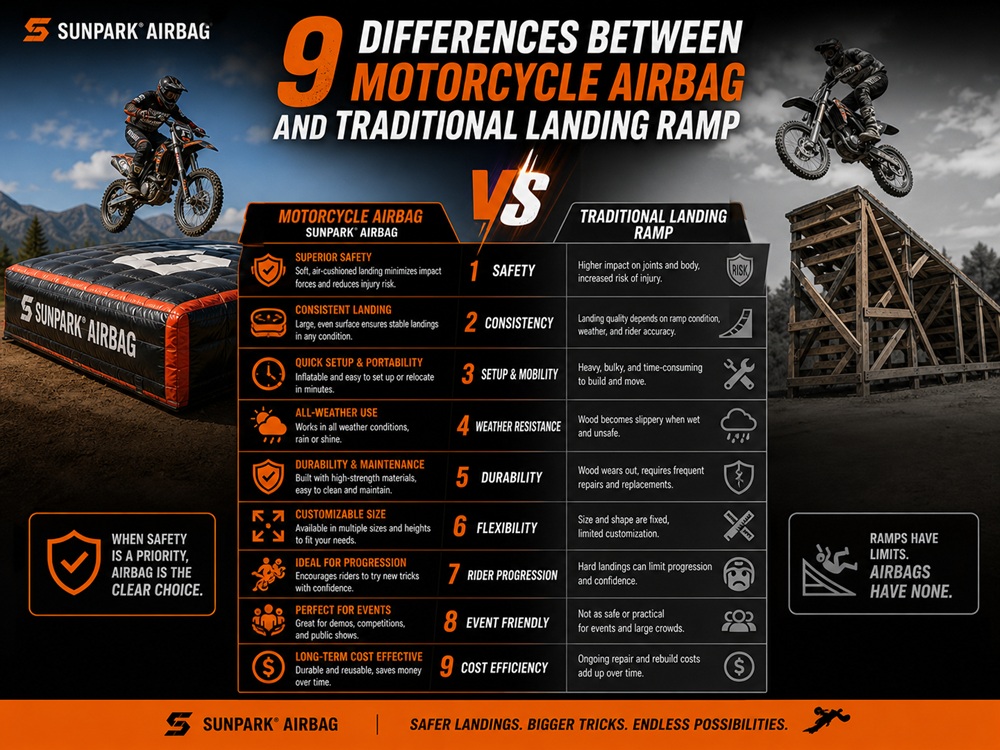
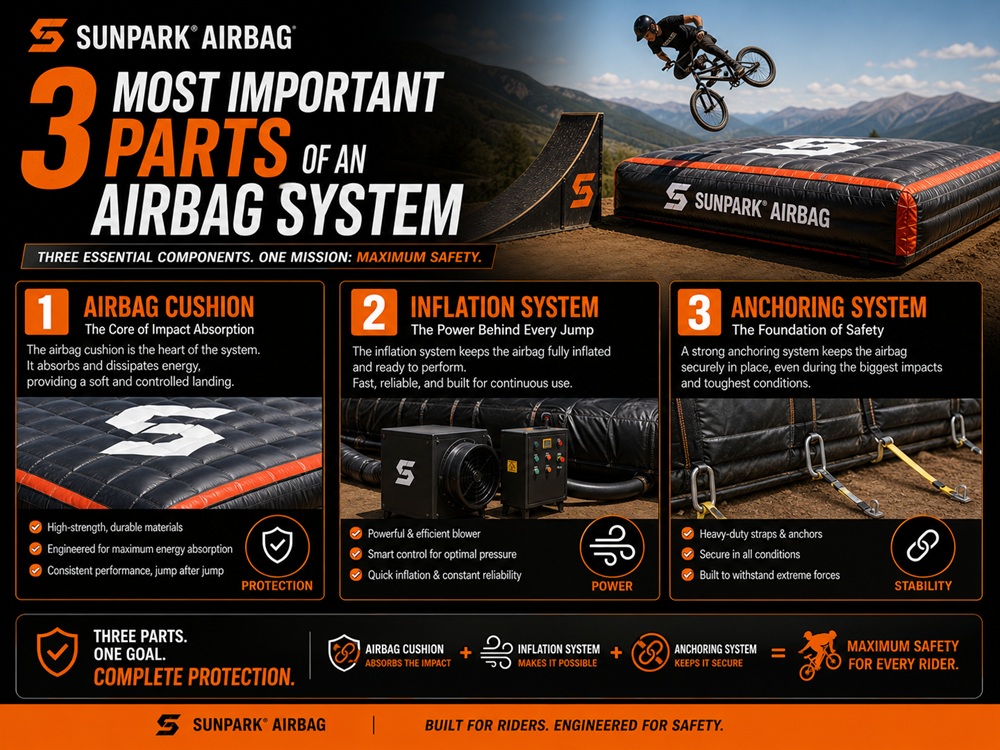
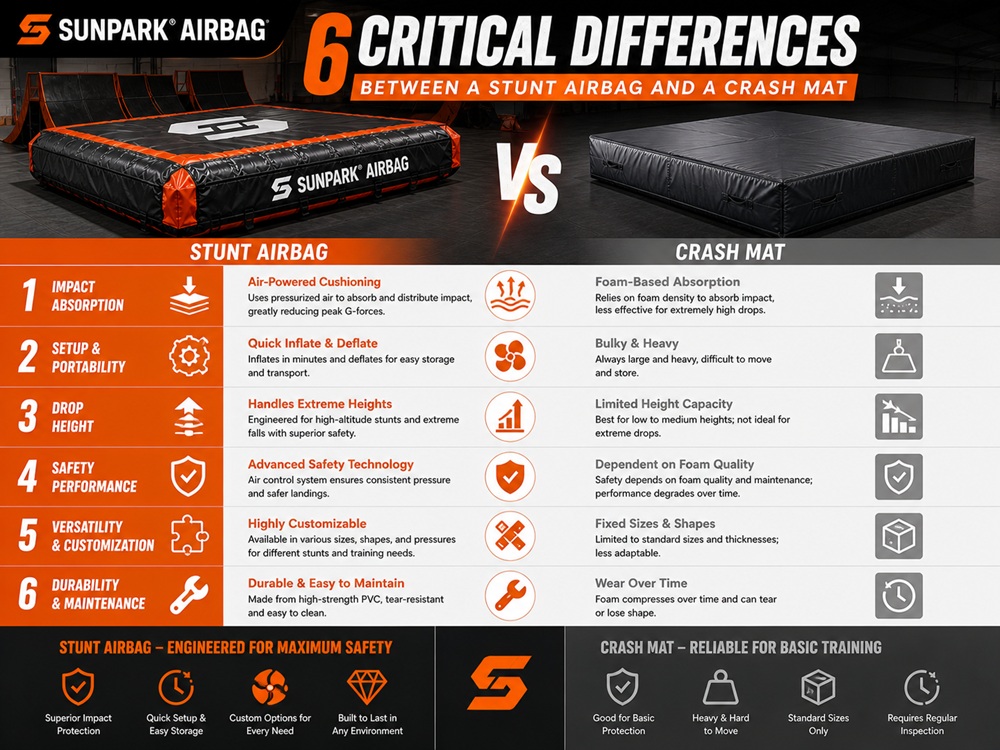
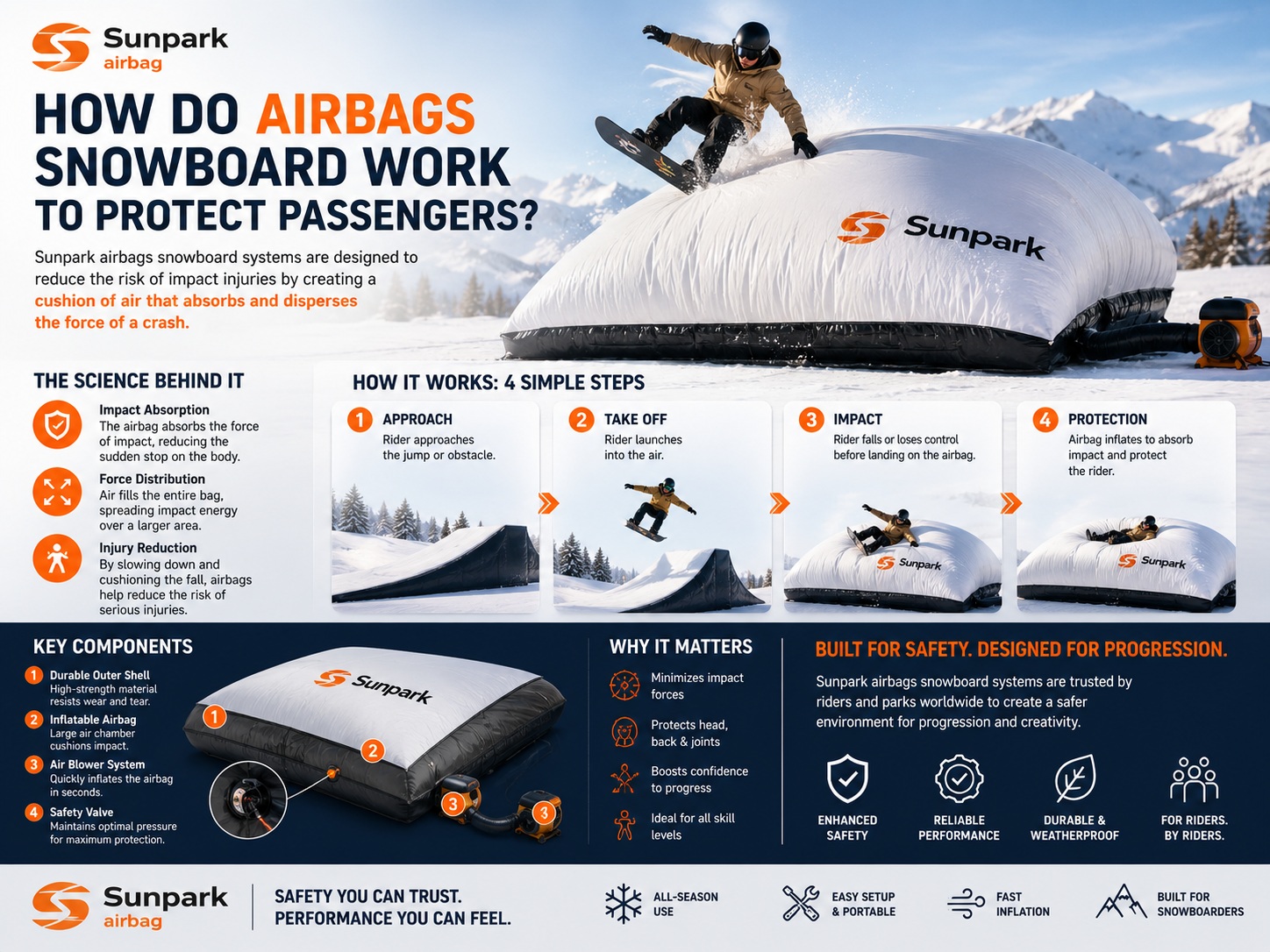
While standard automotive systems utilize single-use, explosive chemical blasts, the extreme sports industry requires a vastly different engineering approach to achieve safety. So, in the high-stakes, high-altitude arenas of freestyle skiing, BMX riding, and professional motocross, how do airbags work to protect passengers and athletes? Instead of a sealed nylon bag that explodes upon a single, catastrophic impact, action sports rely on continuous air circulation and highly advanced multi-chamber pneumatic designs. Heavy-duty industrial electric blowers keep massive, architectural PVC structures constantly inflated at all times.
When an athlete lands on the structure, the top impact chamber acts as the primary decelerator. The heavy kinetic energy of the falling rider compresses the top layer, forcing air down into the internal base chambers and out through precisely calibrated pressure release valves. If you are a facility owner or an athlete looking to push your physical limits safely without visiting the local hospital, reviewing a comprehensive freestyle airbag guide is absolutely mandatory. These advanced setups unequivocally prove that airbags work to protect passengers and riders by seamlessly absorbing repeated, high-tonnage impacts back-to-back, all without ever needing to replace toxic chemical charges or reset the system.
Engineering for Heavy Impact: FMX and Mountain Bikes
When you are dealing with a 250-pound dirt bike and a fully geared rider falling from 40 feet in the air, the stakes are exponentially higher than a simple playground fall. Securing a proper FMX landing airbag for sale is the only legitimate, industry-approved way for professional motocross teams to safely master complex new aerial rotations. The fundamental physics of how airbags work to protect passengers remains identical here—managing impulse and extending deceleration time—but the scale of the physical air displacement is massive. The impact zone features advanced, internal exhaust pillars that systematically release internal air pressure to provide a soft, non-rebounding catch that matches the exact weight of the motorcycle.
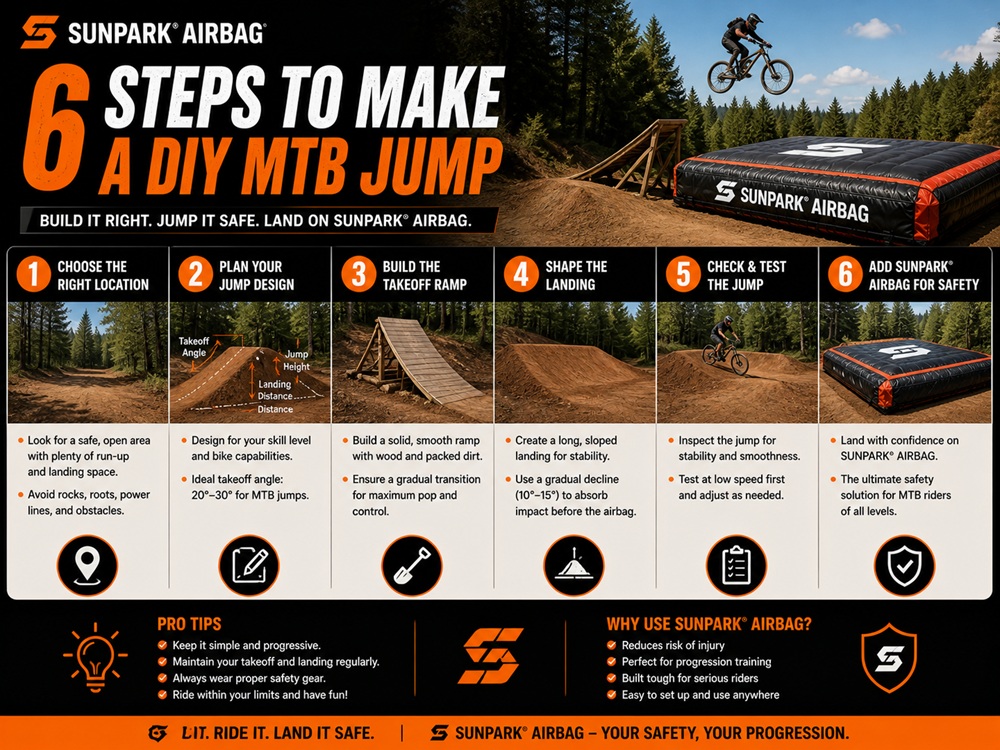
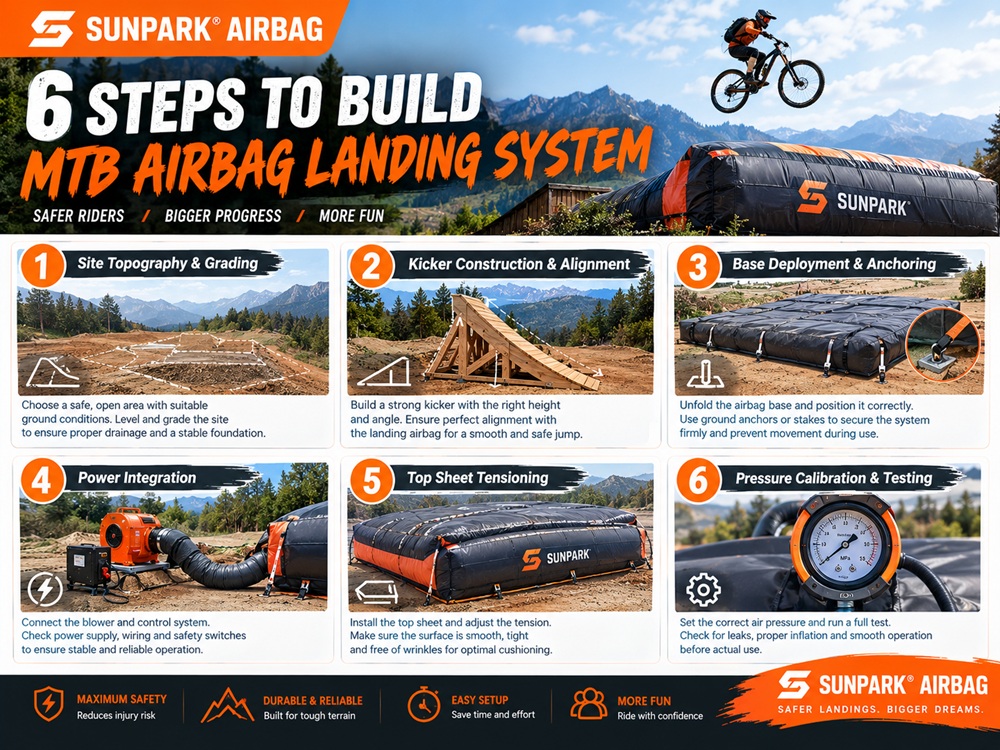
Without this controlled, calculated deflation technology, any inflatable structure is just a dangerous, oversized trampoline waiting to eject a rider back into the air. Similarly, professional bicycle athletes must rely on highly specialized equipment; utilizing dedicated bike airbag landing systems ensures that the specific angle of the inflatable landing ramp precisely matches the downward trajectory of the rider. This architectural precision facilitates a smooth, rolling ride-out rather than a dead, jarring stop, keeping the rider’s momentum flowing safely forward.
The SUNPARK® AIRBAG Manufacturing Standard
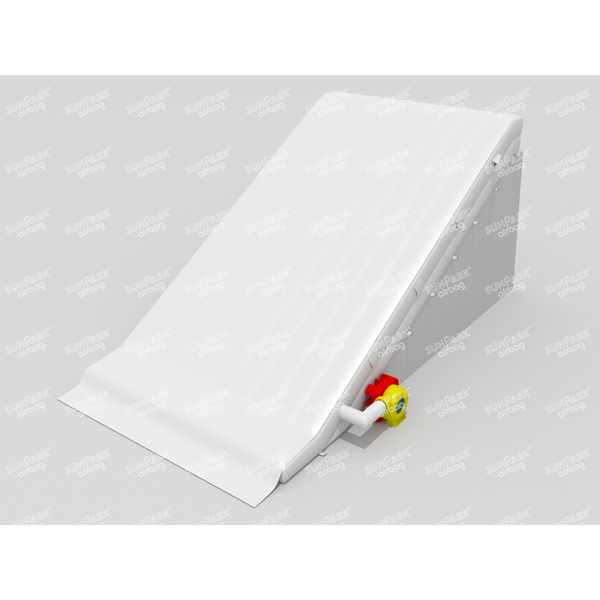
With over 10 years of experience, we provide freestyle airbags for ski resorts, theme park, sports and gymnastics facility around the globe. SunparkAirbag® is the leading manufacturer of Airbags for Extreme Sports and Leisure Industries in China.
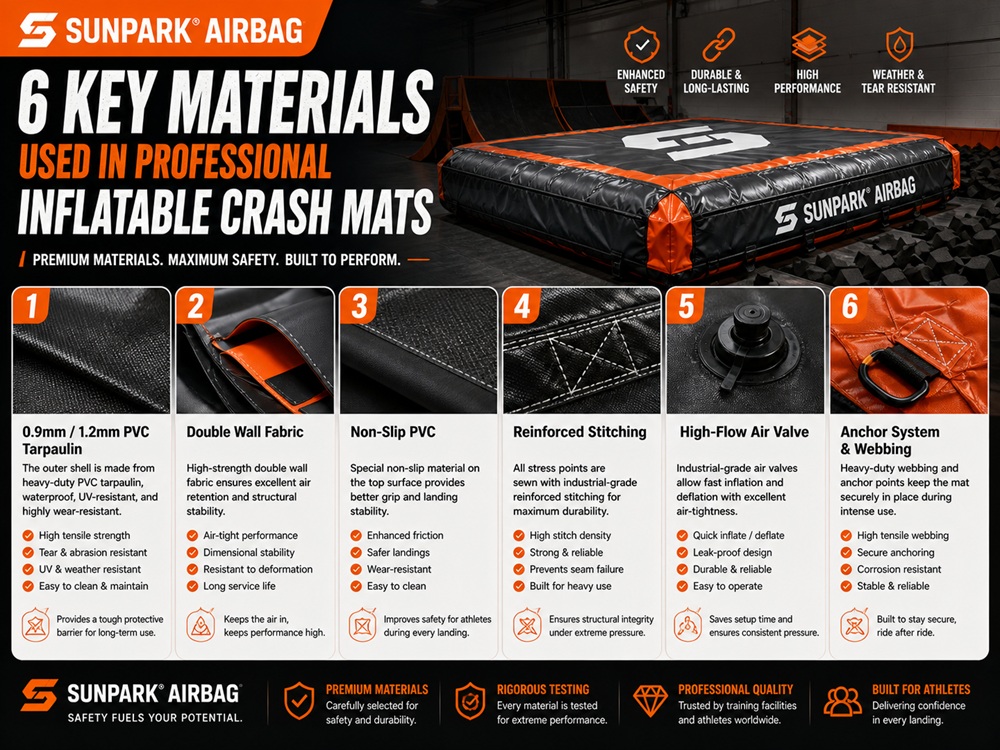
We take the complex science of how airbags work to protect passengers and extreme athletes incredibly seriously. From our extensive manufacturing experience, there is absolutely no room for budget materials, cut corners, or inferior stitching in life-safety equipment. We utilize extreme-duty, commercially rated, fire-retardant Plato PVC, reinforced triple-stitching techniques, and our proprietary dual-chamber internal baffling systems. This ensures that no matter the extreme altitude or the terminal velocity of the physical impact, the user walks away entirely unscathed and ready for another run.
When global facility managers ask us how do airbags work to protect passengers in a high-volume commercial park setting, we point directly to our rigorous, in-house testing protocols and our superior airflow management designs. You simply cannot afford to cut financial corners when gravity, human lives, and facility liabilities are heavily involved.
Summary Table: Automotive vs. Action Sports Airbags
To clearly illustrate the distinct operational differences and to further clarify exactly how airbags work to protect passengers across radically different environmental domains, our engineering team has compiled this technical summary table.
| Engineering Feature | Automotive Safety Airbags | Action Sports Airbags (SUNPARK®) |
|---|---|---|
| Primary Function | Protect vehicle passengers in unexpected, high-velocity collisions. | Provide safe, repeatable deceleration for planned extreme aerial jumps. |
| Inflation Mechanism | Explosive chemical decomposition producing Nitrogen gas. | Continuous ambient airflow driven by industrial electric blowers. |
| Deployment Time | 30 to 40 milliseconds upon sensor impact detection. | Constantly inflated and pressurized during the entire usage session. |
| Deflation Methodology | Rear exhaust vents burst open under body weight pressure. | Calibrated pressure release valves and active air displacement pillars. |
| System Reusability | Strictly single-use; requires total module replacement after firing. | Infinitely reusable for back-to-back training sessions and events. |
Expert Buying Guide and Safety Recommendations
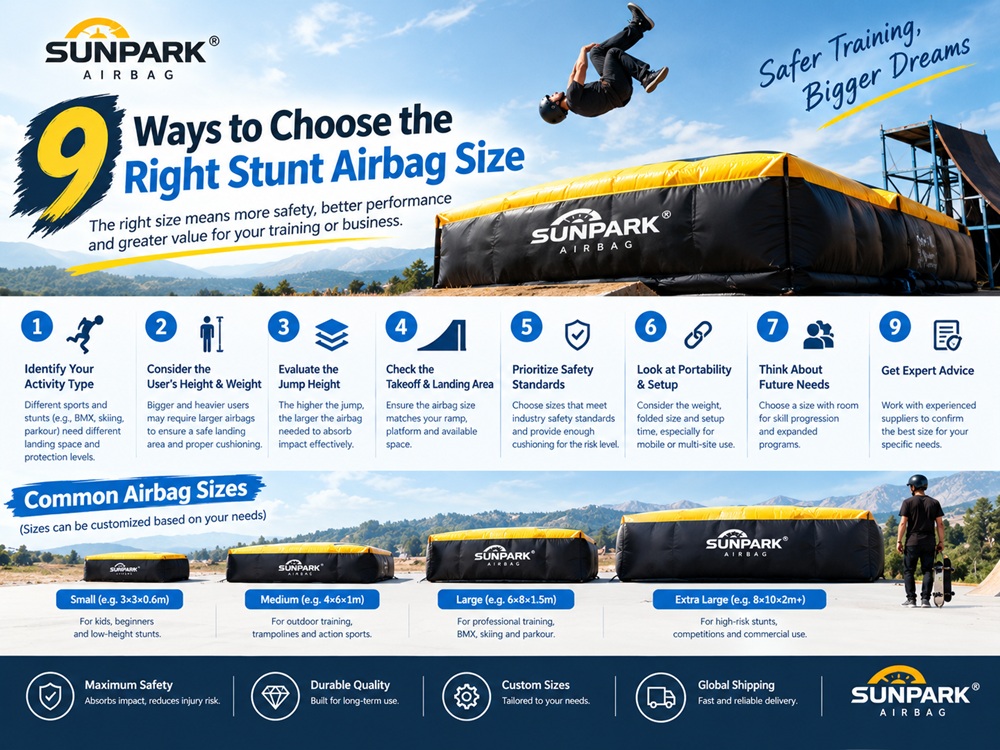
If your extreme sports facility is currently transitioning from outdated, unhygienic foam pits to modern pneumatic landing systems, you must take the time to understand the deep technical specifications involved. For instance, if you consult a detailed mountain bike airbag landing guide, you will immediately notice the heavy emphasis placed on the millimeter thickness of the top impact sheet and the CFM (cubic feet per minute) rating of the blowers. A weak, underpowered blower will inevitably result in the athlete blowing through the chambers, bottoming out, and striking the hard ground underneath. The simple, unforgiving reality is that airbags work to protect passengers only when the internal air pressure is perfectly balanced against the incoming weight of the object striking it.
From our experience, many independent buyers attempt to artificially salvage their budgets by shopping blindly on the second-hand market. While cost savings are tempting, if you choose to go this route, we heavily advise you to meticulously study our buy used airbag landing tips to ensure you are not accidentally purchasing equipment with compromised internal baffles, UV-degraded PVC, or failing seams that could burst upon a heavy landing. Knowing how airbags work to protect passengers empowers you to spot fatal flaws in used equipment before it causes a tragedy on your property.
Frequently Asked Questions (FAQs)
If an airbag remained rigid and fully inflated, it would act exactly like a concrete brick wall. Airbags work to protect passengers by dynamically absorbing kinetic energy; rapid deflation through rear vents allows the nylon bag to safely yield under the immense weight of the human body, smoothly increasing the deceleration time and ultimately preventing fatal blunt force trauma and severe whiplash.
Unlike automotive systems that rely on a one-time, explosive chemical reaction triggered by a crash sensor, sports airbags use continuous industrial blowers to maintain their structural integrity all day long. They utilize specialized internal air chambers and engineered pressure release valves to safely absorb massive, repeated impacts without ever requiring chemical repackaging or downtime.
Yes, they absolutely can. Because automotive airbags deploy at explosive speeds well over 200 mph, they can cause friction abrasions, severe bruising, or even minor bone fractures, particularly if the vehicle occupant is sitting improperly close to the steering wheel or is not wearing a required seatbelt. However, it is a matter of physics: the minor injuries sustained from the bag deploying are vastly preferable to the lethal, catastrophic trauma of striking a solid steering column or shattering a glass windshield.
Industry and Scientific References
To maintain absolute authority, engineering integrity, and transparency regarding how airbags work to protect passengers, we base our structural engineering and safety principles strictly on peer-reviewed chemical science and governmental transportation data. For further technical reading on pneumatic safety systems and chemical deployment metrics, we highly recommend consulting these trusted, authoritative sources: