Snowboarding has always been a sport defined by relentless progression. From landing your first simple straight air to mastering a complex triple cork, pushing the boundaries of extreme sports involves an inherent risk of serious injury. For decades, athletes, coaches, and facility managers relied entirely on traditional foam pits to mitigate this danger. However, the technology surrounding athletic safety and progression has evolved dramatically. Today, the debate of Airbag Snowboard vs Foam Pit is dominating boardrooms at ski resorts, indoor training facilities, and action sports academies worldwide.
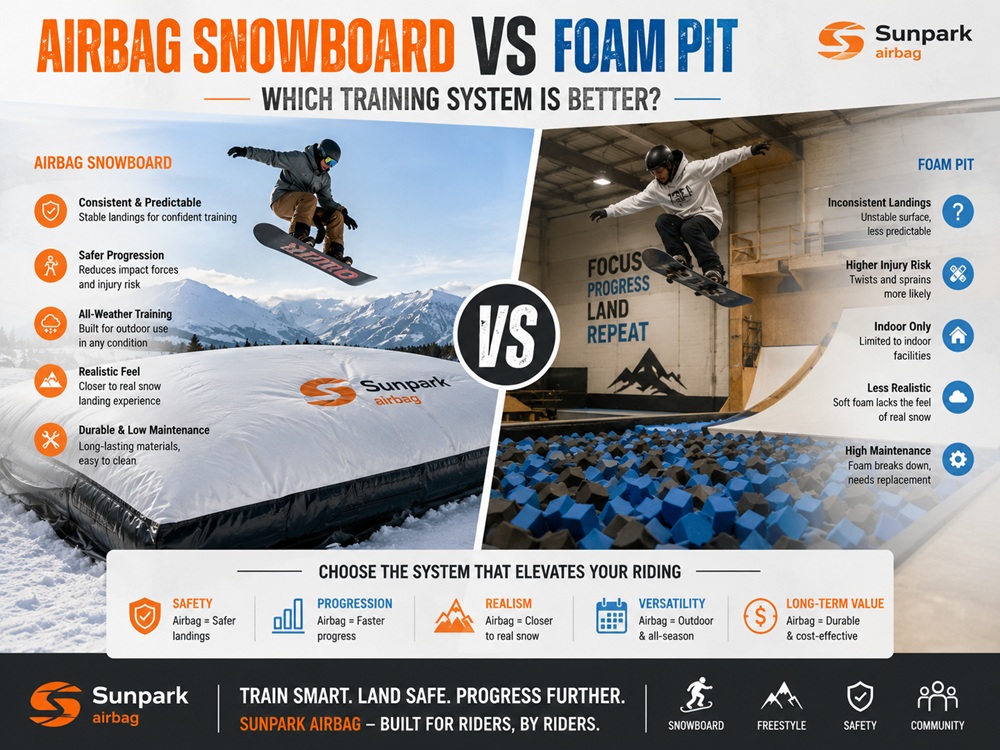
From our experience outfitting the world’s most elite progression centers, we can state unequivocally that the traditional foam pit is rapidly becoming a relic of the past. While foam served its purpose during the early days of freestyle snowboarding, it comes with severe limitations regarding hygiene, maintenance, and realistic trick execution. If you are a facility owner, an athlete, or a coach looking for the ultimate training environment, we strongly recommend transitioning to modern inflatable technology. When you perform a thorough foam pit vs airbag comparison, the inflatable option wins across every critical performance metric.
In this comprehensive, expert-led guide, we will dissect the Airbag Snowboard vs Foam Pit dilemma. We will expose the hidden dangers of foam, highlight the mechanical superiority of airbags, and provide actionable advice on maximizing the return on investment for your training facility.
Table of Contents
- The Evolution of Freestyle Snowboarding Training
- The Harsh Reality: Why Foam Pits Are Holding Athletes Back
- The Superior Choice: Why Airbags Revolutionize Snowboard Training
- Head-to-Head Breakdown: Airbag Snowboard vs Foam Pit
- The Business Perspective: Facility ROI and Marketing
- The SUNPARK® Advantage
- Summary Table: Airbag Snowboard vs Foam Pit
- Frequently Asked Questions (FAQs)
- Industry References
The Evolution of Freestyle Snowboarding Training
Historically, learning a new snowboarding maneuver required waiting for a massive powder day. A fresh, deep blanket of snow was the only forgiving landing surface available. As the sport grew, athletes demanded year-round training capabilities. This necessity birthed the indoor action sports facility, and with it, the massive foam pit. For years, diving into thousands of polyurethane foam blocks was the industry standard for learning aerial awareness without the fear of a hard crash.
However, the demands of the sport changed. Modern snowboarding tricks are intensely complex, requiring precise timing, off-axis spins, and blind landings. Athletes realized that surviving a crash into a foam pit did not necessarily translate to successfully landing a trick on hardpack snow. They needed a training system that allowed them to ride away from a trick, preserving their momentum and reinforcing correct biomechanical muscle memory. This critical gap in the training pipeline led to the invention and mass adoption of the sloped snowboard airbag landing system.
The Harsh Reality: Why Foam Pits Are Holding Athletes Back
We do not mince words when discussing the drawbacks of legacy training systems. From our perspective as safety equipment engineers, traditional foam pits present massive operational, hygienic, and athletic disadvantages. If you are currently operating a foam pit, you are likely already intimately familiar with these severe pain points.
The Hygiene Nightmare
Foam blocks are essentially massive, porous sponges. Every time a rider plunges into a pit, those blocks absorb human sweat, dead skin cells, dirt from snowboard boots, and ambient moisture. Because a foam pit lacks proper air circulation at the bottom, it quickly becomes a breeding ground for harmful bacteria, fungi, and putrid odors. Cleaning a pit requires dozens of hours of manual labor to extract every single block, vacuum the toxic dust that accumulates at the bottom, sanitize the blocks, and replace them. It is a logistical nightmare that most facilities neglect, leading to unsanitary and unsafe training conditions.
Slow Throughput and Ruined Sessions
In the Airbag Snowboard vs Foam Pit debate, throughput is a decisive factor. A foam pit is a crash zone, not a landing zone. When a snowboarder lands in foam, they sink completely. It can take upwards of three to five exhausting minutes for an athlete to unstrap from their bindings, wade through chest-deep blocks, and pull themselves out of the pit. In a one-hour training session, a rider might only achieve ten to fifteen jumps. This abysmal ratio of riding time to recovery time shatters momentum and drastically slows the progression of muscle memory.
Material Degradation and Hidden Danger
Foam degrades rapidly. With constant use, the blocks tear, compress, and lose their impact attenuation properties—a phenomenon known as “packing out.” When the foam packs out, it creates dangerous hard spots. A rider expecting a soft catch can easily punch right through degraded foam and strike the hard concrete floor below, resulting in catastrophic lower extremity or spinal injuries. Furthermore, decaying foam releases micro-particles into the air, creating a severe respiratory hazard for athletes breathing heavily during training.
The Superior Choice: Why Airbags Revolutionize Snowboard Training
We strongly recommend that serious training facilities upgrade to modern inflatable systems. When examining the best airbag landing systems 2026 has to offer, the mechanical and athletic superiority over foam is undeniable. Airbags are not just an alternative; they are an absolute paradigm shift in how athletes progress.
The “Ride-Away” Capability
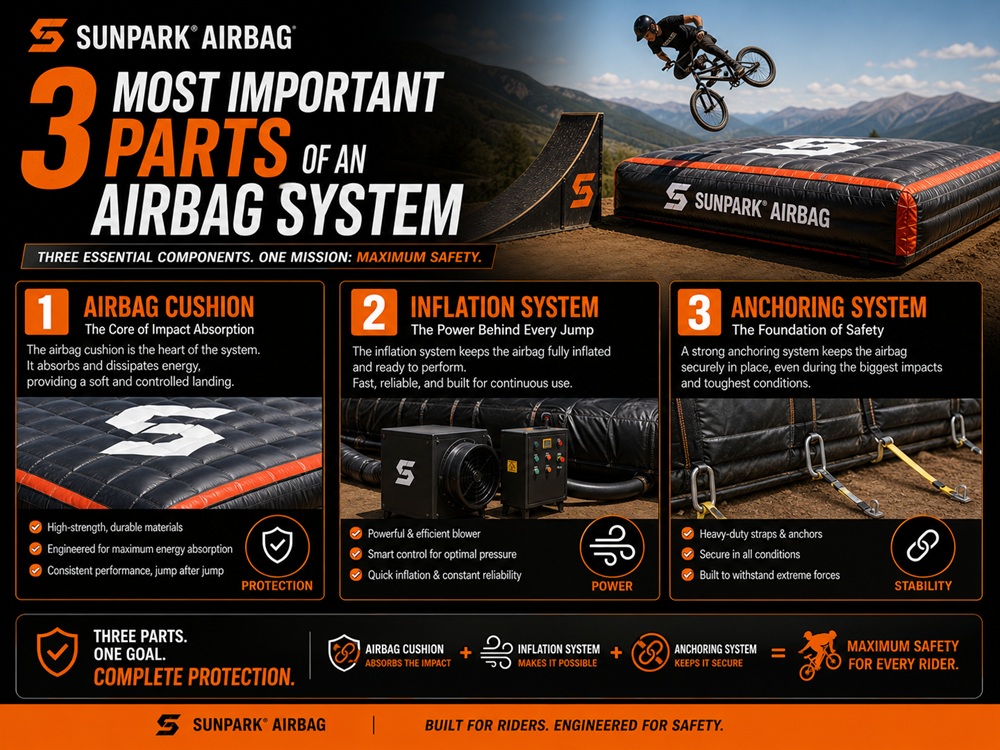
The most profound advantage of an airbag is the ability to replicate a real snowboard landing. Modern systems feature custom-tailored sloped landing profiles. If a rider lands their trick perfectly “bolts,” the surface tension of the airbag allows the snowboard to glide down the transition, enabling the rider to ride away smoothly. This provides instantaneous, accurate feedback. The athlete knows exactly if they would have stomped the trick on real snow. Conversely, if the rider under-rotates or catches an edge, the internal air pillars and proprietary pressure-release vents instantly absorb the crash, enveloping the rider in a safe, soft catch.
Unmatched Repetition and Throughput
Because you ride away from a successful landing or slide quickly off the slick PVC material after a crash, there is zero extraction time. A snowboarder can immediately unstrap, hit the hike-to-surface or magic carpet, and drop in again within seconds. This allows athletes to log fifty to sixty jumps in a single session. This high-frequency repetition is the absolute key to mastering elite maneuvers. Whether you are operating a snowboard jump or a massive FMX airbag landing, the rapid throughput maximizes facility efficiency and athlete satisfaction.
Adjustable Impact Attenuation
Unlike foam, which has a static resistance, an airbag operates on dynamic airflow. Facility operators can adjust the blowers and internal venting to tune the firmness of the landing. You can make the airbag incredibly soft for junior riders learning basic straight airs, or you can dial up the firmness for professional athletes throwing double corks who require a stiffer surface to ride out of the trick at high speeds. This versatility is simply impossible with a traditional foam pit.
Head-to-Head Breakdown: Airbag Snowboard vs Foam Pit
To truly understand which system reigns supreme, we must evaluate the Airbag Snowboard vs Foam Pit matchup across the core operational metrics that matter to facility managers and coaches.
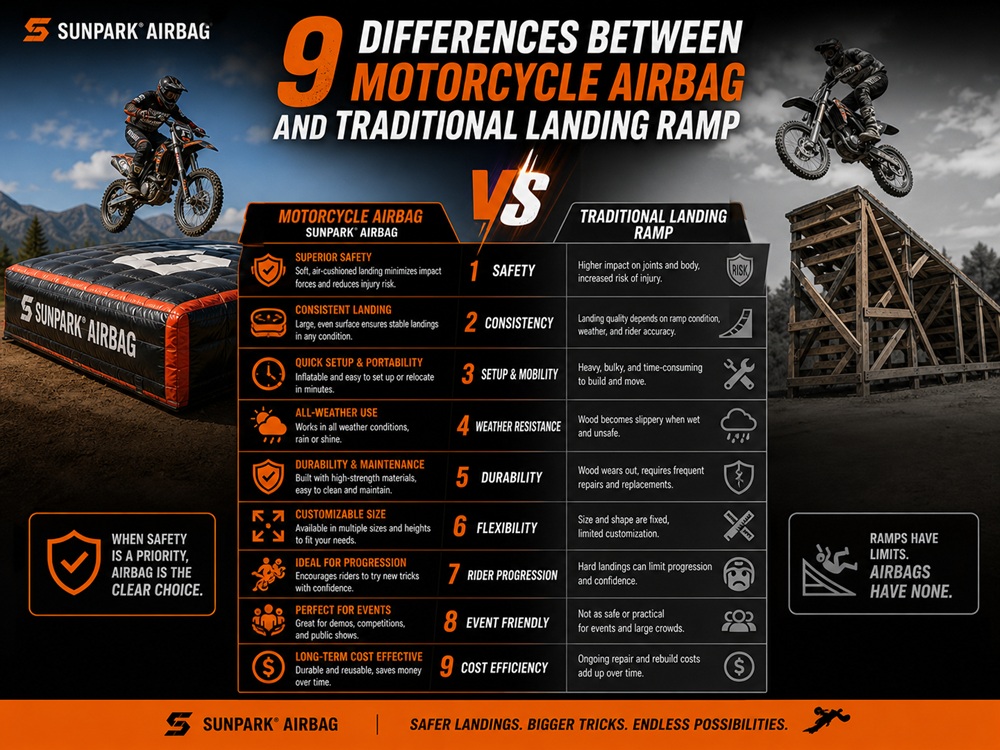
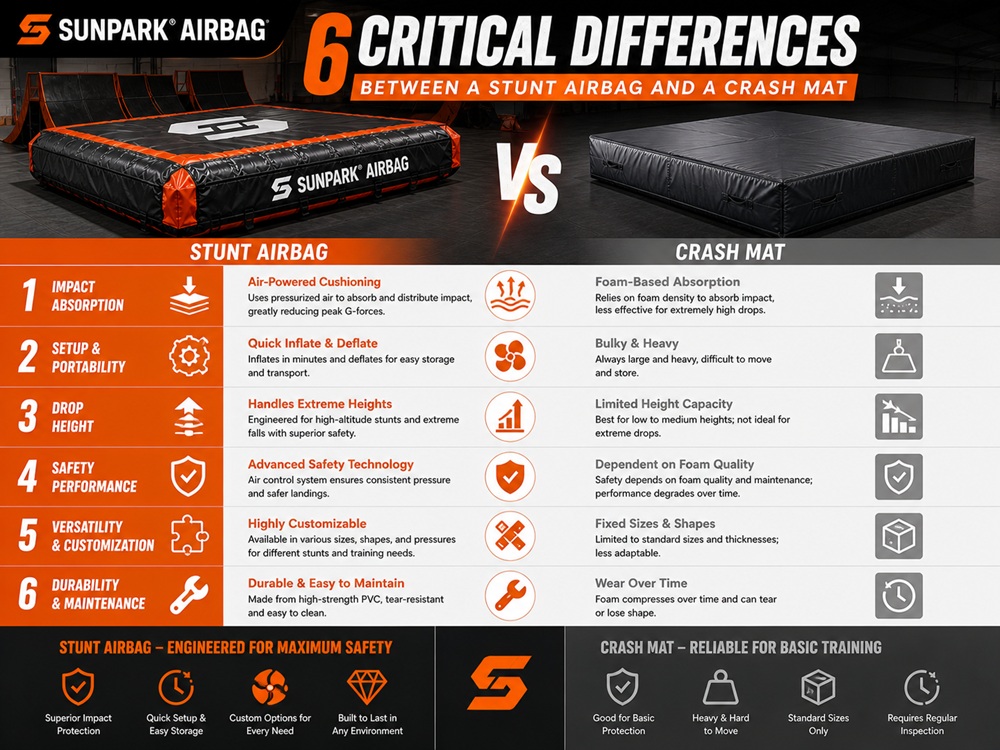
1. Safety and Consistency: Foam degrades unpredictably, creating hidden danger zones. Airbags provide uniform, edge-to-edge impact absorption that remains perfectly consistent from the first jump of the season to the last. There are no gaps, no bottoming out, and no entrapment risks where limbs can be twisted awkwardly between blocks.
2. Hygiene and Sanitation: Cleaning a foam pit requires shutting down operations for days. An airbag features an antimicrobial, heavy-duty PVC or TPU topsheet. Maintaining a sterile environment is as simple as sweeping off any debris and wiping the surface down with a standard sanitizing solution at the end of the day. There is no dust generation and no trapped moisture.
3. Versatility and Footprint: A foam pit is a permanent, massive excavation in your facility floor. Once it is built, it cannot be moved. An airbag is entirely modular. At the end of the season, or if you need to host a different type of event, you simply turn off the blowers, deflate the bag, fold it up, and store it away. This adaptability is why leading trampoline park equipment manufacturers have shifted entirely toward inflatable infrastructure.
4. Weather Resistance: You cannot put a foam pit outdoors on a ski slope; rain and snow would turn it into a frozen, moldy concrete block. Snowboard airbags are designed specifically for outdoor, extreme weather conditions. They function flawlessly in freezing alpine temperatures, allowing resorts to place them directly at the base of on-snow kickers, or utilize them year-round with synthetic dry-slope in-runs.
The Business Perspective: Facility ROI and Marketing
Facility owners often cite the initial capital expenditure of an airbag as a barrier to entry. However, from our experience conducting financial audits for training centers, the total cost of ownership strongly favors the airbag. The Airbag Snowboard vs Foam Pit financial debate is easily settled when you factor in operational expenses.
High-quality fire-retardant foam blocks are exceptionally expensive, and you must replace a large percentage of them annually as they degrade. Add in the high labor costs associated with pit cleaning, and the maintenance budget skyrockets. An airbag requires electricity to run the blowers and occasional minor patching, but its lifespan extends for years with minimal upkeep. Most facilities see a complete return on investment within the first two seasons of switching from foam to air.
Furthermore, an airbag is a massive marketing asset. When parents pay premium prices for freestyle camps, they demand the highest safety standards. Advertising that your facility uses a state-of-the-art inflatable landing system instantly elevates your brand prestige. It shows a commitment to professional-grade safety, whether you are hosting Olympic snowboarders or offering a dirt bike airbag landing for local motocross riders.
SUNPARK® AIRBAG
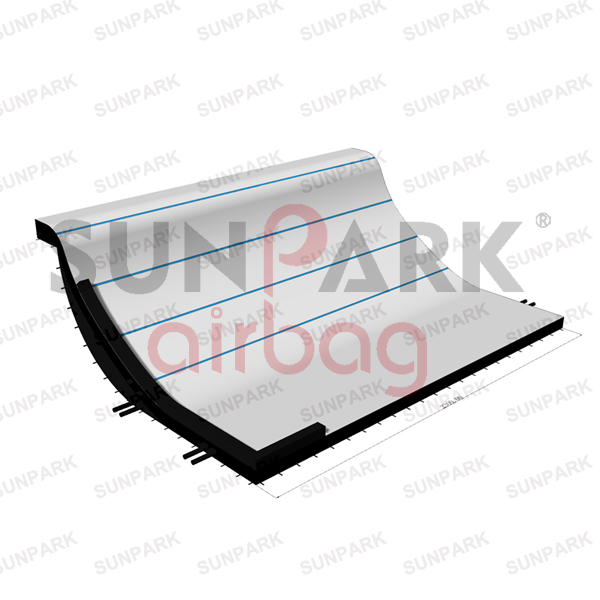
Halfpipe Airbag
With over 10 years of experience, we provide freestyle airbags for ski resorts, theme park, sports and gymnastics facility around the globe. SunparkAirbag® is the leading manufacturer of Airbags for Extreme Sports and Leisure Industries in China.
As extreme sports developed, more and more snowboarders and serious sports enthusiasts are looking for safer training possibilities to progress without risks of getting injured. We create the products for World Champion Snowboarder, famous riders and trampoline parks worldwide. We are deeply committed to the development and improving of our own products.
Summary Table: Airbag Snowboard vs Foam Pit
| Feature / Metric | Snowboard Airbag Landing | Traditional Foam Pit |
|---|---|---|
| Impact Absorption | Consistent, adjustable, dynamic airflow | Degrades over time, static compression |
| Trick Realism | Allows ride-out; mimics real snow landing | Crash zone only; rider sinks and stops |
| Hygiene | Excellent. Easy to wipe down, antimicrobial | Poor. Traps sweat, dust, bacteria, and odors |
| Throughput / Repetition | Extremely high (fast exit, rapid jumps) | Very low (takes minutes to climb out) |
| Maintenance Labor | Minimal. Wipe down and check blowers | Extensive. Requires block removal and vacuuming |
| Outdoor / Winter Capability | Yes. Weatherproof and cold-resistant | No. Absorbs water, freezes, rots |