An inflatable crash pad is only as dependable as its fabric, seams, internal construction, air system, and maintenance history. A thick-looking surface or a high fabric-denier number does not automatically mean a longer service life. For ski resorts, MTB facilities, trampoline parks, and professional training centers, the real question is whether the complete airbag system can withstand repeated impacts and demanding operating conditions without becoming unreliable.
Quick Answer: What Determines Inflatable Crash Pad Durability?
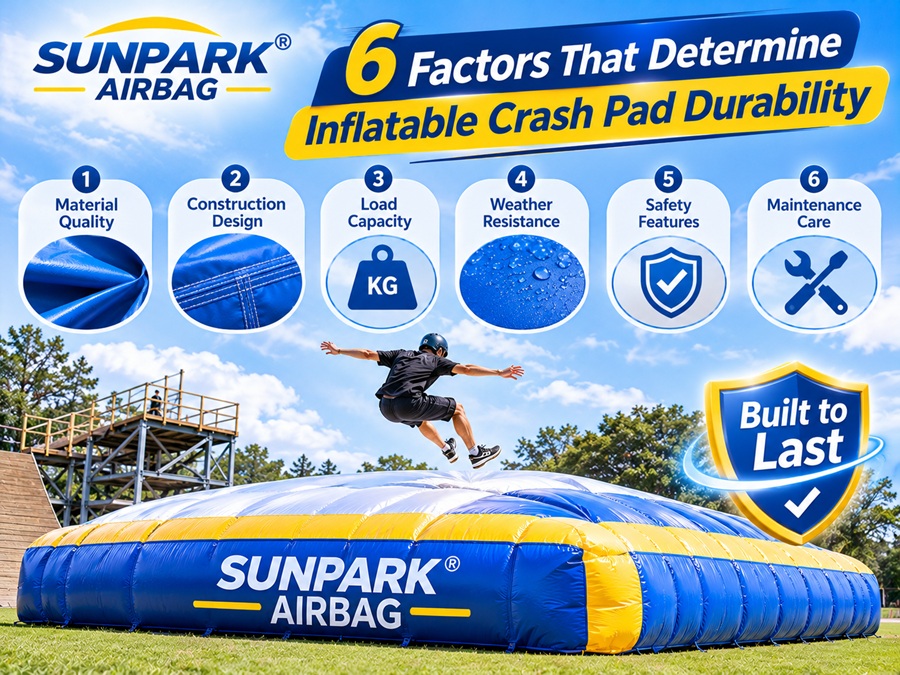
The six most important factors are fabric quality, seam construction, internal structural design, air-retention performance, environmental resistance, and maintenance practices. A durable inflatable crash pad combines strong coated fabric with reinforced high-stress areas, reliable joining methods, consistent air pressure, suitable protection against UV and moisture, and a documented inspection routine.
Our recommendation: evaluate the complete crash pad under its intended impact frequency and operating environment. Do not choose solely by price, fabric thickness, or advertised load capacity. For commercial applications, manufacturing quality and repairability are just as important as the initial material specification.
1. What Is an Inflatable Crash Pad and How Does It Work?
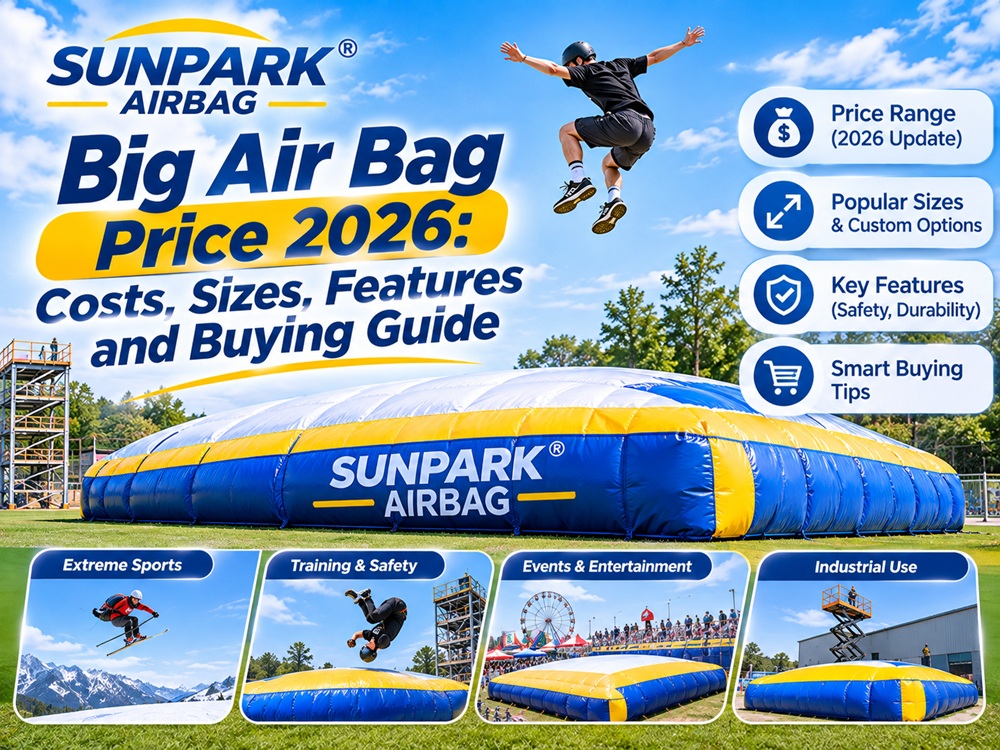
An inflatable crash pad is an engineered air-filled landing structure designed to absorb and manage impact energy during activities such as freestyle skiing, snowboarding, mountain biking, gymnastics, stunt training, and other action sports. Unlike a conventional foam mat, an inflatable crash pad uses a combination of flexible materials, internal air chambers or pressure-management structures, and controlled air movement to provide a landing surface.
Depending on the design, the system may use continuously supplied air, retained air, or a combination of different pressure zones. When an athlete lands, the structure deforms and redistributes the impact load. Air moves within or out of designated areas according to the system’s design, helping manage the landing response.
This distinction matters when assessing durability. A crash pad is not simply a large inflatable fabric bag. It is a complete engineered product in which the outer skin, seams, internal partitions, valves, blower connections, and landing geometry work together.
What Are the Main Benefits?
- Repeatable training opportunities: Athletes can practice selected maneuvers in a controlled training environment.
- Versatile applications: Different designs can support ski and snowboard training, MTB progression, gymnastics, and stunt practice.
- Flexible installation: Inflatable systems can be configured for different venues and operating requirements.
- Potentially lower replacement complexity: A repairable design can make it possible to address localized damage instead of replacing the entire structure.
- Operational adaptability: Properly selected systems can accommodate different landing geometries and training scenarios.
What Are the Limitations?
Inflatable crash pads are not maintenance-free. Some systems depend on continuous blower operation, electricity, correct pressure management, and regular inspections. Sharp objects, abrasion, poor storage, unsuitable weather exposure, and incorrect operation can shorten their useful life.
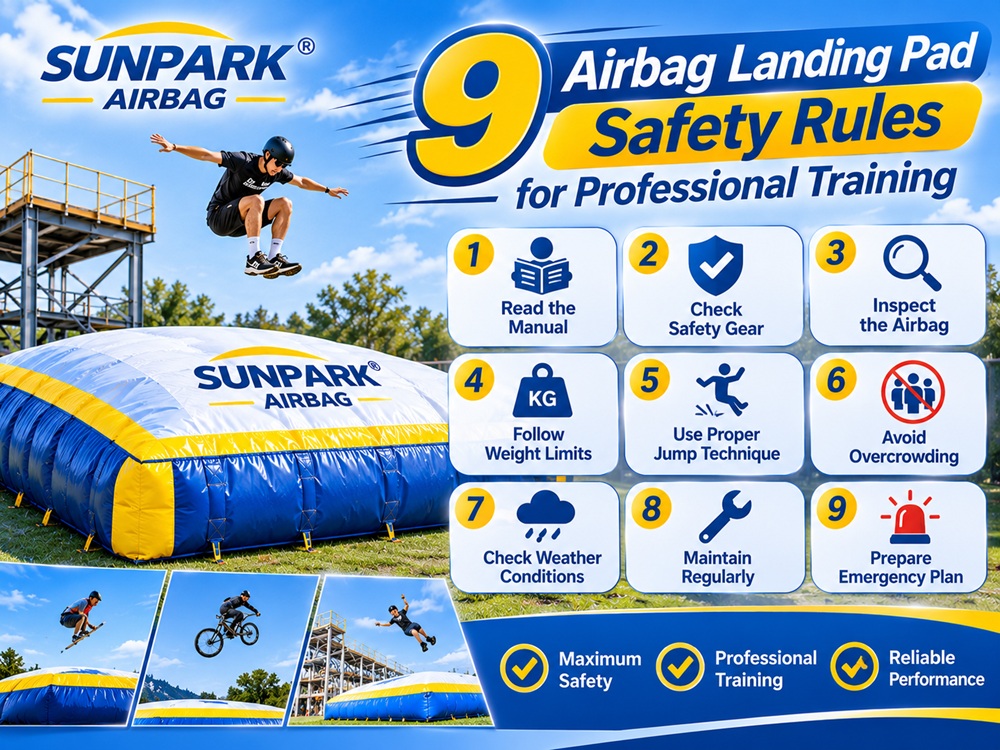
Most importantly, no inflatable crash pad eliminates injury risk. Landing equipment must be selected, installed, inspected, and operated according to the manufacturer’s instructions and the requirements of the activity. It must never be treated as a substitute for professional supervision or a properly designed training environment.
2. Six Factors That Determine Inflatable Crash Pad Durability
Factor 1: Fabric Quality, Coating, and Material Strength
The outer fabric is the first line of defense against impact-related stress, friction, punctures, weather exposure, and repeated handling. Its quality directly affects how well the crash pad maintains its shape and structural integrity over time.
Commercial inflatable products commonly use coated technical fabrics, including PVC-coated polyester. However, simply specifying PVC fabric does not establish whether a product is durable. The fabric’s base yarn, weave, coating formulation, coating adhesion, thickness, and manufacturing consistency all matter.
We recommend evaluating at least four properties:
- Tensile strength: How well the material resists pulling forces before breaking.
- Tear resistance: How well a small cut or damaged area resists spreading under stress.
- Abrasion resistance: How well the surface withstands repeated rubbing against equipment, clothing, footwear, and surrounding surfaces.
- Coating integrity: Whether the coating remains bonded to the base fabric instead of cracking, peeling, or separating.
Fabric weight and denier can help with initial screening, but neither should be treated as a complete durability rating. A heavier fabric may be harder to handle and does not necessarily provide better tear resistance or coating adhesion. Ask manufacturers for actual material test reports rather than relying on a single impressive specification.
Factor 2: Seam Construction and Reinforcement Quality
Seams are among the most important structural details in an inflatable crash pad. Even when the main fabric is strong, poorly designed joints can become the first areas to fail. Repeated loading places stress on connections between panels, internal partitions, handles, attachment points, and landing zones.
Different products use different joining methods, including high-frequency welding, heat welding, and other specialized fabrication processes. The appropriate method depends on the coated fabric, product geometry, and intended application. There is no universal rule that one joining process is automatically superior in every situation.
What matters is the quality of the finished joint. Look for:
- Consistent seam width and alignment.
- Uniform bonding without visible gaps or incomplete sections.
- Reinforcement at corners, transitions, handles, and attachment points.
- Construction that avoids concentrating excessive stress in a single small area.
- Quality-control records and evidence of repeatable production.
For heavy-duty applications, we recommend asking the manufacturer how seams are tested and whether samples from production batches undergo inspection. A close-up photograph is useful, but it cannot replace a documented quality-control process.
Factor 3: Internal Structure and Load Distribution
The internal structure determines how the crash pad responds when an athlete lands. Depending on the design, it may include baffles, partitions, reinforcement panels, internal connections, air channels, or pressure-management zones.
A weak internal structure can allow uneven deformation, localized stress, unwanted bulging, or changes in landing characteristics. These problems may occur even when the outer fabric remains intact.
For example, a commercial MTB facility may experience repeated landings in a relatively concentrated area. A ski training venue may expose a larger landing zone to different approach speeds and impact patterns. The internal design needs to account for these real operating conditions rather than just the overall dimensions of the product.
When assessing construction, ask the supplier:
- How are internal partitions or structural connections attached to the outer shell?
- How is pressure distributed across the landing surface?
- Are high-impact areas reinforced?
- What happens if one internal section develops a leak or damage?
- How does the design maintain consistent landing characteristics under repeated use?
Do not assume that adding more internal reinforcement always produces a better crash pad. Excessive or poorly positioned reinforcement can add weight, complicate repairs, and change the product’s flexibility. The objective is controlled load distribution, not maximum material usage.
Factor 4: Air Retention, Valves, and Blower Reliability
Air management is central to the performance and durability of an inflatable crash pad. A product with excellent fabric and seams can still become operationally unreliable if its valves leak, blower connections loosen, or pressure cannot be maintained consistently.
For continuously inflated systems, the blower and air delivery arrangement must match the product’s requirements. Airflow capacity, operating pressure, connection design, electrical reliability, and ventilation all influence performance. For retained-air designs, the quality of the air-retention structure, valves, closures, and joints becomes especially important.
We recommend checking the following:
- Valve and connector construction, including resistance to repeated handling.
- Availability and replacement cost of compatible valves and blower components.
- Air leakage under normal operating conditions.
- Ease of monitoring pressure and identifying abnormal changes.
- Protection of electrical connections and blower intake areas.
A common purchasing mistake is comparing blowers only by motor power. Higher wattage does not automatically mean better crash pad performance. The required airflow and pressure must be matched to the actual design. An unsuitable blower may increase energy consumption, create unnecessary operating stress, or fail to deliver the intended pressure.
Factor 5: UV, Moisture, Temperature, and Environmental Resistance
Environmental exposure can gradually weaken inflatable crash pad materials. This is particularly relevant for ski resorts, outdoor MTB facilities, and temporary event installations where products may be exposed to sunlight, rain, snow, temperature fluctuations, and prolonged outdoor storage.
UV exposure can contribute to coating degradation, fading, and changes in material flexibility. Moisture can create problems when equipment is folded or stored before it has dried completely. Extreme temperatures may also affect material flexibility and the behavior of seams and valves.
Different venues have different environmental priorities:
- Outdoor ski resorts: Focus on cold-weather suitability, moisture management, snow exposure, and correct off-season storage.
- Outdoor MTB parks: Prioritize UV resistance, abrasion protection, ground-contact protection, and drainage around the installation.
- Indoor training facilities: Focus more heavily on repeated mechanical stress, cleaning compatibility, and ventilation.
- Temporary event operators: Pay particular attention to transport damage, folding procedures, and repeated setup and dismantling.
Ask the manufacturer for the recommended operating and storage temperature ranges, cleaning products, and outdoor exposure limitations. Do not assume that a waterproof coating means the entire crash pad is suitable for permanent outdoor installation.
Factor 6: Maintenance, Inspection, and Repairability
Material quality determines the potential durability of an inflatable crash pad. Maintenance determines how much of that potential is actually achieved.
Small punctures, loose connections, accumulated dirt, moisture, and early seam deterioration are easier to address when discovered promptly. Ignoring them allows minor defects to develop into larger operational problems.
For commercial facilities, we recommend a documented maintenance routine covering:
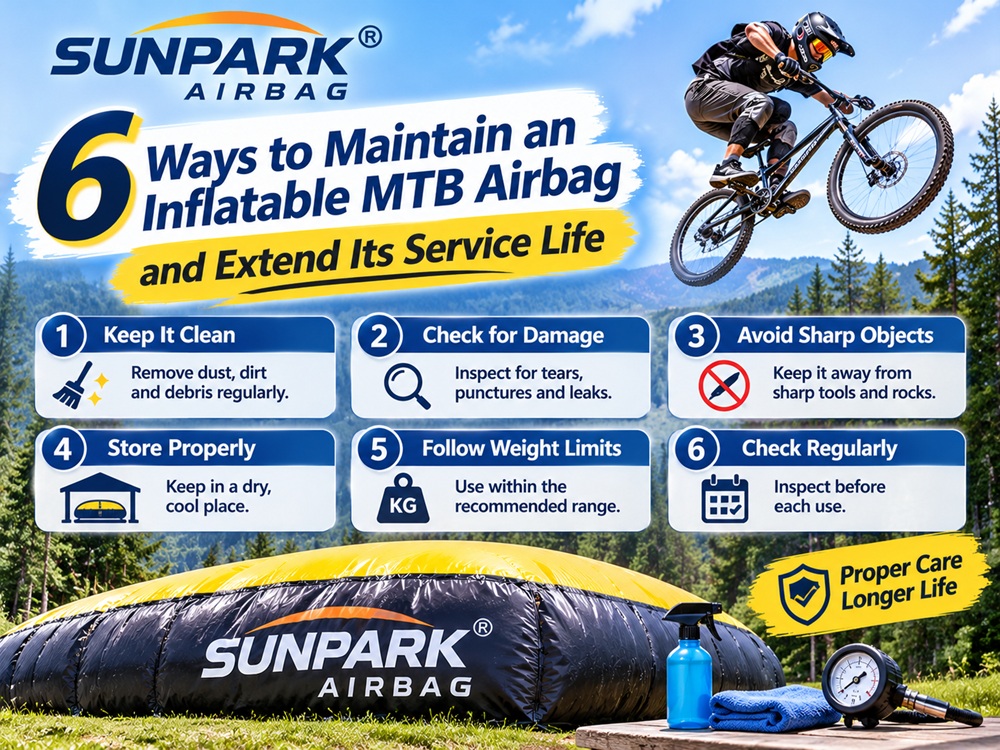
- Pre-use visual inspection of the landing surface and surrounding structure.
- Checks of seams, valves, blower connections, and attachment points.
- Monitoring for abnormal pressure changes or unexpected air loss.
- Cleaning with manufacturer-approved products.
- Drying before folding and long-term storage.
- Recording repairs, recurring defects, and inspection results.
Repairability deserves particular attention when comparing manufacturers. Ask whether the supplier can provide compatible repair materials, replacement valves, technical instructions, and after-sales support. A crash pad that can be repaired correctly may offer a better long-term investment than a cheaper product that must be replaced after localized damage.
3. Material and Construction Comparison: What Should Buyers Prioritize?
The following table is a practical purchasing framework, not a claim that one material or fabrication method is universally best. The correct choice depends on the crash pad design and its intended use.
| Component | What to Evaluate | Why It Matters | Our Recommendation |
|---|---|---|---|
| Outer fabric | Tensile strength, tear resistance, coating adhesion, abrasion performance | Resists everyday wear and structural damage | Request material specifications and test reports |
| Seams | Joint consistency, bonding quality, reinforcement | Reduces the likelihood of joint-related failures | Inspect high-stress areas and production QC |
| Internal structure | Baffle layout, partition connections, load distribution | Supports stable deformation and landing behavior | Match design to actual impact patterns |
| Air system | Valves, airflow, pressure management, connectors | Maintains intended operating characteristics | Verify system compatibility and spare parts |
| Environmental protection | UV, moisture, temperature, cleaning compatibility | Reduces premature material degradation | Specify actual installation conditions |
| After-sales service | Repair kits, replacement parts, technical support | Reduces downtime and lifecycle costs | Choose a supplier with practical repair support |
How Should You Compare Different Crash Pad Designs?
| Comparison Point | Continuous-Air System | Retained-Air System | Buying Implication |
|---|---|---|---|
| Air supply | Requires ongoing air delivery during operation | Designed to retain air without continuous supply | Check the actual operating design |
| Blower dependence | Blower operation is a core operating requirement | May not require continuous blower operation | Evaluate power, backup, and maintenance needs |
| Leak management | Airflow can compensate for designed air discharge and minor system losses within specified limits | Leak prevention and air retention are particularly important | Request pressure and leakage performance information |
| Maintenance priorities | Blower, air inlet, connections, and fabric | Valves, closures, seams, and fabric | Compare total maintenance requirements |
| Application suitability | Depends on the intended landing and pressure-management design | Depends on the intended landing and pressure-management design | Do not choose by system type alone |
Neither system is automatically more durable. The correct comparison is between complete products designed for the same application, with comparable operating requirements and independently documented performance.
4. Pros and Cons of Investing in a High-Durability Inflatable Crash Pad
For a commercial facility, the initial purchase price is only one part of the investment. Downtime, repairs, replacement parts, transport, and operating costs all affect the total cost of ownership.
| Advantages | Limitations and Trade-Offs |
|---|---|
| Higher-quality materials can improve resistance to wear and repeated use. | Premium materials and construction can increase the initial purchase price. |
| Reinforced construction can reduce vulnerability in high-stress areas. | Reinforcement adds complexity and must be correctly engineered. |
| Repairable components can extend practical service life. | Repairs require compatible materials and qualified procedures. |
| Appropriate environmental protection can reduce premature degradation. | No coating makes a product immune to prolonged exposure or poor storage. |
| Reliable air systems can support consistent operating performance. | Blowers, valves, and electrical components still require inspection. |
5. Which Inflatable Crash Pad Is Best for Different Applications?
For Ski Resorts and Snowboard Training
Ski and snowboard facilities should prioritize landing geometry, material flexibility within the specified temperature range, reinforced impact zones, and protection from moisture and UV exposure. A purpose-designed Halfpipe Airbag can be considered where the training layout requires a halfpipe-oriented configuration.
Operators planning a dedicated freestyle training venue should also examine installation requirements and the suitability of the complete landing airbag solutions range. The design should reflect the athletes, maneuvers, available space, and supervision arrangements rather than simply selecting the largest available model.
For MTB Parks and Bike Training Facilities
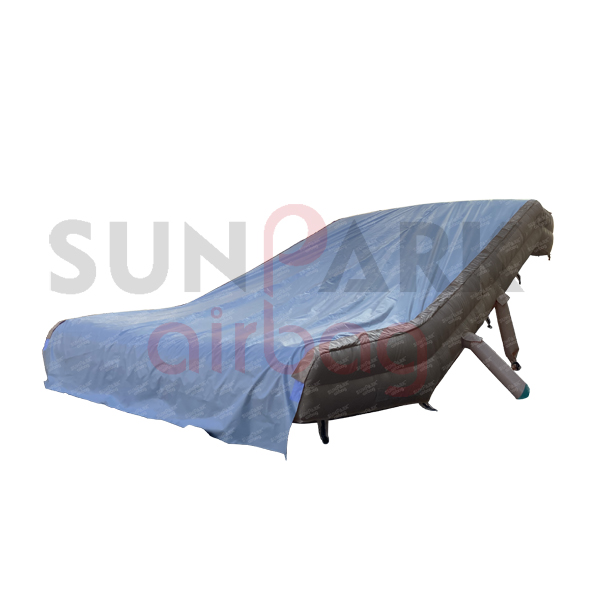
Mountain biking creates demanding conditions because repeated landings may concentrate stress on particular areas. Surface abrasion, ground preparation, dirt, moisture, and equipment contact are important considerations.
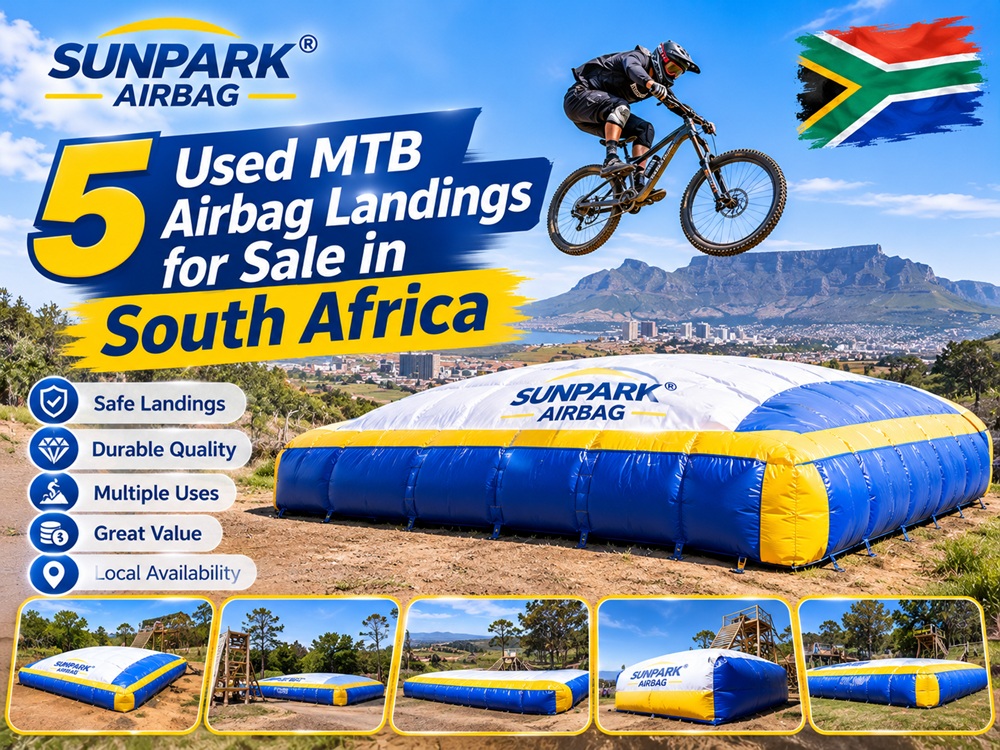
For these installations, compare the construction and repair provisions of a dedicated MTB airbag landing system with the venue’s expected usage pattern. Buyers exploring broader configurations can also review inflatable MTB airbag solutions before finalizing the technical specification.
For Gymnastics and Indoor Training Centers
Indoor facilities often have more predictable environmental conditions, but their equipment may experience frequent daily use. Abrasion, cleaning procedures, repeated loading, and fast turnaround between training sessions become more important.
A dedicated gym airbag for training should be assessed according to the specific training movements and landing requirements. Buyers should not assume that a general-purpose recreational inflatable is suitable for professional gymnastics applications.
For Trampoline Parks and Commercial Leisure Venues
Commercial leisure operators need to consider visitor throughput, inspection procedures, cleaning, repair access, and equipment downtime. A product that performs well during occasional use may not be the best choice for a high-traffic venue.
When budgeting a new facility, durability should be considered alongside installation and operational costs. Our guides to trampoline park construction cost and trampoline park owner income provide additional business-planning context.
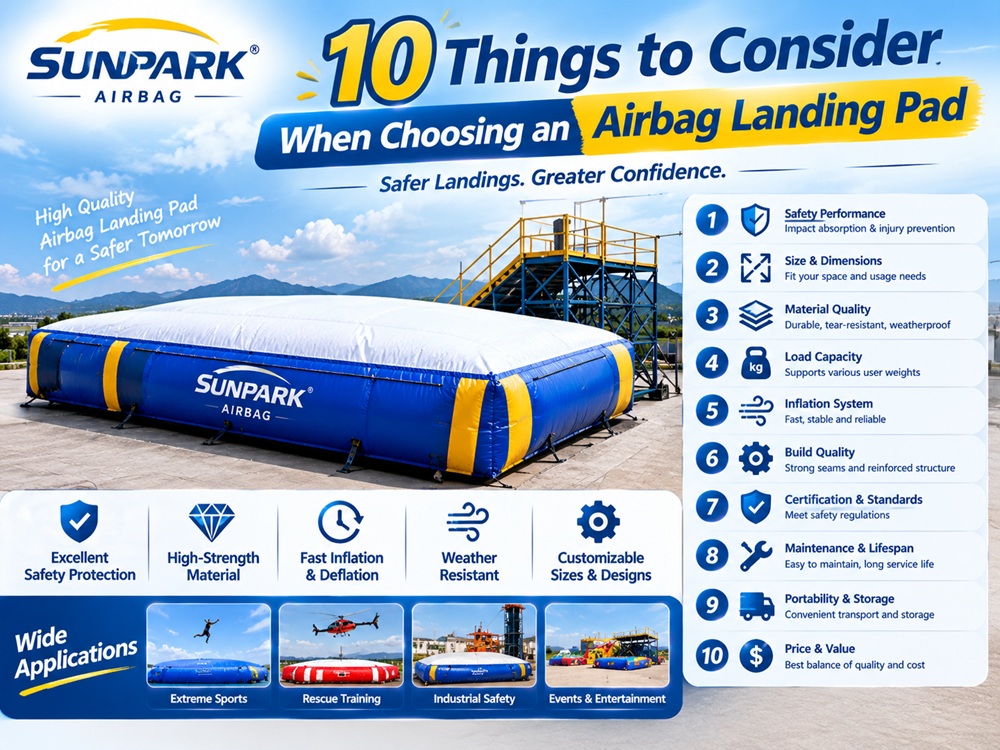
6. Buying Considerations: How to Choose a Durable Inflatable Crash Pad
Before requesting a quotation, define the operating conditions. Manufacturers cannot recommend the right construction accurately if they do not know how the product will be used.
Step 1: Define the Intended Application
Specify whether the crash pad is intended for skiing, snowboarding, MTB, gymnastics, stunt training, or a commercial leisure venue. Explain the intended landing configuration, expected user profile, installation location, and approximate daily usage.
Step 2: Request Material and Construction Documentation
Ask for fabric specifications, relevant mechanical test reports, seam inspection procedures, reinforcement details, and information about internal construction. Where appropriate, request test results from recognized methods for coated fabrics rather than accepting general statements about material strength.
Step 3: Verify the Complete Air System
Request the recommended operating pressure or other relevant operating parameters, airflow requirements, blower specifications, valve details, and instructions for detecting abnormal air loss. Confirm that the equipment is designed to work as a complete system.
Step 4: Evaluate Repairability and Spare Parts
Ask how the supplier handles punctures, seam damage, valve replacement, and blower failure. Confirm whether repair materials are available and whether technical support is provided after installation.
Step 5: Compare Total Cost of Ownership
Calculate the purchase price alongside transportation, installation, power consumption, scheduled inspection, repairs, replacement parts, and expected downtime. A cheaper crash pad may become more expensive if it requires frequent repairs or cannot be serviced quickly.
| Buying Criterion | Questions to Ask the Manufacturer | Priority |
|---|---|---|
| Material | Can you provide fabric specifications and test reports? | Essential |
| Seam quality | How are seams manufactured, reinforced, and inspected? | Essential |
| Structural design | How is the internal construction matched to the intended impact pattern? | Essential |
| Air system | What are the operating requirements and compatible blower specifications? | Essential |
| Environmental suitability | What temperature, moisture, UV, and storage limitations apply? | High |
| Service support | Are repair kits, spare parts, and technical assistance available? | High |
| Warranty | Which components are covered, for how long, and under what conditions? | High |
7. Common Mistakes That Shorten Inflatable Crash Pad Service Life
Even a well-manufactured product can deteriorate prematurely when purchasing and operating decisions are poorly managed. These are the mistakes we recommend avoiding.
- Choosing by fabric thickness alone: Thickness does not establish tear strength, coating adhesion, seam quality, or overall durability.
- Ignoring the intended impact pattern: A product designed for one application may not be appropriate for another.
- Overlooking seam construction: Buyers sometimes inspect the fabric carefully but never ask how panels and internal components are joined.
- Using an unsuitable blower: Air delivery must match the manufacturer’s system specifications.
- Storing equipment while wet: Trapped moisture and inadequate drying can contribute to material and storage problems.
- Dragging the product across rough surfaces: Repeated ground abrasion can damage the coating and create weak points.
- Ignoring minor leaks: Small defects should be investigated before they develop into larger problems.
- Skipping documented inspections: Commercial facilities need consistent inspection records rather than relying on occasional visual checks.
- Assuming a warranty proves durability: Warranty terms describe coverage, not guaranteed performance under every operating condition.
8. How to Maintain an Inflatable Crash Pad for Longer Service Life
We recommend building maintenance into the facility’s operating routine instead of treating it as an occasional repair task. The manufacturer’s instructions always take priority, especially for pressure settings, cleaning products, inflation procedures, and storage limits.
| Maintenance Stage | Recommended Checks | Action |
|---|---|---|
| Before operation | Surface, seams, valves, connectors, blower, anchoring, and surrounding area | Do not operate if damage or abnormal conditions are found |
| During operation | Unusual pressure changes, air loss, movement, and visible deformation | Follow the operating procedure and stop use if safety is uncertain |
| After operation | Dirt, moisture, abrasion, punctures, and loose components | Clean and dry according to manufacturer instructions |
| Periodic inspection | Reinforced zones, internal structure where accessible, valves, and repairs | Document findings and arrange qualified service when needed |
| Long-term storage | Dryness, folding method, storage temperature, and protection from sharp objects | Store in the recommended environment |
For commercial users, we recommend maintaining a maintenance log that records the inspection date, operating hours or usage periods, identified defects, repairs, and the person responsible for each check. This makes recurring problems easier to identify and helps facility managers make replacement decisions based on actual condition rather than guesswork.
There is no responsible universal service-life figure for every inflatable crash pad. Actual longevity depends on design, material specification, impact frequency, environmental exposure, maintenance, and repair history. A manufacturer should provide application-specific guidance instead of promising a fixed lifespan without supporting conditions.
9. Our Expert Recommendation: What Is Worth Paying More For?
From our experience in the inflatable sports equipment industry, the best long-term purchase is not necessarily the crash pad with the highest material weight or the most elaborate specification sheet. It is the system that combines appropriate fabric performance, reliable seams, well-engineered internal construction, suitable air management, and accessible after-sales support.
For beginners or smaller training facilities, we recommend prioritizing application suitability, straightforward operation, clear maintenance instructions, and dependable repair support. Spending heavily on specifications that do not improve the intended use is unnecessary.
For commercial users, particularly ski resorts, MTB parks, and high-traffic training facilities, we recommend a more demanding procurement process. Request documentation, review construction details, clarify operating limits, and compare lifecycle costs. A product that reduces unplanned downtime can be worth a higher initial investment.
For heavy-duty applications, do not accept a generic claim that a crash pad is suitable for professional use. Ask the manufacturer to explain how the design addresses your specific landing geometry, expected impact frequency, operating environment, and inspection requirements.
SUNPARK® AIRBAG: An Inflatable Sports Airbag Manufacturing Partner
With over 10 years of experience, SUNPARK® AIRBAG provides freestyle airbags for ski resorts, theme parks, sports facilities, and gymnastics facilities worldwide. The company focuses on the development and improvement of inflatable airbag systems for extreme sports and leisure applications.
For buyers comparing a project-specific solution, explore the SUNPARK® AIRBAG product range and discuss the intended application, construction requirements, installation conditions, and maintenance expectations with the team.
Our final position is straightforward: durability should be evaluated as a complete-system performance issue, not a fabric specification contest. Choose a manufacturer that can explain the engineering behind the product, provide relevant documentation, and support the equipment after delivery. That is a much stronger basis for a long-term investment than choosing the lowest quotation.
10. Frequently Asked Questions About Inflatable Crash Pad Durability
1. What is the most important factor in inflatable crash pad durability?
There is no single factor that determines the entire service life. Fabric quality, seam construction, internal structure, air management, environmental resistance, and maintenance all work together. In most professional situations, we recommend paying particular attention to fabric test results and seam quality because these are fundamental parts of the structural system.
2. How long does an inflatable crash pad last?
Service life varies according to material quality, manufacturing processes, usage frequency, impact patterns, environmental exposure, storage, and maintenance. A manufacturer should provide realistic guidance based on the specific model and application. Avoid relying on a universal lifespan claim that does not explain its operating assumptions.
3. Is thicker PVC fabric always more durable?
No. Thickness is only one material characteristic. Tensile strength, tear resistance, abrasion performance, coating adhesion, flexibility, and seam compatibility are also important. Ask for relevant test reports and evaluate the complete construction rather than choosing based on thickness alone.
4. Which is better: a continuous-air or retained-air crash pad?
Neither is universally better. Continuous-air designs depend on an appropriate blower and air-delivery system, while retained-air designs place greater emphasis on air retention and sealing. The right option depends on the intended landing characteristics, product design, operating requirements, and maintenance arrangements.
5. Can a damaged inflatable crash pad be repaired?
Some damage, including certain punctures, localized fabric defects, and replaceable component failures, may be repairable. However, repairs must follow the manufacturer’s approved procedures. Damage to critical seams, internal structures, or other load-bearing areas requires professional assessment before the equipment is returned to service.
6. How can I check whether an inflatable crash pad is suitable for outdoor use?
Ask the manufacturer for documented operating and storage temperature ranges, UV and moisture resistance information, cleaning guidance, and outdoor installation requirements. Also evaluate anchoring, drainage, ground protection, and weather-related operating limitations. Waterproof fabric alone does not prove that a complete system is suitable for permanent outdoor exposure.
7. What should commercial buyers ask an inflatable crash pad manufacturer?
Ask for material specifications, relevant test reports, seam and reinforcement details, internal construction information, air-system requirements, inspection procedures, spare-parts availability, repair support, warranty terms, and application-specific operating guidance. These details help distinguish a professional manufacturing solution from a product supported mainly by marketing claims.
8. Is a more expensive inflatable crash pad worth buying?
It can be, provided the higher price reflects measurable improvements in materials, manufacturing consistency, repairability, technical support, or operating suitability. Compare the total cost of ownership, including installation, power, maintenance, repairs, and downtime. A higher purchase price without verifiable benefits is not automatically a better investment.
11. Technical References and Standards
When comparing inflatable crash pad construction, buyers can use recognized material-testing standards to assess specific properties. These standards are useful evaluation references, but they do not independently certify that a particular crash pad is safe or suitable for every action-sports application.
- ISO 1421:2016 – Rubber- or plastics-coated fabrics: Determination of tensile strength and elongation at break. Relevant when evaluating the tensile performance of coated technical fabrics.
- ISO 12947-2:2016 – Textiles: Determination of abrasion resistance of fabrics by the Martindale method. Provides a recognized abrasion-testing framework for applicable textile fabrics. Note that this part does not apply to coated or laminated fabrics; buyers should select the appropriate method for the actual surface material.
- ASTM F2374 – Standard Practice for Design, Manufacture, Operation, and Maintenance of Inflatable Amusement Devices. A useful reference for understanding commercial inflatable-device management. Its scope specifically excludes certain professional stunt and impact-attenuation devices, so buyers must verify applicability rather than assume it covers every crash pad.
Choose Durability Before You Choose the Price
A dependable inflatable crash pad starts with the right engineering and continues with proper installation, inspection, and maintenance. Whether you are developing a ski training facility, an MTB landing area, or a commercial sports venue, evaluate the entire system against your actual operating conditions.
Explore SUNPARK® AIRBAG solutions to discuss a project-specific inflatable airbag system and the construction requirements that matter to your facility.