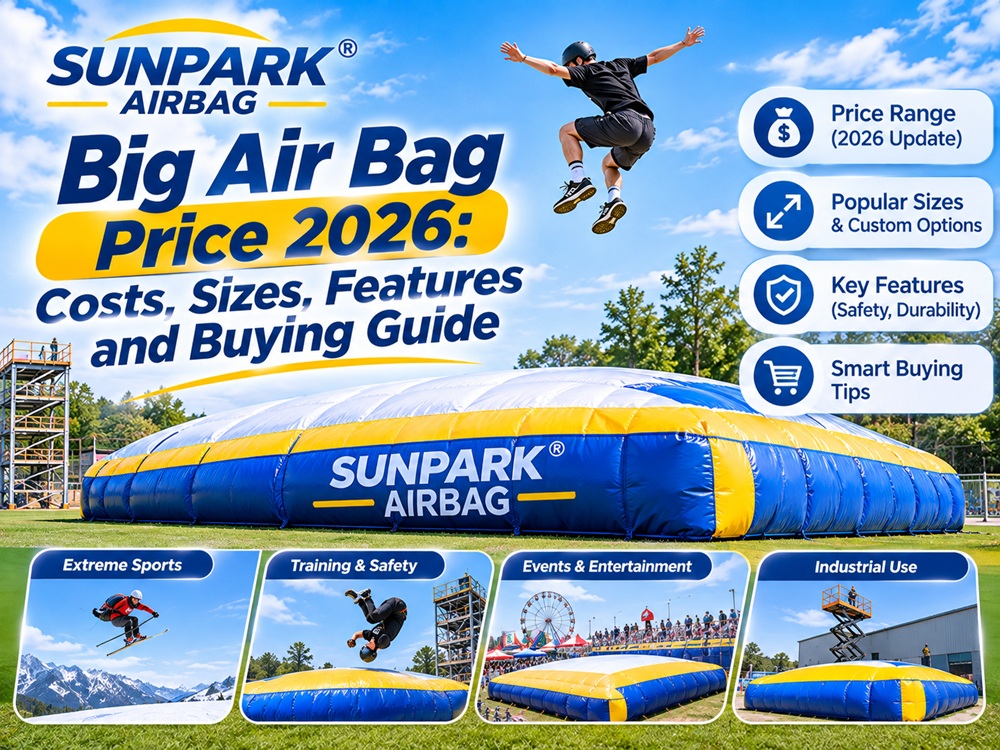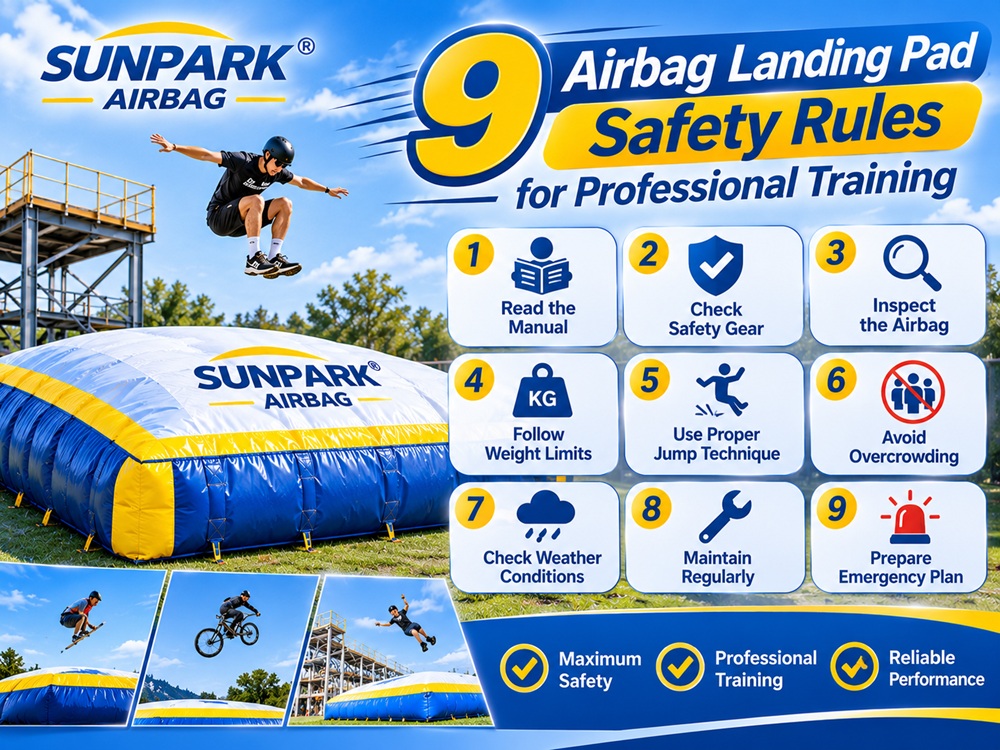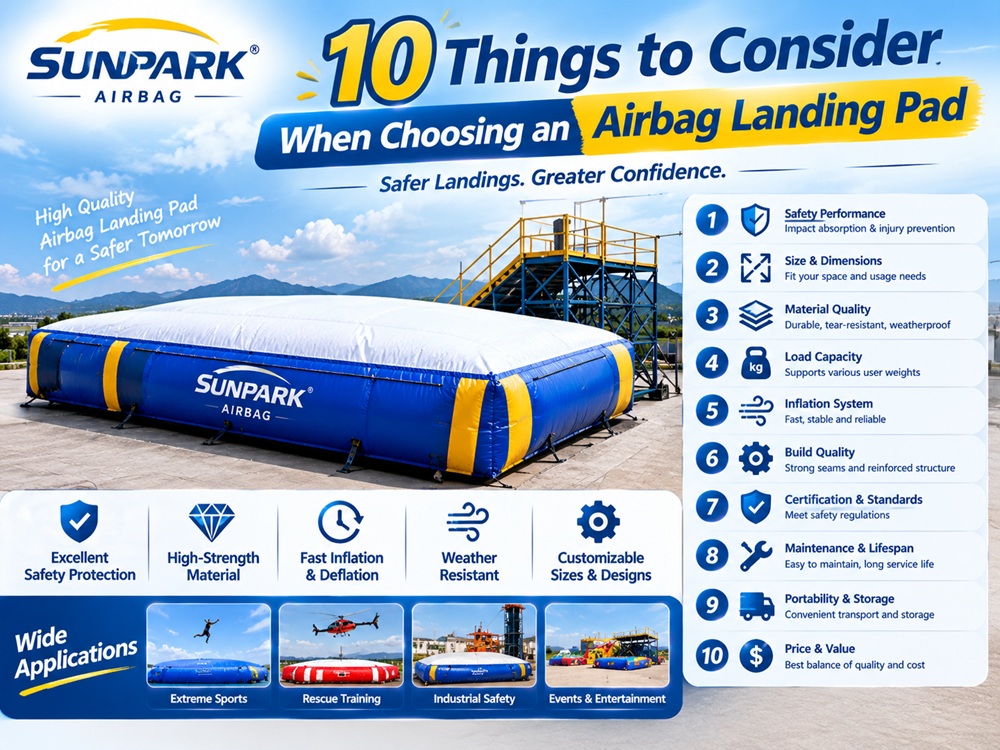
Searching for 5 used MTB airbag landings for sale in South Africa is not simply about finding an inexpensive inflatable landing pad. For mountain bike parks, professional riders, training facilities and action sports businesses, the real challenge is finding equipment that can handle repeated impacts, match the jump design and remain economical after transportation, repairs and installation.
From our experience in the action sports airbag industry, buying second-hand equipment can make financial sense, but only when the construction, inflation system and previous maintenance history are properly evaluated. A cheap airbag with damaged seams or an unsuitable landing profile can become a much more expensive investment than a new system.
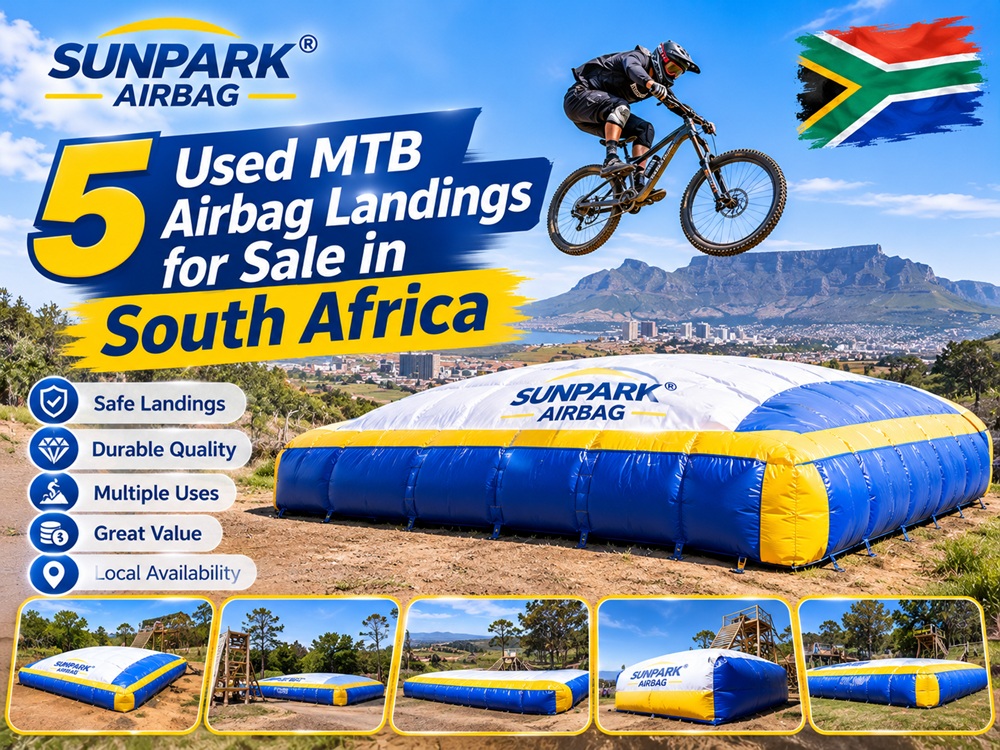
This guide explains five practical ways to source used MTB airbag landing systems in South Africa, how to inspect them, what alternatives to consider and when purchasing directly from an experienced manufacturer such as SUNPARK® AIRBAG is the smarter long-term decision.
Quick Answer: Where Can You Find Used MTB Airbag Landings in South Africa?
Short answer: Start with local mountain bike parks, action sports facility operators, second-hand sports equipment marketplaces, event companies and international specialist resellers. However, do not assume that a used MTB landing airbag is currently available simply because a seller advertises inflatable sports equipment.
We recommend requesting the original manufacturer, production date, repair history, fabric specifications, blower details and a live inflation demonstration before paying a deposit.
For commercial installations or heavy-duty training facilities, a professionally specified new airbag may offer better long-term value than an unverified second-hand unit.
1. What Is a Used MTB Airbag Landing?
A used MTB airbag landing is a previously owned inflatable impact-attenuation system designed to provide a designated landing area for mountain bike riders practising jumps, tricks and aerial manoeuvres.
Unlike a conventional inflatable mattress, a professional mountain bike landing airbag is engineered around a particular landing application. Its internal structure, fabric, air chambers, inflation arrangement and landing surface must work together to manage the impact generated by a rider and bicycle.
These systems are commonly considered for:
- Mountain bike jump training facilities.
- Freestyle MTB and dirt jump parks.
- Bike parks developing beginner progression areas.
- Professional rider training and demonstration facilities.
- Commercial action sports venues.
A second-hand unit may have been used for private training, commercial operations, sporting events or promotional activities. Those previous applications matter because an airbag used occasionally by one rider may have a very different wear profile from equipment used by hundreds of riders every week.
Is a Used Airbag Worth Buying?
Yes, potentially. A used MTB airbag landing can be a worthwhile purchase when the seller can demonstrate its condition, identify the manufacturer and provide reliable maintenance information.
However, we would not recommend purchasing based exclusively on photographs, advertised dimensions or a low asking price. The condition of the internal construction is just as important as the visible landing surface.
Quick Summary: Used MTB Airbag Landing Buying Guide
| Buying factor | What to look for | Our recommendation |
|---|---|---|
| Equipment condition | Fabric, seams, repairs and air connections | Require a complete physical inspection. |
| Manufacturer | Original brand and model information | Choose traceable equipment. |
| Inflation system | Blower capacity, condition and compatibility | Test under operating conditions. |
| Landing design | Dimensions, slope and internal chamber design | Match the system to the actual MTB jump. |
| Previous usage | Commercial, private or event use | Request maintenance and repair records. |
| Transportation | Collection, freight and import expenses | Calculate the delivered cost in South Africa. |
| After-sales support | Replacement fabric, repairs and technical assistance | Prioritise accessible support. |
| Final decision | Total ownership cost and operational suitability | Compare against a new professionally specified system. |
2. 5 Places to Find Used MTB Airbag Landings for Sale in South Africa
Finding a suitable second-hand MTB airbag requires more targeted sourcing than searching for ordinary mountain bikes. These are specialist pieces of sports equipment, and the number of available units can be limited.
1. Existing Mountain Bike Parks and Jump Facilities
Our first recommendation is to contact established mountain bike parks, dirt jump facilities and private training centres.
Facilities periodically change their layouts, upgrade training equipment or discontinue particular activities. An older airbag may become available when an operator invests in a larger landing system or redesigns its jump area.
The advantage of buying directly from an operating facility is that you can potentially inspect the equipment in its original environment. You can also ask how frequently it was used, whether it experienced punctures and which repairs were performed.
What to ask: Request the original equipment specifications, operating history, repair invoices and photographs of the airbag while fully inflated.
2. South African Second-Hand Equipment Marketplaces
General classified advertising platforms can be useful starting points. Search for more than just the phrase used MTB airbag landing for sale South Africa.
Try related terms such as:
- Used MTB landing airbag.
- Second-hand mountain bike jump airbag.
- Freestyle sports landing airbag.
- Used dirt jump landing system.
- Inflatable stunt landing equipment.
- Action sports training airbag.
Platforms such as Gumtree South Africa can help identify local second-hand sports equipment sellers, although general mountain bike listings should not be confused with actual airbag landing listings.
We recommend contacting sellers directly and asking whether they have specialist inflatable equipment or know local facilities disposing of it. Do not treat an ordinary MTB advertisement as evidence that a professional landing airbag is available.
3. Action Sports Event Companies and Equipment Rental Businesses
Event production companies sometimes purchase inflatable landing systems for demonstrations, temporary sporting attractions and promotional activities.
These businesses can be useful sourcing contacts because their equipment may have been transported between venues and used for scheduled events rather than continuous daily operation.
Nevertheless, event equipment can experience substantial handling damage. Check the bottom surface, attachment points, transportation wear and previous patch repairs carefully.
For commercial users, we recommend asking whether the original operating and maintenance documents are available. A good-looking airbag without its technical history is not necessarily a good investment.
4. International Used Action Sports Equipment Sellers
If local sourcing does not produce a suitable system, consider specialist international second-hand equipment sellers.
International marketplaces and action sports communities occasionally list used airbags designed for MTB, BMX, skateboarding and other freestyle activities. For example, specialist cycling marketplaces can provide useful references for the type of equipment being traded internationally.
However, international availability does not mean that the equipment is suitable for direct installation in South Africa. Before purchasing, calculate:
- International freight and oversized cargo charges.
- Import duties, VAT and customs clearance.
- Insurance during transportation.
- Local unloading and installation costs.
- Availability of compatible replacement blowers and accessories.
- Technical support and warranty limitations.
A used airbag advertised at an attractive overseas price can become considerably less attractive after freight and import expenses.
5. Contact Airbag Manufacturers Directly
This is an option many buyers overlook. Established manufacturers may know customers replacing older equipment, facilities upgrading their installations or operators interested in selling previously used systems.
Even when a manufacturer does not offer second-hand stock, it can help you compare an existing used unit against a new system designed for your application.
SUNPARK® AIRBAG is an airbag system manufacturer and solution provider with over 10 years of industry experience, supplying freestyle airbags for sports facilities, ski resorts, theme parks and gymnastics applications around the world.
We recommend discussing the intended jump dimensions, rider requirements, operating frequency and installation environment before selecting an airbag. A suitable solution should be determined by the complete application, not simply by the cheapest available product.
Explore the SUNPARK® AIRBAG product range to understand the available sports airbag solutions.
3. How an MTB Airbag Landing System Works
A professional airbag landing system uses an engineered inflatable structure to dissipate energy when a rider lands on its designated impact area.
Depending on the design, the system may incorporate a base chamber, internal air columns, controlled air release, a landing surface and one or more blowers.
Main Components
- Outer fabric: The external material must withstand the intended impact loads, abrasion and operating environment.
- Internal chambers: These influence how the airbag deforms and manages impact energy.
- Air outlets: Designed to manage air movement during impact according to the system’s engineering.
- Blower system: Supplies the required air pressure or airflow for the specific construction.
- Anchoring system: Helps prevent unwanted movement during operation.
- Landing profile: Determines the geometry and usable landing area for the intended application.
One important point: not every inflatable landing product works in the same way. Some systems use continuously supplied air, while others use captured-air or hybrid construction. A buyer should never assume that two airbags with similar external dimensions have equivalent impact performance.
Why MTB Airbag Design Matters
Mountain bike riders land with different combinations of speed, trajectory, bicycle orientation and body position. A landing system designed for a trampoline park or a small gymnastics training area is not automatically suitable for a high-speed MTB jump.
For more application-specific information, read our mountain bike airbag landing guide and explore the different bike airbag landing systems.
4. Benefits and Limitations of Buying a Used MTB Airbag
Second-hand equipment offers a financial opportunity, but it also transfers part of the equipment’s history and maintenance risk to the buyer.
Pros and Cons Table
| Pros | Cons |
|---|---|
| Potentially lower initial purchase price. | Unknown wear and previous operating conditions. |
| Possibility of purchasing immediately available equipment. | Limited choice of dimensions and landing profiles. |
| May include an existing blower and accessories. | Blowers may be worn or incompatible. |
| Can be suitable for controlled, low-frequency training after assessment. | Repairs may be difficult if the original manufacturer is unknown. |
| May reduce the initial investment for a new facility. | Warranty and replacement-part availability may be limited. |
| Existing equipment can sometimes be inspected before purchase. | Transportation and reinstallation can increase the final cost. |
Who Should Consider a Used MTB Airbag?
Private riders and small training groups: A used system may be worth investigating if the intended use is limited, the landing design is appropriate and a qualified professional confirms its condition.
Small commercial facilities: Second-hand equipment may reduce initial capital expenditure, but maintenance, inspection and operating costs must be included in the business plan.
Established bike parks: Operators should prioritise documented specifications, operational reliability, spare parts and the ability to obtain manufacturer support.
Who Does Not Need a Professional MTB Landing Airbag?
Casual mountain bikers who ride ordinary trails and do not operate a dedicated jump training facility generally do not need to purchase a large landing airbag.
Likewise, a buyer who cannot provide adequate space, trained supervision, suitable installation arrangements and ongoing maintenance should not invest in a commercial airbag simply because a used unit is inexpensive.
5. Used vs New MTB Airbag Landing Systems: Which Is Better?
We believe this is the most important comparison for buyers. The decision should be based on total ownership cost and operational suitability rather than purchase price alone.
| Comparison factor | Used MTB airbag | New MTB airbag |
|---|---|---|
| Purchase price | Usually lower, depending on condition. | Higher initial investment. |
| Equipment history | Depends on seller documentation. | New production and documented specifications. |
| Customisation | Limited by existing dimensions and construction. | Can be specified around the application. |
| Fabric condition | Must be inspected for wear and repairs. | New material, subject to quality verification. |
| Technical support | May be difficult to obtain. | Can be arranged with the manufacturer. |
| Warranty | Often limited or unavailable. | Depends on the manufacturer’s terms. |
| Spare parts | May require sourcing compatible components. | Can be specified and supplied with the system. |
| Best application | Suitable when condition and compatibility are verified. | New installations and long-term commercial projects. |
Used Airbag vs New Airbag: Our Buying Position
For beginners and smaller facilities with limited budgets, a properly inspected used airbag may be an acceptable option.
For commercial users operating daily sessions, we generally recommend a new system with documented construction, technical specifications and a clear maintenance arrangement.
The reason is straightforward: downtime costs money. If an airbag fails during a scheduled commercial session, the business may lose bookings, revenue and customer confidence. The original purchase-price saving needs to be weighed against those operational risks.
Airbag Landing vs Foam Pit
A foam pit is another option for freestyle training. However, it involves different maintenance requirements, space planning and landing characteristics.
An airbag can offer a more controlled landing environment for suitable training applications, while a foam pit may be preferable for other progression exercises and facility layouts.
Neither should be selected without considering the intended manoeuvres, rider skill levels, supervision and available space. Read our detailed foam pit vs airbag comparison before making a facility investment.
6. Used MTB Airbag Landing Inspection Checklist Before Buying
This is where we recommend spending the most time. A second-hand landing airbag can look perfectly acceptable in photographs while hiding problems that become apparent only after inflation and operation.
1. Check the Fabric and Outer Surface
Inspect the entire landing surface, underside and sidewalls. Look for punctures, thinning, abrasion, UV deterioration, delamination and damaged protective layers.
Pay special attention to areas where riders repeatedly land and where the airbag contacts the ground.
2. Inspect Seams and Internal Construction
Seams are critical structural areas. Ask the seller to identify every previous repair and provide photographs of any repaired areas.
If possible, request access to the internal construction documentation. A visual inspection of the outside alone cannot establish the condition of internal chambers.
3. Test the Blower and Inflation System
Ask for a full inflation demonstration using the equipment intended for the installation.
Check the blower model, electrical specifications, operating condition, connection hoses and air delivery. Confirm that the blower is appropriate for the original system and that replacement components can be obtained.
4. Verify the Original Manufacturer
Request the original model number, product specifications, manufacturing date and operating manual.
If the seller cannot identify the manufacturer, treat the purchase as higher risk. You may have difficulty confirming the correct inflation pressure, repair methods and operating limitations.
5. Check the Landing Dimensions
Measure the actual usable landing area rather than relying entirely on the seller’s advertised measurements.
Consider the width, length, height, approach clearance and landing profile. The airbag must be compatible with the jump design and the intended rider progression.
6. Review Previous Repairs
Request a written repair history. Small professionally completed repairs are not automatically disqualifying, but undocumented repairs, recurring leaks and structural modifications deserve careful attention.
7. Verify Installation and Anchoring
Check whether the original anchoring system is included and whether the installation instructions are available. A second-hand airbag may require additional accessories or site modifications before it can be used.
8. Obtain a Professional Assessment
For commercial use, have the equipment assessed by a competent person familiar with inflatable impact-attenuation systems. The assessment should cover the intended installation and operating conditions, not just whether the product can inflate.
7. Cost-Benefit Analysis: What Should South African Buyers Budget For?
There is no reliable single market price for used MTB landing airbags in South Africa. Prices depend on the system’s dimensions, construction, age, condition, original manufacturer, included equipment and transportation requirements.
Rather than relying on an arbitrary advertised price, we recommend calculating the complete landed and operational cost.
Five Cost Categories to Include
| Cost category | What to include | Why it matters |
|---|---|---|
| Purchase | Seller’s price and payment charges. | Determines initial capital expenditure. |
| Transportation | Collection, freight and international shipping. | Large inflatables can be expensive to transport. |
| Import and clearance | Applicable customs duties, VAT and clearance fees. | Important for international purchases. |
| Installation | Site preparation, anchoring and electrical work. | Ensures installation compatibility. |
| Maintenance | Repairs, inspections, replacement parts and blower servicing. | Determines long-term ownership cost. |
When Is a Used Airbag More Economical?
A used airbag can offer good value when its structural condition is verified, the blower is included and operational, the dimensions suit the project and transportation costs are reasonable.
However, if the purchase requires extensive repairs, imported replacement parts and specialist modifications, the original discount can disappear quickly.
For a commercial project, we recommend comparing the five-year expected ownership cost of the used system against a new system. Include downtime, expected maintenance, support and potential replacement expenses.
South African Import Considerations
Buyers importing second-hand equipment should confirm the applicable tariff classification, customs requirements and VAT treatment with a qualified customs clearing agent or the South African Revenue Service before making payment.
Do not assume that an overseas seller’s quoted freight price includes customs clearance, local delivery or import taxes.
8. Common Mistakes When Buying Used MTB Airbag Landings
From our experience, the following mistakes are responsible for many poor equipment purchasing decisions.
Mistake 1: Choosing the Cheapest Listing
A very low price is not necessarily an opportunity. It may indicate damaged fabric, missing blowers, incomplete accessories or equipment that is no longer supported by the manufacturer.
Mistake 2: Assuming All Airbags Are Interchangeable
A BMX landing airbag, MTB jump airbag, FMX landing system and gymnastics airbag may look similar, but their dimensions and impact-management characteristics can be very different.
For larger motorcycle applications, see our dedicated dirt bike jump landing airbag solution. For freestyle motocross projects, explore the FMX airbag landing range.
Mistake 3: Ignoring the Internal Airbag Design
The outer shape is only one part of the system. Internal chambers, pressure management and air release characteristics influence how the equipment performs during impact.
Mistake 4: Forgetting the Cost of Freight
Buyers sometimes negotiate an attractive international price before requesting a freight quotation. This reverses the correct buying process. Obtain a realistic delivered-cost estimate first.
Mistake 5: Treating an Airbag as a Guarantee Against Injury
An airbag can help provide an impact-attenuation landing surface, but it cannot eliminate injury risk. Incorrect jump geometry, excessive speed, poor technique, unsuitable landing conditions and inadequate supervision remain significant hazards.
Mistake 6: Skipping the Manufacturer’s Instructions
Every system has specific operating limits. Do not improvise pressure settings, jump heights or rider capacity. Obtain the correct technical documentation and follow the manufacturer’s requirements.
For additional practical guidance, read our article on five ways to buy a used airbag landing.
9. Industry Standards and Safety Considerations
Professional buyers should evaluate more than the appearance of a second-hand inflatable system. Applicable standards, engineering documentation, installation requirements and site-specific risk assessments should form part of the purchasing decision.
ISO 23659:2022 covers safety requirements for trampoline parks and explicitly includes landing areas such as airbags and foam pits. Its scope is relevant to trampoline park installations, but it should not automatically be treated as certification of an outdoor MTB jump airbag.
ASTM F2374-24 addresses design, manufacture, installation, operation, maintenance and inspection of commercial inflatable amusement devices. Importantly, its scope excludes certain stunt-style airbags that use sudden air loss as part of their intended operation. Buyers must therefore establish which standards actually apply to their specific product.
A published research paper examining impact forces and injury potential from large inflatable airbags also highlights why visual inspection and assumptions about cushioning performance are insufficient.
Our recommendation is to request the manufacturer’s documented operating limits, inspection procedures, material specifications and intended application. Where necessary, commission an independent assessment before putting a second-hand system into service.
10. Our Expert Recommendation: Buy Used or Choose a New SUNPARK® AIRBAG?
At SUNPARK® AIRBAG, we believe the right buying decision should start with the intended sporting application rather than the advertised equipment price.
With over 10 years of experience in the sports airbag industry, we provide freestyle airbag solutions for ski resorts, theme parks, sports facilities and gymnastics facilities worldwide. Our experience includes developing products for professional riders, world champion snowboarders and trampoline park operators.
We focus on developing and improving our own products because airbag performance depends on the complete system, including construction, material selection, air management and the intended application.
SUNPARK® AIRBAG – Explorer of Airbag System for Sports
Professional freestyle airbag solutions for extreme sports and leisure facilities. Discuss your project requirements with our team before choosing a landing system.
When We Recommend Buying Used
- You have verified the original manufacturer and product specifications.
- The equipment has a documented maintenance and repair history.
- The internal and external construction has passed an appropriate inspection.
- The blower and accessories are compatible and operational.
- The complete delivered cost is significantly more attractive than a new alternative.
- You can obtain suitable technical support for installation and operation.
When We Recommend Buying New
- You are establishing a new commercial MTB training facility.
- You need a specific landing profile or customised dimensions.
- You expect frequent operation and repeated rider sessions.
- You require traceable manufacturing specifications and technical support.
- You cannot verify the condition or history of available second-hand equipment.
For businesses considering a broader investment in action sports facilities, our review of the best airbag landing systems in 2026 provides further buying considerations. Facilities planning multiple attractions can also review our guide to trampoline park equipment manufacturers.
11. Frequently Asked Questions About Used MTB Airbag Landings in South Africa
1. Where can I find used MTB airbag landings for sale in South Africa?
Start with mountain bike parks, dirt jump facilities, action sports event companies, sports equipment rental businesses and second-hand marketplaces. You can also contact specialist airbag manufacturers to ask about potential second-hand equipment sources. Availability should always be confirmed directly with the seller.
2. How much does a used MTB airbag landing cost in South Africa?
There is no dependable fixed price because second-hand airbags vary in dimensions, age, construction, condition and included accessories. Request individual quotations and calculate the total cost after transportation, repairs, installation and applicable import charges.
3. Is a used MTB airbag safe for commercial mountain bike training?
It may be suitable, but only after its condition and intended application have been properly assessed. Verify the fabric, seams, internal construction, inflation system, anchoring and maintenance history. Obtain a competent professional assessment and follow the manufacturer’s operating requirements.
4. Can I use a BMX airbag for mountain biking?
Not automatically. BMX and MTB systems may have different landing dimensions, profiles and intended impact conditions. Confirm compatibility with the original manufacturer or a qualified airbag specialist before using one for mountain bike training.
5. How long does an MTB airbag landing last?
There is no universal service life. Actual lifespan depends on material quality, UV exposure, storage, operating frequency, rider loads, maintenance and repair quality. Ask for the manufacturer’s expected service-life guidance and inspect the specific unit rather than relying on its age alone.
6. What should I inspect before purchasing a second-hand airbag?
Inspect the outer fabric, underside, seams, internal chambers, air connections, blower, anchoring points and previous repairs. Request a full inflation demonstration and original technical documentation. A visual inspection alone is not sufficient to establish impact performance.
7. Is buying a new MTB airbag better than buying used?
For commercial facilities, a new system is often preferable because specifications, configuration and technical support can be established around the project. Used equipment can offer value when it is properly documented, professionally assessed and significantly cheaper after all ownership expenses.
8. Can SUNPARK® AIRBAG supply a custom MTB landing airbag?
SUNPARK® AIRBAG provides sports and freestyle airbag solutions for different action sports and leisure applications. Contact the team with your intended use, jump dimensions, rider requirements and installation location to discuss an appropriate solution and confirm available configurations.
9. Can I import a used MTB landing airbag into South Africa?
International purchases may be possible, but buyers should verify applicable customs requirements, duties, VAT, freight arrangements and clearance procedures before purchasing. Consult a South African customs clearing agent to confirm the requirements for the specific equipment.
10. Does an MTB airbag completely prevent injuries?
No. An airbag can provide an impact-attenuation landing area for suitable training applications, but it cannot guarantee injury prevention. Proper jump design, rider progression, equipment inspection, supervision and compliance with operating limits remain essential.
12. References and Technical Resources
The following authoritative and research-based resources provide additional context for evaluating inflatable landing systems and their safety requirements.
- International Organization for Standardization (ISO). ISO 23659:2022 – Sports and recreational facilities: Trampoline parks – Safety requirements. This standard includes landing areas such as airbags and foam pits within its applicable scope. Read the ISO standard overview.
- ASTM International. ASTM F2374 – Standard Practice for Design, Manufacture, Operation, and Maintenance of Inflatable Amusement Devices. Review the scope and exclusions carefully when assessing a specific airbag application. Explore ASTM sports and recreation standards.
- Walsh Medical Media. Impact Forces and Injury Potential from Landing on Large Inflatable Airbags. Research discussing impact forces and injury potential associated with large inflatable landing airbags. Read the research paper.
Looking for an MTB Airbag Landing Solution?
Whether you are comparing second-hand MTB airbag landings in South Africa or planning a new professional jump training facility, choosing the correct system requires more than comparing prices.
Evaluate the landing application, dimensions, material construction, inflation arrangement, installation requirements and long-term maintenance costs before making a purchase.
SUNPARK® AIRBAG is committed to developing and supplying freestyle airbag solutions for extreme sports and leisure industries worldwide. If you are planning a new installation or upgrading an existing facility, contact our team to discuss your requirements.