In the high-stakes world of freestyle skiing and snowboarding, the margin for error is razor-thin. As riders push the boundaries of physics with triple corks and high-altitude rotations, the demand for advanced safety infrastructure has skyrocketed. Modern ski resorts and training facilities no longer rely solely on soft snow or foam pits. Instead, they have turned to the sophisticated engineering of inflatable landing solutions. From our experience as the leading manufacturer of Airbags for Extreme Sports, we have seen how these systems have revolutionized progression for everyone from Olympic hopefuls to local enthusiasts. Understanding the core Functions of a Ski Airbag Landing System is essential for any resort owner or athlete looking to maximize safety while minimizing downtime.
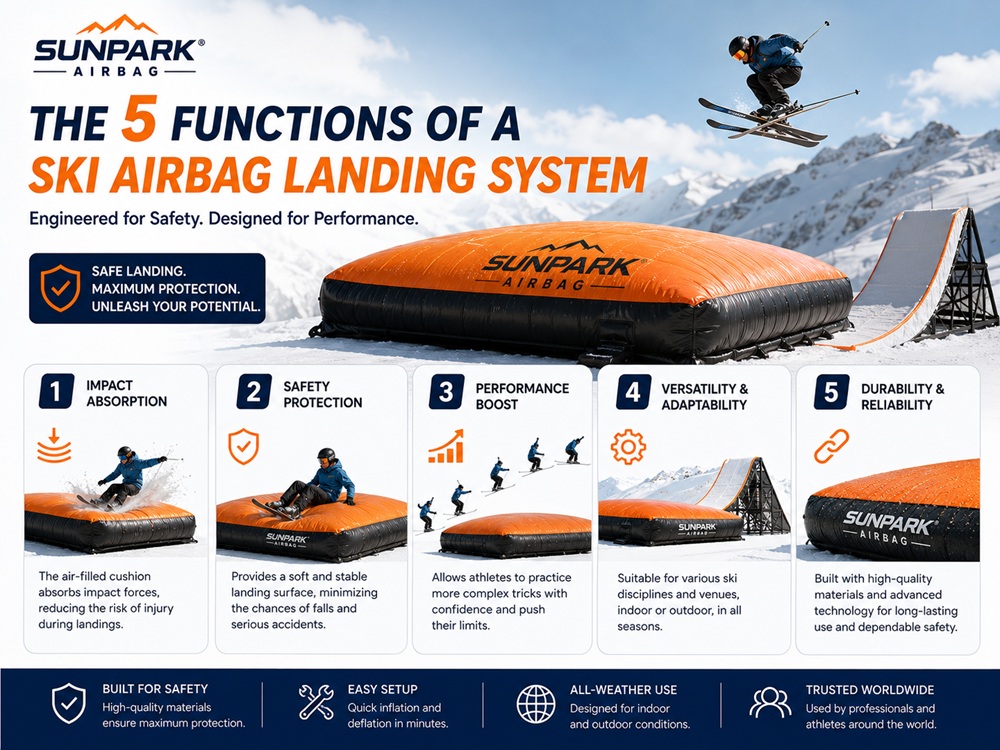
SUNPARK AIRBAG has spent over a decade perfecting these systems. With 10 years of experience providing freestyle airbags for ski resorts, theme parks, and gymnastics facilities globally, we understand the intricate balance between impact absorption and landing stability. Our commitment to creating products for World Champion Snowboarders and famous riders has led to the development of the most durable and functional landing systems on the market today.
Table of Contents
- 1. Advanced Kinetic Energy Dissipation
- 2. Psychological Catalyst for Rider Progression
- 3. Structural Stability for Land-and-Ride Functionality
- 4. Maximizing Operational Efficiency and Throughput
- 5. Multi-Climate Adaptation and Durability
- Summary of System Capabilities
- Frequently Asked Questions
- Technical References
1. Advanced Kinetic Energy Dissipation
The primary and most vital of the Functions of a Ski Airbag Landing System is the controlled dissipation of kinetic energy. When a rider falls from a significant height, the force of impact is determined by the impulse-momentum theorem. In physics, this is represented by the equation:
$J = F \Delta t = m \Delta v$
To reduce the force ($F$) exerted on the rider’s body, the system must increase the time ($\Delta t$) over which the velocity change occurs. A professional landing system achieves this through a dual-chamber architecture. The lower chamber acts as a high-pressure safety base, preventing the rider from ever striking the ground (bottoming out), while the upper chamber utilizes specialized air release valves to soften the initial contact.
From our experience, the internal air pressure must be precisely tuned to the rider’s weight and the height of the jump. If the air is too dense, the impact is jarred; if it is too soft, the rider sinks too deep, increasing the risk of joint hyperextension. SunparkAirbag utilizes sophisticated internal baffle systems and high-flow exit vents to ensure that the kinetic energy is absorbed in a linear, predictable fashion. This function is what makes an inflatable jump airbag far superior to traditional snow landings, where the surface can become dangerously iced or compacted over time.
2. Psychological Catalyst for Rider Progression
Safety is not just a physical requirement; it is a psychological one. One of the subtle yet powerful Functions of a Ski Airbag Landing System is its role as a mental safety net. Extreme sports athletes often face a fear barrier when attempting new tricks. The presence of a high-performance landing system lowers this psychological threshold, allowing for faster progression. When a rider knows that a mistake will not result in a season-ending injury, they are more likely to commit to the rotation.
We recommend facilities integrate these systems into their seasonal training programs. We have observed that athletes using a gym airbag for training during the off-season transition much more effectively to the snow. By providing a safe environment to fail, the system actually facilitates higher success rates. This psychological assurance is why World Champion Snowboarders choose Sunpark systems—they need to know that their training environment is as focused on their longevity as they are on their performance.
3. Structural Stability for Land-and-Ride Functionality
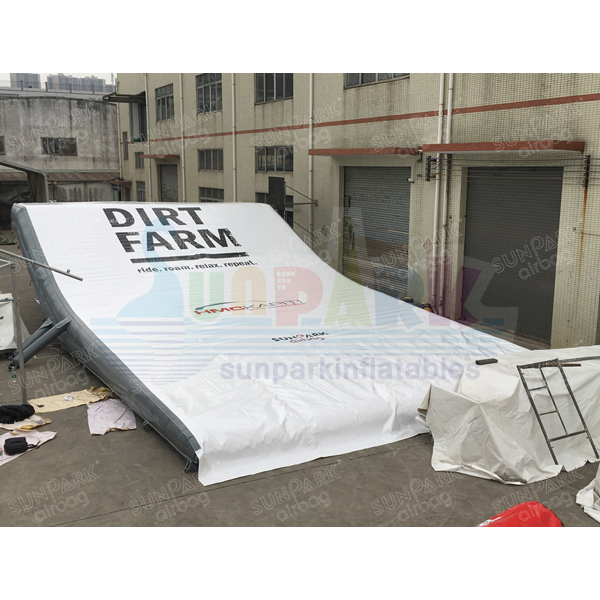
A common misconception is that all airbags are meant to be crashed into. However, the most advanced Functions of a Ski Airbag Landing System include providing a ride-away surface. Modern landing airbags feature a taut, tensioned topsheet made of specialized PVC materials that allow a rider to land on their feet and continue riding out of the jump. This is often referred to as Land-and-Ride technology.
To achieve this, the airbag must maintain a specific internal geometry. Unlike a standard crash pad, a landing system is sloped to match the trajectory of the jump. From our experience, the friction coefficient of the top material is critical. It must be slick enough to allow skis and boards to glide, but textured enough to prevent the rider from sliding off uncontrollably. This function allows for a more realistic training experience, mimicking the feel of a perfect snow landing while maintaining the safety of an inflatable buffer. This technical sophistication is a key factor when considering the trampoline park construction cost or resort upgrade budgets; the more functional the landing, the higher the value to the facility.
4. Maximizing Operational Efficiency and Throughput
In a commercial resort or park setting, the Functions of a Ski Airbag Landing System must extend to operational viability. Traditional foam pits require constant maintenance, as foam blocks degrade and need fluffing. In contrast, a high-quality inflatable system offers rapid cycle times. Once a rider has landed and exited the bag, the internal pressure resets within seconds via high-performance blowers.
From our experience, high throughput is essential for a profitable operation. Facilities can process hundreds of jumps per hour, which directly impacts the trampoline park owner income and resort revenue. A system that stays inflated and stable throughout a long day of use, despite temperature fluctuations, is a mark of superior manufacturing. Sunpark systems are designed with high-volume air intake and precision valves that maintain a constant state of readiness, ensuring the park stays open and the riders stay moving.
5. Multi-Climate Adaptation and Durability
The final and most rugged of the Functions of a Ski Airbag Landing System is environmental resilience. These systems are often deployed in sub-zero temperatures, exposed to heavy snowfall, ice, and high UV radiation. The materials used must be capable of remaining flexible at -40 degrees Celsius while resisting the abrasive nature of ski and snowboard edges. We use 0.9mm high-tenacity PVC and specialized coatings to ensure that our airbags do not become brittle or prone to tearing in the cold.
Moreover, the system must be securely anchored. A landing airbag acts like a giant sail in high mountain winds. Professional systems include reinforced d-rings and heavy-duty anchoring points. We recommend that facilities consult our airbag jump locations guide to see how various terrains and climates affect installation. This adaptability ensures that whether the system is on a glacier in Switzerland or a dry-slope in China, the safety and performance remains consistent.
Summary of System Capabilities
- High-Flow Air Vents
Rapid Pressure ResetHigh throughput for commercial resorts.
| Feature | Function in Ski Landing Systems | Benefit to User/Owner |
|---|---|---|
| Dual-Chamber Design | Impact Absorption & Base Safety | Prevents bottoming out while ensuring soft landing. |
| Tensioned Topsheet | Land-and-Ride Stability | Allows riders to stomp tricks and ride out safely. |
| -40°C Flex PVC | Environmental Resilience | System remains functional in extreme winter conditions. |
| Internal Baffles | Geometric Maintenance | Ensures the slope of the landing stays consistent. |
Comparison of Landing Methods
- Progression Speed
| Method | Safety Level | Operating Cost | |
|---|---|---|---|
| Natural Snow | Low (Risk of ice/hardness) | Slow | High (Grooming required) |
| Foam Pits | Medium (Hygiene/Fire issues) | Moderate | Very High (Replacement foam) |
| SUNPARK Airbag System | Extreme High | Rapid | Low (Electric blower only) |
Frequently Asked Questions
What is the lifespan of a professional ski airbag landing system?
From our experience, with proper maintenance and seasonal storage, a high-quality airbag made from 0.9mm PVC can last between 5 to 8 years in high-use environments. Regular inspections for UV damage and small tears are recommended to maximize longevity.
Can these systems be used for summer training?
Yes, many of the Functions of a Ski Airbag Landing System are identical in summer settings. When paired with a dry-slope material (like m-snow or Neveplast), the airbag provides an excellent year-round training solution for freestyle athletes.
How does the system handle high winds?
We recommend anchoring the system at all provided d-ring points using heavy-duty stakes or weighted ballasts. In extreme wind conditions (above 40km/h), it is often safer to deflate the bag and secure it with a weather-proof tarp.
Is the landing surface slippery when wet?
Modern topsheets are designed to work with water and snow. However, excessive standing water can create hydroplaning. Sunpark systems are designed with drainage paths to ensure the landing surface remains consistent during rainfall or snowmelt.
Technical References
To further understand the safety standards and engineering behind freestyle landing systems, we recommend consulting the following authoritative bodies:
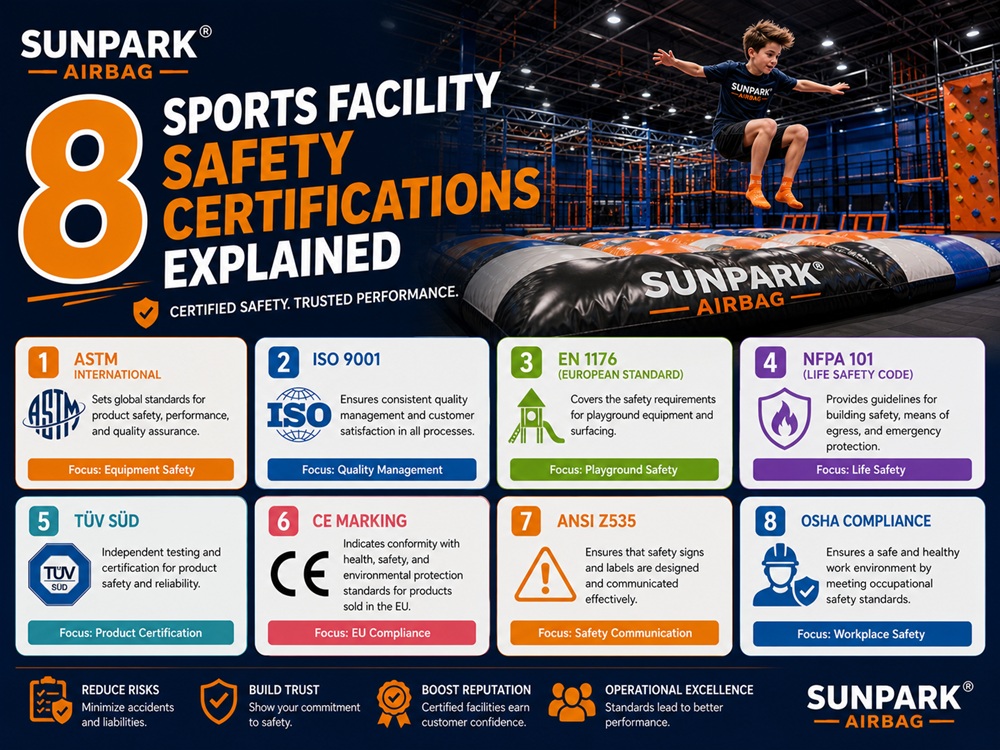
- ISO 23618:2022 – Safety requirements for inflatable play equipment and sports facilities.
- FIS (International Ski Federation) – Freestyle skiing competition safety and infrastructure guidelines.
- ASTM F2374 – Standard practice for design, manufacture, and operation of inflatable devices.
Choosing the right equipment is a strategic investment in the future of action sports. The Functions of a Ski Airbag Landing System are designed to create a sustainable loop of talent development, resort profitability, and most importantly, athlete safety. At SUNPARK AIRBAG, we remain committed to improving our technology to meet the ever-evolving needs of the world’s most daring riders.