Authored by SUNPARK® AIRBAG — With over 10 years of experience, we provide freestyle airbags for ski resorts, theme parks, sports, and gymnastics facilities around the globe. SunparkAirbag® is the leading manufacturer of Airbags for Extreme Sports and Leisure Industries in China. As extreme sports developed, more and more snowboarders and serious sports enthusiasts are looking for safer training possibilities to progress without risks of getting injured. We create the products for World Champion Snowboarders, famous riders, and trampoline parks worldwide. We are deeply committed to the development and improvement of our own products.
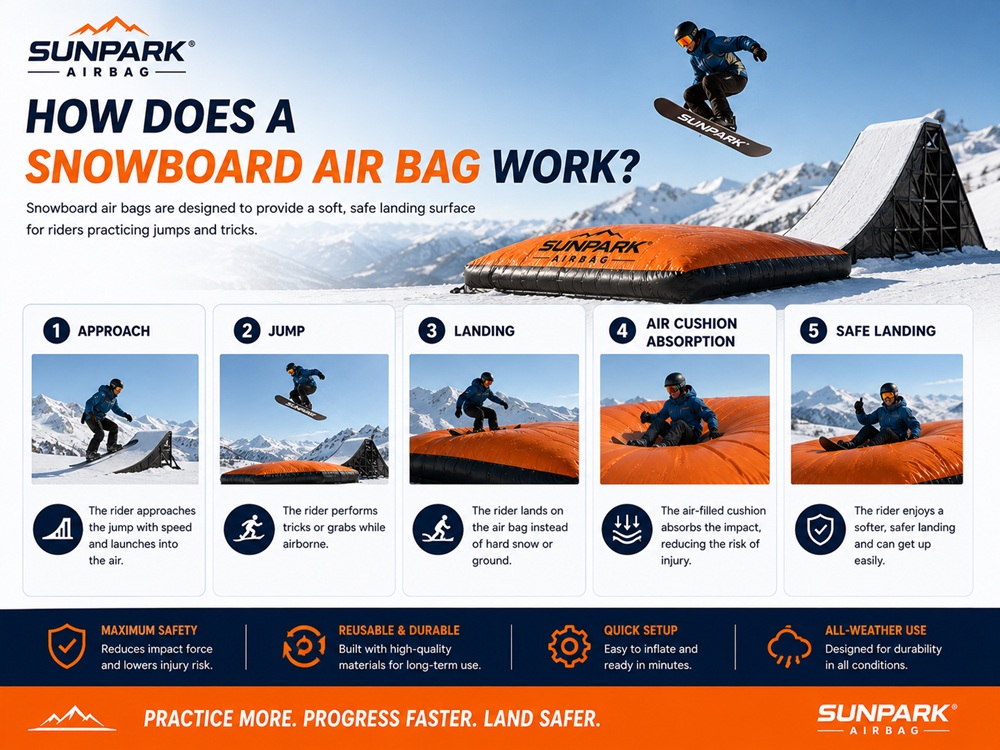
The progression of extreme winter sports over the past two decades has been nothing short of exponential. Tricks that were once considered physically impossible are now standard runs in global competitions. This rapid evolution in snowboarding is heavily attributed to advancements in off-snow and on-snow training safety infrastructure. Foremost among these safety innovations is the inflatable landing system. But how exactly does a snowboard air bag work to arrest the momentum of a human body plummeting from dozens of feet in the air, allowing them to walk away unharmed?
From our experience engineering solutions for Olympic-level athletes and world-renowned ski resorts, the mechanics behind a snowboard air bag work far more intricately than simply inflating a large balloon. It requires precise fluid dynamics, rapid air displacement, and highly durable material science. In this authoritative guide, SUNPARK® AIRBAG details the engineering principles, structural design, and operational procedures that make a snowboard air bag work seamlessly to protect the world’s elite extreme sports athletes.
Table of Contents
- 1. The Core Mechanics: Making a Snowboard Air Bag Work
- 2. Dual-Chamber and Multi-Pillar Systems
- 3. The Physics of Air Displacement and Venting
- 4. Material Science and Top Sheet Construction
- 5. Optimal Setup and Operational Maintenance
- 6. Cross-Sport Versatility and Training Integration
- 7. Summary Table: Air Bag Components and Functions
- 8. Frequently Asked Questions (FAQs)
- 9. Authoritative References
1. The Core Mechanics: Making a Snowboard Air Bag Work
To understand the foundational principles of how a snowboard air bag work, one must look at the concepts of energy absorption and deceleration. When a snowboarder lands, they bring a massive amount of kinetic energy. If they land on a hard, icy surface, that energy is transferred directly into their joints and bones in a fraction of a millisecond, causing catastrophic injury. The primary objective of an airbag is to extend the time it takes for the athlete to decelerate to a complete stop. By spreading the deceleration over a longer period and a larger surface area, the peak force exerted on the human body is drastically reduced.
To make a snowboard air bag work consistently, continuous airflow is required. Unlike car airbags which rely on a singular explosive chemical reaction to trap pressurized air, snowboard airbags are “open systems.” They are connected to industrial electric blowers that constantly push air into the inflatable structure. When a rider impacts the surface, the air inside is forced out through specifically calibrated release valves. The blowers then immediately replace the displaced air, re-inflating the bag in seconds for the next rider. This continuous cycle of air intake and controlled exhaust is the fundamental engine behind how these systems and the snowboard air bag work.
2. Dual-Chamber and Multi-Pillar Systems
The modern design that makes a professional snowboard air bag work involves advanced internal compartmentalization. Early prototypes were often just single-chamber bladders. However, single-chamber designs create a “trampoline effect,” where the rider hits the bag and is violently bounced back into the air—a highly dangerous scenario.
We recommend and manufacture dual-chamber or multi-pillar systems. In a dual-chamber setup, the snowboard air bag work mechanisms are divided into two distinct zones. The bottom chamber remains fully inflated and firm, acting as a supportive foundation that prevents the rider from ever touching the solid ground beneath. The upper chamber is softer and features numerous air pillars or specialized venting zones. When the rider strikes the top chamber, the air displaces laterally and vertically out of the vents. The bottom chamber guarantees ground clearance, while the top chamber absorbs the shock without rebounding the athlete. This sophisticated internal architecture is exactly what makes a SUNPARK® AIRBAG snowboard air bag work safely for athletes attempting quad corks.
3. The Physics of Air Displacement and Venting
The secret to a soft, safe landing lies in the precise calibration of the air vents. To ensure a snowboard air bag work correctly for different weights and impact velocities, the venting system must be highly adjustable. Along the sides of the airbag, there are adjustable flaps or zippered vents.
When you see a snowboard air bag work at a professional facility, the operators have tuned these vents specifically for the day’s training. If heavy adults are training on large jumps, the vents are slightly closed to provide more resistance and prevent “bottoming out.” If young children are training, the vents are opened wider to allow air to escape faster, providing a much softer landing. From our experience, teaching resort operators how to calibrate these vents is crucial for ensuring the snowboard air bag work at maximum efficiency. The constant positive pressure supplied by the blowers works in tandem with these vents to instantly reset the bag.
4. Material Science and Top Sheet Construction
The forces involved in extreme sports require materials that can withstand not only the impact of the rider but also the friction of a sharp snowboard edge. To make a snowboard air bag work in sub-zero alpine environments without tearing, we utilize ultra-durable, heavy-duty Plato PVC vinyl. This material is UV resistant, fire retardant, and treated to remain flexible in freezing temperatures.
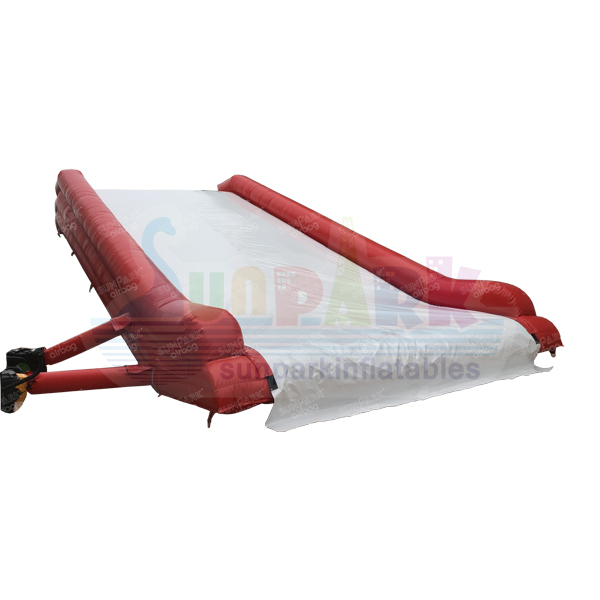
Furthermore, the top sheet—the actual surface the rider lands on—is a critical component. We utilize a highly advanced, low-friction top sheet material that mimics the slide of real snow. This is essential for modern “landing airbags” which are built on an angle to mimic the slope of a real mountain landing. When a snowboard air bag work as a sloped landing pad, the rider does not simply sink into it and stop; rather, they touch down and ride away smoothly off the end of the bag. This prevents rotational injuries to the knees and ankles. You can see this technology deployed in the best snowboard airbag parks around the globe.
5. Optimal Setup and Operational Maintenance
Ensuring that a snowboard air bag work flawlessly day in and day out requires proper installation and maintenance. From our experience supplying these systems worldwide, a flat, debris-free footprint is mandatory. Any sharp rocks or abrasive surfaces beneath the bag can compromise the bottom chamber.
We recommend establishing a daily checklist for operators. This includes verifying the output of the electric blowers, checking the tension of the anchor tie-downs (as wind can severely impact how a snowboard air bag work), and inspecting the top sheet for any micro-tears caused by unfiled snowboard edges. Furthermore, ensuring that the air intakes are free from snow accumulation or debris is vital; if the blowers cannot pull in ambient air, the internal pressure drops, and the snowboard air bag work capacity is dangerously diminished.
6. Cross-Sport Versatility and Training Integration
While we heavily discuss winter sports, the engineering that makes a snowboard air bag work is entirely transferable to other extreme disciplines. The principles of dual-chamber shock absorption and rapid air displacement are universal.
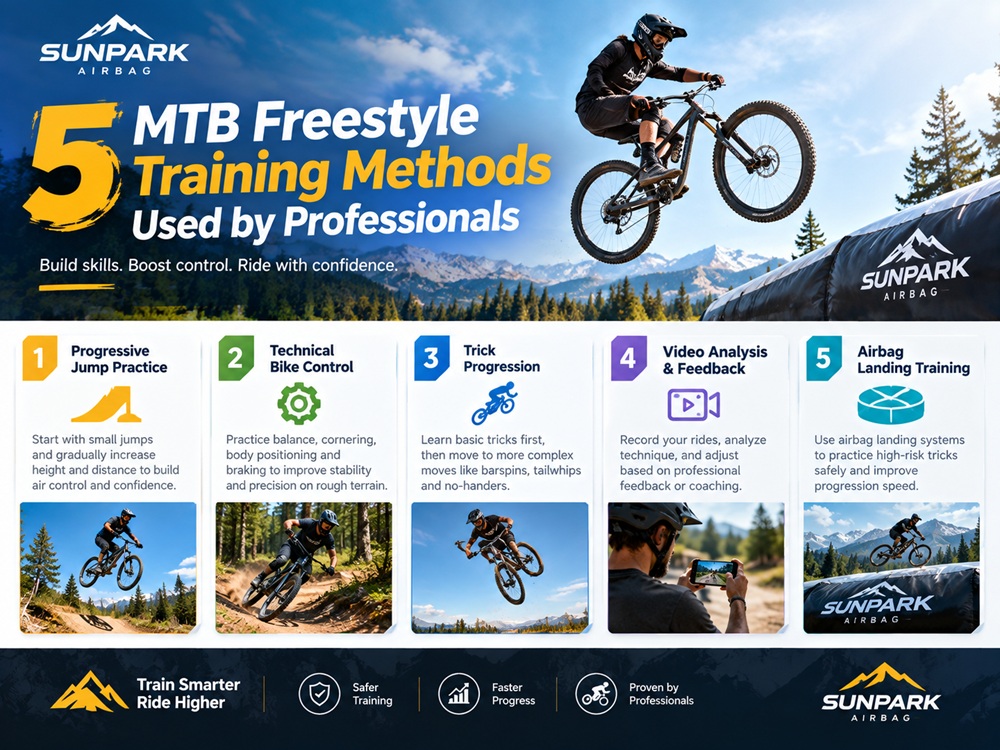
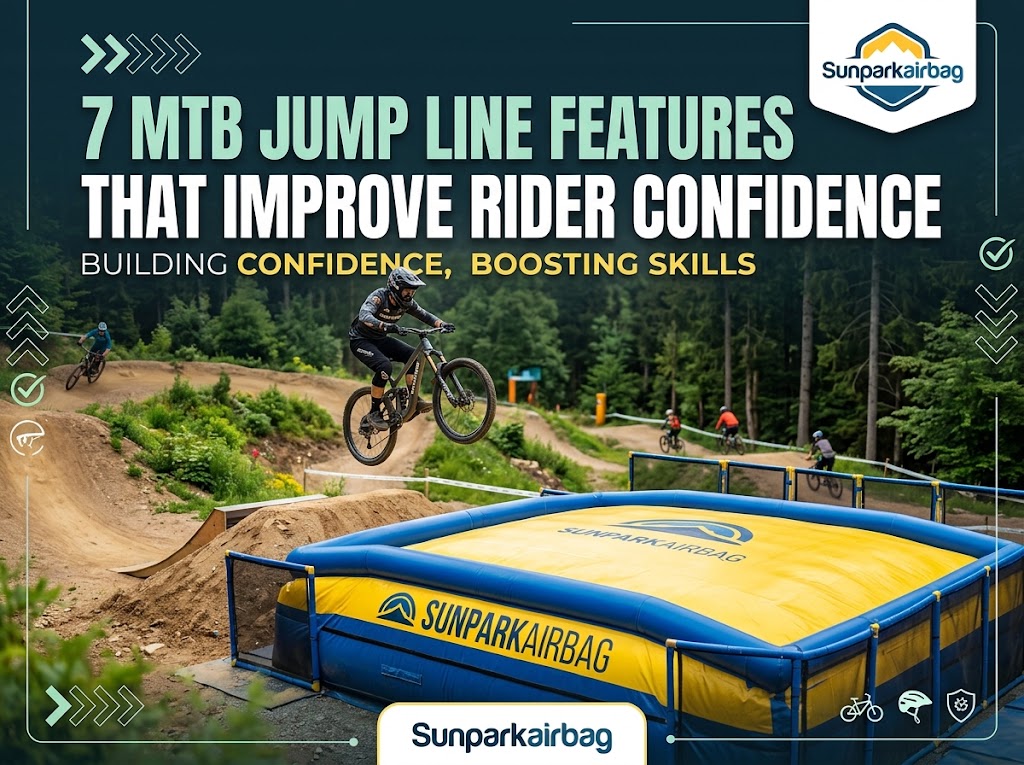
For example, in the warmer months, dirt jumpers and slopestyle mountain bikers rely on specialized MTB airbag landing system setups. The friction coefficients on the top sheet are adjusted to accommodate rubber tires rather than waxed snowboards, resulting in highly effective inflatable MTB airbag solutions. Similarly, freestyle motocross (FMX) riders attempting long-distance flips utilize heavy-duty motorcycle airbag systems 2026. The fundamental way a snowboard air bag work to disperse kinetic energy remains the exact science utilized across all our landing airbag solutions globally.
7. Summary Table: Air Bag Components and Functions
| Component | Material / Specification | Primary Function in How a Snowboard Air Bag Work |
|---|---|---|
| Lower Chamber | Heavy-Duty Plato PVC | Provides a firm, unyielding foundation to prevent ground strikes. |
| Upper Chamber / Pillars | Flexible PVC with Venting | Absorbs impact by rapidly displacing air horizontally and vertically. |
| Electric Blowers | Industrial 2HP / 3HP Fans | Provides continuous airflow to keep the structure pressurized and reset the bag. |
| Adjustable Air Vents | Zippered / Velcro Flaps | Allows operators to tune the firmness of the landing based on rider weight. |
| Advanced Top Sheet | Low-Friction Vinyl Composite | Allows riders to slide out their landings, protecting joints from sudden stops. |
8. Frequently Asked Questions (FAQs)
9. Authoritative References
For more information regarding the safety regulations, training protocols, and global standards applied to freestyle snowboarding and extreme sports infrastructure, please consult the following authoritative bodies:
- International Ski and Snowboard Federation (FIS) – Governing body for international winter sports competitions and safety regulations.
- U.S. Ski & Snowboard – National governing body providing guidelines for athlete training and facility safety standards.
Understanding how a snowboard air bag work highlights the incredible intersection of physics, material engineering, and sports science. By providing a safe, reliable, and highly advanced landing surface, SUNPARK® AIRBAG continues to empower athletes to push the boundaries of what is possible on a snowboard, ensuring they can progress their skills today and ride safely tomorrow.