What Is the Best Dirt to Build Jumps With

What Is the Best Dirt to Build Jumps With? The Trail Builder’s Field Guide
Every mountain biker and BMX rider has suffered through the heartbreak of bad dirt. You spend three weekends swinging shovels, moving wheelbarrows, and carving what looks like a pristine transition, only to watch your takeoff crumble into loose dust on the first session or turn into impassable soup after a 10-minute rain shower. Worse yet, an unstable lip that deforms under tire compression robs your pop, pitches your front wheel forward, and sends you over the bars into a brutal dirt landing. Sourcing the best dirt to build jumps with is not an aesthetic choice; it is an unforgiving soil mechanics problem. Soil is an engineered construction material governed by grain distribution, cohesion, and moisture density. If you pile up whatever dark dirt sits in your backyard without testing its clay-to-sand ratio, your jumps will never survive. Understanding real soil science separates rock-solid, low-maintenance jump lines from crumbling dirt piles that eat up all your riding time.

What Is the Best Dirt to Build Jumps With

Quick Answer: The Best Dirt to Build Jumps With

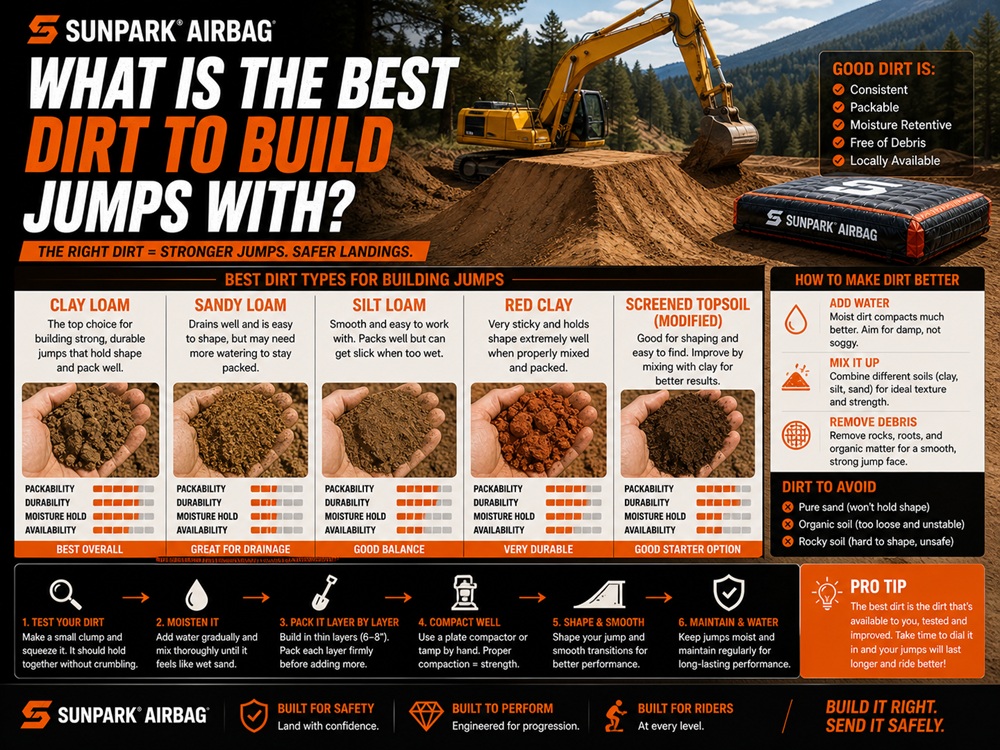
The definitive best dirt to build jumps with is subsoil classified as Sandy Clay Loam or Clay Loam, consisting of approximately 25% to 35% clay, 40% to 50% sharp sand, and 20% to 30% silt. Clean, deep subsoil excavated from beneath the organic root horizon provides the ideal balance: the clay acts as a structural glue that bonds particles into a smooth, brick-hard surface, while the sand provides structural friction and internal drainage that prevents cracking. Pure sand will never pack, pure clay cracks into sharp shards and turns into grease when wet, and organic topsoil is completely unusable. In most professional situations, if your native soil lacks clay, we recommend blending imported subsoil or capping transitions with decomposed granite. For large-scale progression setups where moving hundreds of cubic yards of dirt landing fill is impractical, pairing sculpted clay-loam lips with an engineered MTB airbag landing system provides the ultimate training setup while eliminating catastrophic landing impacts.

Soil Mechanics: What Makes Dirt Pack Rock-Solid

To identify the best dirt to build jumps with, you must understand soil behavior under dynamic tire loads. When a 180-pound rider on a 30-pound mountain bike pumps into the transition of an 8-foot lip at 20 MPH, the downward force (G-out) spikes to multiple times body weight. That pressure concentrates on a contact patch no larger than a credit card. If the soil lacks cohesive strength, the tire pushes the grains outward, creating ruts that catch front wheels.

Soil consists of three primary mineral particle sizes defined by geotechnical engineering standards:

  • Sand (0.05 mm to 2.0 mm): Large, gritty, visible particles. Sand provides friction, structural bulk, and open pore space for water drainage. However, sand has zero plastic cohesion; without a binder, dry sand flows like an hourglass.
  • Silt (0.002 mm to 0.05 mm): Medium, flour-like particles. Silt fills microscopic gaps between larger sand grains, smoothing the surface texture. In excess, silt becomes powdery dust when dry and slippery muck when wet.
  • Clay (Less than 0.002 mm): Microscopic, flat plate-like mineral crystals carrying negative electrical surface charges. When mixed with water, surface tension and ionic bonds bind clay particles together, creating plasticity. When dried, clay cures like fired ceramic brick.

From our experience on trail build sites, soil compaction relies on the Proctor Compaction principle. Soil particles can only achieve maximum dry density when compacted at their Optimum Moisture Content (OMC). When water content is dialed, the moisture film lubricates the mineral plates, allowing them to slide past one another and lock into a dense matrix under shovel slaps and compactor plates. As the water evaporates, capillary tension draws the clay particles together, locking the sand grains in place to produce a smooth, concrete-like riding surface.

Quick Summary Table: Jump Dirt Classifications at a Glance

Soil Classification Clay / Sand / Silt Ratio Compaction & Hardness Weather Resistance Builder Verdict
Sandy Clay Loam (The Gold Standard) 25-35% Clay / 45-55% Sand / 15-25% Silt Cures rock-hard; zero rutting under heavy tires Excellent; sheds rain without cracking when dry The absolute best dirt to build jumps with; holds shape for years
Heavy Clay (“Gumbo” / Potters Clay) 50%+ Clay / <25% Sand / <25% Silt Extremely hard when dry, but shrinks and cracks Terrible; turns into grease when wet, takes days to dry Difficult to work by hand; requires sand blending to be rideable
Sandy Loam / Coarse Sand <15% Clay / 65-80% Sand / 10-20% Silt Poor; crumbles under heavy pump track forces Drains fast, but erodes and blows away in wind Unusable for steep lips; requires clay binder or wood kickers
Organic Topsoil (Garden Dirt) Contains rotted roots, leaves, and humus Spongy; compresses unpredictably under riding Absorbs water like a sponge; stays soggy for weeks Completely useless; scrape off and discard before building
Decomposed Granite (DG) / Screenings Crushed aggregate with stone dust binder Very hard and consistent when compacted wet Good water shedding; can wash out on steep vertical faces Excellent for top-capping lips and berms, expensive for full fills

The Gold Standard Blend: Why Sandy Clay Loam Wins

If you ask veteran trail builders what they look for when scouting a build zone, they will all tell you the same thing: subsoil with balanced clay and sand. Specifically, Sandy Clay Loam hits the ideal mechanical sweet spot that pure soils can never match on their own.

Consider what happens with the alternatives:

  • The Pure Clay Problem: Novice builders often think the hardest clay makes the best jumps. That is a mistake. High-plasticity clays (such as bentonite or montmorillonite) experience massive shrink-swell cycles. When wet, pure clay absorbs water between its crystal layers, swelling into slick, sticky muck that cakes tires and clings to shovels. As it bakes in the summer sun, it contracts, forming deep fissures and sharp surface chunks that ruin smooth takeoffs.
  • The Pure Sand Problem: Beach sand or riverbed sand has zero cohesion. You can pour hundreds of gallons of water on it and pack it with a flat shovel, but as soon as it dries, the first rider who pumps into the lip will blow the transition apart, leaving deep tire trenches.

Sandy Clay Loam eliminates both failure modes. The 40% to 50% sharp sand acts as an internal aggregate skeleton, stopping shrink cracks and letting water drain out of the soil. Meanwhile, the 25% to 35% clay coats every sand grain, acting like natural cement. In our testing across seasonal freezes and summer droughts, jumps shaped from sandy clay loam require only occasional light sweeping and periodic watering to stay in prime riding condition.

How to Field-Test Your Dirt on Site: 3 Proven Tests

You do not need an expensive geotechnical lab to analyze your dirt. Before ordering 20 dump truck loads of fill dirt or spending days digging in the woods, use these three proven field tests to verify whether you have the best dirt to build jumps with.

1. The Hand Squeeze and Ball Drop Test

Grab a handful of subsoil, remove all roots and pebbles, and add just enough water so it feels like damp modeling clay. Squeeze it firmly into a tight ball in your fist, then open your hand. If the ball crumbles immediately, the soil is too sandy. If the ball holds its shape, hold it out at waist height (roughly 3 to 4 feet above the ground) and drop it onto flat, firm dirt. If the ball shatters into dust, it lacks clay. If it deforms slightly into a flat patty without breaking, it has high clay content. If it splits cleanly into three or four solid chunks, you have near-perfect sandy clay loam.

2. The Hand Ribbon Test (Soil Texture Verification)

Take a walnut-sized ball of moist soil. Roll it between your palms into a uniform cylinder roughly 1/2-inch thick (like a cigar). Using your thumb and forefinger, gently press and squeeze the cylinder outward over your hand, letting it extend like a ribbon until it breaks under its own weight.

  • Breaks under 1 inch: Loamy sand or sandy loam (not enough clay; will crumble under tires).
  • Forms a ribbon 1 to 2.5 inches long: Sandy clay loam or clay loam (the sweet spot for jump building).
  • Forms a flexible ribbon longer than 2.5 to 3 inches: Heavy pure clay (too sticky; needs sand blended in to prevent cracking).

3. The Mason Jar Sedimentation Test

For a precise percentage breakdown, dig up clean subsoil, break up all clumps, and fill a straight-sided glass Mason jar 1/3 full of dirt. Fill the rest of the jar with clean water, add a teaspoon of liquid dish soap (which acts as a surfactant to break soil aggregates), and shake vigorously for 60 seconds until all soil is in suspension. Place the jar on a level table:

  • At 1 Minute: The heavy sand grains settle to the bottom. Mark the sand level with a marker.
  • At 2 Hours: The medium silt particles settle out above the sand. Mark the silt level.
  • At 48 Hours: The microscopic clay particles settle, leaving the water clear. Mark the top clay line.

Measure the height of each layer with a ruler to calculate your percentages. If your jar shows roughly 45% sand, 25% silt, and 30% clay, you have struck gold.

Core Operational Benefits of Proper Jump Dirt

When you take the time to find and shape high-grade sandy clay loam, your jump lines deliver noticeable performance advantages over standard backyard dirt piles:

1. Predictable, Consistent Pop on Every Lap

A soft takeoff absorbs tire energy. When your rear wheel compresses into a spongy lip, your suspension absorbs the rebound, deadening your trajectory and causing you to case the knuckle. A hard-packed clay-loam takeoff provides a firm, predictable launch surface that transfers 100% of your pumping energy into upward and forward momentum.

2. Exceptional Tire Grip and Carving Traction

Berms and curved jump lips require high lateral traction. Sandy clay loam provides a smooth surface with enough micro-texture from exposed sand grains to give rubber tire knobs consistent mechanical grip. You can carve hard into transitions without front-tire washouts or loose gravel slides.

3. Weather Resistance and Reduced Maintenance Hours

Properly packed clay-loam lips shed light rain like a shingled roof. Water runs off the sides into your drainage ditches rather than soaking into the jump core. Instead of spending every sunny afternoon repairing ruts and rebuilding collapsed transitions, you can sweep off loose dust, moisten the surface, and start riding immediately.

Inherent Limitations and Climate Challenges of All-Dirt Jumps

Even when built with the finest sandy clay loam on earth, all-dirt jumps carry real physical limitations that every trail builder must plan around:

Builder Warning: No dirt jump line is permanent without ongoing maintenance. Rain, wind, freeze-thaw cycles, and summer sun break down compacted soil over time. If you do not plan for regular maintenance, tarps, and drainage, nature will reclaim your jumps.

  • The Freeze-Thaw Heave Cycle: In cold climates, water trapped inside compacted clay freezes during winter, expanding by roughly 9% and breaking apart your packed surface. In spring, the top two inches thaw into soft mud while the ground below remains frozen, destroying the crisp geometry of your lips.
  • Summer Dessication and Dusting: Prolonged heat waves pull all moisture from dirt. Without regular watering from a hose or spray rig, clay binders dry out, and high-wear tires will quickly chew the top layer into powdery dust.
  • Enormous Labor and Material Volumes: Moving dirt is exhausting work. Building a proper 6-foot-tall tabletop with a wide safety landing requires between 20 and 35 cubic yards of compacted fill dirt—equivalent to 30 to 50 tons of material. For large progressive features, manual shovel work quickly becomes impractical.
  • Zero Margin for Landing Errors: Hard-packed dirt jumps reward precision, but punish mistakes. Casing a gap onto a rock-hard clay knuckle or blowing your pedals on a landing results in brutal impacts. Reviewing common BMX injuries and prevention shows that the vast majority of broken bones and concussions happen on unforgiving dirt landings.

Direct Technical Comparison: Soil Types for Jump Construction

Performance Attribute Sandy Clay Loam Pure Heavy Clay Sandy Loam / Dirt Mix Decomposed Granite (DG)
Packing Hardness Exceptional (Brick-hard) Rock-hard when dry; soft when wet Moderate to poor; ruts easily Very high (Pave-like finish)
Drying Time After Rain Fast (2 to 4 hours in sun) Extremely slow (1 to 3 days) Fastest (Drains instantly) Very fast (1 to 2 hours)
Crack Resistance High (Sand stops shrink cracks) Terrible (Splits into deep cracks) High (Zero clay shrinkage) High (Minimal shrinkage)
Shaping Workability Excellent; cuts smoothly with flat shovel Brutal; sticks to blades like glue Easy to shovel, hard to shape Easy to rake and roll wet
Material Cost Low if native; moderate as fill dirt Low if native; hard to purchase Low cost Expensive ($40 to $70 per ton)

Pros and Cons: Full-Dirt Jumps vs. Dirt Lips with Airbag Landings

Jump Build Strategy Riding & Building Advantages Operational Drawbacks & Trade-Offs
Traditional All-Dirt Jumps
(Dirt Takeoff + Dirt Landing)
  • Classic, satisfying feel of pure dirt jumping.
  • Low material cost if clean subsoil is available on site.
  • Natural aesthetic that blends into outdoor landscapes.
  • Zero electricity, blowers, or synthetic materials needed.
  • Massive labor required to haul and pack landing piles.
  • High risk of severe injury when casing or ejecting mid-air.
  • Constant maintenance needed after heavy rains.
  • Riding sessions get rained out for days at a time.
Hybrid Setup: Dirt/Wood Lip + Airbag Landing
(e.g., Sunparkairbag System)
  • Allows fearless trick progression with soft impact landings.
  • Saves hundreds of hours of dirt moving on massive landings.
  • Rideable in damp weather; simply dry the top sheet.
  • Adjustable internal air pressure for learning new tricks.
  • Portable; can be relocated or packed away for winter.
  • Requires upfront purchase investment for the airbag.
  • Needs a continuous electric blower to stay inflated.
  • Must be protected from sharp tree branches and rocks.

The Modern Progression Shift: Why Commercial Parks Pair Dirt with Airbags

For decades, progression in dirt jumping was an exercise in pain tolerance. If you wanted to learn backflips, 360s, or tailwhips on a mountain bike or BMX, you had two choices: build a smelly foam pit full of damp, soggy foam blocks that rotted outdoors, or send it to a hard-packed dirt landing and accept the consequences. Today, the world’s best bike parks, training compounds, and backyard builders have changed how they build features.

Building an all-dirt takeoff is manageable: a 6-foot lip requires roughly 4 to 6 cubic yards of dirt, which two motivated riders can shape in a weekend. The real problem is the landing. A safe, progressive landing for that same jump must be 8 feet tall, 12 feet wide, and 25 feet long to give riders a safe runoff angle. That requires over 40 cubic yards of soil—dozens of tons of heavy material that will rut, wash out, and require constant repacking.

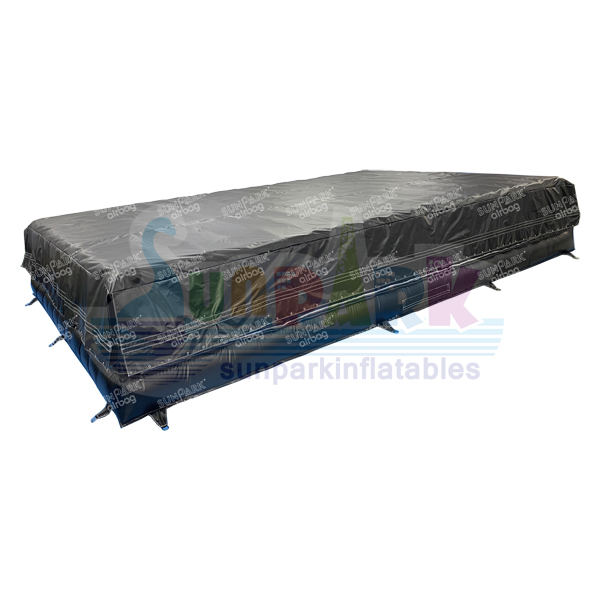
That is why modern action sports facilities deploy airbag landing ramp system setups and dedicated landing airbag solutions. By sculpting a firm, perfectly curved takeoff out of native sandy clay loam and pairing it with a high-durability inflatable landing, riders get the natural pop of real dirt alongside a forgiving landing surface that lets them practice high-consequence tricks safely. Exploring modern bike airbag landing systems shows how commercial operations use this hybrid approach to keep riders progressing without spending all their time pushing shovels.
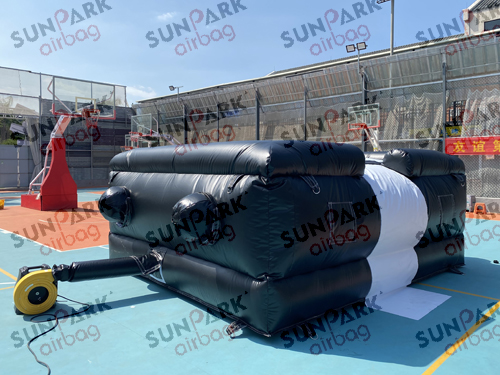
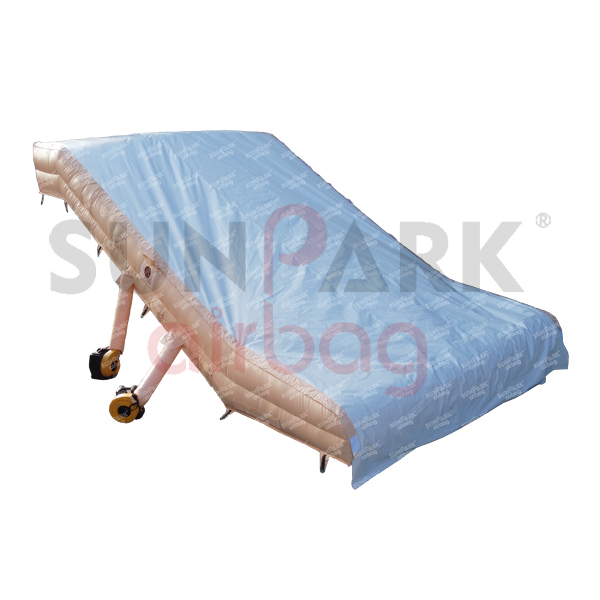
Sunparkairbag Best Bike Jump Airbag Landing Ramp

Progression Solution Spotlight: Sunparkairbag Best Bike Jump Airbag

When you want to spend your weekends riding rather than hauling 50 tons of dirt landing fill, Sunparkairbag provides commercial-grade inflatable landing systems built for action sports athletes. Designed to absorb high-speed impacts from mountain bikes and BMX, this system provides safe, repeatable progression for riders of all skill levels.

Chassis Material 0.55 mm heavy-duty PVC Tarpaulin base for structural durability
Top Sheet Material 0.90 mm reinforced PVC Tarpaulin: waterproof, flame-retardant, UV-protected
Chemical Safety 100% Lead-free and phthalate-free commercial-grade polymer formulation
Dimensions & Sizing Fully customizable landing angles, widths, and heights to match your takeoff
Production & Build Custom built in roughly 15 working days by technicians with 5+ years experience
Included Package High-output commercial blower, comprehensive repair kit, heavy-duty carry bag

Builder Recommendation: Learn more about the Best Bike Jump Airbag specifications or explore versatile inflatable MTB airbag solutions to build a safe, low-maintenance training compound in your own backyard.

Who Should Build Full Dirt vs. Who Needs an Airbag Landing

Every trail build should match your available time, site drainage, and rider skill level. Understanding your setup needs ensures you do not waste time digging features you cannot maintain.

Who Should Build Traditional Full-Dirt Jumps:

  • Experienced Trail Stewards with Native Sandy Clay Loam: If your land naturally sits on deep subsoil with 30% clay, you have access to a water hose, and you enjoy the weekly ritual of watering, sweeping, and packing lips, nothing beats an all-dirt rhythm line.
  • Pump Tracks and Low-Consequence Rollers: Berms, rollers, and small tabletop jumps under 3 feet tall do not require massive soil volumes. Building these features out of native clay-loam is straightforward, rewarding, and cost-effective.
  • Dedicated Public Bike Parks with Full-Time Maintenance Crews: Municipal facilities with tracked skid-steers, vibratory rollers, and paid maintenance staff have the resources to keep all-dirt lines groomed and safe for public use.

Who Should Choose an Inflatable Airbag Landing System:

  • Riders Learning Advanced Aerial Tricks: If you are working on flips, whips, spins, or cashrolls, practicing on a rock-hard clay landing will eventually lead to injuries. A dedicated BMX airbag landing provides the forgiveness you need to build muscle memory safely.
  • Builders with Poor Native Soil: If your property sits on pure sand, rocky gravel, or swampy topsoil, importing 50 truckloads of clean clay fill will cost thousands of dollars. Building a single wood or clay takeoff and pairing it with an airbag landing saves massive excavation costs.
  • Private Backyard Builders with Limited Space: A safe dirt landing requires a long, sloping runout that consumes lots of yard space. An inflatable landing provides controlled, progressive deceleration in a compact footprint.

Costly Building Mistakes That Ruin Dirt Jumps

Factory Floor Warning: Never use organic topsoil to build your jump core. Piling black topsoil inside a jump and covering it with a thin layer of clay creates a spongy core that collapses under rider weight. Always build your jump out of clean subsoil from base to lip.

  1. Building in Thick Layers Without Intermediate Compaction: Dumping 4 feet of loose dirt in a pile and beating the outside surface with a shovel creates a hard crust over loose, uncompacted fill. As soon as a rider lands on it, the crust breaks, sinking deep ruts into the face. Build in 6-inch lifts: spread 6 inches of damp dirt, pack it thoroughly with your boots, a flat tamper, or a compactor plate, and repeat until you reach full height.
  2. Neglecting Drainage and Water Management: Water is the biggest enemy of dirt jumps. If you build your jumps in a low spot without drainage ditches, rainwater will pool around the base of your landings, turning your transitions into mud pits. Always grade the surrounding ground to direct runoff away from your features.
  3. Packing Dirt That Is Too Dry or Soaking Wet: Slapping bone-dry dirt with a shovel creates clouds of dust, not compaction. Trying to shape soaking wet mud creates a soupy mess that takes days to dry. Moisten your dirt until it holds together firmly without squeezing water out between your fingers, then pack it down.
  4. Using Sharp Fill Material with Rocks and Roots: Large stones, decomposing tree branches, and root balls create weak spots inside your jump. Over time, wood rots and leaves empty voids inside the core, causing the jump face to collapse. Sift out all debris larger than a marble before shaping your final riding surface.

Essential Sourcing Checklist: Ordering Truckloads of Fill Dirt

If your property lacks good native dirt, you will need to order commercial fill from an excavation company or local quarry. Use this checklist to make sure you get the right material:

1. Order “Clean Fill Subsoil,” Never Topsoil

Make sure to specify “Clean subsoil fill dirt from below the organic horizon.” Ask the quarry or excavation contractor whether the soil comes from basement digs or road cuts. Tell them you need sandy clay fill with cohesive binding properties. Reject any load that contains dark loam, organic mulch, tree roots, or construction drywall debris.

2. Ask for a Hand Sample Before Ordering 10-Wheeler Loads

Never order 5 dump truck loads based on a phone conversation. Drive to the supplier’s yard or have the driver drop a single bucket sample first. Perform the hand ribbon test on site. If you cannot form a solid 1.5-inch ribbon, reject the pile; it does not have enough clay to hold jump transitions.

3. Calculate Volume with a 30% Compaction Factor

Remember that loose dirt shrinks significantly when packed. One cubic yard of loose fill dirt excavated from a pile will compact down to roughly 0.70 to 0.75 cubic yards once tamped into a dense jump face. If your geometric calculations show you need 20 cubic yards of finished jump volume, order at least 26 to 28 cubic yards of loose fill to account for compaction shrinkage.

4. Sourcing Decomposed Granite for Surface Caps

If your native dirt is slightly too sticky or prone to minor surface cracking, consider ordering a load of Decomposed Granite (DG) with 1/4-inch fines. Spreading a 2-inch layer of damp DG over your clay-loam lip and rolling it smooth creates a durable, weather-resistant cap that rides like asphalt while preserving your underlying jump shape.

Expert Trail Builder’s Verdict

In our professional assessment, spending your weekends riding instead of endlessly repairing damaged lips comes down to soil selection. The best dirt to build jumps with is unambiguously Sandy Clay Loam containing roughly 30% clay and 50% sand. It provides the cohesive strength needed to shape steep, poppy takeoffs, along with the internal drainage and aggregate friction required to prevent surface cracking and weather erosion.

Take the time to test your native dirt using simple hand-ribbon and jar sedimentation tests. If your dirt has the right clay content, build in 6-inch damp lifts and shape your transitions with care. If you plan to build large, progressive jump lines, consider the smart hybrid approach: sculpt clean, poppy takeoff lips from native clay-loam, and pair them with an engineered inflatable landing from Sunparkairbag. You will save dozens of hours of heavy dirt hauling, avoid rain delays, and gain the safe progression platform you need to push your riding to the next level.

Frequently Asked Questions

What is the best dirt to build jumps with for mountain biking and BMX?

The best dirt to build jumps with is subsoil classified as Sandy Clay Loam or Clay Loam, containing roughly 25% to 35% clay, 40% to 50% sharp sand, and 20% to 30% silt. This blend provides the cohesive bonding power of clay to sculpt smooth, brick-hard lips alongside the structural drainage and aggregate friction of sand to prevent cracking and crumbling.

Can you build dirt jumps using standard dark organic topsoil?

No. Organic topsoil contains decomposed leaves, root matter, and spongy humus that traps water and cannot be compacted. Jumps built with topsoil will compress unpredictably under tire pressure, rut out within hours of riding, and erode into mud during the first light rain.

How do you test if your dirt has enough clay to build bike jumps?

Use the hand ribbon test: moisten a handful of soil, roll it into a 1/2-inch thick snake between your palms, and squeeze it outward over your thumb. If you can push out a continuous ribbon 1.5 to 2.5 inches long before it breaks under its own weight, the soil contains the ideal 25% to 35% clay content for jump construction.

Why are bike parks replacing massive dirt landing piles with inflatable airbags?

Building a dirt landing for a 20-foot gap requires 40 to 60 dump truck loads of fill dirt, days of heavy compaction, and endless daily watering and maintenance. Inflatable airbag landings eliminate hundreds of hours of dirt moving, provide progressive impact absorption that prevents severe riding injuries, and allow riders to practice high-consequence tricks safely in any weather.

Authoritative References & Civil Engineering Standards


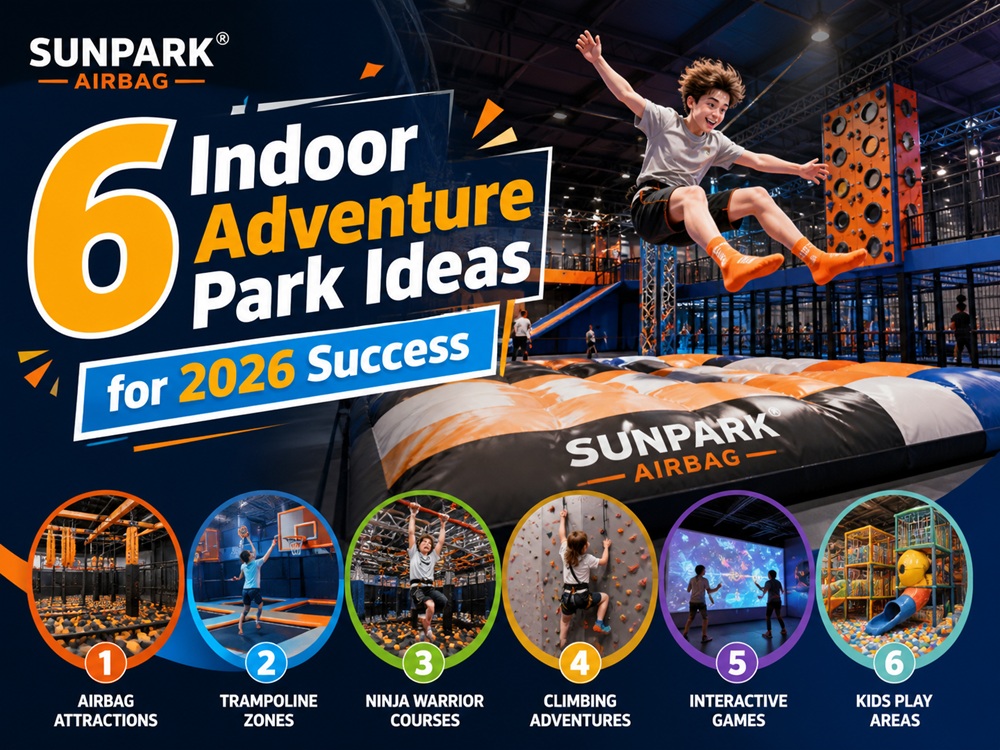
6 Indoor Adventure Park Ideas for 2026 Success

6 Indoor Adventure Park Ideas for 2026 Success

The family entertainment and leisure industry has reached a critical turning point. In the early 2010s, simply opening a warehouse filled with basic trampolines and a foam pit was a license to print money. That era is definitively over. Today’s consumers, heavily influenced by extreme sports media and action-oriented content, demand immersive, high-adrenaline experiences that they cannot replicate in their backyards. If you are an operator still relying on deteriorating foam blocks and generic bounce zones, your facility is bleeding revenue through high maintenance costs and declining customer retention.

6 Indoor Adventure Park Ideas for 2026 Success

From our experience consulting with the most profitable entertainment centers globally, survival in 2026 requires ruthlessly evaluating your attractions based on throughput, maintenance overhead, and safety liability. The solution is entirely architectural: replacing static, unhygienic legacy equipment with dynamic, high-performance inflatable infrastructure. We are going to break down the exact Indoor Adventure Park Ideas that are driving massive ROI right now. We will explain not only what these attractions are, but whether they are actually worth buying and installing in your specific facility.

Quick Answer: What are the Best Indoor Adventure Park Ideas?

The most profitable Indoor Adventure Park Ideas for 2026 transition away from traditional trampolines and toxic foam pits toward extreme sports emulation using advanced pneumatic technology. The top concepts include Freestyle BMX/MTB jump zones, elevated stunt freefall towers, professional gymnastics training sectors, and advanced Ninja Warrior courses. The critical factor for success is replacing outdated impact zones with commercial-grade airbag landing systems, which increase rider throughput by up to 300%, eliminate foam dust hazards, and drastically reduce long-term maintenance costs.

What It Is: The Evolution of Indoor Parks

An indoor adventure park is a large-scale commercial facility designed to offer active, physical entertainment. Historically, these were branded as “trampoline parks.” However, the modern adventure park has evolved into a multi-disciplinary extreme sports hub. It incorporates elements of parkour, free-running, freestyle BMX, and acrobatic stunt training.

The defining characteristic of a 2026 adventure park is its reliance on zero-impact landing technology. Facility owners have realized that traditional landing zones are financial liabilities. Understanding the foam pit vs airbag comparison is the first step in modernizing a facility. Today’s successful parks utilize proprietary air-chamber systems that catch users safely, regardless of their trajectory, and allow them to exit the landing zone in seconds rather than minutes.

How Modern Park Attractions Work

The mechanics of these high-tier Indoor Adventure Park Ideas rely entirely on throughput—the number of guests who can cycle through an attraction per hour. In a legacy foam pit, a jumper lands, sinks into the foam, and spends 45 to 60 seconds physically struggling to crawl out. During this time, the attraction is blocked. Nobody else can jump.

Modern attractions work by utilizing shock-absorbing, multi-chambered airbags. When a guest lands on a commercial airbag, the top layer absorbs the kinetic energy through calibrated air release valves, while the bottom layer remains firm to prevent bottoming out. Because the top sheet is taut and smooth, the jumper can simply stand up and walk off the bag in less than five seconds. This mechanical efficiency allows operators to cycle 10 to 12 jumpers per minute through a single attraction, exponentially increasing the park’s capacity and overall revenue potential.

6 High-ROI Indoor Adventure Park Ideas for 2026

1. Freestyle BMX and MTB Jump Zones

1. Freestyle BMX and MTB Jump Zones

Action sports enthusiasts are a massive, underserved demographic in the indoor park sector. Building a specialized wooden or composite ramp system that launches riders into a bike airbag landing creates a dedicated training facility that operates year-round, regardless of weather. These riders buy monthly memberships, not just single-day passes, providing predictable, recurring revenue.

2. Elevated Stunt Freefall Towers

For commercial users looking to create a “hero attraction” that dominates local social media, the stunt tower is unmatched. Guests jump from elevated platforms (typically 2 to 4 meters high) into a massive stunt airbag landing. It taps into the adrenaline of a Hollywood stunt sequence. The operational footprint is minimal compared to the psychological impact and marketing value it generates.

3. High-Performance Gymnastics and Parkour Sectors

Do not isolate your demographic to toddlers and young children. Teenagers and young adults engaging in parkour and tricking need safe zones to practice complex flips. Integrating professional gymnastics airbag equipment adjacent to sprung floors and tumble tracks attracts serious athletes and specialized training camps.

4. The Big Jump / Mega Drop Attraction

4. The Big Jump / Mega Drop Attraction

This is the ultimate evolution of the trampoline launch. By positioning high-performance trampolines or launch ramps in front of a big jump airbag system, you allow guests to achieve massive airtime with zero fear of a hard landing. This is consistently the highest-rated attraction in post-visit customer surveys.

5. Next-Gen Ninja Warrior Courses

Ninja courses are incredibly popular, but the traditional foam blocks or thin tumbling mats placed underneath them lead to rolled ankles and hygiene complaints. Upgrading the fall zones beneath the swinging rings and warped walls with a continuous inflatable crash mat ensures a sanitary, perfectly calibrated safety net that requires zero fluffing or daily maintenance.

6. Indoor Moto and Dirt Bike Training

For heavy-duty applications in massive warehouse spaces, nothing draws a crowd quite like indoor freestyle motocross. While highly specialized, installing a dirt bike airbag landing positions your facility as a premier regional or national training hub for professional FMX riders, drawing spectators and massive sponsorship opportunities.

Commercial Benefits of Upgrading

In most professional situations, operators resist upgrading because of the initial capital expenditure. However, the commercial benefits of executing these Indoor Adventure Park Ideas are undeniable. First, the reduction in maintenance labor is absolute. You no longer have to pay staff to empty, clean, and replace toxic, crumbling foam blocks. Second, facility hygiene skyrockets. Antimicrobial top sheets on modern airbags can be sanitized daily in minutes, a massive selling point for parents post-2020.

Finally, your insurance premiums will likely stabilize or decrease. The predictability and safety data surrounding top-tier airbags provided by reputable trampoline park equipment manufacturers are highly favored by risk management underwriters compared to the unpredictable hazard of unmaintained foam pits.

Limitations and Infrastructure Constraints

We must use commercial and practical judgment: these attractions are not viable for every space. The primary limitation is ceiling height. You cannot safely operate a stunt jump or a big air launch without a minimum of 6 to 8 meters (20 to 26 feet) of vertical clearance. Secondly, pneumatic systems require constant power to run the internal blowers. While modern blowers are highly efficient, you must account for the continuous electrical draw and the ambient noise they generate, which requires acoustic planning in your facility design.

Who Should Use It vs. Who Does Not Need It

For commercial users: Any operator looking to open a new 15,000+ square foot facility, or a current owner facing declining ticket sales, must implement these extreme-sports-focused Indoor Adventure Park Ideas. If you want to capture the lucrative teenage and young adult market, advanced airbag attractions are mandatory.

Who does not need it: For beginners operating small-scale daycares, soft-play areas for toddlers under 5 years old, or facilities with low ceiling heights (under 15 feet), heavy-duty airbag systems and stunt towers are an unnecessary overcapitalization. Stick to standard soft-play modular framing.

Common Mistakes in Park Design

The most catastrophic mistake we see operators make is buying cheap, uncertified landing equipment from anonymous overseas brokers to save a few thousand dollars. An airbag is a life-safety device. If the internal baffling tears or the air release valves fail to calibrate, a jumper will bottom out against the concrete floor. You must purchase from verified manufacturers.

Another frequent error involves the secondary market. While attempting to save money, operators often look for used gear. If you do not know how to inspect the seams and blower capacity, you are buying liability. If you must go this route, heavily study buy used airbag landing tips to avoid acquiring structurally compromised equipment.

Buying Considerations and ROI

When selecting equipment to bring your Indoor Adventure Park Ideas to life, prioritize modularity and top-sheet durability. A commercial top sheet will eventually wear out from thousands of daily impacts; ensure the manufacturer provides a system where the top sheet is easily replaceable via Velcro or heavy-duty zippers, rather than having to replace the entire airbag unit.

Quick Summary Table: Legacy vs. Modern Park Attractions
Feature Legacy Foam Pit Systems Modern Airbag Systems
Throughput (Cycles/Min) Low (1-2 jumpers per minute) High (10-12 jumpers per minute)
Maintenance Cost High (Constant foam replacement) Low (Daily wipe down, annual checks)
Hygiene Factor Poor (Traps sweat, dust, bacteria) Excellent (Antimicrobial, wipeable surface)
Visual Appeal Outdated, messy Premium, extreme-sports aesthetic
Pros and Cons Table: Implementing High-End Airbag Attractions
Pros Cons
Drastically increases park capacity and daily revenue. Higher upfront capital expenditure than foam.
Attracts serious athletes and recurring memberships. Requires high ceilings and large facility footprints.
Eliminates the risk of fire associated with polyurethane foam. Continuous electrical cost to run inflation blowers.
Offers massive social media and marketing appeal. Requires stringent daily safety inspections.

Expert Recommendation

In most professional situations, the decision to build or retrofit an adventure park comes down to long-term profitability. You cannot build a 2026 facility using 2010 technology and expect to dominate your local market. We strongly recommend entirely abandoning foam pits and investing your capital into specialized airbag landing zones. Whether you are installing a high-flying stunt jump or evaluating the bike airbag landing systems for a BMX zone, the operational efficiency of airbags will pay for the initial investment within the first 12 to 18 months.

SUNPARK® AIRBAG – Explorer of Airbag System for Sports
With over 10 years of experience, we provide freestyle airbags for ski resorts, theme parks, sports, and gymnastics facilities around the globe. SunparkAirbag® is the leading manufacturer of Airbags for Extreme Sports and Leisure Industries in China. As extreme sports developed, more and more snowboarders and serious sports enthusiasts are looking for safer training possibilities to progress without risks of getting injured. We create products for World Champion Snowboarders, famous riders, and trampoline parks worldwide. We are deeply committed to the development and improvement of our own products.

When you partner with SUNPARK® AIRBAG, you are not just buying a piece of vinyl; you are investing in a proven, safety-certified infrastructure that will be the focal point of your commercial success.

Frequently Asked Questions (FAQ)

Why are foam pits being replaced in indoor adventure parks?
Foam pits are highly unhygienic, harbor bacteria, create toxic foam dust, and pose a severe fire hazard. Additionally, they slow down throughput because guests struggle to climb out. Modern parks are replacing them with airbag landing systems that are antimicrobial, fire-retardant, and allow for immediate exit.
How much ceiling height is required for a stunt jump airbag?
In most professional situations, you need a minimum ceiling height of 6 to 8 meters (20 to 26 feet) for a commercial stunt jump or big jump airbag setup to ensure complete safety and proper clearance for the jumpers.
Are indoor adventure parks profitable in 2026?
Yes, provided the park features high-throughput attractions that minimize maintenance labor. Parks relying on outdated equipment face high insurance premiums and operational costs, whereas parks utilizing advanced inflatable technology see faster ROI due to increased guest capacity and lower upkeep.

Authoritative References

To ensure your facility meets international safety and operational standards, we advise consulting the following organizations:

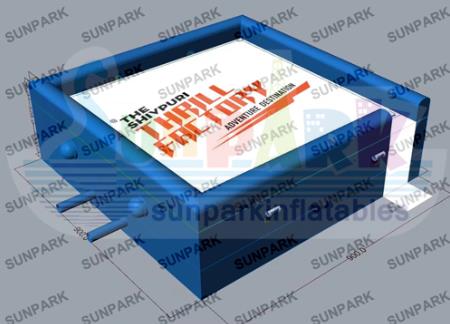
3Foam Pit Airbag for Gymnastics 3

Custom Airbags: From Concept to 3D Design & Delivery

1. Introduction — why a custom airbag matters

A custom airbag lets you move beyond “one-size-fits-all” landing or attraction solutions and get a product tuned to your site, user profile, branding and regulatory needs. Whether you’re specifying a bespoke landing for an Olympic training center, a branded freefall attraction at a theme park, or OEM airbags for a sports-equipment line, a custom approach reduces risk, improves usability and creates a better guest — and athlete — experience. SunparkAirbag explicitly offers custom solutions and will send 3D design confirmations before production. SunparkAirbag+1


2. Who needs a custom airbag? Use cases and examples

Custom airbags are the right choice when off-the-shelf sizes or profiles won’t meet your operational, safety or branding goals. Common use cases include:

  • Olympic / elite training centers that require exact attenuation curves and footprint fits. See Sunpark’s product hub and custom pages for high-performance solutions. SunparkAirbag

  • Theme parks, event operators and attractions that want freefall or twin-platform installations painted with brand colors and logos. See Sunpark’s freefall and attraction product lines. SunparkAirbag+1

  • Trampoline parks and gyms converting cube pits to foam-pit/airbag hybrids tuned for class sizes and ceiling heights. SunparkAirbag

  • OEM partners who want private-label or co-branded airbags for resale or bundled equipment packages. Manufacturer sites show OEM/manufacturing capabilities. SUNPARK

If your project is even slightly non-standard — different slope geometry, vehicle-rated impacts, unusual site constraints, or specific color/branding — you should evaluate a custom design from the start. Sunpark’s custom-airbag page explains bespoke options and contact steps. SunparkAirbag


3. The full design-to-delivery workflow (step-by-step)

Below is the practical workflow Sunpark and most professional manufacturers follow when delivering a production-grade custom airbag. Use this as your procurement map.

  1. Initial briefing & requirements capture

    • Stakeholders, target users (kids / adults / vehicles), regulatory region, site photos, run-in/run-out geometry, weights and throughput targets.

  2. Concept sketches & feasibility

    • Quick 2D layouts and rough sizing to validate concept.

  3. 3D design & CAD model (you’ll receive 3D preview / render for sign-off) — this is where venting, pillar layouts and branding placements are rendered. SunparkAirbag

  4. Material / hardware specification — shell fabric, valves, anchors, blower specs, flame/UV/cold ratings.

  5. Prototype / sample (for large or safety-critical projects) — small section or full-scale mockup if required.

  6. Pre-production testing — bench tests, pressure cycles, seam checks, material certificates.

  7. Production — assembly, sewing, seam welding and QA at the factory. Sunpark documents show their factory and manufacturing processes. SunparkAirbag+1

  8. Shipping & logistics — crating, palletizing, customs paperwork for international shipments.

  9. On-site installation & commissioning — anchor layout, blower setup, test drops and staff training. Sunpark provides installation guides and site support. SunparkAirbag

  10. Handover, documentation & spare parts — as-built drawings, maintenance schedule, repair kits, and any factory warranty paperwork.

Quick process checklist (table)

Phase Deliverable Who signs off
Brief Project brief, photos, constraints Client
Concept 2D sketch, footprint Client & design lead
3D CAD renders / 3D mockups Client
Pre-prod Test report, sample approval Client & QA
Production Final QA report Manufacturer
Install Commissioning report, training log Client & Installer

4. 3D design, prototyping & engineering details

Why 3D design matters

A 3D model turns abstract specs into a tangible model you can rotate, measure and simulate. When Sunpark says “3D design will be sent for confirmation,” it means you’ll get a CAD (or realistic render) showing the exact seams, vents, logos and anchor points before the factory cuts fabric. This is critical for:

  • Verifying that the airbag fits your pit/footprint. SunparkAirbag

  • Simulating pillar/chamber layouts so you avoid bottom-out in the wrong place.

  • Showing exact branding placement and stitch lines for your marketing team.

Typical 3D deliverables

  • Full-scale CAD model or high-resolution photorealistic render.

  • Seams & panel layout drawings for manufacturer input.

  • Technical drawings: cut patterns, valve placements, anchor positions, and blower interface.

  • Optionally, a simple finite-element or dynamic simulation of compression if requested for high-risk designs.

Prototyping notes

For vehicle-rated or very large airbags, a partial prototype (sample pillar module or a single corner) can speed approval cycles and uncover manufacturing challenges early.


5. Materials, certifications and compliance you should require

4Jumbo Air Bag for Trampoline

Custom airbags are made from high-performance coated textiles and hardware; insist on spec sheets and certificates.

Material specs to request

  • Top-layer fabric: PU/PVC coated polyester or TPU — state abrasion, cold flexibility, UV and flame retardancy.

  • Seam type & strength: stitched + welded seams, seam-tensile test certificates.

  • Valve & vent hardware: rated for cycles and serviceability.

  • Anchors & D-rings: stainless or plated steel hardware with load rating.

Standards & certifications (external authoritative references)

Ask your supplier for evidence of compliance with applicable standards — these are commonly used references for inflatable manufacturing and safety:

  • ASTM F2374 — Standard Practice for inflatable amusement devices (design, manufacture, operation and maintenance). ASTM International | ASTM

  • EN 14960 (and related EN standards) — safety and test methods for inflatable play equipment in Europe. https://www.en-standard.eu

  • REACH / chemical compliance for materials sold in the EU — ensure your fabric chemicals are REACH-compliant. echa.europa.eu

Manufacturers like Sunpark state CE or EN certifications where applicable — request documentation for any certification claimed. SunparkAirbag


6. Branding, OEM options and artwork integration

A custom airbag is also a branding asset. Typical branding options:

  • Full-surface digital printing or vinyl appliqué for logos and sponsors.

  • Custom colorways for park/theme consistency.

  • Laser-cut or printed seam lines that integrate with the bag aesthetic.

Sunpark advertises bespoke branding and OEM capabilities — discuss artwork file formats (vector .ai or .eps preferred), color proofs, and trim allowances during the 3D sign-off stage. SunparkAirbag+1

OEM partnerships

For OEM airbags (private-label), confirm:

  • Minimum order quantities (MOQs), lead times, and exclusivity/patent considerations.

  • Labeling & serial numbering for warranty and traceability.

  • After-sales parts support and spare inventory.

Manufacturer sites and their corporate pages often list OEM and manufacturing services—review Sunpark’s manufacturing/ABOUT pages for details. SUNPARK+1


7. Manufacturing, quality control & factory testing

Good factories follow clear QC gates:

  1. Incoming material inspection — confirm roll certificates and chemical compliance.

  2. In-process inspection — stitch count, seam weld tests, and valve mounting checks.

  3. Final pressure/pressure-hold test — verify the bag holds rated pressure and venting performs as designed.

  4. Cycle testing — repeated inflation/deflation cycles on critical models.

  5. Packing & documentation — pack with repair kit, spare filters, and maintenance manuals.

Sunpark’s production pages showcase that they operate experienced facilities and provide pre-production testing—ask for their QC checklist when you request a quote. SunparkAirbag+1


8. Logistics, on-site installation & handover

Shipping & customs

  • Crate, palletize and label for export. Ensure importer documentation is complete (commercial invoice, packing list, HS codes).

  • Discuss who handles import duties and local partner support for installation.

On-site installation checklist

  • Confirm ground prep (flat, debris-free area, ground sheet).

  • Fix anchor positions per supplied drawing; validate ground bearing and drainage.

  • Set up blowers on dedicated circuits and test re-inflate/recovery times.

  • Conduct supervised test drops (incremental, recorded vent settings).

  • Deliver training for operators and handover maintenance documentation.

Sunpark provides installation support and can supply anchor drawings and commissioning assistance as part of the delivery. SunparkAirbag


9. Pricing, lead times and procurement tips

Pricing factors

  • Bag size and complexity (multi-chamber / vehicle-rated).

  • Custom printing and branding.

  • Hardware spec (marine-grade anchors, heavy duty valves).

  • Certifications and testing scope.

  • Shipping and any on-site installation services.

Typical lead times

  • Small custom runs or color variants: 3–6 weeks.

  • Large bespoke systems, vehicle-rated or heavy engineering: 8–14+ weeks (including testing and shipping).

Always ask vendors for a time-phased schedule (concept → prototype → test → production → ship). Consider a pilot or small initial order for new suppliers.


10. Decision checklist — what to ask before you order

  • Can you provide a 3D model and panel layout before production? (Required) SunparkAirbag

  • Do you have material test certificates and flame/UV/cold ratings? (Required)

  • Can you share attenuation / performance testing data for similar models? (Required)

  • What anchor plan do you recommend for my site and wind profile? (Required)

  • What spare parts and service support are included? (Required)

  • What are the exact lead times and payment milestones? (Required)

  • Are OEM/branding and MOQ terms acceptable for my business case? (Negotiable)

Use this checklist when requesting quotes and comparing suppliers.


11. Case studies & internal resources (quick links)

Below are SunparkAirbag pages that are useful during vendor evaluation and project definition — I recommend bookmarking them and referencing the specific product pages during your RFQ (these links are live examples of custom and product pages):

(Use these links in your internal RFQ and add the exact model references in your purchase order.)


12. External standards & authoritative references

When preparing your safety pack and compliance documentation, include and cite the following authoritative standards and guidance:

  • ASTM F2374 — Standard Practice for Design, Manufacture, Operation, and Maintenance of inflatable amusement devices. This is the principal US practice covering inflatables and useful guidance for manufacturers and operators. ASTM International | ASTM

  • EN 14960 — European standard for inflatable play equipment safety requirements and test methods; relevant for units used in EU markets. https://www.en-standard.eu

  • REACH (ECHA) — Chemical regulation for materials placed on the EU market; ask manufacturers for REACH compliance documentation for coated textiles. echa.europa.eu

Including these references (and the supplier’s test certificates against them) strengthens your insurance submission and local authority approvals.


13. Yoast / Publishing & SEO checklist (for editors)

  • Focus keyphrase: custom airbag — present in title, first paragraph, at least one H2 and several times in body.

  • Meta description: Use the SEO Description above (≤155 chars).

  • Slug: custom-airbags-design-process — keep concise.

  • Images & alt text: hero image (1200×628 OG) alt = Custom airbag 3D design and installation; Shopify/blog banner (1920×1080) alt = Custom airbag installation.

  • Internal links: include the internal pages above (we embedded many).

  • External links: include the three standards (ASTM, EN14960, REACH).

  • Readability: short paragraphs, numbered lists and headings (this article follows that).

  • Schema: add Article schema (title, author, datePublished, description, mainEntityOfPage).

  • Yoast checks: keyphrase density (natural), internal links (≥5), meta length and readability score.


14. Conclusion — next steps and contact

A successful custom airbag project balances performance, safety and branding. Start by capturing your requirements (user profiles, site constraints, branding needs), then request a 3D design and attenuation data before you commit to production. Manufacturers such as SunparkAirbag explicitly provide custom design, 3D render confirmations, and production/testing services — use their custom airbag and design pages to kick off your RFQ.

9Olympic-Size-Landing-Airbag-1-1

SNOWBOARD LANDING BAG: REVOLUTIONIZING FREESTYLE TRAINING WITH SAFETY AND VERSATILITY

SNOWBOARD LANDING BAG: REVOLUTIONIZING FREESTYLE TRAINING WITH SAFETY AND VERSATILITY
COMPREHENSIVE OVERVIEW OF SUNPARKAIRBAG® FREESTYLE AIRBAG LANDING SYSTEMS

In the rapidly evolving world of freestyle snowboarding and skiing, access to safe and effective training tools can dramatically accelerate an athlete’s progression while minimizing the risk of injury. SunparkAirbag® has emerged as a pioneering force in this arena, proudly standing as China’s first supplier of sloped snowboard landing bags. Our Olympic-size freestyle airbag landing systems are engineered to offer a realistic, high-performance training experience for riders of all levels—from beginners taking their first jump to professional athletes refining complex tricks for competition. By integrating cutting-edge design with user-focused features, we provide a product that is transforming how winter sports are practiced and perfected around the globe.

A New Standard in Training Safety and Realism
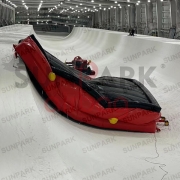
The cornerstone of our freestyle airbag landing system is its innovative sloped design, which closely mimics the natural angle of a snow jump landing. This geometry allows riders to land and ride away smoothly, replicating the sensations and body positions encountered on actual slopes. Unlike traditional flat landing surfaces, our sloped bag reduces the risk of awkward impacts and provides a more authentic training experience. At the heart of this system is advanced air-chamber technology, complemented by multiple adjustable air vents. These vents enable precise control over internal pressure, allowing the bag to be fine-tuned for optimal softness and impact absorption. Whether a user is practicing a straightforward jump or an intricate aerial maneuver, they can trust in a landing that is both soft and secure.

Versatility for All Conditions and Settings
Recognizing that athletic training is a year-round endeavor, we have designed our landing airbag to perform flawlessly in diverse environments. During the winter months, it can be deployed directly on snow at ski resorts, training centers, or terrain parks. When temperatures rise, the same system functions perfectly on dry slopes, synthetic surfaces, or even indoor facilities, enabling continuous skill development regardless of season. This adaptability makes it an invaluable investment for resort operators, sports academies, and event organizers seeking to maximize usage and return on investment. The system’s portability ensures it can be relocated and reconfigured as needed, supporting everything from daily training to special competitions.

Olympic Dimensions and Customizable Options
Our flagship Olympic-size airbag, measuring 30 meters in length, has become a popular choice for large-scale facilities and professional training programs. This dimensions provide ample space for high-speed approaches and extended landing zones, accommodating multiple users simultaneously and supporting the most ambitious tricks. However, we understand that every client has unique needs, which is why we offer fully customizable solutions. Whether you require a smaller unit for a private setup or a tailored design for a specific application, our team works closely with you from concept to production, ensuring the final product aligns perfectly with your goals.

Why Choose SunparkAirbag®?
As an industry leader, we combine state-of-the-art manufacturing with rigorous quality control. Each landing bag is constructed from premium, UV-resistant PVC fabric that is both waterproof and highly resistant to abrasion, ensuring long-term durability even under heavy use. Reinforced stitching and robust internal components guarantee structural integrity, while thoughtful details such as secure anchoring points and streamlined inflation/deflation systems enhance usability. Our products are trusted by ski resorts, national teams, and freestyle enthusiasts worldwide, a testament to their reliability and performance.

Empowering Athletes and Enhancing Facilities
For riders, the SunparkAirbag® system unlocks new possibilities in training. The confidence that comes with a safe landing environment encourages creativity and repetition, both of which are essential for mastering new skills. For facilities, installing our airbag can attract a broader clientele, including professional athletes seeking advanced training options, schools looking for safer learning tools, and event organizers in need of a compelling attraction. This can translate into increased visitation, enhanced reputation, and additional revenue streams.

Join the Future of Freestyle Training
The SunparkAirbag® Freestyle Airbag Landing is more than just a safety product—it is a game-changer for the entire industry. We invite you to explore the possibilities and become part of this exciting evolution. Contact us today to discuss your requirements, request a detailed quotation, or begin designing your own custom landing bag. Together, we can elevate the future of freestyle sports.

Snowboard Airbag Training

Custom Airbags: From Concept to 3D Design & Delivery

Table of contents

  1. Introduction — why a custom airbag matters

  2. Who needs a custom airbag? Use cases and examples

  3. The full design-to-delivery workflow (step-by-step)

  4. 3D design, prototyping & engineering details

  5. Materials, certifications and compliance you should require

  6. Branding, OEM options and artwork integration

  7. Manufacturing, quality control and testing on the factory floor

  8. Logistics, on-site installation & handover

  9. Pricing, lead times and procurement tips

  10. Decision checklist — what to ask before you order

  11. Case studies & internal resources (quick links)

  12. Conclusion — next steps and contact


1. Introduction — why a custom airbag matters

A custom airbag lets you move beyond “one-size-fits-all” landing or attraction solutions and get a product tuned to your site, user profile, branding and regulatory needs. Whether you’re specifying a bespoke landing for an Olympic training center, a branded freefall attraction at a theme park, or OEM airbags for a sports-equipment line, a custom approach reduces risk, improves usability and creates a better guest — and athlete — experience. SunparkAirbag explicitly offers custom solutions and will send 3D design confirmations before production. SunparkAirbag+1


2. Who needs a custom airbag? Use cases and examples

Custom airbags are the right choice when off-the-shelf sizes or profiles won’t meet your operational, safety or branding goals. Common use cases include:

  • Olympic / elite training centers that require exact attenuation curves and footprint fits. See Sunpark’s product hub and custom pages for high-performance solutions. SunparkAirbag

  • Theme parks, event operators and attractions that want freefall or twin-platform installations painted with brand colors and logos. See Sunpark’s freefall and attraction product lines. SunparkAirbag+1

  • Trampoline parks and gyms converting cube pits to foam-pit/airbag hybrids tuned for class sizes and ceiling heights. SunparkAirbag

  • OEM partners who want private-label or co-branded airbags for resale or bundled equipment packages. Manufacturer sites show OEM/manufacturing capabilities. SUNPARK

If your project is even slightly non-standard — different slope geometry, vehicle-rated impacts, unusual site constraints, or specific color/branding — you should evaluate a custom design from the start. Sunpark’s custom-airbag page explains bespoke options and contact steps. SunparkAirbag


3. The full design-to-delivery workflow (step-by-step)

Below is the practical workflow Sunpark and most professional manufacturers follow when delivering a production-grade custom airbag. Use this as your procurement map.

  1. Initial briefing & requirements capture

    • Stakeholders, target users (kids / adults / vehicles), regulatory region, site photos, run-in/run-out geometry, weights and throughput targets.

  2. Concept sketches & feasibility

    • Quick 2D layouts and rough sizing to validate concept.

  3. 3D design & CAD model (you’ll receive 3D preview / render for sign-off) — this is where venting, pillar layouts and branding placements are rendered. SunparkAirbag

  4. Material / hardware specification — shell fabric, valves, anchors, blower specs, flame/UV/cold ratings.

  5. Prototype / sample (for large or safety-critical projects) — small section or full-scale mockup if required.

  6. Pre-production testing — bench tests, pressure cycles, seam checks, material certificates.

  7. Production — assembly, sewing, seam welding and QA at the factory. Sunpark documents show their factory and manufacturing processes. SunparkAirbag+1

  8. Shipping & logistics — crating, palletizing, customs paperwork for international shipments.

  9. On-site installation & commissioning — anchor layout, blower setup, test drops and staff training. Sunpark provides installation guides and site support. SunparkAirbag

  10. Handover, documentation & spare parts — as-built drawings, maintenance schedule, repair kits, and any factory warranty paperwork.

Quick process checklist (table)

Phase Deliverable Who signs off
Brief Project brief, photos, constraints Client
Concept 2D sketch, footprint Client & design lead
3D CAD renders / 3D mockups Client
Pre-prod Test report, sample approval Client & QA
Production Final QA report Manufacturer
Install Commissioning report, training log Client & Installer

4. 3D design, prototyping & engineering details

Why 3D design matters

A 3D model turns abstract specs into a tangible model you can rotate, measure and simulate. When Sunpark says “3D design will be sent for confirmation,” it means you’ll get a CAD (or realistic render) showing the exact seams, vents, logos and anchor points before the factory cuts fabric. This is critical for:

  • Verifying that the airbag fits your pit/footprint. SunparkAirbag

  • Simulating pillar/chamber layouts so you avoid bottom-out in the wrong place.

  • Showing exact branding placement and stitch lines for your marketing team.

Typical 3D deliverables

  • Full-scale CAD model or high-resolution photorealistic render.

  • Seams & panel layout drawings for manufacturer input.

  • Technical drawings: cut patterns, valve placements, anchor positions, and blower interface.

  • Optionally, a simple finite-element or dynamic simulation of compression if requested for high-risk designs.

Prototyping notes

For vehicle-rated or very large airbags, a partial prototype (sample pillar module or a single corner) can speed approval cycles and uncover manufacturing challenges early.


5. Materials, certifications and compliance you should require

Custom airbags are made from high-performance coated textiles and hardware; insist on spec sheets and certificates.

Material specs to request

  • Top-layer fabric: PU/PVC coated polyester or TPU — state abrasion, cold flexibility, UV and flame retardancy.

  • Seam type & strength: stitched + welded seams, seam-tensile test certificates.

  • Valve & vent hardware: rated for cycles and serviceability.

  • Anchors & D-rings: stainless or plated steel hardware with load rating.

Standards & certifications (external authoritative references)

Ask your supplier for evidence of compliance with applicable standards — these are commonly used references for inflatable manufacturing and safety:

  • ASTM F2374 — Standard Practice for inflatable amusement devices (design, manufacture, operation and maintenance). ASTM International | ASTM

  • EN 14960 (and related EN standards) — safety and test methods for inflatable play equipment in Europe. https://www.en-standard.eu

  • REACH / chemical compliance for materials sold in the EU — ensure your fabric chemicals are REACH-compliant. echa.europa.eu

Manufacturers like Sunpark state CE or EN certifications where applicable — request documentation for any certification claimed. SunparkAirbag


6. Branding, OEM options and artwork integration

A custom airbag is also a branding asset. Typical branding options:

  • Full-surface digital printing or vinyl appliqué for logos and sponsors.

  • Custom colorways for park/theme consistency.

  • Laser-cut or printed seam lines that integrate with the bag aesthetic.

Sunpark advertises bespoke branding and OEM capabilities — discuss artwork file formats (vector .ai or .eps preferred), color proofs, and trim allowances during the 3D sign-off stage. SunparkAirbag+1

OEM partnerships

For OEM airbags (private-label), confirm:

  • Minimum order quantities (MOQs), lead times, and exclusivity/patent considerations.

  • Labeling & serial numbering for warranty and traceability.

  • After-sales parts support and spare inventory.

Manufacturer sites and their corporate pages often list OEM and manufacturing services—review Sunpark’s manufacturing/ABOUT pages for details. SUNPARK+1


7. Manufacturing, quality control & factory testing

Good factories follow clear QC gates:

  1. Incoming material inspection — confirm roll certificates and chemical compliance.

  2. In-process inspection — stitch count, seam weld tests, and valve mounting checks.

  3. Final pressure/pressure-hold test — verify the bag holds rated pressure and venting performs as designed.

  4. Cycle testing — repeated inflation/deflation cycles on critical models.

  5. Packing & documentation — pack with repair kit, spare filters, and maintenance manuals.

Sunpark’s production pages showcase that they operate experienced facilities and provide pre-production testing—ask for their QC checklist when you request a quote. SunparkAirbag+1


8. Logistics, on-site installation & handover

Shipping & customs

  • Crate, palletize and label for export. Ensure importer documentation is complete (commercial invoice, packing list, HS codes).

  • Discuss who handles import duties and local partner support for installation.

On-site installation checklist

  • Confirm ground prep (flat, debris-free area, ground sheet).

  • Fix anchor positions per supplied drawing; validate ground bearing and drainage.

  • Set up blowers on dedicated circuits and test re-inflate/recovery times.

  • Conduct supervised test drops (incremental, recorded vent settings).

  • Deliver training for operators and handover maintenance documentation.

Sunpark provides installation support and can supply anchor drawings and commissioning assistance as part of the delivery. SunparkAirbag


9. Pricing, lead times and procurement tips

Pricing factors

  • Bag size and complexity (multi-chamber / vehicle-rated).

  • Custom printing and branding.

  • Hardware spec (marine-grade anchors, heavy duty valves).

  • Certifications and testing scope.

  • Shipping and any on-site installation services.

Typical lead times

  • Small custom runs or color variants: 3–6 weeks.

  • Large bespoke systems, vehicle-rated or heavy engineering: 8–14+ weeks (including testing and shipping).

Always ask vendors for a time-phased schedule (concept → prototype → test → production → ship). Consider a pilot or small initial order for new suppliers.


10. Decision checklist — what to ask before you order

  • Can you provide a 3D model and panel layout before production? (Required) SunparkAirbag

  • Do you have material test certificates and flame/UV/cold ratings? (Required)

  • Can you share attenuation / performance testing data for similar models? (Required)

  • What anchor plan do you recommend for my site and wind profile? (Required)

  • What spare parts and service support are included? (Required)

  • What are the exact lead times and payment milestones? (Required)

  • Are OEM/branding and MOQ terms acceptable for my business case? (Negotiable)

Use this checklist when requesting quotes and comparing suppliers.


11. Case studies & internal resources (quick links)

Below are SunparkAirbag pages that are useful during vendor evaluation and project definition — I recommend bookmarking them and referencing the specific product pages during your RFQ (these links are live examples of custom and product pages):

(Use these links in your internal RFQ and add the exact model references in your purchase order.)


12. Conclusion — next steps and contact

A successful custom airbag project balances performance, safety and branding. Start by capturing your requirements (user profiles, site constraints, branding needs), then request a 3D design and attenuation data before you commit to production. Manufacturers such as SunparkAirbag explicitly provide custom design, 3D render confirmations, and production/testing services — use their custom airbag and design pages to kick off your RFQ.

FREESTYLE SKIING AIRBAG

SunparkAirbag® Freestyle Skiing Airbag: Your Ultimate Safety Companion for All Seasons

Comprehensive Overview of Freestyle Skiing Landing with SunparkAirbag®

Whether you’re a beginner taking your first tentative turns down the slope or a seasoned professional honing your skills for Olympic glory, the SunparkAirbag® Freestyle Skiing Airbag is the ideal solution to meet your diverse needs. This versatile airbag system is designed to significantly reduce the risks associated with freestyle skiing, providing a safe and controlled environment for skiers of all levels to practice and perfect their stunts.

Available in a range of standard sizes or custom-built to cater to specific sports requirements, our airbags incorporate cutting-edge absorption technology. This advanced technology effectively minimizes the impact during falls, ensuring a soft landing regardless of the landing position. It also eliminates the dreaded catapult effect, which can often lead to further injuries. With the SunparkAirbag®, skiers can focus on their technique and performance without worrying about the safety implications of their maneuvers.

As the leading Sports Airbags provider and manufacturer in China, we take pride in offering a wide selection of airbag types to suit various sports and training needs. Our commitment to quality and innovation has made us the go-to choice for athletes and sports facilities worldwide. Contact us today to place your order and experience the unparalleled safety and performance of our freestyle skiing airbags.

Key Features of SunparkAirbag® Airbag for Freestyle Skiing

  • Dual-Chamber Impact Absorption System: Our airbags feature a two-chamber design, comprising a Catching Zone and a Safety Zone. The Catching Zone absorbs the initial impact of the fall, while the Safety Zone provides additional cushioning to ensure a soft and safe landing.
  • Safety Perimeter for Secure Landings: A reinforced safety perimeter surrounds the airbag, providing a stable and secure landing area. This feature is particularly beneficial for skiers who land close to the edge, preventing any potential slips or falls.
  • Anchoring System for Fixation: Our airbags come equipped with a reliable anchoring system that ensures they stay firmly in place during use. This is crucial for maintaining stability and safety, especially on uneven or sloped terrain.
  • Removable & Replaceable Top Sheet and Exit Sheet: The top sheet and exit sheet of our airbags are designed to be removable and replaceable. This allows for easy maintenance and ensures that the airbag remains in optimal condition, even after extensive use.
  • Logo Branding with Printing: Customize your airbag with logo branding and printing options. This is perfect for sports teams, training facilities, or events looking to add a personal touch or promote their brand.
  • Strong Reinforcements in Critical Areas: Reinforcements are strategically placed throughout the airbag to enhance durability and withstand the rigors of daily use. This ensures that your investment in a SunparkAirbag® will provide long-lasting performance and safety.
  • 2-Year Warranty: We stand behind the quality of our products with a comprehensive 2-year warranty. This gives you peace of mind knowing that your airbag is protected against any manufacturing defects or issues.

In conclusion, the SunparkAirbag® Freestyle Skiing Airbag is the ultimate safety solution for skiers of all levels. Its advanced features, robust construction, and customizable options make it the ideal choice for anyone looking to enhance their training experience while prioritizing safety. Contact us today to learn more and order your customized airbag!

JUMBO AIR BAG FOR TRAMPOLINE

SunparkAirbag® Jumbo Air Bag for Trampoline: The Ultimate Upgrade for Trampoline Parks

Comprehensive Description of Trampoline Park Air Bag

The Jumbo Air Bag for Trampoline is an outstanding addition that can serve as a major attraction in any trampoline park or when attached to a standalone trampoline. The Stunt Air Bag for Trampoline, while similar to a foam pit in concept, offers a unique landing platform and an entirely different experience for your customers. Designed with cutting-edge technology, the SunparkAirbag® Trampoline Park Air Bag is expertly engineered to absorb impact in the most effective manner possible, ensuring a safe and enjoyable experience for all users.

With its Landing Crash Pad, this air bag allows for a remarkably comfortable landing, enabling you to perform sky-high jumping tricks with confidence. Whether you’re a beginner looking to try out new moves or a seasoned pro aiming to perfect your skills, the SunparkAirbag® provides a safe and supportive environment for practicing tricks and flips. This makes it an ideal choice for trampoline parks seeking to enhance their offerings and attract more thrill-seekers. For more details and to explore customization options, don’t hesitate to contact us!

Why Choose Our Inflatable Air Bag Over Traditional Foam Pits?

Are you tired of dealing with the drawbacks of toxic foam pits? Here are several compelling reasons to switch to our Inflatable Air Bag:

  1. Hygiene: Traditional foam pits are notorious for collecting dirt, sweat, and other contaminants, making them difficult to clean properly. In contrast, our air bag’s top sheet is removable and easy to sanitize, ensuring a cleaner and healthier environment for your customers.

  2. Safety: Our air bag provides a safer and more comfortable landing surface for jumpers. Unlike foam pits, where there’s a risk of getting buried under the foam, our air bag offers consistent support and reduces the likelihood of injuries.

  3. Tricking: The air bag is an excellent tool for encouraging correct landings when practicing flips and tricks. Its flexible surface helps jumpers develop proper technique and balance, leading to improved performance and reduced risk of accidents.

  4. Cleaning: As mentioned earlier, the removable top sheet of our air bag makes cleaning a breeze. Simply remove the sheet, wash it, and replace it for a fresh and hygienic surface every time.

  5. No Dust: Individuals with asthma or allergies can enjoy our air bag without any concerns. Unlike foam pits that can generate dust and allergens, our air bag provides a dust-free environment, ensuring a comfortable experience for everyone.

  6. Softness: The flexible surface of our air bag offers superior support and cushioning during landings. This makes it generally safer than foam pits, as it reduces the impact on joints and muscles, minimizing the risk of injuries.

In terms of health, hygiene, safety, jump frequency, softness, and durability, sports facilities worldwide are increasingly replacing their foam pits with airbags. The SunparkAirbag® Inflatable Air Bag Alternative is the perfect solution for trampoline parks, Ninja Warrior facilities, indoor freestyle academies, gymnastics centers, and more. Upgrade your facility today and provide your customers with an unparalleled jumping experience!

Custom Airbag Designs How Tailored Solutions Improve Safety in Theme Parks and Sports Facilities

Custom Airbag Designs: How Tailored Solutions Improve Safety in Theme Parks and Sports Facilities

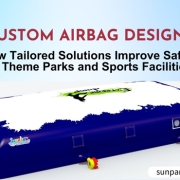
Custom airbag designs are revolutionizing safety measures in theme parks and sports facilities. These tailored solutions are crafted to meet specific needs, providing enhanced protection for users while accommodating a variety of activities. 

By effectively absorbing impacts, custom airbags not only promote a safer environment but also allow for greater freedom in design and functionality. In this article, we’ll explore the numerous benefits of these innovative airbag systems and how they are setting new safety standards in the industry.

Custom Airbag for extreme sports, entertainment and more

BUY CUSTOM AIRBAGS HERE

What Are Custom Airbags?

Custom airbags are specially designed safety devices tailored to meet the unique requirements of various activities in theme parks and sports facilities. Unlike standard airbags, these custom solutions can be crafted to specific sizes, shapes, and impact absorption capacities, ensuring optimal protection for users. Custom airbags have several benefits because they offer:

  • Tailored Design: Each airbag can be modified to fit specific locations or activities, enhancing safety.
  • Impact Absorption: Engineered to effectively absorb shocks and reduce the risk of injury.
  • Durable Materials: Constructed from high-quality, resilient materials for long-lasting performance.
  • Versatile Applications: Suitable for a wide range of extreme sports and recreational activities.

Key Features of Our Custom Airbags:

By prioritizing safety and functionality, custom airbags contribute significantly to creating a secure environment for thrill-seekers and athletes alike. Here are the key features of our custom airbags:

Customizable Size, Shape, and Color

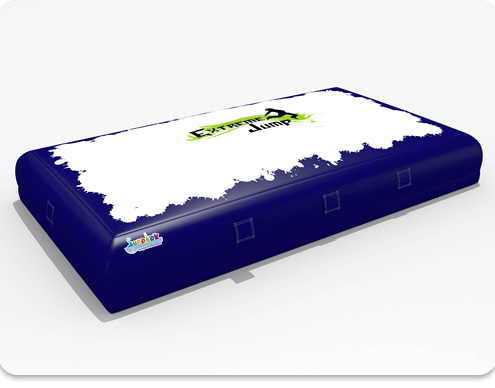
Custom airbags can be tailored in size, shape, and color to meet specific requirements for various activities, from action sports training to entertainment. This customization ensures that each airbag fits perfectly within its intended environment, enhancing both safety and aesthetic appeal.

Durable and High-Quality Materials

Constructed from durable, high-quality materials, custom airbags are designed to withstand rigorous use. Their robust construction ensures longevity and reliability, making them suitable for demanding applications in sports and stunt work.

Advanced Safety Features

These airbags are equipped with advanced safety features that enhance protection for users. Innovations such as multi-layer construction and adjustable air vents provide customizable firmness, reducing the risk of injuries during high-energy activities.

Optional Branding and Logos

Custom airbags can also incorporate branding and logos, allowing facilities to promote their identity while ensuring safety. This feature not only enhances visibility but also reinforces a brand’s commitment to quality and safety in recreational environments.

The Importance of Safety in Theme Parks and Sports Facilities

Trampoline Park Airbag Replacement -Logo Printed Top Sheet

Ensuring safety in theme parks and sports facilities is crucial for both operators and visitors. With the potential for high-impact activities and thrilling rides, effective safety measures can make all the difference in creating a positive experience.

Risk of Injuries

Extreme sports and amusement park attractions often involve inherent risks. Visitors engaging in high-energy activities are susceptible to various injuries, from minor bumps and bruises to serious accidents. The unpredictable nature of these environments requires comprehensive safety measures to mitigate these risks. Custom airbags play a significant role in reducing injury severity by providing a cushioned landing surface that absorbs impact.

Enhancing Visitor Confidence

When safety is prioritized, visitors feel more confident engaging in activities. This trust can lead to increased attendance and customer satisfaction, positively impacting a facility’s reputation. A well-designed safety system, such as custom airbags, reassures guests that their safety is a top priority, encouraging them to try new rides and activities. This confidence not only enhances their experience but also fosters loyalty to the facility.

Regulatory Compliance

Adhering to safety regulations not only protects visitors but also helps facilities avoid legal repercussions. Meeting industry standards is vital for maintaining operational licenses and ensuring liability coverage. Custom airbags designed to comply with safety regulations demonstrate a facility’s commitment to upholding these standards. By investing in safety equipment, operators can avoid potential fines and legal issues while creating a secure environment for all.

Long-Term Sustainability

Investing in safety measures, such as custom airbags, contributes to the long-term sustainability of theme parks and sports facilities. By reducing accidents and enhancing the overall experience, operators can foster a loyal customer base and encourage repeat visits. Facilities that prioritize safety are more likely to thrive in the competitive entertainment industry, as satisfied customers share their positive experiences, attracting new visitors.

The Role of Staff Training

Beyond equipment, proper staff training is essential for maintaining safety. Employees should be well-versed in emergency procedures and equipped to respond swiftly to incidents. Regular training sessions that emphasize the importance of safety protocols ensure that staff members are prepared to manage any situation effectively, further enhancing visitor confidence.

Creating a Culture of Safety

Establishing a culture of safety within a facility encourages everyone—staff and visitors alike—to prioritize safety. Clear communication regarding safety measures, such as the presence of custom airbags, helps reinforce the importance of adhering to guidelines. When safety becomes an integral part of the facility’s identity, it fosters a shared responsibility among all participants, enhancing the overall atmosphere.

Custom Airbag (1)

BUY CUSTOM AIRBAGS HERE

How Custom Airbags Can Improve Safety in Sports Facilities And Theme Parks?

Custom airbags are designed to enhance safety in high-impact environments, making them an essential feature in sports facilities and theme parks. By providing tailored solutions for various activities, these airbags significantly reduce the risk of injuries, allowing users to enjoy exhilarating experiences with added peace of mind.

Enhanced Impact Absorption

One of the primary benefits of custom airbags is their ability to absorb impact effectively. Unlike traditional safety measures, which may not cater to specific activities, custom airbags are engineered to dissipate the force of falls or jumps, significantly reducing the likelihood of injury. Their adaptive design allows them to conform to different shapes and sizes, ensuring optimal cushioning for various types of landings.

Versatile Applications

Custom airbags can be deployed across a wide range of activities in sports facilities and theme parks. Whether used for trampolining, skateboarding, or high-flying stunts, these airbags can be tailored to meet the demands of specific sports and rides. This versatility means that no matter the activity, safety can be prioritized without compromising the thrill of the experience.

Customization for Specific Activities

Every sport and attraction has unique safety needs. Custom airbags can be designed to suit individual activities, taking into account factors such as height, speed, and landing technique. For example, a trampoline park may require larger, thicker airbags to accommodate high jumps, while a bungee jumping facility might need specialized airbags that provide a softer landing. This level of customization ensures that safety measures are always aligned with the activity’s requirements.

Increased User Confidence

When participants know that custom airbags are in place, they feel more secure engaging in high-risk activities. This confidence encourages users to push their limits, leading to greater enjoyment and satisfaction. Facilities that prioritize safety through the use of custom airbags can attract more visitors and retain loyal customers who appreciate the commitment to their well-being.

Compliance with Safety Standards

Custom airbags are often designed to meet or exceed industry safety standards, ensuring that facilities comply with regulatory requirements. By investing in high-quality, purpose-built airbags, operators can avoid potential fines or legal issues while demonstrating their commitment to safety. This compliance not only protects the business but also fosters trust among visitors.

Long-Term Cost Savings

Investing in custom airbags can lead to long-term cost savings for sports facilities and theme parks. While the initial investment may be higher, the reduction in injury rates can significantly lower liability costs, medical expenses, and insurance premiums. Additionally, a safe environment can attract more customers, boosting revenue and offsetting initial expenditures.

Snowboard Park Airbags

Wrap-Up!

Custom airbags are essential for enhancing safety in sports facilities and theme parks. Their ability to absorb impact, versatility across activities, and tailored designs significantly reduce injury risks, fostering confidence among users. 

By prioritizing safety, these innovative solutions not only comply with industry regulations but also contribute to long-term cost savings and a better overall experience for visitors. Investing in custom airbags is a proactive step toward ensuring a safer and more enjoyable environment for all.

Eco-Friendly Airbags The Future of Safe Training in Gymnastics and Trampoline Parks

Eco-Friendly Airbags: The Future of Safe Training in Gymnastics and Trampoline Parks

Safety is a top priority in training environments, especially for high-risk activities like gymnastics and trampoline parks. Airbags play a crucial role in minimizing injury risk, but traditional designs often come with environmental drawbacks. 

Eco-friendly airbags are changing the game—providing a solution that ensures athlete safety while also addressing sustainability concerns. In this article, we’ll explore how these advancements are transforming training, making it both safer for athletes and better for the planet.

Inflatable Airbag Lander

What Are Eco-Friendly Airbags?

Eco-friendly airbags are innovative safety devices designed for use in gymnastics and trampoline parks that prioritize both athlete protection and environmental sustainability. These airbags are engineered to have a reduced environmental impact, emphasizing durability and reusability, which helps minimize waste over time. By focusing on long-lasting design and responsible production practices, eco-friendly airbags contribute to sustainability efforts without compromising safety or performance. 

This shift not only enhances safety for athletes but also contributes to reducing the ecological footprint of training facilities. These are our best eco-friendly equipment for gymnastics and trampoline parks:

Key Features Of Eco-friendly Airbags

  • Reduced Environmental Impact: Eco-friendly airbags are designed with sustainability in mind, focusing on minimizing their ecological footprint throughout their lifecycle.
  • Lower Chemical Use: These airbags avoid the use of harmful chemicals and toxic substances often found in conventional products, creating a safer environment for athletes and reducing environmental harm.
  • Durability: Built to endure intense use, eco-friendly airbags offer the same reliable durability as traditional models, ensuring long-lasting performance and reducing the need for frequent replacements.
  • Reusability and Recycling: With a focus on reusability and responsible disposal, these airbags are designed to reduce waste. At the end of their lifecycle, many components can be repurposed or recycled, promoting a more sustainable future.

Usage image of Case study 2 Gymnastics Airbag with Protruding Section for US Training Facility

BUY ECO-FRIENDLY AIRBAGS HERE

Importance Of Safety in Gymnastics And Trampoline Parks

Safety is paramount in gymnastics and trampoline parks, where athletes engage in high-energy activities that involve flips, jumps, and acrobatics. The potential for injury is significant, making it essential for facilities to implement comprehensive safety measures. A strong focus on safety not only protects athletes but also fosters an environment where they can train and perform with confidence.

The High Risk of Injury

Gymnastics and trampoline activities can lead to various injuries, from minor sprains to severe fractures. Statistics show that the injury rate in gymnastics is notably high, especially among young athletes. This reality highlights the need for effective safety measures, such as:

  • Proper Equipment: High-quality safety equipment, including airbags, mats, and padding, is crucial in minimizing injury risks.
  • Supervision: Trained coaches and staff should always be present to ensure safe practices and provide immediate assistance in case of accidents.

Building Confidence in Athletes

A safe training environment is vital for athletes to develop confidence in their skills. When athletes feel secure, they are more likely to push their limits and explore new techniques. This confidence leads to:

  • Improved Performance: With safety measures in place, athletes can focus on mastering their skills rather than worrying about potential injuries.
  • Greater Participation: A commitment to safety attracts more participants, ensuring that gymnastics and trampoline parks remain welcoming spaces for all skill levels.

Legal and Ethical Responsibility

Gymnastics and trampoline parks have a legal and ethical obligation to prioritize safety. This responsibility includes:

  • Compliance with Regulations: Facilities must adhere to safety standards and regulations set forth by governing bodies to protect their athletes and avoid legal repercussions.
  • Creating a Positive Culture: Prioritizing safety helps foster a positive culture where athletes and coaches prioritize well-being, leading to more enjoyable training experiences.

FMX Landing

Environmental Concerns with Traditional Airbags

While traditional airbags play a key role in safety for gymnastics and trampoline parks, they come with several environmental concerns. The production, use, and disposal methods contribute significantly to their ecological footprint. Recognizing these issues is essential for making informed choices about safety equipment.

Longevity And Waste

Traditional airbags can lead to environmental challenges due to their limited lifespan:

  • Waste Accumulation: Once they reach the end of their life, traditional airbags are often disposed of in landfills, where they contribute to long-term waste management problems.
  • Durability Issues: Shorter product lifecycles can lead to more frequent replacements, increasing the volume of waste over time.

Manufacturing Impact

The production of traditional airbags has its own environmental toll:

  • High Energy Usage: Manufacturing typically requires large amounts of energy, often sourced from non-renewable resources, contributing to greenhouse gas emissions.
  • Pollution: Production processes can release pollutants into the environment, impacting surrounding ecosystems and communities.

End-of-Life Issues

Disposal of traditional airbags can pose environmental concerns:

  • Landfill Dependency: Many facilities dispose of airbags in landfills, contributing to waste issues and increasing the overall environmental burden.
  • Limited Recycling Programs: The lack of widespread recycling options means that many airbags, despite potential for reuse, end up as waste rather than being repurposed.

Benefits of Eco-Friendly Airbags for Gymnastics And Trampoline Bags

While traditional airbags play a key role in safety for gymnastics and trampoline parks, they come with several environmental concerns. The production, use, and disposal methods contribute significantly to their ecological footprint. Recognizing these issues is essential for making informed choices about safety equipment.

Enhanced Safety Features

Eco-friendly airbags are designed with advanced safety features that provide superior protection for athletes:

  • Impact Absorption: Made from high-quality, shock-absorbing materials, these airbags effectively cushion falls, reducing the risk of injury during training and performance.
  • Stable Landing Surface: The design of eco-friendly airbags ensures a stable landing surface, allowing athletes to train confidently and perform complex maneuvers safely.

Reduced Environmental Impact

One of the key benefits of eco-friendly airbags is their reduced ecological footprint:

  • Waste Reduction: Designed for long-term use and durability, eco-friendly airbags help reduce waste by minimizing the need for frequent replacements, extending their lifecycle, and decreasing overall waste in training environments.
  • Energy-Efficient Production: The manufacturing processes for these airbags are often optimized to use less energy, helping to reduce emissions and contributing to a more sustainable future.

Long-Term Cost Savings

Investing in eco-friendly airbags can lead to long-term cost savings for gymnastics and trampoline parks:

  • Durability: These airbags are designed to withstand rigorous use, reducing the frequency of replacements and overall equipment costs.
  • Recyclability: At the end of their lifecycle, eco-friendly airbags can often be recycled, further minimizing disposal costs and environmental impact.

Positive Brand Image

Adopting eco-friendly practices enhances the reputation of gymnastics and trampoline parks:

  • Attracting Environmentally-Conscious Customers: As more individuals seek sustainable options, facilities that prioritize eco-friendly practices can attract a broader audience, fostering a positive community image.
  • Leading by Example: By choosing eco-friendly airbags, facilities demonstrate their commitment to safety and environmental responsibility, setting a standard for others in the industry to follow.

Are PVC Air Bags Eco-Friendly?

Landing Airbag Top Sheet

PVC is known for its durability, making it a sustainable choice compared to less robust materials like foam. PVC tarpaulin is a versatile material made from polyvinyl chloride (PVC) and is very durable. This durability translates to a longer lifespan, which can significantly reduce waste over time. The following are the key features that make PVC tarpaulin an eco-friendly choice:

  • Durability: PVC tarpaulin is highly resistant to wear and tear, which means products made from it last longer than those made from less durable materials. This longevity reduces the frequency of replacements, leading to less waste.
  • Reusability: Many PVC tarpaulin products can be reused multiple times, further minimizing waste. Their robust nature allows them to withstand repeated use without significant degradation.
  • Low maintenance: PVC tarpaulin requires minimal care and cleaning, which can lower the environmental impact associated with maintenance and upkeep.

By emphasizing these qualities, we can present PVC bags as a responsible option for those seeking durable and long-lasting products.

Wrap-Up!

Eco-friendly airbags represent a significant advancement in safety equipment for gymnastics and trampoline parks, combining athlete protection with environmental responsibility. By prioritizing durability and innovative designs, these airbags not only enhance safety but also reduce ecological impact and promote a positive brand image. 

As the industry moves toward greener practices, investing in eco-friendly airbags is a step forward in creating safer training environments while contributing to a healthier planet. Embracing this change can ensure that gymnastics and trampoline parks remain safe, welcoming spaces for all athletes.

Landing Gym Mat Airbag

Revolutionizing Gymnastics Training with the Inflatable Gymnastics Airbag

In the realm of gymnastics training, the shift from traditional foam pits to the innovative Inflatable Gymnastics Airbag marks a significant leap in safety and hygiene practices. As clubs and training facilities prioritize cleanliness and safety, this airbag has emerged as the ideal substitute for foam pits, revolutionizing the way athletes train and perform.

At the forefront of this change is our product, the Inflatable Gym Air Bag, meticulously designed to meet the demands of modern gymnastics training. Its versatility is unmatched—it can be seamlessly placed within the pit or utilized independently on level ground.

Let’s delve into the remarkable features that define this game-changing product:

Unparalleled Safety and Performance

Excellent Impact Absorption: Ensuring a safe and secure landing with top-notch impact absorption.

Strategically Placed Air Pillars: With 4 air pillars per square meter, creating a perfectly soft catching zone for landings.

Innovative Air Chamber System: Positioned in the lower part of the airbag, preventing ground contact and establishing a dedicated safety zone.

Removable and Replaceable Top Sheet: Ensuring ease of maintenance and longevity of use.

Fall Protection Airbags

Customizable and Durable Design

Tailored Branding Options: Offering permanent or replaceable branding to suit your preferences.

Tailor-Made Configuration: Custom-built to accommodate specific requirements and setup preferences.

Enhanced Durability: Featuring double/quadruple stitching and reinforcements in critical areas for extended durability.

Gym Air Bag

Superiority in Affordability

Notably, as a professional Chinese supplier, we take pride in offering an exceptional advantage in pricing compared to foreign suppliers. Our commitment to providing high-quality products at competitive prices underscores our dedication to supporting the global gymnastics community in achieving excellence without financial constraints.

Additionally, our product comes with a substantial 2-year warranty, a testament to its quality and reliability.

Our Inflatable Airbag for Gymnastics stands as a testament to innovation and commitment to the safety and progression of gymnastics training. With its cutting-edge design, unparalleled safety features, and affordability, it has become the preferred choice for gymnastics clubs worldwide.

Experience the evolution of gymnastics training with our Inflatable Gymnastics Airbag—a game-changer in safety, performance, and affordability.

Gymnastics Bar Mat