7 Inflatable Crash Pad Applications for Sports Training Facilities
The sports facility management industry is currently undergoing a brutal reckoning regarding safety and hygiene. For decades, commercial gyms, extreme sports compounds, and trampoline parks relied exclusively on massive pits filled with polyurethane foam blocks to arrest high-velocity falls. Those days are over. Foam pits are unsanitary dust traps, massive fire hazards, and a leading cause of facility liability claims when athletes strike the concrete floor through degraded foam. From our experience at SunparkAirbag, engineering advanced pneumatic landing systems for global sports facilities, the transition to modern air technology is not optional; it is a critical mandate for commercial survival.
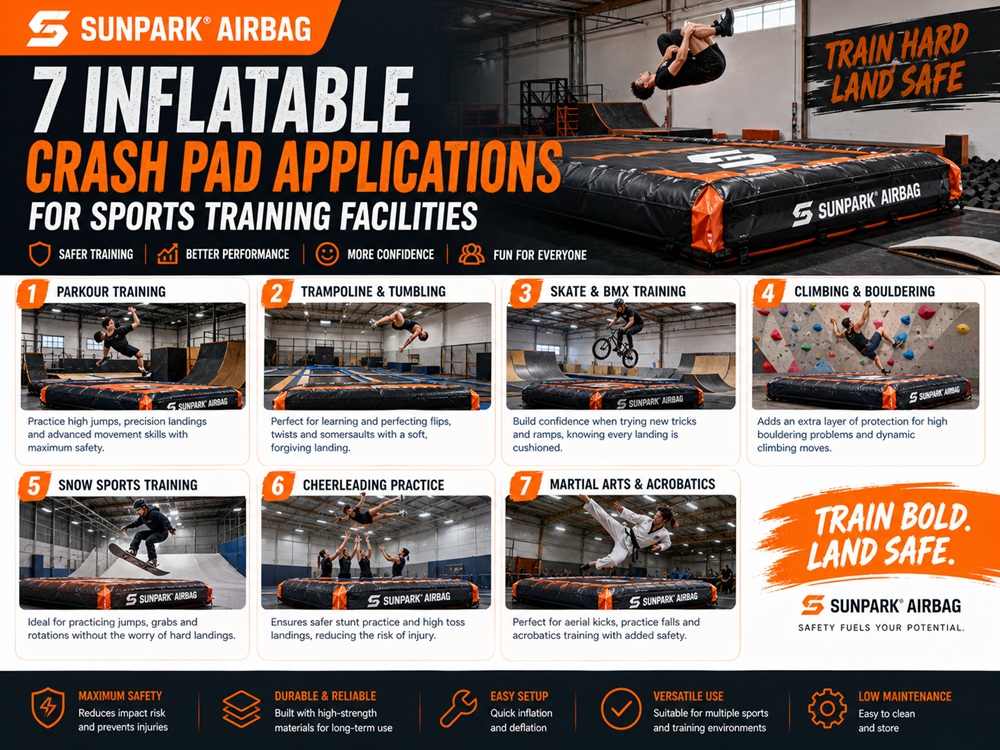
In most professional situations, treating pneumatic landing systems as a mere novelty is a profound commercial miscalculation. You must use commercial and practical judgment when upgrading your facility’s infrastructure. Replacing a foam pit with a dual-chamber airbag instantly quadruples your athlete throughput, eliminates respiratory hazards, and drastically lowers your insurance premiums. The versatility of these systems is reshaping how athletes train across multiple disciplines. In this definitive 2026 guide, we take a rigid, expert stance on facility engineering. We will dissect the top 7 Inflatable Crash Pad Applications, explain the precise pneumatic mechanics that make them superior, and provide you with the exact technical blueprint to procure hardware that maximizes your facility’s safety and profitability.
Quick Answer: The Future of Facility Safety
If you are actively seeking to modernize your facility and explore Inflatable Crash Pad Applications, here is the executive summary of why you must pivot away from traditional foam:
- Throughput Efficiency: It takes an athlete 30 seconds to crawl out of a foam pit. It takes 3 seconds to walk off an inflatable crash pad. This increases jump volume by 1000%, driving massive revenue for commercial parks.
- Sanitation Control: Foam absorbs sweat, skin cells, and bacteria, requiring total replacement every two years. An inflatable pad features an anti-microbial PVC top sheet that can be sanitized with a mop in five minutes.
- Impact Regulation: Dual-chamber bags prevent bottoming out. The lower chamber stays rigid to protect against the floor, while the upper chamber vents air to smoothly absorb kinetic energy.
We recommend that any business operator mapping out their trampoline park construction cost allocate capital strictly to inflatable landing zones. The long-term ROI in maintenance reduction justifies the upfront expenditure immediately.
What It Is: Beyond the Foam Pit
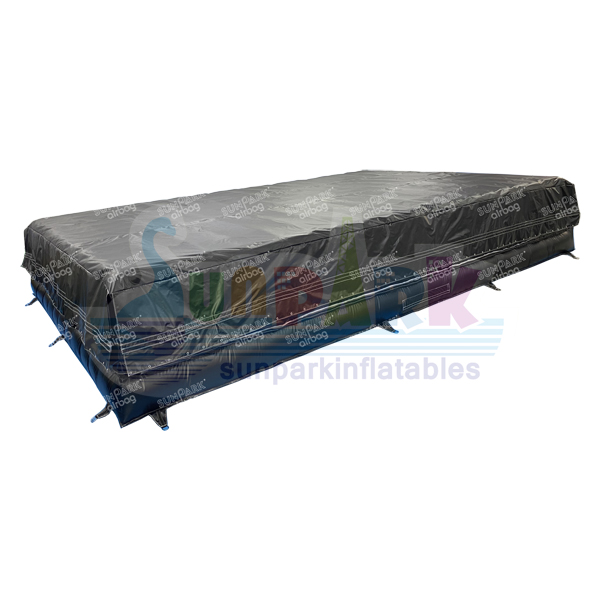
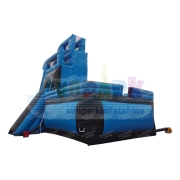
When we discuss Inflatable Crash Pad Applications, we are referring to heavy-duty, commercial-grade pneumatic landing systems. Unlike a residential bouncy castle that is entirely sealed, a professional crash pad is a continuous airflow system. It relies on industrial blowers constantly forcing air into the bag, while specialized exhaust vents allow the air to escape at a controlled rate upon impact. The chassis is constructed from highly durable 0.55mm PVC tarpaulin, topped with a replaceable 0.9mm PVC impact sheet. This material architecture is required to survive the violent, repetitive impacts of heavy adult athletes and specialized equipment.
How It Works: The Dual-Chamber Mechanics
How it works dictates the safety rating of your facility. Cheap, single-chamber bags are dangerous because a heavy athlete falling from a significant height can push the air out faster than the blower can replace it, resulting in the athlete striking the concrete subfloor.
In our testing, safe commercial setups demand dual-chamber mechanics. The bottom chamber operates at a high, rigid pressure, serving as an impenetrable barrier against the ground. The top chamber operates at a lower pressure with adjustable venting. When an athlete impacts the top chamber, the air displaces rapidly to create a soft, decelerating catch, but the bottom chamber remains entirely firm. This precise pneumatic engineering allows facilities to support everything from toddlers to heavy motocross bikes.
The 7 Primary Inflatable Crash Pad Applications
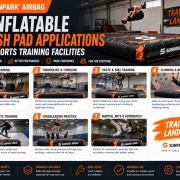
Facility owners are discovering that investing in this technology unlocks multiple revenue streams. Here are the 7 most profitable and safety-critical applications dominating the sports industry in 2026.
1. Elite Gymnastics and Tumbling
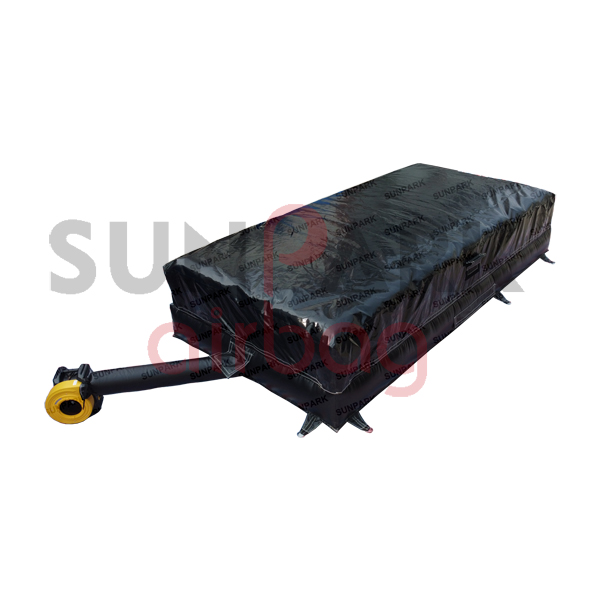
Gymnasts require a surface that mimics a competition mat but forgives critical errors during high-bar dismounts and vaulting. An inflatable crash mat is tensioned to allow gymnasts to land on their feet and walk away, rather than sinking into a foam pit that twists ankles. It is the modern standard for elite repetitive training.
2. Commercial Trampoline Parks
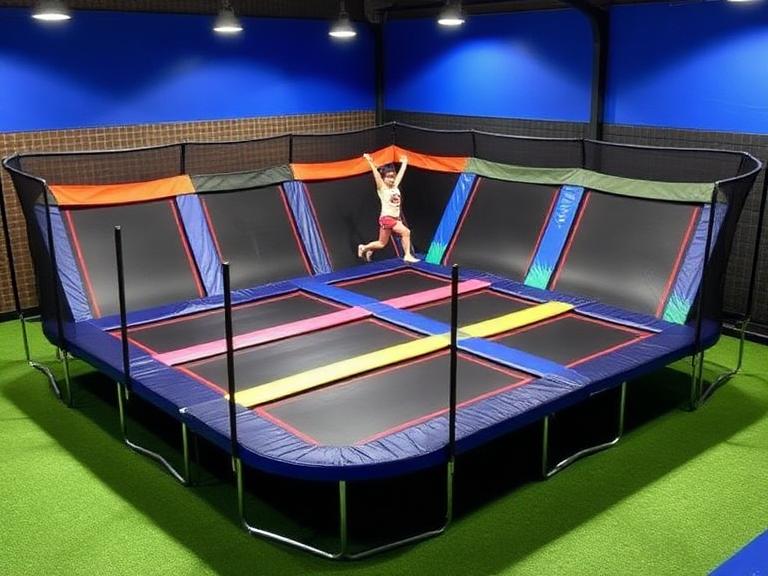
If you are calculating trampoline park owner income, throughput is your primary metric. Placing an inflatable jump airbag at the end of a trampoline runway allows kids to jump, land, and exit in three seconds. Foam pits cause traffic jams that severely limit the number of jumpers you can safely host per hour.
3. Ninja Warrior and Parkour Courses
The explosive growth of obstacle course training requires dynamic fall protection. Athletes routinely slip from warped walls or salmon ladders. Placing a customized inflatable pad beneath these high-risk zones provides a uniform, hygienic safety net that resets instantly after a fall, unlike loose foam that scatters.
4. Action Sports (BMX, Skate, and Snowboard)
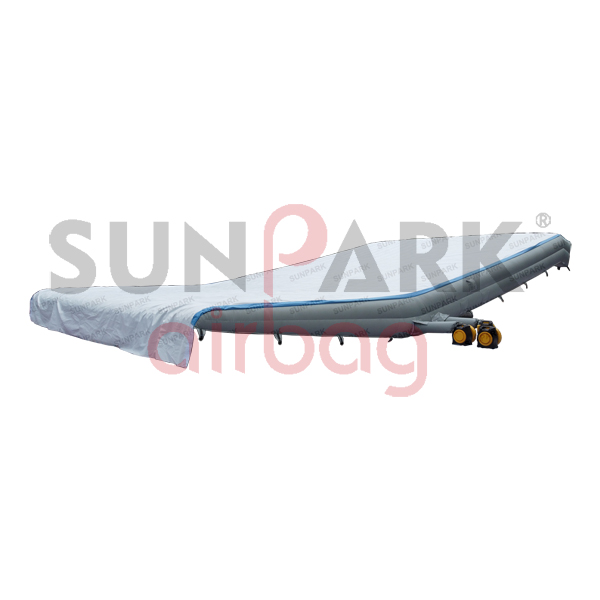
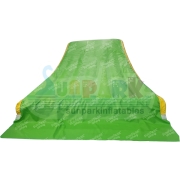
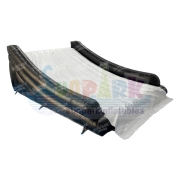
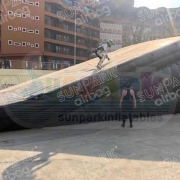
For extreme athletes attempting triple backflips, dirt landings are lethal during the learning phase. A specialized bike airbag landing features a pitched, sloped top sheet that allows the rider to land the trick and ride the bike down the transition smoothly. If they crash, the bag absorbs the kinetic energy of both the rider and the heavy metal frame.
5. Stunt Training and Hollywood Production
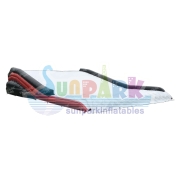
High-fall stunt coordinators have completely abandoned cardboard boxes and primitive mattresses. A massive stunt airbag landing system allows professionals to safely execute 50-foot freefalls. The adjustability of the exhaust vents allows the stunt team to dial in the exact softness required based on the height and weight of the performer.
6. Freestyle Skiing and Big Air Training
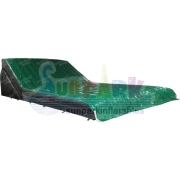
Training for the Winter Olympics requires year-round dedication. Summer training facilities utilize dry-slope ramps launching into a big jump airbag system. This application requires extreme material resilience, as the bag must survive the friction of sharp fiberglass skis and snowboards impacting the PVC top sheet thousands of times a day.
7. General Fitness and Martial Arts
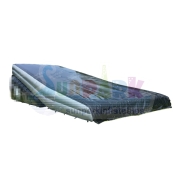
MMA fighters, wrestlers, and functional fitness athletes suffer immense wear and tear from repetitive throwing drills. Integrating a low-profile gym airbag for training allows for high-velocity takedown practice without the severe concussive shock associated with standard 2-inch puzzle mats.
Commercial and Athletic Benefits
The primary benefit of integrating Inflatable Crash Pad Applications is aggressive liability mitigation. Foam pits disguise dropped items—keys, cell phones, and jewelry. When the next athlete jumps in, they strike these hard objects, causing severe lacerations. An airbag presents a flat, highly visible surface; nothing can be hidden inside it. Furthermore, the operational cost of an airbag is remarkably low. Besides the electricity required to run the blowers, there is zero maintenance. You do not have to pay staff overtime to empty, vacuum, and refill a 10,000-block foam pit every three months.
Limitations and Hidden Risks
We must use commercial and practical judgment: pneumatic systems have limitations. The absolute risk is a sudden loss of electrical power. If the local grid fails, the blowers stop, and the bag will deflate within minutes. Commercial facilities must have rigid protocols to clear the jump zones immediately upon a power loss. Additionally, while the 0.9mm PVC top sheet is incredibly tough, it is vulnerable to deliberate vandalism or sharp objects (like a rider wearing spiked pedals or cleats). Strict attire enforcement is mandatory.
Who Should Use This Technology
For Commercial Users and High-Volume Parks: Any commercial entity operating a trampoline park, gymnastics academy, action sports compound, or Hollywood stunt rigging facility must use inflatable technology. If you are scouting airbag jump locations guide data, you will see that the most profitable facilities worldwide exclusively utilize this hardware.
Who Does Not Need It
For Small Residential Setups: If you are a parent trying to put a crash mat under a backyard swing set, a commercial dual-chamber airbag is an absurd waste of capital. You do not have the electrical infrastructure to run the blowers continuously, nor the space. Standard closed-cell foam crash pads are sufficient for low-velocity residential use.
Common Facility Mistakes
From our experience auditing commercial parks, the most catastrophic mistake owners make is buying cheap, single-chamber bags from unverified overseas trading companies. A single-chamber bag offers zero bottom-out protection for heavy adults. The second major mistake is failing to order the bag with a replaceable top sheet. The top layer takes 100% of the friction and UV damage. If the top sheet is permanently welded to the bag, a small tear ruins a $10,000 investment. Always demand a heavy-duty Velcro-attached top sheet.
Expert Buying Considerations
When executing your capital expenditure, you must verify the blower certifications. If your facility is in the USA or Europe, the blowers must carry UL or CE certifications, respectively, or your fire marshal will shut you down. Furthermore, you must measure your facility meticulously. A bag that is too small for your launch ramp trajectory is a massive liability. Work with a manufacturer who provides custom sizing and 3D mockups based on your specific trussing or ramp geometry, especially when sourcing complex gymnastics airbag equipment.
Summary and Comparison Tables
Comparison Table: Foam Pit vs. Inflatable Crash Pad
| Metric | Traditional Foam Pit | Inflatable Crash Pad (Dual Chamber) |
|---|---|---|
| Exit Time (Throughput) | Slow (15 – 30 seconds) | Instant (3 – 5 seconds) |
| Hygiene & Maintenance | Terrible (Collects dust, bacteria, sweat) | Excellent (Wipeable PVC surface) |
| Bottom-Out Risk | High (Foam degrades and compresses) | Zero (Rigid bottom chamber protects) |
| Long-Term Cost | High (Complete block replacement every 2 years) | Low (Only electricity and top-sheet replacement) |
Pros and Cons of Inflatable Crash Pad Applications
| Pros (Why you must upgrade) | Cons (The operational reality) |
|---|---|
| Massive increase in athlete throughput and revenue generation. | Higher initial capital expenditure compared to cheap foam blocks. |
| Drastically reduces respiratory issues caused by toxic foam dust. | Requires continuous, reliable electrical power to operate safely. |
| Adjustable venting allows for tailored firmness based on athlete weight. | Vulnerable to punctures if athletes wear sharp jewelry or improper footwear. |
| Highly modular; can be deflated and moved for facility reconfiguration. | Blowers generate ambient noise, requiring strategic placement. |
Expert Recommendation & Hardware Spotlight
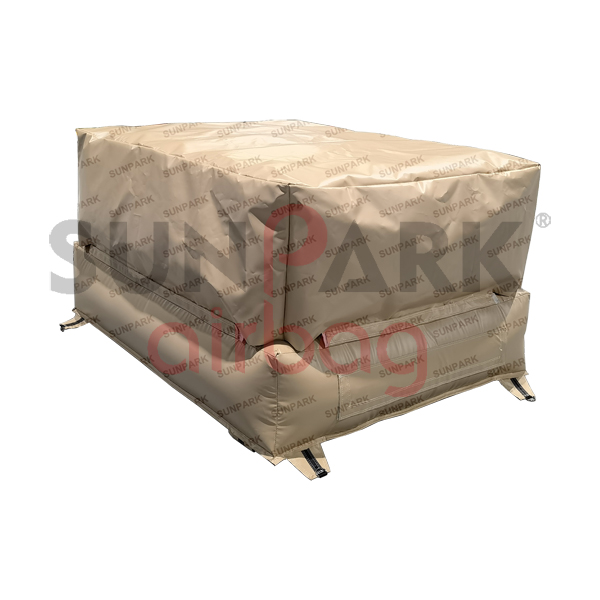
Is the operational friction of setting up dedicated electrical lines for continuous blowers actually worth the investment? Emphatically, yes. Foam pits are an archaic liability that sophisticated insurers are increasingly refusing to underwrite. We recommend that commercial facility operators completely eradicate foam from their premises. Partner directly with a verified manufacturer like SunparkAirbag to deploy custom-fitted, dual-chamber pneumatic systems. It is the only way to scale your operations safely.
Frequently Asked Questions
Are inflatable crash pads safer than traditional foam pits?
From our experience, inflatable crash pads are significantly safer. Foam pits harbor toxic dust, bacteria, and hidden objects that have fallen to the bottom. Furthermore, foam blocks compress unevenly over time. Inflatable dual-chamber pads provide a uniform, calculated deceleration that prevents the catastrophic bottoming-out associated with degraded foam.
How much electricity does an inflatable crash pad consume?
In most professional situations, a standard facility crash pad requires one or two continuous 1500W to 2000W blowers to maintain optimal pressure. While this does incur a daily electrical cost, it is vastly offset by the complete elimination of the manual labor previously required to fluff, clean, and replace thousands of foam blocks.
Can you use inflatable crash pads outdoors for extreme sports?
Yes, provided you source commercial-grade equipment. Modern pads engineered by SunparkAirbag utilize 0.55mm and 0.9mm UV-protected, flame-retardant PVC tarpaulin specifically designed to withstand extreme weather, UV degradation, and the mechanical abrasion of BMX bikes and skateboards.
What happens if the crash pad gets a hole in it?
Because these are continuous-flow systems, a small puncture does not cause catastrophic deflation; the blower simply compensates for the lost air. However, the tear should be addressed immediately at the end of the shift using the provided heavy-duty PVC repair kit and vinyl cement to maintain long-term structural integrity.
Industry References & Authoritative Facility Guidelines
To ensure our structural engineering and facility safety advice aligns with the strictest global standards, SunparkAirbag references the protocols established by the following authoritative organizations:
- ASTM International: The global standards organization that develops and publishes the rigorous consensus technical standards (such as ASTM F2970) for the design, manufacture, installation, and operation of commercial trampoline courts and associated landing systems. Review ASTM Amusement Standards
- USA Gymnastics: The national governing body for gymnastics in the United States, providing strict safety guidelines and equipment specifications regarding the proper use of dismount mats and landing pits in elite training environments. Review USA Gymnastics Safety Guidelines
- The Royal Society for the Prevention of Accidents (RoSPA): A leading authority providing peer-reviewed risk assessment frameworks, operational best practices, and safety inspections for extreme sports parks, leisure facilities, and inflatable amusement equipment. Review RoSPA Leisure Safety Protocols