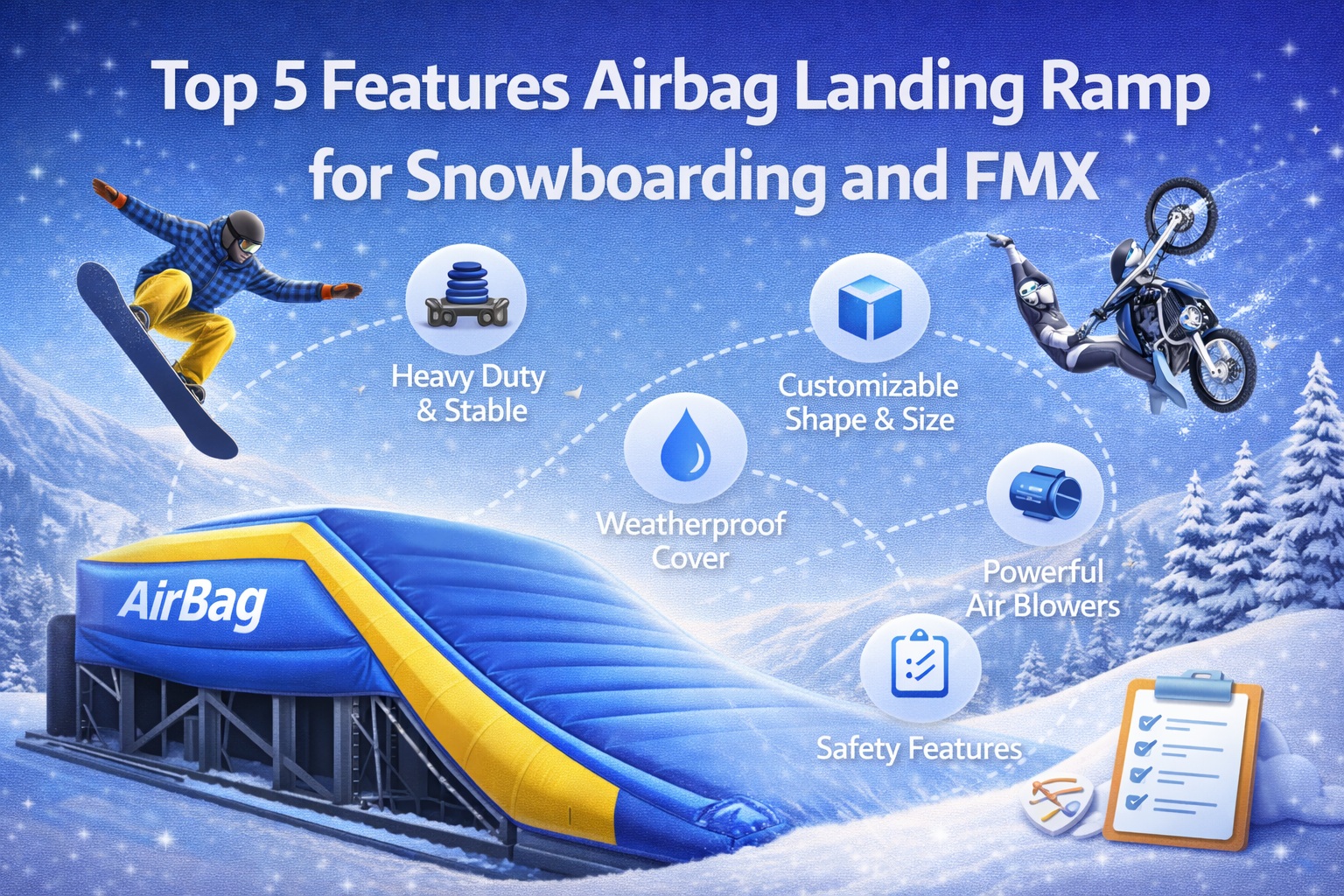
As extreme sports have developed over the past decade, the push for massive progression has been mirrored by an absolute necessity for advanced safety protocols. More and more snowboarders, freestyle motocross (FMX) riders, and serious sports enthusiasts are looking for safer training possibilities to progress without the catastrophic risks of getting injured. The days of relying solely on a Foam Pit Jump Airbag for learning double corks or backflip combinations are evolving. Today, athletes require ride-away solutions that mimic real-world dirt and snow landings while providing a forgiving cushion during a crash. Understanding the core Features to Look for in an Airbag Landing Ramp for Snowboarding and FMX is critical for training facilities, ski resorts, and professional athletes aiming to elevate their progression.
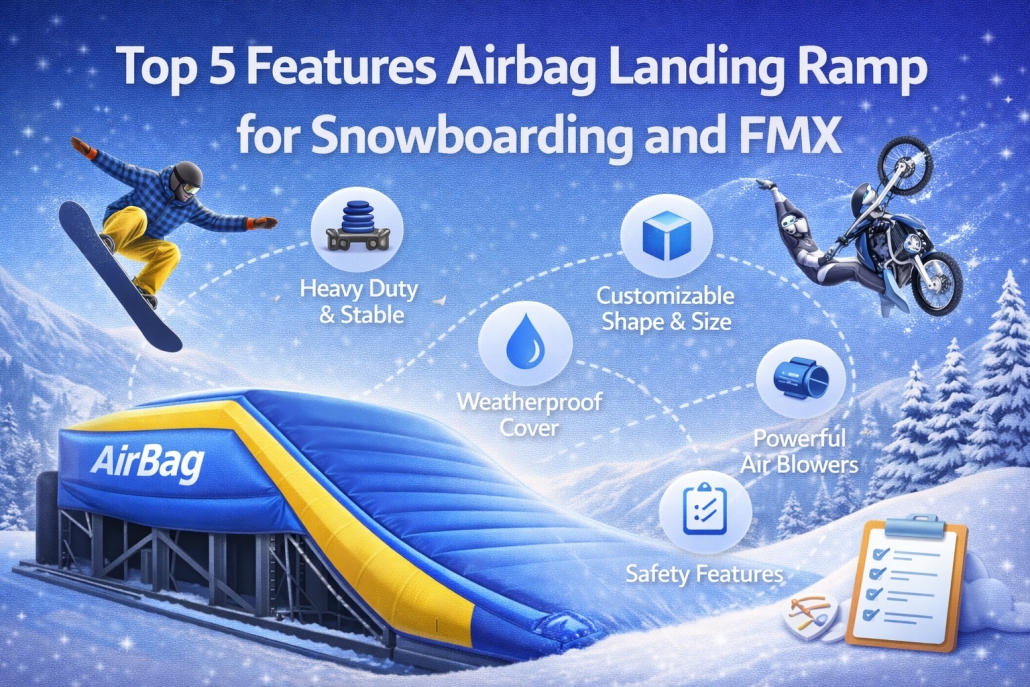
At SUNPARK® AIRBAG, we bring unparalleled expertise to this specialized field. With over 10 years of experience, we provide freestyle airbags for ski resorts, theme parks, sports and gymnastics facilities around the globe. SunparkAirbag® is the leading manufacturer of Airbags for Extreme Sports and Leisure Industries in China. We create products for World Champion Snowboarders, famous riders, and trampoline parks worldwide. We are deeply committed to the development and improvement of our own products, which include our premium Airbag Landing systems, Inflatable Landing setups, Stunt Airbag designs, Free Fall Airbag modules, and fully Custom Airbag solutions. From our experience outfitting the world’s elite training grounds, we have identified the non-negotiable elements that separate a world-class training tool from a dangerous liability. In this comprehensive guide, we detail the top Features to Look for in an Airbag Landing Ramp for Snowboarding and FMX to ensure you make the most informed, safety-conscious investment for your facility.
Table of Contents
- 1. Multi-Chamber Impact Absorption and Pressure Regulation
- 2. Extreme Durability and Tear-Resistant Top Sheets
- 3. True-to-Pitch Custom Sloped Contour Design
- 4. Advanced Air Venting and Blower Systems
- 5. Seamless Portability and Heavy-Duty Anchoring
- Summary Table: Comparing Key Airbag Features
- Frequently Asked Questions (FAQs)
- Industry References and Standards
1. Multi-Chamber Impact Absorption and Pressure Regulation
When analyzing the primary Features to Look for in an Airbag Landing Ramp for Snowboarding and FMX, the internal structural geometry is the absolute most critical factor. Traditional inflatable structures often consist of a single large pocket of air. If an FMX rider weighing over 200 pounds on a 220-pound motorcycle lands heavily on a single-chamber bag, the air displaces violently, often resulting in the rider bottoming out against the hard ground or experiencing a dangerous catapult effect. This is entirely unacceptable in professional extreme sports training.
From our experience, a true Airbag Landing system must utilize an advanced multi-chamber design. At SUNPARK® AIRBAG, we engineer our Inflatable Landing ramps with independent internal air pillars and separated upper and lower chambers. The bottom chamber remains highly pressurized to act as an impenetrable base layer that prevents ground contact under any circumstance. The top chamber features specially calibrated air pillars that absorb and dissipate the kinetic energy of a falling rider or motorcycle. When a snowboarder under-rotates a triple cork, the top layer instantly yields, contouring to the impact and softening the blow, while the rigid bottom layer maintains the ramp’s structural integrity.
We recommend facilities rigorously test the pressure regulation valves. The ability to independently adjust the firmness of the upper and lower chambers is one of the most vital Features to Look for in an Airbag Landing Ramp for Snowboarding and FMX. A beginner learning straight airs requires a softer top sheet, whereas a World Champion Snowboarder executing a perfect landing needs a firmer surface to safely ride away without sinking. The capacity for dynamic pressure regulation ensures the airbag scales with the skill level of your athletes.
2. Extreme Durability and Tear-Resistant Top Sheets
The materials utilized in manufacturing dictate the lifespan and safety of your investment. Snowboards have razor-sharp metal edges, and FMX bikes possess sharp footpegs, spinning knobby tires, and hot exhaust pipes. If you are researching the Features to Look for in an Airbag Landing Ramp for Snowboarding and FMX, you must scrutinize the composition of the top sheet and the primary inflatable chassis.
SunparkAirbag® utilizes heavy-duty, 0.55mm to 0.90mm Plato PVC Tarpaulin. This material is not only industrial-grade but is specifically treated to be flame retardant, UV resistant, and highly impermeable to water. When a 450cc dirt bike lands on an airbag under acceleration, the friction generated is immense. A standard Stunt Airbag will shred under this localized stress. Our specialized Airbag Landing ramps feature an independently replaceable top sheet. This is a massive operational advantage; instead of replacing the entire Inflatable Landing structure when the top layer inevitably shows wear from spinning tires or snowboard edges, you simply detach the Velcro and bungee systems to install a fresh top sheet.
Furthermore, the top sheet material must provide the correct coefficient of friction. For FMX, the material must offer enough grip for the tires to ride away smoothly without sliding out. For snowboarding, the material often requires a specialized slick coating or requires the application of a specialized lubricant to mimic the glide of natural snow. From our experience outfitting high-altitude ski resorts and indoor trampoline parks alike, utilizing an anti-microbial, temperature-resistant PVC blend is one of the most essential Features to Look for in an Airbag Landing Ramp for Snowboarding and FMX.
3. True-to-Pitch Custom Sloped Contour Design
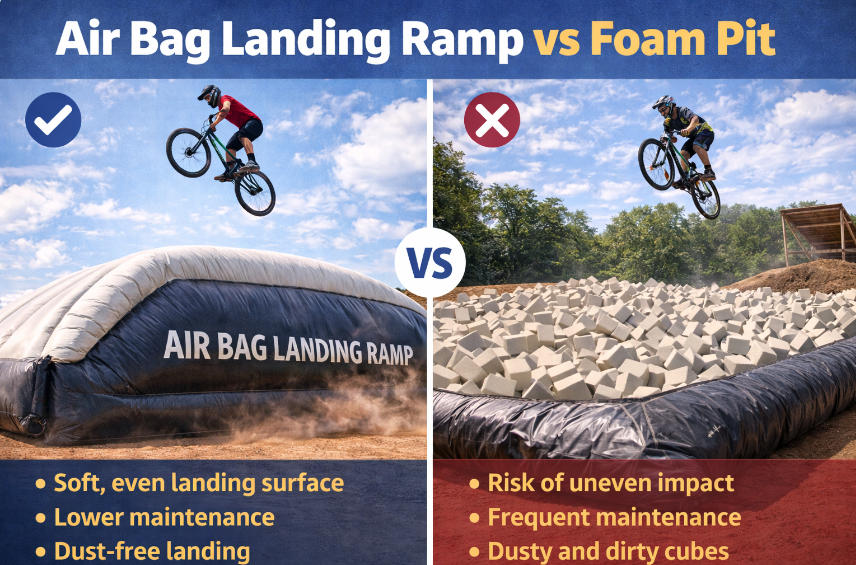
A major evolution from the traditional Foam Pit Jump Airbag is the transition from a flat, crash-pad style landing to a realistic, ride-out ramp. Professional athletes do not want to simply fall out of the sky into a flat bag; they need to practice spotting their landing, matching the angle of the transition, and riding away smoothly. Therefore, the geometric contour of the product is among the top Features to Look for in an Airbag Landing Ramp for Snowboarding and FMX.
We recommend a sloped contour design that perfectly matches the trajectory of a standard dirt or snow landing. If an FMX rider hits a standard 75-foot gap, the landing airbag must replicate the exact pitch of a dirt receiver. If the angle is too steep, the rider will face a harsh compression; if it is too shallow, the risk of bouncing increases. Because no two training facilities have the exact same scaffolding or terrain, a one-size-fits-all approach is dangerous. This is why SUNPARK® AIRBAG specializes in the Custom Airbag process. We use advanced 3D modeling to match your exact take-off ramp geometry, ensuring the sweet spot of the Inflatable Landing is positioned flawlessly to catch the rider’s specific parabolic arc.
4. Advanced Air Venting and Blower Systems
The physics of an airbag rely entirely on how efficiently it can expel and intake air. A closed, sealed inflatable will act like a trampoline, dangerously bouncing the rider back into the air upon impact. The precise calibration of air venting is one of the most technical Features to Look for in an Airbag Landing Ramp for Snowboarding and FMX.
An elite Airbag Landing relies on continuous airflow. Heavy-duty, CE/UL certified blowers constantly pump air into the chambers, while strategically placed, adjustable exhaust vents release air at a controlled rate upon impact. At SunparkAirbag®, our engineering team has perfected the placement and sizing of these vents. When a World Champion Snowboarder impacts our bag, the vents open just enough to absorb the energy, preventing a harsh bounce, and then the high-output blowers re-inflate the impact zone within seconds, making it ready for the next rider in rapid succession. We recommend ensuring that any airbag you purchase includes variable-speed blowers to give your facility operators granular control over the ramp’s firmness.
5. Seamless Portability and Heavy-Duty Anchoring
Whether you are setting up at a temporary extreme sports festival, a summer training camp at a ski resort, or a permanent gymnastics facility, the logistics of deploying the airbag are crucial. Portability combined with unyielding stability are essential Features to Look for in an Airbag Landing Ramp for Snowboarding and FMX.
From our experience, a massive 100-foot FMX landing airbag acts like a giant sail if the wind picks up. Therefore, the anchoring system must be industrial-strength. SUNPARK® AIRBAG integrates heavy-duty, reinforced stainless steel D-rings along the entire perimeter of the base. These anchor points are welded into the PVC using high-frequency heat sealing, ensuring they will not tear out under immense lateral stress. We recommend utilizing heavy-duty ratchet straps and ground anchors to secure the bag to the scaffolding and the earth. Additionally, despite their massive inflated size, our Inflatable Landing and Free Fall Airbag products are designed to deflate rapidly and roll up into manageable, highly durable transport bags, allowing your team to move the setup between venues with standard heavy machinery.
Summary Table: Comparing Key Airbag Features
To assist your procurement team in evaluating the mandatory Features to Look for in an Airbag Landing Ramp for Snowboarding and FMX, we have provided a technical summary table below.
| Critical Feature | Standard Airbag Capability | SUNPARK® AIRBAG Professional Standard |
|---|---|---|
| Internal Structure | Single open air chamber (high bounce risk) | Multi-chamber, independent air pillars with a rigid safety base layer. |
| Top Sheet Material | Standard PVC (prone to edge cuts and tire burns) | Replaceable, 0.90mm Plato PVC, flame retardant, UV resistant, and anti-friction coated. |
| Landing Geometry | Flat or generic wedge shape | True-to-pitch Custom Airbag slope designed to match your specific take-off trajectory. |
| Pressure Regulation | Static firmness | Adjustable exhaust vents and variable-speed blowers for customized rider firmness. |
| Anchoring System | Basic fabric loops | High-frequency welded stainless steel D-rings for extreme weather and lateral stability. |
Frequently Asked Questions (FAQs)
What are the most important Features to Look for in an Airbag Landing Ramp for Snowboarding and FMX regarding safety?
From our experience, the most critical safety feature is the dual-chamber design. The bottom chamber must remain highly inflated to prevent the rider from bottoming out, while the top chamber must feature adjustable air pillars to absorb the impact smoothly. Secondary to this is the presence of an independently replaceable, highly durable top sheet to prevent tears from snowboard edges or motorcycle footpegs.
Can I use the same Airbag Landing for both FMX and Snowboarding?
While the core internal structure of a premium SUNPARK® AIRBAG remains similar, the top sheet and the slope angle often need adjustment. FMX requires a steeper landing pitch and a grippy top sheet for tire traction. Snowboarding requires a slightly mellower pitch and a slick top sheet. We recommend our Custom Airbag solutions, which can be engineered with interchangeable top sheets to accommodate both sports at different times.
How does an Inflatable Landing differ from a traditional Foam Pit Jump Airbag?
A Foam Pit Jump Airbag or standard Free Fall Airbag is designed simply to catch a falling body without any intention of the rider landing on their feet or wheels to ride away. An Inflatable Landing ramp is sloped and tensioned specifically so an athlete can land their trick and ride down the transition, mimicking a real dirt or snow landing perfectly.
How long does a SUNPARK® AIRBAG last under professional extreme sports use?
With proper maintenance, our heavy-duty PVC chassis will last for many years. The replaceable top sheet is designed to take the brunt of the abuse. For a high-traffic ski resort or FMX training facility, you may replace the top sheet every 1 to 2 seasons, preserving the main airbag body indefinitely. We recommend regular cleaning and UV protection application to extend the material’s lifespan.
Industry References and Standards
At SUNPARK® AIRBAG, we align our manufacturing protocols with global safety and engineering standards. For further reading on the specifications and Features to Look for in an Airbag Landing Ramp for Snowboarding and FMX, we suggest consulting the following authoritative sources:
- ASTM International – Standards for the performance, testing, and safety of inflatable amusement and sporting devices.
- International Organization for Standardization (ISO) – Quality management systems and material stress testing protocols utilized in extreme sports equipment manufacturing.
- International Ski and Snowboard Federation (FIS) – Guidelines on freestyle facility construction, safety parameters, and training equipment for professional snow sports.
“`