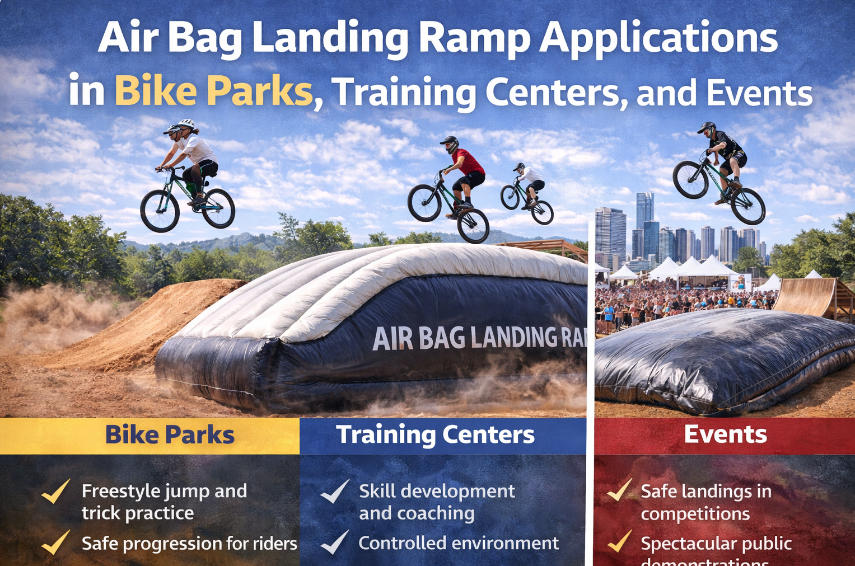
In the high-stakes world of extreme sports, progression is the ultimate goal. Whether you are a professional BMX rider perfecting a double backflip or an MTB enthusiast learning to send your first gap, the safety of your landing zone dictates your confidence and your career longevity. For decades, the industry standard for learning new tricks was the foam pit. However, in recent years, a technological shift has occurred. The emergence of inflatable landing technology has sparked a fierce debate in facility design and athlete training: air bag landing ramp vs foam pit. Which is the superior tool for progression?
As a manufacturer with over 10 years of experience supplying facilities worldwide, we at SUNPARK® AIRBAG have witnessed this transition firsthand. We have supplied World Champion Snowboarders and top-tier trampoline parks, giving us a unique vantage point on safety engineering. From our experience, while foam pits hold a nostalgic place in action sports history, the modern inflatable landing offers distinct advantages in hygiene, efficiency, and realistic training scenarios. In this comprehensive guide, we will dissect the pros and cons of both systems to help facility owners and riders make an informed decision.
- 1. The Evolution of Action Sports Training
- 2. The Foam Pit: The Traditional Approach
- 3. The Air Bag Landing Ramp: The Modern Solution
- 4. Critical Comparison: Air Bag Landing Ramp vs Foam Pit
- 5. Training Efficiency and Turnaround Time
- 6. Hygiene, Health, and Maintenance
- 7. Our Professional Recommendation
- 8. Summary Comparison Table
- 9. Frequently Asked Questions
- 10. References
1. The Evolution of Action Sports Training
Historically, “learning the hard way” meant crashing on dirt or concrete. The introduction of the foam pit revolutionized the sport by allowing riders to attempt tricks with a significantly reduced risk of catastrophic injury. However, as the amplitude of tricks increased and the geometry of jumps evolved, the limitations of foam became apparent.
The industry needed a solution that mimicked a real landing. Foam pits are essentially “crash pits”—you do not ride out of them. This creates a disconnect between learning the rotation and landing the trick on a solid surface. This gap in training methodology led to the development of the Airbag Landing and sloped inflatable ramps. These innovations were designed not just to catch a fall, but to facilitate a “ride-away” scenario, bridging the gap between a soft landing and a real dirt jump.
2. The Foam Pit: The Traditional Approach
A foam pit consists of a large cavity filled with thousands of foam cubes. It acts as a decelerator, absorbing the energy of the rider and the bike upon impact.
The Advantages of Foam
The primary benefit of a foam pit is psychological comfort for absolute beginners. Because the rider sinks into the foam, there is zero expectation of riding away. This total immersion can be helpful for initial rotation attempts where the rider might separate from the bike mid-air. It provides a soft, enveloping cushion that arrests motion in all directions.
The Hidden Dangers and Drawbacks
Despite their popularity, foam pits possess significant downsides. From our experience in safety analysis, foam pits can be deceptively dangerous. When a bike enters the foam, it can twist unpredictably. If a rider’s limb gets caught between the bike frame and the dense foam blocks, the sudden deceleration can cause rotational injuries, such as broken ankles or torn ligaments. Furthermore, excavating a bike from a deep foam pit is physically exhausting, drastically reducing the number of jumps a rider can perform in a session.
3. The Air Bag Landing Ramp: The Modern Solution
The modern air bag landing ramp, such as our Inflatable Landing systems, represents the next generation of safety. Unlike a flat stunt bag used for freefalls, these airbags are designed with a slope and a transition, mimicking the geometry of a real dirt landing or skatepark ramp.
Realistic Training Feedback
The defining feature of an airbag landing ramp is the ability to ride away. If a rider lands the trick correctly, the airbag is firm enough to support the wheels, allowing them to roll down the transition just as they would on dirt. However, if they crash or under-rotate, the internal air vents release pressure to absorb the impact softly. This dual-functionality provides immediate feedback: the rider knows instantly if they “landed” the trick, which is impossible to gauge in a foam pit.
Versatility and Customization
We recommend Custom Airbag solutions for facilities that need to adapt to specific space constraints. Unlike digging a massive pit for foam, an airbag sits on top of the surface. It can be moved, resized, or stored away during the off-season. This modularity is invaluable for multi-use sports complexes.
4. Critical Comparison: Air Bag Landing Ramp vs Foam Pit
To determine the winner in the air bag landing ramp vs foam pit debate, we must evaluate them across several critical performance metrics.
Impact Absorption Technology
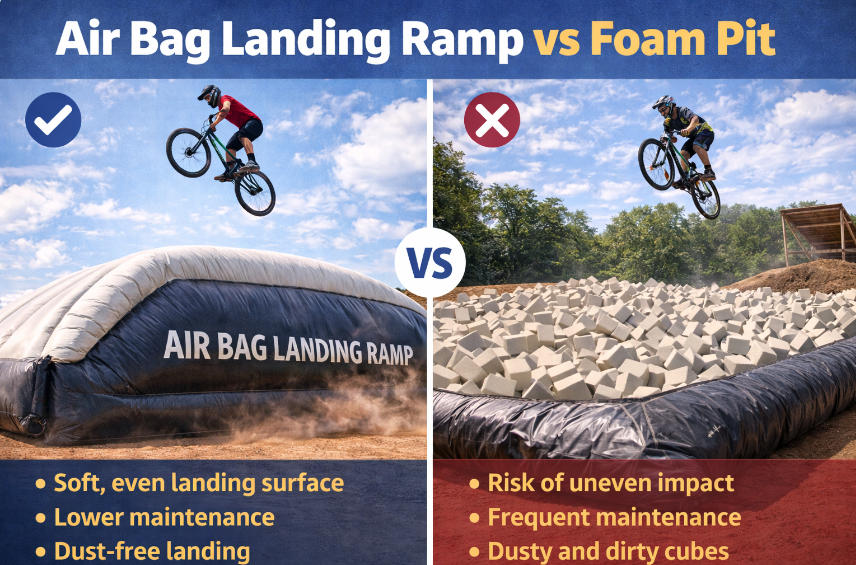
Foam relies on material compression and friction. Over time, foam degrades, breaks down into dust, and loses its cushioning ability (known as “packing out”). This creates dangerous hard spots in the pit. In contrast, an airbag utilizes constant airflow. The internal pressure can be adjusted via blowers to suit the weight of the rider (BMX vs MTB). This ensures consistent shock absorption every single time, regardless of how many times it has been hit that day.
Safety Profile
As mentioned, foam pits pose entrapment risks. Bikes and bodies get tangled. With a Stunt Airbag or landing ramp, the surface is continuous. There are no gaps for handlebars or pedals to get stuck in. The rider slides over the surface upon crashing, dissipating energy through friction and controlled air release, rather than sudden entrapment.
5. Training Efficiency and Turnaround Time
For serious athletes, time is currency. In a foam pit session, a rider might spend 30 seconds setting up for a jump, 5 seconds in the air, and then 3 to 5 minutes struggling to drag their bike out of the foam blocks. This ratio of “riding time” to “recovery time” is incredibly poor.
From our experience supplying training facilities, an airbag landing ramp completely flips this dynamic. If the rider lands the trick, they ride off instantly and head back to the drop-in. Even if they crash, sliding off the slick PVC material takes seconds. A rider can easily perform 5 to 10 times more jumps per hour on an airbag compared to a foam pit. This accelerated repetition leads to much faster progression in skill level.
6. Hygiene, Health, and Maintenance
This is the “dirty secret” of the industry. Foam pits are notoriously difficult to clean. They accumulate sweat, dead skin cells, dust, and inevitably, bacteria and mold. In public parks, they can become biohazards if not completely emptied and sanitized regularly—a costly and labor-intensive process. The foam dust generated by degrading blocks is also a respiratory irritant.
Conversely, our Airbag Landing products are manufactured with high-grade, antibacterial PVC/TPU materials. They can be wiped down, swept, or hosed off easily. There is no dust generation. For facility owners, the maintenance cost is drastically lower. You do not need to constantly top up expensive foam blocks; you simply ensure the blower is running.
7. Our Professional Recommendation
After analyzing the data and feedback from professional riders, our stance is clear. While foam pits serve a niche purpose for absolute beginners learning basic spatial awareness, the air bag landing ramp is the superior choice for BMX and MTB training.
We recommend the Foam Pit Jump Airbag—an airbag designed to sit inside an existing foam pit cavity—as a perfect retrofit solution for gyms looking to upgrade. For outdoor setups, a standalone Inflatable Landing provides the best simulation of dirt jumps. The ability to ride away, the hygiene benefits, and the sheer volume of repetitions possible make the airbag the undisputed king of modern progression.
8. Summary Comparison Table
| Feature | Foam Pit | Air Bag Landing Ramp |
|---|---|---|
| Landing Type | Crash/Submersion | Ride-Away/Slide-Out |
| Training Efficiency | Low (Slow exit) | High (Fast reset) |
| Hygiene | Poor (Dust, bacteria) | Excellent (Wipeable) |
| Durability | Low (Foam degrades) | High (Durable PVC) |
| Feedback Reality | Low (Unrealistic) | High (Simulates dirt) |
| Installation | Requires deep pit | Portable or Pit-insert |
9. Frequently Asked Questions
Is an airbag landing ramp safer than a foam pit?
Yes, in most scenarios. Airbags prevent the “entanglement” injuries common in foam pits where limbs get trapped while the body keeps moving. The consistent pressure of the airbag also prevents hitting the hard bottom, which can happen in “packed out” foam pits.
Can you put an airbag in an existing foam pit?
Absolutely. We specialize in this. A Foam Pit Jump Airbag is custom-designed to fit the exact dimensions of your existing pit. This is a cost-effective upgrade that eliminates foam dust and improves safety without requiring construction work.
How long does an airbag landing last?
With proper care, a high-quality airbag from SunparkAirbag® can last many years. The topsheet, which takes the impact from tires and pedals, is often replaceable, ensuring the main body of the bag remains protected for the long term.
Do airbags feel like landing on concrete?
No. They are adjustable. By controlling the airflow vents, you can make the bag as soft or as firm as required. A softer setting is used for learning new tricks (to absorb impact), while a firmer setting is used for refining landings and riding away.
10. References
- International Association of Trampoline Parks (IATP). (2024). Safety Standards for Airbags and Foam Pits.
- Journal of Sports Science & Medicine. (2023). Injury Patterns in Extreme Sports Training Facilities.